Introduction
For at least the last two decades, the international assistance provided to refugees in Africa has often prompted a practical and ethical question: what about the host nationals, living alongside refugees and often equally in need of basic material aid? To ask this question interrogates the concept of ‘protection’ itself: what it means, who gets it, and why. These questions are implicit in current debates on the ethics and effectiveness of existing models for the housing, feeding, and general management of refugees, especially in protracted settings such as those which predominate in Africa (see, for example, Verdirame and Harrell-Bond, Reference Verdirame and Harrell-Bond2005; Smith, Reference Smith and Smith2004; Harrell-Bond, Reference Harrell-Bond2002). In reference, however, to one particular form of material aid, namely healthcare, there has been little work to elucidate either the ethical arguments around, or the practical implications of, limiting or expanding its provision to both refugees and hosts. This paper argues for more widespread use of what is often called an integrated approach to the delivery of refugee healthcare on the African continent, and offers a basic model of assessment for integrated systems. A defining element of an integrated approach is an equal ability by refugee and host nationals to access the same healthcare resources from the same providers. This differs fundamentally from parallel care, currently the predominant practice, where healthcare services for recognized refugees are maintained through administrative processes separate from services available to the host community, although some cross-over access for each population may exist (Rowley et al., Reference Rowley, Burnham and Drabe2006). In most instances, these parallel systems for refugees are funded by the office of the United Nations High Commissioner for Refugees (from here on UNHCR) or other international agencies, and care is provided by partner non-governmental organizations (NGOs).
Given the unique social, political, and historical attributes of not only each refugee flow but also each host government's attitude and policies towards that refugee population, integrated healthcare will not always be an appropriate solution for refugees or hosts, but it is an approach deserving more widespread and more meaningful implementation than is currently the case. Besides discussing the rationale for integrated healthcare, we propose four criteria, along with suggestions for measures of their success, which would be desirable outcomes common to most successful integrated healthcare systems. These criteria are proposed on the basis of both their relevance to an ecological approach to public health generally, and the fact that their measurement already frequently occurs in an ad hoc fashion. The significance of developing these evaluation tools lies in the framework they provide towards transforming ‘integration’ from a fashionable term into a process which can be evaluated, refined, and improved.
Public health research has neglected to explore the implications of different methods of refugee healthcare provision for long-term goals, whether these be enhanced social integration, better mental health, lowered chronic or infectious disease incidence, or other health outcomes not measured in the emergency surveillance data which are frequently the extent of enquiries into refugee health. This paper enters this neglected field and proposes a practicable evaluative model capable of generating the data needed to ground debates on integrated healthcare in measurable outcomes. It draws on a literature survey that pays particular attention to UNHCR working papers and research documents since 1990.
Historical limitations on integrated care
We would argue that the reasons for the historical neglect of an integrated care approach in Africa fall generally into three categories: (1) political aversions, (2) the nature of existing expertise and funding, and (3) the legal nature of UNHCR's mandate.
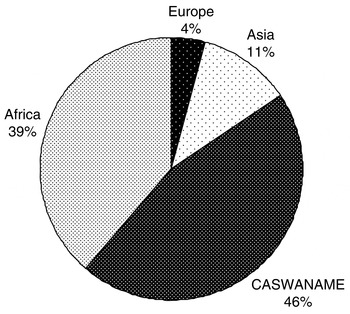
‘Protracted’ refugee populations, by continent, 2006
Notes: Protracted defined as ‘refugee population of 25,000 or more who have been in exile for five or more years, in developing countries, and excluding Palestinian refugees who fall under the mandate of UNRWA’ (UNHCR, 2004: 2).
*Central Asia, South West Asia, North Africa and Middle East
Source: UNHCR, 2004

Political aversions to integrated care often exist at local, national, and international levels of policy making, and among refugees themselves as well as host governments and nationals. This aversion frequently stems from the desire to avoid acknowledging the permanence of a refugee presence. It has been argued that local integration has faced particular resistance in Africa, owing both to the relatively large financial burden refugee hosting creates for low-income states and to the common continuing involvement of refugees in their home countries’ political struggles (Kibreab, Reference Kibreab1996). Underlying these arguments are normative assumptions that refugee populations inherently constitute a burden, as opposed to a potential resource (Jacobsen, Reference Jacobsen2001; Lawrie and van Damme, Reference Lawrie and van Damme2003).
Since the 1980s local integration has been the ‘overlooked’ durable solution (Jacobsen, Reference Jacobsen2001), with repatriation the preferred solution of the 1990s and beyond for governments and international agencies alike throughout the world (UNHCR, 2007: 7; Dryden-Peterson and Hovil, Reference Dryden-Peterson and Hovil2003; Verdirame and Harrell-Bond, Reference Verdirame and Harrell-Bond2005). These stated preferences fit uneasily with the lived reality which the majority of refugees face day after day, year after year. According to 2006 data, in that year 734,000 refugees returned voluntarily to their home countries, 29,560 were resettled in third countries, and approximately 103,000 were naturalized as nationals of a host country (a very rough measure of local integration), yet 9,900,000 recognized refugees remained at year's end without any resolution to their displacement (UNHCR, 2007). Data for 2004 by region recognized 6,200,000 refugees in ‘protracted’ situations of more than five years’ standing, at least 37% of them in Africa (UNHCR, 2004). The majority of refugees remain for years without any resolution to what is still operationally viewed as a temporary setting.
Integrated healthcare is not synonymous with the adoption of local integration as an overarching durable solution, which in theory ends in replacement of refugee status by citizenship or permanent residence. Integrating healthcare may instead be part of the recently formulated approach of ‘interim integration’ (Smith, Reference Smith and Smith2004), with benefits which accrue in the present to both populations regardless of the eventual ‘solution’ found to displacement. Arguably however the integration of healthcare services has often been rejected as a method of care provision because, at different times and in different contexts, host governments and UNHCR alike have considered any generalized integration of refugees into host society to be politically undesirable (see multiple examples in Smith, 2004; Lawrie and van Damme, Reference Lawrie and van Damme2003; Meyer, Reference Meyer2006a and b).
Another reality working against the use of integrated approaches has been that both the expertise and the working models of the international organizations which implement refugee healthcare programmes do not always lend themselves to working within, or even in partnership with, existing national structures. The agendas of national ministries of health, refugee-focused agencies like UNHCR and more general medical relief NGOs often diverge in terms of the populations to be prioritized, the kinds of services to be provided, and the underlying justifications for their presence, resulting in either a lack of communication or outright ‘turf battles’ which are incompatible with an integrated healthcare system (Ooms, Reference Ooms2006; Garrett, Reference Garrett2007; Burnham et al., Reference Burnham, Rowley and Oveberedjo2003; Goyens et al., Reference Goyens1996). Furthermore, in solicitations by humanitarian NGOs for donor funding, healthcare has rarely been given a high priority, with the overwhelming focus on meeting immediate food and shelter needs (Griekspoor et al., Reference Griekspoor, Spiegel, Aldis and Harvey2004). Funding for the support of refugee populations is rarely plentiful and regularly competitive: UNHCR has faced severe budget constraints in recent years (UNHCR, 2006b: 14–17; Rowley et al., Reference Rowley, Burnham and Drabe2005). In such a setting, it is tempting to replicate and advertise previous successes, rather than pursuing an uncertain new approach.
Finally, since its creation in the aftermath of World War II, UNHCR's limited mandate has been to provide protection, not development. Nevertheless UNHCR has acknowledged that protection ‘is a responsibility which comprises many different activities, some of which are not so easily subject to quantitative measurement’ (UNHCR, 2006a: 1). What we term the ‘narrow’ definition of protection is generally understood as ‘the protection of individuals from persecution by the authorities in their countries of origin’ (Allen and Turton, 1996: 17). Protection rarely if ever refers to what we call ‘broad’ protection, which means protection of the basic needs in a basic needs approach (Ghai et al., Reference Ghai, Khan and Lee1980; Ghosh, Reference Ghosh1984; Singh, Reference Singh1979). Protection thus understood would necessitate systemic changes both in refugee generating and hosting sites. The oft-reiterated position that ‘UNHCR is not a development agency’ (Jacobsen, Reference Jacobsen2001: 27) may conflict with actions in the field when there is political will to act otherwise (Kibreab, Reference Kibreab and Allen1996: 57).
At the policy and planning level, a narrow definition of protection has historically been employed. The language of the Convention Relating to the Status of Refugees (1951), the foundation of international refugee protection and the origin of the most widely applied legal definition of a refugee, makes no mention of health or healthcare. The International Covenant on Economic, Social and Cultural Rights posits a right for all to ‘the highest attainable standard of physical and mental health’ (OHCHR, 1966: Article 12), but from a legal standpoint, especially given the lack of evidence on the outcomes associated with integrated healthcare, there is no clear impetus for integrated healthcare as a specific duty held towards refugee populations.
Arguments for integrated care
There are nevertheless strong arguments, both ethical and practical, for a greater implementation of integrated healthcare systems serving refugees and host nationals. In terms of the historical context outlined above, UNHCR's practices in recent decades have encompassed a larger material aid role, recently expanded to include aid to internally displaced persons (UNHCR, 2006b: 10). UNHCR has also recognized that the protection and improvement of refugee health ‘to the highest attainable standard’ is part of its protection mandate (UNHCR, no date [a]). UNHCR's current global strategic objectives contain a recognition that preventing malnutrition and the spread of HIV/AIDS is part of the provision of protection (UNHCR, 2006b: 37). In documents such as UNHCR's Agenda for Protection, there has been a resolve to ‘anchor … refugee issues within national and regional development agendas’ (quoted in Core Group on Durable Solutions, 2003: 9). Other examples of this rhetorical shift towards ‘broad’ protection are easy to find. This does not mean the inherent tensions between ‘narrow’ and ‘broad’ protection have been resolved; it does however indicate that the broad definition has gained some ground.
Given this more sympathetic international context for implementation, now is a propitious time to investigate the potential advantages of integrated care. One of the best-documented advantages is that integrated care systems may lessen tensions with the host population (Meyer, Reference Meyer2006a; Verdirame and Harrell-Bond, Reference Verdirame and Harrell-Bond2005: 242; Core Group on Durable Solutions, 2003: 14). In the absence of an integrated system, UNHCR's presence may actually diminish activity by other organizations which, in seeking to maximize their own measurable impact, shift the focus of their activities to other geographic settings and leave host populations with fewer healthcare options than before (Ressler and Sokoloff, Reference Ressler and Sokoloff1995). This is in addition to the general problem, noted by Garrett (2007) and others, of UNHCR or other NGO programs unintentionally weakening local health services through internal brain-drain when local healthcare worker capacity is drawn into (frequently better remunerated) work in internationally funded programs such as those that only benefit refugee populations.
It has also been asserted that integrated systems may lead to better health outcomes (van Damme, Reference van Damme1995), may be more cost-efficient, and may lead to more equitable uses of limited human and other resources (van Damme et al., Reference van Damme, de Brouwere, Boelaert and van Lerberghe1998; Jacobsen, Reference Jacobsen2001). These assertions are supported by only limited data, but their logic suggests that further research is a worthwhile undertaking. Two fundamental terms invoked here require clarification and consensus in order to be operationalized. The first is the definition of a ‘better’ health outcome, on what criteria and for whom. The second is the definition of cost-effectiveness, which also must state its reference point: cost-efficiency for refugees, local citizens, the host government, UNHCR, and so on.
Another practical rationale for integrating healthcare for refugees and hosts, especially in Africa and other low-income nations, is one of explicit self-interest for the national population. This self-interest may take a number of forms. As increasing evidence points to a connection between the crowded, unsanitary conditions which often prevail in camps and deteriorating health and environmental outcomes (Kalipeni and Oppong, Reference Kalipeni and Oppong1998: 1646–1647), integrated healthcare may provide an effective approach to preventing epidemic outbreaks which do not discriminate on citizenship. National governments may also discern in integrated healthcare a potential funding stream from international agencies for their own national health services. Such considerations are most likely to surface when there is no prospect of repatriation in the near future.
Practical arguments are not independent from the normative assumptions which underlie the value of their anticipated outcomes. An acceptance of the above arguments necessitates first an acceptance that there is value in providing healthcare to refugees and host nationals in an equitable manner – and, indeed, that there is value in providing healthcare to anyone. Adopting a basic needs approach provides a rationale for the provision of healthcare (Gough and Thomas, Reference Gough and Thomas1994). This grounds an additional argument more specific to the peculiar case of refugee healthcare: the need to work against the category's built-in exceptionality.
A basic needs approach holds that all human beings have basic needs for survival. This is similar to the rhetoric of human rights; however, human rights are problematically exercised independently from the states which, in practice, guarantee their enjoyment. Our choice of a ‘basic needs’ rather than a human rights framework acknowledges that, in refugee situations, the relationship of states to individuals is particularly fraught with perils. Healthcare workers however, unlike refugee status determination officers, have the advantage of working within a discipline which can diagnose without regard to legal status.
If a basic needs approach rationalizes the provision of healthcare to refugees and host nationals alike, it does not, on its own, provide an argument for integrating those services. An ethical argument for integrated care must confront the many contradictions of refugee status. The refugee claims an exceptional need to protection because, in her or his case, the national order of (political) protection has broken down or, worse still, the very institution responsible for protecting one's security – the national government – has itself endangered it. Even in a globalizing world, the state remains the practical guarantor of rights and belonging, a point of central importance to refugees (Kibreab, Reference Kibreab1999), whose state of legal exception places them at particular risk. This legal exception tends towards an exception from humanity, a process first described by Hannah Arendt (1958) and later developed in the work of Georgio Agamben (1998). Integrated care works against this tendency and re-humanizes the refugee. At the same time, paradoxically, it is the host national who suffers because there is nothing exceptional, in either sense employed here, about her needs. A refugee's claim, if recognized, frequently results in aid to meet basic needs (water, shelter, food, healthcare) to which host citizens have no recourse. As UNHCR has increasingly taken on the role of providing material needs, refugee status has become, in this respect, a privileged form of suffering, since international legal mechanisms to protect citizens within their own countries are extremely limited in scope.
The refugee category is further complicated by the fact that, in Africa, two different legal definitions of refugee are often employed: that of the United Nations (1951) and that of the OAU (1969), now the African Union. The greater ability of the latter to recognize so-called prima facie refugees (those fleeing generalized emergencies, usually recognized on national or regional as opposed to individual grounds) has increased the already inherent tension between the refugee as a political being and the refugee as what Agamben has called ‘bare life’ (Tuepker, Reference Tuepker2002). The implication of this paradox for integrated healthcare is that attempts at the inclusion of refugees in national society may strengthen the quality of ‘broad’ protection yet weaken the basis of ‘narrow’ protection claims upon which the provision of material aid currently rests. Integrated healthcare faces the challenge of providing care to refugees and hosts alike without compromising the refugee's ability to claim – and access – meaningful ‘narrow’ protection. This difficulty does not negate the arguments for integrated healthcare; if anything, a recognition of these paradigmatic limitations highlights the impact which a specialized aspect of refugee management, such as healthcare, can have on generalized social interactions between hosts and refugees, and strengthens the case for developing clear interpretive tools to understand outcomes.
Criteria for evaluating integrated care
Before implementing an integrated healthcare system for refugees and hosts, a number of criteria need to be assessed to determine if such an approach is suitable. Jacobsen (2001) has made inroads in identifying critical determinants such as government attitudes towards integration as a durable solution, the likelihood of repatriation, and the functional capacity of the existing national healthcare structure. Rowley et al. (Reference Rowley, Burnham and Drabe2006) have put forward administrative techniques for facilitating the integration process. This paper's focus, however, is on planning for successful outcomes through appropriate evaluation tools. We explicitly adopt the perspective of a collective refugee–host population and, working against the exceptionalism inherent in much refugee policy, we reject treating refugees and host nationals as separate populations in terms of their claims to healthcare, while acknowledging that, in some ways, their specific needs will differ. From such a perspective, what would constitute a successful integrated healthcare system? We propose meeting four minimal criteria:
improved health outcomes for both hosts and refugees;
increased social integration;
increased equitable use of healthcare resources; and
no undermining of protection.
Improved health outcomes for both hosts and refugees
In an integrated system, both refugee and host populations should exhibit post-integration improvement on selected health outcomes. An insistence on improving health outcomes for both populations is one way to ensure that the needs and priorities of host governments and host nationals, as well as those of refugees, are being addressed. The availability of, or the opportunity to collect, baseline data for both refugee and host populations will be a factor in determining objectives for improvement. To date, perceptions of quality of care, either in an integrated or a parallel system, have too often been the only information collected for program evaluation, and internal reviews have recommended both better collection of baseline data and more ‘impact-based’, as opposed to ‘performance-based’, evaluation (Kelley et al., Reference Kelley, Sandison and Lawry-White2004: 16, 18). In 2005, UNHCR implemented comprehensive Standard Indicators and Reporting (SIR) requirements, with 12 indicators categorized under ‘food, nutrition, health and HIV and AIDS’. The five indicators of ‘health’ are population per healthcare facility, number of new visits to such facilities, measles vaccination coverage rate, percentage of live births attended by skilled personnel, and percentage of low birth weight babies (DOS, 2006: 67). UNHCR's SIR guidelines also commit to collecting infant and under-five mortality data (DOS, 2006: 66), which are sensitive indicators of both availability and quality of healthcare. Mortality reporting is frequently carried out in both emergency and post-emergency refugee settings with relative accuracy (Speigel et al., Reference Speigel, Sheik, Woodruff and Burnham2001; Talley et al., Reference Talley, Spiegel and Girgis2001, Brown et al., Reference Brown2008). UNHCR does not however collect, or facilitate collection by others, comparative data on proximate populations, although research conducted by some NGOs, notably Médecins Sans Frontières, does explicitly compare refugee and host populations (Singh et al., Reference Singh2004).
These already prioritized indicators constitute an appropriate starting point for the measurement of our criterion of improved health outcomes, particularly in relation to birth weight and mortality. Additionally, these are commonly collected statistics for national populations, so their use would ease any increased data-collection burden on national government partners for whom data collection often possesses a lower priority than it does for international agencies (Kelley et al., Reference Kelley, Sandison and Lawry-White2004). Region-specific disease mortality and morbidity may also be appropriate indicators.
An integrated system's shared points of service delivery would facilitate standardized data collection and avoid the costs associated with duplication of efforts. More data collection by refugee workers themselves, as has been recommended by some professionals (CASA, 2003: 39), could build health information system databases while also potentially contributing to refugee empowerment, economic or otherwise. With time, the evaluative process would itself generate data to be used in future objective setting and evaluation, making the entire process more meaningful for policy planning and assessment.
Increased social integration
Separation of services such as housing and education highlights the socially exceptional status of refugees and contributes to deteriorations in refugee–host relations, as Lawrie and van Damme (2003) have discussed in reference to changing government housing policies in Guinea. These deteriorating relations frequently justify reducing resources earmarked for refugee services, resulting in increased socio-economic hardship and associated poor health outcomes. Considered broadly, increasing social integration not only contributes to the ‘rehumanizing’ of refugees which is an implicit rationale for integrated care, it may itself be considered an aspect or an indicator of good health, especially if one adopts the World Health Organization's three-dimensional definition of health (WHO, 1946).
Potential criteria for social integration have been enumerated by Jacobsen (2001), including standard of living parity, equal freedom of movement, frequency of intermarriage, and freedom or diversity of employment, training, and access to land. Rates of school enrolment could also be a measure of parity. Closer work between healthcare workers and other professionals is needed to develop more rigorous and creative measurements of social integration.
Increased equitable use of healthcare resources
The definition of equity in healthcare employed here is one of ‘equal care for equal needs’, stemming from a distributive justice framework (Culyer and Wagstaff, Reference Culyer and Wagstaff1992) and appropriate to the stated goal of minimizing exceptional status of either refugees or hosts. An appropriate measure of this criterion would be, for example, per capita spending on healthcare across refugee groups and host population, adjusted for disease prevalence. Measures could be more broadly conceived, however, to include practices such as the equitable provision of training as community health workers to refugees and hosts alike. The question of equitable use should also address the current challenge of human resources – doctors, nurses, and other caregivers – being disproportionately drawn into working for only one population, usually internationally funded refugee care (Goyens et al., Reference Goyens1996; Orach and De Brouwere, 2006: 57; Verdirame and Harrell-Bond, Reference Harrell-Bond2005: 242). While integrated healthcare provision should in theory always result in equal access, indicators of access will need to be evaluated. As one example, a good case has been made for obstetric interventions as a sensitive measure of access to these services in sub-Saharan Africa (van Damme et al., 1998).
No undermining of protection
The inclusion of this criterion stems from the concern that integrative mechanisms can undermine UNHCR's central mandate to protect refugees. While completely successful integration results (in theory) in refugees no longer requiring exceptional protection, partially successful integration runs the risk of removing protection prematurely. Internal UNHCR attempts to improve monitoring mechanisms have called for more collaboration and more consideration of the impact of different service provisions upon the protection mandate (Kelley et al., Reference Kelley, Sandison and Lawry-White2004: 9).
Providing genuine protection requires looking at specific local security risks, while also considering whether the refugee population in question is more ‘UN’ (individually persecuted) or ‘AU’ (fleeing generalized instability) in nature. It also requires considering the security needs of the local population and the impact of the refugee population upon those needs. While integrated healthcare provision is not a mechanism for solving security threats, it can be structured in such a way that it separates material assistance (healthcare provision) from refugee recognition procedures. In the case to be discussed, UNHCR's early foray into integrated care in Ethiopia in the 1990s, this criterion was not well handled, but such a lapse in maintaining protection is not intrinsic to integrated healthcare. The retroactive application of our criteria to analyzing the Ethiopian experience allows for a more nuanced mapping of what went wrong, as well as what went right.
The cross-mandate approach in Ethiopia
Ethiopia in the early 1990s presented a strong case for an integrated approach. UNHCR's caseload of refugees and returnees in Ethiopia during this period ranged from 350,000 to 1,200,000 (Ressler and Sokoloff, Reference Ressler and Sokoloff1995). Cultural and economic ties overwrite long histories of movement across the Ethiopia–Somali border, and this contributed to the complexity and cost of registration procedures attempting to impose clear distinctions between Somali refugees, Ethiopian returnees, and individuals lacking these categorizations but impacted by the region's political instability and food insecurity (Allen and Turton, Reference Allen, Turton and Allen1996: 6–7, 18–19). The decision to implement what was called the cross-mandate approach grew out of a UNHCR field staff position that it was ‘indefensible’ to continue putting resources into relief efforts which did not contribute to sorely needed regional development (Ressler and Sokoloff, Reference Ressler and Sokoloff1995: paragraph 10). Central to this approach were four guiding principles: (1) all intervention should be a collaborative, inter-agency effort; (2) ‘assistance should address root causes’; (3) aid would be based on need, not the category of the person needing it; and (4) all aid would be delivered through community structures, not to individuals in camps (ibid.). Refugee determination procedures were temporarily abandoned. Ethiopian government ministries were re-organized to incorporate refugee management into existing portfolios rather than as the province of one ministry, as had been the case. Food relief and other assistance programs were moved out of camps, and ‘community enhancement’ programs were implemented which entitled all participants to relief. UNHCR actively solicited greater collaboration between its own programs and those of other UN agencies like UNDP, as well as collaborations with independent NGOs.
UNHCR's commissioned evaluation of the cross-mandate approach focused heavily on refugee determination and the provision of food aid, without detailing changes in the provision of healthcare. However, it is still illuminating to briefly consider the experiment in light of our four proposed criteria.
1. Better health outcomes for both refugees and hosts
No data on specific health outcomes were made publicly available. The extremely difficult working conditions, which prevail in emergency settings, and the lack of resources for any work not perceived as immediately improving conditions, present barriers to data collection. Yet even limited data (information on mortality rates, for example) would have strengthened the conclusions able to be drawn about the possible benefits of the cross-mandate approach.
2. Increased social integration
In the context of the Ethiopian setting, social integration does not appear to have been perceived as either a problem or a priority: populations of refugee and returnees were already, from an administrative point of view, troublingly indistinguishable. Programs of unspecified nature were described as addressing the need to restore disrupted communities. Since aid was moved out of refugee camps during this period, it would have been useful to measure housing patterns, for example, to indicate social integration.
3. Increased equitable use of healthcare resources
Detailed comparative cost analysis or healthcare resource utilization of the new approach was not carried out, except to point out that the approach had been implemented in hopes of avoiding the costs of another humanitarian crisis like Somalia, where UNHCR was spending $40 million annually (Ressler and Sokoloff, 1995: paragraphs 92–94). The evaluation concluded that the approach had ‘achieved greater equity of assistance to mixed beneficiary populations’ (ibid.: paragraph 32), but this was based on the perceptions of interviewed workers and not supported by objective evaluation.
Additionally, the Ethiopian government, reportedly enthusiastic about the new approach, was disappointed in the level of financial support provided by UNHCR for these new initiatives, in particular for the community enhancement programs and the staff needed to run them. This was presented as a lesson for future programs.
4. No undermining of protection
One of the main criticisms from UNHCR personnel who did not support the new approach was that doing away with determination procedures undermined the agency's protection mandate. Suspending both refugee determination and housing segregation (in the form of camps) was seen as endangering the security of refugees, both in terms of physical security and the ability to access legal protection. Again, in reference to the specific issue of integrating healthcare, no information was provided regarding its impact on security. It is however worth noting a further implication of the perception of insecurity and its impact on integration. Partner organizations including FAO, WHO, and UNDP limited their cooperation with the new approach because they ‘were not prepared to invest heavily into a primarily unstable environment’ (Ressler and Sokoloff, 1995: paragraph 73).
The cross-mandate experiment provided significant experience, but a paucity of measured data, upon which later implementers of similar approaches could build. The guiding principles of the experiment insisted on the need for structural change, from aid to development and away from assistance based on exceptional status. As is often the case with new ideas in stressful settings, the lack of a clear model or adequate funding for new initiatives limited the evaluative phase's usefulness. Implementers reported generally that the cross-mandate approach achieved good outcomes and was a better use of limited resources, but without outcome measures it is difficult to make a convincing case for long-term changes in agency policy.
While the ‘need rather than category’ approach led to criticisms from both aid agencies and refugees themselves, this aspect of the experiment may have provided its most significant legacy, since it put into practice the possibility of a different approach to the care of human beings in terms of their basic needs. In the absence of rigorous and logical evaluation of its outcomes, however, the further adoption of such an approach was handicapped from the beginning. Although the evaluators found that ‘the cross-mandate approach … deserves every consideration as a standard approach’ (Ressler and Sokoloff, 1995: paragraph 55), the term quickly faded from use. The working plan for UNHCR in Ethiopia in 2006 (UNHCR, no date [b]) made no mention of a current cross-mandate approach.
Uganda: integrated healthcare and the Self-Reliance Strategy (SRS)
Uganda provides an example of quite a different approach to integrated healthcare. As in Ethiopia, there is a complex historical overlap between refugee, returnee, and ‘stayee’ populations. In the midst of its own civil war, Uganda has hosted since the 1980s several hundred thousand refugees, mostly Sudanese. An estimated 176,000 refugees live in the West Nile districts of Arua, Adjumani, and Moyo (Burnham et al., Reference Burnham, Rowley and Oveberedjo2003). The refugee presence in Uganda is perceived by the Government of Uganda to be permanent, due to geo-political configurations, yet repatriation, not local integration, is still officially held to be the most desirable solution (Meyer, 2006a, b). By the late 1990s, UNHCR and the Ugandan Office of the Prime Minister agreed on the need for policy and practice to ‘bring about a change from relief to development’ for refugees and host nationals alike (Dryden-Peterson and Hovil, Reference Dryden-Peterson and Hovil2003: 8). One outcome of this has been the post-2000 implementation of integrated healthcare services in the West Nile districts, with all district residents now accessing the facilities initially set up for refugees, who continue to live in designated settlements. Prior to integration, locals fared worse than refugees (and also worse than Ugandans in most other regions of the country) when measured against several criteria such as per capita health spending (Rowley et al., 2006).
Uganda's application of integration in various aspects of refugee management has been linked since its inception to the national Self-Reliance Strategy, or SRS, for refugees. The SRS has been criticized on numerous grounds, including its influence on the definition of integration employed in Ugandan policy (Meyer, 2006; Dryden-Peterson and Hovil, Reference Dryden-Peterson and Hovil2003; Verdirame and Harell-Bond, Reference Verdirame and Harrell-Bond2005: 337).) In addition to abundant critical debate about Uganda's current policies in general, several papers examine particular aspects of integrated healthcare (Burnham et al., 2003; Rowley et al., 2006; Orach and de Brouwere, 2006). The application of our proposed criteria again assists in delineating the successes and failures of this instance of integrated healthcare.
Improved health outcomes for both refugees and hosts
Two independent reports (CASA, 2003: 72; Meyer, Reference Meyer2006a) concluded that the integration of healthcare services is widely perceived as having worsened healthcare for refugees and improved it for host nationals, but these perceptions are not substantiated by measured outcomes. As mentioned, in 2005 UNHCR implemented new SIR measures which should report on a limited number of health outcomes in refugee camps. At the time of writing, these statistics are not yet publicly available. Instead of the UNHCR measures, Adjumani district determined that one of its health outcome objectives was to meet the national Ministry of Health target of 85% vaccination against six diseases for all children (refugee and national alike) under age five (Burnham et al., Reference Burnham, Rowley and Oveberedjo2003: 66). This is an appropriate local determination of objectives, but the outcome has not yet been reported.
Analysis is affected by the fact that there is significant debate about the baseline conditions before integrated healthcare and whether, and to what extent, refugees enjoyed better healthcare than did locals (cf. Orach and De Brouwere, 2006 with Verdirame and Harrell-Bond, 2005: 243–244; also Meyer, 2006a). Orach and de Brouwere (2006) provide useful data in finding that maternal mortality rates were two and a half times higher among host nationals in the region than among refugees in the years preceding and during implementation of integrated healthcare. That this measure was chosen, and successfully measured with existing surveillance systems, supports our assertion that maternal or child mortality data could be a frequently useful measure for this criterion.
Increased social integration
Despite a history of cross-border cultural ties and a strong political rhetoric of pan-African empathy (Meyer, Reference Meyer2006a), the social integration of refugees in Uganda has been undermined by the assumptions of the SRS. As Meyer has summarized, ‘the integration promoted [in Uganda] … is based in bureaucratic integration of services with concomitant marginalization and exclusion of refugees from the political sphere’ (ibid.: 47). In contrast with Ethiopia's approach in the 1990s, Uganda restructured government responsibilities to remove refugee management from district and local planning (Meyer, 2006b). Flawed programs have not facilitated civic interaction with local populations (Meyer, 2006a), although integrated healthcare has been reported to have improved host perceptions of refugees (Orach and de Brouwere, 2006). Once again, interesting conclusions based upon perceptions would be strengthened in terms of their applicability to the dialogue about integrated care if supported by measurable outcomes, such as parity in school enrolment, involvement in civic organizations, or structured surveys on oft-cited perceptions.
Another aspect of healthcare integration noted by Orach and de Brouwere (2006), but not commented upon, was the fact that Ugandan nationals employed as healthcare workers largely remained in their positions, while international NGO staff left. A formal evaluation of the impact of this on both local social dynamics and local economics could provide useful information. Similarly, prior to implementation, concern was expressed by some parties that the SRS might negatively supplant pre-existing training and social integration opportunities for refugees, to the advantage of locals (CASA, 2003: 73). Evidence on any actual shifts experienced in populations accessing training programs would provide interesting data on the experience of social integration.
Increased equitable use of healthcare resources
Under the integrated system, where UNHCR prorated reimbursement to the Ugandan government for running programs based on refugee population size, UNHCR ended up paying less, as a percentage of regional costs, for refugee healthcare under the new integrated system (Orach and de Brouwere, 2006: 59). Real total costs, however, are difficult to assess, given that the Ugandan government did not fully comply in reporting its costs (CASA, 2003: 12). Given that the SRS was largely motivated by the desire for UNHCR to shift its funding priorities to ‘emergencies’ which fell more clearly within its mandate (Burnham et al., 2003: 57–58), this could be viewed as evidence of a successful outcome for UNHCR. Yet as in Ethiopia, the Ugandan government was disappointed in the level of financial support forthcoming from UNHCR (Rowley et al., Reference Rowley, Burnham and Drabe2006). Without measurements of health outcomes for refugees under the new system, it is not feasible to conclude that this system improved equitable use of healthcare resources. Orach and de Brouwere (2004) have done the most detailed work to remedy this shortcoming, by measuring baseline refugees’ against host population's rates of major obstetric interventions and refugees’ against host population's referral rates since integration. Their findings suggest both baseline disparities and movements towards more equitable access, as measured by referral rates.
No undermining of protection
The existing analyses of healthcare integration in Uganda do not address this criterion, one which is highly relevant in the Ugandan–Sudanese political landscape. Unlike in the Ethiopian setting, however, access to healthcare services was achieved without disruption to established determination procedures: host nationals were ‘brought in’ to the services available to already recognized refugees. It is unlikely, then, that this integrated healthcare service significantly affected refugee protection, and the decreased tensions between hosts and refugees after integration, which Orach and de Brouwere (2004) perceived, may have strengthened protection.
Limitations
There are several limitations to our analysis and our model criteria, as well as barriers to the model's implementation. A limitation of the analysis is that the case of self-settled refugees – those who live in neither camps nor officially endorsed settlements – is not considered here at all. Such refugees, popularly but often not legally defined as such, are a sizable population in Africa, but in most instances they are not considered eligible for assistance, including healthcare, from UNHCR. The topics of implementing and evaluating integrated healthcare for self-settled refugees, given their different circumstances, deserve a separate and thorough inquiry.
Another limitation of our analysis is that the direction of integration (refugees into existing national programs, or nationals into programs designed initially for refugees) is not considered. The differing experiences of Uganda and Ethiopia suggest that this may be a logistical factor deserving attention not just at implementation but also during evaluation.
From a refugee or host perspective, our model may be limited in that it does not provide rigorous enough tools to ensure that integrated healthcare is not only evaluated in terms of implementer success, but more importantly, takes the outcomes of refugees’ and host population's health into account. In both Uganda and Ethiopia, UNHCR and its partners have often proclaimed ‘success’ with fewer qualifications than are raised by the refugees served by such programs. These claims are often made without providing evidence to back them up (Kelley et al., Reference Kelley, Sandison and Lawry-White2004: 16). The example of reduced refugee food rations, rather than falling malnutrition rates, being seen in Uganda as a measure of successful self-reliance (Meyer, Reference Meyer2006a) is an urgent reminder of the need to be clear about objectives and how, and by whom, they are to be measured.
There are a number of barriers to implementation of our model which go beyond resource constraints and challenges to accurate data collection. There is now a growing literature, created by NGOs and other organizations determined to conduct research and collect data even in complex humanitarian emergencies, which can provide guidance, if not definitive answers, in how to overcome limited funding, security constraints, and the difficulties of working with mobile and sometimes uncooperative populations (see for example Brown et al., 2008; Singh et al., 2004). Unlike UNHCR, NGOs collectively encompass much broader agendas than narrow protection: this facilitates their ability to develop and implement new research methods. Where integrated care is concerned, this may prove to be as great a strength as their ability to focus on populations based on need rather than category.
Resource constraints present considerable challenges to implementing integrated healthcare, especially in African countries with drastically under-staffed and under-resourced national healthcare systems (see Ooms, 2006; Garrett, Reference Garrett2007). In this context, the difficulties of initiating integrated care, such as the lack of a shared vision or stakeholder ‘buy-in’ identified by Burnham et al. (Reference Burnham, Rowley and Oveberedjo2003), are exacerbated by the lack of available funds to change delivery systems. Even where there is an initial strong commitment to integrated care, limited system carrying capacity may not be able to provide sufficient service delivery (Lawrie and van Damme, Reference Lawrie and van Damme2003).
Another barrier arises in the reality that governments, NGOs, UNHCR, refugees, or hosts often do not want to minimize the exceptional status of refugees. Refugees and the agencies responsible for their benefit may not wish to surrender the privileged access to material aid or organizational funding which is the pay-off for an exceptional status and a clear, limited mandate. In the past NGOs have sometimes resisted dismantling parallel care because it disrupts their funding streams (Smith, 2004; Harrell-Bond, 2002), but they can also be powerful agents for challenging existing methods and providing care on the basis of need alone (Ooms, 2006). Both national governments and refugee agencies will prioritize the needs of their ‘own’ populations, and integration either as a durable solution or as a method for service delivery will always remain an ‘option, not an obligation’ (Core Group on Durable Solutions, 2003: 24). As the Ethiopian experience showed, there is limited donor and implementer support for replacing exceptional categorization with a basic needs approach to providing ‘broad’ protection. The best way to address this barrier is to provide compelling evidence, as yet lacking, of positive outcomes for both host and refugee populations associated with integrated healthcare. The criteria put forward here are designed to elicit that data.
Conclusion
Healthcare beyond the emergency phase is a neglected area in refugee literature. This paper makes both a philosophical and practical argument for greater consideration of integrated healthcare models which have not been frequently employed, and offers a framework for their evaluation. The evaluative criteria proposed in this paper are intended to clarify both normative and positive elements of refugee–host healthcare systems. The use of such criteria in analyzing the Ethiopian and Ugandan case studies is limited by lack of baseline and other data, but, even in these instances, multiple criteria provide a more nuanced picture of the strengths and weaknesses of each case. Had evaluative data been collected, the debate today about integrated healthcare would be benefiting from that evidence.
To date the global community still lacks a consistently operationalized consensus on the responsibilities which governments and non-governmental agencies have towards refugees. This paper and the evaluative model it offers propose ethical arguments against exceptionalizing either refugees or host nationals when it comes to providing the basic needs which include essential water, food, shelter, and healthcare, all of which are elements of the protection which both refugees and host nationals require. Recognition of these fundamental responsibilities is a precondition to adoption of the integrated healthcare policy that has been advocated in this paper.
A global climate of routine disregard of Refugee Convention standards, an increasing tendency towards closed borders in Africa patrolled through techniques copied from Europe and the United States, an increased perception of refugees as burdens and victims, the privatization of healthcare systems in African countries, and a global neo-liberal economic framework which does not accept a ‘right to health’ or systemic international responsibility for refugee flows – all these work against implementing integrated healthcare in the first place. Nevertheless, integrated healthcare has strong ethical and practical arguments in its favour, provided that future work in this area performs more rigorous evaluation of both its terms and its outcomes. To facilitate such change, international agencies such as UNHCR and WHO will need to first develop a consensus in accepting this integrated healthcare approach, and then use their leadership to promote its implementation.