Research conducted on Mesoamerican weaving has revealed the important role that textiles have traditionally played in Mesoamerica from the Classic period through contemporary cultures. As attested in sculpture, pictorial records, hieroglyphic texts, and Colonial-period documents, textiles were highly esteemed throughout Mesoamerica as commodities on a level similar to gold and jade (McCafferty and McCafferty Reference McCafferty and McCafferty2000:39) and were used to signify geographic origin, status, and rank (Hendon Reference Hendon and Robb1999a:267; McCafferty and McCafferty Reference McCafferty and McCafferty2001; Pohl Reference Pohl, Johnson and Sharon1994). Conversely, the absence of textiles, especially clothing, was also highly symbolic. Nudity was a widespread symbol of loss of status and degradation, as illustrated in images of stripped captives from the Danzantes of Oaxaca, to the murals of Bonampak, to the Mixtec codices. Textiles were so valued that they served as a medium of exchange (Sullivan Reference Sullivan and Boone1982:13), as important items of trade and tribute (Berdan and Anawalt Reference Berdan and Anawalt1992:2:32–141) and as elite gifts (Pohl Reference Pohl, Johnson and Sharon1994), and textiles and textile production served as metaphors for at least several Mesoamerican cosmologies (Burkhart Reference Burkhart, Susan Schroeder and Haskett1997:50–51; Klein Reference Klein, Aveni and Urton1982).
Still more research has confirmed a widespread significance for spinning and weaving with regard to the gender identity and social status of Mesoamerican women (Anawalt Reference Anawalt1981:11–14; Brumfiel Reference Brumfiel, Gero and Conkey1991; Burkhart Reference Burkhart, Susan Schroeder and Haskett1997; Cordry and Cordry Reference Cordry and Cordry1968; Hamann Reference Hamann, Claassen and Joyce1997; Hendon Reference Hendon and Robb1999a; Joyce Reference Joyce1993; King Reference King1979; Klein Reference Klein, Aveni and Urton1982, Reference Klein, Cordy-Collins and Sharon1993; McCafferty and McCafferty Reference McCafferty, McCafferty, Blum Schevill, Berlo and Dwyer1991, Reference McCafferty and McCafferty1994; Schaefer Reference Schaefer1990; Schevill et al. Reference Schevill, Berlo and Dwyer1991; Sullivan Reference Sullivan and Boone1982). Through research of Classic Maya depictions and inscriptions, pre-Columbian codices, and early ethnohistoric sources, numerous scholars have together established that the production of textiles was closely associated with the feminine identity in Classic- and Postclassic-period cultures. Among the Aztec, for example, girls were presented with miniature textile-making tools as part of their birth rituals, and training in spinning and weaving began at a very young age (Berdan and Anawalt Reference Berdan and Anawalt1992:2:155, 164; 1992:3:Folios 59–60; 1992:4:118–126). Mesoamerican women of different cultures were also traditionally buried with their spinning and weaving tools (Bell Reference Bell and Ardren2002:102–103; Burkhart Reference Burkhart, Susan Schroeder and Haskett1997:45–49; Dacus Reference Dacus2005; McCafferty and McCafferty Reference McCafferty and McCafferty1994:145–149), and even female sacrificial victims were allowed to burn their textile tools ritually, so important was it for all women to have this equipment in the afterlife (Sahagún 1951:128; Berdan and Anawalt Reference Berdan and Anawalt1992:2:155; Burkhart Reference Burkhart, Susan Schroeder and Haskett1997:45, 49). In addition, spinning and weaving were and continue to be metaphors in Mesoamerica for pregnancy and childbirth (Prechtel and Carlsen Reference Prechtel and Carlsen1988; Schaefer Reference Schaefer1990:347–351, 369, 407), and the Aztec and Maya goddesses of childbirth were also the goddesses of spinning and weaving; they wore spindles, whorls, weaving awls, and unspun cotton as ornaments, and they had weaving combs, needles, hooks, and small spinning bowls as accessories. They also brandished elaborately decorated weaving battens as symbols as well as weapons, for the batten was perceived as the female counterpart to the man's sword and was sometimes used as a symbolic sword in ritual (Bell Reference Bell and Ardren2002: 100–101; Burkhart Reference Burkhart, Susan Schroeder and Haskett1997:48–49; Ciaramella Reference Ciaramella1999; McCafferty and McCafferty Reference McCafferty and McCafferty1988, Reference McCafferty and McCafferty1994:145–148; Sullivan Reference Sullivan and Boone1982; Coggins, comments on McCafferty and McCafferty Reference McCafferty and McCafferty1994:154; Klein Reference Klein, Cordy-Collins and Sharon1993; McKeever-Furst, comments on McCafferty and McCafferty Reference McCafferty and McCafferty1994:158; Prechtel and Carlsen 1988; Schaefer Reference Schaefer1990:347–351, 369, 407).
Among both the Aztec and the Maya, certain types of spinning and weaving were highly respected elite activities that were specifically identified as the proper occupations of noblewomen, especially the spinning of elite fibers such as cotton, feathers, and rabbit fur; specialized weaving such as brocading and embroidery; and the incorporation of precious materials such as expensive dyes, feathers, and pearls into textiles. These same high-status women used spinning and weaving tools made of elite materials, including gold, onyx, shell, alabaster, elaborately carved wood and bone, copper, rock crystal, finely embellished ceramic, turquoise mosaic, and jade (Bell Reference Bell and Ardren2002:102–103; Burkhart Reference Burkhart, Susan Schroeder and Haskett1997:45; Dacus Reference Dacus2005; Johnson Reference Johnson and de Leonard1959:445; Joyce Reference Joyce1993:263, and Kehoe, comments on Joyce Reference Joyce1993:267; Hamann Reference Hamann, Claassen and Joyce1997:157–160, 163; Hendon Reference Hendon and Robb1999a:266–267, Reference Hendon, Gustafson and Trevelyan2002:83; McCafferty and McCafferty Reference McCafferty and McCafferty1994:145–148, and Coggins, comments on McCafferty and McCafferty Reference McCafferty and McCafferty1994:153–154; Miller and Martin Reference Miller and Martin2004:94–95; Sullivan Reference Sullivan and Boone1982:13–14; Thompson Reference Thompson and Eric1939:132).
Nevertheless, although the association of women and textile production is strong from the Classic period on in Mesoamerica, it must also be noted that new evidence suggests that this association was not absolute. Rosemary Joyce (1999) discussed Tlatilco grave artifacts, noting that tools are not associated with individuals according to age or sex but are placed in clusters of burials, and they appear to be more associated with residential group labor, as with workshops. Similar studies of Tlatilco by Geoffrey McCafferty and Nicole Chalfant (Reference McCafferty and Chalfant2002) and by Bryanne Hoar (Reference Hoar2004) corroborate these conclusions, noting that weaving tools were actually found more often in men's than women's graves. Sharisse McCafferty and Geoffrey McCafferty also noted that spindle whorls were found in both men's and women's graves at the Postclassic site of Cholula (McCafferty and McCafferty Reference McCafferty and McCafferty2000:50); they observed that some of these were likely burials of slaves, whose status would have excluded them from having stereotypical gender roles, but they noted that this still suggests that the division of labor was not as strict as that documented in the ethnohistoric accounts. It is possible also that certain types of weaving may have been gendered, as reflected in contemporary Mesoamerican weaving practice. While backstrap-loom weaving is stereotypically a female-gendered activity, men in many parts of Mesoamerica weave on floor looms—but these looms are considered to be machines, and the garments the men weave are therefore not considered to be handmade (Prechtel and Carlsen 1988:n. 2). Even the engenderment of backstrap-loom weaving is flexible in some cultures today, however, as men may properly do certain limited types of backstrap-loom weaving (Cordry and Cordry Reference Cordry and Cordry1968:Figure 15; Pohl Reference Pohl, Johnson and Sharon2004; Schaefer Reference Schaefer1990:258; Solís and Leyenaar Reference Solís and Leyenaar2002:75, Figure 34).
Beyond the ethnographic and historical evidence, archaeological evidence attests that the development and importance of fiber technology and textiles reach back much earlier than the Classic period. While preserved fiber artifacts from ancient Mesoamerica are generally rare, those that have been recovered over the last century collectively confirm that the manufacture and use of textiles reaches back to PaleoIndian times. Early cultures were adept at processing plant fibers and making basketry, cordage, and netting, as evidenced in preserved examples from Oaxaca dating to before 8000 B.C and from the Central Mexican site of Tehuacan dating to 6500 BCE (King Reference King1979:265; MacNeish et al. Reference MacNeish, Nelken-Terner and Johnson1967:164–226). By the Early Formative period, experimentation had led to loom-woven fabrics, as evidenced in a plain-weave impressed potsherd found at Tehuacan (MacNeish et al. Reference MacNeish, Nelken-Terner and Johnson1967:191, 217), and to the development of various plant textile fibers, including palm and yucca fiber, as well as traditional Mesoamerican agave fibers such as maguey, ixtle, and henequen (Sullivan Reference Sullivan and Boone1982:13; Morett Alatorre et al. Reference Morett Alatorre, Sánchez Martínez, Alvarado and Marín1999:67–69; Parsons and Parsons Reference Parsons and Parsons1990:382–383). Woven cotton and cotton-blend textiles had appeared by the end of the Early Formative period (Wilkerson Reference Wilkerson, Jeffrey, Toby Evans and Webster2001:325), as confirmed by well-developed cotton cloth from Tehuacan (MacNeish et al. Reference MacNeish, Nelken-Terner and Johnson1967:192–193, 219–223) and a well-developed cotton- and yucca-fiber textile from the Central Mexican site of Zacatenco (Vaillant Reference Vaillant1930:38, 188, Reference Vaillant1939:170). Finds in central Mexico of textile-related tools such as bone needles and weaving awls in contexts strongly suggestive of workshops (Joyce Reference Joyce, Grove and Joyce1999) further support the existence of a well-developed textile industry by the Middle Formative period.
Despite all of these tantalizing findings, however, few studies have attempted to explore the importance of textiles in Mesoamerican cultures previous to the Classic period. On the Gulf Coast, where the Olmec culture flourished from the Early Formative through the beginning of the Late Formative period, particularly little research has been conducted on textiles because of scant preservation; the tropical environments and acidic soils tend to destroy all but the most durable of ancient remains. Nevertheless, scholars have been able to find evidence of textiles through other material culture, as in Barbara Stark, Lynette Heller, and Michael Ohnersorgen's (1998) essay on cloth production in the Mixtequilla region. The authors illustrate through increased concentrations of spindle whorls, tools, and elaborately garbed figurines that the production and importance of textiles, and in particular cotton cultivation and the production of cotton cloth, may have grown in the Mixtequilla region during the Late to Terminal Formative period and culminated in the Classic period, in conjunction with the Mixtequilla's growth as a regional center after the decline of the Olmec.
Existing material culture may likewise be used to gain insight into Early and Middle Formative cultures. Depictions of textiles and weaving in later Mesoamerican art are noted as valuable sources of information for research (Anawalt Reference Anawalt1990:291–307; Ciaramella Reference Ciaramella1999:29–50; Reents-Budet Reference Reents-Budet1994:16–17), and rich pictorial evidence of textiles in the Formative period exists in the many depictions of fibers and cloth in Olmec sculpture.
PICTORIAL EVIDENCE: TEXTILES IN PROVENIENCED ANTHROPOMORPHIC SCULPTURE
Provenienced small-scale Olmec anthropomorphic sculpture, both in ceramic and in stone, tends to be scantily clad from the Early through the Late Formative periods. Nevertheless, those figurines that are clothed show a variety of textiles. As thoroughly explored in my primary studies of sexed and gendered features, garments, and accouterments in Olmec art and archaeology (Follensbee Reference Follensbee2000, Reference Follensbee, Traci and Hutson2006a, Reference Follensbee2006b), female ceramic figurines wear low-slung pubic aprons with free-hanging flaps; narrow and wide belts, sometimes beaded and usually low-slung; short skirts and long skirts; capes; vests and tunics; thin-band necklaces; snug breast bands; and wrapped-band headdresses and/or hairstyles (Follensbee Reference Follensbee2000:26–53, Reference Follensbee, Traci and Hutson2006a:251–257). Male figurines, meanwhile, wear wide belts or multiple layers of wide and/or thin belts that are high on the waist; wrapped loincloths, sometimes with hanging bands and/or hip cloths; capes; vests; crossed chest bands; and elaborate helmets (Follensbee Reference Follensbee2000:26–53, Reference Follensbee, Traci and Hutson2006a:251–257). Small stone Olmec figures tend to be even more scantily clad, although they reflect the same clothing patterns. Male figures generally wear only a wrapped loincloth and belt, occasionally with hanging bands, although they sometimes wear underwear-like garments; female figures are usually nude but occasionally wear a short skirt or armbands (Follensbee Reference Follensbee2000:144–151, Reference Follensbee, Traci and Hutson2006a:257–259). As is also the case with the ceramic figurines, the small stone figures that wear the least clothing also tend to have the most open poses, with arms and legs separated from the body, and the stone figures also often have pierced ears. These features strongly indicate that, as was common among later Mesoamerican cultures, such sculptures were adorned with additional, perishable garments and ornaments (Follensbee Reference Follensbee2000:42, 76–77, 82–84, 149–151, 282, 350–351, 365, 383, 386).
Most large-scale Gulf Coast Olmec sculpture from the Early Formative period also tends to be scantily clad. In contrast to the Early Formative large- and small-scale sculpture—and in contrast to the contemporary small-scale depictions—Middle Formative- and Late Formative-period large-scale sculpture overall tends to be more elaborately garbed. This fact frequently leads to the logical assumption that the amount of clothing worn by elites, and possibly the demand for and production of these sumptuary goods, increased considerably during the Middle and Late Formative periods (Stark et al. Reference Stark, Heller and Ohnersorgen1998). Closer analysis, however, reveals that this increase in the depiction of clothing is more likely due to the types of sculpture being produced and the function of sculptures from the Middle and Late Formative periods.
Starting in the Middle Formative period, the production of relief sculpture increased greatly, and the number of figures depicted in relief on monuments also increased. With the exception of depictions of captives, the figures on these sculptures tend to be much more elaborately garbed than do Olmec sculptures in-the-round. This is likely because relief sculpture greatly facilitates the depiction in stone of elaborately ornamented clothing, detailed accoutrements, and tall, delicate headdresses.
Further, comparison of earlier and later Formative period sculptures in-the-round illustrates that the earlier versions actually tend to wear more clothing than do the later. Nevertheless, Middle Formative-period sculptures in-the-round with fewer garments tend to be made with much more open poses; as with the contemporary small-scale sculptures, these features suggest that the large sculptures were being adorned with additional garments and ornaments. In addition, as recent studies have illustrated, much evidence exists that Olmec sculptures were grouped together in scenes and that they were rearranged and even reused in other scenes at a later time (Cyphers-Guillen Reference Cyphers1994:294–305; Cyphers Reference Cyphers(-Guillen)1995:18–21; Follensbee Reference Follensbee2000:71–84, 122–123, 129–132, 149–151, 314–316). Changeable accoutrements would have allowed for more versatility while also emphasizing the importance of different, ritual-specific clothing and adornment for the Olmec.
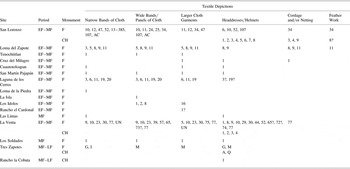
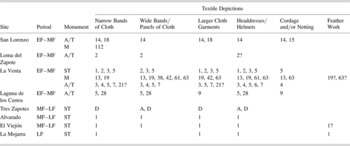
Among the large stone sculptures in-the-round and relief images that are clothed, their garb and adornments match those seen in Olmec ceramic and small stone figures (Follensbee Reference Follensbee2000:437–446), but carved and incised textures on the large sculptures allow for better identification of different types of textiles. Whereas smooth pellets and fillets of clay on the figurines may symbolize in abbreviated form many different types of clothing and ornaments, textures on the large stone sculpture reveal clear distinctions between cordage and cloth and the differences between solid ornaments and feather work; they also illustrate clearly how, in great part, the depicted Olmec garments consisted simply of finely woven textile bands and panels (Tables 1 and 2).
Gulf Coast Olmec monumental sculpture in-the-round: Anthropomorphic images with textile depictions

Notes: Total of 80 sculptures depicting a total of 97 individuals (Follensbee Reference Follensbee2000). EF = Early Formative period; MF = Middle Formative period; LF = Late Formative period; F = figure; CH = colossal head; UN = unnumbered monument; AC = anthropomorphic column (no number).
Gulf Coast Olmec monumental relief sculpture: Anthropomorphic images with textile depictions

Notes: Total of 33 sculptures depicting a total of 84 individuals (Follensbee Reference Follensbee2000). EF = Early Formative period; MF = Middle Formative period; LF = Late Formative period; A/T = “altar” (throne); M = other monument; ST = stela.
Recent research suggests that cordage may have symbolized ritual power in Formative-period Mesoamerica (Kappelman and Reilly Reference Kappelman and Reilly2001). In any event, cordage appears with frequency in contexts associated with rulership and physical power in Early and Middle Formative Gulf Coast Olmec sculpture. On the thrones known as San Lorenzo Monument 14 and La Venta “Altar” 4, for example, the frontal figure holds a thick rope that extends to each side, where it connects to one or more bound individuals. San Lorenzo Monument 15 and Laguna de los Cerros Monument 9, meanwhile, depict figures sitting on stone blocks that are wrapped in rope. Such sculptures presumably show the method of transport for the heavy basalt blocks, which were brought from quarries in the Tuxtla Mountains. These images may also prefigure Maya ritual binding of stelae and altars (Stuart Reference Stuart1996:156).
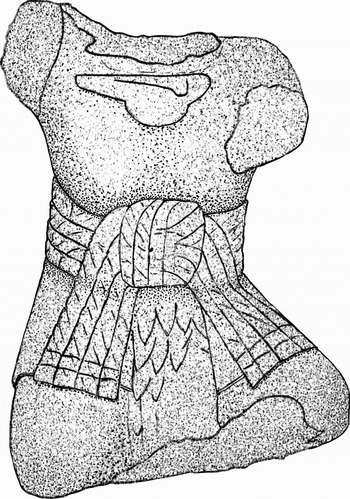
Cordage was also used symbolically, as elements in the headdresses of three San Lorenzo Colossal Heads—Monuments 3, 4, and 9—and in the headdress of Cruz del Milagro Monument 1; in clothing, as on the cape of La Venta Monument 77; and composing belts, armbands, and leg bands, as shown on San Lorenzo Monument 34, La Venta Monument 63, and the recently discovered Loma del Zapote Monument 11 (Figure 1). In addition, cordage appears in the form of woven net garments, as in the headdress of the man on La Venta Monument 13 and in the cape of the elderly woman depicted on La Venta Stela 5 (Follensbee Reference Follensbee2000:190–197).
Loma del Zapote Monument 11, also known as the Ejido de Xochiltepec torso, a large stone figure of a female adolescent wearing a spoon as a pectoral. Drawing by the author.

These many depictions foreshadow how cordage was associated with power and was incorporated into the regalia and symbols of elites in later Mesoamerican societies (Robicsek Reference Robicsek1975; Bruhns Reference Bruhns and Miller1988:Figure 12). For example, Maya rulers are known to have worn multiple-strand cordage belts very much like those depicted on La Venta Monument 63 and Loma del Zapote Monument 11 (Robicsek Reference Robicsek1975:Figure 142). Netted cordage capes and garments very much like those on the La Venta monuments were worn by people of elite status among the Aztec and other later Mesoamerican cultures (Anawalt Reference Anawalt1996; Berdan Reference Berdan1987:245), and similar netted garments composed of jade bead nets were common among Classic-period Maya elites (Bruhns Reference Bruhns and Miller1988).
Depictions of woven textiles on Olmec large-scale sculpture, meanwhile, sometimes take the form of stiff garments perhaps woven of ixtle agave fibers, a humble material that nevertheless formed the capes of elites in some later Mesoamerican cultures (Parsons Reference Parsons1972:61). Other depictions of woven textiles take the form of smooth, undulating garments that suggest fine cloth, likely of high-quality cotton, fur, and/or feather fibers. Recent research has established that the Gulf Coast Olmec region was a favorable and productive area for growing and procuring all of these products in pre-Hispanic times (Stark Reference Stark, Toby Evans and Webster2001:336; Stark et al. Reference Stark, Heller and Ohnersorgen1998:10–15, Footnotes 6–8). Smooth garments on Gulf Coast Olmec sculpture seldom show indications of surface designs, but they may have been embellished with painted or stamped decoration, as attested by ceramic and stone roller stamps that have been recovered from Gulf Coast Olmec sites (Coe and Diehl Reference Coe and Diehl1980:289, Figure 412; Drucker Reference Drucker1952:Plate 42). The garments are meanwhile made elaborate by their composition, with combinations of narrow bands, wider bands, and cloth panels that are wrapped, layered, and interlaced. Cloth bands are also incorporated into Olmec headdresses; the Colossal Heads' “helmets,” for example, do not appear to be solid caps but composed of wrapped or knotted bands and panels with attached ornaments. Depictions of additional adornments such as cloth bands, tassels, and feathers are also incorporated into elite Olmec regalia, as shown in the elaborate, feathered pubic flap worn by Loma del Zapote Monument 11 (Figure 1). Such adornments were highly prized in later Mesoamerican cultures, and cloths that incorporated fur or feathers were considered to be among the finest types of textiles (Hendon Reference Hendon and Robb1999a:266).
These depictions of elite personages wearing intricate cloth garments, cordage, and feather work do not only illustrate that the Olmec produced a variety of textiles; they also attest to the importance that was already placed on elaborate textiles by the Early Formative period. Even more concrete evidence of sophisticated textile production in this region, however, can be found through close examination of artifacts that have been recovered in Olmec excavations.
DIRECT EVIDENCE: TEXTILES AND TOOLS
While preserved cloth has never been recovered from the Gulf Coast Olmec region, direct evidence of Early Formative Olmec textile production emerged in 1988, along with the amazingly intact wooden busts of El Manatí. The anaerobic springs of this offering site preserved fragments of woven, petate mat-like palm-fiber and tule-fiber wrappings, some with a twill pattern, that were tied around the figures with ixtle-fiber cordage (Ortiz Ceballos et al. Reference Ceballos, Ponciano, del Carmen Rodríguez Martínez and Delgado Calderón1997:56–65; Rodríguez Martínez and Ortíz Ceballos Reference Martínez, del Carmen and Ceballos1994:23–27).
Previous to this discovery, the most direct evidence of Olmec textiles consisted of a single impressed potsherd found at the Middle Formative site of La Venta (Drucker Reference Drucker1952:Plate 22e), which Philip Drucker tentatively captioned, “Sherd with textile impression, apparently of closely woven twined basketry (?).” Close study of this potsherd, however, reveals that while it does record an impression of tight, smoothly woven stitches, the stitches are oblong rather than the even, squarish shape of twined basketry stitches, and they do not show the characteristic diagonal slant of twined stitches. Rather, the yarn-like, 1.5 mm stitches are in even rows that compare closely with impressions of tightly loom-woven, weft-faced cloth of 22–23 stitches per square centimeter. Whether cloth or basketry, however, this potsherd attests clearly that the Olmec were creating finely woven textiles by the Middle Formative period.
Investigations of artifacts excavated at the sites of San Lorenzo, La Venta, and Tres Zapotes reveal additional supporting evidence of textiles and textile manufacture during the Formative period. Deposits at La Venta revealed reworked ceramic potsherds that were ground into rounded shapes with notches on each side, presumably so that they could be tied securely with cordage and suspended. Since warp-weighted looms are not known to have been used in Mesoamerica, these objects were likely weights for fishing nets, as also suggested by the excavators (Drucker Reference Drucker1952:144, Plate 45; Coe and Diehl Reference Coe and Diehl1980:283). Other artifacts found at both La Venta and Tres Zapotes that probably served as net weights are a number of small, biconical, hand-molded ceramic objects; each is impressed with a horizontal and a vertical encircling groove, clearly showing that they were meant to be tied and suspended by cordage. (Drucker Reference Drucker1952:142, Plate 42; Drucker et al. Reference Drucker, Heizer and Squier1959:245, Plate 61; Weiant Reference Weiant1943:118, Plate 65).
In regard to woven cloth, spindle whorls are often cited in archaeological research as the strongest supporting evidence of such textiles and textile manufacture in Mesoamerican cultures, and scholars often note that spindle whorls are lacking in Formative-period Gulf Coast contexts. Recent textile research has shown, however, that a paucity of preserved whorls cannot be taken to indicate a corresponding lack of woven cloth. Some Mesoamerican cloth textiles were made without spinning at all, such as the finest agave cloth, which was woven using single-strand, unspun fiber (Sahagún 1961:73, 180; Parsons and Parsons Reference Parsons and Parsons1990:323). Further, throughout pre-Hispanic times, spindle whorls were commonly made of highly perishable materials such as wood and unfired clay, which are rarely preserved archaeologically. Scholars have suggested that the majority of spindle whorls prior to the Postclassic period were made of such perishable materials (McCafferty and McCafferty Reference McCafferty, McCafferty, Blum Schevill, Berlo and Dwyer1991:30–31; Moholy-Nagy Reference Moholy-Nagy2003:46; Parsons and Parsons Reference Parsons and Parsons1990:357). Nevertheless, investigation of artifacts excavated from the sites of San Lorenzo, La Venta, and Tres Zapotes, and reevaluation of these artifacts in light of recent research, reveals that preserved spindle whorls are not unknown for these Formative-period cultures.
Among the Middle Formative artifacts recovered from La Venta were several small, hand-formed, plano-convex spindle whorls (Drucker et al. Reference Drucker, Heizer and Squier1959:245, Plate 61). Because this deposit was mixed with some post-Olmec material, the identification of these whorls as Olmec artifacts was questioned by the excavators. However the whorls were found in closest association with other Middle Formative La Venta artifacts, including diagnostic figurines; the whorls are consistent in paste with the Olmec ceramics; and, the whorls are hand-modeled, like the Middle Formative figurines. Most convincingly, all of these traits contrast strongly with the post-Olmec material that was recovered from La Venta, and these simple, handmade whorls also contrast strongly in form and design with the ceramic whorls of the later cultures of this region, which were consistently mold-made (Drucker et al. Reference Drucker, Heizer and Squier1959:245). Thus, these are most likely Middle Formative artifacts.
Confirming these identifications are identical hand-modeled ceramic whorls recovered from the earliest levels of Tres Zapotes (Weiant Reference Weiant1943:117, Plates 64–65). While Drucker posited that Tres Zapotes was Late Formative in date (Drucker Reference Drucker1943:117–123), recent excavations and a reevaluation of the evidence by Christopher Pool has shown that Tres Zapotes was likely a relatively minor Olmec center during the Early and Middle Formative periods that grew into a larger center during the Late Formative period (Pool Reference Pool, Clark and Pye2000:141–152). These spindle-whorl artifacts recovered from the earliest occupation levels of the site, therefore, would date at least as far back as the Middle Formative period, confirming spinning and weaving activities among Olmec occupations as well as among the Epi-Olmec occupations.
The topic of spindle-whorl classification and use has received considerable attention. Mary Parsons (Reference Parsons1972:47–61) studied Teotihuacan spindle whorls and found numerous correlations between diameter, hole size, and weight of the whorls, defining nine types and numerous subtypes; the correlation of weight to the type and fineness of fiber spun was reiterated in the study by Jeffrey Parsons and Mary Parsons (1990:319) on maguey utilization. Elizabeth Brumfiel's (Reference Brumfiel1996) studies of Morelos and Valley of Mexico whorls considered more closely the relationship between the weight and diameter of whorls and the fineness of the thread produced. Then, focusing on whorls from their excavations at Cholula, McCafferty and McCafferty (Reference McCafferty and McCafferty2000) conducted a detailed study in which they examined correlations between diameter, height, shape, weight, and hole diameter, along with the correspondence of these features with both the fibers spun on such whorls and the desired fineness of the resulting thread or yarn. This study resulted in ten types and numerous subtypes. All together, these studies have considerably refined our understanding of Mesoamerican whorl types and functions.
Close study of the hand-formed La Venta whorls shows that their diameter, height, shape, hole size, and weight classify them as Type III whorls, according to the spindle-whorl typologies developed by Parsons (Reference Parsons1972:47–61) and as Type B whorls according to the spindle-whorl typologies developed by McCafferty and McCafferty (Reference McCafferty and McCafferty2000:46–47). The Tres Zapotes whorls likewise fall into these typologies. Parsons's and the McCaffertys' research both designate such whorls as appropriate for spinning short staple fibers such as cotton and perhaps fine hair such as rabbit fur (Figures 2 and 13a).
Reproduction of a hand-formed ceramic spindle whorl found at La Venta. Reproduction by the author; Drucker et al. (Reference Drucker, Heizer and Squier1959:245, Plate 61).

Still other artifacts that likely served as spindle whorls have been found in both Early and Middle Formative San Lorenzo deposits (Coe and Diehl Reference Coe and Diehl1980:283), Middle Formative La Venta deposits (Drucker Reference Drucker1952:143–144, Plate 42), and throughout the Formative deposits at Tres Zapotes (Drucker Reference Drucker1943:87 and, Plates 30, 32), as well as from Formative-period contexts at other Gulf Coast sites (Stark et al. Reference Stark, Heller and Ohnersorgen1998:15–18). These artifacts consist of potsherds ground into disk shapes, many with central perforations, along with some potsherds that had been ground into spherical, bead-like shapes with central perforations (Coe and Diehl Reference Coe and Diehl1980:Figure 398a). While, as noted by the excavators, very large, unperforated sherd disks may have served as covers or gaming pieces (Drucker Reference Drucker1952:143–144), or even as spinning bowls (Grove Reference Grove and Grove1987a:285–287), the shape and size of the majority of these artifacts places them in the category of reworked sherds that are widely recognized as early Mesoamerican spindle whorls and whorl blanks (Beaudry-Corbett and McCafferty Reference Beaudry-Corbett, McCafferty and Ardren2002:60; Drucker Reference Drucker1943:87; Hendon Reference Hendon, Grove and Joyce1999b:108, Reference Hendon, de Arathoon, González and Willemsen Devlin1999c:9; Niederberger Reference Niederberger1987:632; Stark et al. Reference Stark, Heller and Ohnersorgen1998:17; Willey Reference Willey1978:41–43).
As described and illustrated in the excavation reports (Coe and Diehl Reference Coe and Diehl1980:283; Drucker Reference Drucker1943:87, Plates 30, 32, 1952:143–144, Plate 42), these Formative-period Gulf Coast sherd whorls generally fall into two main whorl typologies: the smaller whorls (Parsons's Type III and lighter Type I whorls or the McCaffertys' Types B–E), which were likely used to spin fine agave fibers, cotton, and possibly feathers and fur (McCafferty and McCafferty Reference McCafferty and McCafferty2000:45–47; Parsons Reference Parsons1972:47–61), and the larger whorls (Parsons's Type II and heavier Type I whorls or the McCaffertys' Types F–J), which were likely used to spin heavier agave fibers, with different sizes for a range of fineness, from two-strand threads through cordage.
OTHER POSSIBLE EVIDENCE: ELITE TOOLS
In addition, a number of other provenienced artifacts may provide substantial further evidence of Formative-period textiles. These consist of a number of enigmatic small stone objects found in Gulf Coast Olmec and Olmec-related caches and gravesites, as well as in “heirloom caches” of Formative-period objects found throughout Mesoamerica, that were initially identified in the excavation reports simply as “ornaments,” “objects of unknown use,” or “miscellaneous objects” (Coe and Diehl Reference Coe and Diehl1980:240–242; Drucker Reference Drucker1952:168–171, Reference Drucker1955:63–65; Drucker et al. Reference Drucker, Heizer and Squier1959:191–194). Contemporary scholars writing texts on Olmec art were likewise mystified, referring to them, for example, as “implements for mysterious unknown purposes” (Covarrubias Reference Covarrubias1957:75). The vast majority of these artifacts were manufactured from greenstone, an elite material highly prized throughout Mesoamerica, with the finest composed of green or bluish-green jadeite, the extremely hard, sodium aluminum silicate mineral that composes nearly all Mesoamerican jades. In 1999, scholars located the source of the Olmecs' preferred bluish-green jadeite in the mountains of central Guatemala (Price Reference Price2002), which attests to the Olmecs' far-flung trade networks and their strong interaction with other Formative-period cultures, to their wealth and the extent to which they would go to acquire this material, and, most significant, to the highly elite nature of these objects.
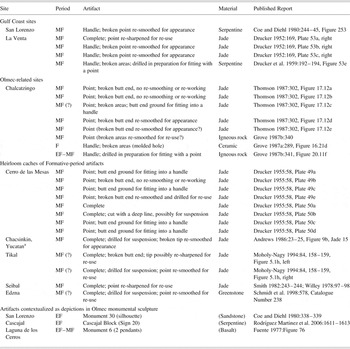
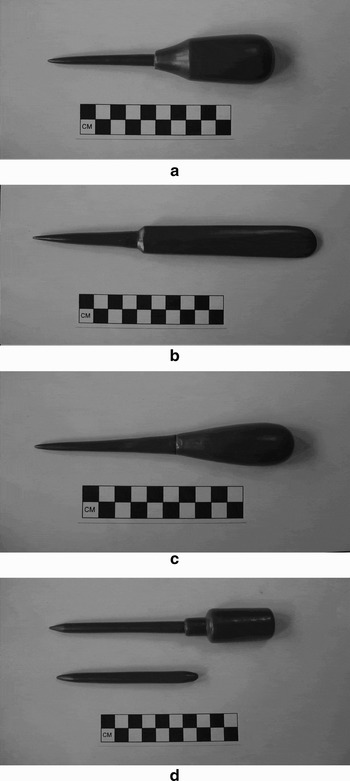
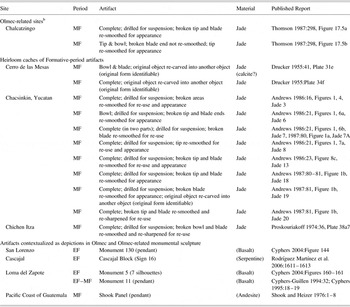
The possible meanings and functions of most of these Formative-period greenstone artifacts remain as mysterious and enigmatic as when they were first uncovered. In fact, only one class of these objects has experienced a wide agreement on its interpretation: the jade picks, popularly known as “bloodletters” (Table 3, Figures 3–4).
Provenienced artifacts: Greenstone picks

Notes: F = Formative period; EF = Early Formative period; MF = Middle Formative period.
aJade 22 from Chacsinkin, Yucatan, may also have been a hummingbird pick (Andrews Reference Andrews and Wyllys1987:81, Figure 1b).
Reproductions of provenienced greenstone picks: (a) pick found in Tomb A (Basalt Log Tomb), Mound A-2, La Venta, with point reconstructed (Drucker Reference Drucker1952:26, 169, Plate 53, right, b); (b) pick found in Tomb B, inside Monument 6 (Sandstone Coffer), Mound A-2, La Venta (Drucker Reference Drucker1952:27, 169, Plate 53, right, a). This pick is unique in that its elongated, rectangular handle flattens into a blade. The pick is effective as a weaving awl, while the flattened end serves well as a short batten, creating an efficient, two-ended weaving tool; (c) pick found in Tomb C (Sandstone Cist), Mound A-3, La Venta, with point reconstructed (Drucker Reference Drucker1952:68–71, 169, Plates 52–53, right, c); (d) pick handle found during general digging in Complex A, La Venta (Drucker et al. Reference Drucker, Heizer and Squier1959:192–194, Figure 53e), with points modeled on reground pick points found at Cerro de las Mesas (Drucker Reference Drucker1955:Plate 50c–d). All reproductions by the author.

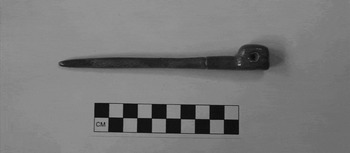
Reproduction of Princeton University Art Museum Collection Number L.1989.109.16, an unprovenienced pick in the form of a stylized hummingbird, with point reconstructed. Reproduction by the author.

When provenienced jade picks were excavated from Gulf Coast sites in the 1940s, they were initially listed as “pointed implements,” “stilettos,” “awls,” “perforator(s),” and, of course, “objects of unknown use” (Drucker Reference Drucker1952:168–169; Stirling Reference Stirling1941:292; Stirling and Stirling Reference Stirling and Stirling1942:641; Coe Reference Coe and Willey1965:745, Figure 32). Depictions of these objects in sculpture were rare and ambiguous in regard to specific function, indicating only that they were important enough to be depicted and that they were at least sometimes used as elite ornament (Table 3, Figure 5). This is still the case. Even the newly discovered appearance of the picks as pictographs, in what is possibly an Olmec writing system, simply serves to further suggest the importance of picks to the Olmec (Rodríguez Martínez et al. Reference Martínez, del Carmen, Ortíz Ceballos, Coe, Diehl, Houston, Taube and Delgado Calderón2006 also Bruhns and Kelker Reference Bruhns and Kelker2007; Rodríguez Martínez et al. Reference Martínez, del Carmen, Ortíz Ceballos, Coe, Diehl, Houston, Taube and Delgado Calderón2007; Cyphers Reference Cyphers(-Guillen)2007a, Reference Cyphers(-Guillen)2007b; Ortíz Ceballos and Rodríguez Martínez Reference Ortíz and del Carmen Rodríguez Martínez2007).
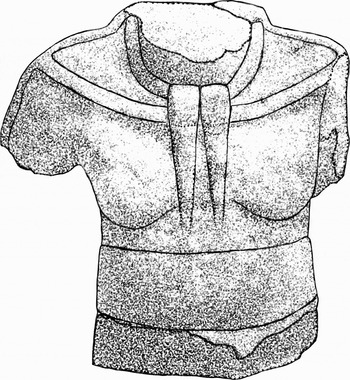
Laguna de los Cerros Monument 6, a large stone figure of an elderly woman that wears two stylized hummingbird-type picks as pendant ornaments. Drawing by the author.

In 1942, Matthew Stirling and Marion Stirling (1942:641) suggested that such picks were meant for “ceremonial bloodletting,” and in his 1952 report, Drucker tentatively proffered the Stirlings' hypothesis that these could be ceremonial perforators (Drucker Reference Drucker1952:169, Plate 53). Other scholars quickly followed suit, and from that point on, all such awl-like jade objects were definitively asserted to be “ceremonial perforators” or “bloodletters,” sometimes with comparisons to representations of personified or deified bloodletters on Classic-period Maya vase painting and sculpture (Coe Reference Coe and Adams1977:188; Coe and Diehl Reference Coe and Diehl1980:244–245; Easby Reference Easby1970:83, Catalogue Number 38; Griffin Reference Griffin and Benson1981:219–220; Joyce et al. Reference Joyce, Edging, Lorenz, Gillespie and Fields1986:144–146; Lothrop et al. Reference Lothrop, Foshag and Mahler1957:233; Smith Reference Smith and Willey1982:243; Taube Reference Taube2004:122–126; Thomson Reference Thomson and Grove1987:302; Willey Reference Willey1978:97–98).
Despite the wide consensus, however, this is a questionable interpretation, as these relatively blunt artifacts would not be functional as bloodletters. As a rule, the greenstone picks are ground stone rather than knapped stone; even the most pointed of these implements do not have the needle-sharp tip necessary for drawing blood. Further, their form and material is inconsistent with illustrations and ethnohistoric accounts of traditional Classic- and Postclassic-period Mesoamerican bloodletting tools, which consisted of obsidian and chert blades, stingray spines, maguey thorns, sharpened bones or bone splinters, and sharp shark's teeth (Chase Reference Chase and Fields1986:89–90; Coe Reference Coe, Benson and Griffin1988:226–227; Joralemon Reference Joralemon and Greene Robertson1974:59–75; Joyce Reference Joyce, Goldsmith, Garvie, Selin and Smith1992:502–504; Schele and Miller Reference Schele and Ellen Miller1986:175–176). Examples of such much more effective, traditional bloodletters have been found in elite Formative-period Gulf Coast graves and caches (Stirling and Stirling Reference Stirling and Stirling1942:641), and these likely served as the bloodletting instruments of choice for the Olmec, as well. A jade object that is clearly an effigy of a stingray spine was also recovered from La Venta (Drucker Reference Drucker1952:169, Plate 53d), but a large portion of the tip is broken off, and whether or not it was knapped at the point into a functional bloodletter is therefore not possible to determine. However, this object is flattened and has carved, serrated fluting on the sides, and it was not supplied with a handle; it is thus entirely unlike any of the greenstone picks. A second stingray spine effigy from the Cerro de las Mesas cache is even more distinctive (Drucker Reference Drucker1955:63, Plate 48k), as it takes the form of a thin, flat, jade plaque that is 2 cm wide and is, again, not at all similar to the greenstone picks.
Comparisons of the greenstone picks with painted representations of Classic and Postclassic Maya deified/personified bloodletters are also problematic. Studies of the lancet portions of the painted bloodletter depictions reveal that they either have the serrated blades of stingray spines or they show specific symbolic designs confirming that they represent obsidian blades. Further, the handles are never simple but take the elaborately sculpted form of the head of a specific deity dubbed “the perforator god” (Joralemon Reference Joralemon and Greene Robertson1974:62–65; Schele and Miller 1986:176). These observations of the Maya images have been confirmed recently by the identification at Piedras Negras of sculpted jaguar-bone handles that closely match painted depictions of the “perforator god” handles. These handles are also carved with carefully formed, flat and narrow grooves to accommodate removable, worked stingray spines and obsidian blades that were found in the same burials (Fitzsimmons et al. Reference Fitzsimmons, Scherer, Houston and Escobedo2003:459–465).
Meanwhile, the streamlined, utilitarian simplicity of the majority of the provenienced, Formative-period picks—and particularly those recovered archaeologically from Gulf Coast sites such as La Venta and Cerro de las Mesas—contrast markedly with the elaborately carved, personified Maya bloodletters. While one provenienced pick from La Venta Tomb B (Monument 6) takes a unique form—one end is a pick and the other end is an elongated, rectangular handle that flattens into a spatulate, tool-like end (Figure 3b; Drucker Reference Drucker1952:169, Plate 53; Stirling and Stirling Reference Stirling and Stirling1942:641)—the remaining provenienced Formative-period picks all take the form of functional awls with simple comfort-grip handles (Figures 3a, 3c–d).
Further research on the jade picks confirms that other scholars have also questioned the “bloodletter” interpretation, have noted their utilitarian form, and have tentatively suggested alternative functions for these objects. Hattula Moholy-Nagy and Elisabeth Easby, for example, have suggested that such picks might have served as a type of stylus (Moholy-Nagy Reference Moholy-Nagy1994:84, 158–159). As styluses and paintbrushes were held like a pencil (Reents-Budet Reference Reents-Budet1994:41), however, the handle-and-pick form of these implements would make them impractical for this sort of use, as would their rounded tips. Anatole Pohorilenko (Reference Pohorilenko1990:703–705) suggests that the picks might have been used as tools in textile making, perhaps used for punching holes for sewing ceremonial vestuary. Donald Cordry and Dorothy Cordry, as well as Peter Furst, meanwhile, have noted the strong similarities of these Formative-period jade picks with later Mesoamerican weaving awls (Cordry and Cordry Reference Cordry and Cordry1968:45–48; Princeton University Art Museum 1995:193).
Weaving awls and picks were common implements throughout the ancient cultures of the Americas (Grove Reference Grove and Grove1987a:291–293; Niederberger Reference Niederberger1987:410–411), most commonly made of deer or bird bone, but sometimes also fashioned from wood, large thorns, and polished stone (Adams Reference Adams2002:184–186; MacNeish et al. Reference MacNeish, Nelken-Terner and Johnson1967:155; Sahagún 1954:49, 1961:36, Figure 75; Schaefer Reference Schaefer1990:40–58). These tools were used for making basketry and also for traditional backstrap-loom weaving, used to tighten and refine the weave, to lift sections of the warp, and to help create fine ornamental work such as brocades (Hendon Reference Hendon, de Arathoon, González and Willemsen Devlin1999c:10; O'Neale Reference O'Neale1945:34, Figure 75h; Sayer Reference Sayer1988:28; Stout Reference Stout1976:11). While the slender bone “pins” found at Maya sites may be too delicate to have served as awls for basketry or leatherwork (Willey Reference Willey1972:235–236), scholars have noted that these also would have served well as weaving picks in the making of fine cloth (Ardren Reference Ardren2002:83; Dacus Reference Dacus2005:17–24). The finer awls, picks, and pins found in elite tombs and caches were sometimes polished, incised, and/or carved with decoration on the handle end (Ardren Reference Ardren2002:83; Dacus Reference Dacus2005; Pendergast Reference Pendergast1979:64, Figure 35c; Willey Reference Willey1972:236, Figure 204; Woodbury and Trik Reference Woodbury and Trik1953:275, Figure 159h).
Artifacts closely related to the greenstone picks are slender, pointed greenstone shafts found in Formative-period caches such as that at Cerro de las Mesas (Drucker Reference Drucker1955:Plates 49–50). The broken butt end of many shafts indicates that they are simply the broken-off tips of weaving awls. One possibility is that these objects might have been saved and later collectively lashed together into weaving combs; such combs of lashed-together wooden shafts, as well as carved wooden combs, were commonly used in weaving by Tzotzil and Zoque cultures (Cordry and Cordry Reference Cordry and Cordry1941:116, Figure 35), and such combs have been recovered from Tehuacan that date from 200 b.c. through the late Postclassic (MacNeish et al. Reference MacNeish, Nelken-Terner and Johnson1967:155–156, 162–163). Combs made of elite materials are also known from ancient Mesoamerican cultures, including a fine, Early Formative- to Middle Formative-period bone weaving comb with a handle in the shape of a duck's head recovered from a Tlapacoya deposit (Niederberger Reference Niederberger, Benson and de la Fuente1996:86, Figure 2, 2000:Figure 5), an elaborately carved, elite bone weaving comb recovered from the Mixtec Tomb 7 at Monte Albán (Caso Reference Caso1969:192, Figure 184; McCafferty and McCafferty Reference McCafferty and McCafferty1994:146–147), and carved greenstone weaving combs recovered from pre-Columbian West Mexican sites (Cordry and Cordry Reference Cordry and Cordry1968:47–48).
The butt end of some greenstone shafts, however, have been ground down into an even, shallow, truncated cone shape. This careful shaping suggests that these shafts may have been fitted for setting into a carved hole, perhaps in a new handle. Composite weaving awls have been recovered from other ancient sites in Mesoamerica, such as the large agave spines provided with handles of tightly wrapped fiber and other materials found at Tehuacan, dating from 6500 b.c. through the late Postclassic period (MacNeish et al. Reference MacNeish, Nelken-Terner and Johnson1967:155) and the bone weaving awls with the ends worked to fit into a utilitarian handle found at the Early Postclassic site of Santa Isabel, Nicaragua (McCafferty and McCafferty, this volume). Given that the slender shafts and pointed tips of all types of awls are prone to breakage, it is not unlikely that some awls made of more precious materials, when broken too near to the handle for resharpening, may have been renewed by drilling the handle and fitting it with a replacement shaft. One such handle was found in Complex A at La Venta, drilled with a conical hole that would readily accommodate the greenstone shafts found in the Cerro de las Mesas Formative-period cache (Figure 3d; Drucker et al. Reference Drucker, Heizer and Squier1959:192–194); these replacement points were perhaps tightly lashed on, pierced and pinned in place, or secured with natural tar or another locally occurring fixative (Follensbee Reference Follensbee1998:n.p.). Two unprovenienced Formative-period awls provide supporting evidence for this hypothesis: a jade awl reported from Veracruz consists of a perforated shaft fitted into a handle (Wilkerson Reference Wilkerson, Jeffrey and Benson1981:194), and a jade awl in the Dumbarton Oaks pre-Columbian collection appears to represent, in effigy, a handle with a perforated shaft inserted and secured by a pin that passes through the two deep bore holes at the tip of the handle (Benson and Fuente 1996:260). Other scholars such as Pohorilenko and Karl Taube have corroborated these hypotheses, and Taube suggests that handles of ceramic and wood may also have served as holders for the broken points (Pohorilenko Reference Pohorilenko1990:689; Taube Reference Taube2004:125).
Still other jade shafts were flattened at the butt end and pierced, either in reuse or as an originally conceived object (Stout 1995:192, Catalogue Number 78; Griffin Reference Griffin and Benson1981:220, Figure 20; Lothrop et al. Reference Lothrop, Foshag and Mahler1957:233, Figure 7; Follensbee Reference Follensbee1998). Some of these may have been pinned into hollowed awl handles, but the flattening near the butt end instead suggests that they more likely had been worked, or reworked, to function as large needles for netting or embroidery. Such implements were associated in later Mesoamerican cultures with high-status individuals and even with goddesses of weaving, such as the Maya goddess Ix Chel, who was known as “the virgin of the jade needle” (Bell Reference Bell and Ardren2002:101; Stout Reference Stout1976; Thompson 1939:132).
An interesting phenomenon is that some fragmentary pieces of these implements were preserved, although they are so small or so broken that they would no longer have been at all functional for their originally intended purpose. These include very short awl or needle tips that were smoothed and pierced again for suspension (Drucker Reference Drucker1955:58, Plate 49e) and some awl handles that were smoothed and pierced on the broken-off pick end, decidedly rendering that object as non-functional for any further purpose but ornament (Easby Reference Easby1970:83, Catalogue Number 38). Ancient Mesoamerican artisans such as spinners, weavers, scribes, and painters commonly wore the functional tools of their trade as part of their regalia, as did the patron gods and goddesses of their arts (McCafferty and McCafferty Reference McCafferty and McCafferty1994:147–148; Kerr Reference Kerr1994), and this practice continues today among some cultures (McCafferty and McCafferty Reference McCafferty, McCafferty, Blum Schevill, Berlo and Dwyer1991:31). These greenstone implements, however, clearly continued to be prized and worn even after they could no longer be manipulated. Although they had been “retired,” these objects apparently could still serve as ornaments and symbols of occupation and/or status.
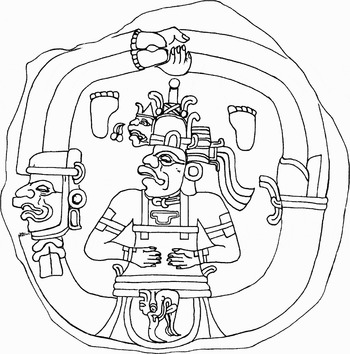
The purpose or meaning of the other Formative-period greenstone artifacts has not been as extensively discussed or as decisively suggested. Some of these objects, however, have been the subject of scholarly speculation. The artifacts popularly called “spoons,” for example, were highly valued throughout pre-Columbian times and have been found in heirloom caches of Formative-period objects throughout Mesoamerica. Although no full-size spoons have yet been identified from Olmec sites, spoons are sculpted in the same manner as other Formative-period Gulf Coast jades, and they often bear Olmec imagery. Spoons are also clearly depicted in Gulf Coast Olmec and Olmec-related sculpture as ornaments worn by anthropomorphic figures (Table 4, Figures 1, 6), and like the greenstone picks, images of spoons appear as pictographs in what may be an Olmec system of writing (Rodríguez Martínez et al. Reference Martínez, del Carmen, Ortíz Ceballos, Coe, Diehl, Houston, Taube and Delgado Calderón2006).
The Shook Panel, a large stone monument recovered from San Antonio Suchitepequez, Guatemala, that illustrates two relief images: a central female figure wearing a spoon pectoral, and an encircling male “acrobat” figure. Drawing by the author, after Shook and Heizer (Reference Shook and Heizer1976:Figure 1).

Provenienced artifacts: Greenstone “spoons”

Notes: EF = Early Formative period; MF = Middle Formative period.
bThe D-shaped jade pectoral ornament from Offering #5 at the Olmec site of La Venta may also be a fragmentary spoon (Drucker et al. 1959:166, Figure 41, Plate 37).
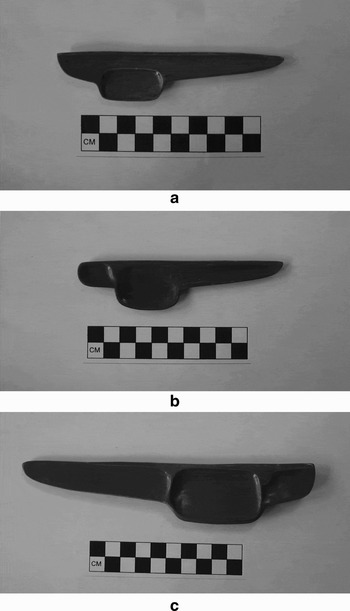
The spoons take slightly varied forms, but they generally consist of a flattened “tail” or blade on one side; a shallow, concave, off-center bowl; and a smaller shallow bowl on the other side of the central bowl (Figure 7). Spoons are also usually pierced on the back for suspension, and they appear in both left-facing and right-facing versions. In the depictions of spoons in sculpture (Table 4), four face left, while six face right (Figures 1, 6), and of the provenienced greenstone examples, eight spoons have the tail on the right side and five have the tail on the left side.
Reproductions of greenstone “spoons”: (a) Chacsinkin Jade 6, reconstructed (Andrews 1986:21, Figures 1, 6a); (b) Chacsinkin Jade 20, tail slightly reconstructed (Andrews 1986:21, Figures 1, 6a); (c) Cleveland Museum of Art Collection Number 856.1994, an unprovenienced spoon (Benson and de la Fuente Reference Benson and de la Fuente1996:255). All reproductions by the author.

In addition, spoons with very truncated tails and/or bowls are also common. However, close examinations of all provenienced spoons (and of numerous unprovenienced spoons) reveals that, without exception, the truncated examples show substantial evidence of breakage, resmoothing, and/or resharpening on the truncated areas, confirming that these objects were originally conceived with fully formed bowls and long tails and originally scaled to be held in the human hand—of varying sizes. Despite this common original form, spoons were conserved even in heavily modified form; some examples are so broken or worn that they are barely identifiable as spoon fragments, yet they were still saved, their rough edges smoothed, and sometimes they were even provided with new suspension holes (Andrews 1986:21, Figure 6a; 1987:Figure 1a, Jade 6). A small jade pectoral ornament recovered from a La Venta grave, in fact, may be one of these objects: the D-shaped ornament is concave, has a slight lobe on one side, and has two perforations on the back, and it may thus be the surviving central bowl of a spoon (Drucker et al. Reference Drucker, Heizer and Squier1959:166, Figure 41, Plate 37). Although these objects, like the broken jade awls, would have been “retired” from actual use when they could no longer serve their originally intended purpose, they were still highly valued and worn as symbols of occupation and status and placed as offerings in graves and caches.
Interpretations of the spoons vary from a type of seashell effigy (Covarrubias Reference Covarrubias1946:172; Cyphers 2004:243–244; Griffin Reference Griffin and Benson1981:219), to effigies of tadpoles (Pohorilenko Reference Pohorilenko and Benson1981:311–314, Reference Pohorilenko1990:945–968), to effigies of the Big Dipper and the Little Dipper (Graham Reference Graham and Jones1998:48), to hand-held artists' paint pots (Kerr Reference Kerr1994), to containers for blood drawn in self-sacrifice rituals (Griffin Reference Griffin and Benson1981:219; Joralemon Reference Joralemon, Benson and de la Fuente1996:256), to effigies of long-tailed birds and snuffing spoons for hallucinogens (Furst Reference Furst and Benson1968:162–163, Reference Furst1995:77–69; Griffin Reference Griffin and Benson1981:219; Pohorilenko Reference Pohorilenko1990:968). While each of these hypotheses is plausible, none has been sufficiently convincing to bring a general consensus among scholars for this type of object.
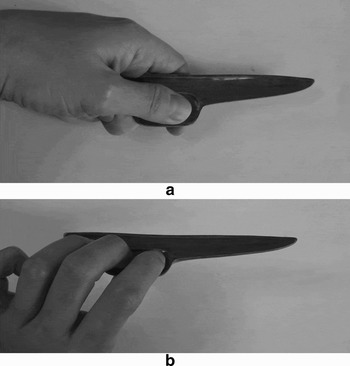
Close analysis of the spoons reveals a number of difficulties with the previously suggested functional interpretations. For example, the main bowls are usually very shallow and flatten greatly at the bottom edge, where they often have little or no rim. In contrast to containers used in later Mesoamerican cultures (Reents-Budet Reference Reents-Budet1994:42–43), few or no spoons would function well as holders for a liquid or a powder. Further, the tail of a spoon is generally flat and blade-like and not particularly comfortable as a handle. Instead, the shallow larger bowl of these objects seems to be perfectly designed and scaled to serve as a thumb grip; held in this manner, the smaller bowl forms a comfortable grip for the remaining fingers (Figure 8a). Alternatively, the flattened lower edge of the larger bowl and the rounded bowl of the tip together form a comfortable surface for holding the spoon with three fingers: the first and middle finger in the larger bowl, and the ring finger resting in the tip—which also allows one to raise or lower the tail easily by applying just light pressure with the third finger (Figure 8b). Holding a spoon in either manner suggests that the long blade is the “working end” of the object: with the larger bowl used as a thumb grip, the tail of the spoon is held flat, while holding the bowl and tip with three fingers places the blade of the tail in an upright position.
Reproduction of Chacsinkin Jade 6 spoon held as a functional weaving batten: (a) held using the bowl as a thumb grip, the blade is flat; (b) held with the first two fingers in the bowl and the third finger in the tip, the blade is upright. Reproduction by the author.

In fact, the blade-like tail of a spoon mimics perfectly the shape of a small weaving batten, and the two holding positions are identical to the two main positions in which a batten is used in weaving—flat and parallel to the weft for packing the threads, and upright and perpendicular to the warp to separate the weft threads. Such a use as a batten would also explain the left-facing and right-facing versions of the spoons: they would have been made to accommodate the weaver's preference for working the batten from the right side or the left side of the loom—which, as can be observed among modern-day weavers, is not necessarily dictated by whether someone is left-handed or right-handed.
Diminutive weaving battens are well-known in Mesoamerica. Small, elaborately carved bone battens have been identified in elite Mixtec gravesites (McCafferty and McCafferty Reference McCafferty and McCafferty1994:145–146; Caso Reference Caso1969:183–217; Gallegos Ruiz Reference Gallegos Ruiz1978:86, Figure 54), and fragments of small bone battens and small jade battens have been recovered at the Early Postclassic site of Santa Isabel, Nicaragua. McCafferty and McCafferty (this issue) postulate that all of these served as functional weaving tools. In addition, although not labeled or identified, a slender, profoundly batten-shaped jade object approximately 19 cm in length is displayed among the Gulf Coast Olmec jades at the National Museum of Anthropology in Mexico City. Such miniature weaving battens for working textile designs are also identified in ethnohistoric resources on the Aztec (Sahagún 1954:49, Figure 75). These smaller weaving tools were used to make narrow textiles and to help create elaborate tapestries and “pick-up” brocade designs, and traditional Mesoamerican tapestry weavers continue to make use of them today (Hall Reference Hall1976:Figure 17; Stout Reference Stout1976:11).
Half-batten tools have also been identified among Mesoamerican cultures. Scholars have identified “heirloom” jade half-battens recovered from sites in Costa Rica (McCafferty and McCafferty, this issue; Bishop et al. Reference Bishop, Sayre, Mishara and Lange1993:Plate 3). Also in Costa Rica, both one-ended and two-ended greenstone batten forms have been recovered that were apparently re-carved from celts and “axe gods.” Given their thin, utilitarian shape, these, too, may have served as functional textile-making tools (Lange Reference Lange and Lange1993:269–288, Figures 21.9c, 21.17, 21.18c). In addition, bone half-battens with elaborately carved handles, some further embellished with turquoise mosaic, were recovered from elite Mixtec gravesites (Caso Reference Caso1969:190–217, Plates 36–37, Figures 182, 200, 223, 238; Gallegos Ruiz Reference Gallegos Ruiz1978:83, 86, Figure 54). These thin, flat, blunt objects were at first tentatively identified as “punches” and later designated plegaderas because of their similarity to bone folders. However, because of their form and their close correlations to the carved-bone Mixtec battens, as well as their find contexts with other weaving tools such as elaborately carved and decorated weaving combs, spindle whorls, and the bone battens, more recent scholars have correctly identified these as also being functional elite weaving tools (McCafferty and McCafferty Reference McCafferty and McCafferty1994:146; Gallegos Ruiz Reference Gallegos Ruiz1978:83–86, Figure 54).
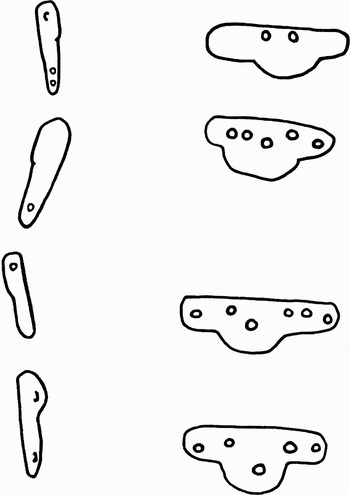
Tiny “spangles” of jade found in La Venta graves and deposits are likely related to the greenstone awls and spoon battens (Drucker Reference Drucker1952:170–171, Plate 58; Drucker et al. Reference Drucker, Heizer and Squier1959:149, 162, Plates 28, 37). Drucker, Robert Heizer, and Robert Squier (1959) noted that, although they measure only 8–23 mm in length, the spangles are often pierced with multiple holes, suggesting that they were ornaments attached securely to a backing, perhaps a garment of cloth or hide. Drucker describes the most commonly occurring forms as “the ‘duckhead’ type—slim, rod-like forms with a round bulge at one end,” and the “half ellipse, with a tab, usually rounded, on one side” (Drucker Reference Drucker1952:170–171; Drucker et al. Reference Drucker, Heizer and Squier1959:149, 162). Comparison of these shapes (Figure 9) to the jade awls and spoon battens (Figures 3–4, 7) illustrates that these spangles are tiny effigies of these jade implements. Along with small jade beads in these deposits that take the form of specific La Venta pottery types (Drucker et al. Reference Drucker, Heizer and Squier1959:152, Plate 28, Figure 42), these perhaps served as symbols or badges of accomplishment for artisans of elite status. This interpretation may also provide the explanation for the unusual imagery on Loma del Zapote Monument 5 (CyphersReference Cyphers1997:184–190). Rather than wearing a spoon batten in a headdress or as a pectoral, this very ruined torso wears the silhouettes of no fewer than seven truncated spoons scattered across its cape, presumably indicating that they were sewn securely onto it. These silhouettes could represent actual spoons that had been “retired” to serve as symbols of status; however, such objects would be quite heavy and difficult to secure as ornaments on a cloth cape. Instead, the silhouettes may more likely represent spangles, artificially enlarged for ease of identification.
Tiny jade pick and spoon effigy ornaments found in La Venta graves and deposits. Drawings by the author, after Drucker (Reference Drucker1952:Plate 58), Drucker et al. (Reference Drucker, Heizer and Squier1959:Plate 28).

Other Formative-period jade artifacts tentatively identified as “ornaments” or “beads” may also have had multiple uses beyond ornamentation, including functions as tools for spinning or weaving. A number of objects identified as stone beads recovered at San Lorenzo and at La Venta, as well as Formative-period heirloom-cache beads from Cerro de las Mesas (Drucker Reference Drucker1955:Plates 51–53), may have served as bead-type spindle whorls. Beads were commonly used as whorls in Mesoamerica to spin fine fibers (Parsons Reference Parsons1972:61), and, while less common than ceramic whorls, small stone whorls and greenstone whorls meant exclusively for spinning are well known in Mesoamerica and Western Mexico (Johnson Reference Johnson and de Leonard1959:445; McCafferty and McCafferty, this volume; Meighan Reference Meighan1976:99–100, Plates 82–83; Moholy-Nagy Reference Moholy-Nagy2003:46–47, Figure 106; Parsons Reference Parsons1972:61; Willey Reference Willey1978:90).
The center perforations of two of the six centrally perforated greenstone beads recovered from San Lorenzo, for example, appear to have been enlarged and made cylindrical, but the other four beads were drilled biconically and tend to have very small central perforations (Coe and Diehl Reference Coe and Diehl1980:Figures 240, 241b). The considerable extra work involved in making cylindrical holes was unnecessary for the suspension of these two beads as ornaments; however, such drilling would have been necessary if a bead was intended to accommodate a spindle. At La Venta, numerous spherical and lobed, well-balanced greenstone beads found in burials and offerings have enlarged, cylindrical central perforations that make them also very well suited for use as bead whorls (Drucker Reference Drucker1952:Plate 52; Drucker et al. Reference Drucker, Heizer and Squier1959:Plates 29, 37, 39), as does the central perforation of a hemispherical jade bead found in Stratitrench 3 (Drucker Reference Drucker1952:146, Plate 44). While the McCaffertys' study did not examine whorls of such small size, Parsons's study establishes that all of these beads fall into the category of Parsons's lighter Type III whorls, which are suitable for use in making fine cotton thread.
Still other jade artifacts that are even more likely to have served as functional spindle whorls appeared in the cache of Middle Formative-period jades at Cerro de las Mesas. These consisted of perforated jade disks of appropriate size, shape, and interpolated weight to serve as functional spindle whorls (Drucker Reference Drucker1955:Plate 48). Some disks (Drucker Reference Drucker1955:Plate 48, disks e–f, o) measure 35–38 mm in diameter, have 5 mm holes, and weigh approximately 12–14 g, identifying them as Parsons's Type III whorls and the McCaffertys' Type D whorls, suitable for cotton and/or feathers. Other disks measure about 20 mm in diameter, have 3 mm holes, and weigh approximately 6 g (Drucker Reference Drucker1955:Plate 48, disk n and perhaps j); these would be Parsons's lighter Type III whorls, suitable for spinning fine cotton thread. Because many of these disks also were drilled with tiny suspension holes, they likely served as ornaments and perhaps as badges of occupation and status.
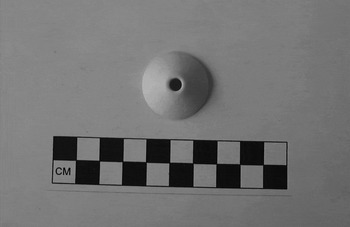
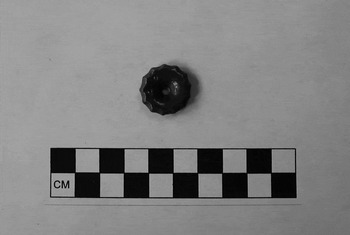
Another such object was found in Tomb D at La Venta. This deposit, which preserved artifacts but no bone matter, was apparently the grave of a small child (Follensbee Reference Follensbee, Traci and Hutson2006a:351–354). Among the other offerings and jade ornaments was a small, fluted, circular jade object with a central perforation (Drucker Reference Drucker1952:72–73, 164, Figure 23, Plates 15, 54; Drucker et al. Reference Drucker, Heizer and Squier1959:162–166). As noted by Drucker, this object might initially resemble a tiny earspool without a stem—and, in fact, it might represent a “recycled,” reworked jade object (Follensbee Reference Follensbee2000:148); however, the existing shape is much more convex and rounded than an earspool, and it strongly suggests a spindle whorl (Figures 10 and 13b). The object is also positioned in the deposit as a pectoral, and it has two tiny suspension holes drilled through the top. Given that the burial was already provided with jade earspools and pendant bobs of traditional form that were placed in the correct anatomical positions, this fluted object is apparently meant to be a singular chest or throat decoration, in addition to its probable use as a functional whorl. At 21 mm in diameter and 5.3 mm in height, with a 3–4 mm hole and a weight of approximately 4 g, this object is consistent with all of the characteristics of Parsons's Type I whorls, designated as cotton spinning whorls. Except for a slightly short depth/shape, it is comparable to the McCaffertys' Type B whorls from Cholula, which are appropriate for spinning cotton and fur. Given that children in later Mesoamerican cultures were taught to spin and weave very early in life (Berdan and Anawalt Reference Berdan and Anawalt1992:2:155, 164, 3:Folios 59–60), the appearance of this spindle-whorl pectoral in a small child's grave as a symbol of elite status and occupation is particularly appropriate, as opposed to a jade “spoon” batten or weaving awl: At this very young age, it is likely that the child would have gained proficiency only in this preliminary part of the textile-making process.
Reproduction of the small, fluted jade pectoral ornament from Tomb D, La Venta. Reproduction by the author; see Drucker (Reference Drucker1952:72–73, Figure 23, Plates 15 and 54).

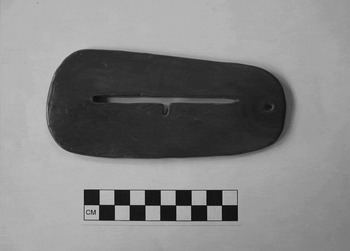
Reproduction of the oval jade plaque found in the cache at Cerro de las Mesas. Reproduction by the author; see Drucker (Reference Drucker1955:63–64, Plate 39).

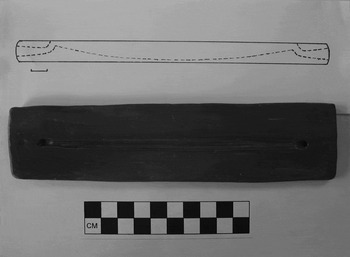
Diagram and reproduction of a rectangular plaque found in the cache at Cerro de las Mesas. Reproduction by the author, drawing by the author after Drucker (Reference Drucker1955:Figure 9); see also Drucker (Reference Drucker1955:63–64, Plate 39).

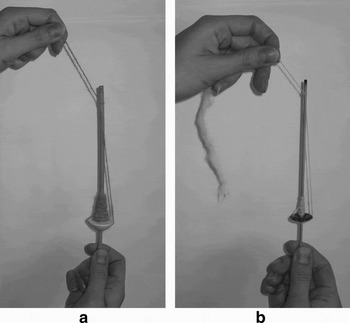
(a) The author spins a cotton-and-fur blend using a reproduction of a ceramic whorl found at La Venta; (b) the author spins cotton using a reproduction of the jade pectoral ornament whorl from La Venta. Reproductions by the author.

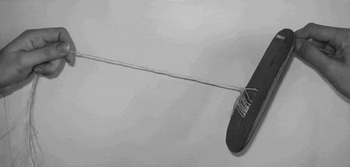
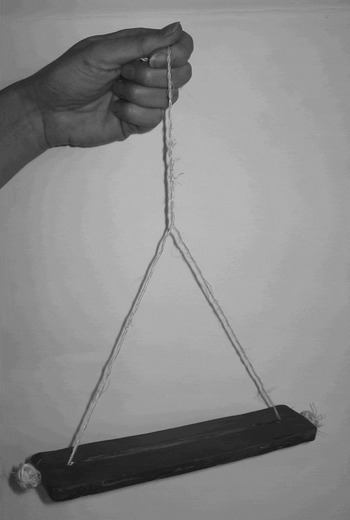
Like the jade whorls, Middle Formative perforated jade plaques found in heirloom caches could also have been both ornamental and functional objects used in making textiles. Oval plaques bearing a T-shaped, cut-through groove, like those found at Cerro de las Mesas (Figure 11; Drucker Reference Drucker1955:63–64, Plate 39c) and at the site of Bagaces (Balser Reference Balser1974:22–24, Plate IX) are similar to hanging, oval jade celts common in later Maya belt assemblages, but they are even more similar to tarabillas, tools long used to manufacture cordage in Mesoamerica (Figure 16; O'Neale Reference O'Neale1945:20–21, Figure 75; Pennington Reference Pennington1969:198–200). Further, the drilled holes and cut slit in each of two rectangular plaques found at Cerro de las Mesas (Figure 12; Drucker Reference Drucker1955:63–64, Plate 39a–b) could simply have been meant to accommodate a cord strung through the back of the plaques, so that the plaque would hang straight and the cord would be hidden during suspension as a neck or belt ornament; however, this effect might have been more easily achieved by drilling a straight hole through each plaque. As noted by the excavators, these objects suggest tools rather than ornaments (Drucker Reference Drucker1955:64). In fact, the complex, curved angles of the holes on each end, and the curved cut in the center, suggest that a cord was meant to pass through the two side holes so that the doubled cord could be held perpendicular to the plaque; as such, this could tentatively be identified as a useful tool for two-plying cordage.
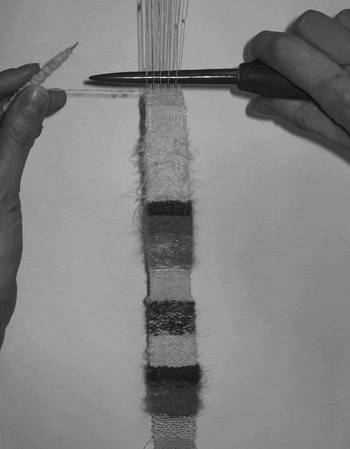
The author uses a reproduction of a pick from La Venta while weaving a variety of different fibers that were spun using the La Venta whorl reproductions. Reproductions by the author.

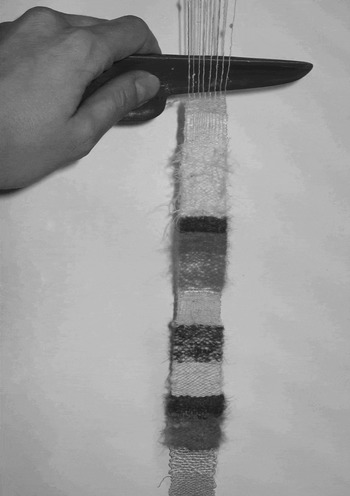
The author uses a reproduction of the Chacsinkin Jade 20 spoon as a batten while weaving a variety of different fibers that were spun using the La Venta whorl reproductions. Reproductions by the author.

The author uses a reproduction of the oval jade plaque from Cerro de las Mesas to make fine cordage. Reproductions by the author.

As illustrated in the sculptural depictions of these objects, and as was common throughout later Mesoamerica, functional tools made of elite materials would have served dual purposes: They could function as actual, useful tools, and they could serve as symbols of elite status, occupation, and/or accomplishment. Further study of other Formative-period jade objects found in these caches may eventually reveal that they, too, were more than mere decorations, despite the use of extremely similar objects simply as ornament in later Mesoamerican cultures. It is also a well-known phenomenon in all cultures for functional objects to take on symbolic meanings and later be used purely for decoration, obscuring their original use and meaning.
SYMBOLIC IMAGERY ON THE GREENSTONE ARTIFACTS
Most of the provenienced greenstone artifacts discussed in this study are unembellished, with no decoration save an elegantly polished surface. Nevertheless, the imagery shown on the few embellished pieces is both instructive and supportive of the hypotheses presented.
Provenienced stone picks are predominantly plain, with no carving or incision. As noted by Pohorilenko, unprovenienced pick handles can be undecorated and utilitarian in form, but they can also be elaborately engraved or take a plethora of forms, ranging from having “incised glyphs to [being] composite figures carved in the round” (Pohorilenko Reference Pohorilenko1990:689–690). The most elaborate handles often take the form of Olmec zoomorphic and anthropomorphic supernaturals, with one relief-carved handle even sporting a face with a helmet similar to that of a Colossal Head (Easby Reference Easby1970:83, Figure 38). Many of the motifs also match creatures found on Gulf Coast Olmec monumental sculpture (Pohorilenko Reference Pohorilenko1990:689–703), and as such, these motifs may represent ancestral or supernatural patrons or even insignia of hereditary elite status.
However, the most common motif by far on the picks—and the only motif to appear on provenienced picks—is avian, and most frequently a hummingbird. The only provenienced picks with embellishment found thus far are Jade 15 of the cache at Chacsinkin, Yucatán (Andrews 1986:23–25, Figure 9b, Jade 15) and a pick reported to be from Edzná (Schmidt et al. Reference Schmidt, de la Garza and Nalda1998:587, Catalogue Number 238), each of which take the form of a small hummingbird with an elongated beak—although the tip of the beak on each also shows evidence of breakage and resmoothing, indicating that they were originally even much longer. On both, the tail was pierced for suspension; worn as a pendant, the hummingbird would hang head down, obscuring its form as a bird but emphasizing its form as an awl. Unprovenienced hummingbird picks are numerous and range from utilitarian forms with incised hummingbird features (Lothrop et al. Reference Lothrop, Foshag and Mahler1957:233, Catalogue Number 6) to stylized but readily identifiable hummingbird forms with a suspension hole pierced through the eyes (Lothrop et al. Reference Lothrop, Foshag and Mahler1957:233, Catalogue Number 7), to abstracted versions of these (Figure 4; Griffin Reference Griffin and Benson1981:220, Figure 20). Of the five depictions of picks appearing in monumental Olmec stone sculpture (Table 4), two appear together as a pair of hummingbird picks worn as pendants (Taube Reference Taube2004:123), suspended by the hummingbirds' eye holes on the chest of what is likely an elderly woman (Figure 5; Figure 4). These two awls hang in the same manner as would the provenienced Chacsinkin Jade 15 and Edzna picks.
Such avian imagery is strongly associated with weaving in the later cultures of Mesoamerica (Hendon Reference Hendon, Claassen and Joyce1997:163–164, Reference Hendon, de Arathoon, González and Willemsen Devlin1999c:14; Joyce Reference Joyce1993:262; McCafferty and McCafferty Reference McCafferty and McCafferty1994:158, 163) and commonly appears on later Mesoamerican weaving tools (Cordry and Cordry Reference Cordry and Cordry1968:45–47, Figures 20–21; Dacus Reference Dacus2005:61–62, Figure 40; Hamann Reference Hamann, Claassen and Joyce1997:163; Hendon Reference Hendon, Claassen and Joyce1997:38, Reference Hendon, de Arathoon, González and Willemsen Devlin1999c:9, Figure 1.2; Pendergast Reference Pendergast1979:63, Figure 35e). While much has been written about the association of hummingbirds with sacrifice, bloodletting, and warfare (Benson Reference Benson and Preuss1989:3–4; Hunt Reference Hunt1977:60–74; Taube Reference Taube2004:123–124), hummingbirds were also specifically associated with the Aztec goddess Xochiquetzal and with the Maya Moon Goddess Po, both patron goddesses of weaving (Bell Reference Bell and Ardren2002:100–101; McCafferty and McCafferty Reference McCafferty, McCafferty, Blum Schevill, Berlo and Dwyer1991:26–29; Thompson 1939:130–133, 138; Ardren Reference Ardren2006). This duality is understandable given that women's weaving tools were used as metaphors for men's weapons in later Mesoamerican cultures (Burkhart Reference Burkhart, Susan Schroeder and Haskett1997:48–49; McCafferty and McCafferty Reference McCafferty, McCafferty, Blum Schevill, Berlo and Dwyer1991:29, Reference McCafferty and McCafferty1994:145–146; Sullivan Reference Sullivan and Boone1982:18; Klein Reference Klein, Cordy-Collins and Sharon1993). In addition, hummingbirds were associated with love and lovemaking. This association has direct parallels with spinning and weaving, which were metaphors for conception, pregnancy, and childbirth; birds were also believed to represent the soul of a child awaiting rebirth (Burkhart Reference Burkhart, Susan Schroeder and Haskett1997:48; McKeever-Furst, comments on McCafferty and McCafferty Reference McCafferty and McCafferty1994:158). In the same manner that the spindle and whorl was a metaphor for coitus (Sullivan Reference Sullivan and Boone1982:14), so was the hummingbird sipping nectar from a flower (Benson Reference Benson and Preuss1989:4–5). Illustrations from later Mesoamerican cultures show these correlations directly, as in the Codex Nuttall, where a spindle and whorl at the feet of Lady 9 Monkey takes the form of a hummingbird (McCafferty and McCafferty Reference McCafferty and McCafferty1994:163, Figure 16; Nuttall Reference Nuttall1975:10).
Like the picks, the vast majority of provenienced spoons are highly polished but otherwise unembellished. As noted by several scholars, the curved, concave form, the ridge along the top, and the hinge-like feature between the two bowls on many spoons suggests an association with seashells (Covarrubias Reference Covarrubias1946:172; Cyphers 2004:343; Griffin Reference Griffin and Benson1981:219; Lange Reference Lange and Lange1993:283–284; Pohorilenko Reference Pohorilenko2007:20, 27), and it is possible that spoons may initially have been modeled somewhat on elongated clamshells, such as those of razor clams; my experimentation indicates that such shells function well as miniature weaving battens. This correlation would also suggest a relationship between spoons and the elongated greenstone clamshell pectorals found in La Venta gravesites and heirloom caches (Andrews 1987:Figures 1a and 1b; Drucker Reference Drucker1952:163, Plate 53, 1955:49–50, Plates 36e, 40a). Nevertheless, a symbolic association between spoons and shells is not definite, as these shell-like features are not present on all spoons (Figure 7a; Andrews 1987:Figure 1a, Jade 6). As suggested by Lange, the shell-like features on some spoons may instead simply be the result of having been re-carved from greenstone clamshell effigies, where the artisan took advantage of the serendipitous correlations between these two forms (Lange Reference Lange and Lange1993:283–284).
Although Pohorilenko espouses the belief that the form of spoons that have not been re-carved indicates that they are effigies of tadpoles, his collective studies of the carved and incised imagery on spoons assert that the most common designs found on both provenienced and unprovenienced spoons are overwhelmingly avian motifs, either in relatively naturalistic form or in composite-zoomorph form. He also notes that the silhouette of un–re-carved spoons could represent a duck's head (Pohorilenko Reference Pohorilenko1990:945–968, Reference Pohorilenko2007)—which might reflect the same association as the Early to Middle Formative bone duck's head weaving comb recovered from a Tlapacoya deposit (Niederberger Reference Niederberger, Benson and de la Fuente1996:86, Figure 2, Reference Niederberger, Clark and Pye2000:Figure 5). Other motifs incised on the spoons, although relatively rare, include Olmec-style faces, which would parallel the faces sometimes found on the picks, and floral motifs, which are similar to floral motifs found on many later Mesoamerican spindle whorls.
As noted by Graham, provenienced spoons from Costa Rica and other Central American deposits often bear heavy modification and re-carving into ornamental objects by later cultures, preserving only the general shape of the original spoons (Graham Reference Graham1993:26). Of the provenienced spoons that were not heavily modified or re-carved, only three bear what is likely to be embellishment contemporary with or near to the time of their creation. Jade 8 from Chacsinkin is rather crudely incised on the concave tip with a square eye and a sharply angled, frowning mouth; while largely ambiguous, the square eye matches the eye carved onto Chacsinkin Jade 12, the strongly avian celt in this same cache (Andrews 1986:23, Figure 8b). Chacsinkin Jade 18, meanwhile, is incised with a Formative-period composite creature incorporating the avian motifs of a “flame eyebrow” and a “hand-paw-wing” design; such creatures are often referred to as “bird monsters” or “dragons” (Andrews 1987:81). Finally, Chacsinkin Jade 19 is surprisingly flamboyant, with the striking form of a bird with a large, down-turned beak and an incised eye. While the strong contrast of this artifact with other spoons might lead to the conclusion that this is a re-carved piece, Pohorilenko astutely notes that such spoons must originally have been conceived in that form, as the beaks are large and extend as far down as the bowl of the spoon (Pohorilenko Reference Pohorilenko1990:952). All together, as with the greenstone awls, the predominant avian imagery of these motifs strengthens the association of spoons with spinning and weaving.
The symbolism of the remaining jade objects is more ambiguous. The jade disks are only polished and bear no incision or other surface carving. The plaques were also left plain on the surface, except for the T-shaped, cut-through groove on the oval plaque. This groove may be purely utilitarian in its shape, but it also resembles the later Maya “ik” hieroglyph, which signifies “wind” and “vital breath” and is a common motif on later elite Maya pectoral ornaments (Schmidt et al. Reference Schmidt, de la Garza and Nalda1998:555, Catalogue Numbers 144–145). The majority of the possible bead whorls are also simply polished, generally spherical forms. The fluted shape of the small jade pectoral whorl could refer to a seashell, perhaps a reference to shell whorls such as those recovered from later Mesoamerican cultures. A similarly fluted ornament, although much larger, is shown being worn by a female figure on San Lorenzo Monument 14 (Follensbee Reference Follensbee2000:227–233, Figure 90), and this ornament is very similar to the much later cut-shell ornaments associated with the Aztec god Ehecatl, the god of wind—an interesting parallel with the possible “ik” glyph on the oval plaque. However, the fluted design of the pectoral whorl, as well as the lobed beads from La Venta, might instead refer to floral designs, which were common on later Mesoamerican spindle whorls (McCafferty and McCafferty Reference McCafferty and McCafferty2000:47). These designs perhaps refer to the “hummingbird-and-flower” coitus references of the spindle and whorl.
THE JADE ARTIFACTS: TESTING THE HYPOTHESES
In order to confirm whether these Formative-period artifacts could actually serve as functional tools, I conducted extensive testing. The jade artifacts unfortunately were universally very well cleaned, with no residues surviving. Nevertheless, microscopic analysis was attempted as a method to determine existing evidence of use or wear of these objects. Initial analyses were conducted on two unprovenienced jade awls in the Dumbarton Oaks Pre-Columbian Museum collection, but this study revealed only a high polish, with no markings consistent with use in weaving; further close analysis of other Formative-period jades, both provenienced and unprovenienced, likewise revealed no apparent use or wear markings. However, Frederick W. Lange (personal communications, 1998, 2008) has pointed out that due to the great density of the jadeite, working softer materials such as leather, cordage, or cloth fibers would not have left discernible markings on the stone. Even if the tools were used regularly over generations, the only result would be a slight heightening of their high polish (Follensbee Reference Follensbee1998). These conclusions are strongly corroborated by other use-wear studies of polished ground-stone tools (Grace Reference Grace1989). Use or wear analysis was thus determined to be an ineffective method of study for verifying whether these polished objects were used on fibers.
Subsequently, using museum-approved procedures, I was allowed to analyze provenienced Formative-period ceramic and greenstone artifacts, studying, measuring, weighing, contouring, and making precise drawings of the jade objects from the La Venta, Tres Zapotes, and Cerro de las Mesas artifacts at the Smithsonian Institution Bureau of American Ethnology collections, the San Lorenzo artifacts at the Peabody Museum of Natural History at Yale University, and the Chacsinkin jades at the Regional Museum of Merida “Palacio Cantón” in Yucatan, as well as of unprovenienced Formative-period jade objects in collections at museums including the Dumbarton Oaks pre-Columbian museum, the Cleveland Museum of Art, the Boston Museum of Fine Arts, the Brooklyn Museum, and the Princeton University Art Museum. In addition, I studied large collections of artifacts on display at numerous museums, including the Formative-period collections exhibited at the Museo Nacional de Antropología e Historia in Mexico City. To preserve the reliability of the data set, I based my hypotheses primarily on the archaeologically recovered objects and used the unprovenienced objects secondarily, as supporting evidence.
For some objects, such as the jade beads from La Venta Offering 3 (Drucker et al. Reference Drucker, Heizer and Squier1959:Plate 29) and the hemispherical bead found in La Venta Stratitrench 3 (Drucker Reference Drucker1952:146, Plate 44), I was allowed to verify my hypotheses by carefully testing the actual objects—in this case, for shape and balance as spindle whorls. In most cases, however, while the jade artifacts were available for careful study, they were not available for hands-on testing. I therefore conducted replication studies to test whether the Formative-period jade artifacts could function as spinning and weaving tools. Replication studies have long been used to study the manufacture and use of lithic artifacts, and the effectiveness of this methodology is well recognized (Andrefsky Reference Andrefsky1998:7–10; Johnson Reference Johnson1978). Recently, particular attention has been paid to replication studies to test the effectiveness of polished ground-stone tools (Adams Reference Adams2002; Grace Reference Grace1989).
As museums generally do not permit casts to be taken from the objects themselves, from 2003 through 2005 I used the information from my extensive and intensive analyses to create precise replicas of the ceramic artifacts of this study, as well as a large representative sample of the Formative-period greenstone artifacts, producing more than 100 accurate reproductions in all. In the case of those greenstone artifacts that showed breakage and reworking, I first created careful replicas of the surviving objects, then extrapolated from my extensive studies of intact artifacts to create reconstructed replicas of these objects.
Because of the difficulty, labor-intensiveness, and expense involved, making replicas from jade or other greenstone was not a viable option. Therefore, after experimentation and careful consideration of the different possible materials, I chose to manufacture these reproductions in porcelain clay, as this fine, high-firing, vitreous ceramic material is close in weight (approximately 90%), in hardness (both jadeite and ceramic rating 7.0 on the Moh's hardness scale), and in surface to the highly polished jadeite artifacts. The most salient difference between these two materials is that the fracture toughness, or overall resistance to breakage, of jadeite is about 10 times that of ceramic. Studies on fracture toughness (a.k.a. ultimate strength), measured in Megapascal (MPa) units, rate jadeite at 710 MPa, while porcelain ceramic registers a much more brittle 70 MPa (Bradt et al. Reference Bradt, Newnham and Biggers1973). Nevertheless, ceramic is much harder than bone, the most commonly used medium for Mesoamerican weaving tools, which rates 5.0 on the Moh's hardness scale, and ceramic is relatively close in fracture toughness to avian and mammalian bone and antler, which varies between 35 MPa and 250 MPa, depending on the type, age, and quality (Currey Reference Currey1984:76–85, 88, 90, 236–237). Overall, as fine ceramic is comparable in weight, hardness, and surface to jadeite, and it is comparable in strength and durability to the most commonly used bone media for these tools, for all practical purposes porcelain remained the best choice of replication material for this study.
The replicas were each modeled in clay and refined through additional sculpting, and those with polished surfaces were burnished. The difficulty I experienced in replicating the long, narrow pick shafts of the greenstone awls and the very thin blades of the spoon battens reveals one reason that awls and battens were not commonly produced in ceramic. Even when crafted using very fine, smooth, porcelain clay, only a small percentage of tools with more delicate features survive the carving, thinning, and burnishing processes. The unfired ceramic pick shafts proved especially delicate, and many of the awls were, by necessity, replicated in two parts. Finally, after the reproductions were fired, the replicas of the greenstone implements were each provided with an authentic, glassy surface by means of either an acrylic sealant or a high-firing glaze, and replicas made in two pieces were joined with epoxy.
After producing the replicas, I tested them for efficacy as spinning and weaving tools. Replicas of the proposed greenstone spindle whorls, as well as replicas of the ceramic sherd whorls and hand-modeled whorls, were tested using different types of traditional Mesoamerican fibers, including agave, cotton, cotton-and-agave blends, fur, cotton-and-fur blends, and cotton-and-feather blends (Figure 13). All of the replicated whorls proved effective for spinning the types of fibers that were proposed in this study as appropriate for their size, shape, hole diameter, and weight. Perhaps even more meaningful, the proposed jade whorls proved to be specifically the types that would be used to spin cotton, cotton-and-fur, and cotton-and-feathers, and this association of elite tools with the more elite fibers suggests a strong correlation with the practices of later Mesoamerican cultures, where the spinning of elite materials was specifically the occupation of elites.
Experimentation on a backstrap loom, weaving all of these types of spun fibers as well as single-fiber agave textiles, confirms the efficacy of the jade picks as weaving awls (Figure 14). The different diameters of the awl points and shafts lend themselves to different types and finenesses of fibers. However, the thicker diameter of some awl points may also simply be the product of successive breakage and re-smoothing to a shorter length, as the shafts tend to be thicker nearer to the handles. Not surprisingly, awls with finer points also tend to be those with the longest shafts.
Likewise, the spoons prove effective as small battens (Figure 15). The shorter, smaller versions are most effective in making thin cloth bands or belts, while the larger spoons serve best for making wider pieces of cloth equivalent to the size of the very wide belts, the loincloths, and the aprons depicted on Gulf Coast Olmec and Olmec-related sculpture. Only the most truncated versions of the spoons proved too difficult to manipulate as actual weaving tools—but, as discussed earlier, these likely had been retired from actual use and were conserved only as symbols of occupation and status.
Finally, experimentation with replicas of the jade plaques demonstrates that these, too, could have served as elite tools. The oval plaque functions well as a tarabilla; with a wooden dowel inserted through the hole at the top and a starter cord tied in the notch of the T-shaped groove, it is possible to spin a smooth cordage from agave fibers (Figure 16). Likewise, the rectangular plaques serve well as tools for plying fine cordage (Figure 17). When the rectangular plaques are used in this manner, the purpose of the unusually angled side holes and the central slot also becomes clear: As the cordage plies together, the angled holes lessen friction on the cords and improve control. The main limitation of the rectangular plaques is that they could be used to make only fine cordage; they might have been specialized tools, however, for making the fine cordage used for netted garments, as shown in sculptural depictions of Olmec elites.
The author uses a reproduction of a rectangular plaque from Cerro de las Mesas to two-ply fine cordage. Reproductions by the author.

CONCLUSIONS
The appearance in Olmec sculpture of figures wearing elaborate garments composed of cordage, netting, fine cloth, and feather work clearly attests to the existence of well-developed textiles among the Gulf Coast Olmec, and the recovery of woven fibers and ceramic tools for making and using textiles attests to their production in these cultures. As the garments depicted in sculpture appear as part of elite regalia, fine textiles likely held importance in this culture as valued commodities that symbolized status and power.
The recovery of jade tools for spinning, weaving, and making fine cordage from elite graves and offering caches further supports these conclusions and holds many other important implications. That tools for textile manufacture would be made of jade reflects the high esteem in which the occupation of textile making was held, as does the placement of these textile-making tools in elite graves and offerings. The depiction in sculpture of elites wearing these tools as ornamentation indicates that the objects were owned and used by the elite during life and that, as in later Mesoamerican cultures, the occupation of making textiles constituted a highly respected, prestigious activity of the elite. This is supported by the fact that the textile tools produced in jade are the particular sizes and types that would be used to manufacture fine cordage and netting as worn by elites; to spin thread and yarn made of fine fibers such as cotton, feathers, and fur; and to create elaborate, expensive textiles such as tapestries, brocades, and feather-work garments. As noted earlier, such specialized working of fine fibers and making of ornamental, elite cloth was, in later Mesoamerican cultures, the preferred occupation of the elite, specifically of noblewomen.
Because of poor preservation, however, little archaeological evidence exists to clarify whether spinning and weaving were gendered activities among the Olmec. Three jade picks and the jade spindle whorl discussed in this study were recovered from Olmec graves, but the acidic soils of the Gulf Coast tend to destroy all perishable materials, and no bone is preserved in these Middle Formative graves; identifying the biological sex of the grave occupants is therefore not possible. One of these burials—Tomb C, the Sandstone Cist in Mound A-3 of La Venta's ceremonial core—did, however, include clearly gendered artifacts in addition to textile tools.
Among the rich offerings in Tomb C was the jade awl handle (Figure 3c) and numerous examples of the jade spangles that take the form of picks and spoons, which were likely sewn to a textile covering the deceased (Drucker Reference Drucker1952:68–71, Plate 52; Follensbee Reference Follensbee2000:462–463). The tomb also included a string of large jade beads placed so that it would have formed a low-slung belt across the hips of the deceased; interestingly, all but the two anchor beads in this belt would have been appropriate for use as bead-type spindle whorls. As established in my primary research on sexed and gendered imagery in Olmec art, the beaded belt is an exclusively female-gendered accessory among the Olmec, and the placement of garments low on the hips is also associated only with female depictions in Olmec imagery (Follensbee Reference Follensbee2000:51, 438–439, 462–463, Reference Follensbee, Traci and Hutson2006a:253–254). This grave also included a female jade figurine offering, as well as pendant jade earspools that are more often associated with women than with men in Olmec imagery (Follensbee Reference Follensbee2000:112–115; 462–463). Finally, next to this burial mound was found La Venta Stela 1, one of the few Olmec sculptures that is almost universally accepted as depicting an image of an elite Olmec woman (Bernal Reference Bernal1969:59; Blom and LaFarge Reference Blom and LaFarge1926:82–83, Figure 67; Stirling Reference Stirling1943:50; Wicke Reference Wicke1971:83; Follensbee Reference Follensbee2000:162–168). All together, the surviving artifacts suggest that this was the grave of a female elite and that spinning and weaving were strongly associated with this individual, who, like women in later Mesoamerican cultures, was buried with her weaving tools.
The contextualization of the jade artifacts in Olmec sculptural depictions is only slightly more helpful in clarifying whether Olmec textile-making was a gendered activity. Two of the three sculptures that portray greenstone picks do not show them in a relatively informative context. The recently published Cascajal Block illustrates images of two picks as symbols in a possible writing system (Rodríguez Martínez et al. Reference Martínez, del Carmen, Ortíz Ceballos, Coe, Diehl, Houston, Taube and Delgado Calderón2006), while San Lorenzo Monument 30 illustrates only a palimpsest-like silhouette of a pick across the undulating body of a supernatural (Coe and Diehl Reference Coe and Diehl1980:338–339). Laguna de los Cerros Monument 6, however, illustrates two stylized hummingbird-type picks worn as pendants (Figure 5). This figure's flaccid, pendulous, well-rounded breasts, its short skirt, its cape, and its wide belt resting on the hips together indicate that this most likely depicts an elderly elite woman (Follensbee Reference Follensbee2000:437–446, Reference Follensbee, Traci and Hutson2006a:249–266).
Among the five sculptures that illustrate spoon battens is the Cascajal Block, which depicts spoons, like its images of picks, as pictographic symbols (Rodríguez Martínez et al. Reference Martínez, del Carmen, Ortíz Ceballos, Coe, Diehl, Houston, Taube and Delgado Calderón2006). As discussed earlier, the silhouettes of seven spoons are scattered in a relatively random pattern across the cape of Loma del Zapote Monument 5, representing either retired weaving tools or, more likely, spangle effigies of tools, either of which would serve as symbols of status or badges of accomplishment. Newly published images of this very worn and broken monument in raking light illustrates much more detail than normally visible, revealing the gender ambiguity of the figure and its clothing (Cyphers 2004:243–244): the chest is not flat and squared as in Olmec male images; nor is it clearly rounded and fleshy, as in Olmec female images. Instead, it protrudes lower on the stocky torso in a softly rounded and sagging, ambiguous form. The figure wears only a narrow, single-layer belt lower on the torso, with a free-hanging flap that extends directly from the belt, both of which were garments worn by male and female Olmec images (Follensbee Reference Follensbee2000:437–449). This figure's gender is therefore ambiguous.
Including the newly reported San Lorenzo Monument 130 (Cyphers 2004:208–209), three stone images wear spoons as pectorals. San Lorenzo Monument 130 is a small, eroded, headless sculpture of a stocky, androgynous human figure, possibly a child, riding on a zoomorph. The figure wears an irregularly shaped spoon on its chest, and the top of a garment is visible on its back; surface wear, however, prevents distinguishing whether this garment is a gender-neutral half-cape or a gendered garment such as a short skirt or shorts (Follensbee Reference Follensbee2000:437–449). This figure's gender is therefore also ambiguous.
Loma del Zapote Monument 11 (Figure 1), meanwhile, has a body that is small relative to the depiction of the spoon pectoral on its chest. The figure's chest protrudes in gently rounded form through its heavy tunic, and it has a pinched waist with flaring hips (especially visible from the back; Cyphers 1995:Figure 16; Cyphers 2004:256–257). The tunic ends in a short skirt below the figure's elaborate rope belt, and a free-hanging, feathered pubic flap extends on top of the skirt from the bottom of the belt. All of the figure's features and garments are consistent with Olmec depictions of female adolescents (Follensbee Reference Follensbee, Traci and Hutson2006a:259–266, Figure 10.14; Follensbee Reference Follensbee2000:437–446).
Finally, the Shook Panel (Figure 6) is a Middle Formative relief recovered from San Antonio Suchitepequez, on the Pacific coast of Guatemala. This strongly Olmec-related image shows two figures. One, which wraps around the scene like a cartouche, is likely male, as he wears a wrapped loincloth, belt, and rounded back-flap skirt. The central figure, meanwhile, is likely female, as she shows a pinched waist and flaring hips and wears the female-gendered garments of a low-slung belt, a wide pubic apron, and a snug breast-band-and-suspenders top (Follensbee Reference Follensbee2000:437–446; Follensbee Reference Follensbee2000:176–185, 212–215, Figures 72–73, 84–85). She also wears a truncated spoon pectoral.
Although an overall strong association between spinning and weaving and Olmec women cannot be inferred from these few examples, the existing evidence does reveal at least some association of elite textile tools and fibers with elite women in Olmec culture. If, in fact, fiber working was the domain of women among the Olmec, as it was in most later Mesoamerican cultures, these findings have the potential to enable better understanding of the engenderment of Olmec material culture, to provide further insights into engendered occupations among the Olmec, and to expand our understanding of women's status, roles, and occupations in ancient Mesoamerica as a whole.
Whatever these possibilities, the results of this study expand our overall understanding of the role that textiles played in ancient Mesoamerica. The evidence for elaborate textiles and textile making illustrates that fine textiles were already held in high esteem by the Gulf Coast Olmec of the Early Formative period. The appearance of elite weaving tools and the ample use of textiles in and/or on sculpture, further, attests that the importance of textiles and the esteem for textile making only continued to grow stronger in the Middle and Late Formative periods. These events foreshadow and perhaps suggest an earlier occurrence of the great symbolic, economic, and social significance of textiles in the Classic- and Postclassic-period Mesoamerican cultures.
RESUMEN
Aunque investigaciones previas han revelado el papel importante desempeñado por los textiles en Mesoamérica desde el período clásico hasta tiempos actuales, pocos estudios han explorado la importancia de los textiles en las culturas mesoamericanas más tempranas. La escasa preservación impide la investigación sobre las culturas del período formativo, tales como los olmecas de la Costa del Golfo, de quienes sólo se han recuperado unos pocos fragmentos de cuerda y tapetes tejidos. Sin embargo, encontramos considerables evidencias sobre los textiles en otros medios, como, por ejemplo, en el rico registro pictográfico de fibras y telas en la escultura olmeca. Esculturas olmecas a escala grande y pequeña muestran personas vistiendo ropa compuesta de fajas delgadas y gruesas y/o paneles de telas, envueltas en ocasiones en múltiples capas, así como borlas, piezas hechas de pluma y la utilización de cuerda como adornos y en atuendo de malla. Las poses abiertas y las orejas perforadas vistas en algunas de estas esculturas sugieren también que eran vestidas con ropa y accesorios cambiables.
Evidencias de la producción textilera entre los olmecas se encuentran en artefactos de cerámica recuperados de sitios arqueológicos de la Costa del Golfo, incluyendo pesas para redes de pesca, malacates o volantes de husos hechos a mano y malacates hechos de tiestos cerámicos. Además, evidencias adicionales pueden encontrarse a través de la reevaluación de ciertos tipos de artefactos de piedra verde recuperados de los sitios de la Costa del Golfo y existentes en las colecciones de objetos del período formativo hallados en escondrijos de fechas posteriores. Estos consisten de objetos puntiagudos que han sido interpretados previamente como ornamentos o perforadores rituales usados para extraer sangre; también hay objetos parecidos a cucharas que se ha sugerido que se usaban para sangre, alucinógenos o pinturas. Análisis cuidadosos de forma y de iconografía indican que es más probable que estos objetos hayan servido como herramientas de la élite usadas en la fabricación de cuerda, de malacates, de leznas para hilar y de pequeñas espadas para hilar. Extensivos estudios experimentales llevados a cabo por la autora confirman la funcionalidad de estos objetos como implementos usados para hilar cuerdas e hilos, fabricar cuerda de dos cabos y tejer telas.
En su conjunto, este estudio demuestra un nivel bastante desarrollado de producción textilera entre los olmecas de la Costa del Golfo. Aunque las evidencias actualmente disponibles no son lo adecuadamente robustas como para sostener la hipótesis de que la producción textilera olmeca haya sido una actividad fuertemente ligada al sexo femenino como lo fue en muchas culturas mesoamericanas posteriores, estas evidencias sugieren cierta asociación entre la élite femenina olmeca y la fabricación de textiles de la élite. En cualquier caso, la apariencia y la fabricación de textiles de la élite y de herramientas textileras de la élite indican que la producción de textiles fue una actividad altamente estimada por estas culturas del período formativo, fenómeno que presagiaría la gran importancia de los textiles para las culturas mesoamericanas de los períodos clásico y postclásico.
ACKNOWLEDGMENTS
This research was made possible through a Dumbarton Oaks 2003 Summer Fellowship and a Missouri State University 2003–2004 Faculty Research Grant, for both of which I express my sincere gratitude. I am also very grateful to the many museums that allowed me into their laboratories and to analyze their collections, including Regional Museum of Mérida “Palacio Cantón” in Yucatan, the Smithsonian Institution Bureau of American Ethnology collections, the Peabody Museum of Natural History at Yale University, the Dumbarton Oaks Pre-Columbian Museum, the Cleveland Museum of Art, the Boston Museum of Fine Arts, the Brooklyn Museum, the Princeton University Art Museum, and the Snite Museum. I also gratefully acknowledge the particular assistance of Kevin Hughes, associate professor of ceramics; ceramics major Chelsea Burnett; Janice Queen, instructor of fibers; Verne Bear, rope crafter; and Jason Jolley, associate professor of Spanish; as well as many other colleagues and friends who served as consultants, sounding boards, and critics, including Jeffrey Quilter, Frederick Lange, Bill Doonan, Gabrielle Vail, Geoffrey McCafferty, Sharisse McCafferty, Loa Traxler, Magali Morlion, Juliet Weirsema, Andrei Tabarev, Susan Evans, Edward DeLong, Thomas R. Wilson, Sharon Harper, Keith Ekstam, Sandra Noble, Patrick Hill, and especially, my husband. Perry J. Elkins.