Disaster medicine encompasses the preparation for both natural and manmade disasters. Reference Cornelius, Andress and Ajayi1,Reference Koeffler, Demeter and Kysh2 Recent events, including mass shootings, terrorist attacks, and devastating weather events have highlighted the urgency for improved disaster planning. Reference Koeffler, Demeter and Kysh2 There has been a movement to establish disaster training in the emergency medicine (EM) residency curricula, with 94.8% of programs incorporating disaster medicine into their education. Reference Sarin, Cattamanchi and Alqahtani3 This training has varied from traditional learning models such as didactic lectures, journal club, and grand rounds formats to interactive simulations, disaster drills, and workshops, with the latter being more favored by residents. Reference Cornelius, Andress and Ajayi1,Reference Sarin, Cattamanchi and Alqahtani3,Reference Grock, Aluisio and Abram4
Disaster medicine education is varied across residency programs. One study noted that EM residents received significantly more hours of training per year (7.3), compared with pediatrics (0.5), surgery (3.1), internal medicine (1.1), and other non-EM subspeciality counterparts (1.3). Reference Grock, Aluisio and Abram4 Of the EM programs that had disaster medicine incorporated in their curriculum, 51.5% believed there was “too little” time spent on the educational topic. Reference Sarin, Cattamanchi and Alqahtani3 This was seen in another study, where few anesthesiologist residents believed that their residency education provided them with sufficient training in natural disasters (22%), radiologic (16%), or pandemic events (17%). Reference Hayanga, Barnett and Shallow5 This deficiency is further pronounced, as less than half of medical students receive disaster medicine training before matriculation into residency. Reference Grock, Aluisio and Abram4
The coronavirus disease 2019 (COVID-19) pandemic brought greater awareness to the impact of disasters across multiple clinical disciplines. One study showed that, during the pandemic, 27.3% of residents in New York City were redeployed to other service care areas, with 40.2% of hospitals redeploying more than one-third of the resident staff. Reference Breazzano, Shen and Abdelhakim6 Although studies and recent events exemplified the necessity for disaster medicine education, challenges such as time restrictions have been identified as barriers to incorporating this education into the clinical curriculum. Reference Grock, Aluisio and Abram4 Given limited time during training, but a known deficit of disaster medication education, we aim to assess resident’s own preferred training methods and attitudes to create a disaster-based educational framework during the COVID-19 era.
Methods
Study Participants
An initial survey was distributed to all pediatric residents at an academic, urban, tertiary care center located in Washington, DC, in Spring 2020 during the COVID-19 pandemic. A follow-up educational session was held for a subset of these residents 3 months later. All subjects were voluntarily recruited, and the study was exempted for review by the Institutional Review Board.
Procedures
Initial survey consisted of binary, checkbox, and multiple-choice questions to assess demographics, attitudes, preferred educational methods, and disaster medicine training. Rating scales evaluated confidence of 4 disaster medicine topics (patient care, triage, hospital protocols, and resident role). Scales ranged from 0 to 10, with 0 representing no confidence and 10 representing maximum confidence. Following analysis of the initial survey, a small group educational session was created based on residents’ responses. This session was a tabletop simulation during a scheduled noon conference, simultaneously conducted in-person and virtually by means of Zoom. The participants were evenly distributed between each teaching platform, and a structured outline of the narrative was followed by facilitators. The narrative outlined a mass casualty incident in which residents reacted to a scenario based in an emergency department. A postsimulation survey evaluated the effectiveness of the education with binary rating scales and open-ended questions. Confidence rating scales were repeated for both patient care and triage in the postsurvey. An additional rating scale ranged from 1 to 5, with 1 representing poor effectiveness and 5 representing outstanding effectiveness. Two open-ended questions assessed “What was most effective?” and “What could have been improved?”, classifying responses according to the key themes. Each answer regarding use of virtual learning in a negative connotation or in-person learning as a positive connotation was scored as a 1. Other responses were scored as 0 for comparison (Table 1).
Examples of open-ended responses and scoring

Note: Score 1: Responses that regard virtual learning in a negative manner or in-person learning in a positive manner. Score 0: Responses that regard virtual learning in a positive manner, in-person learning in a negative manner, or any other response.
Data Analysis
Study data were collected and managed using the secure, Web-based database, REDCap (Research Electronic Data Capture). Reference Harris, Taylor and Thielke7 A significance of P < 0.05 and Microsoft Excel 2019 program was used in all analysis. Frequency and percentages evaluated demographic data, attitudes, and preferred learning methods. Chi-squared analysis was performed to investigate attitudes toward disaster medicine and demographics of residents, such as desired careers and level of training. Mean, standard deviation, and unpaired t-test evaluated confidence scores between the initial and postsurvey. Analysis of variance analyzed the mean confidence scores between all residency levels. Open-ended response themes were identified, scored, and reported descriptively.
Results
Study Participants
A total of 120 residents were contacted by means of email with a response rate of 51.6% (n = 62) and participants from each postgraduate year (PGY), (PGY-1, n = 21; PGY-2, n = 25; PGY-3, n = 16). The majority of the respondents were female (n = 46), with a wide range in career aspirations (EM, 12.9%; intensive care, 21%; hospitalist, 8.1%; primary care, 22.6%; subspeciality, 33.5%). Only 9.7% (n = 6) had experience with a disaster event before COVID-19.
Initial Survey
Twenty-nine residents (46.8%) had less than 1 h of previous disaster training. Only 4.8% (n = 3) have had more than 5 h of training, none of whom were among those with prior exposure to a disaster event. The remaining 30 participants (48.4%) reported receiving 1-5 h. However, 96.8% (n = 60) were interested in disaster medicine as a standard part of their curriculum, and 82.3% (n = 51) believed that this knowledge may be used in future practice during their career. Eighteen percent of residents were “unsure” if disaster medicine training would be used in their future, but no one stated that it “definitely” would not. There was no statistical difference in responses between those who desired careers in EM versus primary care (P = 0.09).
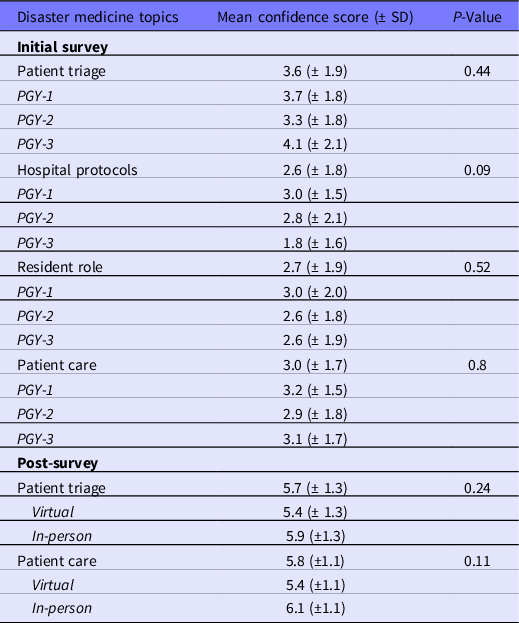
Most residents agreed that metropolitan areas (96.8%), political tensions (54.8%), and social media surrounding COVID-19, natural disasters, and mass shootings (66.1%) motivate them to increase their knowledge of disaster medicine. There was a perceived learning deficit of disaster medicine topics including, bioterrorism (82.3%), pandemics (82.3%), natural disasters (79%), and mass casualty incident (85.5%). Low confidence of disaster medicine knowledge and skills was consistently seen in all levels of training without statistical significance between training year (Table 2). Interns (PGY-1) had the highest confidence in understanding hospital protocols, with a further decrease in confidence with each subsequent year in training (Table 2).
Residents confidence in disaster medicine knowledge and skills

Note: Confidence scores 0-10 (0 = no confidence, 10 = complete confidence).
Participating in academia within a group versus alone was favored by 61.3% (n = 38), with a minority expressing the desire to learn only with their own training level (37.1%). There was an overall greater desire to partake in educational activities if their peers were participating versus with other members of hospital staff (80.6%). Preferred method of teaching was simulation (62.9%), interactive experience/games (25.8%), lectures (8.1%), and journal articles (3.2%), respectively. Disaster medicine education specifically was desired to occur in a simulation center (74.2%), but that the topic would correlate well with EM (100%), intensive care (58.1%), general wards (22.6%), and primary care rotations (19.4%).
Educational Session and Postsurvey
The session was attended by 18 residents (virtually, n = 9; in-person, n = 9) with 50%, 33%, and 17% in their PGY-1, PGY-2, and PGY-3, respectively. Half of the residents (n = 9; 50%) were pursuing subspecialty careers, while others were interested in hospitalist (5.6%), primary care (27.8%), and intensive care (16.7%), with no one seeking a career in EM. Most respondents agreed academic noon conference (100%) and simulation (94.9%) were effective methods for disaster medicine training. All residents said they would participate in a similar training in the future, with a majority (55.6%) of residents rating the session 5/5. Following the educational session, there was an improvement (P < 0.05) in confidence scores for both patient care (3.0 to 5.8) and triage (3.6 to 5.7), without a statistical difference between the virtual and in-person subset (Table 2). However, the majority (66.7%) of residents in the virtual subset stated their learning was hindered by virtual interactions and technical limitations. In contrast, most of the in-person residents (88.9%) regarded the ability to interact hands-on advantageously (Table 1).
Limitations
Although there were participants from all years of residency at a large tertiary academic center, this was a single center study of a pediatric program, which may limit the generalizability to other residency subspecialities. Disaster medicine topics were also pediatric focused, not encompassing adult disaster medicine, as this curriculum was designed for pediatric residents. In addition, secondary to the COVID-19 pandemic and social distancing protocols, this limited participant numbers in the in-person educational session. Virtual educational session also was limited by poor attendance due to ongoing educational changes during the pandemic. The educational session only included patient care and patient triage confidence evaluation, thus not capturing follow-up data of all disaster medicine topics in the initial survey.
Discussion
The COVID-19 pandemic has demonstrated the need for expanded disaster medicine training among all fields of medicine. In the midst of residency training during a pandemic, an overwhelming majority of residents stated they did not have adequate training on epidemic and pandemic preparedness. Furthermore, confidence in disaster medicine knowledge and skills was not improved throughout residency. In fact, knowledge of hospital protocols decreased over time. This may be temporally related, as interns receive education during orientation, with a lack of policy reviews during subsequent years. The knowledge of such concepts should be strived for as a standard in residency training.
Based on residents’ responses to the initial survey, most desired an educational model that was exclusive to residents, with a mix of PGY levels, and in a simulation environment. During the COVID-19 pandemic, temporary alternatives to traditional education formats, such as in-person didactic lectures, have been limited due to public health guidance for social distancing. Surgery programs traditionally rely on simulation for safe surgical education and have used innovative methods to continue training during the pandemic. Reference Chick, Clifton and Peace8 Studies have shown that simulation can be an excellent format for teaching disaster medicine principles. Reference Sarin, Cattamanchi and Alqahtani3,Reference Grock, Aluisio and Abram4,Reference Ketterhagen, Dahl-Grove and McKee9 Both the virtual and in-person participants enjoyed the interactive aspects of the simulation exercise, with an improvement in confidence scores after completing the scenario. Although the in-person group focused their suggested improvements on more scheduled time for simulation, the virtual group desired more face-to-face and hands-on interactions. This supports transitioning to traditional in-person, or a balance of virtual and in-person, simulation disaster training when the public health restrictions such as social distancing are lifted.
While this study focused on a pediatric residency program, results have the potential to be extrapolated to all medical fields, as all specialties have been affected by the pandemic. Reference Breazzano, Shen and Abdelhakim6,Reference Chick, Clifton and Peace8 During the COVID-19 pandemic, residents have been exposed to many aspects of disaster management, including knowledge and skills about the donning and doffing of PPE, supply chain management, infectious disease education, and prevention strategies and crisis management. However, pandemics and epidemics represent just 1 of many types of disaster scenarios for which medical trainees must be prepared. By harnessing the enthusiasm for the topic incited by COVID-19, programs may achieve greater trainee satisfaction and potentially improved operational outcomes by providing disaster medicine education in residency training.
Conclusion
The COVID-19 pandemic, along with recurrence of other disaster events, has magnified the necessity for improved knowledge of disaster preparedness principles and skills for all clinical disciplines. Residents recognize a learning gap exists and are enthusiastic to address this educational aperture. Virtual learning is a valuable option when restrictions such as social distancing are in place. However, residency programs should support diverse educational methods for disaster curricula and should consider simulation, interactive, and hands-on experiences when possible. The pandemic has heightened awareness and enthusiasm for disaster medicine training among pediatric residents. Residency training programs have an opportunity to take advantage of the real-life events, as well as the interest of trainees, to prioritize the integration of disaster medicine principles into training curricula.
Author Contributions
Dr. Boggs designed and conducted the study, performed data collection and analysis, drafted initial manuscript, and revised manuscript. Dr. Goodwin supervised study design and data analysis, revised manuscript. Dr. Simpson designed and conducted the study, supervised study design and data analysis, revised manuscript.
Conflict(s) of Interest
The authors have no conflicts of interest to disclose.