INTRODUCTION
Three major issues have emerged for cultural policy over the last few decades. These are (1) the need for sustainable development, (2) the protection of the intangible heritage, and (3) preservation of cultural diversity in the age of globalization.Footnote 1 All these issues are reflected in countries such as China and India where the adoption of technologies and the dominance of industrialization are given the utmost importance now that they are modernizing at a rapid rate. Their huge populations and rapid urbanization present particular dilemmas in these processes.Footnote 2 One important consequence is the gradual loss of traditional skills whose products cannot compete with mass-produced products at much cheaper prices. The international community has shown its concern with these developments by adopting two new conventions. China became party to the UNESCO Convention for the Safeguarding of the Intangible Cultural Heritage 2003Footnote 3 and to the UNESCO Convention on the Protection and Promotion of the Diversity of Cultural Expressions 2005Footnote 4 in 2004 and 2007 respectively. The Chinese government has thus endorsed the principles set out in those Conventions. However, the 2003 Convention itself does not give very much guidance as to how the many varieties of intangible heritage can be better preserved and encouraged, or how to support them at the local level, while the 2005 Convention, clearly designed to encourage minority groups to improve their status, gives very little detail.
The purposes of the Convention for the Safeguarding of the Intangible Cultural Heritage are said to be not only the safeguarding of the intangible cultural heritage, but ensuring respect for the intangible cultural heritage of communities, groups, and individuals concerned; raising awareness at the local, national, and international levels of the importance of the intangible cultural heritage; and ensuring its mutual appreciation and providing for international cooperation and assistance (Art. 1). The States' Parties have agreed to a convention that gives them an essential role in establishing inventories, nominating particular examples for inclusion in the “Representative List of the Intangible Cultural Heritage of Humanity,” raising awareness of its importance, and applying to a special fund set up within UNESCO for international assistance.
It is not clear, however, how the State is going to support intangible heritage in substance. This question is particularly difficult for a country like China, which has 56 recognized ethnic minorities. With a population of 1.3 billion, the ethnic minorities compose only about 8% of the population, the rest being Han, and these minorities are often in fringe areas in the west and north, a long way from the power politics of Beijing. However committed the Chinese government may be to the principles of the Convention and the development of special programs for the safeguarding of minorities' intangible heritage, it will be impossible for it, in the short term, to study and advance the protection of the varying types of intangible heritage over such a large number of groups, many of them in areas of limited accessibility.
The Convention speaks of “the participation of communities, groups, and relevant nongovernmental organisations” (Art. 11(b)). The “Operational Directives for the Implementation of the Convention for the Safeguarding of the Intangible Heritage”Footnote 5 encourage their participation in the identification of intangible heritage (Directive 80(a)) and sets out for nongovernmental organizations (NGOs) rather bureaucratic criteria concerning their experience, objectives, competence, operational capacities, and accreditation (Directives 90–99). But it gives no real guidance to these NGOs, which are still relatively rare in China; there is little practical experience in the great diversity of such bodies, which has developed over centuries in some other countries. An NGO that seeks to help communities in China is therefore doing pioneering work. This article concentrates on the work of one such NGO and shows how its work with a minority group has contributed to the sustainability of the community, the revitalization of a traditional craft, and the continuing diversity of ethnicities in China.
In a country such as China, which has used its agricultural resources intensively for millennia, the question of further improving the lot of farming families in remote rural areas is seen as a serious issue.Footnote 6 In some areas of China where economic development has not greatly advanced the standard of living and where poverty is still found, intangible heritage may be threatened by the exodus of young people to the vibrant eastern zone where jobs are better available, leaving behind crafts and traditions that are unique to their community. The Menglian Weaving Revival Project hoped to counter this exodus by supporting the traditions of one such community and striving to assist it to revive and further develop a traditional craft in a way that can give its members a good economic future and preserve threatened skills at the same time.
The 2003 Convention on intangible heritage covers a great many different phenomena, but traditional crafts have important implications for minority communities. As Emma Lees points out:
Craft-forms differ from other intangible heritages, for example, oral story telling or religious rituals, in that craft performs a functional role in society. Weaving creates cloth for dress, furnishing and utilitarian items, and as such will always be influenced by changes in fashion trends and alternatives on the market. While remaining true to traditional techniques and practices might maintain the cultural and ritual value of women's craft, dramatic changes may in fact be needed—for example, with production technologies—to remain viable in the market place, thus ensuring sustainable livelihoods can be maintained.Footnote 7
THE ORIGINS OF THE MENGLIAN TEXTILE PROJECT
The Dai people of Menglian County live in the far west of China, in the province of Yunnan near the border with Myanmar. Dai (“Tai”) is one of a group of tonal languages considered generally by Chinese scholars as Sino-Tibetan, though Western scholars now generally classify them as Tibeto-Burman. The Dai are heirs to a rich cultural tradition, closely related to the cultures of their ethnic kin in Myanmar, Laos, and Thailand, but they have become a dispirited community, and the loss of ethnic pride among the younger generation has led to the breaking of cultural and social moorings, resulting in a variety of social problems and difficulties in improving their economic condition. Government development projects in the area do not have a culturally relevant approach to ameliorate these conditions and local authorities, therefore, welcomed the approach of the Beijing Cultural Heritage Protection Center (CHP),Footnote 8 which is rooted in preservation of indigenous cultural heritage as the basis for community economic and social development.
The Menglian Dai, Lahu, and Va Autonomous County, Pu'er Prefecture, is located in southwest of Yunnan. The county is mostly gentle hills and valleys, with villages often located in valleys with reasonable access to farm-to-market roads (distance from the county seat varies from 15 minutes to 3 hours). In addition to Han nationality, there are 21 minority nationalities in the district, comprising 86% of the total population: Yunnan has the highest concentration of ethnic groups in China. Of China's 56 officially recognized ethnic groups, 25 are found in Yunnan. Each ethnic group supports its own unique culture, making Yunnan a place where scores of different cultures have mixed and contributed to the area's amazing diversity. Over recent years, there have been fewer outside influences on Menglian County than on some other ethnic autonomous counties in Yunnan, and as a result Menglian is less prosperous and has fewer tourists. The economy is based on agriculture, with principal crops being rubber, sugar cane, rice, and tea. The annual per capita income of farmers is RMB 2000 (approximately US$316). Dai is a significant minority ethnic group (20% of the population of the district). More than one million Dai live in Yunnan and they are facing major social problems, including cross-border human trafficking, drug addiction, and the related spread of AIDS. Situated in a mountainous region of Yunnan Province, close to the Laos border, Menglian is a tranquil village community with spectacular mountain scenery. It is an isolated area, and not a place where many tourists visit. Residents continue to do the same or similar work they have done for hundreds of years, with the majority of their income coming from agriculture. This does not reflect modern-day China.
From 2005 to 2008, CHP supported a project called the Mengma Archive in Menglian. The Mengma Archive, held in copyright by the Mengma villagers, built on an outline decided by the villagers. It includes their own writings, charts, and photographs. CHP merely created an initiative for the villagers and provided support. As a group of minority people, the Mengma villagers also gained increased self-respect from this project.Footnote 9 However, the boost that the Mengma Archive brought to the villagers was only temporary. People need prospects for their future. While the Mengma Archive recorded the culture, revived a sense of dignity, and thus supported cultural diversity, it did not improve the standard of living, nor did it represent a better future. In terms of the daily difficulties faced by the Mengma villagers, the encouragement brought to their lives by the Mengma Archive was definitely short-lived. CHP realized that projects like the Mengma Archive are only one link in the protection of minority cultural heritage. Truly successful protection work must be based on a sense of modern social life and must address the minority people's daily difficulties and specific needs.
The ability of minority peoples to win respect and maintain their own sense of well-being is a sensitive issue, and it is easy to run into social-psychological problems. Launching an ethnic minority cultural revitalization program especially requires a huge emotional investment. To protect a minority culture, local people must help themselves. Outside help can only provide initiative and assistance; the beginning of a program must therefore concentrate on ensuring that the right mentality is in place. The importance of this factor has been well stated by Aung San Suu Kyi, inspirational leader in Myanmar: “It is not enough merely to provide the poor with material assistance. They have to be sufficiently empowered to change their perception of themselves as helpless and ineffectual” (quoted in the groundbreaking report of the World Commission on Culture and DevelopmentFootnote 10).
Furthermore, such a project should not prevent adoption of at least some modern improvements, concentrating on preserving dignity, discovering the worth of traditional values and seeking happiness through a satisfying standard of living. Hence the launching of such a program must have an understanding of the minority people's daily hardships and specific needs.
On this basis, CHP considered what form and structure cultural heritage protection should take in Menglian. While developing the Mengma Archive Project, CHP discovered that the Mengma villages in Menglian County were home to a unique hand-weaving technique. The ancient handwoven pieces in the local museum are extremely beautiful and CHP realized there might be an opportunity to help the revitalization of local weaving skills.
With the financial and technical assistance of several international organizations, CHP began the one-year-long Menglian Weaving Revival Project. Through this program, CHP hoped to investigate three topics. Other than tourism and museum building, how can a minority cultural heritage be integrated with a modern way of life? How can it better address the daily difficulties and specific needs of the community? And finally, could this be a model for helping other communities move toward a process of sustainable development?
Weaving has long been a traditional occupation and hobby among the Dai people. The Dai traditional craft of weaving experienced a period of high acclaim in the past: In the Tang (618–907 ce) and Song periods (960–1279 ce), Dai brocade had a substantial market: In some places, officials used it as a tribute gift to royal administrators, and such brocades were regarded as treasures of the nobility. However, the technique underwent a steady decline, particularly in the last century. By the beginning of the Menglian Weaving Revival Project in 2010, the woven products produced by the Dai weavers in Menglian had become cheap souvenirs sold on the pavements to tourists. Nobody cared about or paid attention to this textile. CHP's Menglian Weaving Revival Project aimed to change this situation.
Sustainable development is the key to protecting the traditional craft of weaving. While such handmade textiles are still created all over the world in many different communities, few communities have managed to market their products to compete with mass-produced fabrics. Those that have succeeded have generally been able to promote their product as individual, unique, and high-quality textiles, identifiable as handmade and often related to a specific cultural tradition. Royal patronage has encouraged the continued use of traditional weaving designs in Thailand, but private organizations have also done work directly with communities that have their own traditions. An example is the Sawang Boran project in northeast Thailand, where lengths of silk are woven in plain and traditional ikat designs, some made up by village tailors and marketed online.Footnote 11
In Menglian, the CHP project team and the Menglian County leaders discussed ways to revive traditional local weaving techniques, as well as to preserve the cultural heritage of ethnic minorities in China. To achieve this, it was first necessary to enhance the cultural awareness of local residents as a foundation to explore sustainable sources of income for the villagers.
The Project Gets Underway
In 2010, CHP instituted the Menglian Weaving Revival Project, designed to reinvigorate aspects of the Dai culture that had positive economic and social value in the context of contemporary China. The project was funded by the New Zealand Aid Programme with an initial grant of RMB 460,000 (about US$73,000). The 1-year project was later extended to 18 months.
Initial field research for the Menglian Weaving Revival Project was undertaken in early May 2010. A project advisor, He Shuzhong, and a project officer, Napatra Charassuvichakanich from CHP, visited Menglian County in Yunnan. Taking into account the similarities between traditional weaving in Thailand and the Menglian people's traditions, CHP hired a Thai weaving expert Turdsak Insang, who joined the team to help the interested weavers improve the quality of dyes, tools, weaving techniques, and designs to suit the contemporary market.
Thailand also has a strong textile tradition and has been able to regenerate some of its textile making and weaving traditions with considerable success. Turdsak has helped weaving communities in Laos and Thailand, and because there are substantial amounts of cultural overlap between the Dai minority in Yunnan and northern Thai culture, he was able to connect with local weavers fairly easily.
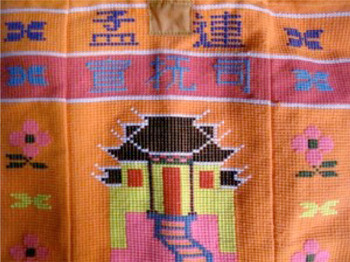
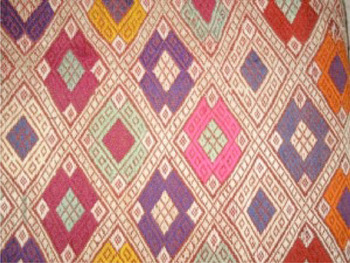
Initial research established that most Dai women in each household in Menglian could weave and that the two most common weaving techniques are the cross-stitch technique (Figure 1) and the diamond-shaped style (Figure 2).
Cross-stitch technique

The diamond-shaped technique

The team decided that Menglian artisans could develop a signature weaving style through improvements in pattern designs, color choices, and materials. The expert was confident that Dai-Menglian weaving had the potential to compete in the international textile market.
During the visit, a good relationship was revived with local authorities from county to provincial level. The project was greeted with enthusiasm and strong support. Local weavers were also very keen to take part in the project. Many expressed their enthusiasm for weaving as their favorite pastime and found the possibility of making money through weaving very desirable. A craft skills assessment conducted found that, on average, most Dai women in Menglian (at least 50–60 people) could weave.
From June to July, CHP collaborated with local project coordinator Zheng Jing to establish a formal association, the Menglian Ethnic Folk Art Inheritance Association (


 ). The association runs independently as a legally registered NGO in Menglian. The local weavers are its members, chaired by the director of the Menglian Museum of Minorities' History. The decision to set up the association and the process involved reflected a crucial step toward achieving the core project objectives. Throughout each stage of the project implementation, (training, manufacturing, marketing, and budgeting), multiple contacts needed to be made between CHP and the local people. A proper organizational structure was needed in Menglian that CHP could work directly with in order to handle such complex processes. This legal organizational structure would also allow the weaving group to get a proper bank account, which otherwise can be very hard to obtain. After reviewing the various organizational structures that are legally recognized by the Chinese government, CHP and the local artisans selected the model that would best support the interests of the local artisans. The establishment of a local grassroots organization was a key step in revitalizing a craft that was in danger of collapse but which, if properly nurtured, could be used as an element for upgrading the economic status of local people.
In August 2010, 12 sets of looms and combs were upgraded in preparation for the training. The previous looms and combs used were narrow ones (approximately 15 cm wide) and could only produce narrow-shaped outputs (e.g., thin, long bags). The upgraded 31-cm-wide version could produce a larger range of outputs including scarves, cloth, traditional wraps, and upholstery materials. In September 2010, training of the artisans in color dyeing began in Menglian. In the recent past, weavers had used finished polyester threads. Although this was a convenient choice, only bright and bold color options were available. This training made it possible for weavers to vary the range of their color palettes and to introduce more subdued, natural-looking hues. After the dyeing and threading stages concluded, the weaving training began. Although unfamiliar with the patterns and color palettes that were presented to them, participants were enthusiastic.
After four weeks training, the weavers' technical ability was highly satisfactory, although the productivity rate remained low. It had been anticipated that the weavers would produce around 5 meters of cloth in one month, but they had only managed to produce 2 meters. Increasing productivity became the key challenge for the project as it would determine the product's labor cost. This rate of work would reduce the competitiveness of Menglian products in the market.
Exploring the Market
In October 2010, a three-person team from CHP conducted market research into ethnic handicraft merchandise available in Beijing. The team visited four stores that sold high-grade items of handicraft and found there was a growing demand from the expanding upper-class and middle-class Chinese consumers for high-quality made-in-China handicrafts.
CHP then conducted a survey of 50 individual Beijing consumers to evaluate preferences for Menglian handmade fabrics and to provide accurate market demand information to the Menglian Ethnic Folk Art Inheritance Association, the weaving trainer and all the weavers. The results of the survey provided clear motivation for the association to produce more products to meet market demand, and through these positive results, encouraged the weavers' productivity. The key message from the survey was the positive feedback from most participants who found Menglian fabric to be different from what they had seen in the existing handicrafts market in China, which acknowledged that the fabric had much potential, especially once converted into finished products.Footnote 12
This helped the weavers create more products to meet market demand and helped the project weaving expert decide how to improve the current choices of design and color. The consumers had also expressed great interest in the products and wanted to help the association continue this weaving tradition, which they understood would confer on the weavers more confidence in their culture, while helping to restore their ethnic pride. CHP concluded that the general Beijing market was opening for ethnic minority products and that, with a thoughtful marketing strategy that leveraged the history and culture of the ethnic minority, people would be willing to pay more for these exotic handicrafts.
Eleven more retail store visits were conducted in Beijing for feedback on the project's fabrics, which received, in general, positive reactions. The majority of the store owners recognized the potential of the product designs, while several were interested in future collaboration. Three business owners agreed to display Menglian fabrics in their stores as a part of market research and publicity. Two stores now carry these fabrics and the Menglian weavers sell directly to them.
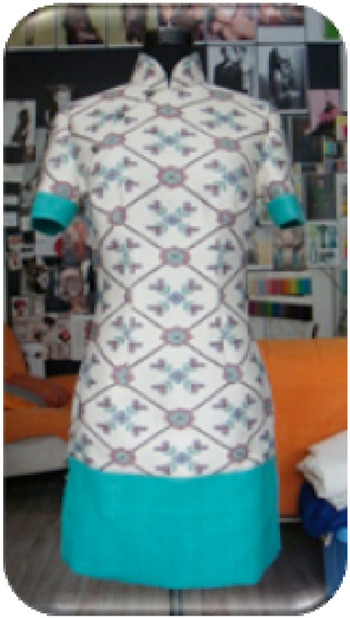
In June 2011, CHP collaborated with Professor Sun Xuefei from the Beijing Institute of Fashion Technology to design fashionable outfits using Menglian fabric. The goal was to increase the value of Menglian fabric by unique and desirable design. One dress was made and currently is displayed at Fei Gallery and Boutique, a high-end boutique focusing on handmade clothing (Figure 3). The textiles are currently being used by Beijing designers.
A dress made from Menglian fabric

In July 2011, CHP hosted a five-day exhibition of Menglian handwoven fabric at one of the busiest tourist streets in Beijing, where many visitors showed great interest and some even gave orders. The head of the Department of Culture of Yunnan Province attended the exhibition and was highly satisfied with the association's work.
The Next Steps
Another trip to the association was necessary to determine a reasonable productivity rate, to find a reliable local thread provider, to set up reasonable prices for existing woven fabrics, to design new products and product packaging, to provide basic business training on cost control and logistics and to document the weaving process in both photo and film.
Local weavers, not themselves experiencing the impact in Beijing, were becoming unsure of the value of their fabric and as to whether it really had a market, so fixing reasonable prices was a priority. It was observed that one skilled weaver could weave 2 centimeters per hour for a patterned fabric. For a 2-meter-long piece of fabric, it would take one weaver about 100 hours. What is more, it takes about two days to set up the looms, which requires washing, winding, and combing the threads, and sometimes dyeing them. Normally, it takes three to four weavers to set up the loom. After discussion with the weavers, it was decided that the ideal production rate, which would give each weaver a satisfying reward, was about 3 meters per month. Because of the complexity of the patterns and the width widening, each weaver could only comfortably work seven hours a day.
Eventually, after searching all the thread stores in Menglian, one desirable brand of good quality thread was found with hues that are softer, have a retro feel, and are more suitable to the taste of modern urban consumers.
Weaving speed and productivity are obviously important. The weavers were used to selling their products themselves and if the product did not sell straight away, they were not willing to produce another batch. The process from weaving through to market sales can take some time, and the weavers were not as well motivated when money did not arrive promptly. Productivity could therefore be low. For example, a weaver might only work one to two hours on the loom per day, feeling that weaving did not compensate for the time and work spent on the fabric. Since the Menglian Museum of Minorities' Histories purchases tourist souvenirs (RMB 50 per bag and RMB 10 per home decorative accessory) regularly from the weavers, they used most of their spare time making these products. The association had also helped the weavers set up a snack stand at the museum, and at least one weaver spent a full day at the snack stand every day. The snacks generate around RMB 100 per day, which is split between the weavers, and they preferred these rapid, though much lower, payments than the return from the distant markets. However, it was pointed out that smaller items, such as a scarf with a business logo, suitable as a corporate gift, could be made, and one was made and finished with the CHP logo as an example during this visit. Such scarves could also be unique items as the weaver can customize the colors and the design. Finally, in order to increase productivity, more people needed to join the association.
Establishing a reasonable price for the fabric was a major concern of all parties involved. Feedback from the Beijing market research was provided to both weavers and local officials.Footnote 13
Younger women, from about 20 to 30 years old (the daughters, daughters-in-law, and nieces of the existing members of the association), had limited skills, but the preservation of traditional crafts requires the active participation of the younger generation. They were definitely interested in learning to weave as part of the association, but they were unsure as to the sales price and the channel through which the fabric was sold. They said that if there were a stable market for fabric and if the sales price was competitive, they would be willing to join the association and inherit the traditional craft of weaving. The market is being established and the number of members of the association has more than doubled in two years.
In terms of cultural heritage protection—especially when it comes to traditional crafts—passing on knowledge and skills to the next generation is important. The Menglian weaving training manual was completed in September 2011 in the Dai language and Mandarin and an outline translated into English. This manual will provide guidelines for the association on training, product design, production control, and marketing promotion.
Product packaging using local materials gave the new products a local ethnic look and other Menglian traditional crafts could now be supported. Menglian handmade paper, bamboo boxes, and cotton threads were chosen as the basic packaging material, commonly used for Dai religious rituals. A short description for each product or fabric was included as was the weaver's name, the date that she completed the product, and words of blessing in the Dai language.
CHP also provided further detailed training in product control by such means as estimating the cost by monitoring the amount of thread that was used by weavers, in order to understand their production rate.
Since there were already a few people in Beijing wanting to order fabric and scarves, the association needed to set up good logistics for shipping. Besides the local post office, two other big logistics companies were located that could deliver the product to Beijing within a week and provide door-to-door service. The arrangement is working well. Thought is also being given to future online ordering by customers overseas, but for the present all of the production is selling in the Chinese market. CHP carries for sale some of the scarves made in Menglian since visitors to the CHP office occasionally buy them.
Mounting a Publicity Campaign
It was also important to gain public attention. From August to September 2011, CHP produced marketing materials and started a publicity campaign for the association. A product brochure emphasizing the social value of Menglian handwoven products was designed, focusing on how the product is made and why people should support rural artisans, which are key to differentiating these products from other ethnic minority products. The brochure will also help the future buyer to identify specific products and make orders directly with the association.
By September 2011, three shops in Beijing were interested in ordering Menglian handwoven products. Since each store requested different products, it was important to connect the shop to the association directly and help the coordinator of the association understand the product requirements and the management of production time.
How successful has this project been? At the commencement, there were 12 weavers; currently there are 29. Some of these had been sex workers in Thailand, who came back after they learned of this association. Because the weavers' skills are improving, they have also increased their income. For example, previously, the weavers would take around two days to weave a type of bag, with a market value of around RMB 50 (US$8). The demand, however, was very small. Now, weavers are producing scarves, which take only one day to weave, and two days' work will produce US$34. In addition the product is in demand because the designs and colors appeal to modern taste.
The association made more than US$20,000 in 2011 and this year (to August 2012) has already made at least US$30,000. Many of the pieces are bought by different local governments as gifts; other pieces are bought by certain high-grade hotels in various large cities. With a good manager and marketing expert, a very beneficial future is assured for the weavers. However, it is important to train a younger member of the association in management and marketing, and it is essential for CHP to raise funds for such a necessary training project. Training up a good manager and market expert for the future requires a great deal of input.
ACHIEVEMENTS AND PROSPECTS
The complexity of a project such as this cannot be underestimated. Without the initial impetus from CHP it is unlikely that the revitalization of the Dai weaving tradition would have taken place. Though the association is now independent, it is clear that the distance from Beijing, the need for developing managerial and marketing skills in some younger members of the association, and keeping in touch with changing tastes to ensure that the product remains viable means that some kind of continuing support will be necessary over the next few years.
One important aim of the project was to prepare the women of Menglian with skills for alternative livelihoods, increasing their opportunities to support themselves without emigrating to seek employment elsewhere. The formation of their own association by the women weavers was a key step: The Menglian Ethnic Folk Art Inheritance Association provides a structure whereby project participants receive as much direct revenue from the project as possible, with a small amount reinvested in the organization. The association ensures the weavers are directly involved in the decision-making process, and are included in all areas of the project operations. This has built their organizational capacity and encouraged minority decision making. By supporting the local artisans to run their own financially and structurally independent entity, CHP has helped build local capacity. The creation of the Menglian Ethnic Folk Art Inheritance Association will also ensure the Menglian Weaving Revival Project is sustainable, as the association will continue to exist when outside funding has ceased.
Another important step has been teaching new weavers the skills needed for old traditions and introducing them to new techniques, while simultaneously encouraging new ideas, new designs, and better understanding of the modern market. The weavers are now in a position to retain existing skills and also to further experiment and innovate.
Besides helping disadvantaged and poor community members out of their previous situation, the scheme has provided the area with a new development model. It has also given the Dai community a sense of the value of traditional Dai skills in the context of modern Chinese society, thereby enhancing Dai self-esteem and reducing vulnerability to the various social ills that afflict the Dai in Menglian today. As Menglian women produce this fabric to be sold in Beijing, they feel a connection to the modernization of China and to the contemporary outside world.
This project has given women a sense of worth through their traditions and the satisfaction of being able to contribute to their families' immediate welfare and livelihoods. Women in the community have been empowered, as have older generations who have been given respect for their long-held skills and knowledge. This comes not from giving the weavers new skills, but from weaving's deep roots in historical Dai culture. This pride in achievement benefits the weavers' families and the whole community and ensures that their unique intangible cultural heritage of skilled weaving will be passed on through generations of family members. Descendants now will learn these skills, and also keep them within the community. This project has increased the participants' pride in their culture, their people, and their history. Cultural traditions of the Dai people have been reinvigorated and kept alive through this project, while being given a modern twist. Ultimately, the end product is also a creative one, as participants are given the freedom to formulate their own designs rather than following strict guidelines. CHP has helped the community to use the Dai-Menglian people's own heritage to expand and build on, which in turn means they are participating in their own heritage, and sharing it with others through their end product. The project has created a platform that combines charities, experts, and government officials to find a way to protect cultural heritage. It is doubtful whether such a project could have succeeded without the assistance of an organization such as CHP, which is able to find the necessary technical assistance, to do the market research, and to find the funds for the initial training. With this kind of help, the abilities and ambitions of marginalized communities can be stimulated in a way that would probably be impossible without this grassroots training.
The economic benefits to the community of the project are evident: The opportunity to make a livelihood from weaving counters the desire for community members to migrate away from their homes and families to seek work in factories in big cities. This in turn enhances community stability: Mothers no longer feel the need to move away from their children and families to earn a living, and girls do not need to leave school to get jobs to support themselves.
The significance of such a project in the wider context of international concern for preserving cultural diversity is also evident. For the outside world, the traditions, lives, and value of the Menglian culture are now becoming better known: There is a developing understanding that the art of weaving is an important part of the traditional cultural heritage of the Dai community. With proper marketing and events to promote the products and the story behind the product, those from outside the Dai community will be able to appreciate the art of weaving and to value the highly skilled work that goes into these unique fabrics.
Despite these very worthwhile achievements, caution must apply to such projects. While there is clearly a niche market for ethnic traditions of weaving and the goods made out of them, how much potential is there? Clearly the first projects that are able to exploit this niche have good chances of success, but there are many ethnic communities in Asia with unique textile traditions and patterns that could be revivified. How big is the eventual market going to be for these specialized handwoven goods? It is probably too early to tell. The market may be much wider than is first thought, allowing for increasing wealth for more expensive products than machine-loomed polyester and for an almost insatiable tourist interest in ethnic designs. But this, to some extent, depends on the continuance of a thriving world economy, for which the prospects at the moment are rather cloudy.
RELATIONSHIP TO THE 2003 AND 2005 UNESCO CONVENTIONS
Such projects can benefit greatly from international exposure. In 2011, the “Weaving of Mosi (fine ramie) in the Hansan region” of the Republic of Korea was inscribedFootnote 14 on the Representative List of the Intangible Cultural Heritage of Humanity. The description read as follows:
Weaving of Mosi in Hansan is transmitted by middle-aged women in the township located in South Chungcheong Province, Republic of Korea. The region boasts fertile land and sea winds that allow ramie plants to thrive. Weaving ramie cloth involves a number of processes, including harvesting, boiling, and bleaching ramie plants, spinning yarn out of ramie fibre, and weaving it on a traditional loom. Ramie cloth is comfortable in hot summer weather and is used to produce a variety of clothing from dress suits and military uniforms to mourning garments. The whiteness of the bleached ramie fabric, as well as its refined quality and neatness, makes it suitable for high-end clothing as well as for clothing for ordinary people. Weaving of Mosi traditionally takes place in the form of women-led family operations in which mothers transmit techniques and experience to their daughters or daughters-in-law. The tradition also binds the community together with neighbours gathered and working in a designated section of the town. At present, around 500 people in the province are engaged in the diverse activities of weaving fine ramie.Footnote 15
It can be seen that this description has many parallels to the case of the Dai weavers. The use of “ramie” as the base material for the weaving distinguishes it from other such projects, but such variations in material are to be expected. The List of the Intangible Heritage is a “representative list.” While that may be its aim, the commercial implications of such publicity may be far more important for the community concerned than the prestige garnered by such international recognition. However, it is interesting to see from the nominations to the List of Intangible Heritage that such ancient, often unique, skills of making textiles are frequently threatened: The description of the craft of making Aubusson tapestry in France, also on the Representative List, for example, describes the process as “time-consuming and expensive…. To stabilize the level of activity and avoid breaking the line of transmission, the interest of the young must be stimulated and this heritage promoted.”Footnote 16 While the preindustrial weaving techniques of many handmade fabrics have been lost in Europe,Footnote 17 there are still many communities in Asia that continue their weaving traditions. In the case of the Menglian weavers, the retained skills and remnants of a once more sophisticated practice have been revived using ancient techniques and modern creativity to provide an economically viable craft.
Threatened traditions of weaving are reported all over the world. Cambodia,Footnote 18 Vietnam,Footnote 19 and LaosFootnote 20 are examples, but there are plenty of others in the Pacific area,Footnote 21 other Asian countries, not to mention Africa and Latin America. Of the 237 items listed on the intangible heritage list, there are 11 associated with weaving. Three of those are from China, the “traditional textile techniques (spinning, dyeing, weaving, and embroidering)” of the Li minority people of Hainan is the only one representing a minority. The other two are Han-associated skills: the craftsmanship of Nanjing Yunjin brocade and the sericulture and silk craftsmanship of China, both related to particular areas in that country. There is one entry on the list from the Republic of Korea and one from Japan. Three other items have been nominated by Azerbaijan and Iran (two items)—all three items relate to carpet making—and the others are from France, Peru, Uganda, and the United Emirates.
In this context there are clearly two considerations. First, we can only hope that the Representative List remains within reasonable bounds, although experience with the World Heritage List on immovables is hardly encouraging in that respect. The list was not designed to promote commercial exploitation. The second is that commercialism is almost certain to follow; the resulting deterioration of many sites on the World Heritage List is a depressing precedent. It is perhaps fortunate that Menglian is so far from the commercial centers that will pay for its outstanding products without the direct influence of heavy tourism and mass market forces.
A third comment seems important here also: It is to be noted that while the Menglian Dai have revived a long tradition of weaving, they are now making adjustments to attract high esteem for their product, which, for at least the last hundred years, had lost its prestige. Finding elderly weavers in the community who still used or knew traditional techniques and patterns was the essential basis of its revival, but it has inspired new currents of creativity and in that sense has contributed new elements to the tradition. The 2003 Convention definition of “safeguarding” includes “measures aimed at ensuring the viability of the intangible cultural heritage” (Art. 2(3)). Traditions have changed over the centuries, new techniques have developed, new designs are made over time. The Convention is careful to encourage, not an unchanging or fictional tradition, but a lively craft embodied in a community's history and daily life.
This project is therefore an important precedent for sustainable development in many communities around the world. It is evident that although primary responsibility for preservation of intangible cultural heritage is accorded by the Convention to national governments, most simply cannot develop such projects for all the communities who may need this kind of initial encouragement and support. Nongovernmental organizations can play a very important role in this work, not least because of their ability to provide online contact between craftsmen and their potential customers all around the world.
By ensuring the continuance of a vibrant weaving culture with a long history and a particular ethnic style, the revitalization of the Dai weaving tradition is ensuring that this element of cultural diversity survives. That is consistent with the objective of the 2005 Convention to protect and promote the diversity of cultures (Art. 1)
Finally the project enacts the United Nations drive for sustainable development discussed at the 1992 United Nations Conference on Environment and Development (UNCED), the “Earth Summit” held in Rio de Janeiro, its tenth anniversary World Summit on Sustainable Development (WSSD) in Johannesburg in 2002, and the United Nations Conference on Sustainable Development held in Rio de Janeiro in June 2012. While issues of pollution, climate change, and exhaustion of resources have so far tested to the limit the ability of politicians in already industrialized countries and those now modernizing, sustainable development is a naturally occurring and important feature of traditional communities. A “sustainable community” refers to population, resources, environment, and other factors that contribute to the balanced development of a civilized geographic location. It seems evident that the establishment of the Menglian Ethnic Folk Art Inheritance Association will play a positive role in the sustainable development of its region.
“Not for three meals a day, nor for officials; but for their own dignity, for their own quality of life. The Dai people do this for themselves and their own enjoyment. We hope that through these precious fabrics, manuscripts and books, a deeper understanding of the Dai people, their culture, arts and crafts is discovered.”
—He Shuzhong at the opening of the fabric and archive exhibition in Beijing, July 2011For further information on the Beijing Cultural Protection Center, see the website http://en.bjchp.org/ and http://www.thebeijinger.com/blog/2010/05/21/Meet-Mr-Preservation-He-Shuzhong-on-Saving-China-s-Cultural-Heritage.