The scrawled filefish Aluterus scriptus (Osbeck, 1765) Monacanthidae (filefish) is a tropical and subtropical cosmopolitan fish who has its habitat description from between 46°N and 24°S. The filefish is a marine fish which is reef-associated; with a depth range of 3–120 m and which is usually captured between 3 and 20 m (Luiz Jr et al., Reference Luiz, Carvalho-Filho, Ferreira, Floeter, Gasparini and Sazima2008; Froese & Pauly, Reference Froese and Pauly2009). Previous southernmost records were registered at Seamount Almirante Saldanha (22°19′S 37°34′W; Bernardes et al., Reference Bernardes, Figueiredo, Rodrigues, Fischer, Vooren, Haimovici and Rossi-Wongtschowski2005), Arraial do Cabo (23°S 42°W; Carvalho-Filho, Reference Carvalho-Filho1999) and more recently in Santa Catarina, Arvoredo Island (27°S 48°W; Hostim-Silva et al., Reference Hostim-Silva, Andrade, Machado, Gerhardinger, Daros, Barreiros and Godoy2006) in Brazil.
The analysis of this specimen included measurements of size to the nearest millimetre, body weight to the nearest gram, and the determination of sex and maturity stage. The species was identified following the key of Berry & Vogele (Reference Berry and Vogele1961).
Sea surface temperature (SST) was obtained by processing an Aqua-MODIS image of 9 km resolution from 2 to 9 December 2008 time coverage with the SeaDAS software. The SST anomalies derive from Reynolds et al. (Reference Reynolds, Rayner, Smith, Stokes and Wang2002).
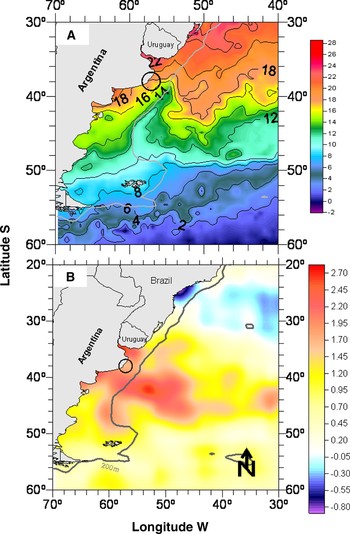
This paper presents the first record of Aluterus scriptus in Argentine waters. Three specimens of A. scriptus were caught using a purse-seine, at 19 nauticol miles offshore Mar del Plata, Argentina (37°58′70″S 57°06′41″W), at the depth of 30 m, on 9 December 2008 (Figure 1). At the time of catch by FV ‘Roma’ (12.6 m length), which was fishing for mackerel (Scomber japonicus), the SST was 18.5°C. However, one specimen was conserved, measured and photographed.
(A) Mean sea surface temperature (SST) during 2 to 9 December 2008; (B) sea surface temperature anomalies (SSTa) in December 2008 (the line is the 200 m isobath). The circle represents the zone where Aluterus scriptus was caught.

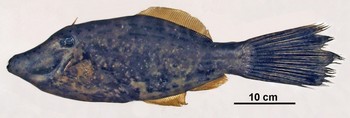
The specimen measured was a juvenile female of 55.5 cm total length, 39.5 cm standard length and a total weight of 788 g. This fish is now in the collection of the Instituto Nacional de Investigación y Desarrollo Pesquero, registration no. INIDEP-815 (Figure 2).
Freshly caught Aluterus scriptus (INIDEP registration no. 815, total length 55.5 cm. Photograph: Marcela Tobio).

The fin ray counts were as follows: Dorsal 1, one folding fin; Dorsal 2, 46; Pectoral, 15; Anal, 49; Caudal, 22. The caudal fin length was a 31.5 and body height 25.5 given as a percentage of the total length. This is consistent with the diagnoses of Berry & Vogele (Reference Berry and Vogele1961), Carvalho-Filho (Reference Carvalho-Filho1999), Floeter et al. (Reference Floeter, Gasparini, Rocha, Ferreira, Rangel and Feitoza2003), Bernardes et al. (Reference Bernardes, Figueiredo, Rodrigues, Fischer, Vooren, Haimovici and Rossi-Wongtschowski2005) and Froese & Pauly (Reference Froese and Pauly2009).
The maps of SST anomalies (SSTa) reveal positive SSTa during December (between 1.40 and 1.60°C); related with the advection of oceanic warm waters to the coast, promoted by favourable wind pattern and low discharge of the Río de la Plata. The year 2008 was characterized by significantly higher SST when compared with the long-term average at regional scales. The SST horizontal distribution showed the presence of warm waters all over the Uruguayan and Argentinean shelf during early December 2008. The 18°C isotherm reached latitudes greater than 41°S close to the Argentine coastal zone and the area where A. scriptus was caught showed similar temperatures (see Figure 1).
The average SSTa off the Argentine coast during springtime (November, December) amounted to 0.4–1.6°C above the long-term average (30 years). Accordingly, the November and December SSTa in 2008 were by far the highest compared with the same measurements in the period 1995–2006. Particularly, during November (between 0.4 and 0.6°C) and in December (between 1.4 and 1.6°C) these values increase.
The year 2008 was also extremely dry, with a precipitation deficit especially conspicuous during spring and summer. All these facts could be link to the isolated appearance of A. scriptus in the south-west Atlantic Ocean. It appears plausible that there exists a connection between increased SST and southward spreading of southern species in the Atlantic Sea. Such interrelation has already been observed in other organisms (e.g. Díaz de Astarloa et al., Reference Díaz de Astarloa, Figueroa, Cousseau and Barragan2000; Milessi & Oddone, Reference Milessi and Oddone2003; Segura et al., Reference Segura, Carranza, Rubio, Ortega and García2008).
The finding of this specimen considerably extends the range of Aluterus scriptus to the south and reveals that it is not confined to tropical and sub-tropical waters as previously assumed. It can also be seen in the light of the established trend of warm/temperate marine fish and invertebrates, expanding their geographical range southwards (Mianzán et al., Reference Mianzán, Acha, Guerrero, Ramírez, Sorarrain and Lasta2000).
The presence of the Brazilian Current most likely sets the southern limit for A. scriptus. However, eddies or other oceanographic processes (e.g. wind forces) may bring some adults further south, accounting for the recent findings of these specimens in Argentinean waters.
Climate change and migrating species are currently very popular topics in marine science (e.g. Barneche et al., Reference Barneche, Anderson, Floeter, Silveira, Dinslaken and Carvalho-Filho2009). We certainly need more than one year's record to say whether or not the occurrence of A. scriptus in the south-west Atlantic is actually linked to rising temperatures.
ACKNOWLEDGEMENTS
Special thanks to the crew of the RV ‘Roma’ for their field work support and friendship and to Marcela Tobio for the photographs. We also thank S. Barbini for the curation of the material deposited in the ichthyologic collections of INIDEP. Thanks to Dr M. Knapp for language improvement, Dr S. Floeter for literature references and an anonymous referee for useful comments on the manuscript. This is contribution INIDEP no. 1578.