INTRODUCTION
Just like other ethnic groups in other parts of Indonesia (see Steedly Reference Steedly1996; Keane Reference Keane1997; Schefold Reference Schefold1998; Moriyama Reference Moriyama2005; Kuipers Reference Kuipers2008), the Javanese in Central Java tend to define their local language based on the most prestigious variety that originates from the local nobility (Errington Reference Errington1985, Reference Errington, Schieffelin, Woolard and Kroskrity1998a,Reference Erringtonb; Goebel Reference Goebel2007:514). Kuipers (Reference Kuipers2008:317–19) argues that through historical processes of standardization and inscription, formal and ritual registers of local languages in Indonesia expand from being a form used to index higher authority to being the distinct form of the local language that presents the most prominent and visible linguistic signifier of local ethnolinguistic identity.
In Indonesia, public monolingual performances of prestigious varieties of local languages often act as ‘scheduled emblematic displays’ of ethnic identity (Silverstein Reference Silverstein2003:538). In this article, I discuss an inter-high-school Javanese language debate competition in Central Java as an example of such a display. This type of event, centered on the monolingual performance of Javanese, generally aims to encourage and reinforce local language maintenance among youths and adolescents.
I not only look at this event simply as a monolingual performance, but also to show that participants still make use of their multilingual repertoires. For the youth contestants, this involves pooling together their shared repertoire, especially building on the interconnections between languages, in the process of preparing and enacting this monolingual event. The language ideology surrounding this event, in which participants define traditional Javanese identity based on the monolingual performance of a distinct variety, lead participants to ultimately put the interconnections between languages under erasure. As such, this Javanese language debate event shows the process by which people can transform their multilingual practices into monolingual performances. To illustrate these interconnections and erasures, I focus on one group of contestants from a vocational high school where I conducted ethnographic research and trace their process of preparing their monolingual performance. Then, I discuss the use of languages by various types of debate participants including noncontestants such as the hosts, organizers, and judges.
My objective is to argue that the transformation from multilingual rehearsal to monolingual performance represents the continuing dialogical tension between the two fundamental dynamics of language in society or what Bakhtin (Reference Bakhtin1981:272) considers as the tension between the centralizing ‘centrifugal’ and the decentralizing ‘centripetal’ forces of language. While recent approaches to multilingualism emphasize the ‘centripetal’ aspect of language, especially the hybrid and flexible nature in which people can use multiple languages, I aim to show that multilingual speakers can still have monolingual ideas about what counts as language, particularly on varieties they consider as iconic to their ethnolinguistic identity. As the work on the ‘monologic imagination’ (Tomlinson & Millie Reference Tomlinson and Millie2017) has argued, the monologic (and monolingual) aspect of language use still has political force, and both the dialogical and monological aspects of language use are social projects, which often implicate each other (Tomlinson Reference Tomlinson, Tomlinson and Millie2017:10).
Hence, the notion of monolanguaging space that I seek to argue for here represents the way the production of a monolingual performance can implicate the use of dialogic and multilingual practice. Monolanguaging spaces are language ideological spaces in which speakers exclusively seek to use a prestigious language variety to perform/project an ideal image of their ethnolinguistic identity. Nevertheless, the process of enacting these monolanguaging spaces can involve multilingual practices. The main objective of my analysis is to show the way speakers at the micro-level of preparation and performance render this connection invisible, through either language ideological erasure across speech events or control of verbal performances (cf. Tomlinson Reference Tomlinson, Tomlinson and Millie2017:6), especially in the form of status-based interactional asymmetries. The resulting monolingual performances are thus shaped not only by the dominant ideology of the local language but also by social rules of status-based power relations, especially regarding the kinds of speakers who have the authority to dictate the conduct of the performance.
LANGUAGE IDEOLOGY, ERASURE, AND TRANSLANGUAGING ACROSS COMMUNICATIVE CONTEXTS
In viewing language use across communicative contexts, I look at what Blommaert (Reference Blommaert2005:57) calls ‘forgotten contexts’, which point to larger economies of communication and textualization. For the purpose of my analysis, this involves not just focusing on the language performance during the Javanese debate event but also on the ‘larger patterns of interaction across events’ (Blommaert Reference Blommaert2005:55). This means that I focus on various communicative events that are all interrelated and form a larger pattern of language use and evaluation surrounding the Javanese language debate. These include the discussion and practice session before the event as well as the forms of talk by noncontestants during the event.
Looking at language use across events helps to capture the process in which speakers ‘re-contextualize’ their use of multiple language forms into different yet interconnected communicative contexts (cf. Bauman & Briggs Reference Bauman and Briggs1990:77). As such, I view the performance in the debate event as a product of linguistic and collaborative work. The debate event itself constitutes what Bauman (Reference Bauman2011) calls cultural performances or what Coupland (Reference Coupland2007) calls high performances. These performances tend to be scheduled, planned, and programmed, with clear boundaries, and often involve collaboration or coordination, while focusing on a central or official activity (Coupland Reference Coupland2007:147; Bauman Reference Bauman2011:715). Bauman views cultural performances as events ‘in which the deepest meanings and values of a culture are embodied, enacted, and placed on display before an audience’ (Reference Bauman2011:715). Coupland, by contrast, notes the communicative focusing of high performances, through the foregrounding of form, meaning, situation, relations, achievement, and repertoire (Reference Coupland2007:147–48). What I do, then, is trace this communicative focusing across various interrelated communicative contexts that make up the enactment of the Javanese language debate.
The notion of performance also involves the evaluation of people's use of language (Bauman & Briggs Reference Bauman and Briggs1990; Bauman Reference Bauman2011). In talking about the evaluation of language, I am guided by the study of language ideology, which Irvine (Reference Irvine1989:255) defines generally as ‘the cultural systems of ideas about social and linguistic relationships, together with their loading of moral and political interests’. More specifically, I focus on what Irvine & Gal (Reference Irvine and Gal2000:37) call the semiotic processes in which ‘people construct ideological representations of linguistic differences’. The two processes of importance for my analysis are iconization and erasure. Iconization refers to the way people view certain linguistic varieties as somehow portraying a social group's inherent nature (Irvine & Gal Reference Irvine and Gal2000:37). Meanwhile, erasure is the process through which language ideology renders certain language practices that are inconsistent with the main ideology—in this case the iconized language form—invisible (Irvine & Gal Reference Irvine and Gal2000:38).
To understand the main language ideological framework present in various communicative events, I follow Blommaert, Collins, & Slembrouck's (Reference Blommaert, Collins and Slembrouck2005:2012) notion of interactional or language regimes, which are sets of behavioral expectations on social conduct including language use. In these regimes, social status also contributes to the distribution of expectations in behavioral and linguistic conduct, especially based on Javanese ideas on the social distribution of politeness and deference in Central Java (Mulders Reference Mulders, Antlov and Cederroth1994; Errington Reference Errington1998b; Irvine Reference Irvine, Schieffelin, Woolard and Kroskrity1998). These notions associated with language ideology highlight the importance of social structure, hierarchy, and power in the use and evaluation of languages (Woolard Reference Woolard, Schieffelin, Woolard and Kroskrity1998; Kroskrity Reference Kroskrity2000).
In talking about the multiple language forms that people use in the various contexts of the Javanese language debate, I use the term repertoire, following Gumperz's definition of the ‘totality of linguistic forms regularly employed in the course of socially significant interaction’ (in Duranti Reference Duranti1997:71). This draws attention to the various language forms that people can use in their interactions. It is broader than simply a grammar-oriented notion of linguistic competence and closer towards Hymes's (Reference Hymes, Pride and Holmes1972) notion of ‘communicative competence’.
The notion of repertoire also lays the foundation to recent approaches to multilingualism. Mainstream definitions of multilingualism tend to define it based on competence in distinct and separate linguistic entities (Makoni & Pennycook Reference Makoni, Pennycook, Makoni and Pennycook2007) or as ‘multiple monolingualisms’ (Juffermans Reference Juffermans2011:166). In contrast, these recent approaches consider language boundaries as porous and focus on the fluidity and mixing of languages (e.g. Rampton Reference Rampton2005 on crossing; Otsuji & Pennycook Reference Otsuji and Pennycook2010 on metrolingualism; Blackledge & Creese Reference Blackledge and Creese2010 on flexible multilingualism). They also emphasize focusing on the actual use of multiple language forms/features for communicative purposes, which does not necessarily require full linguistic competence (e.g. Jorgensen Reference Jorgensen2008 on polylingualism; Blommaert Reference Blommaert2010 on truncated repertoires). The emphasis on language use means that it is congruent with viewing events of language use as performances. It also provides a broader perspective on code-switching and language alternation. It encompasses not only the classical notion of code-switching as signaling changes in the interactive situation (Gumperz Reference Gumperz1982; Bailey Reference Bailey2000:170, Reference Bailey and Heller2007:349; Goebel Reference Goebel2008:80) but also more nuanced forms of discourse-oriented language alternation such as intra-sentential borrowings or transfers (Auer Reference Auer, Milroy and Muyskens1995) and the combination of multiple languages as a medium or code of interaction (e.g. Errington Reference Errington1998b on the ‘language salad’ of Javanese and Indonesian; Gafaranga & Torras Reference Gafaranga and Torras2002 on bilingual medium). Finally, from a general perspective, these new approaches to multilingualism also consider that distinctions between languages are historical, ideological, and often discursive constructs (Irvine & Gal Reference Irvine and Gal2000; Makoni & Pennycook Reference Makoni, Pennycook, Makoni and Pennycook2007). Hence, the new approach to multilingualism—inspired by developments such as linguistic globalization (Blommaert Reference Blommaert2010), superdiversity (Blommaert & Rampton Reference Blommaert and Rampton2011), and concepts such as heteroglossia (Bailey Reference Bailey and Heller2007)—tend to consider the use of languages as being deeply associated with broader issues of social structure, interaction, and change.
One recent approach that explicitly focuses on the interconnection between languages in multilingual repertoires is translanguaging, originally developed in Welsh bilingual education (Lewis, Jones, & Baker Reference Lewis, Jones and Baker2012). Translanguaging can involve various multiple language practices such as alternation, combination, and translation (Creese & Blackledge Reference Creese and Blackledge2010; Garcia Reference Garcia2011). It reflects people's integrated repertoires and is often the communicative norm in multilingual communities, exemplifying their cultural hybridity (Garcia & Li Wei Reference Garcia and Wei2014:21–24). Li Wei (Reference Wei2011:1223) also writes of translanguaging spaces, in which speakers can creatively and critically engage with multiple norms of linguistic behavior to generate ‘new identities, values, and practices’.
I argue that in contexts of emblematic cultural performances, the opposite of translanguaging space may happen. While people may still use or even collaboratively pool their translanguaging practices, they ultimately put these practices under erasure in order to achieve a monolingual performance emblematic of their cultural identity. These monolingual performances thus constitute the communicative focusing on a single language variety, which we can consider as a ‘monolanguaging space’ that represents the ideal linguistic form of a certain ethnic identity.
Following works on the ‘monologic imagination’ (Tomlinson & Millie Reference Millie, Tomlinson and Millie2017), I view monolanguaging space in multilingual settings, such as Indonesia, as social projects or products of sociodiscursive work. On the one hand, it implies or involves connections to multilingual practices. On the other hand, speakers render these connections invisible through both language ideological erasure and discursive mechanisms of control (Tomlinson Reference Tomlinson, Tomlinson and Millie2017). The discursive mechanisms often work together with what Urban (Reference Urban2001, Reference Urban, Tomlinson and Millie2017) calls meta-culture, as reflexive evaluations on cultural practice. The notion of meta-culture—as evaluative frameworks on actual sociocultural practice including language use—is thus equivalent to the notions of language ideology and meta-pragmatics (Irvine Reference Irvine1989; Silverstein Reference Silverstein1993; Kroskrity Reference Kroskrity2000). Concurrent with Millie's (Reference Millie, Tomlinson and Millie2017) observation of Islamic preaching in West Java, I see a similar pattern in which a dominant ‘public meta-culture’ becomes the interpretive framework for language users in evaluating, misrecognizing, and putting under erasure actual language performance compared to a reified ideal, thus creating a monolanguaging space. I further argue that in the current case study, the monolanguaging space created based on this public meta-culture is supported by discourse-oriented techniques of code-mixing and by local structures of status and authority.
Consequently, while recent approaches to multilingualism may consider language boundaries as socially arbitrary and porous or as ‘inventions of social, cultural and political movements’ (Makoni & Pennycook Reference Makoni, Pennycook, Makoni and Pennycook2007:2), the notion of languages as distinct and separate entities still has social force in the lived experience of language users (Bailey Reference Bailey and Heller2007:271). Urban (Reference Urban, Tomlinson and Millie2017:38–40) also argues that meta-cultural values of homogenization (including ideologies of monolingualism) are often efforts of modern collectives in controlling heterogeneity through the production of a unitary voice and social identity. Hence, homogenized values are nonetheless connected to situations and practices of cultural and linguistic heterogeneity (and vice versa; see Urban Reference Urban, Tomlinson and Millie2017:36–38). Broad-scale institutional processes, such as colonialism, education, and mass media, help to circulate, establish, and ‘enregister’ ideologies of homogenized languages as the normal form of language practice (Bourdieu Reference Bourdieu1991; Agha Reference Agha2007; Errington Reference Errington2008), even in sociopolitical contexts where people use multiple languages, such as Indonesia. This underscores the persistent epistemic normality and unmarked nature of monolingualism in structuring definitions of language and language use (see Gramling Reference Gramling2016), as well as its connection to conceptualizations of multilingual practice.
In Indonesia, there is an implicit connection between heterogeneity and homogeneity, starting from the national motto Bhinneka Tunggal Ika (lit. ‘diverse yet one’). In the field of languages, as I have alluded to in the introduction, the application of this ideal and public meta-culture is through the delineation and standardization of local languages, often based on prestigious varieties, as a way of managing local ethnolinguistic superdiversity (Kuipers Reference Kuipers2008; Goebel Reference Goebel2015). Concurrently, centralized language planning also positioned Indonesian (historically standardized from literate Malay) as the unifying national language, referentially transparent, with no clear ties to local ethnic groups (Errington Reference Errington1998b). The result is a managed ethnolinguistic diversity that supports a national unified identity, partly a legacy of colonialism but also partly the result of nation building (see Maier Reference Maier1993; Schefold Reference Schefold1998; Boellstorff Reference Boellstorff2002). By discussing monolanguaging space, I illustrate the way language users accomplish this ideal of ‘unified diversity’ at the micro-level of cultural performances.
RESEARCH LOCATION AND DATA COLLECTION
The Javanese language debate is part of a larger competition organized by a state university in 2013 in Semarang, Central Java, for Scout groups (Pramuka) at the high-school level. The competition, titled ‘Kartini in Action’, commemorates the national hero R. A. Kartini, a figure of women's emancipation in Indonesia's late colonial period but also a representation of Javanese identity, due to her status as a Javanese noblewoman. Hence, not only does the competition highlight Girl Scouts, it also has emblematic Javanese components, such as the Javanese language debate and a pageant-like event in traditional clothing.
The data I discuss in this article comes from the Javanese language debate event and the preparations of contestants from the Bebengan state vocational high school (Sekolah Menengah Kejuruan Negeri—SMKN) located in the southwest periphery of Semarang. I collected this data through participant observation and recording as part of a broader ethnographic study on youth multilingualism (Tamtomo Reference Tamtomo2016) in two vocational high schools in Semarang during the 2012–2013 academic year.
JAVANESE LANGUAGE IDEOLOGY AND THE LANGUAGE ECOLOGY OF CENTRAL JAVA
In this section, I discuss the language ideology surrounding the Javanese language since it forms the underlying public meta-culture that shapes the debate event. I also describe the broader language ecology in Central Java, especially relating to the social evaluation of Indonesian and English, the two other prominent languages that the debate participants and organizers also use.
Some scholars (e.g. S. Poedjosoedarmo Reference Poedjosoedarmo1968; Wolff & Poedjosoedarmo Reference Wolff and Poedjosoedarmo1982) consider that the Javanese language has three broad speech levels (other terms include speech style and code, with code being rather ‘value neutral’ in regards to deference)—ngoko, mádyá, and krámá, in that order of coarseness to refinement.Footnote 1 In contrast, I follow Siegel's (Reference Siegel1986) and Errington's (Reference Errington1998b) differentiation of Javanese into two broad categories of ngoko and krámá (or básá) (see also Goebel Reference Goebel2005) based on speakers’ notions of deference to interactional others. This broad differentiation also reflects the practical way in which the event participants (contestants, organizers, and judges) make use of the language.
The language ideology related to the difference between ngoko and krámá involves the issue of politeness, deference to others, and judgments of refinement (Errington Reference Errington1998b). The ngoko speech level is the basic language that speakers use when there is no interactional other or in speech that reflects their thoughts (Errington Reference Errington1998b:38) and with certain people (such as intimates and familiars) as well as certain speech acts (such as cursing, epithets) that do not require deference (Siegel Reference Siegel1986:24). By contrast, speakers use the krámá speech level to mark their stance of polite awareness or deference to an interactional other (Errington Reference Errington1998b:38; Irvine Reference Irvine, Schieffelin, Woolard and Kroskrity1998:57).
The ngoko speech level constitutes the ‘basic language and is antecedent to and structurally foundational’ to the polite speech level of krámá (Errington Reference Errington1998b:38). Therefore, one does not (and functionally cannot) learn to speak krámá without first learning to speak ngoko. All krámá forms also have ngoko equivalents but not vice versa (Anderson Reference Anderson1990:208). It is the first speech level and mother tongue that Javanese children initially learn (Wolff & Pudjoesoedarmo Reference Wolff and Poedjosoedarmo1982). As a result, most Javanese (both commoners and the nobility/priyayi) can use and understand ngoko, even in peripheral regions of the Javanese cultural area, such as Banyumas, East Java, and Banyuwangi (see Hatley Reference Hatley1984). Ngoko is also the variety that speakers generally maintain in migrant Javanese communities, including overseas settlements such as Suriname (e.g. Wolfowitz Reference Wolfowitz, Carlin and Arends2002).
In contrast, the krámá speech level consists of lexical items and affixes that differ from ngoko forms. Speakers also have to use these krámá forms in ‘syntagmatic co-occurrence’ (Ervin-Tripp Reference Ervin-Tripp, Gumperz and Hymes1972) in their utterances. These forms index the deference that is associated with this speech level. In interactions of unequal social status, based on age, occupation, education, official rank, nobility, and even gender in marriage (see Smith-Hefner Reference Smith-Hefner2009), speakers tend to exchange speech levels asymmetrically, with the higher-status person receiving the polite krámá while replying in the basic ngoko to lower-status interlocutors (Errington Reference Errington1998b; Goebel Reference Goebel2007). Speakers also view the ability to speak and master krámá as a symbol of ‘exemplary status’ since they associate it with nobility (the priyayi social class), especially from the two Javanese courts in Surakarta and Yogyakarta (Errington Reference Errington1985, Reference Errington1998b, Reference Errington2000). Purwoko (Reference Purwoko1994:120–21) mentions that Moedjanto (Reference Moedjanto1986) traces the establishment of krámá linguistic etiquette to the sixteenth century Mataram kingdom in Yogyakarta, in which this prestigious variety functioned to consolidate elite identity and to keep commoners at a reasonable social distance (see also Anderson Reference Anderson1990:205–207). When used in public, krámá’s power of deference works to make interactions more formal and ceremonious, somewhat like a social mask used to dissimulate the self and social intentions (Berman Reference Berman1998:28; Errington Reference Errington1998b:41). Nonetheless, much of the Javanese speaking population has limited active control of the krámá speech level (Wolff & Poedjosoedarmo Reference Wolff and Poedjosoedarmo1982:84; Errington Reference Errington1998b).
The exemplary status of krámá results in a language-ideological skew in the way Javanese speakers define what counts as their ‘language’. They tend to view krámá as the ideal manifestation of their adhiluhung ‘noble sublime’ cultural identity (Errington Reference Errington, Schieffelin, Woolard and Kroskrity1998a:279) and regard those not competent in this speech level as immature or ‘not yet Javanese’ (Heryanto Reference Heryanto, Makoni and Pennycook2007:45). Local language education in formal schools in Central Java also reflects this language-ideological skew, with the local content curriculum specifying a krámá-oriented Javanese language class emphasizing politeness and speech etiquette (Goebel Reference Goebel2010:20–22).Footnote 2 The ngoko speech level, which constitute the basic language and daily vernacular, tends to be ‘erased completely from the category of language’ (Zentz Reference Zentz2014:356).
The organizers of the Javanese language debate have also defined their event based on krámá, specifying it as the language form participants have to use. Cultural performances or events such as the Javanese language debate often constitute efforts of language maintenance in the eyes of local language users. We must be aware, however, that the enactment of these cultural performances often requires the erasure of language varieties that are inconsistent with the iconic local ethnolinguistic identity. Discussions of Javanese language maintenance often predominantly rely on speakers’ reports and focus on language forms instead of their actual use (e.g. Kurniasih Reference Kurniasih and Allan2006; G. Poedjosoedarmo Reference Poedjosoedarmo2006; Cohn & Ravindranath Reference Cohn and Ravindranath2014). As a result, they often reproduce speakers’ iconization of krámá in Javanese ethnolinguistic identity. This feeds into the notion common among native speakers and policymakers that the predominant use of the ngoko speech level over krámá is a form of endangerment of the Javanese language.
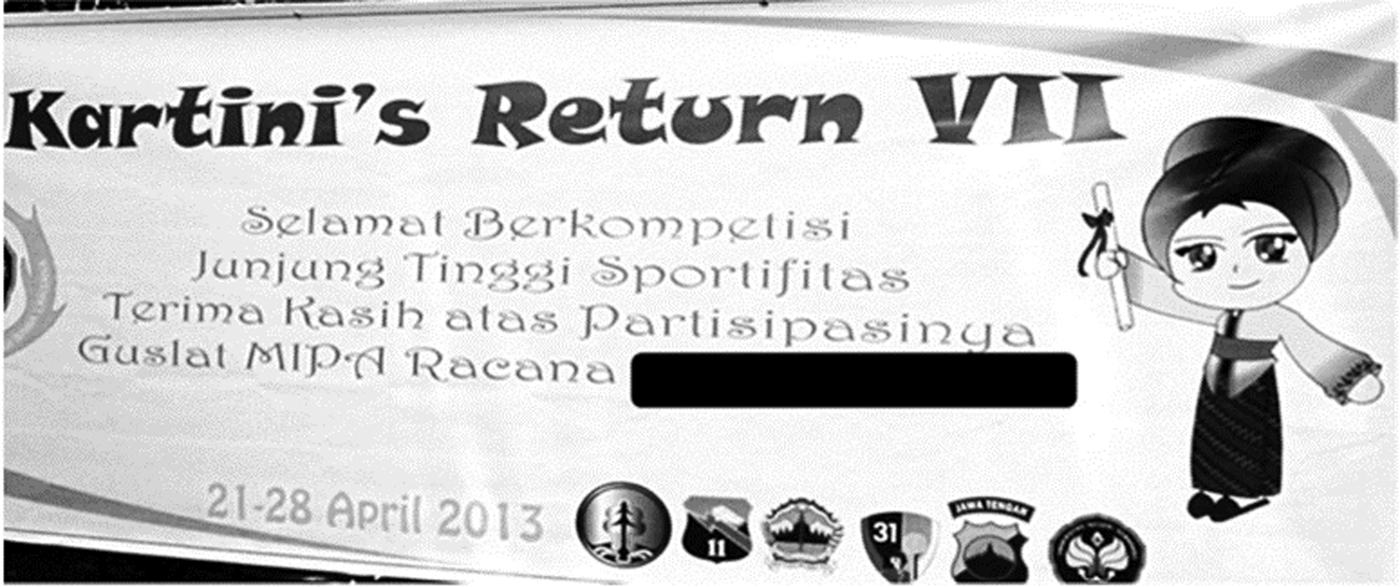
In contrast, focusing on actual language use reveals that participants and organizers of monolingual cultural performances do not exclusively conduct them in one language. For example, all of the rules and documents of the Javanese language debate are in Indonesian. In addition, the debate itself is part of a broader Scout competition event that, despite emphasizing emblematic Javanese elements, uses a combination of Indonesian and English in their official documents and displays. The main title of the competition is in English: ‘Kartini in Action: Kartini's Return VII’ (Figure 1). Two events in the competition also have English titles: (a) ‘Who wants to be the next Kartini?’ (a pageant and talent show event) and (b) ‘Kartini the Explorer’ (an obstacle-course event based on scouting skills common in Scout competitions).
‘Kartini's Return’ banner.

The use of languages other than Javanese points to the broader context of the language ecology of Central Java. First, as in other parts of the country, Indonesian as the national language is widespread in various formal domains of communication such as law, bureaucracy, mass media, schooling, and formal public interactions (Lowenberg Reference Lowenberg1992:65–66; Sneddon Reference Sneddon2003:206–207). Indonesian is the official language, often functioning as a ‘referentially transparent’ language of objectivity, formality, and state authority (Errington Reference Errington, Schieffelin, Woolard and Kroskrity1998a, Reference Errington2000; Lutz Reference Lutz1998). Second, while locals tend to use Javanese in daily interpersonal interaction, they often tend to alternate it or combine it with Indonesian, highlighting the permeation of Indonesian into local language interaction (see Wolff & Poedjosoedarmo Reference Wolff and Poedjosoedarmo1982; Errington Reference Errington1998b; Goebel Reference Goebel2007, Reference Goebel2010, Reference Goebel2014). Third, the use of English in the competition highlights its symbolic value in school and in public life. Not only is English a prestigious socioeconomic language in media and business (Sneddon Reference Sneddon2003:173–77), it is also the main foreign language taught in schools (Darjowidjojo Reference Darjowidjojo1998). Youths also view it as conferring a ‘cool’ (keren) impression compared to the conventional use of Indonesian (interview with SMKN Bebengan students, 11 December 2012), thus positioning English as the language of social difference and potential social mobility (Lamb & Coleman Reference Lamb and Coleman2008; Zentz Reference Zentz2015).
Hence, despite the iconic position of krámá in Central Java's local language ideology, it nonetheless co-exists with Indonesian and English as languages that speakers commonly use in public communication. These languages constitute an integrated albeit unequal part of speakers’ repertoires and of the language ecology that they face in daily life.
CONTESTANT PREPARATIONS: TRANSLANGUAGING AND SELF-ERASURE
In this section, I discuss the preparations of the debate team from SMKN Bebengan, which consists of three girls—Ulli (UL), Sari (SR), and Lutfah (LF)—who are all in their second year of high school. Ulli is the most fluent in krámá, as the extracts below show, while Lutfah is the most timid speaker, leading to numerous corrections from her peers. Two other Pramuka members, Indah (IN, female) and Nanda (ND, male), are also present in the preparation sessions. I show that these contestants employ translanguaging practices through their use of various language varieties in their repertoire, particularly ngoko and Indonesian, in processes of construction and translation as they try to produce a linguistic performance that approximates as closely as possible the monolingual krámá Javanese ideal.
The event organizers have set debate topics largely written in krámá Javanese, though even they could not avoid using Indonesian and English terms, as shown in the debate topics in some of the extracts below. In their preparation sessions, the SMKN Bebengan debate team encounters the main problem of formulating arguments on these topics exclusively using krámá Javanese, following the event's rules. This problem produces numerous instances of corrections and uncertainties on whether they are using the correct krámá forms, as shown in extract (1) below.
(1) Debate topic:
Pernikahan dini saged nyegah wontenipun pergaulan bebas.
‘Early marriage can prevent incidents of uncontrolled interaction.’


In lines 1–4, for example, the other members of the team correct Lutfah's use of ajeng ‘will’, replacing it with badhé ‘shall’. Sari provides a meta-linguistic explanation in line 4, using ngoko Javanese, that badhé is ‘better’ or more polite since one uses ajeng with peers that are closer in age and status. Next, in line 6, Lutfah stops in mid-utterance to ask the other members for the krámá equivalent of the Indonesian pendapat ‘opinion’. Sari replies in line 7 by offering the krámá form pepanggihan. Lines 11–14 illustrates the way Ulli and Sari collaboratively provide suggestions when Lutfah encounters problems in formulating her utterance. In line 12, Ulli suggests the krámá Javanese menawi ‘that’ when Lutfah stumbles in her utterance. When Lutfah still encounters problems, Sari uses ngoko Javanese in line 14 as a meta-pragmatic marker to suggest a possible replacement krámá utterance for Lutfah's argument.
The team's discussion in extract (1) illustrates aspects of the translanguaging practices they employ in preparing a krámá performance for the debate. The team members collaboratively rely on making use of the ngoko speech level of Javanese for both ‘relational talk’ (Goebel Reference Goebel2014) and meta-lingual talk regarding their krámá speech preparations. This highlights the way in which translanguaging practices are often collaborative, and that the various varieties and codes in speakers’ repertoires are integrated (Garcia & Li Wei Reference Garcia and Wei2014), as seen in the way the students can use one variety as a scaffold to talk about constructing a performance in another variety.
Another problem that emerges in the team's preparation is the issue of finding krámá equivalents of certain Indonesian terms. In extract (1), the team uses the original Indonesian forms from the organizers’ debate topic in their otherwise krámá utterances (lines 9, 10). In extract (2) below, the team not only struggles to find the krámá equivalent to the Indonesian term (and English loanword) seks but also to generally talk about the topic.
(2) Debate topic:
Piwulang seks dini becik kagem lare-lare.
‘Early sex education is good for children.’

In line 2, Indah poses the crucial question that the team would struggle with: ‘What is sex in Javanese?’. Ulli's response in line 3 states the fact clearly for the team: according to her, there is no Javanese equivalent term to the clinical meaning of the Indonesian seks. However, this does not stop the other team members (primarily Nanda) from suggesting a series of possible translations. This ranges from the jokingly euphemistic ehem-ehem in line 4, the dismissive rusuh ‘rude’ in line 5, the descriptive tumpak-tumpakan ‘on top of each other’ in line 6, to finally the religious and Arabic-sourced Sunnah Rosul ‘the Prophet's teaching’ starting in line 8. Since they are unable to find the Javanese term for sex, Lutfah ultimately uses the Indonesian term (and English loanword) seks in line 20 to begin formulating their argument.
We can draw a number of inferences from the team's problems in extract (2). First, the team members may just lack the vocabulary to translate ‘sex’ into Javanese, especially in the krámá speech level. While there are ngoko words for sex, they may be too coarse or explicit for them to use, particularly with the debate's emphasis on speech etiquette. They may also not be familiar with krámá terms for sex, such as (a)sanggama or saresmi, due to their exoteric provenance in classical Javanese manuscripts, such as the Serat Kadis Saresmi on traditional teachings for married couples (Florida Reference Florida1993:201). Second, and on a related note, sex is also a topic that the Javanese often consider as taboo and generally only appropriate for adults to discuss. Finally, schools generally use Indonesian when (and if) they provide classes on sex education. Therefore, these adolescents rarely use Javanese, other than the coarse ngoko vocabulary, to talk about sex, if they ever do.
Extract (1) and (2) show the difficulties that the team face in trying to formulate debate arguments exclusively in krámá Javanese. The constant self-correction and questioning hamper their efforts in developing their arguments. As a result, they turn to another translanguaging strategy: translation (Garcia Reference Garcia2011). Ultimately, the team decides to first formulate arguments in Indonesian and then translate them into krámá Javanese.
Extract 3 below illustrate the team's switch to formulating arguments in Indonesian. The other team members encourage Lutfah, who is tasked with forming arguments, to use Indonesian to speak whatever comes to mind (Nanda in line 3) and as a form of studying the material (Indah in line 4). The team's encouragement leads Lutfah to begin formulating arguments entirely in Indonesian in line 7.
(3)

In addition to verbally planning their arguments, the team also decides to write down the main points of their arguments in Indonesian so they can then elaborate and verbally translate into krámá. Even then, the youths still find it difficult to refrain from using Indonesian when verbally translating into krámá, since they habitually use Indonesian in public speaking or in discussing many of the issues in the debate topics. Extract (4) shows three examples of Ulli, the most fluent krámá user in the team, still struggling to avoid using Indonesian in her krámá arguments.
(4) Debate topic:
Home schooling langkung efektif kanggé ngawontenaken pendidikan tinimbang sekolah umum.
‘Home schooling is more effective in providing education than public schools.’

In (4a), Ulli struggles to finish her utterance because she inadvertently uses the Indonesian phrase takut terjerumus ‘afraid of falling into’. In (4b), her need to use the Indonesian metaphor berkaca (lit. ‘to look into a mirror’, but meaning ‘to reflect’) hampers her krámá argument. In (4c), the constant struggles and difficulties to express arguments in krámá Javanese lead her to switch to Indonesian to express her frustration (Kita cuma belum terbiasa bro! ‘We are just not used to it, bro!’). Her frustration highlights that exclusively using krámá Javanese in a monolingual manner is not a practice that is normal or habitual for these students.
The difficulties that the team members face in the above extracts illustrate that there are two broad issues regarding their krámá repertoire. First, the team members have constant doubts regarding whether they are using the proper and correct krámá forms, indicating uncertainties about their competence in this speech level. Second, the team members constantly and habitually slip into using Indonesian forms in constructing their arguments. We can argue that this is not only due to their truncated krámá repertoire but also due to the broader social practice of language use, in which people (including the debate organizers) normally use Indonesian for many of the public themes in the debate topics (see Errington Reference Errington1998b; Lutz Reference Lutz1998; Sneddon Reference Sneddon2003).
Even so, the way in which the team members make use of the various languages in their repertoire illustrates their translanguaging strategies of meeting the monolingual demand of the Javanese language debate. First, the team members routinely use ngoko Javanese for relational talk in motivating one another in their efforts to formulate arguments. Second, they also use ngoko in their meta-linguistic discussions and corrections of the krámá forms in their arguments. Third, the team members ultimately decide to use Indonesian to formulate key debate points, which they then use as a thematic scaffold for verbal translation into krámá Javanese. The translanguaging strategies featuring language alternation, mixing, scaffolding, and translation (Garcia Reference Garcia2011:147) enable the team members to not only use other languages or language varieties but to also collaboratively pool together their common repertoire to construct utterances that are in krámá as exclusively as possible.
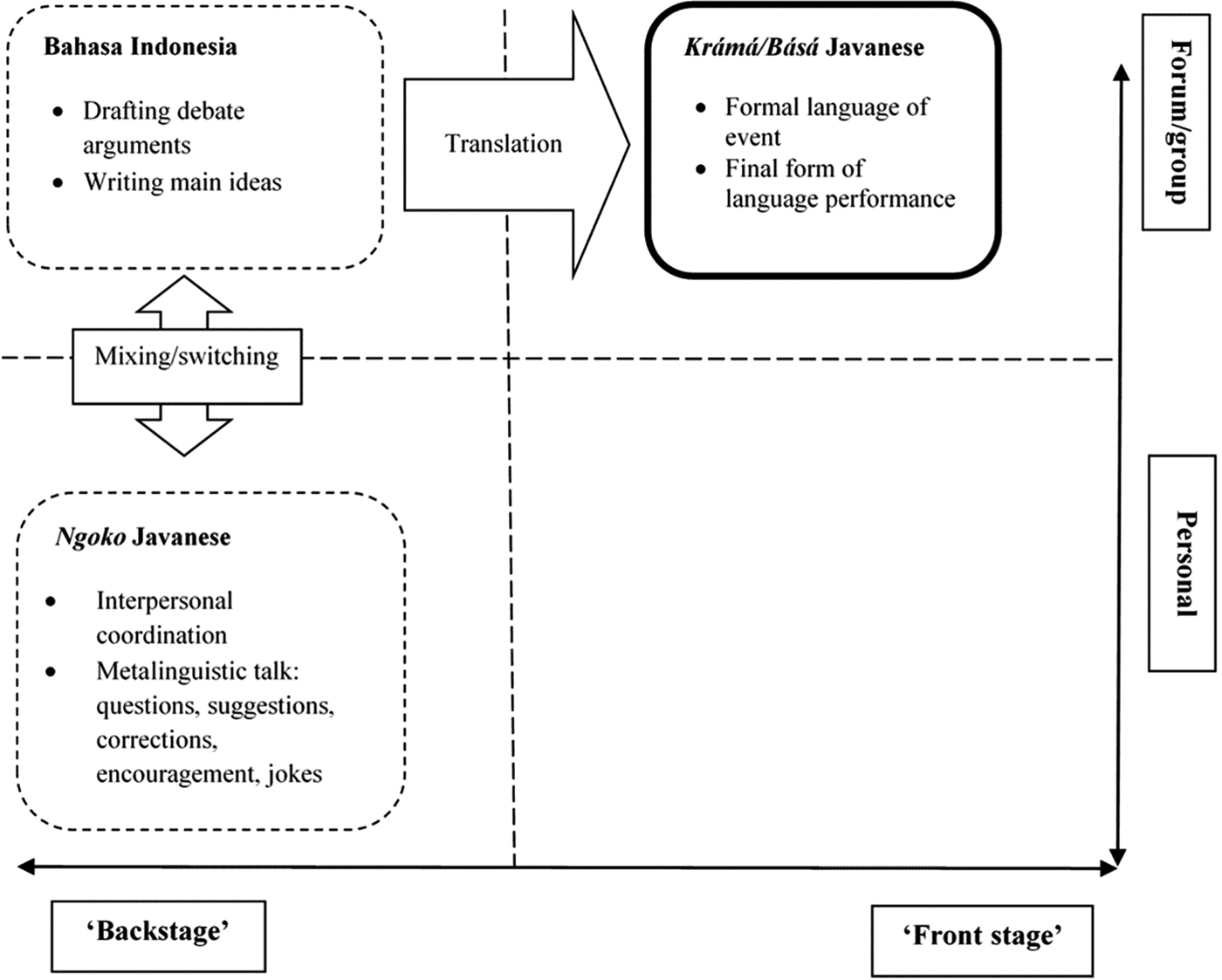
Nonetheless, the language ideological demands of the Javanese language debate's ‘monolanguaging space’ leads the team members to increasingly conduct self-erasure of their translanguaging practices as they move closer towards their debate-ready performance. Their preparatory discussions thus constitute a ‘backstage’ (Goffman Reference Goffman1959) region of performance in which they can still use translanguaging practices as their main ‘interactional or language regime’ (Blommaert, Collins, & Slembrouck Reference Blommaert, Collins and Slembrouck2005). In order to construct performances that meet the standard of the debate's ‘front-stage’ region of performance, the team members increasingly limit (i.e. put under erasure) their translanguaging by either correcting or translating to produce a monolingual krámá Javanese performance, although with difficulties. We can illustrate the discursive process across these inter-related contexts of speech and performance in Figure 2 below.
Interactional regime of debate preparation.

The students’ self-erasure of their translanguaging practices highlight that in certain multilingual contexts in which speakers define local ethnic identity based on notions of ‘reified language’ (Saxena Reference Saxena2011), the emblematic linguistic enactment of these identities often occurs within a monolanguaging space. In contrast to translanguaging spaces, local speakers in monolanguaging spaces seek to perform exclusively in the language form iconic to their ethnolinguistic identity. What I have shown in this section is that speakers accomplish their preparations towards enacting these monolanguaging spaces through a collaborative effort and often using their multilingual repertoires, though they render this multilingual connection under erasure.
CONTESTANT PERFORMANCES: MEETING AND NOT MEETING THE LANGUAGE DEMANDS
The organizers of the Javanese language debate define the event on the exclusive performance of krámá Javanese. For the contestants, this meant operating in a language or interactional regime in which they had to perform all of their public utterances exclusively in krámá Javanese, without any mixture of other languages (Kartini's Return VII Technical Meeting, 14 April 2013). Their main performance is of course the debate itself, in which each team presents their arguments and counter arguments on the debate topics chosen by the organizers. According to the organizer's regulations, each team has to conduct their debate performance purely in high or ‘smooth’ krámá (krámá alus). In this section, I show examples from two debate teams to illustrate a performance that does not meet the organizer's standards and a performance that meets these standards. In particular, I highlight not only the linguistic features of each performance but also certain discursive strategies that the successful contestant uses to integrate Indonesian lexical items into her largely krámá Javanese performance.
As the previous section showed, the SMKN Bebengan team members encountered problems in meeting the organizer's monolingual demands for the debate. This affected their public debate performance and, as a result, they did not pass the first round of the debate competition. Extract (5) below shows a small portion of their debate performed by Ulli.
(5) Debate topic:
Ujian Akhir Nasional dados pathokan keberhasilan proses pendhidhikan.
‘The National Examinations is the benchmark of the success of the education process.’

Of course, there are other teams whose performance largely meets the organizers’ demands. Extract (6) below shows the performance in one of the preliminary rounds of the eventual winner of the debate event, a private Muslim boarding school from Kendal Regency, west of Semarang.
(6) Debate topic:
Bencana alam ing Indonesia mujudaken tanggeljawab pamarentah.
‘Natural disasters in Indonesia bring about the government's responsibility.’

The strength of the performance in extract (6) lies in the relatively thorough use of krámá lexical items and affixes (especially -ipun and -aken) that projects an image of fluency in this speech level. The contestant delivers the speech in an overall smooth manner, especially from line 6 onwards. Even in her pauses, the contestant uses the Javanese form nápá (a clipped form of the krámá question word menápá), which helps make them less prominent. She uses lexical items that other contestants do not commonly use, for example, the conjunction sáhá, the noun mangertási (‘understand’, line 3), and the plural prákáncá (‘friends’, line 8). The speech also contains verbose features, which the Javanese tend to value in krámá public performances (see Pemberton Reference Pemberton1994:197–235; Errington Reference Errington1998b:69). Examples include repetition of phrases (menawi wánten mriki… kitá wánten mriki, lines 5–6), demonstratives (niku bencana alam meniká, lines 7–8), and the use of literal detail in her metaphor about being reflective (kedah ngilowá:: wánten ing nggèné kácá ingkang ageng ‘need to reflect in a mirror that is large’, lines 6–7).
In contrast, Ulli's performance in extract (5) is less smooth. There are pauses throughout the speech and they are more prominent, due to her use of the nonlanguage specific eh. Ulli also uses fewer krámá affixes, and she also uses more forms that are considered ngoko or low krámá (e.g. padal ‘although’, line 3; ngéten ‘like this’, lines 2, 6; nggèn ‘in/at’, line 8). As a result, her speech comes off as less polished and coarse, perhaps even reflecting speech considered as substandard or ‘country’ krámá (see Wolff & Poedjosoedarmo Reference Wolff and Poedjosoedarmo1982:37–39).
Both contestants could not avoid using Indonesian lexical items in their speech. However, the contestant in extract (6) is able to use krámá Javanese affixes—such as -ipun and the ng/ny-aken construction—to integrate these Indonesian items into her krámá speech: for example, khusus-ipun ‘especially’ (line 2), ny-(s)iap-aken ‘prepare’ (line 4), ng-andal-aken ‘rely’ (line 4). This discursive strategy of morphological integration enables Indonesian lexical items to fit ‘transparently’ into largely Javanese utterances, reducing the markedness of these forms as divergences from Javanese (Errington Reference Errington1998b:112–13). The contestant in extract (6) also reproduces the organizers’ practice of using Javanese borrowings of Indonesian lexical items (see the debate topic in extracts (5) and (6)), such as tanggel jawab ‘responsibility’ (line 8) from the Indonesian tanggung jawab and pamarintah/pamarentah ‘government’ (line 6) from the Indonesian pemerintah (the contestant uses both Javanese and Indonesian forms, e.g. lines 5, 6). The structural similarity between Indonesian and Javanese, their numerous cognates, and the ubiquity of Indonesian in local Javanese interaction enables Javanese speakers to exploit these inter-language connections through using Indonesian derived forms in otherwise Javanese language interaction (Errington Reference Errington1998b).
The failure of the SMKN Bebengan team and the success of the performance in extract (6) highlight two main points. The first is that the prestige of krámá rests on its unequal distribution among the native-speaking population, which contrasts with the dominant language ideology that it is the iconic form of Javanese. It is an additional speech level or register that certain social types or classes of speakers, such as the contestant in extract (6), have active control of while others do not. Second, even in the speech of the winning contestant, we can see traces of translanguaging practices and multilingual repertoires, although the discursive strategies the contestant uses helps to make them less visible (i.e. under erasure). The monolanguaging space of the contestants’ krámá performances are thus accomplished through discursive work that implicate yet also put under erasure their multilingual repertoires.
NONCONTESTANT PERFORMANCES: STATUS-BASED ASYMMETRY
In this section, I focus on the performances of adult and college-student noncontestants in the debate, such as the host, event organizers, and the judges, who are also participants that contribute to the overall performance of the debate. I argue that the noncontestants’ performances highlight two aspects of the language and interactional regime shaping the debate as a monolingual space. The first is that as people older than the high school contestants, these noncontestants have a higher social status according to Javanese language ideology. There is thus a status-based asymmetry in language rights and interaction, in which noncontestants have broader rights in language choice while also being entitled to receive deference in krámá Javanese from the contestants. This hierarchy and asymmetry in language rights is similar to what Goebel (Reference Goebel2007, Reference Goebel2014) has shown in his study of language use among bureaucrats in Semarang, in which higher-ranked staff and leaders often initiate the alternations between Indonesian and Javanese as well as the strategic discursive possibilities these alternations offer. Second, their official roles as organizers and judges also give these noncontestants the right to evaluate the contestants’ use of language. As a result, noncontestants are able to deviate from the monolingual krámá Javanese standards (that they themselves have set up) due to this status-based asymmetry, while also evaluating and dictating the linguistic conduct of the debate.
Noncontestants can deviate from the monolingual norm in two broad ways. The first is through situational code-switching, in which language alternation brings forth social meaning that changes the situation (Gumperz Reference Gumperz1982; Bailey Reference Bailey2000:170, Reference Bailey and Heller2007:349). Extracts (7) and (8) provide examples in which the switch into Indonesian functions to signal changes to the situation or differences in the social meaning of the talk.
(7)

In extract (7), the host of the debate (MC), who moderates and leads the event's proceedings, switches into Indonesian (line 2) in order to read out the rules of the event. This constitutes an indexically significant code-switch since it signals a shift in the situation of the talk, from the host greeting the audience to the host reading out or ‘animating’ the regulations ‘authored’ by the organizers (Goffman Reference Goffman1981).
(8)

In extract (8), one of the contestants (PS) poses a question to the host (MC) largely in krámá Javanese. However, because the host could not provide a definite answer, she defers to one of the organizers (line 7) who gives a definitive answer in Indonesian (OG, line 8). The organizer's switch into Indonesian is indexical, since it represents the difference between an unofficial answer from the host and an official answer from a representative of the organizing committee.
Although the rules of the debate specify the exclusive use of krámá Javanese, the code-switch to Indonesian by noncontestants shows us that the asymmetry in language rights enables them to flout this rule while still maintaining their roles in enacting this event. While we can also consider their deviation from krámá as a temporary suspension of the cultural performance, this is nonetheless something that only the higher status noncontestants can do. Either way, this constitutes a form of status-based asymmetry and erasure, in which deviations from the monolingual norm performed by those of higher status are effectively ‘misrecognized’ (Bourdieu Reference Bourdieu1991) as still being part of the monolingual cultural performance.
The second way noncontestants can use other languages, particularly Indonesian, is through intra-sentential language alternation of words and phrases or ‘transfers’ (Auer Reference Auer, Milroy and Muyskens1995), which does not cause any situational change in the utterance. In a way, this is similar to the practice shown in extract (6), where the contestant integrates Indonesian elements into krámá utterances. The difference here is that noncontestants, particularly judges, have the authority to give negative evaluation when contestants do these transfers while also having the privilege of performing these intra-sentential alternations themselves. Extract (9) illustrates this paradox, in which one of the judges (a lecturer at the host university) cautions contestants for using Indonesian while also performing this exact practice of translation and combination (i.e. translanguaging) that he disapproves of.
(9)

In lines 1–5, the judge corrects a number of instances in which contestants use Indonesian lexical items instead of krámá, such as terungkap instead of kawiyat ‘revealed’ (line 1) and sadar diri instead of nglenggáná ‘self-conscious’ (line 3). However, his advice in lines 6–12 features the same instances of translation and alternation that he cautions against: he uses Indonesian lexical items such as menterjemahkan ‘translating’ (line 10) and struktur bahasa Indonesia ‘Indonesian language structure’ (lines 10–11) instead of their equivalent krámá forms. The judge's use of menterjemahkan is particularly salient as Indonesian since, in addition to the root terjemah, it also features the full Indonesian derivational me- and -kan affixes instead of the krámá Javanese affixes such as the ng- and -aken construction.
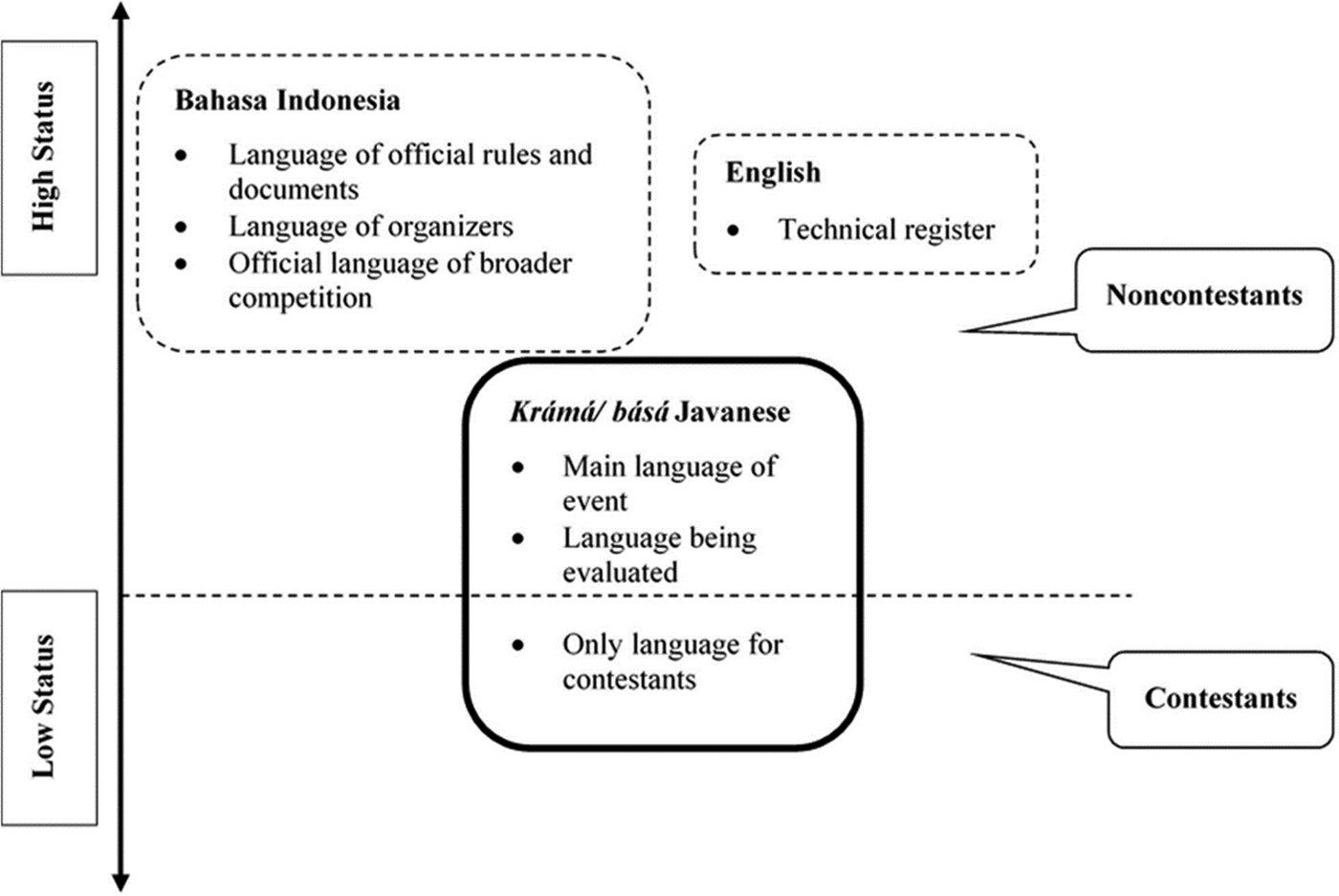
The interactional regime of the Javanese language debate, operating under the principle of status-based asymmetries, allocates broader language rights and evaluative authority to the higher-status noncontestants. The ‘do as I say, not as I do’ correction and advice from the judge in extract (9) illustrates this asymmetry in power, where those of higher status can set the standards of linguistic behavior for others while simultaneously flouting those same standards. We can illustrate the status-based interactional regime of the debate event in Figure 3 below.
Interactional regime of the Javanese language debate.

Looking at the noncontestants’ performance in the Javanese language debate reveals that the monolanguaging space of this cultural performance is built not only on language ideology or public meta-culture but also on the enactment and support of these ideological values by institutional hierarchies and asymmetrical power relations in inter-personal interaction.
CONCLUSION
The Javanese language debate represents an example of a cultural performance in which participants prepare and enact a monolanguaging space by also making use of their multilingual repertoire and translanguaging practices. Speakers of course put this connection between monolanguaging space and translanguaging practices under language ideological erasure and the connection only becomes noticeable through ethnographic observation of a series of connected communicative events.
The ethnographic observation also shows that monolanguaging spaces are performances accomplished through ideological and discursive work. The language ideology or public meta-culture that functions as the underlying framework of Javanese language debate positions the krámá speech level as the iconic language variety of Javanese ethnolinguistic identity. Participants in the Javanese language debate seek to accomplish this monolingual ideal through a number of discursive techniques. The first is through the self-erasure of translanguaging practices that they employ in their preparations for the performance. These include collaboratively pooling their multilingual repertoires and translating their speech into the monolingual standards the debate event demands. Second, successful contestants also use morphological strategies to integrate non-krámá Javanese items into their overall performance. Third, the organizers and contestants enact the monolanguaging space of the actual debate event based on principles of power relations, interactional asymmetry, and social hierarchy. The higher status noncontestants largely define and dictate the form and standard of the monolanguaging space while also enjoying broader rights in language use and the authority of evaluating the contestants’ language performances.
Monolanguaging spaces are thus connected to multi/translingual practices. Recent notions of multilingualism, such as translanguaging, tend to overemphasize the creative and transformative aspect of the use of multiple languages. Part of the reason is their origin in the core of the global North, where contemporary multilingual contexts often revolve around the integration of immigrants. In contrast, the multilingual contexts of the peripheral global South are often about dealing with the transnational flows of global languages on top of the already present dynamics between national and local languages (e.g. Kosonen Reference Kosonen2008; Higgins Reference Higgins2009; Vaish Reference Vaish2010; Saxena Reference Saxena2011). In these contexts, the language ideological demands for local language maintenance may lead to the erasure of the use of translanguaging practices in favor of monolanguaging spaces and performances that conserve an iconic representation of local ethnolinguistic identity. The erasure of translanguaging, however, enables it to co-exist in practice with monolanguaging spaces, as long as it remains invisible in relation to the dominant language ideology or public meta-culture.
An ethnographic approach to monolanguaging spaces that is attuned to speakers’ evaluations of languages reveals nuances in the way speakers define and perform their local language. These nuances complicate not only our understanding of local languages but also our efforts in maintaining them. As Zentz (Reference Zentz2014) points out, the monolingual emphasis of modernist language ideology (i.e. one nation/ethnicity, one language) leads to the view of language shift primarily as shifts in the language forms or codes that people use. This distorts the fact that it is actually about changes in the social contexts and social structures surrounding language use. I argue further that common views of language maintenance are often based on iconizations of certain language forms without critically viewing their relationship to social identities, contexts, and social relations. In Central Java, the hegemonic krámá-centric language-ideology projects an ideal social identity associated with local nobility that is in turn produced through traditional notions of polite or respectable interaction based on asymmetrical relations of power and status. The resulting monolanguaging spaces reflect not only the dominant language ideology and public meta-culture but also reflect (and often rely on) the power relations and social structure that invisibly support this cultural ideology.
Viewing monolanguaging spaces as connected to multi/translingual practices uncovers the contradictions and dissonances that strike at the heart of the way speakers consider what it means to speak a language and to be of a certain ethnolinguistic identity. In other locales, these dissonances can lead to ‘language ideological debates’ (Blommaert Reference Blommaert1999), where language users openly negotiate definitions of languages and their sociopolitical uses and values. In Indonesia, where a centralistic and monologic ideal of unity has a long history of political dominance, speakers have tended not to publicly articulate these debates (though, see Zentz Reference Zentz2014 for examples of personal tensions in dealing with krámá Javanese language norms). Hence, just as krámá is an effective sociolinguistic mask that dissimulates tension, disagreement, and conflict, the krámá-centric Javanese traditional identity functions also as a dominant symbol of a unified ethnic identity that masks diversity, stratification, friction, and social change within contexts of seemingly social harmony (cf. de Jong & Twikromo Reference de Jong and Twikromo2017).
APPENDIX: TRANSCRIPTION CONVENTIONS