Introduction
When analysing patterns of relative abundance of parasite species among host individuals, parasite body size can be used as a proxy for productivity (Mouillot et al., Reference Mouillot, George-Nascimento and Poulin2005) and estimates of parasite energetic requirements (George-Nascimento et al., Reference George-Nascimento, Muñoz, Marquet and Poulin2004; Poulin & George-Nascimento, Reference Poulin and George-Nascimento2007). However, patterns in parasite communities are commonly detected using only numerical descriptors, which may not hold when parasite mass is used. For example, in the southern pomfret, Brama australis Valenciennes, parasite infracommunities did not show significant correlations between numerical and volumetric descriptors, nor between numerical abundance and the body size of parasites (George-Nascimento et al., Reference George-Nascimento, Garcías and Muñoz2002).
The host whose infracommunities are studied here, Genypterus maculatus Tschudi, is a marine fish species that harbours one of the largest parasite species reported along the coast of Chile, the cestode Anonchocephalus chilensis Riggenbach. Although this host is said to harbour species-poor infracommunities (George-Nascimento & Huet, Reference George-Nascimento and Huet1984; Mouillot et al., Reference Mouillot, George-Nascimento and Poulin2005), other analyses suggest structured infracommunities (Mouillot et al., Reference Mouillot, George-Nascimento and Poulin2005). Some authors have interpreted patterns in species distribution and/or abundance as a result of interspecific interactions (Gotelli & Rohde, Reference Gotelli and Rohde2002; Mouillot et al., Reference Mouillot, George-Nascimento and Poulin2005), while others have considered that a species assemblage is structured if it diverges in a repeatable or predictable way from a random assortment (Poulin, Reference Poulin1998). In any case, most parasite infracommunities in marine fishes seem to be unsaturated with either individuals or species, and therefore intra- and interspecific competition would not be important, but only sporadic (Rohde, Reference Rohde1984, Reference Rohde2005; Poulin, Reference Poulin1998; Mouillot et al., Reference Mouillot, George-Nascimento and Poulin2003, Reference Mouillot, George-Nascimento and Poulin2005; Muñoz et al., Reference Muñoz, Mouillot and Poulin2006).
Among infracommunity patterns found to hold across host species, a consistent, decreasing relationship between evenness and abundance, both measured as biovolume, has been reported in eight marine fish host species off the coast of Chile (Mouillot et al., Reference Mouillot, George-Nascimento and Poulin2005). These authors suggested that the pattern could emerge because in an immunologically polymorphic host population, highly resistant host individuals should show low levels of productivity ( = total parasite biovolume per infracommunity), affecting rare parasite species more strongly, which would lead to high evenness values. Conversely, in more productive parasite infracommunities, host individuals would be more prone to become re-infected, and then a decrease in evenness would be expected because these more susceptible hosts would be able to accept more species, leading to higher rates of recruitment of rare species, resulting in low evenness values.
Here we evaluate the existence of patterns in parasite infracommunities of G. maculatus by: (1) taking into account the relationships of aggregated descriptors (see Micheli et al., Reference Micheli, Cottingham, Bascompte, Bjørnstad, Eckert, Fischer, Keitt, Kendall, Klug and Rusak1999) between parasite numerical and volumetric forms, as well as with host body mass; (2) assessing the relationship between evenness and abundance; (3) testing whether species co-occurrences depart from expected frequencies in competitively structured communities (e.g. C-score, V-ratio; see Gotelli, Reference Gotelli2000; Mouillot et al., Reference Mouillot, George-Nascimento and Poulin2005); and (4) by means of comparing abundance in infracommunities with and without A. chilensis.
Materials and methods
Ninety G. maculatus host individuals obtained from landings made by artisanal fishermen near Tumbes, Bio Bio region, central Chile, in the austral spring months of October and November 2005, were examined for parasites. Hosts were kept frozen at − 18°C until examination. After defrosting, fish body mass (g) was measured, and parasites collected as described in George-Nascimento & Iriarte (Reference George-Nascimento and Iriarte1989). The body volume of each parasite taxon was measured as described in George-Nascimento et al. (Reference George-Nascimento, Muñoz, Marquet and Poulin2004) and expressed in mm3. Both ecto- and endoparasites were included in the analysis since the unit of replication in this study is the host individual, or the parasite infracommunity, i.e. all parasites of all species within one individual host (Bush et al., Reference Bush, Lafferty, Lots and Shostak1997; Muñoz et al., Reference Muñoz, Mouillot and Poulin2006). In addition, all the species in these communities have the potential for direct or indirect interactions (Rohde, Reference Rohde2005; Pedersen & Fenton, Reference Pedersen and Fenton2007)
In addition to species richness, the following infracommunity descriptors were calculated in numbers and biovolume: abundance (Bush et al., Reference Bush, Lafferty, Lots and Shostak1997), diversity (Brillouin's index), dominance (Berger–Parker index) and evenness (Bulla's ‘O’ index) (see Mouillot, Reference Mouillot2002). The Spearman rank correlation coefficient was calculated to assess the association between the host body mass and the aforementioned descriptors, as well as to explore relationships between numerical and volumetric measurements in parasite infracommunities with and without A. chilensis.
We compared the total volumetric abundance of parasitic taxa other than A. chilensis between infracommunities with and without the cestode, by means of the Tsutakawa and Hewett test (Tsutakawa & Hewett, Reference Tsutakawa and Hewett1977). This test involves fitting an OLS regression line (the one that gives the best fit) to the whole data set, and then compares, by means of a contingency table analysis, the distribution of bivariate data above and below the regression line.
The relationship between evenness and total abundance, both measured as biovolume, was examined using the regression model described by Mouillot et al. (Reference Mouillot, George-Nascimento and Poulin2005), with special emphasis on the effect that the presence of A. chilensis could have.
Two indices were used to detect whether parasite infracommunities significantly deviated from patterns expected for competitively structured communities: these were the C-score and V-ratio, both of which are based on the presence/absence matrix (see Gotelli, Reference Gotelli2000; Gotelli & Rohde, Reference Gotelli and Rohde2002; Mouillot et al., Reference Mouillot, George-Nascimento and Poulin2005). The observed C-scores were compared to a simulated distribution of C-scores, obtained by fixing the sum of rows and columns of the presence/absence matrix, with 5000 C-scores calculated using the program EcoSim 7.0 (Gotelli & Entsminger, 2007). The observed V-ratio was calculated as the ratio between the column sum (numerator) and the row sum (denominator) in a presence/absence matrix, with parasite taxa in rows and host individuals in columns. If a niche limitation restricts the number of coexisting species, the variance in species richness across host individuals will be small compared to the null model (indicating a community structured by competition; Gotelli, Reference Gotelli2000; Mouillot et al., Reference Mouillot, George-Nascimento and Poulin2005). Using EcoSim 7.0 software we generated a null distribution with all row sums fixed (the number of occurrences for each parasite species is assumed to be constant) and all columns equiprobable (each parasite species is randomly assigned to a host individual, but only as many as expected according to their prevalence in the tested sample). Then, 5000 indices were generated to compare the observed V-ratio with the simulated distribution of V-ratios.
Results
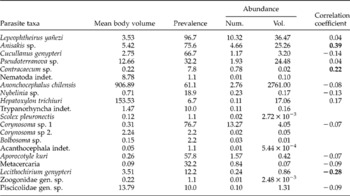
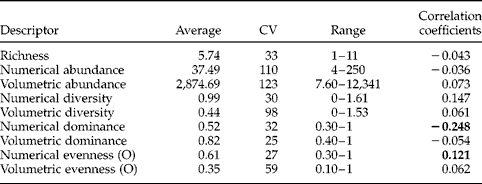
All of the hosts examined harboured parasites (average: 5.74 species; coefficient of variation, CV: 33%), with a total of 3374 parasite individuals collected. The total number of parasites per host spanned c. 3 orders of magnitude, whereas the total biovolume of parasites per host spanned c. 7 orders of magnitude (table 1). Parasite body size was positively correlated with volumetric abundance (Spearman correlation coefficient, r s = 0.80, P < 0.0001, n = 20). Also, numerical abundance and volumetric abundance were positively correlated (r s = 0.53, P < 0.0001, n = 90) (table 2). However, parasite body size was not significantly correlated with either numerical abundance (r s = 0.30, P = 0.19, n = 20) or prevalence (r s = 0.34, P = 0.14, n = 20). Consequently, taxa accounting for the values of a given community index measured in its numerical form are not the same taxa that account for indices when measured in the volumetric form.
Mean body volume (in mm3), prevalence, abundance in numbers (Num.) and in biovolume (Vol.), and Spearman rank correlation coefficients between the volumetric abundance and the host body mass of parasite taxa found in Genypterus maculatus off Chile. Bold entries are significant at α=0.05.

Spearman correlation matrix between parasite infracommunity descriptors in 90 specimens of the black ling (Genypterus maculatus). Num., refers to numerical data and Vol. to volumetric data.

*P < 0.05; **P < 0.01; ***P < 0.001.
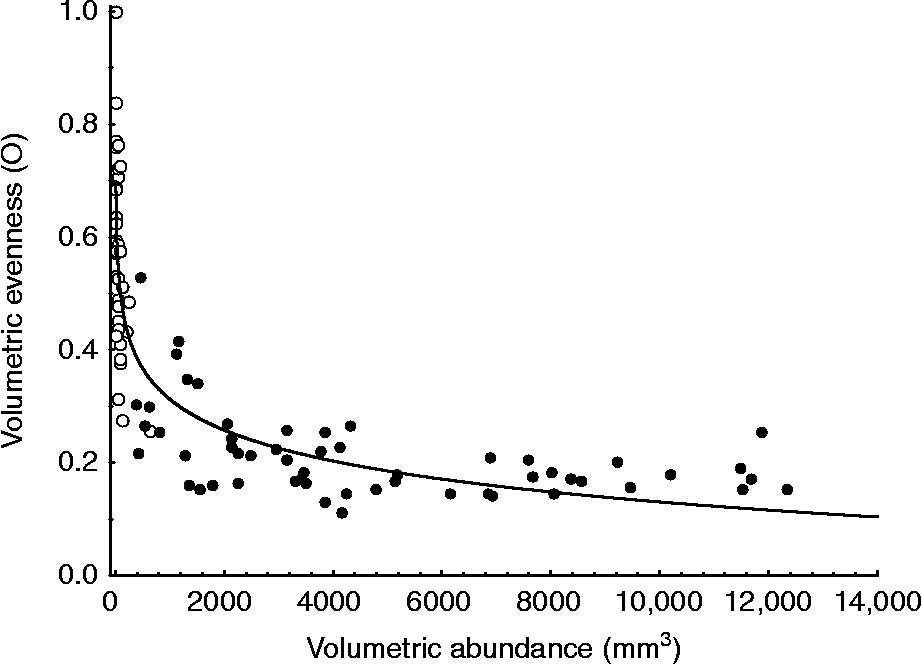
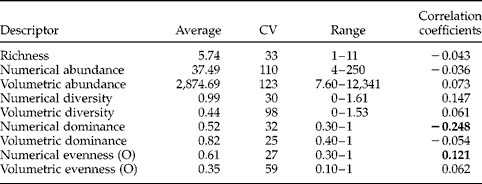
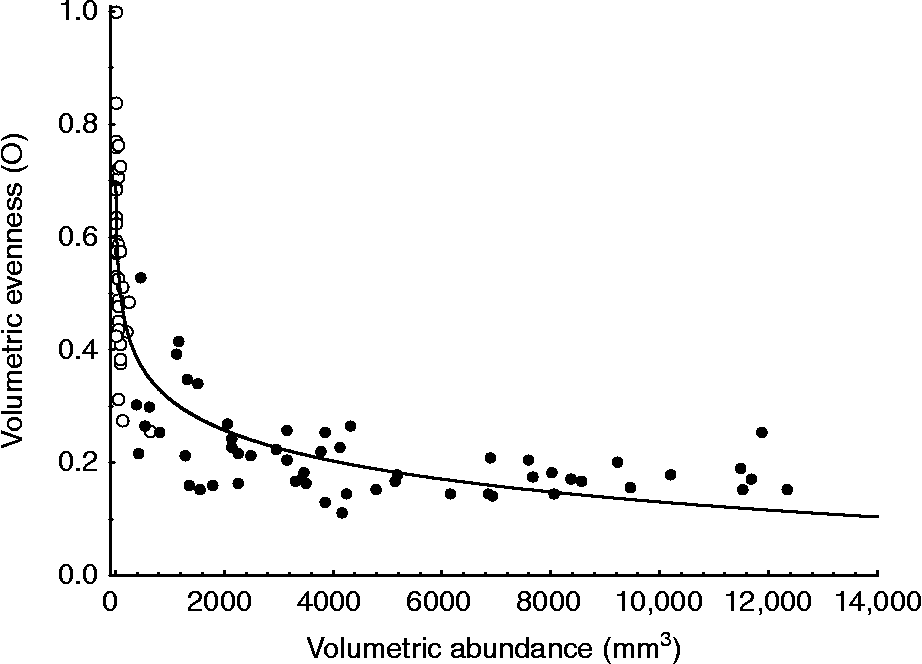
Only numerical dominance and numerical evenness showed significant correlations with host body mass (table 3). The best regression model relating evenness and total abundance in biovolume was given by a log linear function (F 1,88 = 272.65, P < 0.0001, R 2 = 0.75). The lowest values of abundance correspond to the highest evenness values, that is, where A. chilensis is absent, whereas the highest volumetric abundance and lowest evenness values are found where the cestode is present (fig. 1).
Average, coefficient of variation (CV), range, and Spearman rank correlation coefficients of numerical and volumetric descriptors with the host body mass for 90 parasite infracommunities in Genypterus maculatus. Bold numbers show significant values (P<0.05).
Regression between volumetric evenness (Bulla's ‘O’ index) and volumetric abundance (V), in mm3, of parasite infracommunities in Genypterus maculatus, according to the presence (solid circles) or absence (empty circles) of Anonchocephalus chilensis. O = − 0.079Ln(V) +0.85; R 2 = 0.75.
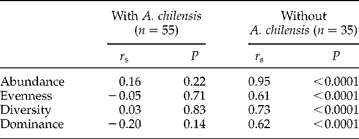
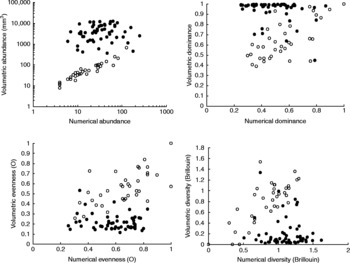
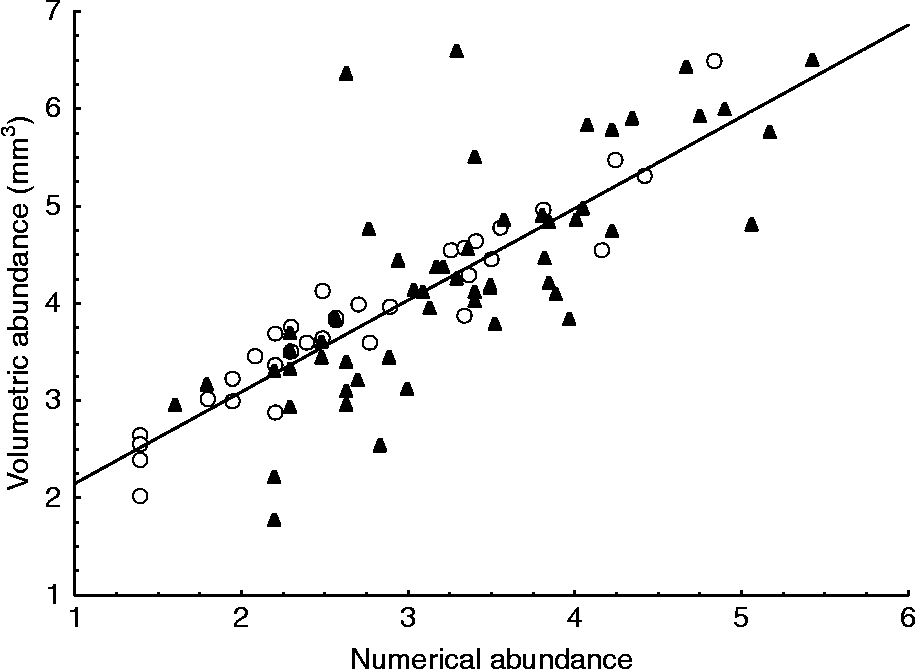
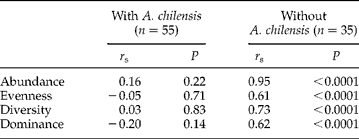
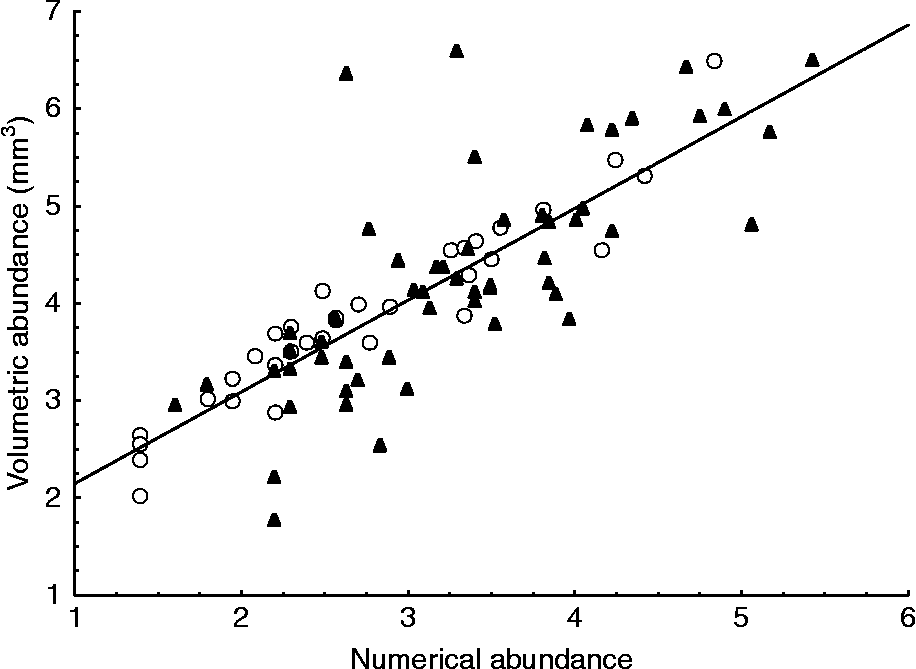
Abundance, dominance, evenness and diversity present positive correlations between their numerical and volumetric forms only in infracommunities where A. chilensis is absent (table 4, fig. 2). When A. chilensis is present, the remaining species showed a lower total volumetric abundance than in infracommunities without the cestode (fig. 3, Tsutakawa and Hewett test, χ2 = 6.66, df = 1, P = 0.010).
Spearman correlation coefficients between numerical and volumetric descriptors of parasite infracommunities in Genypterus maculatus, according to the presence of the cestode Anonchocephalus chilensis.
Relationship between numerical and volumetric descriptors of parasite infracommunities in Genypterus maculatus (abundance, evenness, diversity, dominance), according to the presence (solid circles) or absence (empty circles) of Anonchocephalus chilensis.

Ordinary least square regression between the abundance in numbers and the abundance in biovolume of all parasite species, except for Anonchocephalus chilensis, in Genypterus maculatus, according to the presence (solid triangles) or absence (empty triangles) of A. chilensis.
Observed C-scores were not significantly different from those expected by chance (table 5). The observed V-ratio was significantly higher than the expected value from the simulation, indicating that interspecific interactions are not an important structuring force in these communities (table 5).
C-score and V-ratio calculated for parasite infracommunities of the black ling (Genypterus maculatus). Basic statistics are shown for the simulated indices and their associated probability.

Discussion
The infracommunity richness found in this study was larger than that observed in previous studies of this host species (George-Nascimento & Huet, Reference George-Nascimento and Huet1984, Mouillot et al., Reference Mouillot, George-Nascimento and Poulin2005). However, the taxa with the highest prevalence and abundance were roughly the same as in previous studies (i.e. Lepeophtheirus yañezi, Cucullanus genypteri, Anisakis sp. and A. chilensis), suggesting stability of parasite community composition in G. maculatus.
The significant positive correlations of volumetric abundance with volumetric dominance, and between richness with numerically based diversity reveal that a few species account for the majority of the observed variation. Similar reasoning is applicable for the negative correlations found between abundance and evenness, as well as between richness and evenness (see table 2). These correlations are mainly explained by Corynosoma sp. and L. yañezi in its numerical form, and by A. chilensis in its volumetric form (table 1).
Numerical and volumetric abundance are neatly correlated in infracommunities where A. chilensis is absent, but the correlation disappears when the cestode is present (table 5), and total parasite biovolume reaches a maximum value independent of total numerical abundance of parasites (see fig. 2).
According to the results obtained with the C-score index, parasite infracommunities in G. maculatus are not structured by interspecific competition, which is contrary to analyses by Mouillot et al. (Reference Mouillot, George-Nascimento and Poulin2005) on the same host species. However, since previous analyses were based on presence/absence data, it is no longer possible to evaluate the potential influence of competition on abundance, as seen in this study, in infracommunities where A. chilensis is present.
Furthermore, the smaller total biovolume attained by the remaining parasite species in the presence of the cestode suggests the competitive effect of A. chilensis (fig. 3). These observations can be explained by the huge body volume of the cestode, which perhaps interferes with the growth of the remaining species, similar to the situation with Diococestus asper in the grebe Podiceps grisegena (Stock & Holmes, Reference Stock and Holmes1987).
In this sense, the immunological hypothesis proposed by Mouillot et al. (Reference Mouillot, George-Nascimento and Poulin2005) as an explanation for the negative relationship between total volumetric abundance and volumetric evenness is applicable whenever species are not too different in body size. In cases like this, where a large species accounts for most of the total biovolume in the infracommunities (fig. 1), the decrease in volumetric evenness in infracommunities with high volumetric abundance is not due to the addition of rare species, rather it is due to the presence of a much larger species.
Finally, the pattern observed in the host G. maculatus between the numerical and volumetric infracommunity descriptors is not likely to be found in G. chilensis or G. blacodes (unpublished data), where A. chilensis is also a highly prevalent species (Vergara & George-Nascimento, Reference Vergara and George-Nascimento1982; George-Nascimento & Huet, Reference George-Nascimento and Huet1984; Riffo, Reference Riffo1994; Mouillot et al., Reference Mouillot, George-Nascimento and Poulin2005). This observation highlights that it cannot be anticipated that the cestode will behave in a similar way in other host species. Consequently, complementary analyses of infracommunity patterns of its numerical and volumetric forms must be considered.
Acknowledgements
This study was supported by grant FONDECYT 1050528. Special help by Paula Neill was essential to improve our written version.