Introduction
Although kidney transplantation is effective for treating chronic kidney disease (CKD) in children, the progressive loss of renal function and the development of cardiovascular disorders remain severe and undesirable complications of this procedure.Reference McDonald and Craig 1 – Reference Seeman 3 The development or persistence of hypertension (HTN) during the post-transplantation period is a major cardiovascular comorbidity among these patients.Reference Seeman 3 – Reference Charnaya and Moudgil 6 It is also likely that post-transplantation HTN promotes graft loss and decreases survival due to its adverse effect on renal function.Reference Mitsnefes, Khoury and McEnery 5 Besides donor and recipient factors, the most commonly identified risk factors for post-transplantation HTN include time on dialysis, immunosuppressive therapy, and transplant renal artery stenosis.Reference Charnaya and Moudgil 6 However, the role of prenatal variables has been underexplored.
Over the past three decades, there has been much focus on the role of low birth weight (LBW) as an important risk factor in the later development of cardiovascular diseases.Reference Barker 7 – Reference Franco, Christofalo, Sawaya, Ajzen and Sesso 9 Evidence suggests that children who are born with LBW are at increased risk for high blood pressure, renal damage and endothelial dysfunction.Reference Franco, Christofalo, Sawaya, Ajzen and Sesso 9 , Reference Franco, Nishida and Sesso 10 Despite this, there is no information to date regarding whether LBW could be an additional risk factor for arterial HTN in kidney transplanted children. Therefore, this study aimed to evaluate the effect of LBW on the incidence of HTN in paediatric patients during the 6–72 months following renal transplantation.
Methods
We conducted a case-control study involving paediatric patients in the Renal Transplant Unit of the Nephrology Division at the Kidney & Hypertension Hospital (Federal University of São Paulo; UNIFESP-EPM, São Paulo, Brazil). This study included 96 children who underwent kidney transplantation (60 boys and 23 girls). Patients of either sex were included in this study if the prenatal data were available and if the post-transplantation duration was 6–72 months. Based on these criteria, four patients were excluded for missing birth weight data; one patient, for transplantation time longer than 72 months; and eight patients, for high birth weight (≥4000 g). None of the patients included in this study had a systemic infection or clinically diagnosed and biopsy-proven acute rejection. Each patient’s medical records were reviewed, and pre- and post-transplantation data were extracted. Prenatal data were obtained via a structured interview wherein the presence of pregnancy complications (e.g., previous spontaneous abortion, gestational diabetes, preeclampsia, placental diseases), type of childbirth, use of medications or drugs of abuse during pregnancy. The birth weight data from the mother’s recall were confirmed with medical records. At the time of recruitment, the body weight and height were measured using a standard balance beam. HTN was diagnosed by the nephrologist during the clinical visit and defined as a systolic or diastolic blood pressure >95th percentile for age, sex and height. 11 All children with HTN receive antihypertensive medication treatment, and no children have borderline or severe HTN. The estimated glomerular filtration rate (eGFR) was determined based on the serum creatinine (Scr) levels using the Bedside Schwartz equation as follows: (eGFR = 0.413 ×-height (cm)/Scr [mg/dl]=ml/min/1.73 m2). The following cutoff points were adopted: LBW < 2500 g, donor age >13 years (>50th percentile), cold ischemia time > 1283 min (>50th percentile), time from transplantation >14 months (> 50th percentile), CKD (eGFR < 60 ml/min/1.73 m2)Reference Schwartz and Work 12 , 13 and overweight/obesity (body mass index ‐ BMI > 85th percentile).
Statistical analysis
Categorical variables are presented as frequencies and percentage distributions. Continuous variables are expressed as means, standard deviations and ranges. The analyses were performed by stratifying patients according to the presence or absence of HTN. Logistic regression analyses were performed to establish the degree of association between various risk factors and post-transplantation HTN. Multivariate logistic regression models were fitted for the presence of confounding factors. All variables showing a P < 0.20 in the univariate analysis were presented to the multivariate models by using the forward method. Variables were retained in the model if a Wald test revealed P < 0.05. Data are expressed as odds ratios (OR) and 95% confidence intervals (CI). Statistical analyses were performed in SPSS version 22 (IBM, Armonk, New York, USA).
Results
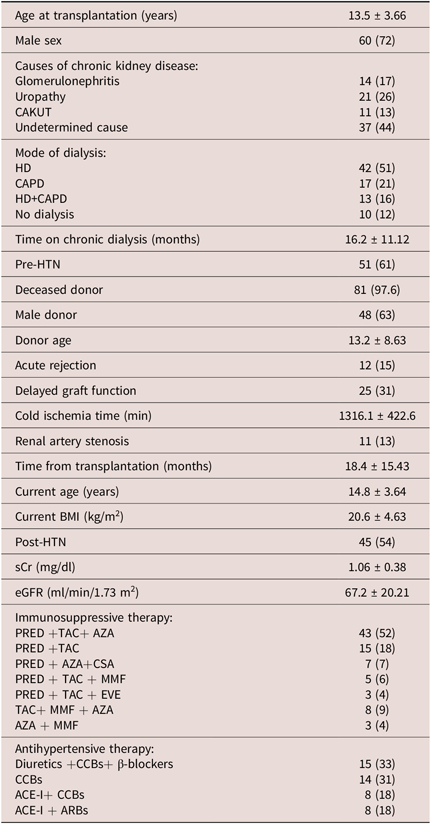
The present study included 83 paediatric transplant patients (72% male) with a mean age at transplantation of 13.5 years (range, 3–17 years) (Table 1). Mean birth weight was 2922 g (range, 2000–3900 g), the incidence of LBW (<2500 g) was 25% and the rate of prematurity was 12% (n = 10). The causes of kidney failure were uropathy (26%), glomerulonephritis (17%), congenital anomalies of the kidney and the urinary tract (CAKUT, 13%) and undetermined aetiology or other causes (44%) (Table 1). Only 12% of the patients did not receive dialysis treatment. Of the 73 patients who did receive dialysis treatment, 51% received haemodialysis (HD), 21% continuous ambulatory peritoneal dialysis (CAPD) and 16% began HD and later switched to CAPD. Mean duration of dialysis was 16 months (range, 1–57 months) and 51% received dialysis for more than 14 months (Table 1). HTN was observed in 61% of the patients before kidney transplantation (Table 2). We found that the risk of developing HTN during this period was higher in patients who received HD (OR: 3.2, 95% CI: 1.04–9.81; P = 0.038), those who had LBW (OR: 3.0, 95% CI: 0.98–9.20; P = 0.049) and those who received dialysis treatment for more than 14 months (OR: 3.9, 95% CI: 1.41–10.87; P = 0.007).
Critical variables before and after kidney transplantation

CAKUT, congenital anomalies of the kidney and the urinary tract; HD, haemodialysis; CAPD, continuous ambulatory peritoneal dialysis; BMI, body mass index; sCr, serum creatinine; eGFR, glomerular filtration rate estimated by creatinine; TAC, tacrolimus; MMF, mycophe-nolate mofetil; AZA, azathioprine; CSA, cyclosporine A; PRED, prednisone; EVE, everolimus; ACE-I, ACE inhibitors; CCBs, calcium channel blockers; ARBs, angiotensin receptor blockers; HTN, hypertension.
Data are reported as number with percent in parentheses or mean with standard deviation.
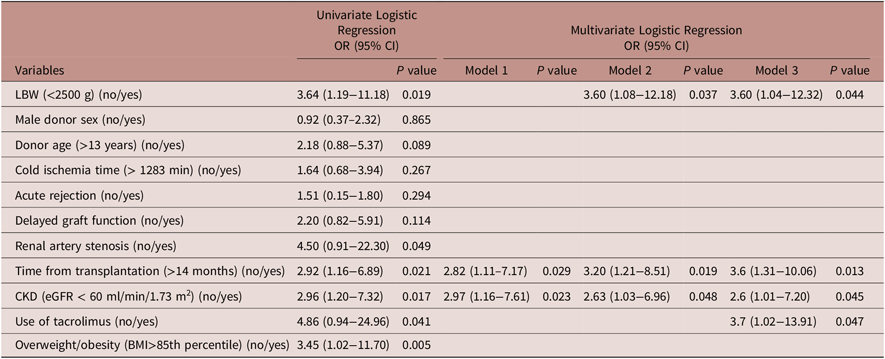
Univariate and multivariate logistic regression analyses of factors associated with post-transplantation HTN in paediatric patients

CKD, chronic kidney disease; eGFR, estimated glomerular filtration rate; BMI, body mass index; HTN, hypertension; LBW, low birth weight.
Data are reported as odds ratio (OR) and 95% confidence interval (95% CI).
Cutoffs points used were: LBW < 2500 g, donor age >13 years (>50th percentile), cold ischemia time > 1283 min (>50th percentile), time from transplantation >14 months (>50th percentile), CKD (eGFR < 60 ml/min/ 1.73 m2) and overweight/obesity (BMI > 85th percentile).
Model 1: Multivariate logistic regression, overall model adjusted for donor age, delayed graft function, renal artery stenosis, time from transplantation, current CKD and use of tacrolimus.
Model 2: Multivariate logistic regression, adjusted for covariates in Model 1 plus LBW.
Model 3: Multivariate logistic regression, adjusted for covariates in Models 1 and 2 plus current overweight/obesity.
Donor characteristics are shown in Table 1. Most patients received a kidney from a deceased donor (97.6%) and the mean donor age was 13.2 years (range, 2–47 years). Only 9 of the donors were adults and 74 donors were younger than 18 years of age. Overall, 12 recipients experienced an episode of acute rejection and 11 had renal artery stenosis (Table 1). With respect to the time from transplantation, 42 of 83 (51%) patients underwent kidney transplantation more than 14 months prior to this study. Most recipients were on triple immunosuppressive therapy (78%). Fifteen recipients were taking only prednisone with tacrolimus and three additional recipients received immunosuppression schemes with mycophenolate mofetil associated with azathioprine (Table 1). Thirteen patients (33%) were on triple antihypertensive drug therapy and 31% received only calcium channel blockers (CCBs). Sixteen recipients were taking ACE inhibitors with CCBs or angiotensin receptor blockers (Table 1). After renal transplantation, 34 of 83 (41 %) children had CKD. HTN was detected in 45 children and 26 children had HTN and CKD. Importantly, the presence of both conditions was significantly higher among patients with a history of LBW (46% vs. 16%; OR 4.57; 95% CI 1.60–13.08; P = 0.003). Overweight or obesity in the post-transplantation period was noted in 18 of 83 patients (22%). A univariate logistic analysis revealed that the risk of post-transplantation HTN was higher among patients with a history of LBW, with renal artery stenosis, underwent transplantation >14 months, were on immunosuppressive therapy that included tacrolimus, were overweight or obese, or had CKD (Table 2).
We performed a multivariate logistic regression model fit in a forward fashion with all covariates that tended to correlate (P < 0.20) with the development of post-transplantation HTN (Table 2). In the first model we considered variables related to recipient and donor characteristics (e.g., delayed graft function, renal artery stenosis, donor age, time from transplantation, current CKD and tacrolimus use). In this model, time from transplantation >14 months and current CKD were independent predisposing factors (Table 2). To account for a potential confounding effect of LBW, a second model was fit with the same variables as well as with the birth weight category. We found that time from transplantation >14 months, current CKD and LBW were also associated with post-transplantation HTN (Table 2). The subsequent inclusion of current nutritional status in the final model supports the presence of a significant relationship between post-transplantation HTN and time from transplantation >14 months, current CKD, LBW and current overweight/obesity (Table 2).
Discussion
It is well recognised that the negative consequences of LBW begin at birth and continue to manifest during childhood until adult life.Reference Barker 7 – Reference Franco, Nishida and Sesso 10 A predisposition to arterial HTN conferred by LBW may promote additional risk in kidney-transplanted children. HTN is a frequent cause of complications in paediatric patients after kidney transplantation and represents a significant risk factor for cardiovascular diseases.Reference Seeman 3 – Reference Charnaya and Moudgil 6 For this reason, transplanted children constitute a critical group and knowledge of new risk factors is of great importance.
In the present study we show evidence that kidney-transplanted children who weigh less than 2500 g at birth were more likely to develop post-transplantation HTN. We also identified considerable risk of post-transplantation HTN in patients who underwent transplantation >14 months, in those who already presented with a loss of renal function and in those who were overweight/obese. Several risk factors contribute towards the development of post-transplantation HTN in kidney-transplant recipients.Reference Charnaya and Moudgil 6 , Reference Weir, Burgess and Cooper 14 Its multifactorial aetiology includes donor factors, immunosuppressive medications (e.g., calcineurin inhibitors), current obesity and genetic factors.Reference Charnaya and Moudgil 6 , Reference Weir, Burgess and Cooper 14 , Reference Seeman 3
It is well established that the duration following transplant contributes to the aetiology of HTN.Reference Charnaya and Moudgil 6 The prevalence of risk factors, such as obesity, immunosuppressive medication effects, renal artery stenosis, recurrent CKD and sedentarism, tends to be higher 1 year after kidney transplantation.Reference Charnaya and Moudgil 6 Our study is in line with the literature, showing that patients who underwent kidney transplantation more than 14 months ago presented with a 3.6-fold increase in the odds of developing HTN. Although the predicted association between loss of kidney function and post-transplantation HTN is unclear in the literature, our findings suggest that the increased likelihood of post-transplantation HTN may be due to worsening kidney function. This is supported by the observation that HTN incidence among patients was 2.6-fold higher in patients with eGFR <60 ml/min/1.73 m2. Previous studies have shown a negative correlation between GFR and blood pressure levels in paediatric transplant patients.Reference Silverstein, Mitchell, LeBlanc and Boudreaux 15 Some studies have also reported that lower eGFR levels were a significative risk factor for post-transplantation HTN in paediatric patients after 6 monthsReference Nagasako, Nogueira, Machado and Pestana 16 and 3 yearsReference Nagasako, Nogueira, Machado and Pestana 17 of renal transplantation. Finally, obesity is also commonly observed in patients after kidney transplantation due to multiple causes, including steroids use, physical inactivity, and lack of dietary counseling.Reference Mitsnefes, Khoury and McEnery 5 , Reference Charnaya and Moudgil 6 We noted that currently overweight or obese patients had a 3.7-fold increase in the odds of developing post-transplantation HTN. Our results are supported by the results of some studies reporting higher body mass indices for paediatric patients after kidney transplantation.Reference Nagasako, Nogueira, Machado and Pestana 17 , Reference Carvalho and Soares 18
Although our study provides evidence that LBW is a risk factor for post-transplantation HTN in paediatric patients, we did not provide insights into the possible mechanisms. Some studies have reported that LBW children commonly present with changes in endothelial function due to multiple factors, including decreased circulating nitric oxide levels and high levels of uric acid and homocysteine.Reference Franco, Christofalo, Sawaya, Ajzen and Sesso 9 , Reference Franco, Higa and D’Almeida 19 In addition, it has been proposed that individuals with LBW are more susceptible to HTN due to a reduction in nephron numbers.Reference Luyckx and Brenner 20 It is plausible that transplantation patients with LBW could have some degree of endothelial dysfunction, impairment of nephron number or alterations in biomarkers that contribute to the development of post-transplantation HTN. LBW would, therefore, emerge as a significant risk factor for recipients of renal allografts.
We recognise that our study has limitations. Our data were retrospectively collected in a single centre from a small number of patients. We have limited information regarding donor factors, immunosuppressant dosing and lifestyle habits. Moreover, we cannot make inferences about how long time the patient became hypertensive. Therefore, further studies that investigate other confounding factors are needed for risk assessments related to post-transplantation HTN and birth weight.
In conclusion, our data suggest that LBW is a potential risk factor for developing post-transplant HTN. This finding has important clinical implications as it serves to alert clinicians about this additional risk factor in paediatric patients undergoing kidney transplant.
Acknowledgements
First, we would like to thank the families participating in this study for their cooperation. We thank nurse Poliana Pedroso Lasanha and nephrologist Luciana Porini for their excellent work and engagement.
Financial Support
This research was supported by a Project Grant from the Fundação de Amparo à Pesquisa do Estado de São Paulo, Brazil (FAPESP; Project Number: 2013/03139-0), and Conselho Nacional de Desenvolvimento Científico e Tecnológico (CNPq; Project Number: 443248/2014-1).
Conflicts of Interest
None.
Ethical Standards
The study was conducted according to the guidelines of the Declaration of Helsinki. All procedures described in this study were approved by the Ethics Committee of the Federal University of São Paulo (Number: 354.875). All parents and children signed written informed consent/assent forms.