Introduction
Various perinatal risk factors have been identified as associates of adverse offspring mental health outcome in adulthood (Thompson et al. Reference Thompson, Syddall, Rodin, Osmond and Barker2001; Mittendorfer-Rutz et al. Reference Mittendorfer-Rutz, Rasmussen and Wasserman2004; Riordan et al. Reference Riordan, Selvaraj, Stark and Gilbert2006, Reference Riordan, Morris, Joanne Hattie and Stark2011; Zammit et al. Reference Zammit, Odd, Horwood, Thompson, Thomas, Menezes, Gunnell, Hollis, Wolke, Lewis and Harrison2009; Gravseth et al. Reference Gravseth, Mehlum, Bjerkedal and Kristensen2010) but it is not clear how such associations might be mediated. Numerous hypotheses have been proposed. Some focus on the antenatal intrauterine environment (Brown et al. Reference Brown, van Os, Driessens, Hoek and Susser2000; Glover & O'Connor, Reference Glover and O'Connor2002; Huizink et al. Reference Huizink, Robles De Medina, Mulder, Visser and Buitelaar2003; Limosin et al. Reference Limosin, Rouillon, Payan, Cohen and Strub2003; O'Keane & Scott, Reference O'Keane and Scott2005; Burnett et al. Reference Burnett, Anderson, Cheong, Doyle, Davey and Wood2011; Favaro et al. Reference Favaro, Tenconi, Ceschin, Zanetti, Bosello and Santonastaso2011) and some focus on the postnatal environment or childhood environment (Bowlby, Reference Bowlby1977; Barker et al. Reference Barker, Osmond, Rodin, Fall and Winter1995; Hazel et al. Reference Hazel, Hammen, Brennan and Najman2008; Aguilera et al. Reference Aguilera, Arias, Wichers, Barrantes-Vidal, Moya, Villa, van Os, Ibáñez, Ruipérez, Ortet and Fañanás2009; Bruffaerts et al. Reference Bruffaerts, Demyttenaere, Borges, Haro, Chiu, Hwang, Karam, Kessler, Sampson, Alonso, Andrade, Angermeyer, Benjet, Bromet, de Girolamo, de Graaf, Florescu, Gureje, Horiguchi, Hu, Kovess, Levinson, Posada-Villa, Sagar, Scott, Tsang, Vassilev, Williams and Nock2010) whereas others, such as those described by epigenetics (Tsankova et al. Reference Tsankova, Renthal, Kumar and Nestler2007) or developmental plasticity (Bateson et al. Reference Bateson, Barker, Clutton-Brock, Deb, D'Udine, Foley, Gluckman, Kirkwood, Lahr, McNamara, Metcalfe, Monaghan, Spencer and Sultan2004), are not necessarily specific to either the antenatal or postnatal environment. Elucidating the relative importance of the antenatal versus postnatal environment may help in improving our understanding of when and how any early influences are mediated (Tharpar & Rutter, Reference Tharpar and Rutter2009; Rice et al. Reference Rice, Harold, Boivin, van den Bree, Hay and Thapar2010), which may be of importance in informing future public health preventative strategies.
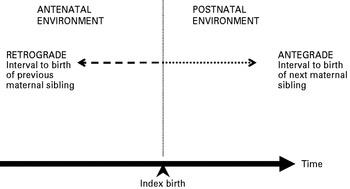
Short interbirth spacing may be a maternal stressor, in that, for example, caring for one infant throughout the gestation of the next may increase the risk of maternal anxiety, and mothers who have had little time to recover from an earlier pregnancy may be at higher risk of stress or nutritional deficiency during a subsequent pregnancy (Smits & Essed, Reference Smits and Essed2001). We hypothesized that should the early origins of mental disorder have their roots predominantly in the intrauterine environment, then adverse mental health outcomes would be associated with a shorter interval to the mother's previous delivery (retrograde birth interval) but not with a shorter interval to the mother's subsequent delivery (antegrade birth interval), the latter being likely to mediate an influence only through the postnatal environment. This hypothesized influence of retrograde and antegrade birth intervals on antenatal and postnatal environments respectively is illustrated in Fig. 1.
Illustration of the hypothesis that the antenatal environment is likely to be related to the retrograde interbirth interval and the postnatal environment to the antegrade interval.

This study aimed to seek evidence for the hypothesis of foetal origins of adult mental illness by using retrograde interbirth intervals as a proxy measure of antenatal maternal stress and thus an indicator of the intrauterine environment, while using antegrade interbirth interval as a control. The study used Scottish Morbidity Record (SMR) data to examine the relationship between both retrograde and antegrade birth intervals and offspring mental health in later life.
Method
This study used electronic linkage of datasets held by the Information Services Division (ISD) of the National Health Service (NHS) National Services Scotland. These datasets consist of the SMR, which contains data on births in Scottish hospitals (through maternity hospital discharge records), Scottish general hospital discharge records and Scottish psychiatric hospital discharge records. The dataset we used also included birth registration details from the General Register Office for Scotland (GROS). The studied was approved by the ISD Privacy and Advisory Committee (PAC) and by the chair of the local Medical Ethics Committee.
The SMR maternity return is completed at the time of discharge of any mother from a Scottish maternity hospital. There is also a facility for data to be returned in the case of home births, although this is less complete. SMR maternity records have been collected since 1969, in which year they covered 64% of all births registered in Scotland, rising to more than 95% of all births registered in Scotland from 1975 onwards.
A birth cohort was identified, consisting of all singleton births for which a mother's SMR maternity record, dated between 1 January 1975 and 31 December 1988, could be identified and linked to a GROS birth registration record. Any pregnancy of less than 24 weeks' gestation did not generate an SMR maternity record unless it resulted in a live birth. Linkage to birth registration records was used to determine names of offspring, hence enhancing linkage to subsequent hospital records.
The SMR maternity dataset is a ‘permanently’ linked dataset held by the ISD, linked using probability matching algorithms. This allows all maternity records from the same women to be identified and brought together. This matching technique takes account of changes in items of person-identifying information by quantifying levels of discrepancy. Algorithms were used to compare individual items on each record and an accumulative linkage weight was calculated. This linkage process is described in detail by Kendrick & Clarke (Reference Kendrick and Clarke1993). Such probabilistic record linkage to routine Scottish maternity records has been validated (Nitsch et al. Reference Nitsch, Morton, Destavola, Clark and Leon2006).
Where an SMR maternity record for a previous pregnancy was identifiable for a mother, the time interval between the index birth date and the most recent previous delivery date, the retrograde birth interval, was noted. Similarly, where an SMR maternity record was identifiable for a later pregnancy for the same mother, the time interval to the next delivery date, the antegrade birth interval, was noted. Data were collected on intervals to the most recent preceding birth and to the next subsequent birth only. Intervals to the births of any other maternal siblings were not recorded.
Data were also collected on several potential confounding variables that were available from SMR maternity records. These variables were: birthweight, gestational age at birth, maternal age, maternal parity, family size and socio-economic deprivation quintile. Family size was calculated by adding the maternal parity (as recorded in the SMR maternity record) plus 1 (index pregnancy) plus the number of later SMR maternity records identified for that mother. The socio-economic deprivation quintile was determined from the maternal postcode, using the Carstairs and Morris deprivation index (Carstairs & Morris, Reference Carstairs and Morris1990).
Outcome
Cohort members were followed up until 31 December 2007. Outcome was determined through linkage, using probability matching, of the SMR maternity file to the SMR general hospital dataset and to the SMR psychiatric hospital dataset, providing information respectively on discharges from general hospitals following self-harm and discharges from psychiatric hospitals and diagnosis. Individuals were considered to constitute a case of self-harm if a general hospital discharge record was identified with an ICD-9 (WHO, 1977) diagnostic code of E95 (up to March 1996) or an ICD-10 (WHO, 1992) diagnostic code of X60–X84 (from April 1996).
Admissions to a psychiatric hospital were classified according to an ICD-9 or ICD-10 diagnostic category with a separate analysis conducted on each of the following diagnostic categories:
(1) Disorders related to substance misuse (ICD-9 codes 291, 292, 303, 305; ICD-10 codes F10–F19).
(2) Psychotic disorders (ICD-9 codes 295, 297, 298; ICD-10 codes F20–F29).
(3) Affective disorders (ICD-9 code 296; ICD-10 codes F30–F39).
These three broad diagnostic categories accounted for approximately 85% of all psychiatric hospital admissions.
Self-harm and psychiatric hospital admission outcomes were determined independently of each other, with the potential for some cohort members to be included both as a case of self-harm and as a psychiatric hospital admission. However, for each cohort member diagnostic categories were considered for the first admission to a psychiatric hospital only.
Analysis
Data were analysed using a Cox proportional-hazard regression model, with univariable and multivariable analysis of both outcomes for the following subcohorts:
(1) Subjects with identifiable elder siblings, in which the retrograde birth interval was treated as a categorical variable.
(2) Subjects with identifiable younger siblings, in which the antegrade birth interval was treated as a categorical variable.
‘Only children’, that is those with no identifiable maternal sibling, were excluded from the study. Eldest children were included in the antegrade interval analysis only, youngest children in the retrograde analysis only.
In the multivariable analysis the following categorical variables were controlled for: birthweight, maternal age, maternal parity, family size and socio-economic deprivation quintile. Gestational age was treated as a continuous variable and gender as a dichotomous variable. These variables were included in a single multivariable analysis. Where complete data were not available for all variables, such cases were excluded from the multivariable analysis.
The time to event was calculated from a person's date of birth to the date of the first recorded instance of each outcome (self-harm and first psychiatric admission) respectively. Where there was no event, the time to event was censored at 31 December 2007.
The shortest birth intervals were chosen as the reference category as these were the category of greatest interest to the aim of the study.
Results
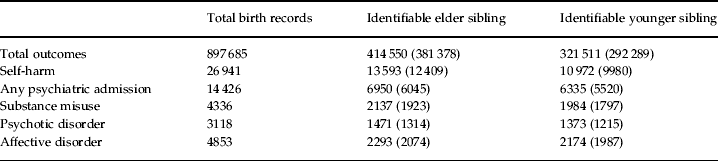
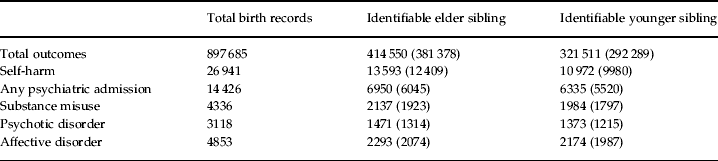
A cohort of 897 685 persons was identified, representing 96.8% of the 927 108 births registered by the GROS in Scotland between 1975 and 1988 (GROS, 2009). The numbers of cohort members in each outcome category are summarized in Table 1. Of the 897 685 cohort members identified, 26 941 had been discharged from a Scottish general hospital following an episode of self-harm before 31 December 2006. A total of 14 426 had been admitted to a Scottish psychiatric hospital, and of these, on their first admission 4336 were diagnosed with a disorder relating to substance misuse, 3118 with a psychotic disorder and 4853 with an affective disorder. Of the total cohort, 177 332 were classified as ‘only children’ (maternal parity = 0; no subsequent maternal record identified) and therefore excluded from the study.
Numbers of records identified for the total cohort, and for each subcohort, according to each outcome
Values for multivariable analyses given in parentheses.
Maternity records for a previous delivery were identified in 414 550 cases, of whom 13 593 had been admitted to a general hospital following self-harm and 6950 had been admitted to a psychiatric hospital. Of these, on their first admission 2137 were diagnosed with a disorder relating to substance misuse, 1471 with a psychotic disorder and 2293 with an affective disorder. Following the exclusion of cases with incomplete data, 381 378 cases were admitted to the multivariable analyses of retrograde interbirth interval, 12 409 of whom had been admitted to a general hospital following self-harm and 6045 had been admitted to a psychiatric hospital, of whom 1923 were diagnosed with a disorder relating to substance misuse, 1314 with a psychotic disorder and 2074 with an affective disorder.
Maternity records for a subsequent delivery were identified in 321 511 cases, of whom 10 972 had been admitted to a general hospital following self-harm and 6335 had been admitted to a psychiatric hospital; of these, on their first admission 1984 were diagnosed with a disorder due to substance misuse, 1373 with a psychotic disorder and 2174 with an affective disorder. Following the exclusion of cases with incomplete data, 292 289 cases were admitted to the multivariable analyses of antegrade interbirth interval, 9980 of whom had been admitted to a general hospital following self-harm and 5520 had been admitted to a psychiatric hospital; of these, 1797 were diagnosed with a disorder due to substance misuse, 1215 with a psychotic disorder and 1987 with an affective disorder.
The discrepancy between the number of previous delivery and subsequent delivery records identified is consistent with the secular trend of falling fertility across the time period over which the cohort was recruited.
Records were identified for both elder siblings and younger siblings in 84 206 cases, and these were therefore included in both retrograde and antegrade analysis.
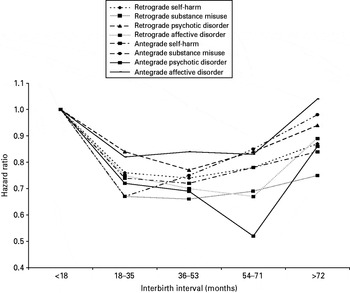
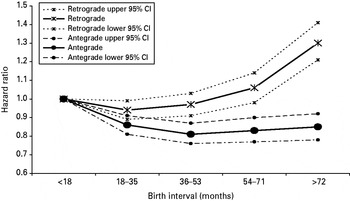
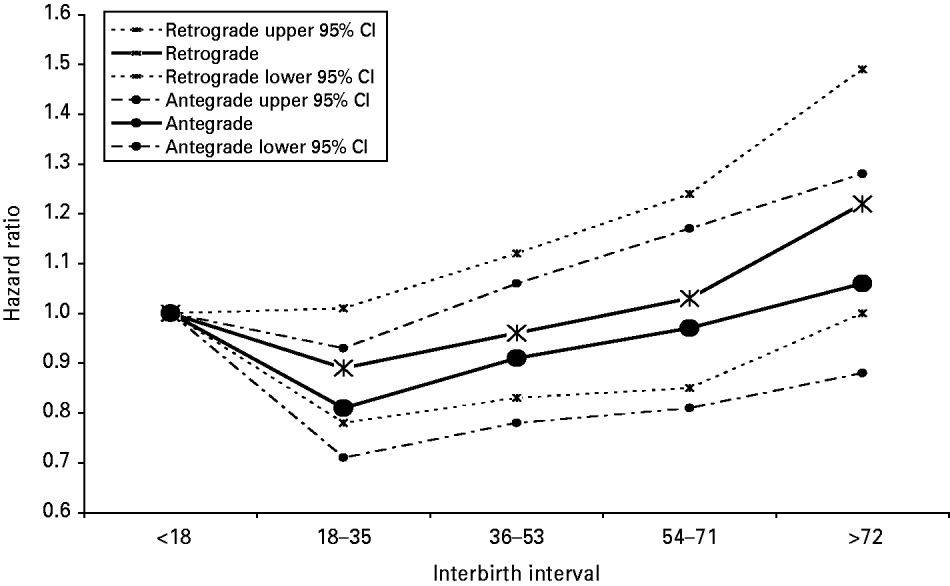
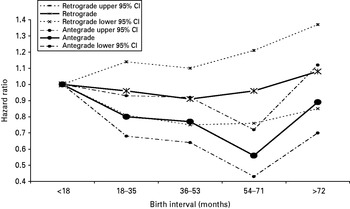
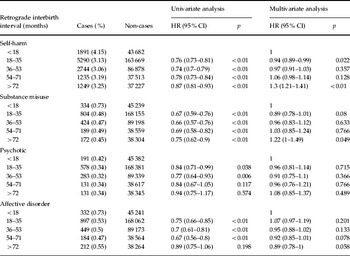
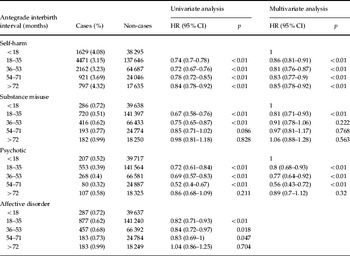
Univariable and multivariable analyses of retrograde birth interval are presented in Table 2, and of antegrade birth interval in Table 3. On both univariable and multivariable analyses, in the case of both retrograde and antegrade interbirth intervals, for each outcome studied, the graph of the relationship between birth interval length and outcome tended to be U-shaped (Figs 2–5).
Univariable hazard ratios for risk of each outcome for retrograde and antegrade interbirth intervals.

Hazard ratios with 95% confidence intervals (CIs) for risk of self-harm for retrograde and antegrade interbirth intervals.

Hazard ratios with 95% confidence intervals (CIs) for risk of substance misuse for retrograde and antegrade interbirth intervals.
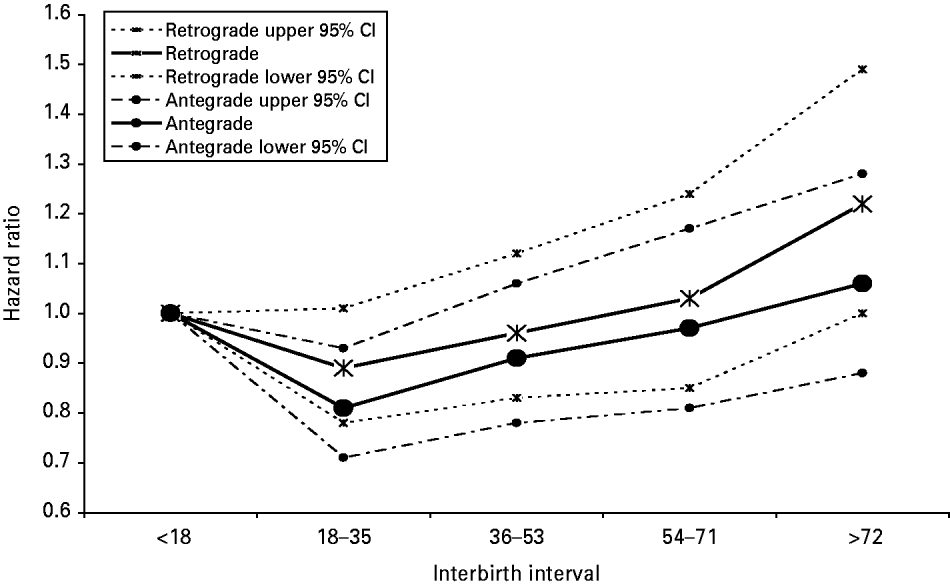
Hazard ratios with 95% confidence intervals (CIs) for risk of psychotic disorder for retrograde and antegrade interbirth intervals.

Hazard ratios (HRs) for self-harm, substance misuse, psychotic disorder and affective disorder according to length of retrograde interbirth interval (n = 381 378)

CI, Confidence interval.
Hazard ratios (HRs) for self-harm, substance misuse, psychotic disorder and affective disorder according to length of antegrade interbirth interval (n = 292 289)

CI, Confidence interval.
Short intervals
On univariable analysis, those born after short (<18-month) retrograde birth intervals or before short antegrade intervals were observed to have a significantly higher risk of all four outcomes studied when compared with those born after or before intermediate intervals of 18–35 months or 36–53 months (Fig. 2). However, following adjustment, on multivariable analysis these observed risk differences were attenuated in all cases.
Retrograde
In the case of short (<18-month) retrograde intervals (reference category), a significantly higher risk was observed only in the case of self-harm, and this was confined to the comparison with the 18–35-month category [hazard ratio (HR) 0.94, p = 0.22]. Multivariable analysis demonstrated no significant relationship between a short retrograde birth interval and risk of substance misuse, psychotic disorder or affective disorder.
Antegrade
By contrast, risks associated with short (<18-month) antegrade intervals, although also attenuated following adjustment, remained significantly higher compared with all other interval categories in the case of self-harm (18–35 months HR 0.86, p < 0.001; 36–53 months HR 0.81, p < 0.001; 54–71 months HR 0.83, p < 0.001; >72 months HR 0.85, p < 0.001), compared with the 18–35-month category in the case of substance misuse (HR 0.81, p < 0.001), and compared with all categories other than the longest intervals (>72 months) in the case of psychotic disorders (18–35 months HR 0.8, p < 0.001; 36–53 months HR 0.77, p < 0.001; 54–71 months HR 0.56, p < 0.001).
Multivariable analysis demonstrated no significant relationship between risk of affective disorder and a short antegrade birth interval.
Long intervals
Retrograde
On univariable analysis, long (>72-month) retrograde intervals were associated with a significantly lower risk of self-harm and substance misuse, compared with the reference category of short (18-month) intervals, but no significant differences were observed for risk of psychotic or affective disorder. However, following adjustment, long (>72-month) retrograde intervals were associated with significantly increased risk of self-harm (HR 1.3, p < 0.01) and substance misuse (HR 1.22, p = 0.049), although remaining insignificant for psychotic and affective disorders.
Antegrade
On univariable analysis, significant differences between long (>72-month) and short (<18-month) antegrade intervals were confined to cases of self-harm (>72 months HR 0.84, p < 0.001), a risk difference that remained almost unchanged following adjustment (HR 0.85, p < 0.001).
Discussion
This study observed little significant relationship between mental health outcome and a short retrograde birth interval. We did, however, observe independent associations between a short antegrade birth interval and the risk of psychotic disorders and substance misuse disorders in young adulthood. Increased risk of self-harm and substance misuse was also linked to a long retrograde interval but not to a long antegrade interval.
Although an association between higher risk of schizophrenia and short retrograde and short antegrade birth intervals has been reported previously (Smits et al. Reference Smits, Pedersen, Mortensen and van Os2004), we are not aware of any other studies linking either interbirth interval or interpregnancy interval with mental health outcome.
The U-shaped relationship between birth interval and adverse outcome, observed in this study, is similar to that described by the literature on the relationships between interpregnancy intervals and various perinatal and obstetric complications, such as premature birth and low birthweight (Zhu et al. Reference Zhu, Rolfs, Nangle and Horan1999; Conde-Agudelo et al. Reference Conde-Agudelo, Rosas-Bermudez and Kafury-Goeta2006). This suggests that short and long interbirth intervals may be non-specific indicators of risk of adversity, and would seem unlikely risk mediators. Similarly, in this study, the consistent attenuation of differences in HRs between interval categories following adjustment for potential confounders on which data were available suggests that there remains residual confounding by unidentified variables.
Any discussion on possible mediators is therefore speculative. However, as the study contains data on both retrograde and antegrade intervals, it does allow comparison between the possible relative importance of antenatal and postnatal stressors respectively, regardless of what those stressors might be.
Short intervals
Retrograde
We had speculated that a short retrograde birth interval might be a proxy for gestational stress, either physical or psychosocial. Such mothers may be at risk of not having recovered nutritionally from their earlier pregnancy (Smits & Essed, Reference Smits and Essed2001) and caring for one infant (of age <18 months) throughout the gestation of the next may increase the risk of prenatal stress. Any observation of a short retrograde birth interval being associated with an increased risk of adverse outcome might therefore have been thought of as consistent with the foetal origins hypothesis.
However, in this study, evidence of such an association with a short retrograde interval was confined to the comparison between <18-month and 18–35- month intervals in the case of self-harm. Furthermore, it should be noted that the 95% confidence interval (CI) around the HR involved overlapped with the corresponding antegrade CI, suggesting that this observation is not specific to short retrograde intervals and residual confounding may be a factor. The study therefore did not demonstrate evidence to support the foetal origins theory. One possibility for this failure could be that the short retrograde interbirth interval is not a valid proxy measure of maternal stress. In this regard our data differ from those of Smits et al. (Reference Smits, Pedersen, Mortensen and van Os2004), which demonstrated a relationship between schizophrenia and both short retrograde and antegrade intervals.
Antegrade
In contrast to short retrograde intervals, and contrary to what we had hypothesized, significant associations were observed between outcome and short antegrade intervals. This is consistent with factors in the early postnatal or childhood environment playing an important role in the early origins of psychosis and self-harm behaviour. Such environmental factors may include suboptimal infant nutrition (Barker et al. Reference Barker, Osmond, Rodin, Fall and Winter1995), poor attachment (Bowlby, Reference Bowlby1977) or other adversity in infancy or early life (Bruffaerts et al. Reference Bruffaerts, Demyttenaere, Borges, Haro, Chiu, Hwang, Karam, Kessler, Sampson, Alonso, Andrade, Angermeyer, Benjet, Bromet, de Girolamo, de Graaf, Florescu, Gureje, Horiguchi, Hu, Kovess, Levinson, Posada-Villa, Sagar, Scott, Tsang, Vassilev, Williams and Nock2010), either biological or psychosocial.
Long intervals
The observation of increased risks of adversity associated with long (>72-month) retrograde birth intervals is also consistent with previous studies linking a long interpregnancy interval and birth complications (Zhu et al. Reference Zhu, Rolfs, Nangle and Horan1999; Conde-Agudelo et al. Reference Conde-Agudelo, Rosas-Bermudez and Kafury-Goeta2006), for which Zhu et al. (Reference Zhu, Rolfs, Nangle and Horan1999) have proposed a ‘physiological regression hypothesis’ as a possible explanation. This proposes that, after childbirth, a woman's physiological childbearing ability is enhanced, lowering the risk of subsequent birth complications, but this enhancement declines over time, hence the risks after long intervals becoming similar to those in primagravidae.
Although birthweight and gestational age at birth were controlled for in this study, it remains possible, in this case of mental health outcomes, that other obstetric factors may be confounders. However, a potential confounder of more probable importance, for which we were unable to control, is the stability of parental relationships. Unstable family units are likely to be over-represented among the long birth interval groups and there is a well-established link between the stability of the relationship between biological parents and offspring mental health outcomes (Richards et al. Reference Richards, Hardy and Wadsworth1977; Tweed et al. Reference Tweed, Schoenbach, George and Blazer1989; Rodgers, Reference Rodgers1994).
However, were the increased risks linked with long intervals mediated primarily by the psychosocial stresses resulting from exposure to parental disharmony in early life, then antegrade intervals would be expected to be linked with at least similar, if not greater, risk than retrograde. Antegrade interval describes the elder of a sibling pair, hence in the case of a long interbirth interval following parental separation, the elder sibling is the child more likely to have experienced paternal absence (Flour & Buchanan, Reference Flour and Buchanan2003). However, the data on increased risk linked with long retrograde, but not long antegrade, intervals suggest that it is the younger of a sibling pair who experiences the greater risk. This suggests an antenatal process.
If long interbirth interval risk is mediated by incidence of parental relationship instability, one possible antenatal mechanism may involve a maternal – foetal immunological process, similar to the H–Y antigen response that has been postulated as an explanation for the elder brother effect on male homosexuality (Blanchard, Reference Blanchard2001). Such a maternal immunological response to one foetus might be modified by the degree of genetic relatedness to any earlier foetus, and therefore be different for half siblings and full siblings. This might influence the epigenetic expression of behavioural traits such as impulsivity or risk taking, and thus be manifested as a greater risk of self-harm or substance misuse.
Family systems
A family systems model of psychological development (Cox & Paley, Reference Cox and Paley2003) may be relevant to the interpretation of these data. This emphasizes the importance of the family as a whole dynamic unit rather than focusing on individual parent–child relationships. Intersibling relationships may play an important role within family systems (Cox, Reference Cox2010), and age differences, or interbirth intervals, are likely to influence the nature of such relationships. Such intersibling relationships could play an important role during the transition to adulthood (Conger & Little, Reference Conger and Little2010), and therefore may be important mediators of mental health in young adulthood.
Limitations and methodological issues
Population-based studies, such as this, by using large national datasets, have access to high case numbers, thus yielding considerable statistical power. In addition, although potentially subject to documentation bias, they are not subject to recall bias.
A limitation of this method is the potential to exaggerate the importance of variables on which data are available, to the exclusion of variables on which data were not recorded. Data were lacking on several potential confounding factors that we were therefore unable to quantify or control for. These potential confounders include data on intention to breastfeed, which were not included in the SMR before 1992 and were therefore not available. Data were confined to pregnancies of longer than 24 weeks' gestation, hence we were unable to control for early pregnancy loss. In addition, breastfeeding is a potential confounder (Ford & Labbock, Reference Ford and Labbok1990) as it has been linked with better offspring outcomes (Fergusson & Woodward, Reference Fergusson and Woodward1999), but also tends to delay the return of maternal fertility post-partum, hence breastfed babies are likely to be under-represented in the short birth interval groups.
Another potential confounder on which no data were available is the degree to which pregnancies were planned or wanted. A history of fertility problems might well influence interbirth spacing while also causing significant maternal anxiety. It is possible that unplanned or unwanted pregnancies may be over-represented among the very short and very long interval pregnancies and the offspring of such unplanned or unwanted pregnancies may be at higher risk of adverse mental health outcome (Kubicka et al. Reference Kubicka, Roth, Dytrych, Matejcek and David2002). We would therefore urge caution in using these data to inform decisions on pregnancy planning.
In choosing outcome measures a balance needed to be achieved between ensuring adequate statistical power through sufficient case numbers and diagnostic specificity of outcome measures. As a result, broad diagnostic categories were used, some of which, such as that for self-harm, arguably constituted a cohort of considerable clinical heterogeneity.
Outcome measure was confined to events within Scotland, theoretically biasing our results towards finding higher risks among those less likely to have left the country. A previous study (2) using a similar cohort estimated, using census data, that 77% of the birth cohort would have been still resident in Scotland as young adults.
These retrograde and antegrade interbirth interval data are derived from two different subcohorts, one confined to those with an identifiable elder sibling, the other to those with an identifiable younger sibling. It should also be noted that many of the birth intervals studied were either retrograde intervals to births before 1975 or antegrade intervals to births after 1988, and hence to siblings who were themselves not included in the outcome measures. Caution is therefore required in making direct comparisons between these two cohorts. We cannot exclude the possibility of secular trends in, for example, admission rates or diagnostic practices having influenced our data. Of particular note is the secular trend of reducing birth rates, as a result of which the retrograde cohort was larger than the antegrade.
The data obtained from maternity records pertained to the date of birth, hence this study used birth interval (the time between two births) rather than interpregnancy interval (the time between the birth of one baby and the beginning of a mother's next pregnancy). The literature on birth and interpregnancy intervals suggests that studies using birth interval, rather than interpregnancy interval, tend to overestimate the association between very short intervals and risks of perinatal complications (24). We have addressed this by controlling for gestational age in the birth interval multivariable analysis.
Finally, most of the data used for multivariable adjustment were collected at or before the time of birth, the exception being family size. For example, data on socio-economic factors were limited to deprivation indices at the time of the pregnancy rather than during childhood or at the time of the outcome event. This could have led to a bias towards adjusting for antenatal confounders more than postnatal. It is possible in the case of self-harm, where unadjusted data indicated similar relationships with both antegrade and retrograde intervals, that such a bias could account for some of the persistence of significant differences in risk according to antegrade intervals, whereas the differences were much more attenuated for retrograde intervals.
Conclusions
The data do not provide support for foetal origins of mental disorders but, in the cases of self-harm and psychotic disorders, suggest that the early postnatal environment rather than the antenatal may be of greater importance. Research to further understand the nature of these relationships could give insights into the aetiology, which may be of clinical and public health importance.
Acknowledgements
Funding for this study was provided by the Scottish Chief Scientist Office.
Declaration of Interest
None.