Antimicrobial stewardship programs (ASPs) are recognized as an essential tool in the effort to combat the increasing threat of antibiotic resistance. Reference Barlam, Cosgrove and Abbo1 In 2015, the US National Action Plan for Combating Antibiotic Resistant Bacteria set a goal for implementation of ASPs in all hospitals receiving federal funding. 2 The Joint Commission and Centers for Medicare and Medicaid Services now require all acute-care hospitals to have active ASPs for accreditation. 3 Inpatient ASPs have resulted in improved patient outcomes with reduced antimicrobial use and resistance as well as increased cost savings. Reference Nathwani, Varghese, Stephens, Ansari, Martin and Charbonneau4–Reference Kapadia, Abramson and Carter8
Despite the focus on hospital-based stewardship, >85% of antibiotic use occurs in outpatient settings including emergency departments (EDs), urgent care clinics, offices, and retail clinics. Reference Duffy, Ritchie, Metcalfe, Van Bakel and Thomas9 In the United States, antibiotic expenditures totaled $56 billion between 2010 and 2016; of this amount, $33.1 billion was spent on outpatient antibiotics. Reference Suda, Hicks, Roberts, Hunkler, Matusiak and Schumock10 The annual antibiotic prescribing rate in children and adults in the United States is estimated to be 506 prescriptions per 1,000 population, with 28%–30% being unnecessary. Reference Fleming-Dutra, Hersh and Shapiro11,Reference Hersh, King, Shapiro, Hicks and Fleming-Dutra12 In addition, ∼20% of necessary antibiotics are prescribed inappropriately (incorrect antibiotic selection, dose or duration). Reference Ray, Tallman, Bearden, Elman and McGregor13 Expanding ASP efforts to outpatient settings is therefore an urgent need. Reference Zetts, Garcia, Doctor, Gerber, Linder and Hyun14
Traditional antimicrobial stewardship methods, including prospective audit with feedback and prior authorization, are well described in the pediatric inpatient setting. However, these methods are not always feasible in the ambulatory setting due to real-time prescribing and short interactive time with patients. Reference Gerber, Jackson and Tamma15 Given the expanse of the outpatient environment and often limited access to pediatric infectious diseases resources, targeted, high-impact interventions are necessary to maximize stewardship effects. Reference Zetts, Garcia, Doctor, Gerber, Linder and Hyun14 In 2016, recognizing the importance of antibiotic use in the ambulatory setting, the Center for Disease Control and Prevention (CDC) released the 4 Core Elements of an outpatient ASP. These Core Elements highlight (1) commitment and engagement, (2) action for policy and practice, (3) tracking and reporting, and (4) education and expertise. Reference Sanchez, Fleming-Dutra, Roberts and Hicks16 The Joint Commission then published 5 elements of improvement to address antimicrobial stewardship in the ambulatory setting in 2019, with similar emphasis on establishing goals, implementing guidelines, providing education, and reporting, in addition to identifying an ASP leader replete with facility support. 17
A systematic review of 50 studies assessing the impact of outpatient ASP on antibiotic use found that ASP efforts improved antibiotic prescribing and had no negative impact on patient outcomes. Reference Drekonja, Filice and Greer18 Despite this information and an increasing number of publications highlighting outpatient ASP successes, many institutions do not have dedicated efforts for outpatient ASP. In a cross-sectional survey published in 2017 that included 37 pediatric EDs, no hospital ASPs reported active monitoring of outpatient ED prescribing. Reference Mistry, Newland and Gerber19 Incorporating the measures recommended by the CDC and The Joint Commission requires time, personnel, and funding, which may not be available in many institutions. Therefore, the extent of outpatient stewardship in pediatrics is unknown. In the current study, we evaluated the state of outpatient ASP in a large network of pediatric institutions; assessed resources, needs and barriers; and sought areas for future collaboration. This information will provide the framework for future investigations to determine strategies with greatest impact in pediatric outpatient ASPs.
Methods
Survey design, participants, and setting
In this cross-sectional study, we conducted an investigator-developed survey to assess current resources, interventions, and obstacles of outpatient ASP. We recruited institutions from the Sharing Antimicrobial Reports for Pediatric Stewardship (SHARPS) OutPatient collaborative (SHARPS-OP). SHARPS is an ongoing quality improvement collaborative focusing on establishing best practices for antimicrobial use among hospitalized children. Reference Zachariah, Newland and Gerber20–Reference Tribble, Lee and Flett22 The recent development of SHARPS-OP, a new voluntary collaborative focusing on outpatient antibiotic use, stemmed from enthusiastic support among SHARPS participants and those peripherally associated with pediatric stewardship endeavors (eg, adult sites with pediatric ASPs), and through SHARPS electronic mailing Listserv. Reference McPherson, Vesoulis and Metjian23 At the time of this survey, SHARPS-OP included 54 sites in the United States and 2 institutions from the United Kingdom, which were in various phases of outpatient ASP work.
We distributed an internet-based survey to the entire SHARPS-OP listserv in September 2020 and asked 1 person per institution to complete it. In addition, 3 reminder e-mails were sent, 1 week apart with the survey link. The Institutional Review Board of Children’s Mercy Kansas City determined that the proposed activity does not involve human research. We did not apply any exclusion criteria. Participation in the survey was voluntary and did not impact the status of the institution in the collaborative.
Survey development
The principal investigator and coinvestigators developed survey items in conjunction with national experts in the field of pediatric infectious diseases and antimicrobial stewardship. We modeled the first iteration of the current project from a previous SHARPS intake survey, Reference Newland, Gerber and Weissman24 and supplemented questions specific to outpatient ASP using the CDC’s core elements.
The survey included 4 sections (Appendix online). The initial section delineated demographic information related to the institution, primary point of contact, types of outpatient facilities (eg, EDs, urgent care clinics, primary care or specialty care clinics, affiliated clinics, and retail clinics), and the type of electronic medical record (EMR) used. The second section focused on assessing the pediatric outpatient ASP in the institution, including full-time equivalent (FTE) support for inpatient and outpatient ASP, estimated time spent on outpatient ASP work, and areas where the work is implemented. The third section comprised an extensive list of outpatient ASP interventions undertaken by the institutions, including commitment letters, antibiotic use reports, individual prescriber cards, quality improvement and research projects, antimicrobial guidance, EMR changes, antibiotic allergy clarifications, collaborations, etc. Branching logic was utilized to collect details related to each intervention selected by an institution. The final section focused on assessing SHARPS-OP collaborative goals and allowed for free-text comments. Participants were invited to identify collaborative needs and educational topics of interest or expertise sharing to enhance the collaborative experience. A final comment was included to allow participants to elaborate on any additional items of importance.
The survey was adapted for electronic administration using REDCap software (Vanderbilt University Medical Center, Nashville, TN). It was then pilot tested with 3 antimicrobial stewardship experts from different institutions for feedback prior to launching it to all sites.
Data analysis
Data were analyzed using SPSS version 24 software (IBM, Armonk, NY). We use descriptive statistics to examine institution characteristics, current outpatient ASP work and to elucidate collaborative goals. One coinvestigator (E.M.) abstracted free-text comments and grouped them by similar words or concepts. These qualitative data were linked to categories based on responses received: internal program needs, educational topics, and willingness to share expertise.
Results
Hospital characteristics
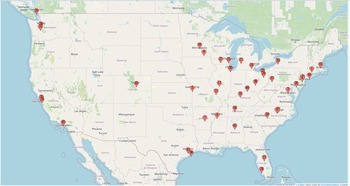
We received responses from 45 (80.4%) of 56 institutions invited to participate. In total, 46 surveys were completed from 44 geographically diverse sites in the United States and 1 site in the United Kingdom (Fig. 1); we excluded one duplicate survey. Three incomplete surveys were included in the final analysis. The responses came largely from free-standing children’s hospitals (n = 22, 48.9%) and children’s hospitals within a large adult and pediatric health system (n = 18, 40.0%) with a median number of pediatric beds of 234 (interquartile range, 146–354; range, 73–973) (Table 1).
Map of US sites that responded to the survey. One additional response from the United Kingdom is not included in this map. Dynamically created using Google Maps, retrieved on April 21, 2021.

Characteristics of the Surveyed Institutions

Note. ASP, antimicrobial stewardship program; FTE, full-time equivalent; IQR, interquartile range.
Pediatric outpatient ASP assessment
Although 42 (95.6%) institutions had allocated FTE support for their inpatient ASP, only 5 (11.1%) had dedicated FTE support for an outpatient ASP, and an additional 18 (40.0%) had shared ASP efforts for both inpatient and outpatient (Table 1). Of the 5 programs with FTE support for outpatient ASP, 4 programs had physician FTE (median, 0.2; interquartile range, 0.05–0.35), and 1 program had 1.0 FTE for pharmacy. When asked about time spent on outpatient ASP work, 37 (82.3%) reported spending 5 hours or less each week of combined pharmacist and physician time. Despite the lack of dedicated efforts and time, 41 (91.1%) institutions reported performing outpatient ASP projects within the institution, and 5 (11.1%) had projects outside of the institutions, all of which were with local primary care offices (Table 1).
Pediatric outpatient ASP interventions
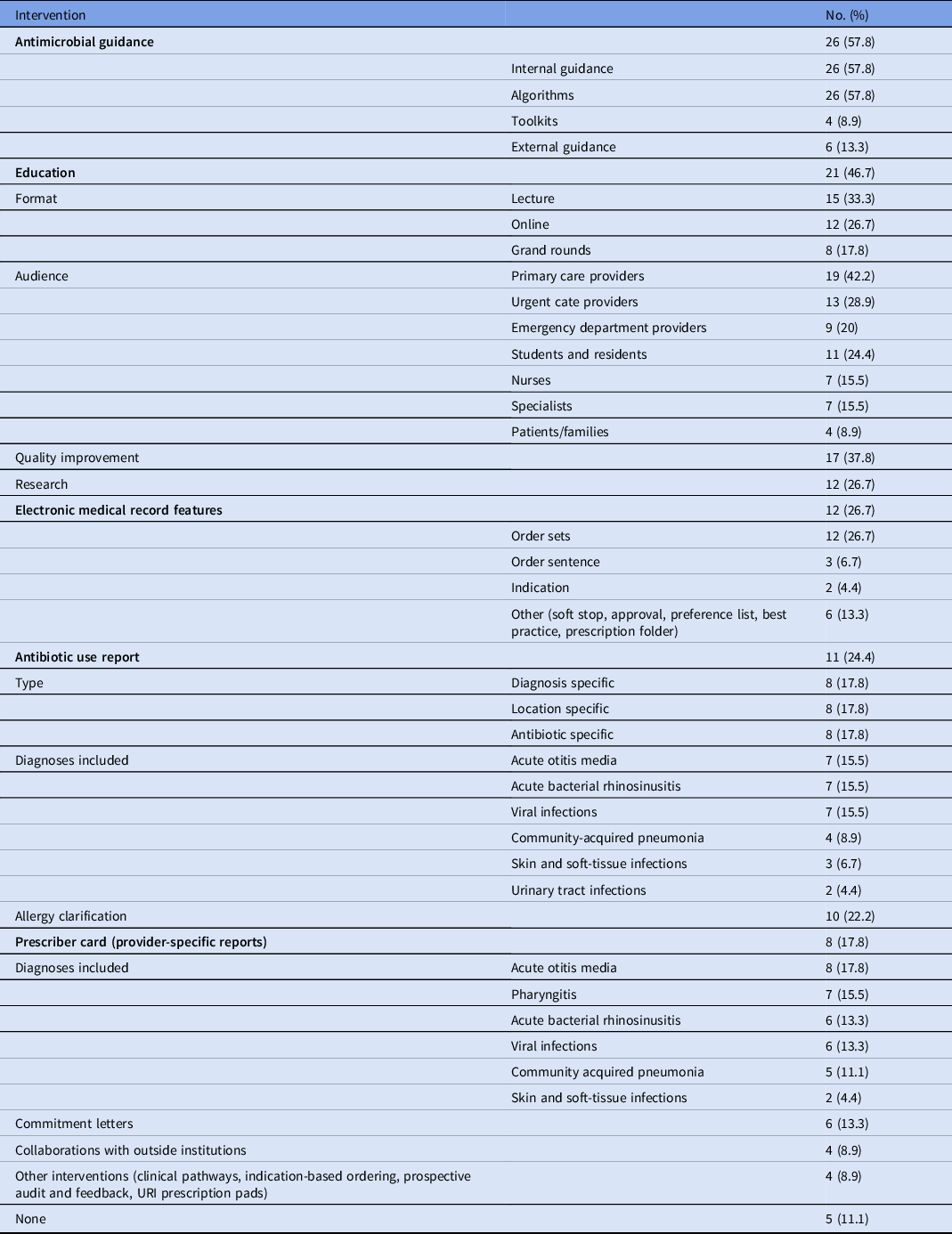
The most frequently used ASP intervention was the development of guidance such as empiric antimicrobial guidance (eg, guidelines, algorithms, protocols, toolkits; n = 26, 57.8%) most of which were targeting prescribers within the institution. Antimicrobial guidance was primarily focused on respiratory infections: community-acquired pneumonia (n = 20, 76.9%), acute otitis media (n = 14, 53.8%), and acute bacterial rhinosinusitis (n = 13, 50.0%), as well as urinary tract infections (n = 19, 73.1%). Other ASP interventions included education (n = 21, 46.7%), quality improvement projects (n = 17, 37.8%), research (n = 12, 27.8%), and EMR features (n = 12, 27.8%) (Table 2). Only 6 (13.3%) institutions reported having developed commitment letters, although other components of commitment (eg, communicating with clinic staff members to set patient expectations) were not measured with our survey.
Outpatient Antimicrobial Stewardship Interventions

Needs, barriers, and collaborative goals
The most important conditions that responders felt needed to be targeted with ASP efforts were urinary tract infections (n = 19, 42.2%), acute otitis media (n = 15, 33.3%), upper respiratory infections (n = 15, 33.3%), and skin and soft-tissue infections (n = 11, 24.4%). Time was identified as the biggest barrier for outpatient ASPs (n = 41, 91.1%) followed by financial support (n = 24, 53.3%), development of meaningful reports (n = 23, 51.1%), and hospital administrative support (n = 20, 44.4%).
Respondents identified learning opportunities, sharing resources, developing clear metrics for pediatric outpatient ASPs, and benchmarking as very important goals of the collaborative (Fig. 2). Optional comments were provided by 42 (93.3%) of respondents, which were condensed into 8 themes. Securing operational support (35.8%) and strengthening data analysis (31.3%) were the most pertinent program needs. Likewise, data analysis (43.7%) was the most frequently cited request for potential collaborative discussions, followed by a desire for shared learning opportunities (25.0%). Program management (42.1%) and data analysis (31.6%) were the 2 most frequently cited themes among respondents offering to share stewardship expertise (Table 3).
Perceived importance of the collaborative goals. The number on the right represents the mean Likert scale for each goal: 1 = not important, 2 = neutral, 3 = somewhat important, 4 = important, 5 = very important.

Themes by Free Text

Discussion
In this report, we describe the status of outpatient ASPs in pediatric institutions. Of the 45 participating sites, only 5 sites (11%) had allocated FTE support for an outpatient ASPs, although almost all had allocated support for their inpatient ASPs. The most widely used ASP interventions included antimicrobial guidance and education, whereas reporting and commitment letters were less frequently used. Our results agree with available adult data. A recent survey evaluating ambulatory ASPs found that only 7% of the 129 responding institutions had a fully functional outpatient ASP compared to 88% with inpatient ASPs. However, many were under development, and 57% reported commitment to outpatient ASPs. Similar to our findings, the use of institution-specific treatment guidelines was the most common stewardship action. Reference Eudy, Pallotta and Neuner25 Time, in addition to financial and administrative support, were identified by our survey as the biggest barriers to outpatient ASPs. This survey facilitated the identification of important goals, particularly engaging in shared learning, and developing benchmarking reports for pediatric outpatient ASPs.
Outpatient ASPs are essential for improving patient outcomes and slowing the development of antimicrobial resistance. Reference Yadav, Stahmer, Mistry and May26,Reference Marcelin, Chung and Van Schooneveld27 Outpatient ASPs are currently required by The Joint Commission and the CDC, Reference Sanchez, Fleming-Dutra, Roberts and Hicks16,17 and they have proven successful in improving outcomes in outpatient settings. Reference Drekonja, Filice and Greer18,Reference Dona, Barbieri and Daverio28 However, most participating pediatric institutions have no allocated administrative support or dedicated time to conduct outpatient antimicrobial stewardship efforts, despite the robust presence of inpatient ASPs. As demonstrated by our results, many stewards divide time between inpatient and outpatient program functions, suggesting outpatient activities are often added onto additional inpatient ASP priorities required to meet national standards.
Despite the lack of support, >90% of participants reported some outpatient ASP interventions. Although the CDC has issued 4 Core Elements for a successful outpatient ASPs, Reference Sanchez, Fleming-Dutra, Roberts and Hicks16 most survey participants are implementing 1 or 2 elements. Institutions may focus on easier to implement elements, such as education and development of clinical practice guidelines, which may also benefit the inpatient setting (eg, community-acquired pneumonia practice guidelines). Reference Walters, D’Auria, Jackson, Walsh-Kelly, Park and Willis29,Reference Brennan-Krohn, Ozonoff and Sandora30 Education alone may be less reliable and/or sustainable. Other interventions with evidence supporting positive impact on antibiotic prescribing, such as commitment letters, quality improvement projects, and prescriber cards, Reference Gerber, Jackson and Tamma15,Reference Bozzella, Harik, Newland and Hamdy31,Reference Newland32 are being utilized less frequently, likely due to the barriers elucidated in this study. In addition, many sites are focused on 1 division or clinical area such as emergency departments while other essential clinical areas remain untouched, particularly specialty clinics, which may require more time and resources. In our survey, data analysis to facilitate tracking and reporting of antibiotic prescribing was a universal need to support robust outpatient ASPs. Although essential for inpatient ASP work, data analysis is crucial for a successful outpatient ASP in which real-time audit and feedback is often difficult and interventions are often driven by antibiotic use reports. Reference El Feghaly, Burns, Goldman, Myers, Purandare and Lee33 Interestingly, 15% of programs provide education to nurses which is part of the Core Elements and often absent from inpatient stewardship.
Formalization of standards for outpatient ASPs, sharing resources, and benchmarking with peer institutions are valued goals to further outpatient ASP efforts. Currently, significant challenges are inherent in measuring antibiotic prescribing in outpatient settings, particularly in pediatrics. No national guidance clearly addresses the best way to report pediatric outpatient antibiotic use. Standardized metrics to establish national benchmarks for appropriate antibiotic use in children evaluated in outpatient settings are necessary to assess use and to elucidate opportunities for intervention. Reference Gerber, Jackson and Tamma15 The SHARPS-OP collaborative will identify benchmarking metrics meaningful for pediatrics and will create a benchmarking platform to facilitate comparisons among pediatric institutions to incentivize hospital administrations to support outpatient ASP efforts.
Multi-institutional collaborations are essential in improving the quality of care. Many collaboratives are being formed to address specific quality metrics. For example, the Improving Pediatric Sepsis Outcomes (IPSO) collaborative aims to decrease sepsis-attributable mortality in children by increasing recognition and prompt antibiotic administration, Reference Larsen, Brilli and Macias34 and a neonatal collaborative was successful in reducing antibiotic use in the neonatal intensive care unit. Reference Cantey, Wozniak, Pruszynski and Sanchez35 Successes in improving antibiotic use in the hospitals are best exemplified by the SHARPS collaborative. As of 2018, the collaborative had developed >26 data reports and resulted in >36 distinct stewardship interventions. Reference Newland, Gerber and Kronman21 Support for these collaboratives (funding, data analysis, administration support) is necessary to fulfill governing body requirements by all hospitals nationally.
This study had several limitations. The institutions recruited to participate are all part of the SHARPS collaborative electronic mailing listserv and had all shown interest in outpatient ASPs. Despite this selection bias, most of the institutions reported no financial support for outpatient ASP work. We expect that other pediatric institutions across the country with less robust inpatient ASPs have even less support to expand into the outpatient setting. In addition, the survey was completed by one person in the institution; therefore, that individual may not be familiar with all ongoing outpatient ASP efforts. To mitigate this issue, we invited physicians or pharmacists with an ASP role in the institutions to complete the survey. However, much of outpatient care may not have a direct connection to a children’s hospital stewardship program; stewardship activities may be occurring that the surveyed group had no participation in. Finally, barriers and goals may have been evaluated subjectively by the respondent and may not represent the opinion of the entire team. The strengths of the current study area included a high response rate (80%) and an extensive questionnaire detailing all interventions performed by the different institutions.
The commonplace presence of inpatient ASPs is reassuring; however, outpatient ASP remains in a fledgling state among most pediatric institutions surveyed. The most common Core Element implemented is education, which has utility in promoting awareness of ongoing outpatient antibiotic use. The design of robust, reliable, and sustainable interventions, such as tracking and reporting, which leads to quality improvement work, requires administrative and financial support, which are currently lacking.
Supplementary material
To view supplementary material for this article, please visit https://doi.org/10.1017/ice.2021.416.
Acknowledgments
We acknowledge all institutions participating in the SHARPS-OP collaborative.
Financial support
No financial support was provided relevant to this article.
Conflicts of interest
All authors report no conflicts of interest relevant to this article.