Introduction
The codling moth, Cydia pomonella L. (Lepidoptera: Tortricidae), is the most serious worldwide insect pest of apple, Malus domestica Borkhausen (Rosaceae), and pear, Pyrus communis L. (Rosaceae), except in Japan and a few other regions of Asia (Croft, Reference Croft, Metcalf and Luckman1982). The control of codling moth is largely achieved with chemical insecticides, such as various neuroactive products (organophosphates, carbamates, synthetic pyrethroids and neonicotinoids) and insect growth regulators (IGR, chitin synthesis inhibitors, juvenile hormone mimics and ecdysone agonists). However, the extensive and continued use of these products has led to the development of resistance by the codling moth to a number of different insecticides in several countries (Thwaite et al., Reference Thwaite, Williams and Hately1993; Varela et al., Reference Varela, Welter, Jones, Brunner and Rield1993; Waldner, Reference Waldner1993; Sauphanor et al., Reference Sauphanor, Brosse, Monier and Bouvier1998; Reuveny & Cohen, Reference Reuveny and Cohen2004; Fuentes-Contreras et al., Reference Fuentes-Contreras, Reyes, Barros and Sauphanor2007). The resistance is mainly associated to the detoxification systems mixed function oxidases (MFO), glutathione-S-transferases (GST) and esterases (EST) (Bush et al., Reference Bush, Abdel-Aal and Rock1993; Sauphanor et al., Reference Sauphanor, Cuany, Bouvier, Brose and Berge1997; Soleño et al., Reference Soleño, Anguiano, Pechén de D'Angelo and Montagna2004; Reyes et al., Reference Reyes, Franck, Charmillot, Ioriatti, Olivares, Pasqualini and Sauphanor2007). Furthermore, a kdr mutation corresponding to a L1014F replacement in the voltage-dependent sodium channel protein is involved in resistance to deltamethrin (Brun-Barale et al., Reference Brun-Barale, Bouvier, Pauron, Bergé and Sauphanor2005), and the F290V replacement in acetylcholinesterase (AChE) is involved in resistance to azinphos-methyl and carbaryl (Cassanelli et al., Reference Cassanelli, Reyes, Rault, Manicardi and Sauphanor2006).
The spread of resistance in insect populations depends on multiple factors, including the intensity of insecticide selection pressure, the migration ability of individuals and the fitness costs linked with resistance (May & Dobson, Reference May and Dobson1986). In C. pomonella, resistance to insecticides, based on enhanced GST and MFO activities, are associated with pleiotropic costs with respect to reproduction and development rate (Boivin et al., Reference Boivin, Chaber d'Hyères, Bouvier, Beslay and Sauphanor2001). In addition, a recent microsatellite DNA analysis on samples from different countries suggests that C. pomonella populations are structured according to geographical distance at supranational scale and that the intensity of insecticide applications is the main force structuring the populations at the national level (Franck et al., Reference Franck, Reyes, Olivares and Sauphanor2007). In the same way, Espinoza et al. (Reference Espinoza, Fuentes-Contreras, Barros and Ramírez2007) and Fuentes-Contreras et al. (Reference Fuentes-Contreras, Espinoza, Lavandero and Ramírez2008) did not detect differentiation by distance between Chilean C. pomonella populations, even when they were separated by more than 180 km. In contrast, Timm et al. (Reference Timm, Geertsema and Warnich2006) detected geographical differentiation in South-African populations. The intensity of insecticide applications has an important impact on the level of genetic structure, and insecticide treatments are efficient to reduce population density, even when some cases of insecticide resistance are present (Franck et al., Reference Franck, Reyes, Olivares and Sauphanor2007). Resistance mechanisms to chemical insecticides were independently analysed in C. pomonella populations from several geographical areas (Bush et al., Reference Bush, Abdel-Aal and Rock1993; Sauphanor et al., Reference Sauphanor, Bouvier, Beslay, Bosch and Avilla2000; Soleño et al., Reference Soleño, Anguiano, Pechén de D'Angelo and Montagna2004; Fuentes-Contreras et al., Reference Fuentes-Contreras, Reyes, Barros and Sauphanor2007; Reyes et al., Reference Reyes, Franck, Charmillot, Ioriatti, Olivares, Pasqualini and Sauphanor2007). However, it is difficult to assess the geographical variability of the resistance mechanisms due to the absence of similar methodology in these studies. For example, most of the studies have considered only a single mechanism (Bush et al., Reference Bush, Abdel-Aal and Rock1993; Soleño et al., Reference Soleño, Anguiano, Pechén de D'Angelo and Montagna2004) and have been limited to populations from a narrow geographical area (one country or one continent). Furthermore, these prior analyses of several mechanisms have been performed in different individuals, which preclude a more careful exploration of the potential linkages among several insecticide resistance mechanisms.
Herein, a large collaborative project is reported, which aimed to analyze the potential variability of resistance mechanisms among C. pomonella populations from different geographical regions. All five known resistance mechanisms (i.e. EST, GST, MFO, kdr and modified AChE) were measured on each individual moth. In addition, each metabolic resistance was expressed as activity per milligrams of protein, which avoids the biases of sexual dimorphism in body size. Data are reported for each sex. The association of the recent agricultural practices applied in the orchards surveyed with the resistance mechanisms was also examined.
Material and methods
Insects
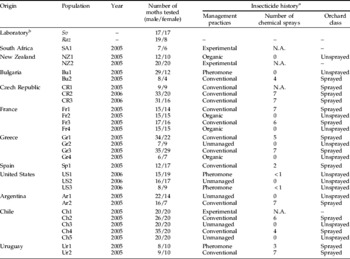
Diapausing larvae of C. pomonella were collected in orchards using corrugated cardboard traps during 2005 and 2006 (Audemard, Reference Audemard, Van der Geest and Evenhuis1992). A total of 958 individuals (a 55:45 male:female ratio) were collected from 29 sites in New Zealand (2), South Africa (1), Bulgaria (2), France (4), Greece (4), Spain (1), Czech Republic (3), Chile (5), Argentina (2), Uruguay (2) and United States (3) (table 1). All larvae were shipped via land or air transportation to the INRA laboratory in Avignon, France. Larvae were kept at 2°C and 12:12 (light:dark) for three months and then placed under conditions suitable for adult emergence (25°C, 60% RH and 16:8 light:dark).
Summary of field populations and laboratory strains of Cydia pomonella included in the analyses of enzyme activity and genetic mutations associated with insecticide resistances.

a Conventional, conventional insecticide programs; pheromone, sex pheromone-based programs with and without the addition of insecticides; organic, organic with or without the supplemental use of granulosis virus; unsprayed, no insecticides used; experimental, research sites where various plots were treated with an array of products.
b Sv, susceptible lab strain; Raz, azinphos-methyl resistant laboratory strain.
Populations of C. pomonella were collected from orchards under a wide range of management practices. Orchards were grouped into two classes (unsprayed and sprayed) based on the number of synthetic insecticides applied in the year that the larvae were collected (table 1). Populations from both sprayed and unsprayed orchards were collected from five countries: Bulgaria, France, Greece, Argentina and Chile. The unsprayed group (<1 application) included unmanaged orchards, experimental orchards where an unknown proportion of trees were treated with a wide range of insecticides, organic orchards sprayed only with granulosis virus and one orchard treated only with sex pheromone (table 1). Sprayed orchards were treated with 2–7 sprays of synthetic insecticides from among 1 to 4 insecticide classes including organophosphates, carbamates, synthetic pyrethroids, neonicotinyls and insect growth regulators. Organophosphates and carbamates accounted for nearly 78% of all sprays applied in these orchards. Unfortunately, the spray records from four orchards could not be obtained, and these data were not included in the binomial classification.
Individuals from two laboratory strains of C. pomonella were included in this study. The Sv strain was originally established in 1995 from susceptible individuals identified via bioassays from apple orchards in southern France (Boivin et al., Reference Boivin, Bouvier, Chadoeuf, Beslay and Sauphanor2003). This founding colony has been mass-reared on an artificial diet (Guennelon et al., Reference Guennelon, Audemard, Fremond and El Idrissi Ammari1981) at INRA Avignon (France) for more than ten years without any exposure to insecticides. The Raz strain originated from a pear orchard from the Lerida region in Spain which had been conventionally managed with organophosphate insecticides and control failures had been documented (Sauphanor et al., Reference Sauphanor, Bouvier, Beslay, Bosch and Avilla2000). Raz had been mass-reared on artificial diet at the INRA laboratory in Avignon for more than ten years and has regularly been submitted to selection pressure by exposing the larvae to diet surface-treated with 375 mg l−1 azinphos-methyl. While Sv strain is susceptible to insecticides, Raz is resistant to most of the insecticides currently used against codling moth. Both strains are clearly differentiable by their GST and MFO activities (Reyes et al., Reference Reyes, Franck, Charmillot, Ioriatti, Olivares, Pasqualini and Sauphanor2007).
Analytical procedures
Adult moths were sexed before analysis. All five resistance mechanisms were analyzed in each individual moth. GST, MFO and EST activities were evaluated using adult abdomens which were dissected and divided longitudinally into two equal parts in NaCl (6 g l−1). Activities are expressed per mg protein. Target site modifications were investigated using DNA extracts from a hind leg. Fluorescence and absorbance were measured using a microplate reader (HTS 7000, Perkin Elmer, Massachusetts, USA).
Biochemical assays
GST and EST activities were determined using the same extract. One half of each adult abdomen was individually homogenized on ice in 75 μl of Hepes buffer (50 mm, pH 7.0) and centrifuged at 15,000 g for 15 minutes at 4°C. The supernatants were used as enzyme source. Protein content of each sample was measured in 10 μl of extract diluted ten times, according to Bradford (Reference Bradford1976) using bovine serum albumin to build the standard curve.
Glutathione-S-transferase (GST)
GST activities were determined using monochlorobimane (MCB) as substrate (Nauen & Stumpf, Reference Nauen and Stumpf2002). Each well was supplied with 30 μl of enzyme extract, 168 μl of 100 mm reduced glutathione (GSH) in Hepes buffer (50 mm, pH 7.0) and 2 μl of 30 mm MCB (Reyes et al., Reference Reyes, Franck, Charmillot, Ioriatti, Olivares, Pasqualini and Sauphanor2007). Twelve wells in each 96-well plate loaded with Hepes buffer instead of protein extract were used as controls. Fluorescence was measured after 20 min of incubation at 22°C with 380 nm excitation and 450 nm emission filters. Enzyme activity was expressed as fluorescence units per mg of total protein.
Esterases
Total esterase activities were measured using β-naphthyl acetate as substrate (Sauphanor et al., Reference Sauphanor, Cuany, Bouvier, Brose and Berge1997). Each well was supplied with 0.1 mm substrate in 50 mm of phosphate buffer (pH 6.5), 0.5 μl of enzyme extract and 89.5 μl of Hepes buffer (50 mm, pH 7.0). After 15 min of incubation at 30°C, 20 μl of a staining reagent containing 3 g l−1 Fast Garnet and 35 g l−1 sodium dodecyl sulfate were added to the solution, and the absorbance was measured at 492 nm after 15 min at room temperature. Twelve wells without enzyme were included as controls. EST activities are expressed as nm of β-napthol/mg protein/min.
Mixed function oxidases (MFO)
MFO activities were determined using 7-ethoxycoumarin O-deethylation (ECOD) (Ulrich & Weber, Reference Ulrich and Weber1972) adapted for in vivo analysis with a microplate (De Sousa et al., Reference De Sousa, Cuany, Brun, Amichot, Rahmani and Berge1995). Each half of the adult abdomens was individually introduced into a well containing 100 μl of phosphate buffer (50 mm, pH 7.2) and ethoxycoumarin (0.4 mm). After four hours of incubation at 30°C, the reaction was stopped by adding 100 μl of 0.1 mm glycine buffer (pH 10.4)/ethanol (v/v). The 7-hydroxycoumarin fluorescence was quantified with 380 nm excitation and 450 nm emission filters. Twelve wells filled with only glycine buffer prior to incubation were used for controls on each plate. MFO activities are reported as pg of 7OH formed/mg protein/min.
DNA diagnostics
Target mutations in sodium channel and AChE proteins were detected by PCR-RFLP (Reyes et al., Reference Reyes, Franck, Charmillot, Ioriatti, Olivares, Pasqualini and Sauphanor2007). Total DNA was extracted from an adult leg with 200 μl of 10% Chelex 100 (Biorad, California, USA) solution (Walsh et al., Reference Walsh, Metzger and Higuchi1991) and 3 μl of 10 mg ml−1 of proteinase K. After a four times dilution, extracts were used as DNA templates for partial PCR amplifications of the sodium channel and ace1 genes. PCR amplifications were carried out separately for each gene in a 25 μl reaction volume containing 1× reaction buffer (10 mm Tris-HCl, pH 9.0, 50 mm KCl, 1.5 mm MgCl2), 200 μm of each dNTP, 0.4 μM of each primer, 1 unit of Taq DNA polymerase and 2 μl of DNA template. Restrictions were performed by pooling the PCR products from both genes (5 μl each) with 0.2 units of Tsp509I (NEB) in 20 μl reaction volume for 16 h incubation at 65°C. DNA fragments were separated by electrophoresis on 6% polyacrylamide gel and visualized after silver staining. The kdr and sensitive alleles for the sodium channel were identified by DNA fragments of 77 bp and 112 bp, respectively. The resistant V290 and sensitive F290 alleles for ace1 were identified by DNA fragments of 190 bp and 152 bp, respectively (Reyes et al., Reference Reyes, Franck, Charmillot, Ioriatti, Olivares, Pasqualini and Sauphanor2007).
Statistical analysis
Nonparametric statistics were used to compare classes of orchards, origin, moth sex and C. pomonella field populations and laboratory strains because several standard transformations could not consistently normalize the variances (Shapiro-Wilkes test). A Wilcoxon rank sum test was used to compare the enzyme activities among the susceptible and resistant laboratory strains (Analytical Software, 2003). Pearson correlations were used to evaluate the relationships of mean enzyme activity levels across all field-collected individuals. A Wilcoxon rank sum test was also used to compare enzyme activities due to moth sex and to compare the various enzyme activities in each field population versus the Sv strain. The same statistical test was used to evaluate mean enzyme activities in a binomial classification of orchards based on their spray history and their geographic origin (European vs. Non European orchards). A one-tailed Fisher exact test was used to compare the frequency of resistant individuals in each population with the Sv strain. All these statistical tests were run with Statistix 8 (Analytical Software, 2003). Moths were classified as resistant if their enzyme activities exceeded the upper 95% confidence limit for GST activity (42,589.2 fluorescence units/mg protein) and MFO activity (95.6 pg of 7OH formed/mg protein/min) of the Sv strain. With EST, individuals were classified as resistant if either their enzyme activity was greater than (EST >) the upper (552.78 nm of β napthol/mg protein/min) or less than (EST <) the lower (183.1 nm of β napthol/mg protein/min) 95% confidence limit for the Sv strain. Finally, Fisher's exact tests were performed using the GENEPOP software (Rousset, Reference Rousset2008) to test departure to the Hardy-Weinberg equilibrium in each population for the sodium channel and AChE loci.
Results
Significant differences in the mean activity levels of each of the three enzymes were found among the two laboratory strains of C. pomonella (table 2). As expected, the insecticide-resistant Raz strain had significantly higher MFO and GST activities than the susceptible strain. Sv male moths had significantly higher GST activity than Sv females.
Mean enzyme activities expressed in two laboratory strains of Cydia pomonella.

Column means for each strain (both sexes) followed by a different uppercase letter and means for each sex within each strain followed by a different lowercase letter, were significantly different; P<0.05, Wilcoxon rank sum test.
a The activities of glutathione S-transferase (GST), mixed-function oxidases (MFO) and esterases (EST) are reported as fluorescence units/mg protein, pg of 7OH formed/mg protein/min, and nm of β napthol/mg protein/min, respectively.
b The Sv strain is susceptible to insecticides, while the Raz strain has been selected with azinphos-methyl for nearly ten years and is resistant to most of the insecticides currently used against codling moth.
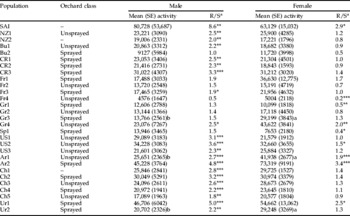
When the whole sample was analyzed, MFO and EST activities were higher in females, while GST activity was higher in males. For each 29 samples, activities of at least one enzymatic system significantly differed with those reported in the susceptible strain Sv. The mean GST activity values among field populations ranged 17.6- and 14.6-fold for female and male moths, respectively (table 3). However, a clear assessment of each population's resistance ratio (R/S) was complicated by the significant differences in GST activity between sexes within Sv. For example, 21 versus six field populations had GST levels significantly higher than Sv for the female versus male moths (table 3). The mean GST activity was higher in male than in female moths in three populations (Gr3, Ar1 and Ur2). Both sexes in six field populations (SA, Gr4, Ar1, Ar2 and Ur1) had significantly higher GST activity than Sv.
Mean activities of glutathione S-transferase activities (fluorescence units/mg protein) and their resistance ratios (R/S) compared with the insecticide-susceptible laboratory strain (Sv) for 29 field populations of male and female Cydia pomonella.

Differences between field and laboratory populations were tested with the nonparametric, Wilcoxon rank sum test:
*, P<0.05; **, P<0.01; and ***, P<0.001. Row means followed by different letters were significantly different, P<0.05, Wilcoxon rank sum test.
a R/S ratio equals the mean enzyme activity of the field population versus the laboratory, insecticide-susceptible strain (Sv).
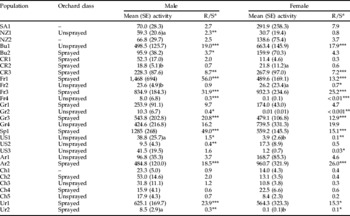
The mean MFO activity among field populations varied 147-fold for females and >10,000-fold for male moths (table 4). The mean MFO activities were significantly higher than in the susceptible strain for eight samples (Ur1, Ar2, Sp1, Gr3, Fr1, Fr3, CR3 and Bu1) out of the 29 orchards analyzed with resistant ratios up to 25 in both female and male sub-samples (table 4). No significant differences in MFO activities between sexes were observed in these eight samples. All of them, except Bu1, were from orchards sprayed with chemical insecticides (table 1).
Mean activities of mixed function oxidase (pg of 7OH formed/mg protein/min) and their resistance ratios (R/S) compared with the susceptible laboratory strain (Sv) for 29 field populations of male and female codling moth.

Differences between field and laboratory populations were tested with the nonparametric, Wilcoxon rank sum test:
*, P<0.05; **, P<0.01; and ***, P<0.001. Row means followed by different letters were significantly different, P<0.05, Wilcoxon rank sum test.
a R/S ratio equals the mean enzyme activity of the field population versus the susceptible laboratory strain (Sv).
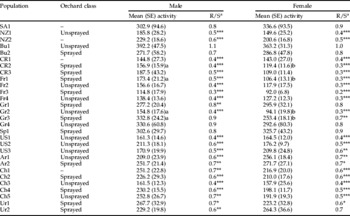
The mean EST activity among field populations varied from three to fourfold for female and male moths, respectively (table 5). Female and male moths in 23 and 22 field populations, respectively, had mean EST activities significantly lower than Sv strain (table 5). No field populations had mean EST activities significantly higher than Sv strain for either sex.
Mean activities of esterases (nm of Β napthol/mg protein/min) and their resistance ratios (R/S) compared with a susceptible laboratory strain (Sv) for 29 field populations of male and female codling moth.

Differences between field and laboratory populations were tested with the nonparametric, Wilcoxon rank sum test:
*, P<0.05; **, P<0.01; and ***, P<0.001. Row means followed by different letters were significantly different, P<0.05, Wilcoxon rank sum test.
a R/S ratio equals the mean enzyme activity of the field population versus the laboratory insecticide-susceptible strain (Sv).
The linear correlations of enzyme activities of each of the three enzymes analyzed were positive and statistically significant across all moths (GST with MFO, r=0.72, P<0.001; GST with EST, r=0.79, P<0.001; and EST with MFO, r=0.81, P<0.001. Within each population sample, paired enzyme activities were significant correlated in 12 populations with three GST-MFO (r=0.37–0.50), ten GST-EST (r=0.34–0.98) and two MFO-EST (r=0.34–0.63) positive correlations. Only one population had more than one significant correlation: Ar2 (GST-MFO (r=0.425; P=0.042), GST-EST (r=0.46; P=0.025), and MFO-EST (r=0.56; P=0.045).
Significant differences in MFO activities were found between samples from sprayed (417±108 pg of 7OH formed/mg protein/min) and unsprayed (125±64) orchards (P<0.05). GST activities for unsprayed (22,864±2587 fluorescence units/mg protein) and sprayed (26,663±4315) orchards were similar (P=0.89). EST activities were also similar between the unsprayed, (201.3±21.7 nm of β-napthol/mg protein/min) and sprayed 220.7±19.7) orchards (P=0.43).
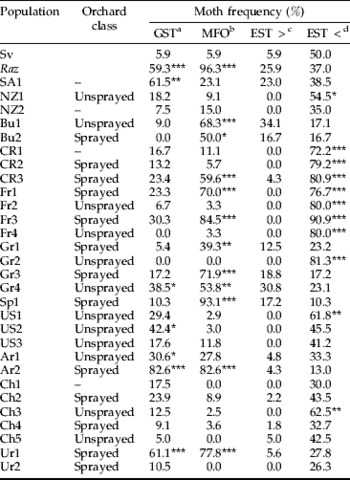
The proportion of adults within each population having enzyme activities categorized as resistant varied from 0.0 to >90% (table 6). Insecticide-resistant strain, Raz, had a significant proportion of individuals with both GST and MFO resistance. Six field populations had significantly higher proportions of moths with GST resistance compared to the susceptible strains. These were from both sprayed and unsprayed orchards and only one was from Europe (the unsprayed, organic Gr4). Eleven populations had significantly high proportions of individuals with elevated MFO activity compared to the sensitive strains and all but two of these were from sprayed orchards. The two exceptions were Bu1 and Gr4, which were unsprayed. No populations had a significant proportion of moths with elevated EST activity, while 11 populations had significant proportions with low EST activity. Six populations among this later group were from unsprayed orchards. The only populations from sprayed orchards that contained significantly high proportions of individuals with low EST compared to the sensitive strains were from the Czech Republic and France (table 6).
Frequency of codling moth adults within two laboratory strains and 29 field-collected populations characterized as resistant based on enzyme activities.

Column percentages were compared with the corresponding susceptible strains using Fisher exact test:
* P<0.05; **, P<0.01; and ***, P<0.001.
a,b Percentage of individuals expressing GSTa or MFOb activity higher than the upper 95% confidence limit of the mean response of the Sv strain (42,589.2 fluorescence units/mg protein and 5.6 pg of 7OH formed/mg protein/min, respectively).
c Percentage of individuals expressing EST activity higher than the upper 95% confidence limit or lessd than the lower 95% confidence limits of the mean response of the Sv strain (552.78 and 183.1 nm of β napthol/mg protein/min, respectively).
For two of the three enzymatic systems, activities significantly differed between the European and non-European samples (P<0.001, for each enzyme), with higher means values for MFO (443.04 (53.0) vs. 101.87 (52.7) pg of 7OH formed/mg protein/min) and GST (20,913.6 (1738.3) vs. 30,032.8 (1731.0) fluorescence units/mg protein) activities in European and non-European samples, respectively.
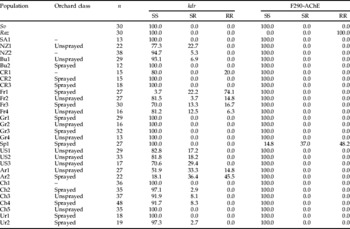
The kdr mutation was detected in 16 populations and from all countries except South Africa, Greece and Spain (table 7). The highest frequencies of kdr mutation were observed in populations from Argentina (31.5–63.6%) and France (12.5–82.5%). The proportion of the kdr mutation in the other countries never exceeded 20.0%. Significant heterozygote deficiency with regards to Hardy-Weinberg equilibrium were detected in the populations from four orchards (CR1, US1, Fr2 and Fr3; Fisher's exact tests, 0.0007<P<0.045) out of the 16 polymorphic population samples where kdr was detected. The F290 mutation in the AChE conferring resistance to organophosphate insecticides was only detected in the Spanish population (table 7). No departure to Hardy-Weinberg equilibrium was observed in this population (Fisher's exact test, P=0.401).
Genotype frequency (%) of codling moth adults within two laboratory strains and 29 field-collected populations for kdr and F290-AChE loci.

n, number of moths examined.
Discussion
Our study is the first attempt to investigate, simultaneously, all known resistance mechanisms in C. pomonella adults in populations collected from five continents. In addition, for the first time, all resistance mechanisms were analyzed in each male or female moth and enzyme activities were expressed per mg of protein. This allows precise measurement of the associations among resistance mechanisms within individual insects and between sexes irrespective of significant differences in their mean weight.
Unfortunately, sampling constraints impacted several aspects of this study. First, there were not enough insects obtained to include toxicological tests, but the analysis of resistance mechanisms could be a useful first approach. Then, an imbalanced experimental design with respect to the comparative numbers of sprayed and unsprayed orchards with chemical insecticides from each country, and the number of countries per continent limited our ability to more clearly evaluate the influence of management practices and geography. Some qualitative and quantitative measures of the degree of isolation of each orchard from surrounding populations of C. pomonella, especially for populations exposed to different pest management practices would be useful. For example, Bu1, Gr4 and Ar1 populations collected from unsprayed sites had significant proportions of individuals with elevated GST or MFO activity, and these orchards were situated within commercial apple production areas. Similarly, high proportions of the kdr allele were detected in several orchards (NZ1, Fr2, Fr4, US1, US3, Ar1), which were unsprayed with chemical insecticides. Among these orchards, the codling moth populations collected in Fr2 and US1 displayed heterozygote deficiency at the sodium channel locus. This suggests a selection of the kdr homozygote resistant genotypes that probably occurred in the conventional orchards surrounding these two sample sites. In addition, summarizing a more extended historical record of the spray practices made within each orchard may have been useful. The difficulty in obtaining a sample size large enough for meaningful statistical analysis was problematic for a few sites. The high intra-population variation in populations with low numbers of individuals (especially SA1 and Bu2) reduced the power of certain statistical tests.
Significant differences in the mean enzymatic activities were detected when the whole sample was analyzed. MFO and EST activities were higher in females, while GST activity was higher in males. Despite these differences, activity ratios were higher in females than in males for GST. This information suggests that, for this enzyme, the difference between sexes should not be involved in resistance. In contrast, MFO activity values and ratios were higher in females than in males. Previous studies with C. pomonella have reported significant differences in the activities of detoxification enzymes (Fuentes-Contreras et al., Reference Fuentes-Contreras, Reyes, Barros and Sauphanor2007) and different tolerance to insecticides (Varela et al., Reference Varela, Welter, Jones, Brunner and Rield1993) between sexes within a population when the responses were expressed per whole insect. These differences in both studies were attributed to the larger size of female adults. Enzyme activities in our study were all reported per mg of protein, and few significant differences were found between sexes when each population was analyzed separately. Further investigations on these mechanisms are needed in order to validate these results.
Among the three enzymes examined, only MFO activity was significantly different within a binomial classification of orchards based on recent spray history. This result confirms, at the world level, previous observations in French apple orchards, in which the proportions of resistant MFO phenotypes were positively correlated with the number of chemical insecticide treatments (Franck et al., Reference Franck, Reyes, Olivares and Sauphanor2007). The GST and EST activities were not related with the number of chemical insecticide treatments in this study in spite of the importance of both detoxification mechanisms in the resistance to the azinphos-methyl and of GST in the resistance to emamectin (Reyes et al., Reference Reyes, Franck, Charmillot, Ioriatti, Olivares, Pasqualini and Sauphanor2007). The spatial (immigration) and temporal (historical spray history) uncertainties association with our orchard classification system likely weaken its predictive capabilities. In contrast, significant correlation of enzyme activities with insecticide bioassay results is more direct and provides a best estimate of the impact of EST and GST expressions on insecticide resistance (Fuentes-Contreras et al., Reference Fuentes-Contreras, Reyes, Barros and Sauphanor2007; Reyes et al., Reference Reyes, Franck, Charmillot, Ioriatti, Olivares, Pasqualini and Sauphanor2007). Chile was the only country included in our study where C. pomonella populations collected from sprayed orchards did not exhibit elevated enzyme activities. In contrast, significant differences in the levels of all three enzymes were found previously among field populations from Chile when compared with a susceptible laboratory strain (Reyes et al., Reference Reyes, Bouvier, Boivin, Sauphanor and Fuentes-Contreras2004). A recent genetic study of C. pomonella populations across two major apple-growing regions in central Chile found low genetic differentiation among populations independent of orchard management practices (Fuentes-Contreras et al., Reference Fuentes-Contreras, Espinoza, Lavandero and Ramírez2008). This lack of differentiation was attributed to the widespread occurrence of C. pomonella populations developing in unmanaged sites, such as host trees associated with homes surrounding orchards. Many Chilean commercial orchards receive large numbers of insecticide sprays, and recent regulatory efforts to remove extra-orchard sources of moths could seriously impact the evolution of resistance in this country.
Among the three detoxification enzymes, EST had the lowest variability in activity among the populations samples (resistance ratios <5), and no difference was detected between the two laboratory strains (table 2). As previously signaled, most populations expressed significantly lower EST activity than the laboratory strain. Previous studies with C. pomonella have reported lower (Bush et al., Reference Bush, Abdel-Aal and Rock1993; Bouvier et al., Reference Bouvier, Boivin, Beslay and Sauphanor2002; Reyes et al., Reference Reyes, Franck, Charmillot, Ioriatti, Olivares, Pasqualini and Sauphanor2007) or higher activity than the reference strain (Sauphanor et al., Reference Sauphanor, Bouvier, Beslay, Bosch and Avilla2000; Soleño et al., Reference Soleño, Anguiano, Pechén de D'Angelo and Montagna2004) and no correlation (Fuentes-Contreras et al., Reference Fuentes-Contreras, Reyes, Barros and Sauphanor2007) of EST activities with resistance to organophosphate insecticides. Further investigation is required to clarify the contribution of this enzymatic group to insecticide resistance in C. pomonella. Different authors have used different substrates to characterize EST activity in C. pomonella (Bush et al., Reference Bush, Abdel-Aal and Rock1993; Reuveny & Cohen, Reference Reuveny and Cohen2004; Reyes et al., Reference Reyes, Franck, Charmillot, Ioriatti, Olivares, Pasqualini and Sauphanor2007), and it is expected that all the EST are not involved in insecticide resistance. For that, using a single substrate to measure EST activity cannot be enough to conclude on its participation on insecticide resistance (Reyes et al., unpublished data). Development of new analytical tools that can discriminate S and R forms of these enzymes, i.e. using other substrates or molecular tools, are needed (Taylor & Feyereisen, Reference Taylor and Feyereinsen1996; Field & Devonshire, Reference Field and Devonshire1998; Daborn et al., Reference Daborn, Yen, Bogwitz, Le Goff, Feil, Jeffers, Tijet, Perry, Heckel, Batterham, Feyereisen, Wilson and ffrench-Constant2002).
Different metabolic mechanisms prevail in the countries surveyed in the present study, although GST was widely distributed followed by MFO. Previous studies indicated that enhanced MFO and GST activity were the most frequently encountered resistance mechanisms in European populations of C. pomonella (Sauphanor et al., Reference Sauphanor, Bouvier, Beslay, Bosch and Avilla2000; Reyes et al., Reference Reyes, Franck, Charmillot, Ioriatti, Olivares, Pasqualini and Sauphanor2007). These two detoxifications mechanisms would also be implicated in insecticide resistance in codling moth populations from the New World. Note, however, that enhanced GST activity was rarer among the European populations compared to those from the New World (table 6). These data confirm, to some extent, previous results in the Chilean populations that showed that insecticide resistance was mainly related to an increase in GST activity in this country (Reyes et al., Reference Reyes, Bouvier, Boivin, Sauphanor and Fuentes-Contreras2004; Fuentes-Contreras et al., Reference Fuentes-Contreras, Reyes, Barros and Sauphanor2007). Inversely, enhanced MFO activity is very frequent among the European populations as previously noted by Reyes et al. (Reference Reyes, Franck, Charmillot, Ioriatti, Olivares, Pasqualini and Sauphanor2007). Interestingly, the two population samples in South America with the highest MFO activity (Ur1 and Ar2) also showed the highest GST activity. This suggests that enhanced MFO and GST activity could be combined to increase insecticide resistances.
The occurrence of the kdr mutation appeared to be widely distributed. The highest proportions of the kdr allele were observed in the population samples from France and Argentina (table 7). In all the countries, kdr occurs in samples collected in both sprayed and unsprayed orchards with chemical insecticides. The kdr mutation in C. pomonella was proved to have low fitness cost (Boivin et al., Reference Boivin, Chaber d'Hyères, Bouvier, Beslay and Sauphanor2001), which may explain the high proportions of kdr observed at sample sites not treated with pyrethroids. Management of C. pomonella in Argentina relied heavily on the use of synthetic pyrethroids up through the 1990s. Field control failures with esfenvalerate were observed in several Argentine populations, and resistance to this compound was confirmed by bioassays (Cichón et al., Reference Cichón, Fernández, Soleño, Montagna, Anguiano and Pechen de D'Angelo2003; Soleño et al., Reference Soleño, Montagna, Anguiano, Fernández and Pechén de D'Angelo2003). Similarly, resistance to deltamethrin was documented widely in apple production from southern France and attributed to both enhanced MFO activity and kdr mutation (Sauphanor et al., Reference Sauphanor, Cuany, Bouvier, Brose and Berge1997; Bouvier et al., Reference Bouvier, Boivin, Beslay and Sauphanor2002; Brun-Barale et al., Reference Brun-Barale, Bouvier, Pauron, Bergé and Sauphanor2005).
The modified AChE detected in the Raz strain was only observed in the Spanish population. This mutation confers resistance to some organophosphate and carbamate insecticides (Cassanelli et al., Reference Cassanelli, Reyes, Rault, Manicardi and Sauphanor2006) but was not detected in samples (Fr1, Fr3, Gr3, Ar2, Ch2 and Ur2) from orchards heavily treated with these insecticides (6–7 applications) for years. These results suggest that other mechanisms, such as enhanced MFO activity, might be involved in the control failures with organophosphate insecticides reported from some of these orchards. An additional hypothesis is that other AChE mutations than those screened in the present study are involved in organophosphate resistances in the codling moth, as previously reported in Drosophila (Villatte et al., Reference Villatte, Ziliani, Marcel, Menozzi and Fournier2000).
In summary, our study reports that a wide variation is present in both the enzymatic activities and the presence of genetic mutations associated with insecticide resistance in C. pomonella throughout its world-wide range. Elevated levels of MFO and the occurrence of the kdr mutation appeared to be the most frequent resistance mechanisms, but both elevated GST and lowered non-specific EST levels are often observed. The complexity of these relationships was not substantially clarified by examining the impact of recent spray history of orchards or their geography within or across the major apple production areas in the world. More likely, insecticide resistance in C. pomonella is affected by local conditions influencing selection pressure, the spatial distribution of managed and unmanaged hosts, and population movement between habitats. Several recent genetic studies of C. pomonella populations have shown that these factors can create widely different geographical patterns within France (Franck et al., Reference Franck, Reyes, Olivares and Sauphanor2007), Chile (Espinoza et al., Reference Espinoza, Fuentes-Contreras, Barros and Ramírez2007) and South Africa (Timm et al., Reference Timm, Geertsema and Warnich2006). However, within all geographical regions, effective efforts to combat resistance will require continuous monitoring of resistance mechanisms and the implementation of resistance management practices by both growers and the insecticide industry. Another point is that MFO was highly correlated with GST in some populations, which might denote a co-selection of these mechanisms. Further research is needed, however, to clarify the responsible factors involved.
Acknowledgements
Maritza Reyes is grateful to the Comisión Nacional de Ciencia y Tecnología (CONICYT) and the Embassy of France in Santiago, Chile for her doctoral fellowship. We would like to thank our colleagues from Argentina (Leandro Pisano, Bayer CropScience, Río Negro), Bulgaria (Nionka Velcheva, Plant Protection Institute, Ploidiv), Chile (Wilson Barros and Cristian Muñoz, Universidad de Talca, Talca), Czech Republic (Jitka Stara, Research Institute of Crop Production, Prague), Greece (Kostas Vourouris, University of Thessaly, Larissa), New Zealand (Jim Walker, HortResearch Hawke's Bay, Havelock North), Spain (Dolors Bosch, Marcela Rodríguez and Jesús Avilla, UdL-IRTA, Lerida), South Africa (Peter Zeier, Bayer CropScience, Stellenbosch), Uruguay (César Basso, Universidad de la República, Montevideo) and the United States (Duane Larson, US Department of Agriculture, Wapato, WA) for their help in the collection of C. pomonella samples.