When bilinguals read or listen to words in their second language (L2), information about words in their first language (L1) is also active (e.g., Dijkstra & Van Heuven, 2002; Jared & Kroll, 2001; Marian & Spivey, 2003). From a developmental perspective, finding evidence for language nonselectivity even among highly skilled bilinguals is surprising. One might think that with increasing skill, learners become capable of functioning autonomously in the L2 (e.g., Segalowitz & Hulstijn, 2005). However, recent evidence that demonstrates parallel activation of words in both languages during visual and spoken word recognition suggests that acquiring proficiency in a L2 does not imply that the individual has acquired the ability to switch off the influence of the L1. Furthermore, these cross-language influences are not limited to the effects of the L1 on the L2. Even when proficient bilinguals process words in their L1 alone—without any reason to believe that L2 is relevant—there are effects of the L2 on the L1 (e.g., Van Hell & Dijkstra, 2002; Van Wijnendaele & Brysbaert, 2002).
Despite the compelling evidence for parallel activation of both languages during lexical access in proficient bilinguals, very little research has addressed the consequences of cross-language activity in less proficient L2 processing. This question is the focus of the work we report here: What lexical information is active in the learner's L1 during L2 processing? The present study investigates the influence of the L1 on the L2 during lexical processing in a laboratory setting.
Within SLA research, laboratory studies are sometimes viewed with skepticism; whether they reflect actual language use has been questioned because of the manner in which language exposure is controlled and the nature of the experimental tasks (but see Hulstijn, 1997, for a discussion of the role of laboratory research in SLA). Within psychology, however, a wealth of information about reading and comprehension has been gained in similar laboratory settings. (See Rayner, Foorman, Perfetti, Pesetsky, & Seidenberg, 2001, for an illustration of how psychological science and laboratory studies inform the teaching of reading and are predictive of reading performance.) A goal of the present study is to take this approach to investigate the way in which the L1 affects the L2 at different levels of L2 proficiency. The measurement of reaction time (RT) and accuracy when L2 learners make judgments about words in the two languages provides a window into the cognitive processes underlying lexical processing. Because the influence of L1 on L2 is likely to involve processes that occur briefly and without conscious access, psycholinguistic methods might be particularly well suited for an examination of these effects.
What becomes apparent when one examines the developmental evidence with respect to lexical processing is that two different types of claim have been made about lexical-level influences of L1 on L2. One line of research, related to demonstrations of language nonselectivity in proficient bilinguals, examines the manner in which lexical form relatives are active and compete during word recognition. Another line of research, related more to claims about lexical development than to bilingual word recognition, suggests that the translation equivalents of L2 words are active in the L1, at least during early stages of acquisition. In the study reported in this article, we compare the contribution of these alternatives for learners at different stages of L2 proficiency.
These two approaches to lexical activation in proficient and developing bilinguals have been characterized by the bilingual interactive activation (BIA) model (Dijkstra & Van Heuven, 1998; Dijkstra, Van Jaarsveld, & Ten Brinke, 1998; Van Heuven, Dijkstra, & Grainger, 1998) and the revised hierarchical model (RHM; Kroll & Stewart, 1994), respectively. In past research, the two models were not compared directly because they describe different aspects of the bilingual lexicon (but see Kroll & Dijkstra, 2002). However, for the purpose of the present study, we contrast the predictions of the models specifically with regard to the hypothesized activity of the L1 during processing of the L2. We first review the general features of each model and then consider the predictions that each makes about L2 lexical processing.
TWO MODELS OF THE BILINGUAL LEXICON
The Bilingual Interactive Activation Model
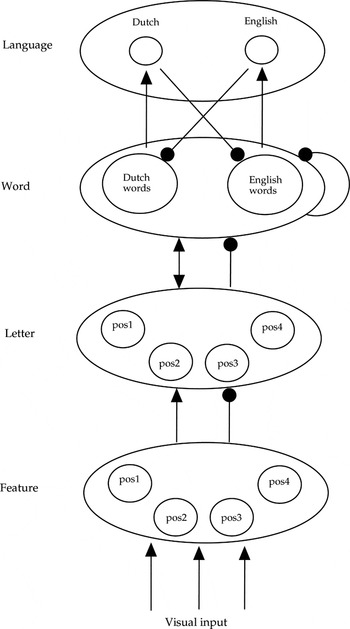
The BIA model (see Figure 1) is a model of bilingual word recognition based on the interactive activation model first proposed by McClelland and Rumelhart (1981). BIA differs from the monolingual model in that the representations of words in both of the bilingual's languages are included in an integrated lexicon, and an added level, the language nodes, specifies language membership. Like the earlier word recognition models, BIA consists of a hierarchical arrangement of features, letters, words, and language nodes, as seen in Figure 1. The arrows represent activation and the filled circles represent inhibition. According to the model, when a proficient bilingual is presented visually with an input letter string, several lexical candidates—regardless of language—are activated. The activated lexical alternatives compete with each other for selection; the winner surpasses its activation threshold and the losers are suppressed. The language nodes exert a top-down inhibitory effect on the words of the other language, which can ultimately induce differential language selection processes in proficient bilinguals (see Dijkstra & Van Heuven, 2002, for a revision of this mechanism in the extended BIA+ model).

The bilingual interactive activation model. (Adapted from Dijkstra et al., 1998.)
A Spanish-English bilingual, for example, upon seeing the letter string gate, would activate neighbors in both languages, such as the word gato (meaning cat in Spanish) and the word game. The words compete with each other in the word recognition process until the top-down inhibitory mechanism suppresses the activation of the unintended language (in this case Spanish) and the bilingual recognizes the correct word gate.
The evidence for the BIA model comes from bilingual word recognition studies that exploit the presence of words that share lexical features across languages in order to determine whether information in both languages is active. The logic of these studies is to ask whether there are consequences of cross-language relations even when word recognition is performed in one language alone. If lexical access is language selective, then no effects should be observed for words with and without these cross-language form relatives.
In what is now an extensive body of research, there is compelling evidence for language nonselective lexical access. For example, studies that used cross-language neighbors, words that are orthographically similar in the two languages but otherwise unrelated (e.g., the English word gate has neighbors in English, such as game, but also neighbors in Spanish, such as gato) have shown that word recognition in both the L1 and the L2 is influenced by the neighborhood properties of words in both languages (e.g., Grainger & Dijkstra, 1992; Jared & Kroll, 2001; Van Heuven et al., 1998). In other words, even when performing a task in one language alone, there is evidence that neighbors in the other language are active. The recognition of interlingual homographs—words that share lexical form but not meaning (e.g., red, which means net in Spanish)—is influenced by the availability of the nontarget reading of the word and by its frequency (De Groot, Delmaar, & Lupker, 2000; Dijkstra et al., 1998; Dijkstra, De Bruijn, Schriefers, & Ten Brinke, 2000; Jared & Szucs, 2002; von Studnitz & Green, 2002). Additionally, lexical decision in L2 (Dijkstra et al., 1998) and even in L1 (Van Hell & Dijkstra, 2002) is faster for cognates than for matched controls. Cognates are translation equivalents that have similar orthography and phonology (e.g., hotel in Spanish and English). Bilinguals are at an advantage in recognizing words that are cognates, whereas monolinguals show none of these effects. If it were possible to simply switch off one language, there would be no effect of these lexical properties. To the contrary, all of these results support the main claim of the BIA model: Proficient bilinguals activate information about words in both languages in parallel, regardless of their intention to function within one language alone. Although a great deal of research has investigated lexical processing in proficient bilinguals, very few studies have asked how the dynamics of cross-language lexical activation change for learners as they acquire increasing skill in the L2. Those experiments that have examined this aspect of lexical development suggest that the pattern of cross-language influence changes with increasing L2 proficiency (e.g., Bijeljac-Babic, Biardeau, & Grainger, 1997; Jared & Kroll, 2001; Kroll, Michael, Tokowicz, & Dufour, 2002; Talamas, Kroll, & Dufour, 1999).
At early stages of acquisition, as other studies of transfer suggest (see MacWhinney, 2005, for a review), the influence of the L1 on the L2 will be greater than the influence of the L2 on the L1 (e.g., Jared & Kroll, 2001). With increasing L2 skill, the effects become more similar, with the L1 and the L2 influencing each other more equally. However, because most proficient bilinguals maintain dominance in one of their two languages, the effects are rarely perfectly symmetric (see Izura & Ellis, 2002, for evidence on the effects of age of acquisition on lexical access).
The Revised Hierarchical Model
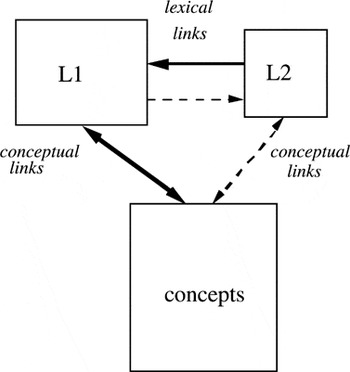
The RHM (see Figure 2) is a developmental model that captures the interlanguage connections between lexical and conceptual representations as learners become more proficient in the L2. Unlike the BIA model, the RHM does not specify the precise dynamics of lexical recognition. Instead, the focus is on how word-to-concept mappings are developed and accessed during language processing.

The revised hierarchical model. (Adapted from Kroll & Stewart, 1994.)
The model proposes independent lexical representations for words in each language, but an integrated conceptual system. During early stages of SLA, words in the L2 are hypothesized to be associated to their translation equivalents. Because words in the L1 are assumed to have direct access to their respective meanings, the activation of the translation equivalent in L1 facilitates access to meaning for the new L2 words. The model also assumes that word-to-concept connections are stronger for the L1 than for the L2 for all but the most proficient and balanced bilinguals. At the lexical level, there might be some feedback that allows direct translation from the L1 to the L2, but the model assumes that the strong conceptual connections from L1 to meaning will increase the likelihood that translation from the L1 to the L2 is conceptually mediated. With increasing proficiency in the L2, the RHM further assumes that the strength of word-to-concept connections for the L2 increases and the presence of lexically mediated processing decreases. To illustrate, during early stages of language learning, the Spanish word gato is hypothesized to be associated to the translation equivalent cat in English. The English word cat will have privileged access to the meaning; thus, the word-to-concept connection is stronger in the L1 than in the L2. As proficiency increases in the L2, the model hypothesizes that the connection between gato and the concept will strengthen and the dependency on the L1 translation equivalent will diminish.
The evidence for the RHM comes primarily from experiments on translation performance. According to the RHM, translation in the forward direction—from L1 to L2—should be conceptually mediated, but translation in the backward direction—from L2 to L1—should be lexically mediated. To test this prediction, Kroll and Stewart (1994) had highly proficient Dutch-English bilinguals translate in both directions. In one condition, the words to be translated were blocked by semantic category, and in the other, they were randomly mixed. Kroll and Stewart found that translation from L1 to L2—the direction hypothesized to be conceptually mediated—was slower in the context of the semantically categorized lists than in the mixed conditions, but translation from L2 to L1—the direction hypothesized to be lexically mediated—was unaffected by the semantic manipulation. Additionally, even for these highly proficient bilinguals, there was a translation asymmetry, with longer latencies in the L1 to L2 direction than in the L2 to L1 direction.
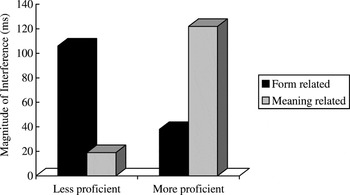
Subsequent research has tested the asymmetries proposed by the RHM in proficient bilinguals and in learners at different stages of L2 development. For example, Talamas et al. (1999) used the translation recognition task first reported by De Groot (1992) to examine the performance of English-dominant L2 learners who differed in their proficiency in Spanish. In this task, participants were presented with two words, one in each language. Their task was to decide whether the second word was the translation of the first. The critical focus in the Talamas et al. study concerned those trials in which the two words were not translation equivalents (i.e., the “no” trials). For example, the pair man-hombre would constitute a correct translation trial. On the critical “no” trials, the second word of the pair was related by virtue of word form similarity to the translation equivalent (e.g., man-hambre “hunger”) or meaning (e.g., man-mujer “woman”). Talamas et al. showed that the L2 form relatives of the translation equivalent caused more interference for the less proficient bilinguals relative to the unrelated controls, whereas L2 meaning-related words caused more interference for the more proficient bilinguals relative to the unrelated controls. Figure 3 shows the main results of the Talamas et al. study; the magnitude of interference (i.e., the difference between related and unrelated distracters) is given for the form and meaning distracters for the two groups of participants. The overall pattern of results provided support for the hypothesis that early in L2 learning, it is the lexical form relations to the translation equivalent between L2 and L1 that provide the basis of interlanguage connection. Only with increasing L2 proficiency are L2 learners able to access the meanings of L2 words directly.

Results of Talamas et al. (1999) that show the magnitude of interference in translation recognition for form and semantic distracters as a function of L2 proficiency. Interference is measured as the difference in RT between the related and unrelated conditions.
Although some studies have not obtained support for the predictions of the RHM (e.g., Altarriba & Mathis, 1997; De Groot & Poot, 1997; La Heij, Hooglander, Kerling, & Van der Velden, 1996), others have replicated both the translation asymmetry and the differential effect of semantic variables on the forward direction of translation (e.g., Kroll et al., 2002; Sánchez-Casas, Davis, & García-Albea, 1992; Sholl, Sankaranarayanan, & Kroll, 1995). However, the critical issue with respect to the RHM and lexical activation for present purposes is that the RHM hypothesizes that translation equivalents, rather than lexical form relatives, are active in the L1 when the L2 is processed.
To summarize, the main predictions of the two models are as follows: The BIA predicts nonselective access for proficient bilinguals but makes no prediction for less proficient bilinguals. The nature of the lexical activation is at the level of word form. For example, in a Spanish-English bilingual, words such as gato and gate would compete during word recognition. The RHM predicts that the nature of the lexical activation is at the level of translation equivalents (e.g., gato-cat). Moreover, the RHM predicts a shift in the reliance on the L1 translation equivalent as proficiency in the L2 increases.
THE PRESENT STUDY
As we have seen, the BIA model predicts that lexical form relatives are active for proficient bilinguals. The RHM predicts that translation equivalents are active for L2 learners. The question we investigate in the present study is whether both types of form-related interference occur: form related to the L1 word itself (as proposed by the BIA model) and form related to the translation equivalent (as proposed by the RHM model). To our knowledge, this study is the first to place distinct predictions about lexical activation in L2 learners in the same context.
Testing Hypotheses About Lexical Activation
The primary goal of the present study was to assess the extent to which the two distinct types of lexical competitors are active at different levels of L2 proficiency. A secondary goal was to examine the extent to which conceptual information is active during lexical access at different levels of proficiency. The RHM predicts that with increasing proficiency, the L2 learner will be able to access concepts directly in the L2 without reliance on lexical (translation equivalent) links. A great deal of evidence supports the claim that proficient bilinguals are able to process the L2 conceptually (e.g., De Groot, Dannenburg, & Van Hell, 1994; La Heij et al., 1996; Zeelenberg & Pecher, 2003). However, it is not clear at what point learners become able to access the concepts to which L2 words refer. Some studies suggest that the ability to do so is available quite early in learning (e.g., Altarriba & Mathis, 1997; De Groot & Poot, 1997; Frenck-Mestre & Prince, 1997; Potter, So, Von Eckardt, & Feldman, 1984), whereas other studies suggest that it develops in stages (e.g., Dufour & Kroll, 1995; Talamas et al., 1999).
The design of the present study is an extension of Talamas et al. (1999) that will enable us to directly contrast the influence of lexical form and translation competitors in L1 to test the predictions of the two models. The experiment includes distracters that are related in form to the L1 lexical neighbor, like those used to test the BIA model, but also lexical neighbors of the translation equivalent, like those used by Talamas et al. to test the RHM. By including both types of lexically related distracters, the experiment will allow us to determine which type of lexical activation is most prominent at each level of L2 proficiency. Furthermore, by including meaning-related distracters, we will be able to identify the point at which L2 learners are able to retrieve the meaning of L2 words directly.
The assumption in using the translation recognition task is that the time it takes to reject a word pair and the accuracy in rejecting the word pair reflect lexical processing and the underlying architecture of the developing lexicon. Accordingly, the extent to which the two different types of form relatedness and meaning relatedness cause interference as well as the degree to which that interference is modulated by proficiency provide critical empirical evidence to test models of lexical retrieval. To illustrate, consider the correct translation pair cara-face. In the critical trials in the translation recognition task, the participant is presented with a pair of words that are not translation equivalents, such as cara-card. Upon presentation of the Spanish word cara, it is hypothesized that the orthography of the word card is also activated, according to the BIA model. However, for L2 learners at different levels of proficiency, the ability of the word cara to activate lexical neighbors across languages might differ. When the participant is presented the second word of the pair card and is then asked to judge whether the two words are translation equivalents, the extent to which lexical neighbors cause interference relative to unrelated controls will determine the observed response times; that is, a lexically related word in English, like card, should be more difficult to reject than an unrelated control word in English, like lake. Likewise, if we take an item pair such as cara-fact, in which fact is a translation neighbor of face, we can consider the relative activation of the translation equivalent. Upon presentation of the word cara, there might be the initial orthographic activation of items similar to cara, as described earlier. However, depending on proficiency, there might also be activation of the translation equivalent, activation of the concept, or both. Less proficient learners might first access L1 lexical links to gain access to the concept; that is, they might process cara and immediately access the translation equivalent face, which then activates the conceptual information. The more proficient learners might be able to directly access the concept without the L1 lexical link. Therefore, only the less proficient learners might be expected to have difficulty rejecting a word pair when the distracter is similar in form to the L1 translation equivalent that they have activated to gain access to the concept.
Sensitivity to Grammatical Class
A final variable was included in the design to address an issue that was not controlled by Talamas et al. (1999). Two words that are translation equivalents, if they are otherwise unambiguous, are necessarily members of the same grammatical or lexical class. However, two words that are related by form or meaning only, as the nontranslations were in the Talamas et al. study, might be members of the same grammatical class. If L2 learners are sensitive to the grammatical class of words presented out of context, then, in the previous study, grammatical class might have provided a differential cue that potentially modulated the degree of interference in the critical conditions, particularly for the more proficient participants. As proficiency in the L2 increases and learners have a more fully developed lexical representation of the L2 word, then grammatical information might be predicted to increasingly function as a cue to lexical status. If two words are related in lexical form and are also members of the same grammatical class, then the latter cannot function as a cue to rejecting the pair as nontranslations.
Although the two above-described models do not account for the role of grammatical class in lexical processing, some models of SLA make specific claims about how grammatical information is transferred from the L1 to the L2. For example, Jiang (2000) proposed that lexical development progresses in stages, with L1 syntax first mapped on to new lexical items before complete integration occurs in the L2 with all of the formal specifications of the L2 word represented. Some research in the SLA literature speaks to an underlying sensitivity to grammatical class. Poulisse (1999), in research on slips of the tongue in L2 production, found that 97% of the time learners substituted only lexical items that belonged to the same word class. This phenomenon has become known as the syntactic category constraint, which suggests that nouns tend to be substituted for nouns, verbs for verbs, and so forth. Berg (1992) investigated gender and word class to see whether lexical access was constrained by either of these two features and ultimately found that both play a role in lexical access, with word class playing a more significant role. The current study will systematically investigate the extent to which grammatical class interacts with form, meaning, and L2 proficiency in L2 lexical processing.
Research Questions
- Is lexical information in the L1 active when L2 words are processed?
- Does the activation of lexical information in the L1, either with respect to lexical form or to the translation equivalent, differ for learners who are more and less proficient in the L2?
- Does access to the meaning of L2 words increase with increasing proficiency?
- Does grammatical class function as a cue to lexical status and, if so, is it differentially effective for more and less proficient L2 learners?
METHOD
Participants
One hundred seven university students with normal or corrected-to-normal vision participated in the experiment and were compensated monetarily. All participants were native English speakers recruited from Spanish language classes at a large university in the United States.1
Although we recruited native English speakers at different levels of Spanish proficiency, several Spanish-English bilinguals (dominant in Spanish) participated in the study as well. These participants were excluded in order to maintain a homogenous L1 background for all participants.
Determining proficiency by experience in the language and self-ratings is also admittedly imperfect. Therefore, two additional measures were used to investigate the differences between these two groups. The first measure was related to the participants' L1 cognitive performance. Recall that all participants shared the same L1, English, and differed only in their proficiency in L2 Spanish. Because past research (e.g., Kroll et al., 2002) has shown that more proficient L2 speakers might have enhanced cognitive abilities, a reading span task was administered to ensure that the proficiency groups did not differ in cognitive resources. Second, a predictive validity measure on an independent picture-naming task was administered to all participants to ensure the proficiency differences between the two groups. In the next subsections, the two tasks will be described briefly and the results will be reported.
Reading Span Task.
The span task, which includes both a storage component and a processing component, was adapted from a reading span measure designed by Waters and Caplan (1996). In the task, participants saw a series of 80 sentences, taken from Waters and Caplan, on a computer screen and judged the semantic plausibility of the sentences. If a sentence made sense, the participant pressed a button labeled “yes,” and if a sentence did not make sense, the participant pressed a button labeled “no.” The participants were instructed to make the plausibility judgment as quickly and as accurately as possible. The 80 sentences were grouped into 20 sets. There were four sets of each of two, three, four, five, and six sentences. Half of the sentences were plausible and half were implausible. The number of words per sentence was matched so that it did not vary significantly across plausible versus implausible sentences or across the sentences in the five different set sizes. Additionally, Waters and Caplan controlled for a number of characteristics of the words to be recalled; the words were matched on word length, frequency, familiarity, concreteness, and imageability.
After a set of between two and six sentences, participants were instructed to recall the final word of each sentence in that set. The participants had a small booklet that contained a separate page for each set of sentences so that they were unable to see the words that they had written in previous sets. There were six lines on each page of the booklet in order to eliminate any cue to how many sentences would be in each set. Each trial in each set proceeded as follows: A fixation point was presented on the screen for 300 ms, followed by a sentence that remained on the screen until the participant made a key press response. Each set ended with a screen with the word RECALL. The participants then wrote their responses in the booklet, and when they were ready to proceed, they pressed a key to start the next trial. The span score was based on the total number of words the participant could recall only on trials for which the plausibility judgment was correct. If the participant did not judge a sentence correctly but recalled the final word of that sentence, the word was not included in the tally of the total number of items recalled.
Reading Span Results.
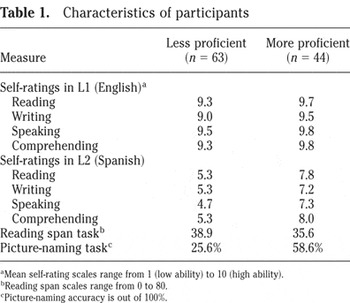
To determine whether the two proficiency groups identified on the basis of their language experience also differed in cognitive abilities, a t-test was performed to compare the total recall scores on the reading span task. Recall that the reading span task was performed in English, the L1 of all the participants. The results showed that the difference between the two groups was not significant, t(99) = 1.67, p = .10. If anything, the absolute level of recall was greater for the less proficient group (M = 38.9) than for the more proficient group (M = 35.6). These data suggest that advantages observed for the more proficient L2 learners on the translation recognition task can be attributed to their language experience rather than to individual differences in cognitive resources.
Picture-Naming Task.
Participants were presented with 40 dictionary-like line drawings and their task to was name the picture in Spanish as quickly as possible. All participants were tested individually and were given verbal instructions by the experimenter. A practice block of 10 pictures was given prior to the start of the experiment. Participants were presented with the randomized pictures one at a time at the center of the computer screen. A fixation point in a box preceded each picture. The fixation point remained on the screen until the participant pressed a button. The fixation point was then replaced by a line drawing of an object. Participants were instructed to respond aloud. The picture was replaced with a fixation point after a response from the participant was registered. The participants' responses were tape-recorded and later coded for accuracy. The accuracy of naming was the main dependent variable.2
We also collected response latencies in this picture-naming task and investigated picture-naming under mixed and blocked conditions. These results are reported elsewhere (Sunderman, 2002).
Picture-Naming Results.
To determine whether the two proficiency groups identified on the basis of their language experience was valid, a one-way ANOVA was performed to compare the accuracy of the two groups in naming pictures. The results showed that the difference between the two groups was significant, F(1, 105) = 100.7, p < .001. The less proficient learners had a mean accuracy of 25.6%, whereas the more proficient learners had a mean accuracy of 58.6%. These data suggest that the differences between the two groups are attributable to their proficiency in the L2. The self-ratings of the two proficiency groups as well as the reading span and picture-naming measures are shown in Table 1.
Characteristics of participants

Materials
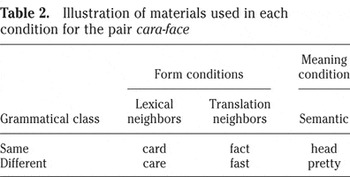
There were 48 correct translation pairs initially chosen. For each word pair, such as cara-face, six total distracters were constructed; two different distracters (which differed by whether they matched the target word for grammatical class) were designed for each of the three conditions: (a) form related to the first item of the pair (i.e., an orthographic neighbor in English to the word cara), (b) form related to the second item of the pair, the translation equivalent (i.e., an orthographic neighbor in English to the word face), or (c) meaning related. The first condition we call lexical neighbors and the second condition we call translation neighbors, using the term neighbors simply to mean two items that are orthographically similar.
Table 2 provides an illustration of how related word pairs were generated in the three critical conditions of the translation recognition experiment. The words card and care are both orthographically related to the word cara. The words fact and fast are both orthographically related to the word face. We operationalized orthographic similarity as the sharing of an onset of the word, which typically included the first two to three letters of the word.3
Items were not matched on phonological similarity. A study investigating the roles of phonology and orthography in L2 lexical processing is an excellent future avenue for research in this area.
Whenever possible, words for the meaning-related condition were selected from the Edinburgh Associative Thesaurus, an interactive online associative thesaurus that generates common word associations to a given word (see Kiss, Armstrong, Milroy, & Piper, 1973, for a complete description).
Illustration of materials used in each condition for the pair cara-face

In each of the three conditions, as illustrated in Table 2, the words were either matched or mismatched on grammatical class. The distracters were designed such that half of the distracters were drawn from the same grammatical class as the first item of the pair and the other half of the distracters were drawn from different grammatical categories. In the case of the noun cara (face in English), the two form-related lexical neighbor distracters, as seen in Table 2, are fact (noun) and fast (adjective). In judging whether two items are translation equivalents, it is necessarily the case that they must share the same grammatical class. It stands to reason that in judging a pair such as cara-fast, if the participant is able to use grammatical class information as a cue, then this decision should be faster than judging cara-fact, in which case the two items are matched on grammatical class and, therefore, could be possible translation equivalents. Finally, given that some nouns can also be verbs, such as the word table (e.g., to table a motion), words were always used according to their most frequent grammatical sense as determined by the frequency norms of Francis and Kucera (1982).5
Approximately 60% of the stimuli have dual grammatical classes. Given the discrepancy in the relative frequency of the two grammatical classes, it is assumed that the more frequent word class will be activated first and will therefore be the salient cue in this task.
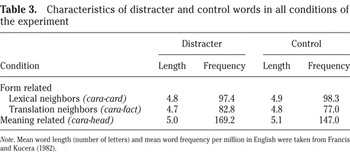
For each of the six related distracters for any given item, unrelated distracters matched on word length and frequency to their respective related pairs were also constructed. It was important to generate individual unrelated distracters for each condition because the lexical properties of distracters that fell into these conditions varied. By matching the word length and frequency of the unrelated distracters to the related distracters, we attempted to eliminate the contribution of other variables that might influence translation recognition performance. For example, the words card and lake both have a mean word frequency of 61 per million in English (Francis & Kucera, 1982) and a word length in letters of four. If it takes a participant longer to decide that the pair cara-card is not a correct translation pair than it takes to make the decision for the pair cara-lake, we can be reasonably certain that the lexical form similarity, not other lexical properties of the words, is responsible for the observed interference. Thus, all of the unrelated distracters were, in principle, unrelated to the same degree. However, within each type of relatedness investigated in this experiment (form related to lexical neighbor, form related to translation neighbor, and meaning related), the unrelated and related pairs were matched on length and frequency only within each type of relatedness, but not across relatedness.
Table 3 gives the mean word length in number of letters and mean word frequency per million in English (Francis & Kucera, 1982) for the full set of distracters and matched unrelated controls. The distracter words and their controls were matched as closely as possible on these two factors: word length and frequency. However, for the length of the meaning-related pairs, although the absolute difference between the distracter (5.0 letters) and control words (5.1 letters) was very small, it was significant, t(95) = −2.22, p < .05. All other distracter-control pairs in the remaining conditions were not significantly different in length or frequency, thus ensuring that the materials were matched.
Characteristics of distracter and control words in all conditions of the experiment

Within each of the three conditions, the related and unrelated pairs were matched on length and frequency. However, the pairs were not matched to one another across the three conditions in terms of length and frequency. This would have been virtually impossible to accomplish without diminishing the representativeness of the relations within each condition. Thus, for each distracter type, the related and unrelated pairs were matched closely on lexical properties. However, across distracter types, there were some differences in word frequency and word length. For a description of a similar procedure, see Dijkstra, Grainger, and Van Heuven (1999). Refer to Table 2 for examples that illustrate the different distracter types in these conditions and the lexical properties for the critical and control materials. Samples of items used for the critical “no” trials can be found in the Appendix; a full set of the materials can also be obtained by contacting the lead author.
Design
In total, 576 distracters (288 related and 288 unrelated) were selected to be included in the experiment. Six different versions of the materials were created, with 96 different critical items per version (48 related and 48 unrelated). The 96 critical items were not the correct translations, therefore corresponding to the “no” condition in translation recognition. Note that the correct translations that generated the distracter families for the critical pairs described previously were never actually presented in the experiment. Instead, two sets of 48 “yes” trials were created and matched to the correct translations of the critical set as closely as possible on word length and frequency (Francis & Kucera, 1982). As such, each participant saw two sets of 48 trials, for a total of 96 trials; of the 96 trials, 48 were “yes” trials and 48 were “no” trials.
Procedure
Participants were tested individually and were given verbal instructions by the experimenter in addition to instructions that appeared on the computer screen. Their task was to decide if two words were translation equivalents of each other. The words were always presented so that the L2 (Spanish) word appeared first, followed by the L1 (English) word. Prior to the presentation of the two words, a fixation point was presented at the center of the screen. The participant initiated the trial by pressing a key on a button box connected to the computer. The first word replaced the fixation point for 400 ms followed by a brief 100-ms blank screen and then the second word appeared in the same position. The second word remained on the screen until the participant pressed either the “yes” or the “no” button. Participants were instructed to make their responses as quickly and accurately as possible, and, if they were unsure, to guess. RT was recorded to the nearest millisecond from the onset of the presentation of the second word. The presentation order of the word pairs was randomized for each participant by the PsyScope program (Cohen, MacWhinney, Flatt, & Provost, 1993). Ten practice trials were given prior to the start of the experiment.
RESULTS AND DISCUSSION
Data Analysis
Only correct responses on critical trials were included in the RT analyses; the accuracy analyses included data from all critical trials. Accuracy was coded by PsyScope as either correct or error. RTs that were faster than 300 ms or slower than 3000 ms were removed from the analyses and treated as outliers. Means for the “yes” and the “no” trials were calculated separately for each participant. Based on these values, RTs that were 2.5 standard deviations above or below the participant's mean RT for each of the overall conditions were excluded from the analyses and treated as outliers. Data trimming was done in this way because it is typically thought that extremely fast scores reflect anticipatory processes, whereas extremely slow scores are due to lapses in attention or other processing strategies and, therefore, do not reflect the processes of interest (Ratcliff, 1993). Less than 1% of the data were excluded as outliers.6
The excluded data did not differentially affect the less or more proficient group.
Correct Translation Pairs.
Although our main interest was in the critical “no” conditions, it is useful to examine the performance by the two different proficiency groups on the “yes” conditions, in which the two words were translation equivalents of each other. The less proficient learners and the more proficient learners differed significantly in their ability to judge and the speed at which they could judge correct translation pairs that were fillers in the experiment. The less proficient learners were slower and less accurate than the more proficient learners, F(1, 105) = 3.1, p < .01 for RTs and F(1, 105) = 43.3, p < .001 for accuracy. The less proficient learners responded, on average, in 850 ms, whereas the more proficient learners were significantly faster at 792 ms. The less proficient learners were also significantly less accurate than the more proficient learners (77% vs. 87%). The differences in RT and accuracy for the two groups provide additional support for the validity of the proficiency distinction.
Critical Trials.
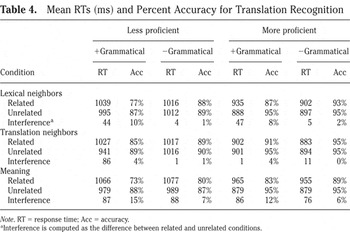
The complete results for the critical translation trials are shown in Table 4; RTs and percent accuracy are given for each type of word pair. Recall that there were three types of critical “no” trials. These pairs were form-related lexical neighbors, form-related translation neighbors, and meaning-related words. In each case, participants judged each of the three types along with matched unrelated controls. Furthermore, for each word type, half of the “no” pairs matched on grammatical class (+grammatical) and half did not (−grammatical).
Mean RTs (ms) and Percent Accuracy for Translation Recognition

The magnitude of interference was calculated for each type of distracter as the difference between the related and the unrelated trials. The difference scores give an indication of the sensitivity to each distracter type in each condition. Separate ANOVAs were performed on the mean correct RTs and percent accuracy for each type of distracter in order to test the reliability of the pattern emerging in Table 4. Although the stimulus lists contained all word types in a random order, the analyses were performed separately due to the nature of the matching procedure for lexical properties.
An ANOVA was performed using participant means as random factors, one between-group factor (proficiency: less or more), and two within-group factors (related or unrelated and matched or unmatched grammatical class). We report the results separately for each of the three critical distracter types: form-related lexical neighbors, form-related translation neighbors, and meaning-related words.
Form-Related Lexical Neighbors (Cara-Card/Cara-Care)
Response Latencies.
What is immediately apparent in the pattern of interference shown in Table 4 for the form-related lexical neighbors is that both the less proficient and more proficient participants showed interference, but only when the grammatical class was matched; relatively little interference was observed when the grammatical class was not matched. Furthermore, the magnitudes of interference for the more and less proficient learners were very similar.7
Given that the less proficient participants are also slower and that slower cognitive processes are often more susceptible to interference, it might be the case that the absolute magnitude of interference for the learners is actually less relative to their baseline RTs. However, given the magnitude of interference, it is clear the less proficient learners still experienced significant form interference.
Two results were significant in the analysis. There was a main effect of relatedness, such that all participants, regardless of their L2 proficiency, were slower to reject form-related pairs, F(1, 105) = 4.33, p < .05. Although the BIA model predicts that form-related relatives are active in both languages during word recognition for proficient bilinguals, this result shows form-based interference for both proficiency levels, which not only supports the claim of the BIA model but also extends the result to learners at lower proficiency levels of L2 acquisition. There was also a main effect of proficiency: The more proficient learners responded faster than the less proficient participants, F(1, 105) = 5.91, p < .05. The overall proficiency difference suggests that the time needed to perform the translation recognition task was sensitive to proficiency differences. Although the interference values suggest an interaction between relatedness and grammatical class, this interaction did not reach statistical significance, F(1, 105) = 1.80, p = .182. However, the interaction is significant in the accuracy data discussed in the following subsection.
Accuracy.
There was a significant interaction in the accuracy data between grammatical class and relatedness, F(1, 105) = 16.59, p < .001. Simple effects tests on the interaction showed that when a word pair was both form related and matched on grammatical class, all participants were less accurate in judging the words as translation equivalents, p < .001. In fact, there was also a main effect of grammatical class F(1, 105) = 13.62, p < .001. All participants, regardless of proficiency, were less accurate in judging word pairs that shared the same grammatical class. The presence of an effect of grammatical class, and one that appears to be independent of proficiency, is important for two reasons. First, the BIA model does not include information about grammatical class and makes no claims about how such information might interact with form-related activation. This result suggests that information about grammatical class might be represented at a level in the lexicon that influences the process of word recognition. Second, the data suggest that both more and less proficient bilinguals are sensitive to grammatical class, which supports Jiang's (2000) model. Finally, as in the RT data, we see a main effect of proficiency in the accuracy data, with the less proficient participants less accurate than the more proficient participants, F(1, 105) = 17.03, p < .001. There was also a main effect of relatedness, F(1, 105) = 23.98, p < .001, such that all participants, regardless of proficiency level, were less accurate in judging related than unrelated word pairs. Overall, this result suggests—as in the RT analysis—that there is increased competition among form-related alternatives and that this competition is present for less proficient learners.
Post Hoc Analysis.
The comparison of RTs for more and less proficient learners is potentially complicated by the fact that the accuracy of their performance also differed. Because translation recognition is a binary choice task, it is possible that less skilled individuals might have adopted a guessing strategy that had the consequence of not only generating lower levels of accuracy but also of masking RT differences among conditions. The apparent interaction between lexical form relatedness and grammatical class failed to reach significance in the RT analysis reported previously. To determine whether the sensitivity of the statistical comparison was compromised by the data of individuals with low accuracy, a post hoc analysis was performed using data only from participants whose accuracy on the “yes” translation trials was 75% or greater. The resulting analysis included 42 less proficient learners and 43 more proficient learners. Of the 22 excluded participants, only one had been identified previously as more proficient. An ANOVA revealed a significant interaction between form relatedness and grammatical class, F(1, 83) = 5.28, p < .05. Although there was a main effect of proficiency group, with faster RTs for the more proficient than for the less proficient participants, F(1, 83) = 4.60, p < .05, this factor did not interact with any other variables. This result suggests that lexical form interference is modulated in the presence of information about grammatical class and that this effect is present for both more and less proficient L2 learners. We consider the implications of this observation in the general discussion.
Form-Related Translation Neighbors (Cara-Fact/Cara-Fast)
Response Latencies.
An examination of the interference values for the distracters that were form related to the translation neighbor revealed that there were differences in the nature of the interference effect for the less and more proficient learners. The less proficient learners appeared to be sensitive to the presence of form-related translation distracters, whereas the more proficient learners showed virtually no interference for this type of distracter. However, like the pattern observed for lexical form neighbors, these effects only appeared when the distracters were drawn from the same grammatical class. Neither group appeared to show interference when the distracters were not matched on grammatical class.
The main effect of relatedness was not significant, F(1, 105) = 2.96, p = .09; however, it was qualified by a significant interaction between relatedness and proficiency, F(1, 105) = 4.84, p < .05. Simple effects tests showed that the less proficient learners were significantly slower to respond to the translation-related form pairs compared to the unrelated pairs (p < .01). The more proficient learners were not influenced by form similarity to the translation neighbor. This is an important result because it shows that the pattern of lexical interference depends on proficiency in the L2. This finding replicates the result reported by Talamas et al. (1999): Less proficient learners experience more form-related interference at early stages of acquisition, and form-related interference diminishes with increasing proficiency. There was also a marginal interaction between relatedness and grammatical class, F(1, 105) = 3.50, p = .06. When a word pair was both related and matched on grammatical class, it was the most difficult to reject for all participants. Although the three-way interaction among relatedness, grammatical class, and proficiency failed to reach significance, F(1, 105) = 1.97, p = .163, there was a trend in this direction, which suggests that the less proficient learners were most sensitive to both the form relatedness and the grammatical class, as seen in Table 4. Finally, there was a main effect of proficiency, F(1, 105) = 5.55, p < .05. The more proficient participants were again faster than the less proficient participants to reject the word pairs that were not translation equivalents.
Accuracy.
In the accuracy data, there was a main effect of relatedness, F(1, 105) = 4.92, p < .05, such that all participants were less accurate in rejecting pairs that were form related to the translation neighbor. There was also a main effect of grammatical class, F(1, 105) =5.96, p <. 05. All participants were less accurate in rejecting word pairs that were matched on grammatical class. There was also an interaction between relatedness and grammatical class, F(1, 105) = 4.15, p <. 05. Simple effects tests on the interaction showed that the pairs that were related and matched on grammatical class produced the lowest accuracy (p < .01). There was also a main effect of proficiency, with the less proficient participants less accurate overall than the more proficient ones, F(1, 105) = 16.95, p < .001.
Post Hoc Analysis.
A critical difference between the less and more proficient learners was that only the less proficient group experienced form-related interference in RTs for translation neighbors (cara-fact). Although the differential result supports the predictions of the RHM in suggesting that less proficient learners rely on lexical links via the translation equivalent, the less proficient learners were also slower than the more proficient learners. The slower time course of processing for the less proficient group might increase the likelihood that the translation equivalent becomes active.8
However, Segalowitz and Hulstijn (2005) argued that it is not speed per se that changes, but it is the restructuring of the system.
An ANOVA on the RTs for the related and unrelated pairs for the translation neighbor distracter condition was performed with faster and slower participants in each proficiency level as the between-participants factor. For the more proficient learners, there was no effect of relatedness and no interaction between relatedness and performance speed. The slower participants in the more proficient group still did not show a translation effect. For the less proficient learners, there was a main effect of relatedness, F(1, 61) = 7.98, p < .05, but it was not qualified by an interaction between relatedness and speed, F(1, 61) = .09, p = .765. This lack of an interaction suggests that proficiency is driving the translation strategy, not speed of processing per se. Although the average range of processing speed was similar for the two proficiency groups (less proficient: 854 ms for the fast group and 1153 ms for the slow group, vs. more proficient: 763 ms for the fast group and 1027 for the slow group), only the less proficient learners were sensitive to the translation equivalent. In sum, this analysis suggests that the processing strategy adopted by the less proficient learners was qualitatively different from that used by the more proficient learners.
Grammatical Class Post Hoc Analysis
The data that we reported in each of the form-related conditions show that both less and more proficient learners were sensitive to the grammatical class of words in the L2 and were able to use that information to override the deleterious effects of form-related similarity. To be certain that the observed modulation of form-related interference was not due to confounded lexical-level differences in the between-items comparison, we conducted a post hoc analysis on orthographic similarity and grammatical class. The interaction of relatedness and grammatical class was marginally significant in the RT analyses for the lexical form pairs, F(1, 105) = 3.5, p = .06; however, this interaction was significant in the accuracy analyses for all three types of relatedness investigated in the present study. These results are particularly surprising because the translation recognition task was performed out of sentence context and because we did not expect to see sensitivity to grammatical class in late L2 learners who were less proficient.
Before concluding that there was sensitivity to grammatical class even for learners at early stages of L2 acquisition, we wanted to rule out other possible factors that might have contributed to the observed differences. For example, despite the effort to create distracters in each condition that were matched on length and frequency and that differed only with respect to grammatical class, the critical comparisons are between items, and it is possible that there was a confound such that the words matched on grammatical class were orthographically more similar than the words that were not matched on grammatical class. To determine whether a confounding with orthographic similarity was present, we computed the similarity measure described by Van Orden (1987) for all of the critical “no” items.
An ANOVA on the orthographic similarity measure was performed using items as the random factor to examine the effects of distracter type, relatedness, and grammatical class. There were main effects of distracter type and relatedness that were qualified by a significant interaction between them, F(1, 564) = 48.8, p < .001. The interaction revealed differences in orthographic similarity that are related to the way in which the materials were constructed. Form-related neighbors were designed to be structurally similar and the post hoc analysis verified that property of the items. Simple effects tests on the relatedness effects for each of the distracter types showed that the relatedness effect was significant only for the lexical form condition, F(1, 564) = 144.6, p < .001, and not for the translation neighbor, F(1, 564) = 1.1, p = .281, or the meaning-related condition, F(1, 564) = .04, p = .834. However, of critical interest, the analysis of orthographic similarity produced no significant differences as a function of grammatical class or interactions between grammatical class and any other factor (all F-values < 1). Although it remains possible that there are residual differences along other lexical dimensions, this analysis suggests that a simple confounded orthographic similarity effect is not responsible for the observed sensitivity to grammatical class.
Meaning Related (Cara-Head/Cara-Pretty)
Response Latencies.
The data for the meaning-related condition shown in Table 4 suggest that meaning-related distracters affected both the less and more proficient learners similarly, and unlike the results for the form-related conditions, these effects were not dependent on the grammatical class match within the word pair. The results for the meaning-related distracters failed to replicate the pattern observed by Talamas et al. (1999) that was shown in Figure 3, but supported the conclusions of Altarriba and Mathis (1997) and Frenck-Mestre and Prince (1997) in that even less proficient learners of a L2 appeared to be sensitive to conceptual information.
The ANOVA produced two main results. There was a main effect of relatedness, F(1, 105) = 39.18, p < .001, such that all participants were slower to reject the pairs that were meaning related relative to their unrelated controls. This suggests that the less proficient learners as well as the more proficient learners were accessing conceptual information. There was also a main effect of proficiency, F(1, 105) = 5.49, p < .05. The less proficient participants were slower overall than the more proficient participants, as we have seen in the data for the other distracter types.
Accuracy.
Although there was no effect of grammatical class in the RT data, there was a main effect of grammatical class in the accuracy data that was significant, F(1, 105) = 9.30, p < .05. All participants were less accurate to reject pairs that were matched on grammatical class. There was also a main effect of relatedness, F(1, 105) = 69.05, p < .001. All participants were less accurate in rejecting pairs that were meaning related. There was also an interaction between relatedness and grammatical class, F(1, 105) = 13.23, p < .001. Simple effect tests on the interaction showed that the participants were least accurate when the word pair was related and matched on grammatical class (p < .001). As in the previous analyses, there was a main effect of proficiency, F(1, 105) = 19.92, p < .001. The less proficient participants were less accurate than the more proficient participants. However, there was no interaction between proficiency and either meaning relatedness or grammatical class. Given the main effects described previously, this suggests that both more and less proficient learners were sensitive to both meaning relatedness and to grammatical class.
Post Hoc Analysis.
With respect to the observed meaning interference, we now consider whether the similar overall effects for both proficiency groups are attributable to the same semantic relations and genuinely independent of proficiency. In the present study, all participants, regardless of their proficiency in the L2, were slower to reject nontranslation pairs that were meaning related (operationalized in this study in a broad manner). Furthermore, unlike the interference attributable to form relatedness, the meaning interference effect in RT was not modulated by grammatical class; word pairs from matched and mismatched grammatical classes were equally likely to result in meaning interference. Studies of semantic priming (e.g., McRae & Boisvert, 1998) have suggested that the degree of semantic feature overlap between primes and targets might be critical in determining the presence and magnitude of priming. One hypothesis about L2 development is that the ability to access meaning directly for words in the L2 is a function of the strength of the relation of the meaning in L1 and L2. Some support for this idea comes from studies of translation performance (e.g., De Groot, 1992; De Groot et al., 1994) that show that the speed of translating from one language to the other depends on the degree of semantic overlap between concepts in the two languages. In the Talamas et al. (1999) study, sensitivity to meaning appeared to be a function of proficiency, with only the more proficient L2 learners demonstrating meaning interference in the translation recognition task. However, Talamas et al. performed a post hoc analysis to determine whether there were any meaning-related pairs to which less proficient speakers were sensitive. They found that the less proficient L2 learners were indeed sensitive to semantic relations, but only when the word pairs were highly semantically similar. The more proficient participants in that study showed meaning interference regardless of the degree of semantic similarity among meaning-related word pairs. The pattern of results suggested a quantitative change in semantic access with increasing proficiency in the L2.
The overall pattern of results for the meaning-related pairs reported here differed from that obtained by Talamas et al. (1999) in that both less and more proficient L2 learners appeared to experience meaning interference for meaning-related pairs. However, because the set of materials in the present study differed from that used by Talamas et al., it is important to determine whether the apparent similarity in the overall pattern for both groups was the result of the same underlying mechanism. To investigate this possibility in the current study, an additional post hoc analysis was conducted to obtain semantic similarity ratings for the related word pairs used in the translation recognition experiment. The main question was whether the sensitivity to this measure of semantic relatedness would be the same for all participants, regardless of proficiency.
To obtain an independent measure of semantic similarity, each of the 48 target words was paired with its meaning-related distracter and presented in English to 41 native English-speaking participants who rated them for semantic similarity. Semantic similarity is the strength of a relationship between two ideas or concepts. These ratings were collected to assess the strength of the semantic relationship in the dominant L1 of all of the participants of the main experiment and to avoid any confound with L2 proficiency. None of these students had participated in the translation recognition experiment. Participants were instructed to look at the two words and decide the similarity of the two meanings of the words. They were told to use a 7-point scale in which 1 meant very different and 7 meant very similar. An ANOVA revealed that perceived similarity was greater for semantically related pairs that matched on grammatical class (M = 4.1) than those that did not (M = 3.2), F(1, 190) = 46.23, p < .001. In other contexts, grammatical class effects have been shown to be correlated with lexical/semantic properties (e.g., Vinson & Vigliocco, 2002).
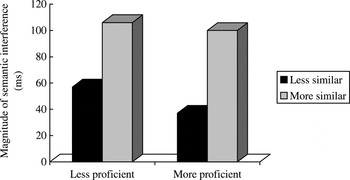
The similarity scores were entered into a regression analysis along with proficiency group and grammatical class to determine whether the magnitude of meaning interference was greater for semantically related pairs that had been rated as more similar and whether these effects would be modulated by L2 proficiency. The result was a significant contribution of semantic similarity alone (p < .05) but no modulation of these effects by proficiency or grammatical class. These data suggest that although grammatical class influenced the offline rating, there was little consequence for online performance. Moreover, the magnitude of meaning interference was larger for word pairs that were rated as being more similar than for those that were rated as less similar, but the effect was the same for both proficiency groups. Figure 4 shows these data; two groups of items have been created: one above and the other below the median semantic similarity value. Unlike the results reported by Talamas et al. (1999), there was no indication in the present results that proficiency influenced access to conceptual information. Thus, it appears that the extent to which there is conceptual mediation in L2 learners might depend on proficiency as well as on the nature of the semantic relation and the experimental task (see Silverberg & Samuel, 2004, for evidence that sensitivity to semantic relations might also be a function of the age at which L2 acquisition began).

The magnitude of semantic interference (ms) as a function of rated semantic similarity and L2 proficiency. Interference is measured as the difference in RT between the related and unrelated conditions.
GENERAL DISCUSSION
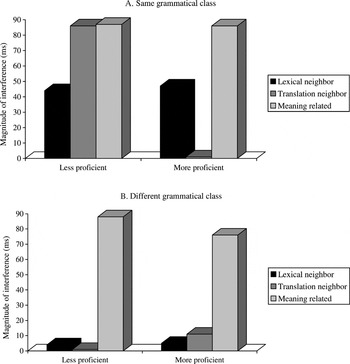
This study placed the predictions of the BIA model (Dijkstra et al., 1998; Dijkstra & Van Heuven, 1998; Van Heuven et al., 1998) and the RHM (Kroll & Stewart, 1994) in the same context in order to address lexical processing in the L2. The performance of two groups of native English speakers (one less proficient and the other more proficient in Spanish) was compared on translation recognition. The critical conditions consisted of words in each language that were not translation equivalents but that were related in form (either as a lexical neighbor of the L2 word or by form similarity to the L2 translation equivalent) or in meaning and were either matched or unmatched on grammatical class. A summary of the results is shown in Figure 5; Figure 5A shows the data for critical trials in which the grammatical class of the words was the same, whereas Figure 5B shows the data for the same conditions when the grammatical class of the words was different. When the grammatical class of the two words was the same, there were reliable interference effects for all of the distracter conditions. The one critical exception was that only the less proficient learners appeared to experience competition from the translation equivalent. In other respects, the less and more proficient learners, aside from obvious differences in the speed and accuracy of their performance, were generally similar with respect to the effects of L1 lexical form and semantic interference. When the grammatical class of the two words was different, there were effects only for the meaning-related distracters; all form-related effects were eliminated, both for direct lexical form relatives and for words related to the form of the translation. We now consider how these results might constrain future models of lexical processing.

The magnitude of interference (ms) for the three distracter types (lexical neighbor, translation neighbor, meaning related) for less and more proficient L2 learners. Interference is measured as the difference in RT between the related and unrelated conditions.
The present study revealed several important findings that hold implications for models of the bilingual lexicon and for L2 lexical processing. First, the results confirmed the predictions of both the BIA and RHM models insofar as lexical activation of the L1 was found. The activation of lexical form neighbors was present for both less and more proficient learners. In contrast, only the less proficient learners also appeared to activate the L1 translation equivalent. Thus, both types of lexical activation are present, but, as predicted by the RHM, sensitivity to the L1 translation diminished with increased L2 proficiency. An important issue for future research will be to determine whether the two types of lexical activation are independent of one another. For example, it will be of interest to determine whether decreased sensitivity to the translation equivalent occurs at the same point in development at which L2 form neighbors begin to have the sort of inhibitory effects observed in the more dominant L1.
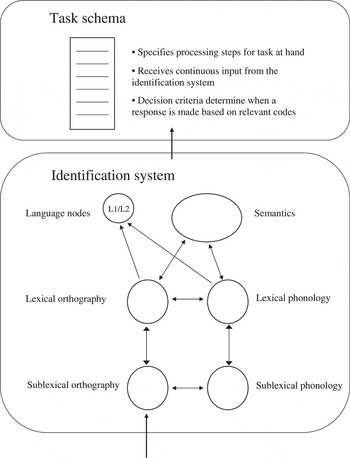
A second finding that introduces new constraints into models of the bilingual lexicon is that form-related interference was modulated by grammatical class. Models of word recognition have, for the most part, provided accounts of the recognition of isolated words and, therefore, assumed that grammatical information is either not engaged at this level or available only following the identification of the orthography of the word. The BIA model itself cannot account for this result, but it has recently been extended as BIA+ (Dijkstra, 2005; Dijkstra & Van Heuven, 2002; Thomas & Van Heuven, 2005) to include semantics within the lexical identification system and a task schema system that falls outside of the identification system. The model is shown in Figure 6. Although the BIA+ model does not explicitly include grammatical class information, it does specify the relation between the outputs of the bottom-up processes that characterize the word identification system and the top-down processes that allocate the outputs of the identification system for the purpose of making decisions within particular task contexts. On this account, higher-level effects attributable to the operation of linguistic factors, such as sentence context, are hypothesized to be able to penetrate the bottom-up processes that guide word recognition.

The BIA+ model. (Adapted from Dijkstra & Van Heuven, 2002.)
The extended BIA+ model can accommodate the present findings if we assume that translation recognition engages a task schema in which the outputs of the identification processes for both the L2 and L1 words are compared. The translation recognition task requires that meaning be checked before a response is generated; therefore, it seems likely that translation recognition performance will reflect the contribution of both bottom-up and top-down processes. To the extent that the presentation of two words sequentially engages the same mechanisms that are active during sentence processing, the grammatical class information might also be more available than in a typical single presentation word recognition experiment.
In the condition of the present experiment, in which words were lexical form neighbors, the activation of shared orthographic codes is likely to have induced competition among a set of lexical candidates. Because unrelated lexical form neighbors are unlikely to produce converging meaning activation, grammatical class information might become available and be used as a cue to lexical identity. Any information that provides a cue to mismatch can be used by the task system to judge the pair as not being translation equivalents. By this explanation, the initial bottom-up activation of form neighbors is blind to grammatical class; only later in processing is that information used as a criterion for making a response. A number of recent studies that examined the effect of sentence context on language nonselectivity in lexical access reached a similar conclusion (e.g., Elston-Güttler, 2000; Schwartz, 2003; Van Hell, 1998). Sentence context appears to modulate the cross-language interactions observed in out-of-context word recognition tasks, but in a manner that suggests that only some types of information influence lexical identification. For example, both Van Hell and Schwartz found that in highly constrained sentence contexts, lexical access appeared to be language selective. However, in each of these studies, parallel activity of the nontarget language remained when sentence contexts were less constrained toward the target alternative. If the language of the context alone had been sufficient to direct access to the language-appropriate alternative, then nonselective effects should not have been observed in any of the sentence context conditions. The fact that such effects were observed suggests that information about the language of the context does not modulate the parallel activation of lexical alternatives in both of the bilingual's two languages.
An alternative that has been suggested in the literature on vocabulary acquisition is that L2 learners copy the L1 syntactic and semantic information onto the L2 lexical item (Jiang, 2000). If a majority of L2 words become fossilized at this stage and never become fully integrated with L2 specific syntactic, semantic, and morphological specifications, then sensitivity to the semantic and grammatical information might be an underlying sensitivity to the residual L1 system that is acting as the L2 system. A goal of future research will be to determine how these processes function in and out of sentence context and to examine to what extent the effects of grammatical class in the present study reflect the genuine engagement of syntactic information or access to lexical/semantic features that are correlated with grammatical class. Although the extended BIA+ model can potentially handle the interaction of grammatical class and lexical form interference by appealing to the contribution of the task system, the model in its present form cannot as easily account for the effects of translation neighbors or for the fact that the magnitude of meaning interference was independent of grammatical class.
A final and important result in the present study is that both groups produced large and similar meaning interference effects. A puzzle, then, is to explain the sensitivity to meaning for the less proficient learners, given past evidence suggesting that conceptual mediation only develops with increasing expertise in the L2 (e.g., Kroll et al., 2002; Kroll & Stewart, 1994). Some studies that argued against full conceptual processing at early stages of L2 proficiency (e.g., Dufour & Kroll, 1995; Talamas et al., 1999) admitted sensitivity to albeit a smaller range of semantic properties. However, as the post hoc analyses in the present study suggest, the strength of the semantic association did not differentially affect the less and more proficient learners. A number of past studies have argued that learners are sensitive to conceptual information from the start of acquisition (Altarriba & Mathis, 1997; De Groot & Poot, 1997; Frenck-Mestre & Prince, 1997). There are a number of ways to reconcile the apparently conflicting results across these different studies (see Kroll & Tokowicz, 2001). The past research that showed that learners can access meaning directly for L2 words typically used comprehension rather than production measures (but see De Groot & Poot for an exception), a small set of materials used repeatedly (e.g., Altarriba & Mathis), and a word or picture context that preceded the L2 word (e.g., La Heij et al., 1996). The presence of the L1 word in translation recognition might have increased the ability of learners to access the meaning of the L2 word, especially in the absence of a requirement to speak in their L2, although that alone does not explain why the present results differ from those reported by Talamas et al., who used the same task (and see also Finkbeiner, Forster, Nicol, & Nakamura, 2004, for another case in which task demands interacted with access to L2 meaning).
It seems then that the question should not be whether there is sensitivity to meaning during L2 acquisition, but, rather, what characterizes the nature of that sensitivity. A number of recent reports suggested limits in the degree to which even proficient but late bilinguals can fully access semantic distinctions in L2 that are available to native speakers (e.g., Jiang & Forster, 2001; Kotz & Elston-Güttler, 2004; Silverberg & Samuel, 2004). Other studies have also called into question the degree to which concepts—especially abstract concepts such as privacy, love, happiness, and so forth—are shared across languages in bilinguals (e.g., Grabois, 1999; Pavlenko, 1999). It is clear that the nature of conceptual processing in L2 and the extent to which it is constrained by L1 is a point for future research.
CONCLUSIONS
The goal of this study was to investigate how lexical processing changes with increasing skill in a L2. To answer the first two research questions regarding the activation of lexical information when L2 words are processed, we reported evidence that suggests that both lexical form relatives and translation equivalents in the L1 appear to influence performance but that this influence is modulated by L2 proficiency. With respect to form-related lexical neighbors, we found that all learners, regardless of proficiency, revealed inhibitory effects. In that sense, and as predicted by the BIA model, the results suggest that the presence of form-related interference is not an indication of unavoidable activation of the L1 during only the earliest stages of L2 acquisition, but a general characteristic of bilingual word recognition. With respect to the form-related translation neighbors, we found that in contrast to the effect of lexical form itself, only the less proficient learners showed an effect of relatedness via the translation equivalent. This result supports the prediction of the RHM that the translation equivalent in L1 is salient during early stages of L2 acquisition. The differential effects of the translation equivalent for the two proficiency groups and the overall differences in performance as a function of proficiency suggest that the data were sensitive to level of L2 skill. These data are the first to show that both types of activation can be seen in the same participants, but that only L1 lexical activation attributable to the translation equivalent is modulated by proficiency in the L2, thus ultimately supporting both the BIA and the RHM.
With respect to the third research question, regarding activation of meaning, the data reported here—contrary to the predictions of the RHM—showed that all participants, regardless of proficiency, revealed inhibitory effects for meaning-related distracters. The failure to obtain a differential effect of meaning as a function of proficiency suggests that information about L2 meaning might be available even during a stage of acquisition in which learners rely on translation equivalents. This conclusion runs contrary to some earlier claims that access to L2 meaning develops slowly in late L2 learning.
Finally, with respect to the fourth research question, investigating the modulating effects of grammatical class, the data reported here suggest that grammatical class information might be available and might influence processing even in an out-of-context task such as translation recognition. The most critical finding in this regard was that lexical interference appeared to be modulated by grammatical class. The translation recognition data suggest that even less proficient learners might be responsive to the grammatical class of words in their L2 and that the information about grammatical class was sufficient to override the interfering effects of lexical form similarity. At the same time, meaning interference was not modulated by grammatical class.
To summarize, this study tested two models of the bilingual lexicon that have not been compared directly in the past and used their predictions to understand the nature of lexical competition at differing levels of L2 proficiency. The results support the claim that the L1 is active during L2 processing for both learners at early stages of acquisition and for those who are more advanced, although mediation of L2 through the L1 translation equivalent appears to characterize only the initial stages of L2 learning. A natural consequence of looking at two such distinct models is the realization that neither model fully captures the complexity of lexical competition. We have suggested a number of ways in which the pattern of empirical results reported in this study might be used to constrain the development of a more comprehensive model of L2 lexical processing. We plan to pursue that direction in future research.
Appendix
Appendix: Sample of Critical Items (“no” Trials)