Introduction
The soil seed bank is the reserve of viable seeds located on the soil surface or buried in the soil or litter. This reserve is essential for plant population persistence in unpredictable environments because it buffers the negative effects of unfavourable climatic conditions (Thompson, Reference Thompson and Fenner2000; Venable, Reference Venable2007), high competition intensity (Aikio et al., Reference Aikio, Ranta, Kaitala and Lundberg2002) and high predation risk (Brown and Venable, Reference Brown and Venable1991; Hulme, Reference Hulme1998). The study of soil seed banks is therefore basic to understanding recruitment patterns and population dynamics of plants. The distribution, density and longevity of seeds are significant characteristics in determining whether plants are able to form soil seed banks. Distribution and density of seeds in the soil can be highly heterogeneous because of spatial and temporal fluctuations in seed production, seed dispersal and seed predation (Mull and MacMahon, Reference Mull and MacMahon1996; Marone et al., Reference Marone, Rossi and Lopez De Casenave1998). Thus, seed density can vary by several orders of magnitude among microhabitats (Reichman, Reference Reichman1984; Aguiar et al., Reference Aguiar, Soriano and Sala1992). Seed longevity depends on morphological and physiological traits such as seed size and dormancy, but also depends on the mortality caused by predators and pathogens. In fact, soil pathogens such as fungi and bacteria seem to be the main cause of seed mortality (Crist and Friese, Reference Crist and Friese1993; Chambers and MacMahon, Reference Chambers and MacMahon1994; Chee-Sanford et al., Reference Chee-Sanford, Williams, Davis and Sims2006). Seeds can form different types of soil seed banks depending on their longevity. Seeds remaining viable in the soil for < 1 year form transient seed banks, seeds remaining viable for >1 but < 5 years form short-term persistent seed banks, and those remaining viable for >5 years form long-term persistent seed banks (sensu Thompson, Reference Thompson, Hendry and Grime1993; but see Walck et al., Reference Walck, Baskin, Baskin and Hidayati2005).
Cacti are conspicuous and dominant plants in American arid and semi-arid environments, especially in Mexico, Argentina, USA and Chile (Ortega-Baes and Godínez-Alvarez, Reference Ortega-Baes and Godínez-Alvarez2006). Despite their ecological dominance, the information about whether cactus plants are able to form soil seed banks is scarce (Bowers, Reference Bowers2000, Reference Bowers2005; Ordoñez, Reference Ordoñez2008; Cano-Salgado et al., Reference Cano-Salgado, Zavala-Hurtado, Orozco-Segovia, Valverde-Valdés and Pérez-Rodríguez2012; Cheib and Garcia, Reference Cheib and Garcia2012; Holland and Molina-Freaner, Reference Holland and Molina-Freaner2013). Most studies conducted on this topic have analysed morphological and physiological traits such as seed size and dormancy, or germination of seeds stored for different periods of time in laboratory conditions (Rojas-Aréchiga et al., Reference Rojas-Aréchiga, Casas and Vázquez-Yanes2001; De la Barrera and Nobel, Reference De la Barrera and Nobel2003; Flores-Martínez et al., Reference Flores-Martínez, Manzanero, Rojas-Aréchiga, Mandujano and Golubov2008; for a review see Rojas-Aréchiga and Batis, Reference Rojas-Aréchiga and Batis2001 and references therein). Based on this evidence, these studies infer the potential of cactus species to form particular types of soil seed banks in the field. Up to now, very few studies have determined the presence of soil seed banks through evaluation of distribution, density and longevity of seeds in the field (Bowers, Reference Bowers2000; Olvera-Carrillo et al., Reference Olvera-Carrillo, Márquez-Guzmán, Sánchez-Coronado, Barradas, Rincón and Orozco-Segovia2009; Cheib and Garcia, Reference Cheib and Garcia2012). These studies are necessary to determine whether cacti have functional soil seed banks, as well as to record the existing types of seed banks. To fill this information gap, we determined the existence and studied the soil seed bank of Stenocereus stellatus, a columnar cactus endemic to central Mexico. Fruiting in this species occurs at the end of the rainy season and dispersal of seeds at the beginning of the dry season; therefore, presence of a soil seed bank would allow seeds to avoid unfavourable climatic conditions for germination and establishment. Currently, there are only a few studies on soil seed banks in columnar cacti, which found contrasting results. One study found that Carnegiea gigantea has a transient seed bank, based on incidental observations in the Sonoran Desert (Bowers, Reference Bowers2005). Other studies found that Arthrocereus glaziovii and A. melanurus (Cheib and Garcia, Reference Cheib and Garcia2012) as well as Polaskia chende (Ordoñez, Reference Ordoñez2008) have persistent seed banks, based on the evaluation of seed longevity in the field.
This study reports the distribution, density and longevity of seeds of the columnar cactus S. stellatus in the field and discusses whether this species has a functional soil seed bank. This information contributes to understanding of the role of soil seed banks in the population persistence of columnar cacti, and increases the information on seed banks in the cactus family.
Materials and methods
Study site and plant species
This research took place in Coxcatlán, Puebla, México (18°14′N, 97°08′W, 1116 m above sea level), within the Tehuacán-Cuicatlán Biosphere Reserve. The mean annual rainfall is 440 mm (80% falling between June and September) and the mean annual temperature is 24°C. The main plant community is a columnar cactus forest mixed with plants from seasonally deciduous forest and secondary vegetation. Dominant species are Acacia cochliacantha, Conzattia multiflora, Escontria chiotilla, Opuntia spp., Parkinsonia praecox, Solanum tridynamum and S. stellatus (Valiente-Banuet et al., Reference Valiente-Banuet, Solís, Dávila, Arizmendi, Silva, Ortega-Ramírez, Treviño, Rangel-Landa and Casas2009).
S. stellatus (Pfeiff.) Riccob. is a columnar cactus that grows up to 5 m, with stems branching from the base. It shows vegetative propagation and sexual reproduction (Godínez-Alvarez et al., Reference Godínez-Alvarez, Ríos-Casanova and Pérez2005). Flowering and fruiting occur during summer (Godínez-Alvarez et al., Reference Godínez-Alvarez, Ríos-Casanova and Pérez2005; García-Suárez et al., Reference García-Suárez, Carreto-Montoya, Cárdenas-Navarro, Díaz-Pérez and López-Gómez2007). Flowers are pollinated by the lesser long-nosed bat (Leptonycteris curasoae; Arias-Cóyotl et al., Reference Arias-Cóyotl, Stoner and Casas2006). Fruits are thorny and indehiscent, with red-purple pulp and dull-black seeds. Seeds are dispersed by the grey-breasted woodpecker (Melanerpes hypopolius; R. Álvarez-Espino et al. unpublished data) and are predated by the ants Pogonomyrmex barbatus and Pheidole sp. (Godínez-Alvarez et al., Reference Godínez-Alvarez, Ríos-Casanova and Pérez2005). Germination occurs in open sites and under canopies of trees and shrubs, although seedling survival and establishment are better under plants because they decrease solar radiation and increase soil water availability (Godínez-Alvarez et al., Reference Godínez-Alvarez, Ríos-Casanova and Pérez2005). It occurs in wild, managed in situ, and cultivated populations (Casas et al., Reference Casas, Caballero, Valiente-Banuet, Soriano and Dávila1999). However, our study only focused on wild populations because we were interested in determining the ecological significance of the soil seed bank in natural conditions.
Distribution and density of seeds
Distribution and density of seeds were determined by taking soil samples in two microhabitats: (1) under A. cochliacantha, the dominant shrub in the study site; and (2) from areas lacking vegetation, throughout 12 months. The number of samples was proportional to the fraction occupied by each microhabitat in five 50-m line transects (i.e. A. cochliacantha 0.416, areas lacking vegetation 0.584). Twenty-five samples were collected under shrubs and 35 samples from areas with no vegetation. Soil sampling began in autumn, the time of seed dispersal, and was conducted every 2 months from October 2009 to October 2010. Samples were collected using a cylindrical metal core (5 cm diameter, 3 cm depth), placed in paper bags, and stored in darkness until processing. Samples were sieved with USA Standard Testing Sieves No. 10 (1.73 mm opening) and No. 20 (0.84 mm opening), to separate the soil fraction containing S. stellatus seeds. This fraction was placed under running tap water to separate seeds.
Seeds were tested for germinability at each sampling period by using Petri dishes containing filter paper soaked in distilled water, and sown with 50 seeds each. Five dishes were used for each microhabitat. Germination experiments were conducted under laboratory conditions (20–30°C, 12 h photoperiod) and dishes were watered every 2 d. Germination was recorded every 48 h, for 45 d, and seeds were considered germinated when the radicle emerged from the testa. Viability of ungerminated seeds was assessed with a cutting test at the end of the experiment. We used this test because it is simple and has been used widely in several studies (Moreira et al., Reference Moreira, Tormo, Estrelles and Pausas2010; Jayasuriya et al., Reference Jayasuriya, Qijetunga, Baskin and Baskin2013). Seeds with firm, yellowish-white, healthy looking embryos were considered viable (Gosling, Reference Gosling, Smith, Dickie, Linington, Pritchard and Probert2003).
Seed longevity
Seed longevity was evaluated by burying seeds under A. cochliacantha shrubs and in areas lacking vegetation, exhuming them at regular intervals, and examining their germinability. Seeds were obtained from 5–10 mature fruits of 30 S. stellatus plants at the end of the fruiting season, in October 2009. Germination of these recently collected seeds was lower than 0.1%, but they were viable according to cutting tests. The experimental design used to determine the effect of microhabitat and burial time on germination was a split-plot design. The block was an area within which one A. cochliacantha shrub was located with an adjacent area lacking vegetation. The whole plot was microhabitat (i.e. under shrubs and areas lacking vegetation) and the subplot was burial time (i.e. 2, 4, 6, 8, 10 and 12 months). Ten nylon mesh bags (0.5 mm opening) containing 50 seeds each were buried randomly at 3–5 cm depth under shrubs and in areas lacking vegetation at the end of the fruiting season. We used five blocks separated by at least 10 m, for a total of 60 bags under shrubs and in areas lacking vegetation. Five bags from each microhabitat and burial time were randomly exhumed every 2 months. This experiment was originally planned to continue for 12 months, but we were unable to exhume the last bags because local conflicts impeded access to our study region. These bags were exhumed after 24 months of burial.
Exhumed seeds were stored in dark conditions for 5 d until their germinability was determined through germination experiments and cutting tests, as described above. Ungerminated seeds consistently showed mouldy embryos and mycelium in the outer and inner sections of the seed coat. Therefore, fungi were isolated from 100 seeds exhumed from soil under shrubs after 24 months, and from seeds stored in dry and dark conditions in the laboratory for 24 months. Seeds from areas lacking vegetation could not be used because bags were lost. Seeds were cultured on potato-dextrose-agar (PDA). Isolated fungi were identified with taxonomic keys and their identity was confirmed by sequencing polymerase chain reaction (PCR) products (Raeder and Broda, Reference Raeder and Broda1985). Details of these methods are available in the accompanying supplementary material. The sequences were deposited in GenBank to obtain the accession numbers and were compared with the database.
Statistical analysis
The number of seeds in the soil was analysed with generalized linear models (GLM) considering the effects of microhabitat, time and their interaction. The link function was logarithmic and the error distribution was quasi-Poisson because of data overdispersion. Germination percentages were arcsine transformed and analysed with linear mixed effects models (LME). Microhabitat and burial time were considered as fixed factors and block as a random factor. The link function was identity and the error distribution was normal. In both cases – number of seeds and germination percentage – the minimum adequate models (i.e. the models that only include significant terms) were fitted through step elimination using R statistical environment, version 2.8.1 (http://www.r-project.org/).
Results
Distribution and density of seeds
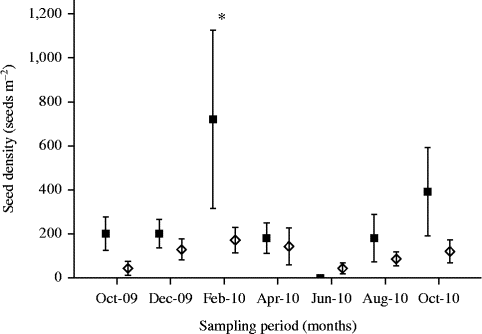
Distribution and density of seeds varied depending on microhabitat (deviance = 29.79, df = 1, P< 0.00001) and time (deviance = 33.20, df = 1, P< 0.00001). The number of seeds was significantly higher under A. cochliacantha shrubs (391 seeds m− 2) than in areas lacking vegetation (120 seeds m− 2; t= 3.2, df = 405, P= 0.0015). The number of seeds was relatively similar in all months (100–250 seeds m− 2), except February. This month had the highest number of seeds (720 seeds m− 2; t= 3.7, df = 405, P= 0.0002), but this was because one of the 60 soil samples collected this month had 20 seeds while the rest of the samples had fewer than 4 seeds (Fig. 1). Seeds found in soil from under shrubs did not germinate, nor seeds found in soil from areas lacking vegetation, although seeds from both microhabitats were viable.
Number of seeds of Stenocereus stellatus (mean ± 1 standard error) found under Acacia cochliacantha shrubs (solid squares) and in areas lacking vegetation (open diamonds). The * indicates statistically significant differences (P< 0.001).

Seed longevity
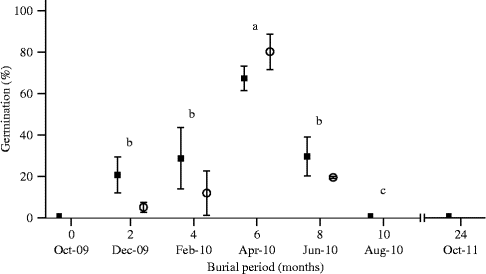
Germination was similar between microhabitats, but varied depending on burial time (F= 45.61, df = 2,35; P< 0.0001). Germination varied between 0 and 90% throughout 24 months of burial (Fig. 2). The highest germination (60–90%) occurred at 6 months followed by germination at 2, 4 and 8 months (5–45%). The lowest germination occurred in recently collected seeds (0.1%), and at 10 (0.3%) and 24 months (0%).
Germination percentage (mean ± 1 standard error) of Stenocereus stellatus seeds buried under Acacia cochliacantha shrubs (solid squares) and in areas lacking vegetation (open circles). Months marked with different letters are significantly different (P< 0.001). Germination percentages in October 2009 and 2011 were not included in the statistical analysis.

The proportion of viable seeds varied among recently collected seeds and seeds buried for 10 and 24 months. All recently collected seeds were viable. However, this proportion decreased at 10 months, being 38% under A. cochliacantha shrubs and 65% in areas lacking vegetation. At 24 months, the proportion of viable seeds decreased to 0% under A. cochliacantha shrubs. The proportion of viable seeds in areas lacking vegetation could not be evaluated because bags were lost.
Fungi found in exhumed seeds (Fusarium oxysporum – GenBank accession number KC734517, similarity 99%; F. solani – KC764912, 99%; F. nivale – KC764913, 99%; and Curvularia inaequalis – KC764914, 98%) differed from those found in stored seeds (Pleiochaeta ghindensis – KC764915, 98%; Cladosporium sp. – KC764916, 97%; and Eurotium sp. – KC764917, 98%).
Discussion
Field studies on soil seed banks of the Cactaceae are limited, particularly for columnar cactus species. In this study, we have shown that distribution, density and longevity of S. stellatus seeds indicate that this columnar cactus is able to form a soil seed bank. Seed distribution and density varied spatially because we found a higher number of seeds under dominant shrubs than in areas lacking vegetation. This pattern agrees with those reported for other species of the Cactaceae (de Viana et al., Reference de Viana, Sühring and Manly2000; Montiel and Montaña, Reference Montiel and Montaña2003; Ordoñez, Reference Ordoñez2008). The higher number of seeds found under shrubs could be due to the fact that trees and shrubs in desert landscapes trap seeds dispersed by the wind and serve as perches for frugivorous birds, increasing the probability that seeds will be deposited under their canopies (Whitford, Reference Whitford2002; Li, Reference Li2008). Trees and shrubs also play an outstanding role in cactus establishment because they decrease soil surface temperatures and evapotranspiration, increase nutrient and soil water availability and provide protection against predators, enhancing seed germination and seedling survival of many species (for a review, see Godínez-Alvarez et al., Reference Godínez-Alvarez, Valverde and Ortega-Baes2003 and references therein). In our study, germination of S. stellatus seeds was seemingly higher under A. cochliacantha shrubs than in areas lacking vegetation, although we did not find significant differences between these microhabitats.
Seeds collected just at the beginning of the dry season did not germinate, although most of them were viable. This indicates that S. stellatus seeds have primary dormancy when dispersal occurs (sensu Baskin and Baskin, Reference Baskin and Baskin2004). Seeds reached their maximum germination after 6 months of burial under shrubs and in areas lacking vegetation, showing that primary dormancy is broken by an afterripening period. This finding agrees with Rojas-Aréchiga et al. (Reference Rojas-Aréchiga, Casas and Vázquez-Yanes2001), who found that wild and cultivated seeds of S. stellatus increased their germination percentage with an increase in storage time under laboratory conditions. Seeds from other cactus species, such as Ferocactus wislizeni (Bowers, Reference Bowers2000), Opuntia tomentosa (Olvera-Carrillo et al., Reference Olvera-Carrillo, Márquez-Guzmán, Sánchez-Coronado, Barradas, Rincón and Orozco-Segovia2009), P. chende (Ordoñez, Reference Ordoñez2008) and Stenocereus griseus (Silvius, Reference Silvius1995), also require an afterripening period before they can germinate. Seed germination decreased to almost 0% after 10 months of burial, although 38–65% of seeds were viable, suggesting that they enter secondary dormancy and remain viable in the soil for at least 1 year. This idea is reinforced by the relatively similar densities of seeds found in soil samples taken from under shrubs and in areas lacking vegetation throughout the year, as well as by their lack of germination. Seeds found in soil samples from both microhabitats did not germinate, probably because they had already entered secondary dormancy. Seeds buried for 24 months did not germinate, nor were viable, because they were probably attacked by Fusarium fungi. This negative effect does not agree with the results reported for other cactus species, such as Opuntia streptacantha (Delgado-Sánchez et al., Reference Delgado-Sánchez, Ortega-Amaro, Jiménez-Bremont and Flores2011) and O. tomentosa (Sánchez-Coronado et al., Reference Sánchez-Coronado, Márquez-Guzmán, Rosas-Moreno, Vidal-Gaona, Villegas, Espinosa-Matías, Olvera-Carrillo and Orozco-Segovia2011), in which Fusarium fungi promote seed germination.
Considering that S. stellatus seeds enter secondary dormancy and retain their viability for less than 24 months, we suggest that they have the potential to form a short-term persistent seed bank (sensu Thompson, Reference Thompson, Hendry and Grime1993). However, this should be confirmed by determining seed viability after 12 months of burial. The potential of S. stellatus to form a soil seed bank is related to some traits found in their seeds, such as a light requirement for germination and a post-maturation period (Rojas-Aréchiga and Batis, Reference Rojas-Aréchiga and Batis2001; Rojas-Aréchiga et al., Reference Rojas-Aréchiga, Casas and Vázquez-Yanes2001). Seeds of S. stellatus remain viable in the field for less than 24 months (i.e. ecological longevity) whereas those stored in the laboratory remain viable for 41 months (i.e. potential longevity; Rojas-Aréchiga et al., Reference Rojas-Aréchiga, Casas and Vázquez-Yanes2001). This difference between ecological and potential longevity highlights the importance of evaluating seed longevity in the field to determine the presence of a functional soil seed bank. Studies on soil seed banks in columnar cacti are still limited and contradictory because some species, such as A. glaziovii and A. melanurus in south-eastern Brazil (Cheib and Garcia, Reference Cheib and Garcia2012) and P. chende in central Mexico (Ordoñez, Reference Ordoñez2008), form short-term persistent seed banks. However, other species, such as C. gigantea in south-western USA, form transient seed banks (Bowers, Reference Bowers2005) or lack soil seed banks (e.g. Lophocereus schottii in north-western Mexico; Holland and Molina-Freaner, Reference Holland and Molina-Freaner2013). These few studies do not reflect clear patterns among types of soil seed bank, geographic distribution and taxonomy. The potential of S. stellatus to form a short-term persistent seed bank would increase the probability of germination, because seeds dispersed at the beginning of the dry season could survive until the rainy season of the following year. This soil seed bank and the ability of S. stellatus to propagate vegetatively could be viewed as complementary mechanisms that contribute to population persistence in the field (Godínez-Alvarez et al., Reference Godínez-Alvarez, Ríos-Casanova and Pérez2005).
This study represents one of the few efforts to determine the presence of a soil seed bank through the evaluation of distribution, density and longevity of seeds in the field. Our results suggest that S. stellatus has the potential to form a short-term persistent seed bank. However, it is necessary to conduct studies on other S. stellatus populations throughout their geographical distribution to confirm our results. Finally, the results of this study and those reported for other columnar cactus species might be used as a basis to determine whether there are general patterns among types of seed banks in certain genera or species.
Supplementary material
To view supplementary material for this article, please visit http://dx.doi.org/10.1017/S0960258514000324
Acknowledgements
The authors thank L. Ríos-Casanova, Z. Cano-Santana, V. Sosa-Fernández and S. Anderson for their helpful comments on earlier versions of the manuscript. E. Parra-Ordóñez, M. Duarte, F. Espino, V. González-Romero and O. Téllez provided invaluable assistance with the field and laboratory work.
Financial support
This study was supported by PAPIIT IN211410 (DGAPA, Universidad Nacional Autonóma de México), PAPCA 2009 (Facultad de Estudios Superiores Iztacala, Universidad Nacional Autonóma de México), and PAPCA 2010-2011 (Facultad de Estudios Superiores Iztacala, Universidad Nacional Autonóma de México). R.Á.-E. received a Consejo Nacional de Ciencia y Tecnologia (CONACyT) grant during his PhD studies at the Posgrado en Ciencias Biológicas, Universidad Nacional Autonóma de México.
Conflicts of interest
None.