Introduction
According to the U.S. Census Bureau, by the year 2030, over 20% of the population will be 65 years of age or older (He et al., Reference He, Sengupta, Velkoff and DeBarros2005). These demographics and their social implications, both positive and negative, have prompted rapidly growing scientific interest in the study of aged individuals. The cognitive neuroscience of aging is a new and burgeoning field (Cabeza et al., Reference Cabeza, Nyberg and Park2005), combining the approaches of neuroscience and cognitive psychology in the pursuit of understanding the neural and cognitive changes associated with normal aging in such spheres as memory, decision-making, and affect. The study of decision-making in particular has been the subject of relatively few studies. In one, Denburg and colleagues (Reference Denburg, Tranel and Bechara2005) compared healthy older adults (aged 56–85 years) to healthy younger adults (aged 26–55 years). Approximately one-third of the older individuals (while no younger adults) exhibited significant difficulty with complex decision-making on the Iowa Gambling Task (IGT; Bechara, Reference Bechara2007) despite fully intact performances on a broad array of neuropsychological instruments. A subsequent study found that these older adults identified as impaired decision-makers were more susceptible to deceptive advertising (Denburg et al., Reference Denburg2007), indicating that poor decision-making among the elderly persons can result in serious real-world consequences that directly impact individuals’ psychological and financial well-being.
Relationship of personality to decision-making across the life span
Investigations across the adult life span have identified personality as an important individual differences variable that is related to decision-making ability. In particular, impulsivity has been associated with poor decision-making, albeit with mixed results. Franken and colleagues (Reference Franken, van Strien, Nijs and Murus2008) examined the relationship of impulsivity to decision-making with the IGT in a sample of 70 undergraduate psychology students with a mean age of 21 years. High impulsivity was associated with decision-making deficits overall, and in particular, with weaknesses in the learning of reward and punishment contingencies; this is assessed by the earlier phase of the IGT when knowledge about the task is acquired implicitly and decisions are made under ambiguous circumstances. Davis and colleagues examined personality characteristics associated with decision-making deficits on the IGT among 245 participants aged 25–45 years (Davis et al., Reference Davis, Patte, Tweed and Curtis2007). They found that higher levels of impulsivity, sensitivity to reward, sensitivity to punishment, and addictive personality were all significantly associated with deficits in decision-making. By contrast, impulsivity was not associated with decision-making performance on the Cambridge Gamble Task (Rogers et al., Reference Rogers, Tunbridge, Bhagwagar, Drevets, Sahakian and Carter2003), a decision-making task in which there is no learning component to successful performance, and information about the probability of success or failure for each decision (i.e. “risk”) is provided explicitly. This suggests that impulsivity may be associated with poor decision-making under ambiguous circumstances, but such interference in decision-making may be diminished when the degree of risk is known.
Suhr and Hammers (Reference Suhr and Hammers2010) studied 58 adults, aged 18–23 years, to examine the relationship of several variables to decision-making on the IGT, including personality and negative affect, as well as intellect and executive functioning. The authors utilized the Fun-Seeking subscale of the Behavioral Activation Scale (BAS; Carver and White, Reference Carver and White1994) to assess impulsive sensation-seeking. In contrast to the aforementioned studies, the hypothesized relationship between impulsivity and deficient IGT performance did not reach significance, although there was a trend in the expected direction along with a moderate effect size (0.48). Negative affect was not associated with poor decision-making.
In a follow-up study to the older adult investigations noted above, Denburg and colleagues (Reference Denburg2009) examined the relationship of the Big Five personality traits, assessed with the NEO Five-Factor Inventory (Costa and McCrae, Reference Costa and McCrae1992), to decision-making on the IGT in 152 healthy adults aged 26–85 years. They found that poor decision-making among older adults (but not younger adults) was associated with higher Neuroticism. Of note, impulsiveness is one of the six “facets” constituting the multifaceted Neuroticism score.
Findings by Zermatten and colleagues (Reference Zermatten, Van der Linden, d’Acremont, Jermann and Bechara2005) indicated that the inconsistency regarding the relationship of impulsivity to poor decision-making might reflect different measures. They assessed four characteristics proposed as distinct components of impulsivity by Whiteside and Lynam (Reference Whiteside and Lynam2001) (i.e. urgency, lack of premeditation, lack of perseverance, and sensation seeking), and found that lack of premeditation was the only one of the four measures significantly correlated with performance on the IGT. Overall, the pattern of these findings suggests that personality characteristics, in particular impulsivity, are associated with poor decision-making, but the relationship is complex and the specifics depend to some extent on the particular aspects of personality and decision-making being examined. Other aspects of personality that may contribute to poor decision-making are not well studied.
Aim of study
In the current study, our objective was to further investigate the nature of the relationship between personality characteristics and decision-making deficits in healthy older adults. Since deficits in decision-making have been associated with damage to the prefrontal cortex (Tranel et al., Reference Tranel, Anderson, Benton, Boller and Grafman1994), and damage to prefrontal cortex has been associated with disturbances in executive personality characteristics—i.e. not momentary behaviors such as a test performance, but tendencies regarding executive functioning that are enduring across real life situations and over years (Barrash et al., Reference Barrash, Tranel and Anderson2000), we focused specifically on “executive” personality characteristics: Lack of Planning, Poor Judgment, Lack of Persistence, Perseveration, Lack of Initiative, Impulsivity, and Indecisiveness. It was hypothesized that poor decision-making, as assessed by the widely used IGT, would be associated with: (i) the degree of disturbances developed late in life in these executive personality characteristics, and (ii) the degree of longstanding disturbances in these aspects of personality functioning, but (iii) would not be associated with disturbances in other dimensions of personality, such as distress or disturbed social behavior. It was further hypothesized that the role of executive personality disturbances is independent of the (possible) effects of demographic characteristics, neuropsychological factors, and mood on decision-making.
Method
Participants
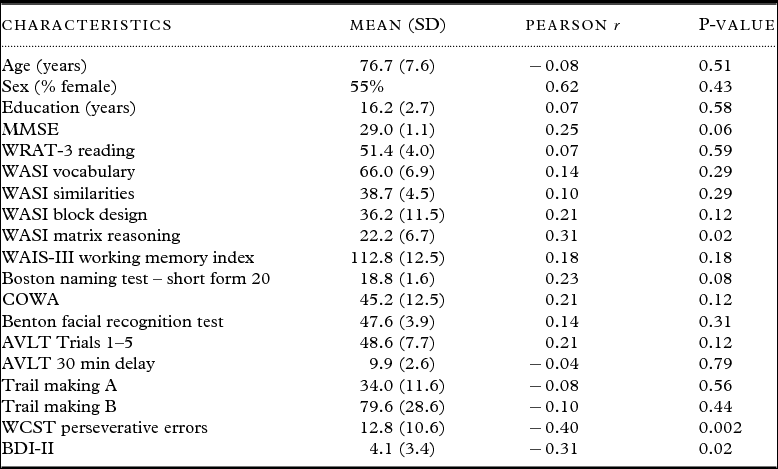
The participants were drawn from a pool of community-dwelling, independently living, neurologically and psychiatrically healthy individuals aged 60 years and older involved in a larger, ongoing project investigating the neural correlates of decision-making. Participants’ health status was determined via a semi-structured screening interview assessing medical conditions, alcohol/drug consumption, medications, and mood (after Tranel et al., Reference Tranel, Benton and Olson1997). A sample of 58 adults participated, with a mean age of 76.7 years (standard deviation 7.6, range 60–91). Demographic and cognitive characteristics of participants are provided in Table 1.
Descriptive statistics and correlations of demographic, neuropsychological, and mood characteristics to iowa gambling task scores of participants (n = 58)

Note. Raw scores are provided for each of the neuropsychological variables, with the exception of those noted. Shown are Folstein Mini-Mental State Examination (MMSE); Wide Range Achievement Test – Revision 3 (WRAT-3) Reading subtest (in Standard Scores); Wechsler Abbreviated Scale of Intelligence (WASI) subtests; Wechsler Adult Intelligence Scale – Third Edition (WAIS-III) Working Memory Index (in Standard Scores); Controlled Oral Word Association Test (COWA); Benton Facial Recognition Test; Rey Auditory – Verbal Learning Test sum of trials 1–5 and 30 minutes delayed recall (AVLT Trials 1–5 and AVLT 30 minutes Delay); Wisconsin Card Sorting Test (WCST); and Beck Depression Inventory – Second Edition (BDI-II). The significance of continuous measures was tested evaluated by test of Pearson correlation; the categorical variable, gender, was tested by χ2 test.
Measures
Decision-making
The Iowa Gambling Task (IGT; Bechara, Reference Bechara2007) was used to assess decision-making. The IGT is a computer-administered test in which participants make 100 card selections from four decks of cards. Two decks are predetermined to provide relatively high immediate gains but even higher long-term loss, yielding an overall net loss of money (Decks A and B, dubbed “the bad decks”); the other two decks are predetermined to provide relatively lower immediate gains but even lower long-term loss, yielding an overall net gain of money (Decks C and D, dubbed “the good decks”). Participants are not informed of the number of trials or the gain/loss schedule.
Personality
The Iowa Scales of Personality Change (ISPC; Barrash et al., Reference Barrash, Anderson, Hathaway-Nepple, Jones and Tranel1997) was used to assess personality. The ISPC is a revision of an earlier scale, the Iowa Rating Scales of Personality Change (IRSPC; Barrash et al., Reference Barrash, Anderson and Tranel1996) with enhanced reliability and validity (Barrash et al., Reference Barrash, Asp, Markon, Manzel, Anderson and Tranel2011). The ISPC assesses 30 personality characteristics by way of behaviorally anchored ratings completed by an informant, typically a family member or close friend. The behavioral rating guidelines for each of the personality characteristics explicitly focuses the rater's attention on enduring behavioral tendencies or characteristics that have been in evidence across a variety of situations, rather than specific instances of behavior at a specific point in time (as would be seen in a test performance). Two ratings are made for each assessed aspect of personality: “Before” (characteristic functioning over the adult years prior to the onset of a neuropathological condition), and “Now” (characteristic functioning over the past several months, after the onset of the neuropathological condition). For the present study with healthy older adults, the ISPC was modified to reflect a developmental perspective in a non-neurologic population (Denburg and Barrash, Reference Denburg and Barrash2007). In this adaptation, all references to a “neurological condition” were removed, “Before” ratings explicitly reflected characteristic personality functioning over the middle-aged years, and “Now” ratings explicitly reflected personality functioning over the past several months. Ratings were made on an asymmetrical 7-point scale (1–7), with “3” reflecting the usual amount of the characteristic for a typical adult of the same sex and age, as judged by the informant, and ratings above 3 reflecting increasing disturbance in that characteristic. The “executive” personality characteristics examined in this study – Lack of Planning, Poor Judgment, Lack of Persistence, Perseveration, Lack of Initiative, Impulsivity, and Indecisiveness – were identified based on the results of a principal components analysis of the Iowa Scales (Barrash et al., Reference Barrash, Asp, Markon, Manzel, Anderson and Tranel2011). Several other dimensions of personality disturbances, including disturbed social behavior, diminished motivation/hypo-emotionality, irascibility, and distress, were also examined.
Disturbance Ratings
To address study hypotheses concerning the relationship of poor decision-making to disturbances in personality functioning, ratings of longstanding personality functioning (“Before” ratings) and of current personality functioning (“Now” ratings) were created by collapsing the three ratings in the normal range of the scale (1–3) into one category (while scores of 4, 5, 6, and 7 remained as separate categories), resulting in a five-point scale ranging from 0 (“no disturbance”) to 1 (“mild disturbance”), 2 (“moderate disturbance”), 3 (“moderately severe disturbance”), and 4 (“severe disturbance”).
Acquired Personality Disturbances
For a personality characteristic to be considered an acquired personality disturbance required that: (i) the characteristic was disturbed to some degree (i.e. a Now disturbance rating of 1 or higher), and (ii) this level of disturbance represents an increase in disturbance over the longstanding level (i.e. the Now rating was an increase of at least 1 over the Before rating).
summary measures
To create a single measure of the degree of “longstanding executive personality disturbance,” the Before disturbance ratings were summed across the seven executive characteristics, and summary measures were calculated for each the other four dimensions of personality disturbance (i.e. disturbed social behavior, diminished motivation/hypo-emotionality, irascibility, and distress). Parallel summary measures were calculated for acquired personality disturbances. These summary measures were the key independent variables of interest in all regression analyses.
Neuropsychological Battery
All participants completed comprehensive neuropsychological testing. The following measures were administered (see Lezak et al., Reference Lezak, Howieson, Bigler and Tranel2012, for further description): Estimated premorbid intellect (Wide Range Achievement Test – III Reading subtest), verbal and non-verbal intellectual functioning (Vocabulary, Block Design, Similarities and Matrix Reasoning subtests of the Wechsler Abbreviated Scale of Intelligence), general mental status (Folstein Mini-Mental State Examination), attention and working memory (Digit Span, Arithmetic, Letter-Number Sequencing subtests of the Wechsler Adult Intelligence Scale–Third Edition), language (Boston Naming Test 20-Item Short Form (Barrash et al., Reference Barrash, Cross and Manzel1999); and Controlled Oral Word Association Test), visuoperception (Benton Facial Recognition Test), learning and memory (including (i) sum of trials 1–5, and (ii) 30-minute delayed recall from the Rey Auditory Verbal Learning Test), processing speed (Trail Making Test, Part A), executive functioning (Trail Making Test, Part B; and perseverative errors on the Wisconsin Card Sorting Test), and self-reported mood (Beck Depression Inventory-II).
Procedure
The Institutional Review Board at the University of Iowa approved the study protocol, and all participants provided informed consent. Participants were tested individually in a quiet and comfortable laboratory room. Overall, the protocol, including interview, took approximately 4 h to complete. To ensure that fatigue would not affect neuropsychological performance, the protocol was divided into two sessions. The IGT was administered immediately after the informed consent process. All participants were financially compensated for their involvement at the rate of $15 per hour.
Statistical analysis
Preliminary analysis examined data for the presence of outliers and the appropriateness of assumptions of normality, linearity, and homoscedasticity. Assumptions were supported and parametric analyses were employed unless otherwise noted. The relationship of continuous measures of demographic characteristics, neuropsychological scores and mood to decision-making was tested with Pearson's correlation tests, and by χ2 test for the categorical variable, sex.
Hierarchical regression analyses were conducted to examine the relationship between executive personality disturbances and decision-making, with attention to their unique contribution over and above the effects of demographic characteristics, relevant neuropsychological factors, and mood. The first regression analysis examined the relationship the five personality dimensions to decision-making. In the first step, the longstanding disturbance scores for each of the five personality dimensions were allowed to compete for stepwise entry into the predictive model to address the primary study hypothesis that deficits in decision-making are associated with weak executive personality characteristics. All longstanding disturbances entering the predictive model in the first step at the 0.05 level of significance were retained. In the second step, acquired disturbances in the five personality dimensions were allowed to compete for stepwise entry into the model to determine whether acquired disturbances could account for significant variance in decision-making over and above prediction based on longstanding personality disturbances retained in the model after the first step.
In the second hierarchical regression analysis, demographic variables (age, sex, and years of education), neuropsychological factors (those found to be significant in univariate analyses), and mood (BDI-II score) were entered into the regression equation in the first step. In the second step, longstanding or acquired personality disturbances predicting decision-making, as indicated in the first regression analysis, were entered into the model to determine whether the unique contribution of personality disturbances remains significant after accounting for variance predictable by demographic characteristics, neuropsychological factors, and mood.
Results
As shown in Table 1, age, education, and sex were not significantly associated with decision-making. Neuropsychological performances were not significantly associated with decision-making, with two exceptions: Weaker performances on the WASI Matrix Reasoning subtest was associated with poor decision-making on the IGT (p < 0.02), as were more perseverative errors on the WCST (p < 0.002). The lack of association of most conventional neuropsychological instruments to decision-making on the IGT is something we have found previously (see Denburg et al., Reference Denburg, Tranel and Bechara2005, Reference Denburg, Recknor, Bechara and Tranel2006), adding credence to the notion that some older adults who display defects in real-world decision-making are not simple “people with dementia” or “on the road to dementia” (such as Alzheimer's disease).
In the first step of the first regression analysis, longstanding executive personality disturbance entered the model, accounting for an adjusted 8.1% of the variance in decision-making (p = 0.027). No other longstanding personality disturbances entered the model. In the second step, with longstanding executive personality disturbance retained in the model, no acquired disturbances in any of the five personality dimensions were able to predict significant incremental variance in decision-making. A post hoc analysis showed that had it been allowed to enter the equation in step 2, recently acquired disturbances in executive personality disturbance would only contribute a non-significant 1.5% of incremental variance in decision-making performance. However, even after controlling for variance that could be accounted for by acquired personality disturbances, the contribution of longstanding executive personality disturbances would remain significant in predicting decision-making outcome (β = −0.30, p = 0.024).
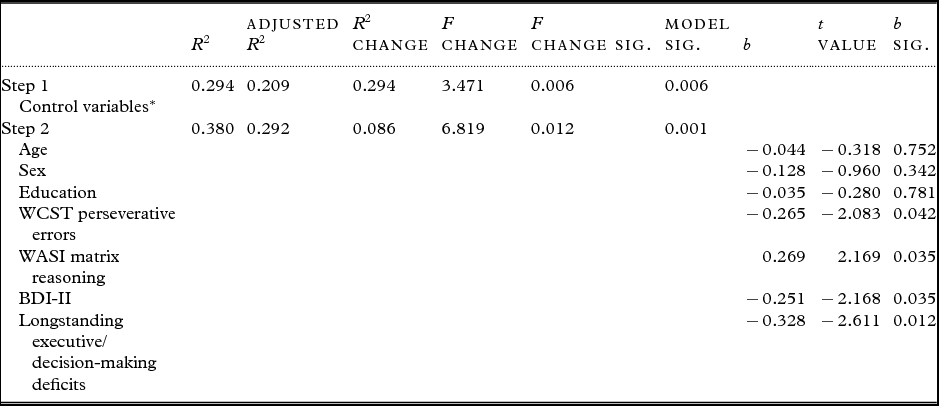
The second regression analysis, presented in Table 2, showed that demographic variables, neuropsychological factors, and mood, collectively, accounted for a significant 20.9% (adjusted) variance in decision-making performance (p = 0.006). After accounting for variance predicted by those variables, adding longstanding executive personality disturbances to the predictive model increased the amount of decision-making variance accounted for by a significant 8.6% (adjusted), p = 0.012.
Hierarchical regression of decision-making on demographic characteristics, neuropsychological factors, mood, and executive personality disturbances
*Age, Sex, Education, WCST Perseverative Errors (raw), WASI Matrix Reasoning (raw), BDI-II.
Discussion
The present study supports the conclusion that certain personality characteristics are related to complex decision-making in elderly persons. More specifically, the results supported the hypothesis that disturbances in executive personality characteristics – Lack of Planning, Poor Judgment, Lack of Persistence, Perseveration, Lack of Initiative, Impulsivity, and Indecisiveness – were significantly associated with decision-making deficits on the Iowa Gambling Task (Bechara, Reference Bechara2007) in healthy, independently living persons ranging in age from 60 to 88 years. Although it was expected that deficits in decision-making would be most highly related to acquired disturbances of these personality characteristics developed in later years, results revealed that it was actually longstanding disturbances in these characteristics that were significantly associated with poor decision-making, and once the latter were taken into account, acquired disturbances did not add appreciably to prediction. Further, the results of multiple regression analyses showed that it was not personality disturbances generally, but disturbances in executive personality characteristics specifically, that were related to compromised decision-making. Demographic characteristics, neuropsychological factors, and mood, collectively, were also significantly associated with decision-making performance. However, hierarchical regression demonstrated that, as hypothesized, after taking into account the relationship of these variables to decision-making, executive personality disturbances continued to predict a significant portion of unique variance in decision-making performance.
In interpreting our findings, it is important to take into consideration other neuropsychological abilities. We examined performances from an array of cognitive domains and found that participants with weak performances on the decision-making task (IGT) performed more poorly on a measure of non-verbal reasoning (Matrix Reasoning) and executive functioning (WCST perseverative errors). The former may reflect that subclinical cognitive decline contributes to the weakening of decision-making abilities, consistent with previous research documenting an association between IGT performance and Matrix Reasoning (Suhr and Hammers, Reference Suhr and Hammers2010) and intelligence more generally (Toplak et al., Reference Toplak, Sorge, Benoit, West and Stanovich2010). Too, perseverative errors on the Wisconsin Card Sorting Test have been shown previously to be associated with IGT performance (Brand et al., Reference Brand, Recknor, Grabenhorst and Bechara2007). However, this relationship is not found consistently (Suhr and Hammers, Reference Suhr and Hammers2010), and it has been posited that the relationship between the WCST and IGT is complex and shifts as the decision-making demands of the IGT change over the course of the task (with the strongest relationship occurring during the earlier trials of the IGT; see (Brand et al., Reference Brand, Recknor, Grabenhorst and Bechara2007), for a more in depth consideration of the relationship of the WCST to the IGT). Moreover, the IGT and the WCST have been shown to have different, non-overlapping neural underpinnings in prefrontal regions, with the IGT being supported by structures in the ventromedial prefrontal sector and the WCST being supported by more dorsolateral prefrontal sectors (Gläscher et al., Reference Gläscher2012).
The societal and public policy ramifications of early identification of older adults with decision-making impairments are considerable given the importance of preserving the autonomy and protecting the welfare of this population. Older adulthood is frequently a time when individuals are faced with critical life decisions such as medical care and housing choices, investment of retirement income, and allocation of personal wealth. A poor decision in any of these domains can lead to detrimental outcomes to one's physical condition, finances, and/or psychological health. To make matters worse, older adults are frequently the targets of misleading and fraudulent scams as illustrated by a survey conducted by the non-profit group Investor Protection Trust in which 20% of Americans aged 65 years or older reported having been taken advantage of financially (Investor Protection Trust, 2010). Even with the increasing awareness of consumer fraud, some seniors believe fraudulent pitches and experience difficulty identifying fraud when it is present. In addition, older adults are often reluctant to seek advice about financial matters.
Elderly people with decision-making impairments are in need of support from family, friends, and healthcare practitioners, as they are frequently unaware of their own problems. One of the hallmarks of frontal lobe dysfunction is impaired self-awareness regarding acquired cognitive deficits (anosognosia). The individual with anosognosia is unaware of their cognitive deficits, therefore, they also lack insight into the ways in which real-life functioning will be compromised and the problems that may cause. Such patients may deny that they have anything wrong with them, even though their deficits are patently obvious to everyone around them. They are particularly liable to place themselves in harm's way, as noted above with regard to consumer fraud. This makes it all the more important for family and friends and, importantly, practitioners, to be able to detect a person's potential compromise, and assist in the effort of raising awareness to an individual and encouraging help-seeking behaviors. Fortunately, our study suggests that spouses and family members can indeed identify and quantify executive deficits in their loved ones. Given this, clinicians (e.g. physicians, nurses, social workers, and psychologists) should inquire into executive personality characteristics with collateral informants when screening for decision-making impairments among their older adult clients.
Several limitations of this study warrant mention. The participants in the study, on average, had close to a college education, which is relatively high for an older adult sample; the 2010 Census data indicated that only approximately 20% of the population 65 years of age and older had earned a bachelor's degree or higher (U.S. Census Bureau, 2010). Too, the present study had a fairly small sample size, and the sample was relatively homogenous in terms of socioeconomic background and race. These issues may limit generalizability of our findings.
It is also acknowledged that the clinical implications of a disturbance rating of 1 (“mild disturbance”) or a 1-point change is disturbance level can be questioned, and data are not available to address this. However, it is noted that a similar definition of “acquired personality disturbance” in a prior study (Barrash et al., Reference Barrash, Tranel and Anderson2000) was both sensitive and specific to hypothesized differences between patients with prefrontal brain damage (patients with real-life personality disturbances) versus patients with damage elsewhere. The less stringent disturbance criterion in this study may be justified by the fact that the population in this study does not have neuropathological or psychiatric conditions and they are independent, community-dwelling individuals. Therefore, it is expected that maladaptive personality characteristics that hypothetically contribute to declining decision-making would be more subtle. It is not clear that the limited prior data on the clinical implications of ratings of “mild disturbance” diminish the fact that, as hypothesized, disturbance ratings of 1 for executive personality characteristics were associated with compromised decision-making in elderly individuals.
An additional limitation of the study is the utilization of a single measure of decision-making. Decision-making is complex multifaceted, and undoubtedly difficult to measure fully with one task. The inclusion of various decision-making tasks would enhance broad-based assessment of individual differences in decision-making.
This investigation has provided initial evidence that identification of healthy, independently living elderly persons with decision-making deficits is enhanced by attention to longstanding executive personality characteristics. Future research is necessary to validate study findings in a more heterogeneous sample, and to critically evaluate more elaborate prediction models. Further investigation of the optimal set of personality characteristics and other relevant variables may enhance the ability to identify healthy, independently-living elderly persons who are at risk for the development of impaired decision-making.
Conflict of interest
None.
Description of authors’ roles
All authors made contributions toward the design, analysis, interpretation of data, and preparation of manuscript. Mr. Nguyen contributed to the design, acquisition, analysis, interpretation, and preparation of manuscript. Mrs. Koenigs contributed to the design and acquisition of data. Drs. Barrash, Bechara, Tranel, and Denburg contributed to the design, analysis, interpretation, and preparation of manuscript.
Acknowledgments
Preparation of this paper was supported by a National Institute on Aging Career Development Award (K01 AG022033) to Dr Denburg, and a R01 DA022549 to Dr Tranel. The authors thank Shelia Barron, PhD, Department of Psychological and Quantitative Foundations, University of Iowa, for her expert statistical consultation.