Introduction
Somatic cell nuclear transfer (SCNT; ‘cloning’) has resulted in offspring from several species, but the overall efficiency is still low. Many different approaches have been tried in order to improve cloning efficiency, and some have aimed to improve the crucial step of reprogramming the somatic donor cells used. In one example, somatic cells were treated prior to SCNT with cytoplasmic extract produced from bovine or porcine oocytes (Tang et al., 2008; Miyamoto et al., Reference Miyamoto, Tsukiyama, Yang, Li, Minami, Yamada and Imai2009). However, due to the limited accessibility of mammalian oocytes, a tempting alternative is the use of non-mammalian eggs that have large volume, e.g. eggs from amphibians such as Xenopus laevis (frog). These eggs are thousands of times larger than mammalian oocytes and are easily collected in large quantities to prepare large amounts of extracts. Previous studies have shown increased transcriptional reprogramming of both porcine fibroblasts (Miyamoto et al., Reference Miyamoto, Furusawa, Ohnuki, Goel, Tokunaga, Minami, Yamada, Ohsumi and Imai2007a) as well as human and bovine somatic nuclei (Hansis et al., Reference Hansis, Barreto, Maltry and Niehrs2004; Alberio et al., Reference Alberio, Johnson, Stick and Campbell2005) after incubation in extracts from Xenopus oocytes or eggs. Importantly, treatment of somatic cells with nucleoplasmin, isolated from Xenopus egg extract, has been shown to facilitate reprogramming and increase bovine SCNT efficiencies (Betthauser et al., Reference Betthauser, Pfister-Genskow, Xu, Golueke, Lacson, Koppang, Myers, Liu, Hoeschele, Eilertsen and Leno2006).
Because of the molecular size(s) of the reprogramming factor(s) in the extract, the donor cell's membrane has to be made more permeable to allow transport of substances from the extract into the cell's cytoplasm and nucleus. Such permeabilization must be reversible and can be performed in several different ways such as physical electroporation (Chiang & Tang, Reference Chiang and Tang2009), or by chemical treatment with streptolysin O (SLO; Håkelien et al., Reference Håkelien, Landsverk, Robl, Skålhegg and Collas2002; Bru et al., Reference Bru, Clarke, McGrew, Sang, Wilmut and Blow2008), digitonin (Alberio et al., Reference Alberio, Johnson, Stick and Campbell2005; Miyamoto et al., Reference Miyamoto, Yamashita, Tsukiyama, Kitamura, Minami, Yamada and Imai2008), α-toxin (Ahnert-Hilger et al., Reference Ahnert-Hilger, Wegenhorst, Stecher, Spicher, Rosenthal and Gratz1992) or Triton X-100 (van de Ven et al., Reference van de Ven, Adler-Storthz and Richards-Kortum2009). SLO and digitonin are the most frequently used agents for extract treatment and cause pores to form in the plasma membrane of sizes that are sufficient for passive diffusion of proteins up to 100 kDa (Adam et al., Reference Adam, Sterne-Marr and Gerace1992; Walev et al., Reference Walev, Bhakdi, Hofmann, Djonder, Valeva, Aktories and Bhakdi2001). Interestingly, it has also been shown that permeabilization agent without further extract treatment is able to improve the cell fusion and in vitro development of SCNT embryos (Naruse et al., Reference Naruse, Quan, Kim, Choi, Park and Jin2009). In contrast, Miyamoto et al. (Reference Miyamoto, Ohnuki, Minami, Yamada and Imai2007b) found that permeabilization and extract treatment could not increase the blastocyst rate; only the cell number of the individual embryos increased. It has also been noticed that reactivity to digitonin varied for different cell types and different species (Miyamoto et al., Reference Miyamoto, Yamashita, Tsukiyama, Kitamura, Minami, Yamada and Imai2008). However, the effect on the efficiency of SCNT of culturing permeabilized cells with Xenopus egg extract has not been investigated previously.
The aim of the present study was to investigate the early development of hand-made cloned porcine embryos produced with fetal fibroblasts in prolonged culture after pre-treatment with digitonin with or without Xenopus laevis egg extract.
Materials and methods
All chemicals were purchased from Sigma Chemical Co., unless otherwise stated.
Preparation of Xenopus laevis egg extract
Xenopus egg extracts were prepared as described previously (Higa et al., Reference Higa, Ullman and Prunuske2006) with minor modifications. Briefly, Xenopus frogs were superovulated, and freshly laid eggs were collected in 15 ml tubes (i.e. more than 1000 eggs) before being washed two to four times in 1× Mare's Modified Ringers (MMR; 100 mM NaCl, 2 mM KCl, 1 mM MgSO4, 2 mM CaCl2, 0.1 mM EDTA and 5 mM HEPES, pH 7.8). The eggs’ jelly coat was removed by dejelly buffer (1 mM DTT, 20 mM Tris–HCl and 100 mM NaCl) for 4 min, and washed in 0.25× MMR to remove the remaining jelly cover. Eggs were subsequently rinsed with extraction buffer (5 mM MgCl2, 50 mM KCl, 2 mM 2-mercaptoethanol, protease inhibitor cocktail, 5 mM EGTA, 10 μg/ml cytochalasin B and 50 mM HEPES, pH 7.4) and transferred to centrifuge tubes. After removal of excessive buffer, eggs were centrifuged at 15,000 g for 30 min at 4 °C. The middle cytoplasmic layer of the tubes was collected and recentrifuged at 15,000 g for 20 min at 4 °C. The cleared cytoplasmic extract was supplemented with 5% glycerol, frozen in liquid nitrogen and stored at –80 °C until use.
Extract from one frog was used for the experimental work in this study. The protein concentration of the extract was 47 mg/ml, and its osmolarity was 815 mOsm.
Preparation of somatic cells
Porcine fetal fibroblast monolayer cultures were established from a 40-day-old fetuses, while adult fibroblast monolayer cultures were established from the ear of a 4-year-old sow and cultured in Dulbecco's Modified Eagle Medium (DMEM; Gibco BRL, Life Technologies) supplemented with 10% fetal bovine serum (FBS: Gibco BRL) as described previously (Kragh et al., Reference Kragh, Vajta, Corydon, Purup, Bolund and Callesen2004). The cells were used for permeabilization/extract treatment at passages 3–12.
Permeabilization of cell membranes
Two kinds of dye with different molecular weights were used to test the permeabilization, i.e. to visualize the presence and size of pores in the cell membrane: Texas Red–dextran (MW: 70,000; Invitrogen Corp.) and propidium iodide (PI; MW: 668.39).
Fibroblasts were plated on poly-l-lysine-coated coverslips in a 4-well dish and grown to 50–70% confluency. The cells were washed in Ca2+- and Mg2+-free phosphate-buffered saline (PBS) and Hank's balanced salt solution (HBSS), and then permeabilized in 250 μl HBSS containing digitonin (Calbiochem; 0 to 30 μg/ml) for 2 min while kept on ice. The digitonin-treated cells were incubated in Texas Red for 30 min or in PI for 10 min before the cell membranes were re-sealed for 2 h in DMEM supplemented with 2 mM CaCl2. Cells that stained positively for Texas Red (i.e. typically the red signal in the whole cell) or PI (i.e. the red signal mainly in the nucleus) were counted under a fluorescence microscope (Leica DMIRB). The results were expressed as the number of red cells/total attached cells while non-attached cells were regarded as dead cells.
Extract treatment and in vitro cell culture
The digitonin-permeabilized cells were incubated in extract containing an ATP-regenerating system (2.5 mM ATP, 125 μM GTP, 62.5 μg/ml creatine kinase and 25 mM phosphocreatine, as well as 1 mM NTP (Roche)) for 0.5 h at 37 °C (Hansis et al., Reference Hansis, Barreto, Maltry and Niehrs2004), then cultured in DMEM supplemented with 2 mM CaCl2 at 37 °C for 2 h for membrane re-sealing (Håkelien et al., Reference Håkelien, Landsverk, Robl, Skålhegg and Collas2002; Miyamoto et al., Reference Miyamoto, Yamashita, Tsukiyama, Kitamura, Minami, Yamada and Imai2008). After re-sealing, the remaining cells were cultured in DMEM with 10% FBS for 3–5 days. Three days after treatment, the cells reached 100% confluency.
Selection of digitonin concentration
To find the combination of digitonin concentration and incubation time used in our study (based on Miyamoto et al., Reference Miyamoto, Yamashita, Tsukiyama, Kitamura, Minami, Yamada and Imai2008), the number of positively stained and dead cells (i.e. non-attached cells) was estimated after digitonin and extract treatment. After staining with Texas Red, less than 10% cells could take up the dye with 7.5 μg/ml digitonin, while both the permeabilization rate and the per cent of dead cells increased rapidly when digitonin concentration was increased from 10 to 30 μg/ml. For staining with PI, the permeabilization rate increased rapidly from 5.0 to 7.0–7.5 μg/ml digitonin (from approximately 10% to 50–60%), while the per cent of dead cells was less than 10%. Almost half of the cells were permeabilized when using 7.0 μg/ml digitonin. This finding indicated that the pore sizes in the cell membrane caused by digitonin at lower concentrations were sufficient to allow passage of small molecules such as PI, but not larger molecules such as Texas Red.
A previous study had found that the survival rate of the treated cells could be increased when using a lower digitonin concentration (Miyamoto et al., Reference Miyamoto, Yamashita, Tsukiyama, Kitamura, Minami, Yamada and Imai2008). Similarly in our experiment, most of the cells (about 90%) died during the 30–60 min of the extract treatment, when cells were permeabilized in 10–20 μg/ml digitonin and incubated in extract for 1 h. Therefore, we chose to use both a lower digitonin concentration (5.0–7.5 μg/ml) and shorter treatment time (0.5 h) for extract incubation. Of the cells permeabilized by 7.0 μg/ml digitonin, 70% survived after extract incubation for 0.5 h, so this regime was selected as the treatment conditions used in Experiments 1 and 2.
In vitro maturation of oocytes
Cumulus–oocyte complexes (COCs) were aspirated from 2–6 mm follicles in slaughterhouse-derived sow ovaries. COCs were selected according to their morphological characteristics before culture for 42–44 h in 4-well dishes (Nunc) in bicarbonate-buffered TCM-199 (Invitrogen) supplemented with 10% (v/v) cattle serum (CS; Danish Veterinary Institute, DTU), 10% (v/v) pig follicular fluid, 10 IU/ml pregnant mare serum gonadotrophin (PMSG) and 5 IU/ml hCG (Suigonan Vet) at 38.5 °C with 5% CO2 in air with maximum humidity in the Submarine Incubation System (SIS; Vajta et al., Reference Vajta, Holm, Greve and Callesen1997).
Handmade cloning (HMC) and embryo culture
HMC was performed as described previously (Du et al., Reference Du, Kragh, Zhang, Purup, Yang, Bolund and Vajta2005, Reference Du, Kragh, Zhang, Li, Schmidt, Bøgh, Zhang, Purup, Jørgensen, Pedersen, Villemoes, Yang, Bolund and Vajta2007). Briefly, matured COCs were freed from cumulus cells with 1 mg/ml hyaluronidase. After partial digestion of the zona pellucida with 3.3 mg/ml pronase in T33 (TCM-199 with 33% (v:v) CS), oocytes were lined up in a T2 drop supplemented with 2.5 mg/ml cytochalasin B. Oriented bisection of the oocyte based on the position of the polar body was performed manually with a microblade (AB Technology) under a stereomicroscope. Large halves without the polar body were selected as cytoplasts and transferred into a T2 drop for HMC.
Suspended treated or non-treated (as control group) cells were obtained by trypsin digestion of monolayers as described previously (Kragh et al., Reference Kragh, Du, Corydon, Purup, Bolund and Vajta2005). Fusion was performed in two steps, with the second fusion including the initiation of activation (Kragh et al., Reference Kragh, Du, Corydon, Purup, Bolund and Vajta2005; Li et al., Reference Li, Du, Zhang, Kragh, Purup, Bolund, Yang, Xue and Vajta2006). For the first step, each cytoplast was transferred to 1 mg/ml of phytohemagglutinin for 2–3 s, then dropped over a single somatic cell. After attachment, cytoplast–fibroblast pairs were fused in the fusion medium (0.3 M mannitol, 0.1 mM MgSO4 and 0.01% [w/v] PVA) in a fusion chamber (BTX microslide 0.5 mm fusion chamber, model 450; BTX) with a single direct current (DC) impulse of 2.0 kV/cm for 9 μs. After 1 h incubation in a T10 drop, each pair was fused with another cytoplast in activation medium (0.3 M mannitol, 0.1 mM MgSO4, 0.1 mM CaCl2 and 0.01% PVA) by a single DC pulse of 0.86 kV/cm for 80 μs.
Fifteen minutes after the second fusion, reconstructed embryos were transferred into 4-well dishes that contained porcine zygote medium 3 (PZM-3; Yoshioka et al., Reference Yoshioka, Suzuki, Tanaka, Anas and Iwamura2002) supplemented with 5 mg/ml cytochalasin B and 10 mg/ml cycloheximide. The reconstructed embryos were incubated for 4 h at 38.5 °C in 5% CO2, 5% O2 and 90% N2 with maximum humidity.
After repeated washing in PZM-3, reconstructed embryos were further cultured individually in microwells (WOW; Vajta et al., Reference Vajta, Peura, Holm, Páldi, Greve, Trounson and Callesen2000) made in 4-well dishes filled with PZM-3 medium. Cleavage and blastocyst rates were evaluated on day 2 and day 6, respectively (day 0 = day of HMC).
Counting of cell numbers
All blastocysts found on day 6 from each group were stained with 10 μg/ml Hoechst 33342 for 20 min and mounted on a slide in 5 μl glycerol. The total number of cells was then counted under a fluorescence microscope.
Experimental design
Experiment 1: Development of cloned embryos reconstructed with donor cells pre-treated with digitonin and extract
The effect on porcine HMC of using fetal fibroblasts pre-treated with permeabilization and Xenopus egg extract after prolonged culture for 3–5 days was investigated. Non-treated cells were used as the control group. Rates of cleavage and blastocyst formation as well as total cell number per blastocyst were compared.
For capacity reasons, cloning on one particular day was performed with one or two groups of treated fibroblasts and one control. Accordingly, each group of treated cells had their own controls, but the number of replicates varies between groups.
Experiment 2: Development of cloned embryos reconstructed with donor cells pre-treated with digitonin alone
The effect of pre-treatment with digitonin alone on early development of HMC embryos was investigated. Pre-treated fetal and adult fibroblasts were cultured for 3 or 5 days before being used for HMC. Non-treated cells were used as control groups. Rates of cleavage and blastocyst formation as well as total cell number per blastocyst were compared.
Statistical analysis
Cleavage rates and blastocyst rates were analyzed by chi-squared test, and total cell number was analyzed using Duncan's multiple comparison (SAS version 9.2). A probability of p < 0.05 was considered to be statistically significant.
Results
Experiment 1. Development of cloned embryos reconstructed with donor cells pre-treated with digitonin and extract
A total of 443 reconstructed embryos from at least five replicates for each group were made (Table 1). Digitonin permeabilization and extract treatment of fetal porcine fibroblasts cultured for 3 or 5 days did not cause significant differences in cleavage rates compared with the control (89% and 91% vs. 93%). Blastocyst rates were, however, significantly increased compared with the control when the donor cells were cultured for 5 days after treatment (46% vs. 34%, p < 0.05). The total cell number in blastocysts did not differ between groups.
Developmental competence of cloned porcine embryos produced with digitonin and extract-treated fetal fibroblast cells cultured for different periods before SCNT

a,b Different superscripts in the same column indicate significant differences (p < 0.05).
Experiment 2. Development of cloned embryos reconstructed with donor cells pre-treated with digitonin alone
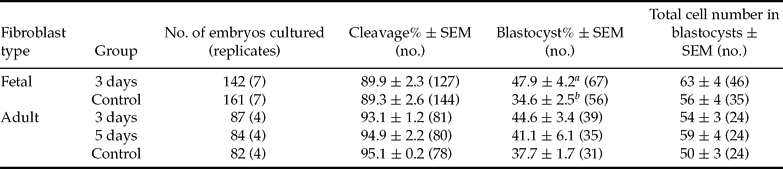
Fetal fibroblasts: In seven replicates, a total of 203 reconstructed embryos were produced with fetal fibroblasts pre-treated by digitonin or with non-treated cells. No significant effect of digitonin permeabilization was noted on cleavage rates compared with the control group (90% and 89%, respectively). Also no difference in blastocyst cell numbers was observed (Table 2). However, the blastocyst rate increased significantly with cells pre-treated with digitonin and cultured for 3 days compared with controls (48% vs. 35%, p < 0.05).
Developmental competence of cloned porcine embryos produced with digitonin-permeabilized fetal fibroblasts cultured for 3 days before SCNT, and adult fibroblasts cultured for 3 and 5 days before SCNT
a,b Different superscripts in the same column indicate significant differences (p < 0.05).
Adult fibroblasts: In four replicates, digitonin permeabilization did not cause significant changes in cleavage rates of cloned embryos using cells 3 or 5 days after treatment. Also, no significant difference was observed in blastocyst rates as well as cell numbers with adult fibroblast pre-treated with digitonin compared with controls (Table 2).
Discussion
In the present study we show that the developmental competence, measured as blastocyst formation, of porcine SCNT embryos increases when the donor cells are permeabilized with digitonin and treated with Xenopus egg extract before re-sealing. Our results show that prolonged culture of cells after the extract treatment is an important factor for this increased developmental capacity of the porcine SCNT embryos. This finding indicates that treated cells require a time period to recover before they can benefit from the full effect of the extract. These results are similar to earlier publications, in which pluripotency marker transcripts were first detected on treated cells after several days of culture, thus after several cell generations (Hansis et al., Reference Hansis, Barreto, Maltry and Niehrs2004; Miyamoto et al., Reference Miyamoto, Furusawa, Ohnuki, Goel, Tokunaga, Minami, Yamada, Ohsumi and Imai2007a).
Interestingly, a similar effect on cloning efficiency was observed when at least certain donor cells were pre-treated with digitonin alone. Other authors have demonstrated increased in vitro cloning efficiency after SLO permeabilization of fetal fibroblasts when employed without membrane re-sealing, which correlates with an increased fusion rate of the donor cell and enucleated oocytes during the cloning procedure (Naruse et al., Reference Naruse, Quan, Kim, Choi, Park and Jin2009). In our work, no differences in fusion rates were observed (data not shown), so this finding is most probably not the reason for our observed increase in cloning efficiency. However, one possible reason for the digitonin effect could be due to a change in cell metabolism. Previous work has shown that digitonin-permeabilized cells had reduced cytoplasmic volume and swelling of the endoplasmic reticulum (Grant et al., Reference Grant, Aunis and Bader1987). We also observed that digitonin-treated cells were smaller than non-treated cells (data not shown). Boquest et al. (Reference Boquest, Day and Prather1999) reported that most small cells were at the G0/G1 stage, which suggests a normal development of SCNT embryos. Another possible reason for a digitonin effect may be activation of the cell's survival mechanisms; a phenomenon that has also been observed after various environmental stresses such as starvation (Lewis et al., Reference Lewis and Hughes-Fulford2000) or high hydrostatic (Du et al., Reference Du, Lin, Schmidt, Bøgh, Kragh, Sørensen, Li, Purup, Pribenszky, Molnár, Kuwayama, Zhang, Yang, Bolund and Vajta2008) or osmotic pressure (Lin et al., Reference Lin, Kragh, Purup, Kuwayama, Du, Zhang, Yang, Bolund, Callesen and Vajta2009).
In conclusion, our study demonstrates that a significant increase in porcine SCNT in vitro efficiency may be achieved by pre-treatment of donor cells with digitonin and Xenopus egg extract. Furthermore, a possible and fairly simple way for improving porcine SCNT efficiency may be permeabilization with digitonin followed by re-sealing and in vitro culture of at least certain donor cells before cloning. Continued work is in progress to further explore the mechanisms of this phenomenon.
Acknowledgements
The authors thank Anette M. Pedersen, Janne Adamsen, Klaus Villemoes, Ruth Kristensen and Annette K. Nielsen for excellent technical assistance. The work was supported financially by grants from the ‘Nutriomics’ project (Danish Agency for Science, Technology and Innovation, 2101–06–0034) and the ‘Pigs & Health’ project (Danish National Advanced Technology Foundation, 013–2006–2).