Introduction
Wild rodent populations are commonly examined for their helminth assemblages, and studies conducted worldwide have revealed a plethora of nematode, cestode and trematode species being harboured by various rodent fauna. In the UK, several commonly identified helminth species have been documented in rodents from different sites. The most frequently reported digeneans of the wood mouse Apodemus sylvaticus tend to be Corrigia vitta and Brachylaemus recurvum (syn. Brachylaima recurva), typically found infecting the pancreatic ducts and the small intestine, respectively, of their host (Elton et al., Reference Elton, Ford and Baker1931; Lewis, Reference Lewis1968; Lewis & Twigg, Reference Lewis and Twigg1972; Behnke et al., Reference Behnke, Lewis, Mohd Zain and Gilbert1999; Abu-Madi et al., Reference Abu-Madi, Behnke, Lewis and Gilbert2000). The parasites of A. sylvaticus and other small mammals have been studied extensively in populations located in a periaquatic environment at the Malham Tarn Nature Reserve, North Yorkshire, UK (Allan et al., Reference Allan, Craig, Sherington, Rogan, Storey, Heath and Iball1999; Hughes et al., Reference Hughes, Williams, Morley, Cook, Terry, Murphy, Smith and Hide2006, Reference Hughes, Thomasson, Craig, Georgin, Pickles and Hide2008; Rogan et al., Reference Rogan, Craig, Hide, Heath, Pickles and Storey2007; Hide et al., Reference Hide, Morley, Hughes, Gerwash, Elmahaishi, Elmahaishi, Thomasson, Wright, Williams, Murphy and Smith2009; Thomasson et al., Reference Thomasson, Wright, Hughes, Dodd, Cox, Boyce, Gerwash, Abushahma, Lun, Murphy, Rogan and Hide2011) including the discovery of a new digenean species (Boyce et al., Reference Boyce, Hide, Craig, Harris, Reynolds, Pickles and Rogan2012). Specifically, Rogan et al. (Reference Rogan, Craig, Hide, Heath, Pickles and Storey2007) reported the occurrence of the intestinal digenean Plagiorchis muris in the wood mouse A. sylvaticus over a 13-year period with an overall prevalence of 16.9%.
The occurrence of P. muris within the UK is rare. As far as can be determined, the first report of P. muris in the UK occurred in Oxford during a study on the health of a wild mouse population, which took place from September 1925 to January 1928 (Elton et al., Reference Elton, Ford and Baker1931). During this study the digenean Lepoderma muris (syn. P. muris) was described from the small intestine of the wood mouse (A. sylvaticus) at a very low prevalence of 0.1%. Lepoderma muris was furthermore reported in the brown rat Rattus norvegicus in Cambridgeshire, UK (Baylis, Reference Baylis1939) and later an occurrence of P. muris was recorded in Scotland when the digenean was unexpectedly recovered from the intestine of a Scottish hill sheep during a parasitological necropsy (Fahmy & Rayski, Reference Fahmy and Rayski1963). These studies, including those of Rogan et al. (Reference Rogan, Craig, Hide, Heath, Pickles and Storey2007) were all based on classical parasite identification using morphology and have not benefited from the greater precision available for DNA sequencing analysis.
Members of the genus Plagiorchis are cosmopolitan and tend to demonstrate low definitive host specificity. Species of this genus have been previously described from the intestines of reptiles and birds in addition to mammals (Janssen & Bock, Reference Janssen and Bock1990; Biserkov & Kostadinova, Reference Biserkov and Kostadinova1998; Ito & Itagaki, Reference Ito and Itagaki2003). Plagiorchis muris is no exception. This species was originally described from the small intestine of the black rat Rattus rattus and the brown rat R. norvegicus, by Tanabe in Kyoto, Japan (Tanabe, Reference Tanabe1922), and has since been considered to be predominantly a digenean of wild rodents (Elton et al., Reference Elton, Ford and Baker1931; Seo et al., Reference Seo, Rim and Lee1964; Ito & Itagaki, Reference Ito and Itagaki2003; Chai et al., Reference Chai, Park, Guk, Kim, Kim, Kim, Shin, Klein, Kim, Chong, Song and Baek2007; Rogan et al., Reference Rogan, Craig, Hide, Heath, Pickles and Storey2007). However, there has been considerable variability in the recorded definitive hosts of P. muris, including the domestic dog Canis familiaris in Japan (Saito et al., Reference Saito, Morishige and Tongu1995), the feral Japanese raccoon Procyon lotor (Yamada, Reference Yamada2000; Sato & Suzuki, Reference Sato and Suzuki2006) and the Mexican greater funnel-eared bat Natalus mexicanus (Perez-Ponce de Leon et al., Reference Perez-Ponce de Leon, Leon-Regagnon and Garcia-Vargas1996), in addition to several cases of natural avian infection in the USA (McMullen, Reference McMullen1937; Cort & Ameel, Reference Cort and Ameel1944; Secord & Canaris, Reference Secord and Canaris1993). Typically, P. elegans has been considered foremost in the genus Plagiorchis for infecting birds (Shimalov, Reference Shimalov2002); however, this species has also been reported to parasitize several species of rodent, including A. sylvaticus (Montgomery & Montgomery, Reference Montgomery and Montgomery1990a), the yellow necked mouse Apodemus flavicollis (Hildebrand & Zaleśny, Reference Hildebrand and Zaleśny2009), the striped field mouse Apodemus agrarius (Shimalov, Reference Shimalov2002; Hildebrand & Zaleśny, Reference Hildebrand and Zaleśny2009) and the bank vole Myodes glareolus (Hildebrand & Zaleśny, Reference Hildebrand and Zaleśny2009).
Little is known about the exact life cycle of Plagiorchis spp. that infect these rodents and, in particular, the identity and role of intermediate hosts. The high prevalence reported in this periaquatic site at Malham Tarn, UK (Rogan et al., Reference Rogan, Craig, Hide, Heath, Pickles and Storey2007) suggests that the presence of water, water fowl and aquatic organisms might be key factors. In the current study we investigated the rare occurrence of P. muris at Malham Tarn, Yorkshire, UK (Rogan et al., Reference Rogan, Craig, Hide, Heath, Pickles and Storey2007) by examining prevalence, intensity and seasonality of adult stages collected from rodents trapped at defined woodland sites around this upland lake. Furthermore we highlight the difficulty in distinguishing P. muris from P. elegans in the absence of molecular tools.
Materials and methods
Collection and examination of rodents
The study was carried out at Malham Tarn Nature Reserve located in North Yorkshire, north-west England at an altitude of 375 m above sea level and is an area that has previously been investigated for a range of host parasite systems (Kennedy & Burrough, Reference Kennedy and Burrough1978; Allan et al., Reference Allan, Craig, Sherington, Rogan, Storey, Heath and Iball1999; Hughes et al., Reference Hughes, Williams, Morley, Cook, Terry, Murphy, Smith and Hide2006, Reference Hughes, Thomasson, Craig, Georgin, Pickles and Hide2008; Rogan et al., Reference Rogan, Craig, Hide, Heath, Pickles and Storey2007; Behnke et al., Reference Behnke, Eira, Rogan, Gilbert, Torres, Miquel and Lewis2009; Hide et al., Reference Hide, Morley, Hughes, Gerwash, Elmahaishi, Elmahaishi, Thomasson, Wright, Williams, Murphy and Smith2009; Thomasson et al., Reference Thomasson, Wright, Hughes, Dodd, Cox, Boyce, Gerwash, Abushahma, Lun, Murphy, Rogan and Hide2011; Boyce et al., Reference Boyce, Hide, Craig, Harris, Reynolds, Pickles and Rogan2012).
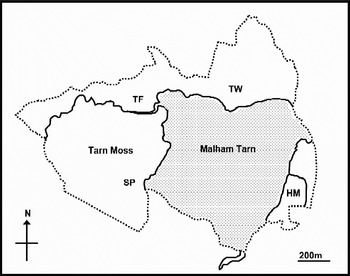
Rodent trapping and examination was conducted according to the methods described by Boyce et al. (Reference Boyce, Hide, Craig, Harris, Reynolds, Pickles and Rogan2012). In total, 117 wood mice (A. sylvaticus) and 63 voles (54 bank voles Myodes glareolus and 9 field voles Microtus agrestis) were trapped from four sampling sites around Malham Tarn: Tarn Woods (54°06′03.3″N, 002°09′44.9″W – position based on GPS WGS84 referencing system), Tarn Fen (54°06′00.0″N, 002°10′43.4″W), Spiggot Hill (54°05′72.9″N, 002°10′43.1″W) and Ha Mire Plantation (54°05′64.5″N, 002°09′53.7″W) between January 2010 and October 2011 (fig. 1). A permit was granted by the National Trust to allow sampling within the boundaries of the reserve. Plantations within these boundaries are represented by Tarn Woods, Ha Mire Plantation and Spiggot Hill. Ownership boundaries form part of the reserve perimeter, restricting sampling in part. Tarn Fen is an area of raised bog covered by deciduous woodland located within the reserve boundaries. Because water is considered to be an important aspect in the life cycle of Plagiorchis spp., suitable rodent trapping sites were carefully selected that were located in close proximity to each border of the tarn.
Map of Malham Tarn Nature Reserve and adjacent woodlands. Redrawn from Shorrock & Sutton (Reference Shorrock and Sutton2010). TW, Tarn Woods; TF, Tarn Fen; SP, Spiggot Hill; HM, Ha Mire Plantation. The dotted line represents the reserve boundary.

Parasite identification and molecular analysis
Morphological examination of the digenean specimens recovered from the small intestine of A. sylvaticus was carried out according to the methods described by Boyce et al. (Reference Boyce, Hide, Craig, Harris, Reynolds, Pickles and Rogan2012). The majority of the specimens were fixed in 70% ethanol, suitable for molecular analysis. DNA was extracted from 12 individual worms, collected from different host specimens of A. sylvaticus when feasible, using a phenol:chloroform method modified from Thomasson et al. (Reference Thomasson, Wright, Hughes, Dodd, Cox, Boyce, Gerwash, Abushahma, Lun, Murphy, Rogan and Hide2011), which encompassed halving the amount of reagent at each stage of the protocol. DNA was extracted from three individual worms isolated from three different wood mice trapped from each of the four sampling sites. However, only one wood mouse from Spiggot Hill was found to be infected, therefore three individual worms from the same host specimen needed to be used in this instance.
The internal transcribed spacer (ITS), including the ITS1, 5.8S, ITS2 and flanking regions of the 3′ end of the 18S and 5′ end of the 28S were amplified, using the forward universal primer BR (5′-GTAGGTGAACCTGCGGA-3′) and reverse digenean specific primer dig11 (5′-GTGATATGCTTAAGTTCAGC-3′) according to Tkach et al. (Reference Tkach, Pawlowski and Sharpilo2000a). The partial 28S rDNA gene region was amplified using the forward digenean specific primer dig12 (5′-AAGCATATCACTAAGCGG-3′) and the reverse universal primer Lo (5′-GCTATCCTGAGRGAAACTTCG-3′) according to Tkach et al. (Reference Tkach, Pawlowski and Mariaux2000b).
Each 50 μl polymerase chain reaction (PCR) contained 5 μl 10 × DreamTaq buffer including 2 mm MgCl2 (Fermentas GmbH, Sankt Leon-Rot, Germany), 0.05 μmol deoxynucleoside triphosphates (dNTPs) (100 mm, Bioline, London, UK), 2.5 μm forward primer, 2.5 μm reverse primer, 5 U DreamTaq DNA polymerase and 2 μl DNA template. All PCR reactions were performed using a Robocycler 96 PCR machine (Stratagene, La Jolla, California, USA) and visualized on a 1% (w/v) Tris–acetate–EDTA (TAE) agarose gel stained with gel red using a G:Box gel imaging system (Syngene, Cambridge, UK). The amplification profile consisted of one cycle at 94°C for 10 min, followed by 35 cycles of 1 min at 94°C, 1 min at 54°C and 1 min at 72°C and one final cycle at 72°C for 10 min. The target bands were excised from the gel using a UV transilluminator and purified using a PCR purification kit (Geneflow, Lichfield, Staffordshire, UK) according to the manufacturer's instructions. Samples were commercially sequenced in both directions (Source Bioscience, Nottingham, UK). The 12 DNA sequences for the ITS gene were primarily aligned using the multiple sequence alignment program ClustalW (www.genome.jp/tools/clustalw/) to check for sequence homology between specimens from each of the four sampling sites. This procedure was repeated with the 28S rDNA data. In both instances a FinchTV trace viewer (Geospiza, Seattle, Washington, USA) was utilized in order to verify any regions of ambiguity. The two DNA sequences generated for the ITS and 28S rDNA from Malham Tarn were compared with those held in the National Center for Biotechnology Information (NCBI) database using the BLAST program (www.blast.ncbi.nlm.nih.gov/Blast.cgi).
Data analysis
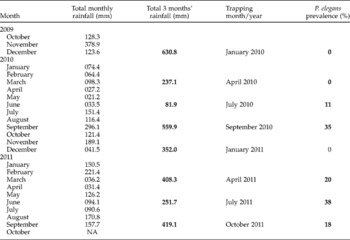
Differences in prevalence observed between sampling sites and seasons were investigated using the chi-squared test for heterogeneity. Host sex and host age were analysed statistically using chi-squared 2 × 2 contingency tables (http://www.graphpad.com/quickcalcs/contingency1.cfm). For determination of age, rodents were split into three age cohorts according to Behnke et al. (Reference Behnke, Lewis, Mohd Zain and Gilbert1999). Associations between prevalence and host length (cm), weight (g) and rainfall data (mm) were analysed using Spearman's rank of correlation. Monthly rainfall data were provided by Malham Tarn Field Centre. Prevalence calculated during each season over a 2-year period was analysed in relation to the previous 3 months' rainfall (mm) adapted from Rogan et al. (Reference Rogan, Craig, Hide, Heath, Pickles and Storey2007).
Results
In total, 717 Plagiorchis worms were recovered successfully from the small intestine of 27 of 117 examined wood mice between January 2010 and October 2011. Plagiorchis sp. was not detected from any of the vole species despite careful observations. An overall prevalence rate of 23% was determined from all four sampling locations: Tarn Woods, Tarn Fen, Spiggot Hill and Ha Mire Plantation, indicating this digenean species to be dispersed throughout the Malham Tarn area. Worm burden ranged from 0 to 275, with a mean intensity of 26.6 ± 61.5 (717/27) appearing to be typically overdispersed in distribution (variance to mean ratio (VMR): σ2/μ = 158.89), with 84.6% of wood mice being uninfected or infected with just a single worm in comparison to just 1.7% harbouring the majority of parasites (>100 worms). A goodness of fit indicated a good agreement with the negative binomial distribution (Gcalculated= 21.17, df= a− 3 (12 − 3) is 21.67, P= 0.01).
Morphological characterization
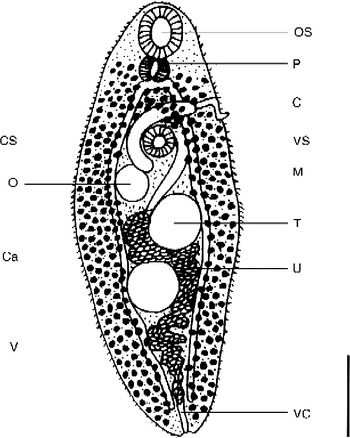
Plagiorchis sp. was identified following the microscopical analysis of fixed and unstained specimens. The adult worm measures 1.66–2.93 mm (mean 2.64 mm) in length by 0.46–0.76 mm (mean 0.58 mm) in width at the widest part (across the region of the most anterior testis) (fig. 2). The tegument possesses minute spines covering the entire surface. The dorsal surface appears to be obscured by an extensive array of vitelline glands that fail to maintain confluency within the anterior region. The oral sucker is roughly spherical in shape and measures 200–300 μm in length (mean 256 μm) by 200–300 μm (mean 247 μm) in width. The oral sucker lies anterior to the pharynx from which the intestinal bifurcation occurs. The intestine appears short and indistinct and thereafter extends into two very long, blindly ending caeca that are often difficult to observe, commonly being masked by a copious mass of vitelline glands, but reaching the near posterior extremity of the body. The ventral sucker is smaller in size than that of the oral sucker, measuring 130–200 μm (mean 163 μm) in length by 130–200 μm (mean 163 μm) in width. These measurements indicate an oral to ventral sucker ratio of 1.52:1 (width ratio) to 1.57:1 (length ratio). Two circular-shaped testes are situated posterior to a single ovary. The testes are obliquely positioned, with the anterior testis situated slightly right of the median line and the most posterior testis to the left. The ovary lies just posterior to the ventral sucker, separated by the cirrus sac, which curves in a posterior direction along the left-hand side of ventral sucker. The metraterm can be seen to curve posteriorly along the right-hand side of the ventral gland adjoining the anterior region of the uterus when not obscured by the vitelline glands. The uterus extends to the posterior extremity of the body, presenting a characteristic s-shape that reaches from the region of the ovary and continues intertesticularly towards a posterior vitellarian commissure. On the ventral surface the vitelline glands continue along both lateral sides, from the far extremity of the hind body and into the forebody, surpassing the ventral sucker and creating confluency often up to the posterior border of the pharynx.
Plagiorchis specimen recovered from the small intestine of Apodemus sylvaticus at Malham Tarn. The drawing was made from a photograph taken using a Leica ICC50 digital camera attached to a Leica DM500 microscope. Abbreviations: OS, oral sucker; P, pharynx; C, cirrus; CS, cirrus sac; VS, ventral sucker; M, metraterm; O, ovary; T, testis; Ca, caecum; U, uterus; V, vitellaria; VC, vitellarian commissure. Scale bar = 500 μm.

There does not appear to be any clear indication in the literature of the morphological features used by previous authors to distinguish P. muris from P. elegans. As such, the description provided in this section holds a sufficient similarity for both species and use of morphology alone could be considered ambiguous. The use of molecular differentiation is therefore regarded as an important means to complement species classification in this case.
Molecular characterization
DNA was successfully extracted and amplified from 12 individual Plagiorchis worms recovered from the small intestine of 10 A. sylvaticus mice trapped from the four different sites. Amplification of the internal transcribed spacers (ITS) including the ITS1, 5.8S and ITS2 generated a sequence of 1213 bp (GenBank accession: JX522536). The 12 ITS sequences generated from all four sampling sites were 100% identical. The ITS sequence generated from Malham Tarn was compared against five DNA sequences generated from Plagiorchis adults that were held in the NCBI database: P. maculosus (AF316152) collected from the chaffinch Fringilla coelebs (Snyder & Tkach, Reference Snyder and Tkach2001); P. elegans (AF151952) collected from a red-backed shrike Lanius colluri, P. koreanus (AF151944) collected from Kuhl's pipistrelle Pipistrellus kuhli, the common noctule Nyctalus noctula and Daubenton's bat Myotis daubentoni, P. vespertilionis (AF151949) from M. daubentoni and P. muelleri (AF151947) from the serotine bat Eptesicus serotinus, all obtained within the Ukraine (Tkach et al., Reference Tkach, Pawlowski and Sharpilo2000a). The ITS sequence from Malham Tarn shared a 100% sequence homology with that of P. elegans, with only one omission of adenosine at site 571. This omission was observed in all 12 generated DNA sequences. The Malham Tarn sequence shared only 94% sequence homology with P. maculosus, 89% with P. koreanus, 91% with P. vespertilionis and 90% with P. muelleri.
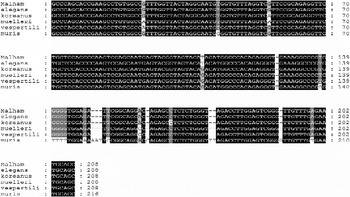
Amplification of the 28S rDNA gene generated a partial sequence of 1263 bp (GenBank accession: JX522535). The 12 28S rDNA sequences generated from all four sampling sites were also 100% identical. This sequence was also compared against five available DNA sequences from the NCBI database: P. elegans (AF151911) (Tkach et al., Reference Tkach, Grabda-Kazubska, Pawlowski and Swiderski1999), P. muris (AF096222) obtained from the intestine of a rat in the Republic of Korea (Lee et al., Reference Lee, Huh and Sohn2004), P. muelleri (AF184250) (Tkach et al., Reference Tkach, Pawlowski, Mariaux, Swiderski, Littlewood and Bray2001), P. koreanus (AF151930) and P. vespertilionis (AF151931) collected from N. noctula in the Sumy region of the Ukraine and M. daubentoni in the vicinity of Kiev, Ukraine (Tkach et al., Reference Tkach, Pawlowski and Mariaux2000b). The 28S sequence generated from the Malham Tarn specimens shared 100% homology with P. elegans and 98% with P. muelleri, P. koreanus and P. vespertilionis. The only 28S sequence currently available for P. muris is 304 bp in length, which demonstrated a 95% match only with the Malham Tarn specimens (fig. 3). Comparison of the full 1263 bp 28S rDNA sequence from Malham Tarn with a 1263 bp sequence for P. elegans (AF151911) also indicated 100% sequence homology.
Comparison of the partial 28S rDNA sequence of P. muris collected from Malham Tarn against other Plagiorchis species retrieved from the NCBI database: P. elegans (AF151911), P. koreanus (AF151930), P. muelleri (AF184250), P. vespertilionis (AF151931) and P. muris (AF096222). Comparison has been made using the GeneDoc alignment tool (http://www.nrbsc.org/gfx/genedoc). Black shading indicates regions of conserved homology. Grey indicates regions of conservation between four or more species.

These data, in combination with the 100% sequence homology match demonstrated by the ITS region, question the identity of P. muris at Malham Tarn and infers that the species present at this location is in fact P. elegans. For the remainder of this paper, references to Plagiorchis sp. in this study should be read as P. elegans. The prevalence of P. elegans at this location was examined.
Ecological analysis
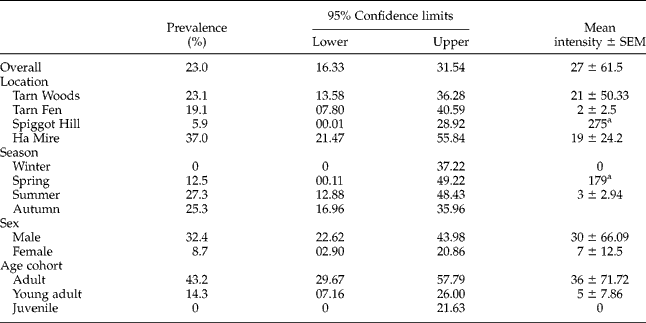
Prevalence was analysed in relation to both extrinsic and intrinsic factors. During the study a comprehensive data set was established which recorded trapping location, date, host sex, host weight and host length. Prevalence data, 95% confidence limits and mean intensities were recorded by location, season, and host sex and host age-group (table 1). To determine whether there was an association with prevalence and a particular trapping site, the rate of prevalence was examined between the four sampling sites using the chi-squared test for heterogeneity. The greatest prevalence was observed at Ha Mire Plantation in which 37.03% of sampled wood mice (n= 27) carried a mean intensity of 19 ± 24.2 worms (187/10). The prevalence at Tarn Woods, which is the original sampling site reported by Rogan et al. (Reference Rogan, Craig, Hide, Heath, Pickles and Storey2007), was less, with only 23.07% of wood mice (n= 52) being infected despite a slightly higher mean intensity of 21 ± 50.33 (246/12). At Tarn Fen, only four of the 21 examined wood mice were infected with P. elegans, giving a prevalence of 19.05%. A very low worm burden of just 2 ± 2.5 (9/4) was also observed at this site. Only a single wood mouse was infected with P. elegans at Spiggot Hill, providing the lowest prevalence of the study at 5.88% (n= 17). This mouse, however, harboured 275 worms, the highest number recorded during the study. No significant heterogeneity was found between the prevalence of P. elegans and any of the four sites (χ2= 3.79, P= 0.05, v= 3).
Prevalence (with 95% confidence limits) and mean intensity data for P. elegans in A. sylvaticus from Malham Tarn.

a Figure derived from a single host infection.
As studies of Plagiorchis infection in natural rodent populations have demonstrated seasonal variation in prevalence and intensity, we examined this hypothesis at Malham Tarn. Mean prevalence and mean intensity were calculated each season over a 2-year period. Both mean prevalence and mean intensity were zero during the winter (January) sampling periods (n= 8). Only one mouse was infected during the spring (April), giving a prevalence of 12.5% (n= 8). This mouse, however, harboured 179 worms. Peak prevalence occurred during the summer (July) when 27.3% (n= 22) of mice carried a mean intensity of 3 ± 2.94 worms (20/6). Prevalence thereafter decreased slightly to 25.3% (n= 79) during the autumn (September/October); however, mean intensity increased considerably to 26 ± 61.46 worms (518/20) for this period. Despite observable differences in prevalence, no significant heterogeneity was found between the prevalence of P. elegans and season (χ2= 3.38, P= 0.05, v= 3). A Spearman's rank of correlation also indicated a very weak but significant correlation (r s= 0.095, P < 0.05, n= 27) between the prevalence of P. elegans and rainfall for the 3 months preceding each sampling session (table 2).
Rainfall data used to analyse the correlation between the total amount of 3 months' rainfall (mm) and P. elegans prevalence (%) by Spearman's rank of correlation. Rainfall data were supplied by Malham Tarn Field Centre. Emboldened numbers are the figures that have been used within the statistical analysis.

In total, 71 male mice and 46 female mice were examined. Prevalence in male mice was greater, at 32.4%, in comparison to only 8.7% for female mice. Furthermore, male mice harboured the majority of worms, carrying 688 of 717 recovered, with a mean intensity of 30 ± 66.09 (688/23) against only 7 ± 12.5 (29/4) for female mice. A highly significant difference between P. elegans infection and A. sylvaticus sex was identified using a chi-squared 2 × 2 contingency table (χ2= 7.55, P= 0.05, v= 1).
The data were further analysed to determine whether there was an age-dependent prevalence occurring at this location. Plagiorchis elegans was recorded in a total of 19 out of 44 adult wood mice (43.2%) which was greater than that observed for young adult mice (14.3%, n= 56). No juvenile mice were infected during the present study (n= 17). A similar pattern was observed for mean intensity, with adult wood mice harbouring the vast majority of infection, carrying 677 of 717 worms recovered. Adult males (n= 34), however, carried 650 of these worms, in comparison to just 27 worms carried by adult female mice (n= 10). Mean worm burden in the adult group was 36 ± 71.72 (677/19) in comparison to only 5 ± 7.86 (40/8) for young adults and zero for juvenile mice. No significant difference was observed between the juvenile and young adult age categories (χ2= 1.46, P= 0.05, v= 1); however, the difference between adult wood mice and young adults (χ2= 9.02, P= 0.05, v= 1) and adult and juvenile (χ2= 8.74, P= 0.05, v= 1) age cohorts was found to be highly statistically significant using a chi-squared 2 × 2 contingency table. Wood mice ranged in weight from 4.0 to 29 g and in length from 4.5 to 9.8 cm. A Spearman's rank of correlation using these data against prevalence gave a very strong correlation in both cases (r s= 0.929 P= < 0.05, n= 113 and r s= 0.955, P= < 0.05, n= 117, respectively) indicating an age-dependent prevalence at this location.
Discussion
In the present study we used molecular differentiation to investigate further the occurrence of P. muris at Malham Tarn. Results indicate that the currently identified specimens of P. muris at this location are P. elegans. As far as we can determine, our previous report (Rogan et al., Reference Rogan, Craig, Hide, Heath, Pickles and Storey2007) was the fourth known report of P. muris in British wildlife (Elton et al., Reference Elton, Ford and Baker1931; Baylis, Reference Baylis1939; Fahmy & Rayski, Reference Fahmy and Rayski1963), although the conclusion from this study indicates that this trematode was, in fact, P. elegans, and also raises the question as to whether other previous studies have correctly identified the species. Elton et al. (Reference Elton, Ford and Baker1931) reported only a prevalence and Baylis (Reference Baylis1939) simply listed an occurrence of the digenean. Neither author described the morphology of the parasite involved, nor was DNA sequencing an aspect of biological surveys at that time. The third report, by Fahmy & Rayski (Reference Fahmy and Rayski1963), was a short report which provided no written account, but rather incorporated a diagram as a means of description. Unfortunately, the diagram contained insufficient detail to clarify its status as P. muris from that of P. elegans.
Previously, Fahmy (Reference Fahmy1954) described a new species of Plagiorchis, P. lutrae, from the otter (Lutra lutra) in Scotland. This new species closely resembled the description of P. muris but was differentiated on the basis of size. The measurements of this new species did, however, coincide with those provided in the original description of P. muris described by Tanabe in Kyoto, Japan in 1922; despite this, P. lutrae was compared with P. muris described by McMullen (Reference McMullen1937) from Douglas Lake in Michigan State, USA, which was much larger in size.
The description of P. muris from various locations appears ambiguous. The majority of reports describing P. muris from outside of South-East Asia indicate both a greater range in length and oral to ventral sucker ratio. The description of P. muris by McMullen (Reference McMullen1937) was based upon adult digeneans recovered from a range of experimental hosts in addition to a range of naturally infected avian fauna. The average length and oral to ventral sucker ratio of these specimens was, however, beyond the maximum dimensions reported for South-East Asian P. muris (Tanabe, Reference Tanabe1922; Seo et al., Reference Seo, Rim and Lee1964).
Interestingly, the measurements provided for P. muris by McMullen (Reference McMullen1937), Rogan et al. (Reference Rogan, Craig, Hide, Heath, Pickles and Storey2007) and the current study overlap with the description generated for P. elegans from a PhD study conducted by A.M. Gorman at Leeds University in 1980. Experimental evidence provided by Gorman (Reference Gorman1980) did, however, identify intraspecific variation within a pure strain of P. elegans. The study identified various manifestations in several anatomical structures, not only between different definitive host species but, furthermore, within the same definitive host, including differences in the extent of the vitellaria and aperture shape of both the oral and ventral suckers (Gorman, Reference Gorman1980). Confluency of the vitelline glands has been used on several occasions as a means of differentiation for Plagiorchis species (Fahmy, Reference Fahmy1954; Tkach et al., Reference Tkach, Pawlowski and Sharpilo2000a); however, as pointed out by Blankespoor (Reference Blankespoor1974) and Gorman (Reference Gorman1980), use of the glands for diagnosis may not be appropriate due to the intraspecific variation observed in this feature. For instance, the vitelline glands of P. muris have been reported to extend to either the posterior border of the pharynx (Tanabe, Reference Tanabe1922; Hong et al., Reference Hong, Woo and Chai1996) or the level of the oral sucker (Fahmy & Rayski, Reference Fahmy and Rayski1963; Seo et al., Reference Seo, Rim and Lee1964; Hong et al., Reference Hong, Ahn and Woo1998). Nonetheless, Hong et al. (Reference Hong, Woo and Chai1996) described P. muris from a human case of plagiorchiasis using the positioning of the vitelline glands to morphologically differentiate P. muris from both P. vespertilionis and P. koreanus. There was, however, no mention of P. elegans in this report, despite this species appearing to display the most morphological similarity to P. muris in the distribution of the vitellaria. As far as can be determined, there have currently been no reported cases of P. elegans infection in either Korea or Japan, where P. muris appears to be considered the typical dominant Plagiorchis species found in rodents.
Currently, there is ambiguity in the criteria used to morphologically differentiate P. muris from P. elegans. Furthermore, there is a paucity of DNA sequence information for the digeneans in this group. To date, only 19 DNA sequences for various genes are available for members of the genus Plagiorchis, which includes 11 sequences for the internal transcribed spacer regions (including five repeated isolates), six partial sequences for the 28S and two partial sequences for the cytochrome c oxidase subunit 1 gene.
Fortunately, the use of DNA sequencing could be employed in the current study to confirm the identity of the Malham Tarn specimens. The internal transcribed spacer regions and the partial 28S rDNA gene indicate the specimens recovered from Malham Tarn to be P. elegans. Based on these results, and considering the unreliability of morphological differentiation for the two species in question (Blankespoor, Reference Blankespoor1974; Gorman, Reference Gorman1980; Hong et al., Reference Hong, Ahn and Woo1998), it could be speculated that other reports describing P. muris based purely on morphology have also misidentified the species involved. For example, in his report McMullen (Reference McMullen1937) commented that the cercariae used for experimental infection possessed seven or eight pairs of penetration glands on either side of the stylet, which is a combination typical of P. elegans (Faltýnková et al., Reference Faltýnková, Našincová and Kablásková2007) as opposed to the four pairs originally described for P. muris by Tanabe (Reference Tanabe1922). This morphological description provided for P. muris by McMullen (Reference McMullen1937) has since been a basis for morphological comparison made by some European authors (Fahmy, Reference Fahmy1954; Rogan et al., Reference Rogan, Craig, Hide, Heath, Pickles and Storey2007).
Despite the questionable identity of Plagiorchis at Malham Tarn, the occurrence of this digenean at this location within the UK is nonetheless considered rare, in particular with a consistent prevalence recorded since 1993 (Rogan et al., Reference Rogan, Craig, Hide, Heath, Pickles and Storey2007). Furthermore, the overall prevalence rate of 23% recorded during the present study appears to be much greater than that reported in the literature. Other UK reports involving either P. muris or P. elegans in small mammal hosts have encompassed very low prevalence rates of 0.1 and 0.05%, respectively (Elton et al., Reference Elton, Ford and Baker1931; Montgomery & Montgomery, Reference Montgomery and Montgomery1990a). A further two reports of P. muris in the wood mouse A. sylvaticus in Ireland have also indicated very low prevalence rates of 1% or less (Langley & Fairley, Reference Langley and Fairley1982; O'Sullivan et al., Reference O'Sullivan, Small and Fairley1984). Further afield, Ito & Itagaki (Reference Ito and Itagaki2003) reported a prevalence of just 1.7% in the large Japanese field mouse Apodemus speciosus in Japan, and Chai et al. (Reference Chai, Park, Guk, Kim, Kim, Kim, Shin, Klein, Kim, Chong, Song and Baek2007) recorded an overall prevalence of 5.3% in the striped field mouse Apodemus agrarius in Korea. Plagiorchis elegans does, however, appear to be the species reported most often from small mammals within Europe. Hildebrand & Zaleśny (Reference Hildebrand and Zaleśny2009) reported a prevalence of 1.3% in the bank vole Myodes glareolus trapped in Poland. A single specimen of P. elegans recovered from M. glareolus in Pallasjärvi, Finland, gave a prevalence of just 0.5% (Tenora et al., Reference Tenora, Henttonen and Haukisalmi1983) and a slightly higher prevalence rate of 3.1% was reported by Shimalov (Reference Shimalov2002) from A. agrarius in Belarus.
The reasons for the occurrence of P. elegans at such a high prevalence at Malham Tarn are unclear. Malham Tarn is a ‘Site of Special Scientific Interest’ (SSSI) boasting a vast array of plant and animal species. The surface area of the tarn is approximately 150 acres, with an average depth of 2.4 m and a maximum depth of 4.4 m in various regions (Woof & Jackson, Reference Woof and Jackson1988). Similarly to this study, previous studies have observed the occurrence of Plagiorchis in regions of close proximity to significant water bodies (Cort & Olivier, Reference Cort and Olivier1943; Cort & Ameel, Reference Cort and Ameel1944; Bock, Reference Bock1984; Hong et al., Reference Hong, Woo, Lee and Huh1999; Hildebrand & Zaleśny, Reference Hildebrand and Zaleśny2009). Being the only upland marl lake of its kind in Britain (Rogan et al., Reference Rogan, Craig, Hide, Heath, Pickles and Storey2007), it could be postulated that Malham Tarn itself may play an important role by providing important breeding sites for intermediate host species. Molluscs of the genus Lymnaea are the dominant snails acting as the first intermediate host for Plagiorchis species worldwide (Tanabe, Reference Tanabe1922; Velasquez, Reference Velasquez1964; Bock, Reference Bock1984; Manga-Gonzalez et al., Reference Manga-Gonzalez, Gonzalez-Lanza and Kanev1994; Zakikhani & Rau, Reference Zakikhani and Rau1999; Väyrynen et al., Reference Väyrynen, Siddall, Valtonen and Taskinene2000; Faltýnková et al., Reference Faltýnková, Našincová and Kablásková2007). Four species of Lymnaea have been recorded at Malham Tarn – L. stagnalis, L. peregra, L. palustris and L. truncatula (Norris, Reference Norris2003). To date, 1603 Lymnaeid snails have been examined from Malham Tarn for the presence of Plagiorchis sp. intramolluscan stages after crushing, but currently none of these hosts have been positively implicated (data not shown). A similar situation was demonstrated by Hong et al. (Reference Hong, Woo and Chai1996) in the Republic of Korea. Insects act as the second intermediate host and dragonflies are the most commonly reported insects found to be naturally infected (Hong et al., Reference Hong, Woo, Lee and Huh1999). Malham Tarn is home to several species of dragonfly (Shorrock & Sutton, Reference Shorrock and Sutton2010); however, further study is required in order to identify first and second intermediate host species involved in transmission at this location.
In the present study, P. elegans was recorded from all four trapping sites. Only a weak association between prevalence and rainfall amount was identified, suggesting that temporary water bodies may not be an important determinant for transmission and rather that infection is related to the presence of intermediate host species that breed within the tarn body itself. Each trapping site is separated from the tarn by a narrow shingle beach and earth ridge, and although this is terrain that wood mice may be capable of crossing, a crude morphological examination of the stomach contents of A. sylvaticus (n= 117) at Malham Tarn demonstrated the presence of adult insect remains. This suggests the main source of infection for A. sylvaticus to be adult insects infected with metacercariae that may migrate into the home range of the wood mouse following emergence from the Tarn lake. Other studies have also indicated that the diet of A. sylvaticus includes various adult insects (Montgomery & Montgomery, Reference Montgomery and Montgomery1990b; Khammes & Aulagnier, Reference Khammes and Aulagnier2007).
The distribution of P. elegans at Malham Tarn demonstrated a typical pattern of overdispersion, with rodent age and sex being the two main factors associated with prevalence. Khammes & Aulagnier (Reference Khammes and Aulagnier2007) used three age categories to examine the differential diet of A. sylvaticus and indicated arthropod remains to be more abundant in the stomach contents of adult mice. In the present study, the prevalence of P. elegans was significantly greater in adult mice than in younger age cohorts. This is likely due to differences in exposure to infective-stage parasites through differences in diet, with adult mice being more likely to consume insect material than younger cohorts.
Several studies have indicated a change in the feeding habits of A. sylvaticus from a granivorous diet to one involving animal material during periods when seeds are scarce, during the spring and early summer months (Lewis, Reference Lewis1987; Montgomery & Montgomery, Reference Montgomery and Montgomery1990b). A study by Montgomery & Montgomery (Reference Montgomery and Montgomery1990b) in County Down, Northern Ireland, compared the stomach contents of A. sylvaticus at two locations. In both sample sets animal material was seen to decline rapidly after September. The typical consumption of insect material by A. sylvaticus between spring and autumn coincides with the detectable prevalence period of P. elegans in the present study. Furthermore, other studies have identified seasonal patterns of infection in natural rodent populations (Chai et al., Reference Chai, Park, Guk, Kim, Kim, Kim, Shin, Klein, Kim, Chong, Song and Baek2007). Seasonality in prevalence is likely to be due to the developmental cycle of the intermediate host species involved in transmission. Hong et al. (Reference Hong, Ahn and Woo1998) demonstrated that up to 96% of Plagiorchis worms were expelled from the intestine of albino laboratory rats within 28 days post infection, indicating the likelihood of finding adult digeneans from the previous season to be low.
Male mice had both a significantly higher prevalence and carried a higher worm burden than their female counterparts. It is likely that the differences observed between male and female and adult and younger adult mice are due to variation in behaviour between the various groups. It has been well documented that the home range of male rodents is much greater than that for female rodents (Langley & Fairley, Reference Langley and Fairley1982; Wolton, Reference Wolton1985; Attuquayefio et al., Reference Attuquayefio, Gorman and Wolton1986), particularly during the breeding season between April and October (Bueshing et al., Reference Buesching, Newman, Twell and Macdonald2007) during which male wood mice have been observed to increase their home range by as much as five times (Corp et al., Reference Corp, Gorman and Speakman1997). Male adult wood mice are also much more arboreal than their younger counterparts and female wood mice (Buesching et al., Reference Buesching, Newman, Twell and Macdonald2007). Arboreality in wood mice is considered to be due to their insectivorous nature, with insects and other small invertebrates often inhabiting the tree canopy. Climbing as a means to acquire food may, however, be energetically expensive (Bueshing et al., Reference Buesching, Newman, Twell and Macdonald2007), and female wood mice, which have a greater dependency on resources, have been observed establishing mutually exclusive breeding territories (Flowerdew, Reference Flowerdew1993) and, as such, are less likely to become infected due to a reduced exposure to metacercaria-infected insects than adult males, which appear more prone to wanderlust.
While this study sheds light on the detailed parasite–multihost interactions within this complex periaquatic ecosystem, it also demonstrates the difficulties associated with understanding these interactions, a key issue clearly being the need for accurate identification methods of all life-cycle stages. What is evident is that there is much ambiguity regarding the important morphological characteristics that can be used to differentiate P. muris and P. elegans and, as such, it may be questioned as to whether a sufficient amount of data is available to confirm these two species as distinct. Interestingly, Blankspoor (Reference Blankespoor1974) commented that there may, in fact, be no difference between certain Plagiorchiids known to occur in both avian and mammalian hosts, which could possibly be the case for P. muris and P. elegans, which have both been described from a range of birds and mammals. It could therefore be suggested that these two species may be synonyms, and that previous cases of identification regarding P. muris and P. elegans have been influenced by the host species from which the specimen was recovered. If so, the question should be raised as to just what extent has the effect of host-induced intraspecific variation previously been overlooked in this group of digeneans? The idea of synonymization between P. muris and P. elegans has been incorporated as a fleeting comment at several points within the literature (Blankespoor, Reference Blankespoor1974; Gorman, Reference Gorman1980); however, as far as can be determined, to date no attempts have been made to reconcile this notion. Due to the high morphological similarity observed between members of the genus Plagiorchis, it is likely that identification based on morphology alone will be a problem for the other species within this group that are also likely to have been misidentified at the adult or larval stages, which is an issue that molecular tools can significantly clarify.
Acknowledgements
This project was funded by the University of Salford PhD Studentship scheme. We would also like to thank the Nuffield Foundation and the National Trust for granting the licence that enabled this work to be conducted, in addition to all staff at Malham Tarn FSC field centre, in particular the current warden Mike Cawthorn and Kate Martin for support and assistance. We would also like to thank Dr Belgees Boufana for technical advice and Jaroslav Bajnok for assistance during the summer sampling, in addition to the many undergraduate and postgraduate students who contributed to the fieldwork during the autumn sampling period.