


I. Introduction
“Once again, the judiciary, this time at the European level, is claiming powers that do not belong to it, in the face of responsibilities that are political,” said Giorgia Meloni on X after the Court of Justice of the EU (CJEU) had issued a ruling unfavourable to her policies.Footnote 1 Meloni’s comment cannot be viewed in isolation; Dutch politician Geert Wilders consistently refers to judges as members of the political party D66 (liberals) due to judgments he dislikes,Footnote 2 the Trump administration disregards court rulings,Footnote 3 international courts have suffered from backlash in West, East and Southern Africa,Footnote 4 and recently twenty-seven European states urged the European Court of Human Rights to adopt a more deferential approach in migration cases, arguing its current stance is “too strict.”Footnote 5 This backlash against judges comes at a time when attention for the phenomenon of strategic litigation is at a high. Strategic litigation entails “the (intention of) legal action through a judicial mechanism in order to secure an outcome, either by an affected party or on behalf of an affected party […] used as a means to reach objectives which consist of creating change (e.g., legal, political, social) beyond the individual case or individual interest.”Footnote 6 Moreover, there is consensus that strategic decision-making (on the legal forum, claim, arguments) takes place within litigation to achieve these objectives.Footnote 7
Backlash against the judiciary (as well as against civil society organisationsFootnote 8 ) indicates that strategic litigation is striking a nerve. The topic has been researched extensively worldwide in the sociolegal field and many scholars have shed their light on the question of social change through strategic litigation. The outcomes are a mixed bag: some authors ascribe more promising outcomes to strategic litigation than others. The present article aims to take stock of the field as it currently stands, answering the research question: under what conditions and through which mechanisms can strategic litigation contribute to social change? From this main research question, two specific sub-questions follow. First, the research field is characterised by interdisciplinarity, as legal scholars and social scientists have addressed the topic. Therefore, one sub-question is: what methodologies (including conceptualisation and operationalisation) are deployed?Footnote 9 Second, there is a wide range of policy areas that have been researched, leading to the second sub-question: what policy areas feature prominently in research and how does impact vary along policy area?
In the literature surveyed, the term used for the phenomenon “strategic litigation” differs, with some authors using the term “public interest litigation,” “legal mobilization’” “impact litigation,” or “strategic human rights litigation.” Similarly, not all authors use the notion social change, as some deploy the term (social) impact or effect. Nevertheless, the common denominator is that this field investigates legal action and measures its outcomes going beyond the “law on the books.”Footnote 10 While there is much literature globally, we do not know much about the societal effects of strategic litigation in Europe.Footnote 11 Due to the vastness of this field of study globally and the gap in the literature on the question of impact of strategic litigation in Europe, the current article uses a narrative review to map the field, synthesise the state-of-the-art and create a roadmap for further research.Footnote 12 Research that has been taken on board in this study varies in terms of jurisdiction, ideological purpose behind litigation, field of law, type of interest, etc. This may seem counterintuitive, after all, areas of law differ significantly. Nevertheless, the research in this sub-field is in constant conversation with one another, despite the dissimilarities in case studies.Footnote 13 As there appears to be a gap in the European literature, specific attention is devoted in some of the subsections to the European context. Section 2 sets out the methodology deployed. Section 3, subsequently, maps identified emerging trends and recurring themes. Finally, Section 4 provides concluding remarks answering the research questions.
II. Methodology: semi-systematic or narrative literature review
In other disciplines, such as medical research and social science research, the use of literature reviews has become a standardised tool for creating an overview of existing knowledge and knowing how new research can add new insights to a large body of literature. Different types of literature reviews with different methodologies can be found in these disciplines, such as critical reviews, meta-analyses, rapid reviews, mixed-methods reviews and scoping reviews.Footnote 14 Literature reviews can help prevent confirmation bias in research, by including sources that would otherwise have been left out – as they do not confirm the hypotheses of the researcher.Footnote 15 Moreover, in vast fields of study, mere “snowballing” could leave out important sources that have been overlooked by others. Whereas legal research did not include extensive methodological considerations for a long time, the balance has shifted and more – though not all – legal scholars pay attention to the (legal) methodology deployed.Footnote 16
This article uses the approach of one specific type of literature review, the semi-systematic or narrative review, in order to create an overview of the state-of-the-art with regard to research on law/litigation and social change. It does not deploy a regular systematic review for feasibility reasons: a large review can include around 100 articles that are systematically analysed,Footnote 17 whereas this research topic has generated hundreds, if not thousands, of academic sources.Footnote 18 A systematic review (or scoping review) would require all suitable sources to be included, whereas a semi-systematic review is appropriate if this is impossible.Footnote 19 In order to limit the scope of inquiry, one could have chosen to look at strategic litigation in a specific sector. Nevertheless, such an approach would neglect the common elements of the phenomenon that apply across legal fields, making research looking at different areas of the law all the more interesting to assess collectively. Moreover, the topic has been conceptualised and studied differently, as explained in the introduction. Therefore, the present article uses a semi-systematic review, which is more appropriate for research using different conceptualisations.Footnote 20 A semi-systematic review looks at how research has progressed and developed over time, and it synthesises meta-narratives.Footnote 21
To this end, the article deploys a database research strategy using the same search words in three databases.Footnote 22 The first twenty results of each database have been included in the review. Not all studies were equally relevant; the title and abstract of each piece were assessed first in order to control for suitability of the article. Studies were excluded if they did not concern (primarily) the phenomenon of strategic litigation (or public interest litigation/legal mobilisation). For example, some studies only mentioned the notion in passing.
Through snowballing – by looking at the references of the selected studies – other sources have been included. The snowball “sample” is large, for two reasons. First, many studies found in the sample refer consistently to older literature that did not come up in the database research, seemingly forming the first generation of important works. Second, snowballing allowed for the inclusion of newer studies that were consistently referred to, possibly forming a second-generation of seminal works. The requirement for inclusion is that sources had to come up numerous times in the footnotes of selected works from the databases. Additional other works of authors who came up more than once in the database search have been added as well.Footnote 23 Special significance has been given to footnotes in works that in themselves attempt to provide overviews, such as a chapter by Boutcher and McCammon, a report by Vanhala and Kinghan, and an article by Cummings and Rhode.Footnote 24 The databases selected are more geared towards legal audiences (with the exception of Google Scholar), therefore, specifically articles from socio-legal journals (such as Law & Social Inquiry and Law & Society Review) have been included through snowballing. Although arbitrariness cannot be eliminated completely due to the selected semi-systematic strategy, the overview includes a broad range of 148 sources, including books, book chapters, articles and reports from authors that have different disciplinary backgrounds and are spread out globally. The time span ranges from the 1970s (when the research field was more or less established) to 2026.Footnote 25
The works have been systematically reviewed by categorising certain variables: (the conceptualisation of) change, the types of change identified, area of the law analysed, jurisdiction discussed, methodology deployed and the disciplinary background of the author. General trends and themes emerge from this analysis, which are outlined below. Because this is not a systematic literature review, this article provides only a general, not an exhaustive, overview of the state-of-the-art of research on strategic litigation and social change. Below is a figure (Figure 1) displaying the origin of the sources found. A significant amount of sources comes from legal journals (US law journals, law journals (other) and human rights journals), whereas only a small amount comes from sociology journals.
Sources.

III. Results and discussion
Despite a diverse range of literature, general themes and trends emerge in response to the research questions, both consistently and developing over time. This section deepens out these trends and themes, focusing first on the trends: globalisation, a more movement-centred approach, methodological trends, the conceptualisation of change and outcomes and policy areas. Thereafter, some emerging themes are discussed: the scepticism around strategic litigation as a tool for social change, including negative effects reported (such as backlash), and the preconditions for advantageous use.
1. General emerging trends
a. Globalisation
A first trend towards a more global literature can be observed in the literature. The origin of the field clearly lies in the United States, where authors such as Galanter, Scheingold and Handler (in the 1970s),Footnote 26 and later Rosenberg and McCann (in the 1990s)Footnote 27 laid the groundworks for this area of research. The use of strategic litigation started earlier, but in response to criticism on the counter-majoritarian nature of strategic litigation in the United States, a school of thought arose dubbed as “legal liberalism” – meaning an alliance of activist courts and lawyers with a faith in law to correct the defects of a diverse democratic society.Footnote 28 Critique from within this camp led to research that explores the (dis)advantages of using strategic litigation to achieve (extra)legal aims. Epp explains that the American “rights revolution” – an increase in the protection of individuals (especially minorities) through strategic litigation – occurred due to the rise of a support structure for constitutional rights.Footnote 29 These rights had always been there, but could now be effectively invoked in court due to civil society. In comparison to older literature, the approach of these authors was to look at litigation in its societal context, as opposed to in isolation (i.e., more doctrinally).
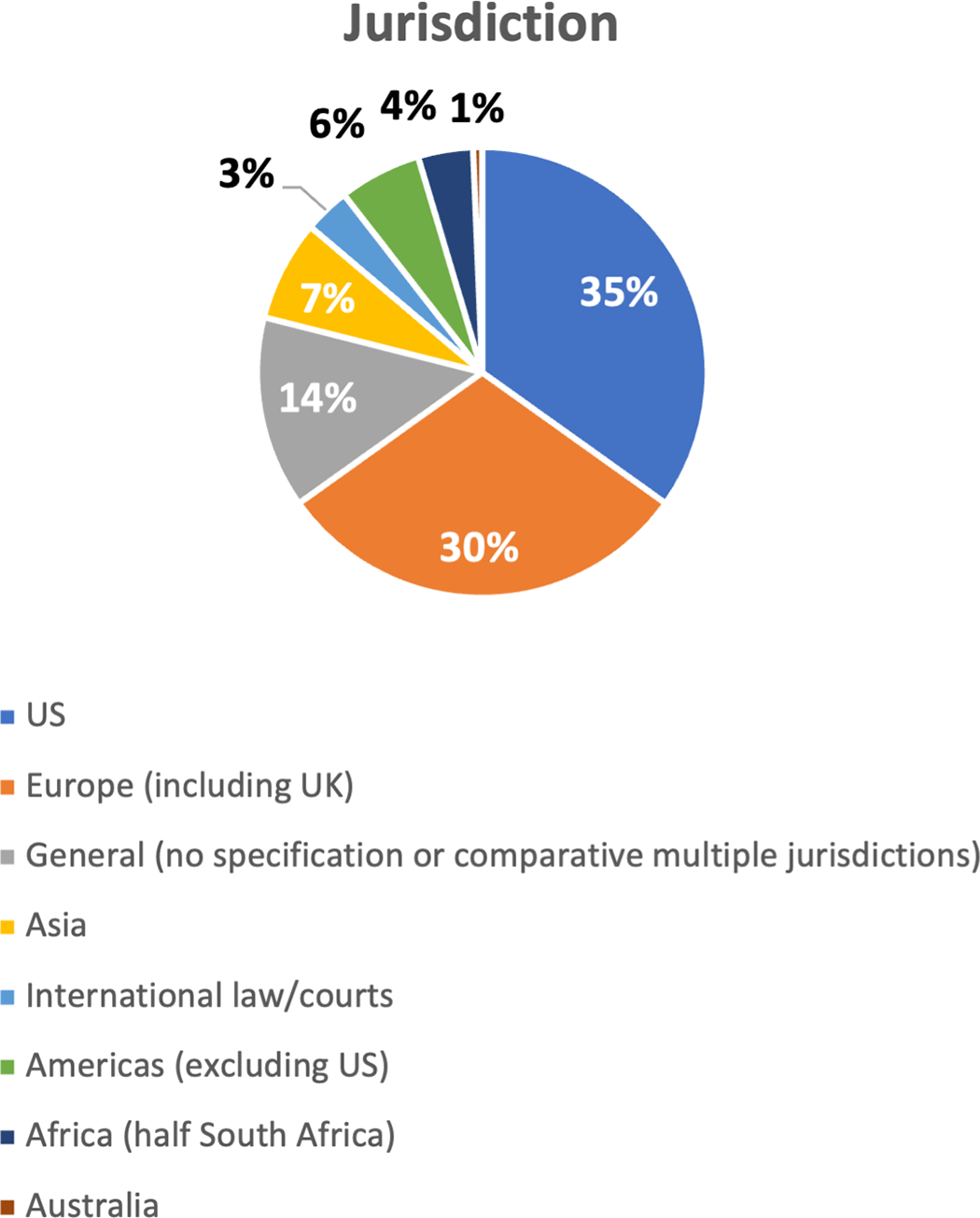
Nowadays, we can observe a true global literature investigating strategic litigation and social change. Research focuses on the international context or individual countries/regions (see Figure 2 for an overview). Examples include sources looking at jurisdictions similar to the United States,Footnote 30 research on authoritarian contexts/illiberal democracies,Footnote 31 and studies relating to new(er) democracies/developing countries.Footnote 32 At the same time, strategic litigation in the United States has also internationalised.Footnote 33 It is noteworthy that especially the Global South is represented in the literature found.Footnote 34 Finally, there is scholarship in individual countries in Europe.Footnote 35 Europe has had its own “rights revolution”Footnote 36 due to the creation of supranational courts (the multi-level system) and fundamental rights at European and international level (alongside national-level bills of rights).Footnote 37 More specifically, the EU has brought in a new level of opportunity structures.Footnote 38 A literature devoted to strategic litigation in the EU has now developed as well.Footnote 39
Jurisdiction.

b. From court- to movement-centred
A second shift can be observed over time, from a focus on courts to a centring of movements. The more recent literature from the United States has moved beyond “mechanistic conceptions” of what strategic litigation can achieve by looking at court cases and outcomes only, but rather focuses on capacities of courts combined with movement action which leads to a degree of influence over longer-term change.Footnote 40 The commencement of this approach lies with McCann, who – as a social scientist – took an interpretivist approach to the study of strategic litigation and social change.Footnote 41 This tradition of research decentres litigation as object of study, but rather looks at law as a “social practice.”Footnote 42 The approach stands somewhat in contrast with the approach taken by Rosenberg, for example, who took the law as an independent variable, whereas researchers – inspired by the “interpretivist” turn – take the law as an interdependent variable.Footnote 43
Cummings has labelled this development the “social movement turn,” a move away from legal liberalism (which centred courts and litigation as drivers of reform), to movement liberalism, with law and litigation embedded in a broader toolkit of movements.Footnote 44 In this “social movement turn,” a link has been made by (United States) sociolegal scholars with the (political science) literature on the reasons why organisations, movements or individuals go to court, as this research focuses on political and legal opportunities as well as organisational resources that shape the (movement and) litigation context.Footnote 45 Subsequently, this has led to a new perspective taken on strategic litigation: as opposed to looking at litigation and social reform in isolation, a broader, holistic perspective is taken, referred to as the legal mobilisation approach.Footnote 46 This approach is process-based (iterative), takes a bottom-up (movement) perspective, looks at litigation in the broader context of strategies and acknowledges the unequal power dimension between lawyers and the movement.Footnote 47 At times, also academia is involved in this movement turn through research and practice of “movement law.”Footnote 48 Not all studies take this legal mobilisation approach; some studies continue to focus narrowly on cause lawyers (or political lawyers), without looking at the movements within which – or outside of which – they are operating.Footnote 49
c. Methodologies: causality and a (European) doctrinal bias
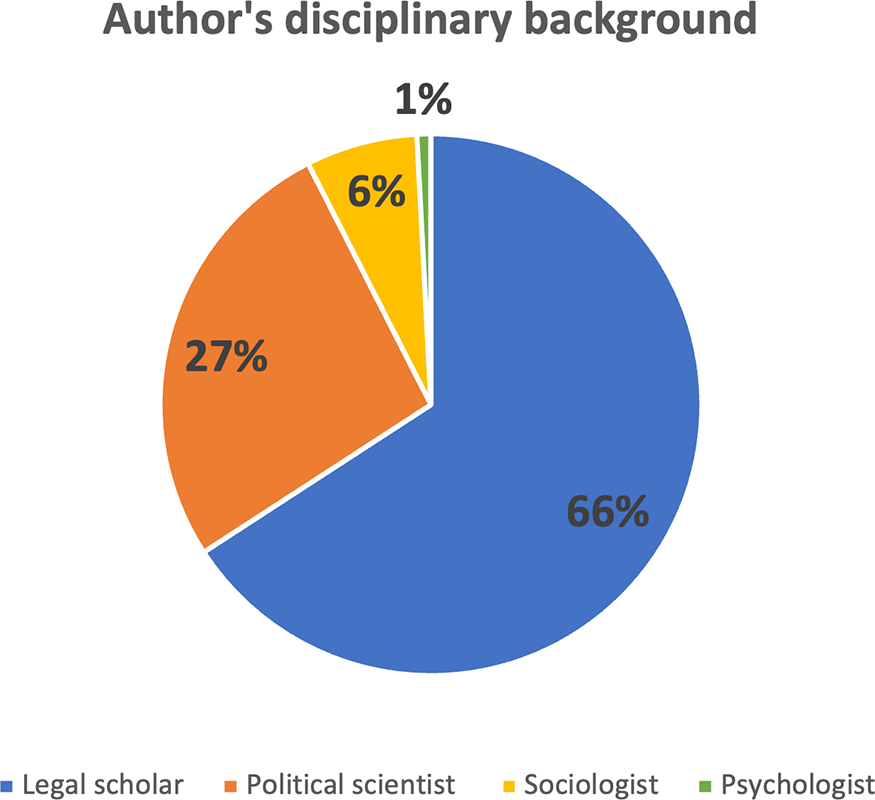
Research on strategic litigation and social change has been carried out by a mix of political scientists, sociologists and (socio-)legal scholars. From the political science field, litigation has been viewed as part of the repertoire or toolbox of CSOs from the 1950s onwards.Footnote 50 Strategic litigation is a tool “beyond conventional use of the legal system”Footnote 51 and academic attention has been paid to the relativity of strategies: why one strategy would be used over another.Footnote 52 In the (socio-)legal field, Galanter’s foundational work investigated why the “haves” come out ahead in litigation (see also 3.2.3 below).Footnote 53 Generally, researchers in this field rely on qualitative data collection and analysis (through interviews with officials, activists etc.), as well as document and doctrinal analysis.Footnote 54 There is only limited quantitative data on the topic available.Footnote 55 The empirical approach (using qualitative/quantitative data) appears necessary to investigate “real-life” societal change– which can only be assessed to a certain extent via other tools. Nevertheless, several works in the international context lack empirical evidence with authors employing (only) a legal-doctrinal analysis.Footnote 56 The evidence presented in such studies is often focused on legal change and wins.Footnote 57 Studies, therefore, often rehash similar (dis)advantages of strategic litigation found in earlier work. For example, one effect often mentioned is that strategic litigation can change public opinion, but these claims are rarely empirically tested.Footnote 58 Thus, many “reflections” on strategic litigation focus on litigation procedures and their immediate legal (and perhaps policy) impact, without the use of a broader – legal mobilisation – perspective on litigation and social change.Footnote 59 Looking at Figure 3, this doctrinal focus could be explained by the large amount of legal scholars writing on the topic.Footnote 60
Author’s disciplinary background.

The claim made in the introduction, that there is a lack of knowledge on the societal effects of strategic litigation in Europe, appears in contradiction with Figure 2. Nevertheless, as Hermansen and Pavone conclude as well, most studies on EU litigation and social change (which they refer to as “downstream effects”) focus on direct effects, i.e., compliance and policy change, whereas research on indirect effects (public opinion, media attention) is lacking.Footnote 61 This finding is echoed by Cebulak, Morvillo & Salomon.Footnote 62 The European literature is thus predominantly doctrinal – as can be explained potentially by the large number of legal scholars writing on the topic.Footnote 63 In the EU, there are (more) distinct legal and political scientific fields of study.Footnote 64 For example, studies on compliance exist in abundance (looking at “judicial Europeanization”), which investigate the effects of European Court of Justice (ECJ) rulings at the domestic level.Footnote 65 A rare example of a study bridging the political and doctrinal gap points to NGOs as decentralised enforcers of EU law, however, these authors themselves state that there is a significant gap in the literature on whether NGOs are successful at this.Footnote 66
A different, methodological trend identified is that sources often pay limited attention to causality.Footnote 67 It is not clearly explained how a certain form of change is causally linked to strategic litigation. Some studies do address this problem, such as the report of the Open Society Justice Initiative, but then fail to explicate how the problem of showing causality has been overcome.Footnote 68 Causality and/or correlation are rarely addressed, the net is instead “cast wide,”Footnote 69 without discussing what implications such an approach has – or how operationalisation takes place. Moreover, many studies use only anecdotal evidence, making it unclear how findings can be translated to a broader context.Footnote 70 Newer comprehensive studies, such as Cummings’ 2021 book, show the complexity of litigation within a broader social movement and in relation to other (political) strategies.Footnote 71 This approach attributes types of social change that have occurred not to litigation or another strategy individually, but more to the myriad of strategies deployed.
d. Conceptualisations of change – potential outcomes
The concept of (social) change, interchangeably used with “impact(s)” or “effect(s),” is often kept vague and broad, with different typologies deployed. This lack of consistency is not necessarily a problem, but conceptualisations often fail to take into account the specificities of legal system and the status quo in that specific area of the law. Three distinct approaches in conceptualising change can be found: (1) a wide range of impacts without classification into categories, (2) categorising different types of change and (3) temporal distinctions. Duffy is an example of the first category: in her book on strategic human rights litigation, she identifies a range of possible (positive) impacts (based on her first-hand experience): victim impact, legal impact, impact on policy & practice, institutional impact, information & truth, social & cultural, mobilisation and empowerment, democracy and rule of law.Footnote 72 This approach can also be found in civil society reports, where there appears to be a bias towards more positive effects.Footnote 73
The second approach consists of two sub-types: the first adhering to broad categories and generic effects,Footnote 74 the second using a categorisation but explicating different examples within the categories.Footnote 75 With regard to the former, a possible conceptualisation is between legal, political and material impact,Footnote 76 or legal effects, socio-economic effects and political effects.Footnote 77 With regard to the latter, a common distinction made is between direct and indirect,Footnote 78 or positive and negative effects of litigation.Footnote 79 Positive effects reported, from a movement-perspective, are putting a certain topic on the political agenda,Footnote 80 creating legal precedent, empowerment, changing public opinion,Footnote 81 leveraging power from opponents, raising expectations among movement constituents, legitimating a movement’s goals through publicity, building organisational resources and mobilising constituents.Footnote 82 NeJaime argues that also strategic litigation loss can have several internal effects (constructing organisational identity and mobilising constituents, building resolve and fundraising) and external effects (appealing to other state actors, appealing to the public).Footnote 83 Albiston, in response to NeJaime, advances that there are additional risks to using litigation to create social change (diverting resources from other strategies, sparking countermobilisation). Moreover, litigation carries the risk to deradicalise and reshape a social movement more in line with the status quo.Footnote 84 These downsides are further reflected on in Section 3.2.1.
Finally, the third approach to conceptualising change is making a temporal distinction. Handler, as one of the first, distinguishes between the (immediate) effect of law reform and the (later) effect of social change.Footnote 85 Gloppen echoes Handler’s approach by differentiating between success in the narrow sense (legal victory), immediate impact (compliance) and systemic impact.Footnote 86 A comprehensive recent study was conducted by Botero, in which she makes a distinction between immediate effects and outcomes.Footnote 87 Immediate effects consist of ideas and discourse, formal norms, organisational changes and resources. Outcomes relate to the effect on the underlying constituency, such as rights realisation (in the long term).Footnote 88 Importantly, Botero combines the concept of compliance (with which she refers to Rosenberg) and the symbolic/ideational effects of litigation in her conceptualisation of impact (more in line with McCann).Footnote 89
e. Policy areas
A range of policy areas is represented in the database: public health, gender equality, marriage equality, indigenous rights, racial discrimination, disability rights, migration, etc. Most of the studies centre on progressive causes; conservative causes are under-represented in the literature found (see Figure 4). Progressive causes are understood here as left-leaning (ideological) social justice aims, whereas conservative causes are understood as right-wing ideological aims. Nevertheless, it should be acknowledged that it is not always a clear-cut distinction: libertarian causes could be classified as either. The classification between the two made in this review was based on the sources themselves: if they spoke of conservative strategic litigation, the source was classified as such.
Policy area.

It is noteworthy that in the European literature, there appears to be more attention for conservative strategic litigation than elsewhere.Footnote 90 Many studies do not focus on a policy area specifically, rather, they are generalist in nature, e.g., human rights focused, jurisdiction focused, etc. There is a clear emphasis in progressive causes on equality (gender, racial, marriage, etc.). Several comprehensive recent works, providing an overview of the state-of-the-art or extensive books on strategic litigation and social change, focus on socio economic rights.Footnote 91 Finally, it is noteworthy that methodologically, not often much consideration is devoted to the specificities of strategic litigation in a certain policy area, whereas this could be an important factor – such as political salience and negative discourse around a constituency.Footnote 92
2. Recurring themes
a. Scepticism and negative effects
Most sources contain a rather sceptic outlook on the use of strategic litigation to create social change. Two early works within this field are illustrative. Scheingold, firstly, spoke of a “myth of rights,” by which he meant American civil society placing excessive faith in courts and legal rights as engines of social change.Footnote 93 In 1991, Rosenberg published his book “The Hollow Hope,” in which he concluded that the famous case of Brown v. Board of Education had not led to any “significant social reform,” based on empirical data about school segregation.Footnote 94 Following up on Rosenberg and Brown, Bell concludes that the litigation suffered from an accountability problem, as lawyers put their own vision and interests above those of their clients and community.Footnote 95 The focus on a fully desegregated school system was, according to Bell, not the right strategy.Footnote 96 Similarly, Neier more generally critiques those litigating for making tactical errors, misreading of public opinion and being overinclusive, meaning the original aims of litigation were not achieved.Footnote 97 There is an overall understanding that without the proper strategy within strategic litigation, it is not possible to achieve the desired aims.Footnote 98 This is not to say that all literature is sceptic. NeJaime, as mentioned above, famously argued that a strategic litigation case does not necessarily have to be won in court in order to create social change (“winning through losing”).Footnote 99 In the ‘globalization’ turn, there appears to be a more positive outlook on strategic litigation as a tool to create social change.
Next to scepticism, there are also specific significant downsides that are highlighted by several authors. One of these is backlash: using strategic litigation can backfire and create a more negative socio-political environment on the topic of the litigation.Footnote 100 Even beyond that, Cummings emphasises that not only backlash, but also countermobilisation can ensue when strategic litigation is pursued.Footnote 101 In the United States, the rise of the conservative movement has been explained as flowing from successful strategic litigation by progressive actors.Footnote 102 A specific downside to strategic litigation is that individuals or separate organisations can influence the agenda of a movement by starting litigation on their own motion – whereas other initiatives such as legislative influence require co-optation and organising.Footnote 103 This is referred to as the legal mobilisation dilemma.Footnote 104
b. Preconditions for advantageous use
i. Embeddedness in a broader campaign
Despite the wide range of policy areas and jurisdictions represented in the literature sample, a red thread in necessary preconditions for the use of strategic litigation to create social change can be found. One of these is embeddedness of litigation in a broader socio-political campaign.Footnote 105 Thus, litigation – according to these authors – needs to be included in broader advocacy efforts, including collaboration with community groups, legislative and administrative strategies and grassroots organising.Footnote 106 If used effectively, litigation is a political tool that can complement other efforts. Whether litigation achieves its aims is relative to other tools available and it is necessary to examine the political, economic, cultural and organisational conditions within which a lawsuit operates in order to identify change.Footnote 107 The embeddedness of the tool means that civil society has a role to play before, during and after the procedure. Especially the period after a case has been decided, involving the implementation and enforcement of a judgment, is regarded as critical in order to achieve social change.Footnote 108 Cummings shows that enforcement failures, resistance and co-optation are not unique to litigation but are inherent to all tools aimed at redistributive social change.Footnote 109 While litigation can be effective in some contexts, it regularly fails (similar to legislation, regulation and contracts) at the implementation stage due to complex systems and powerful opposition, making enforcement gaps the norm rather than the exception. For strategic litigants, litigation is therefore treated as a tactical component, deliberately integrated with organising, public pressure and other advocacy strategies rather than pursued as a standalone solution.Footnote 110 Finally, several authors stress the importance of aiming for incremental change with strategic litigation, as opposed to sweeping reform.Footnote 111
ii. Public opinion/political support
A second precondition that appears is favourable public opinion and/or political support for the underlying cause. This precondition is conceptualised in various ways. Epp, for example, speaks of a “culture and rights consciousness” favourable to the aims pursued.Footnote 112 Rosenberg argues that political and public support is required to enable courts to produce social reform.Footnote 113 In the United States context, he claims that what is needed is support for change from Congress and the executive, as well as support from some citizens – or at least low levels of opposition from all citizens.Footnote 114 This requirement is also described as “societal momentum.”Footnote 115 Other studies are more clear-cut, stating that administrative enforcement and cultural change are required to have impact with court victories, which by themselves are merely symbolic.Footnote 116 It is noteworthy that this precondition is sometimes conflated with judicial attitudes, the latter dependent (according to some) on public opinion/cultural attitude.Footnote 117
iii. Strong legal framework
A third precondition that can be found in many works is a strong (constitutional) legal framework. Some speak of the necessity of an enforceable bill of rights,Footnote 118 a constitutional framework,Footnote 119 or an existing rights frameworkFootnote 120 – whether that be national or international.Footnote 121 Rosenberg argued the opposite, by stating that the US Constitution has limited constitutional rights, however, this can be remedied according to him if there is ample legal precedent for change.Footnote 122 There are also authors who incorporate a strong legal framework in a broader framing, by speaking of institutional opportunities, or new judicial avenues or laws.Footnote 123 Finally, there is literature on mobilisation of the law that refers to the notion “legal opportunity (structure)” – referring to (among others) standing rules and substantive rights.Footnote 124 In Europe specifically, as alluded to above, the creation of new laws at EU level has given legal arguments to civil society to use in strategic litigation.Footnote 125 When EU law is not always implemented effectively at national level, as is often the case, there is the CJEU as an additional legal avenue.Footnote 126
iv. Role of the judiciary
The fourth precondition that is repeated throughout the literature is the role of the judiciary. In principle, courts often only have limited ability to structurally make changes in society, especially when litigation is not paired with a push for political and institutional change.Footnote 127 Nevertheless, due to the institutional legitimacy of courts (who can establish authoritative legal norms), there is a degree of influence over longer-term change.Footnote 128 In order for this to be the case, it is important that the judiciary is independentFootnote 129 and has power to review all cases.Footnote 130 A favourable judicial environment entails judges who take judicial leadership and have docket control,Footnote 131 plus who are willing to take on cases on politically sensitive matters.Footnote 132 In some jurisdictions, such as India, courts have more far-reaching powers (imposing structural remedies and continuing jurisdiction over cases), leading to an even more favourable environment for strategic litigation, in theory.Footnote 133
v. Resources
The final persistent precondition in the literature sample revolves around resources in the broadest sense of the word. Already in 1974, Galanter’s foundational work investigated why the “haves” (i.e., those with resources) come out ahead in litigation.Footnote 134 He described how repeat-players, repetitively involved in litigation, enjoy structural advantages to shape legal outcomes beyond individual cases, due to greater resources, more experienced legal counsel, being able to play the long game and influencing precedent.Footnote 135 One-shotters, on the other hand, don’t have these advantages and are limited in their ability to win cases. His findings are repeated in the later literature on law and social change. Litigation is an expensive strategy, taking away resources from potentially other strategies. Many authors identify well-resourced advocacy organisations (including skilled lawyers) as vital why strategic litigation in their respective studies has achieved its aims – or could be able to.Footnote 136 Epp spoke of a “support structure” necessary to support strategic litigation efforts.Footnote 137 There are even studies that statistically show a higher chance of winning a case if the litigant is well-resourced.Footnote 138 Although the public interest sector has professionalised in many countries,Footnote 139 money is often provided in ad hoc structures, whereas there is a need for more structural funding.Footnote 140 Botero builds on these works by stressing the need for “legal density” of a movement: i.e., to what extent there are multiple organisations who collaborate on a certain topic subject to strategic litigation.Footnote 141 Nevertheless, if the legal density of the social movement is too diverse, their aims and approaches do not always align and this can negatively affect impact.Footnote 142 Finally, in the European context, authors have emphasised the importance of specific “Euro-expertise” or Euro-lawyers, entailing (human) resources to provide technical knowledge on EU law.Footnote 143
IV. Conclusion
Backlash against courts indicates that civil society is successful in achieving its aims with strategic litigation. Nevertheless, we have mixed evidence whether strategic litigation has societal impact. By deploying a narrative review, this article has attempted to synthesise the global field of research on litigation and social change.Footnote 144 First, with regard to the main research question, the literature agrees that strategic litigation is rarely a standalone driver of social change. Instead, its contribution is conditional, indirect and made effective through multiple mechanisms: by producing binding legal norms (legal impact), shaping political behaviour (policy impact), influencing discourse and public agendas (discursive impact) and strengthening or mobilising social movements (organisational impact). However, these mechanisms do not operate automatically. Their effectiveness depends on the interaction between litigation and its surrounding environment. In particular, five interrelated conditions recur across the literature: (1) the embeddedness of litigation within broader advocacy strategies, (2) the presence of favourable public or political support (or at least limited resistance), (3) a robust legal framework, (4) a receptive and independent judiciary and (5) adequate resources. Where these conditions are absent, litigation tends to yield primarily symbolic or limited effects and may even provoke backlash or countermobilisation.
Second, regarding the sub-question on methodologies, the field is marked by significant interdisciplinarity but uneven methodological development. While sociolegal and political science scholarship has introduced qualitative, empirical and process-oriented approaches, much of the literature, especially in the European context, remains doctrinal. This doctrinal bias limits the ability to capture broader societal effects. Across disciplines and policy areas, there is a challenge in operationalising and measuring “social change,” as well as in establishing causal links between litigation and observed outcomes. Many studies either rely on anecdotal evidence or possibly conflate correlation with causation. Although more recent scholarship adopts more sophisticated, multi-layered conceptualisations – distinguishing between immediate effects and long-term outcomes – there remains a need for empirical research.
Third, as to the sub-question on policy areas, the literature demonstrates both breadth and imbalance. Research spans a wide range of domains, such as equality, socio-economic rights, migration and public health, but is dominated by progressive causes, with conservative strategic litigation only more recently gaining attention, particularly in Europe. Importantly, the review suggests that impact is not uniform across policy areas. Instead, it varies according to factors such as political salience, societal polarisation and the degree of institutional (political) support. Highly contentious areas (such as migration) appear more prone to backlash and contested implementation, whereas areas with broader societal consensus may allow litigation to translate more readily into policy and practice. Despite these differences, most studies do not systematically account for policy-area-specific dynamics, indicating an avenue for future research.
This narrative review is not able to provide a complete, non-exhaustive overview of the literature, as the field is too vast. Moreover, not every source relates fully to the other. For example, some literature focuses on compliance, whereas others want to highlight effectiveness of court judgments (looking also at the role of civil society).Footnote 145 Moreover, the literature on judges’ ability to act (focusing on judicial independence, rules and procedure, public opinion on courts (legitimacy)) does not speak to the more “subjective” literature deploying the legal mobilisation approach.Footnote 146 Nevertheless, a consistent picture arises from the sources used for this review, which is useful for future research on the topic. Finally, the review underscores an important gap: while Europe features prominently as a site of strategic litigation, knowledge about the broader societal effects of strategic litigation in Europe remains limited, particularly with regard to indirect and long-term impacts. Addressing this gap will require moving beyond doctrinal analysis and embracing interdisciplinary, empirically grounded approaches that can better capture how litigation interacts with politics and society over time.
Competing interests
The author declares none.
Appendix 1: List of sources through database research and snowballing
Found from database research (only research articles and book chapters, book reviews excluded):
Google Scholar (20)
-
1. S Budlender, G Marcus and N Ferreira, Public Interest Litigation And Social Change In South Africa: Strategies, Tactics And Lessons (The Atlantic Philanthropies 2014) <https://www.atlanticphilanthropies.org/wp-content/uploads/2015/12/Public-interest-litigation-and-social-change-in-South-Africa.pdf> accessed 16 April 2026
-
2. S Gloppen, “Public Interest Litigation, Social Rights and Social Policy” Conference Paper 2005 <https://derechoycambiosocial.pbworks.com/f/Gloppen.rev.3[1].pdf> accessed 16 April 2026.
-
3. S Cummings and D Rhode, “Public Interest Litigation: Insights From Theory and Practice” (2009) 36 Fordham Urban Law Journal 603.
-
4. M Langford, “The Impact of Public Interest Litigation: The Case of Socio-Economic Rights” (2021) 27 Australian Journal of Human Rights 505.
-
5. L Vanhala and J Kinghan, Literature Review on the Use and Impact of Litigation (Public Law Project research paper 2018) <https://e9a68owtza6.exactdn.com/wp-content/uploads/2018/05/Public-Law-Project-Literature-review-on-the-use-and-impact-of-litigation.pdf> accessed 16 April 2026.
-
6. C Albiston, “The Dark Side of Litigation As a Social Movement Strategy” (2011) 96 Iowa Law Review Bulletin 61.
-
7. R Rabin, “Lawyers for Social Change: Perspectives on Public Interest Law” (1976) 28 Stanford Law Review 207.
-
8. H Hershkoff and D Hollander, Rights into Action: Public Interest Litigation in the United States, (Many Roads to Justice: The Law-Related Work of Ford Foundation Grantees Around the World 2000) <https://gretchen.law.nyu.edu/fac-chapt/774> accessed 16 April 2026.
-
9. C Losekann, “Typifying the Effects of Litigation in Companies and Social Movements”, (2016) 1 Homa Publica – Revista Internacional de Derechos Humanos y Empresas 1.
-
10. S Buckel, M Pichl and C Vestena, “Legal Struggles: A Social Theory Perspective on Strategic Litigation and Legal Mobilisation” (2024) 33 Social and Legal Studies 21.
-
11. H McCammon and A McGrath, “Litigating Change? Social Movements and the Court System” (2015) 9 Sociology Compass 128.
-
12. A Sarat and S Scheingold (eds), Cause Lawyers and Social Movements (Stanford University Press 2006).Footnote 147
-
13. T Ezer and P Patil, “Strategic Litigation to Advance Public Health” (2018) 20 Health and Human Rights Journal 149.
-
14. S Boutcher and H McCammon, “Social Movements and Litigation” in D Snow, S Soule, H Kriesi and H McCammon (eds), The Wiley Blackwell Companion to Social Movements (John Wiley & Sons Ltd 2019).
-
15. M McCann, “Legal Mobilization and Social Reform Movements: Notes On Theory And Its Applications” in M McCann (ed), Law And Social Movements (Routledge 2016) p 3–32.
-
16. K van der Pas, “Conceptualising Strategic Litigation” (2021) 11 Oñati Socio-Legal Series 116.
-
17. S Ahlhaus, “Strategic Litigation as a Challenge for Deliberative Democracy” (2025 early view) American Journal of Political Science.
-
18. A Bedner and W Berenschot, “Legal Mobilisation and Civil Society: On the Use and Usefulness of Strategic Litigation in Southeast Asia” in E Hansson and M Weiss, Routledge Handbook of Civil and Uncivil Society in Southeast Asia (Routledge 2023) p 81–97.
-
19. T Hondora, “Civil Society Organisations’ Role in the Development of International Law through Strategic Litigation in Challenging Times” (2018) 25 Australian International Law Journal 115.
-
20. P Bouwen and M Mccown, “Lobbying Versus Litigation: Political and Legal Strategies of Interest Representation in the European Union” (2007) 14 Journal of European Public Policy 422.
Heinonline (Full Text, journal articles, number of times cited by articles)Footnote 148 (20)
-
1. M Galanter, “Why the “Haves” Come Out Ahead: Speculations on the Limits of Legal Change” (1974) 9 Law & Society Review 95.
-
2. S Cummings and I Eagly, “A Critical Reflection on Law and Organizing” (2001) 48 UCLA Law Review 443.
-
3. D NeJaime, “Winning Through Losing” (2011) 96 Iowa Law Review 941.
-
4. WN Eskridge Jr., “Channeling: Identity-Based Social Movements and Public Law” (2001) 150 University of Pennsylvania Law Review 419.
-
5. S Cummings, “The Politics of Pro Bono” (2004) 52 UCLA Law Review 1.
-
6. AA Akbar et al., “Movement Law” (2021) 73 Stanford Law Review 821.
-
7. O Lobel, “The Paradox of Extralegal Activism: Critical Legal Consciousness and Transformative Politics” (2007) 120 Harvard Law Review 937.
-
8. T Brown-Nagin, “Elites, Social Movements, and the Law: The Case of Affirmative Action” (2005) 105 Columbia Law Review 1436.
-
9. FB Cross, “The Error of Positive Rights” (2001) 48 UCLA Law Review 857.
-
10. B Stephens, “Translating Filartiga: A Comparative and International Law Analysis of Domestic Remedies for International Human Rights Violations” (2002) 27 Yale Journal of International Law 1.
-
11. S Cummings and D NeJaime, “Lawyering for Marriage Equality” (2010) 57 UCLA Law Review 1235.
-
12. D Rhode, “Public Interest Law: The Movement at Midlife” (2008) 60 Stanford Law Review 2027.
-
13. S Cummings, “Movement Lawyering” (2020) 27 Indiana Journal of Global Legal Studies 87.
-
14. S Cummings, “The Internationalization of Public Interest Law” (2008) 57 Duke Law Journal 891.
-
15. M Diamond, “Community Lawyering: Revisiting the Old Neighborhood” (2000) 32 Columbia Human Rights Law Review 67.
-
16. D NeJaime, “Before Marriage: the Unexplored History of Nonmarital Recognition and Its Relationship to Marriage” (2014) 102 California Law Review 87.
-
17. J Lobel, “Courts as Forums for Protest” (2004) 52 UCLA Law Review 477.
-
18. A Southworth, “Conservative Lawyers and the Contest over the Meaning of Public Interest Law” (2005) 52 UCLA Law Review 1223.
-
19. LB Nielsen et al., “Individual Justice or Collective Legal Mobilization – Employment Discrimination Litigation in the Post Civil Rights United States” (2010) 7 Journal of Empirical Legal Studies 175.
-
20. SM Ashar, “Movement Lawyers in the Fight for Immigrant Rights”, (2017) 64 UCLA Law Review 1464.
Westlaw (20) (in “International Materials”).
-
1. P Cebulak, “Mapping the Potentials and Pitfalls of Using European Law for Strategic Litigation Against Illiberal Reforms” (2024) 20 International Journal of Law in Context 379.
-
2. G Cliquennois, S Chapter and B Champetier, “How Conservative Groups Fight Liberal Values and Try to ‘Moralize’ the European Court of Human Rights” (2024) 20 International Journal of Law in Context 360.
-
3. D Anagnostou and S Millns, “Gender Equality, Legal Mobilization, and Feminism in a Multilevel European System” (2013) 28 Canadian Journal of Law and Society 115.
-
4. J Atiles, “Enacting Transparency: Activist-Scholarship and the Legal Mobilisations for the Right to Access Information in Puerto Rico” (2025) 21 International Journal of Law in Context 607.
-
5. J Meakin, “The Opportunity and Limitation of Legal Mobilisation for Social Struggles: A View from the Argentinian Factory Recuperation Movement” (2022) 18 International Journal of Law in Context 196.
-
6. J Gilbert, “Litigating Indigenous Peoples’ Rights in Africa: Potentials, Challenges and Limitations” (2017) 66 International & Comparative Law Quarterly 657.
-
7. G Fuchs, “Strategic Litigation for Gender Equality in the Workplace and Legal Opportunity Structures in Four European Countries” (2013) 28 Canadian Journal of Law & Society 189.
-
8. K Kocemba and M Stambulski, “Populism, Non-State Actors and Right-Wing Legal Mobilization in Europe”, (2024) 20 International Journal of Law in Context 297.
-
9. P Goedde, “Is There a Public Interest Law Movement in South Korea? The Role of People’s Solidarity for Participatory Democracy and Legal Mobilization” (2007) 1 Korea University Law Review 1.
-
10. Z Adams, “Legal Mobilisations, Trade Unions and Radical Social Change: A Case Study of the IWGB” (2023) 52 Industrial Law Journal 560.
-
11. F Gardos-Orosz and Z Szente, “The Role of Populist NGOs in Building a Populist Democracy in Hungary” (2024) 20 International Journal of Law in Context 346.
-
12. F Hualing, “Challenging Authoritarianism Through Law: Potentials and Limit” (2011) 6 National Taiwan University Review 339.
-
13. M Dawson, E Muir and M Claes, “Enforcing the EU’s Rights Revolution: The Case of Equality” (2012) 3 European Human Rights Law Review 276.
-
14. J Goldston, “Race Discrimination in Europe: Problems and Prospects” (1999) 5 European Human Rights Law Review 462.
-
15. K Kong, “Public Interest Litigation in Hong Kong: A New Hope for Social Transformation?” (2009) 28 Civil Justice Quarterly 327.
-
16. M Ramsden, “Strategic Litigation Before The International Court Of Justice: Evaluating Impact in the Campaign for Rohingya Rights” (2022) 20 European Journal Of International Law 441.
-
17. S Deva, “Public Interest Litigation in India: A Critical Review” (2009) 28 Civil Justice Quarterly 19.
-
18. F Mahomed, JE Lord and MA Stein, “Transposing the Convention on the Rights of Persons with Disabilities in Africa: The Role of Disabled Peoples’ Organisations” (2019) African Journal of Comparative and International Law 335.
-
19. A Aziz Khan, “NGOs, the Judiciary and Rights in Bangladesh: Just Another Face of Partisan Politics?” (2012) 1 Cambridge Journal of International and Comparative Law 254.
-
20. D Anagnostou, “Gender Constitutional Reform and Feminist Mobilization in Greece and the EU: from Formal to Substantive Equality?” (2013) 28 Canadian Journal of Law & Society 133.
Found through snowballing (alphabetically ordered):
-
1. K Alter, The New Terrain Of International Law: Courts, Politics, Rights (Princeton University Press 2014).
-
2. D Anagnostou, “Law and Rights’ Claiming on behalf of Minorities in the Multi-level European System” in D Anagnostou (ed), Rights and Courts in Pursuit of Social Change: Legal Mobilisation in the Multi-Level European System (Hart Publishing 2014) p 1–24.
-
3. E Andersen, Out of the Closets and into the Courts: Legal Opportunity Structure and Gay Rights Litigation (University of Michigan Press 2006).
-
4. C Barber, “Tackling the Evaluation Challenge in Human Rights: Assessing the Impact of Strategic Litigation Organisations” (2012) 16 The International Journal of Human Rights 411.
-
5. M Baumgärtel, Demanding Rights: Europe’s Supranational Courts and the Dilemma of Migrant Vulnerability (Cambridge University Press 2019).
-
6. D Bell Jr., “Serving Two Masters: Integration Ideals and Client Interests in School Desegregation Litigation” (1976) 85 Yale Law Journal 470
-
7. D Bell Jr., “The Unintended Lessons In Brown V. Board Of Education” (2005) 49 New York Law School Law Review 1053
-
8. A Bhuwania, “Courting the People: The Rise of Public Interest Litigation in Post-Emergency India” (2014) 34 Comparative Studies of South Asia Africa and the Middle East 314.
-
9. S Botero, Courts that Matter: Activists, Judges, and the Politics of Rights Enforcement (Cambridge University Press 2023).
-
10. J Brickhill, Strategic Litigation in South Africa: Understanding and Evaluating Impact (Dphil Thesis, University of Oxford 2021) <https://ora.ox.ac.uk/objects/uuid:e7be10e6-c511-40b1-8126-df3b3b229b5b> accessed 16 April 2026.
-
11. S Caserta and M Rask Madsen, “When the Sun, the Moon and the Stars Align: Litigating LGBTQIA+ Rights and the Death Penalty in East Africa and the Caribbean” (2024) 35 European Journal of International Law 727.
-
12. P Cebulak, M Morvillo and S Salomon, “Strategic Litigation in EU Law: Who Does it Empower?” (2024) 25 German Law Journal 800.
-
13. R Cichowski, The European Court and Civil Society: Litigation, Mobilization and Governance (Cambridge University Press 2007).
-
14. R Cichowski, “The European Court of Human Rights, Amicus Curiae, and Violence against Women” (2016) 50 Law & Society Review 890.
-
15. L Chua, “Pragmatic Resistance, Law, and Social Movements in Authoritarian States: The Case of Gay Collective Action in Singapore” (2012) 46 Law & Society Review 713.
-
16. L Conant, Justice Contained: Law and Politics in the European Union (Cornell University Press 2002).
-
17. L Conant, A Hofmann, D Soennecken and L Vanhala, “Mobilizing European law” (2018) 25 Journal of European Public Policy 1376.
-
18. C Costello and I Mann, “Border Justice: Migration and Accountability for Human Rights Violations” (2020) 21 German Law Journal 311.
-
19. S Cummings, “The Social Movement Turn In Law” (2018) 43 Law & Social Inquiry 360.
-
20. S Cummings, “Law and Social Movements: Reimagining the Progressive Canon” (2018) 3 Wisconsin Law Review 441.
-
21. S Cummings, An Equal Place: Lawyers in the Struggle for Los Angeles (Oxford University Press 2021).
-
22. A Donald and E Mottershaw, “Evaluating The Impact Of Human Rights Litigation On Policy And Practice: A Case Study Of The UK” (2009) 1 Journal Of Human Rights Practice 33.
-
23. H Duffy, Strategic Human Rights Litigation. Understanding And Maximising Impact (Hart Publishing 2018).
-
24. C Eckes, “Strategic Climate Litigation before National Courts: Can European Union Law be used as a Shield?” (2024) 25 German Law Journal 1022.
-
25. C Epp, The Rights Revolution: Lawyers, Activists, and Supreme Courts in Comparative Perspective (University of Chicago Press 1998).
-
26. C Epp, “Law as an Instrument of Social Reform” in K Whittington, R Kelemen and G Caldeira (eds), The Oxford Handbook of Law and Politics (Oxford University Press 2008) p 595–613.
-
27. R Evans Case and T Givens, “Re-engineering Legal Opportunity Structures in the European Union? The Starting Line Group and the Politics of the Racial Equality Directive” (2010) 48 Journal of Common Market Studies 221.
-
28. G De Fazio, “Legal Opportunity Structure and Social Movement Strategy in Northern Ireland and Southern United States” (2012) 53 International Journal of Comparative Sociology 3.
-
29. D Fjellborg, “Banging on Closed Doors or Beating the Drum? Social Movements’ Interpretations of Opportunities in Legal Appeal Processes” (2025) 24 Social Movement Studies 95.
-
30. E Fokas and D Anagnostou, “The “Radiating Effects” Of The ECtHR On Social Mobilizations Around Religion And Education In Europe: An Analytical Frame” (2019) 12 Politics And Religion 9.
-
31. G Fuchs, “Using Strategic Litigation For Women’s Rights: Political Restrictions In Poland And Achievements Of The Women’s Movement” (2013) 20 European Journal Of Women’s Studies 21.
-
32. V Gauri and D Brinks (eds), Courting Social Justice: Judicial Enforcement of Social and Economic Rights in the Developing World (Cambridge University Press 2008).
-
33. J Goldston, “Public Interest Litigation In Central And Eastern Europe: Roots, Prospects, And Challenges” (2006) 28 Human Rights Quarterly 492.
-
34. R Goldstone and B Ray, “The International Legacy of Brown V. Board Of Education” (2004) 35 McGeorge Law Review 105.
-
35. L Greenhouse and R Siegel, “Before (And After) Roe V. Wade: New Questions About Backlash” (2011) 120 The Yale Law Journal 2028.
-
36. J Handler, Social Movements and the Legal System: A Theory of Law Reform and Social Change (Academic Press 1978).
-
37. J Handmaker and S Taekema, “O lungo Drom: Legal Mobilization as Counterpower” (2023) 15 Journal of Human Rights Practice 6.
-
38. C Harlow and R Rawlings, Pressure Through Law (Routledge 1992).
-
39. A Hatano, “Can Strategic Human Rights Litigation Complement Social Movements: A Case Study of the Movement against Racism and Hate Speech in Japan” (2019) 14 University of Pennsylvania Asian Law Review 228.
-
40. J Hernandez and A Levesque, “Movement Lawyering and the Caring Society Litigation” (2023) 15 Journal of Human Rights Practice 395.
-
41. H Hershkoff, “Public Law Litigation: Lessons and Questions” (2010) 10 Human Rights Review 157.
-
42. H Hershkoff and A Mccutcheon, “Public Interest Litigation: An International Perspective” in M McClymont and S Golub (eds), Many Roads to Justice: The Law Related Work of Ford Foundation Grantees Around The World (The Ford Foundation 2000) p 89–126.
-
43. M Heywood, “South Africa’s Treatment Action Campaign: Combining Law And Social Mobilization to Realize The Right To Health” (2009) 1 Journal Of Human Rights Practice 14.
-
44. C Hilson, “New Social Movements: The Role of Legal Opportunity” (2002) 9 Journal of European Public Policy 238.
-
45. C Hilson, “The Courts and Social Movements: Two Literatures and Two Methodologies” (Mobilizing Ideas, 18 February 2013). <https://mobilizingideas.wordpress.com/2013/02/18/the-courts-and-social-movements-two-literatures-and-two-methodologies/ > accessed 16 April 2026.
-
46. J Hoevenaars, A People’s Court? A Bottom-Up Approach to Litigation before the European Court of Justice, (Eleven Publishing 2018).
-
47. A Hofmann, “The Legal Mobilization of EU Market Freedoms: Strategic Action or Random Noise?” (2025) 48 West European Politics 423.
-
48. A Hofmann and D Naurin, “Explaining interest group litigation in Europe: Evidence from the comparative interest group survey” (2021) 34 Governance 1235.
-
49. L Israël, “Legalise It! The Rising Place of Law in French Sociology” (2013) 9 International Journal of Law in Context 262.
-
50. D Katz and L Bernabei, “Practicing Public Interest Law in a Private Public Interest Law Firm: The Ideal Setting to Challenge The Power” (1994) 96 West Virginia Law Review 293.
-
51. M Klarman, “How Brown Changed Race Relations: The Backlash Thesis” (1994) 81 Journal of American History 81.
-
52. T Keck, “Beyond Backlash: Assessing the Impact of Judicial Decisions on LGBT Rights” (2009) 43 Law & Society Review 151.
-
53. H Kitschelt, “Political Opportunity Structures and Political Protest: Anti-Nuclear Movements in Four Democracies” (1986) 16 British Journal of Political Science 57.
-
54. A Lejeune and J Ringelheim, “Workers With Disabilities Between Legal Changes and Persisting Exclusion: How Contradictory Rights Shape Legal Mobilization” (2019) 53 Law and Society Review 983.
-
55. A Lejeune and J Ringelheim, “The Differential Use of Litigation by NGOs: A Case Study on Antidiscrimination Legal Mobilization in Belgium” (2023) 48 Law & Social Inquiry 1365.
-
56. J Lobel, Success Without Victory: Lost Legal Battles and the Long Road to Justice in America (New York University Press 2004).
-
57. K Loewy, “Lawyering For Social Change” (2000) 27 Fordham Urban Law Journal 1869.
-
58. S Lyder Hermansen and T Pavone, “EU Law Litigation: Who Litigates, Who Influences Judges, What Downstream Effects?” in D Naurin, U Sadl and J Zglinski (eds), Empirical Legal Studies of EU Law (Cambridge University Press 2026).
-
59. T Matthews, “Interrogating the Debates Around Lawfare and Legal Mobilization: A Literature Review” (2023) 15 Journal of Human Rights Practice 24.
-
60. M McCann, Rights at Work: Pay Equity Reform and the Politics of Legal Mobilization (University of Chicago Press 1994).
-
61. M McCann, “Litigation and Legal Mobilization” in K Whittington, R Kelemen and G Caldeira (eds), The Oxford Handbook of Law and Politics (Oxford University Press 2008) p 522–40.
-
62. A Neier, Only Judgment: The Limits of Litigation in Social Change (Wesleyan University Press 1982).
-
63. D NeJaime, “The Legal Mobilization Dilemma” (2012) 61 Emory Law 663.
-
64. E Birchall (ed), Strategic Human Rights Litigation in Australia (The Federation Press 2025).
-
65. Open Society Foundations, Advancing Public Health Through Strategic Litigation: Lessons From Five Countries, 2016 <https://www.opensocietyfoundations.org/uploads/c60a09ac-8877-43d4-a875-6ad3ede223a2/advancing-public-health-through-strategic-litigation-20160622.pdf> accessed 16 April 2026.
-
66. Open Society Foundations, Strategic Litigation Impacts. Insights From Global Experience, 2018 <https://www.justiceinitiative.org/uploads/fd7809e2-bd2b-4f5b-964f-522c7c70e747/strategic-litigation-impacts-insights-20181023.pdf> accessed 16 April 2026.
-
67. Open Society Foundations, Implementing Human Rights Decisions: Reflections, Successes, And New Directions, 2021 <https://www.justiceinitiative.org/uploads/3e398a5e-0b10-4fa4-ba28-275bc909a8f8/implementing-human-rights-decisions-20210721.pdf> accessed 16 April 2026.
-
68. K van der Pas, The ‘Strategy’ in Strategic Litigation: The Why and How of Strategic Litigation by Civil Society Organizations in the Field of Asylum Law in Europe, (Europa Law Publishing 2024).
-
69. V Passalacqua, “Legal Mobilization via Preliminary reference: Insights from the Case of Migrant Rights” (2021) 58 Common Market Law Review 751.
-
70. T Pavone, The Ghostwriters: Lawyers and the Politics behind the Judicial Construction of Europe, (Cambridge University Press 2022).
-
71. A Pijnenburg and K van der Pas, “Strategic Litigation against European Migration Control Policies: The Legal Battleground of the Central Mediterranean Migration Route” (2022) 24 European Journal of Migration and Law 401.
-
72. V Protopapa, “From Legal Mobilization to Effective Migrants’ Rights: The Italian Case” (2020) 26 European Public Law 477.
-
73. K Reiners and E Versluis, “NGOs as New Guardians of the Treaties? Analysing the Effectiveness of NGOs as Decentralised Enforcers of EU Law” (2023) 30 Journal of European Public Policy 1518.
-
74. M Roa and B Klugman, “Considering Strategic Litigation as an Advocacy Tool: A Case Study of the Defence of Reproductive Rights in Colombia” (2014) 22 Reproductive Health Matters 31.
-
75. C Rodríguez-Garavito, “Beyond the Courtroom: The Impact of Judicial Activism on Socioeconomic Rights in Latin America” (2010) 89 Texas Law Review 1669.
-
76. G Rosenberg, The Hollow Hope: Can Courts Bring About Social Change (University of Chicago Press 1991, 1st edn).
-
77. G Rosenberg, The Hollow Hope: Can Courts Bring About Social Change (University of Chicago Press 2008, 2nd edn).
-
78. G Rosenberg, The Hollow Hope: Can Courts Bring About Social Change (University of Chicago Press 2023, 3rd edn).
-
79. G Rosenberg, “Courts as Agents of Change” in L Epstein, G Grendstad, U Sadl and K Weinshall (eds), Oxford Handbook of Comparative Judicial Behaviour, (Oxford University Press 2023) p 869–92.
-
80. A Sarat and S Scheingold (eds), Something to Believe in: Politics, Professionalism, and Cause Lawyering (Stanford University Press 2004).
-
81. S Scheingold, The Politics Of Rights: Lawyers, Public Policy and Political Change (University of Michigan Press 1974, 1st edn).
-
82. S Scheingold, The Politics of Rights: Lawyers, Public Policy and Political Change, (University of Michigan Press 2004, 2nd edn).
-
83. B Simmons, Mobilizing for Human Rights: International Law in Domestic Politics (Cambridge University Press 2012).
-
84. T Stoddard, “Bleeding Heart: Reflections on Using the Law to Make Social Change” (1997) 72 New York University Law Review 967.
-
85. M Tankard and E Paluck, “The Effect of a Supreme Court Decision Regarding Gay Marriage on Social Norms and Personal Attitudes” (2017) 28 Psychological Science 1334.
-
86. S Teles, The Rise of the Conservative Legal Movement (Princeton University Press 2008).
-
87. L Vanhala, Making Rights a Reality? Disability Rights Activists and Legal Mobilization (Cambridge University Press 2011).
-
88. L Vanhala, “Is Legal Mobilization for the Birds? Legal Opportunity Structures and Environmental Nongovernmental Organizations in the United Kingdom, France, Finland, and Italy” (2018) 51 Comparative Political Studies 380.
-
89. L Vanhala, S Lambe and R Knowles, “‘Let Us Learn’: Legal Mobilization for the Rights of Young Migrants to Access Student Loans in the UK” (2018) 10 Journal of Human Rights Practice 439.
-
90. C Vose, “Litigation as a Form of Pressure Group Activity” (1958) 319 The Annals of the American Academy of Political and Social Science 20.
-
91. B Wilson and J Rodríguez Cordero, “Legal Opportunity Structures and Social Movements” (2006) 39 Comparative Political Studies 325.



 Open access

