INTRODUCTION
Depression is a serious psychological problem in palliative care, affecting nearly 15% of terminally ill patients (Hotopf et al., Reference Hotopf, Chidgey, Addington-Hall and Ly2002). Clinicians often lack the knowledge and skills to identify psychological issues such as depression in this patient population (Block, Reference Block2000). In frail and fatigued patients, typical of those found in the palliative care setting, screening tools need to be brief and acceptable.
Research on brief screening tools for depression in palliative care has attracted wide interest. Mahoney et al. (Reference Mahoney, Drinka, Abler, Gunter-Hunt, Matthews, Gravenstein and Carnes1994), for example, showed that a single-item interview for depression was as accurate as the Geriatric Depression Scale in detecting depression in older adults in palliative care. Chochinov et al. (Reference Chochinov, Wilson, Enns and Lander1997) found that the single question, ‘‘Are you depressed?’’ successfully screened for depression in 197 patients receiving palliative care for advanced cancer, with 100% sensitivity, specificity, negative and positive predictive value compared with a score of four or greater on the Structured Interview Assessment of Symptoms and Concerns (SISC). A United Kingdom study was unable to replicate perfect sensitivity and specificity for this single item screening approach, although methodological variation between the two studies may have accounted for these differences (Lloyd-Williams et al., Reference Lloyd-Williams, Dennis, Taylor and Baker2003). Other authors (Bayés et al., Reference Bayés, Limonero, Barreto and Comas1997; Julião et al., Reference Julião, Oliveira, Nunes and Barbosa2013a) developed screening instruments based on time and life perception and its relation with depression, although such tools are still far from being clinically useful.
Despite all the research efforts, researchers continue to study the efficacy and characteristics of brief screening tools for depression in patients with advanced diseases.
This study was designed to examine a brief screening instrument for depression within 100 terminally-ill outpatients being cared for in palliative care at the Champalimaud Clinical Center (CCC) in Lisbon. Within these patients, we sought to compare the single Portuguese question for depression “Está deprimido?” (“Are you depressed?”) and the HADS depression sub-scale (HADS-d), using a score ≥11 on the latter as the gold standard (Pais-Ribeiro et al., Reference Pais-Ribeiro, Silva, Ferreira, Martins, Meneses and Baltar2007) for clinically significant depressive symptoms.
METHODS
All outpatients answered the single question as well as the HADS as part of a battery of psychometrics administered to each patient prior to every palliative medicine consultation at the CCC. HADS is a screening tool for depressive symptoms, although used as a gold-standard in this study. The data concerning patients was collected retrospectively from medical records, from March 2013 to April 2014. Each battery of psychometrics is anonymous, having a serial number attached to each patient medical record. Ethical approval was obtained from the CCC Ethics Committee. Statistical analysis was done using SPSS 20.0 (Lisboa, Portugal).
RESULTS
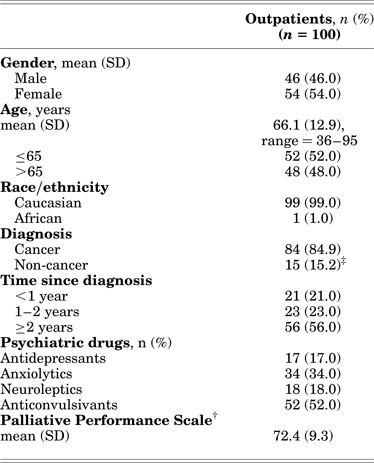
One hundred patient's records were obtained from 100 different individuals. Response rate for the single Portuguese question for depression was 100%. Prevalence of depression symptoms (HADS-d ≥ 11) was 43%. Summary demographic and illness data are presented in Table 1. Table 2 shows the screening performance of the single Portuguese question “Está Deprimido?” compared with the HADS-d ≥ 11 as the gold standard. Sensitivity, specificity, positive predictive and negative values were calculated (also in Table 2).
Summary characteristics of patients

* Based on medical records or patients information.
† Palliative Performance Scale: 100% – healthy; 0% – death.
‡ Missing data (1 patient).
Screening performance for depression symptoms of the single Portuguese question for depression “Está deprimido?” compared with HADS-d ≥11, in 100 terminally-ill outpatients
HADS-d, Hospital Anxiety & Depression Scale – depression sub-scale; NPV, negative predictive value; PPV, positive predictive value.
*Are you depressed?
To the question “Está deprimido?” 60 patients responded “yes.” Sixteen patients who replied “no” to the single question had clinically significant depressive symptoms based on the HADS-d.
DISCUSSION
Various attempts have been made to develop brief screening approaches for depression in the terminally ill (Chochinov et al., Reference Chochinov, Wilson, Enns and Lander1997) in different palliative care settings around the world, including European countries. This is the first preliminary retrospective Portuguese study of the single question for depression in terminally ill individuals, although it has shown poor screening properties. The present study, while performed in a small sample of patients cared for in a palliative care setting, provides new insight on a new potential screening tool for depression in Portuguese terminally ill. To date, such a brief tool has been lacking in daily Portuguese palliative care practice.
Our results are similar and consistent to those already published by other authors about the properties and clinical applicability of a single question for depression applied in other patientś cohorts, after the seminal work of Chochinov et al. (Reference Chochinov, Wilson, Enns and Lander1997). Our single item question didn't perform as well as the results presented by Chochinov et al. (Reference Chochinov, Wilson, Enns and Lander1997). Perhaps this difference might be due to two main reasons: the first one, using a high severity threshold of four or greater on SISC (equivalent to “depressed most of the time”) might have improved results; and finally, using a semi-structured interview like SISC, could have allowed patients to be asked about depression in a more reflexive way and a determination made on its severity could have yielded more favorable results. Some differences may also be rooted in the concept of what it means to be depressed in different countries and cultures. This suggests that cultural perceptions on depression may be required prior to widespread uptake of such instruments in screening for depressive symptoms in palliative care. Future research on this particular aspect will be undertaken in Portuguese terminally ill.
Some other issues require further consideration. First, the high prevalence of depression symptoms found in this patientś cohort, higher than found in the literature and consisted with previously Portuguese published research (Julião et al., Reference Julião, Barbosa, Oliveira, Nunes and Vaz Carneiro2013b; Reference Julião, Oliveira, Nunes, Vaz Carneiro and Barbosa2014). We are aware that this high prevalence likely strengthened the screening properties of the single Portuguese question for depression.
Finally, the authors think this should be presented as a negative study demonstrating poor performance of the single Portuguese item depression screening. The single Portuguese question for depression achieved low sensitivity and specificity values, although relevant for clinical practice and research.
At this point with the available Portuguese data, we think our preliminary findings show that the single Portuguese question does not perform sufficiently well to be used as a screening tool alone, although it could help clinicians to carefully identify those patients having depression as well as to identify those individuals having no depressive symptoms. Therefore, future research in larger and mixed patientś samples of Portuguese terminally ill is necessary to find more accurate properties of this brief tool in different cohorts. We think future multicentric research using similar cultural samples of patients is warranted.
ACKNOWLEDGMENTS
MJ and AB were responsible for the conception and design. MJ was responsible for supervising the study, analyzing the data and writing the initial draft and final report. MAS, DD and II helped with the data collection. BN supervised the data statistical analysis. AB and BN helped with the revising of the final report. All co-authors helped revise the final manuscript and had full access to all of the data. We would also like to acknowledge Professor Harvey Max Chochinov for his guidance and wisdom throughout the study and revisions of the manuscript.