Ruminant digestive physiology has been widely studied because information about forestomach motility can be used as an overall indicator of cattle health (Grünberg and Constable, Reference Grünberg, Constable, Anderson, Rings and Abrahamsen2009). The forestomach motility largely depends on the contractions of the first two forestomachs of cattle: the reticulum and the rumen, also referred to as the reticulorumen (Grünberg and Constable, Reference Grünberg, Constable, Anderson, Rings and Abrahamsen2009). There are three main reticuloruminal contraction patterns: primary, secondary and rumination (Beauchemin, Reference Beauchemin2018). Primary contractions are responsible for mixing the ingesta, and begin with the reticulum's biphasic contraction to subsequently involve the rumen in a craniocaudal order (Foster, Reference Foster2017). Secondary contractions are associated with the eructation process and occur independently of the primary contractions (Foster, Reference Foster2017). Rumination refers to the process in which a bolus of ingesta is regurgitated from the reticulorumen, re-masticated, re-insalivated and finally re-swallowed (Beauchemin, Reference Beauchemin2018). An additional reticular contraction preceding the normal biphasic contraction of the reticulum is necessary for rumination to proceed (Beauchemin, Reference Beauchemin2018). For this reason, the term reticuloruminal contraction rate (RRCR) refers to the complete reticuloruminal contraction cycle, including the biphasic contractions occurring in the primary cycle and the extra-reticular contractions occurring during rumination (Sellers and Stevens, Reference Sellers and Stevens1966). The RRCR transiently increases in frequency and amplitude during eating (Balch, Reference Balch1952; Ruckebusch, Reference Ruckebusch and Church1993), and decreases during rumination and recumbency (Sellers and Stevens, Reference Sellers and Stevens1966). Lactating dairy cows spend about 7 h/d ruminating (range: 2.5–10.5 h/d), 4.5 h/d eating (range: 2.4–8.5 h/d) (Beauchemin, Reference Beauchemin2018). Dairy cows with unrestricted feed access tend to spend less time eating, and they ruminate for a longer period (Beauchemin, Reference Beauchemin2018).
RRCR can be assessed by measuring the frequency of contractions (number of contractions per unit of time) or intercontraction interval (ICI – time unit divided by the number of contractions). The ICI averages 40–60 s for the primary contractions and 120 s for the secondary contractions (Grünberg and Constable, Reference Grünberg, Constable, Anderson, Rings and Abrahamsen2009). Methods for measuring the RRCR are classified as either invasive or non-invasive, depending on whether surgery is required to apply the measuring device (Braun and Rauch, Reference Braun and Rauch2008; Han et al., Reference Han, Kaur, Bai, dos Reis, White, Nawrocki, Voyles, Kang and Priya2022). Invasive methods include electrodes applied in the forestomach to measure electrical activity (Plaza et al., Reference Plaza, Arruebo, Sopena, Bonafonte and Murillo1996; Wierzbicka et al., Reference Wierzbicka, Domino, Zabielski and Gajewski2021) and placement within the reticulum of air- or water-filled pressure devices (Holtenius et al., Reference Holtenius, Jacobsson and Jonson1971; Egert-McLean et al., Reference Egert-McLean, Sama, Klotz, McLeod, Kristensen and Harmon2019; Scheurwater et al., Reference Scheurwater, Hostens, Nielen, Heesterbeek, Schot, van Hoeij and Aardema2021). Non-invasive methods include ultrasonography and indwelling reticuloruminal boluses, which directly measure reticular movement; less direct non-invasive methods include clinical examination, auscultation and palpation of the paralumbar fossae; however, they cannot differentiate between primary and secondary cycles (Grünberg and Constable, Reference Grünberg, Constable, Anderson, Rings and Abrahamsen2009).
Previous experimental studies have used prototype indwelling boluses to measure the temperature, pH, ICI, and contraction amplitude of the reticular motility of cows on various diets (Cantor et al., Reference Cantor, Costa and Bewley2018; Arai et al., Reference Arai, Okada, Sawada, Takahashi, Kimura and Itoh2019; Hamilton et al., Reference Hamilton, Davison, Tachtatzis, Andonovic, Michie, Ferguson, Somerville and Jonsson2019; Francesio et al., Reference Francesio, Viora, Denwood, Tulley, Brady, Hastie, Hamilton, Davison, Michie and Jonsson2020), and to assess the effects of xylazine and atropine (Choi et al., Reference Choi, Ro, Hong, Ahn, Kim, Choi, Kim and Kim2020). Similarly, neck collars mounted with accelerometers have been widely used to assess the amount and proportion of time spent ruminating (Konka et al., Reference Konka, Michie and Andonovic2014; Iqbal et al., Reference Iqbal, Draganova, Morel and Morris2021; Pavlovic et al., Reference Pavlovic, Czerkawski, Davison, Marko, Michie, Atkinson, Crnojevic, Andonovic, Rajovic, Kvascev and Tachtatzis2022). In a recent study conducted in the Netherlands, 5 years of data were collected using neck collars equipped with triaxial accelerometers (Nedap, Groenlo, The Netherlands), demonstrating a distinct diurnal pattern for time spent ruminating (Hut et al., Reference Hut, Mulder, van den Broek, Hulsen, Hooijer, Stassen, van Eerdenburg and Nielen2019). To the best of our knowledge, no reports have described and characterised the pattern and type of RRCR using a commercial indwelling accelerometer bolus (Han et al., Reference Han, Kaur, Bai, dos Reis, White, Nawrocki, Voyles, Kang and Priya2022). The three objectives of this study were firstly to determine whether the indwelling bolus provided observations which were consistent with RRCR as determined by clinical examination using auscultation and ultrasound, secondly to compare estimates of time spent ruminating using the indwelling bolus and a collar-based accelerometer and finally to describe the diurnal pattern of RRCR using the indwelling bolus data.
Materials and methods
Animals and experimental procedures
The data were obtained from six rumen-fistulated, adult, non-lactating, non-pregnant Jersey cows aged between 6 and 12 years, on the University of Glasgow research unit (Cochno farm) for 14 d in June 2021, with approval under Home Office Project Licence PP7153972. The cows were 623.5 ± 31.15 kg (mean ± standard deviation). A full clinical assessment of the animals was performed 2 d before the experiment, and no abnormalities were detected in any of the cows. Cattle remained healthy throughout the trial, with no abnormalities. Rumen fistula surgery was performed some years before the present study (2019 for 2 cows and 2013 for 4 cows). Cows were housed together in a single straw-bedded pen (~100 m2) throughout the study. The total feed fence and water trough lengths were 9 and 1.1 m, respectively. No other animals were housed in the shed during the study period. Hay and water were offered ad libitum throughout the study; hay was replenished daily at 7.30–8.00 and 15.45–16.00. The hay was introduced 6 weeks before the trial to stabilise the RRCR, flora and pH (Sellers and Stevens, Reference Sellers and Stevens1966). Feed analysis was outsourced to an external laboratory (SRUC, Veterinary and Analytical Services, Pentlands Science Park Bush Loan, Penicuik, Midlothian, EH26 0PZ, UK) (detailed in online Supplementary Table S1).
Two devices each equipped with a tri-axial accelerometer – an indwelling reticuloruminal bolus (SmaXtec Animal Care GmbH, Graz, Austria), and a neck collar (Silent Herdsman, Afimilk Ltd. Kibbutz Afikim, Israel) – were applied to the six cows. Collars were fitted to cows 6 weeks before the study period and boluses were inserted by a trained technician through the rumen fistulae directly into the reticulum 3 d before starting the study. Cows were individually moved into a crush next to their pen for auscultation and ultrasound examination. The ultrasonographic examination was performed as previously described (Braun and Schweizer, Reference Braun and Schweizer2015). The sternal region was clipped and contact gel was applied; the ultrasonography was performed using a convex 3.5 MHz probe (CTS-900 V, SIUI, China) placed on the ventral paramedian area of the abdomen, to the left of the caudal projection of the xiphoid (Braun and Schweizer, Reference Braun and Schweizer2015). A contraction was considered to occur when the ventral wall of the reticulum lifted noticeably above the ventral abdominal wall. Simultaneously, a second operator recorded ruminal contractions identified by auscultation of the left paralumbar fossa. The recording period was 10 min/cow and started for both operators when the first RRCR was detected ultrasonographically. The examination was performed twice daily, between 09.00–10.30 and 16 : 30 and 18 : 00 h, for 3 d (Monday, Wednesday, and Friday). The time of sunrise ranged from 04.32 to 04.37 h and sunset from 21.54 to 22.03 h, with average daylight of 17 h/d. During the second week of the study, collars and boluses were left on the animals and there was no clinical examination to prevent any possible perturbation to the normal diurnal pattern of RRCR.
Data collection
Clinical data were initially recorded on pre-printed paper record sheets and subsequently transferred to a spreadsheet (Microsoft Excel, 2020). Accelerometer data were obtained as plain text files from the commercial web-platforms for each technology and additional, pre-summarised data for reticuloruminal motility were provided by smaXtec. In each case, the raw accelerometer data were filtered and transformed by the commercially protected algorithms of the manufacturing company. For collars, hourly summarised time spent rumination (collar rumination time – CRT, min/h), eating (collar eating time – CET, min/h) were acquired. For the boluses, 10 min summarised time spent ruminating (bolus rumination time – BRT, min/h, from the commercial platform), inter-contraction interval (BICI, seconds) and contraction duration (BCD, seconds) summarised every 30–60 s and supplied directly by smaXtec were gathered and were aggregated to the hour for consistency with the collar data. Time-series data from the devices were filtered to two datasets: hourly summarised bolus and collar data for the entire study period and separately, bolus data corresponding with the 10-min periods of the clinical examinations.
Statistical analysis
Summary statistics of the mean, sd, first, and third percentile were calculated for each variable. The inter-contraction interval (ICI) was calculated from the 10 min period of the clinical examination (ultrasound and auscultation) as ICI = 600 s/number of contractions. Statistical analyses were performed using R (R core Team, 2020), using the ‘ggplot’, ‘tidyverse’, ‘lubridate’, and ‘mgcv’ packages. Distributions were checked. Pearson's correlation coefficients were calculated and Bland–Altmann plots were generated to compare clinical examination (ultrasound ICI: USICI and auscultation ICI: AUSCICI) variables with bolus contraction intervals (BICI) and to assess the relationship between the rumination and activity indices from neck collars and boluses. A cyclic generalised additive model (GAM) with cow as fixed effect and smoothed time was fitted using the R function ‘gam’ in the package ‘mcgcv’, with up to 24 knots, to define the effects of hour of day (diurnal pattern).
Results
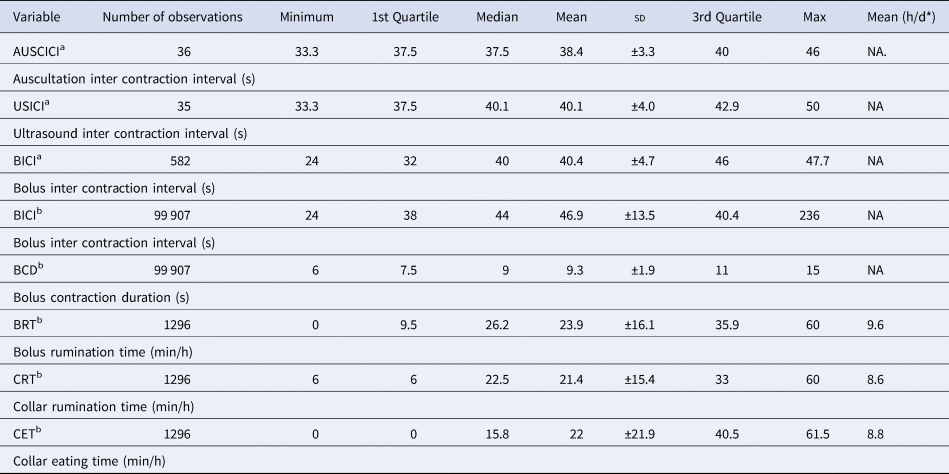
Table 1 lists summary statistics for the two data sets obtained from indwelling reticuloruminal boluses and neck collars. For the hourly collar data, 1296 observations were recorded for the entire study period and 99907 data points were obtained from indwelling boluses. Thirty-six and thirty-five 10-min intervals were measured for AUSC and US, respectively. The mean BICI and USICI were 40.4 ± 4.7 and 40.1 ± 4.0, respectively. For data obtained during the 10 min of clinical examination, the Pearson correlation coefficients (R) for BICI and USICI were 0.55 (95% CI 0.31–0.77; P < 0.001); for AUSCICI and BICI R = 0.40 (95% CI 0.06–0.62; P = 0.018); for AUSCICI and USICI R = 0.69 (95% CI 0.47–0.83; P < 0.001). Polyphasic distributions were observed for BICI and BCD. A zero-inflated distribution was observed for some of the parameters recorded: CRT, CET, BRT.
Summary of the descriptive statistic

a Data were collected during the 10 min of clinical examination.
b Data were collected during the 14 d study period.
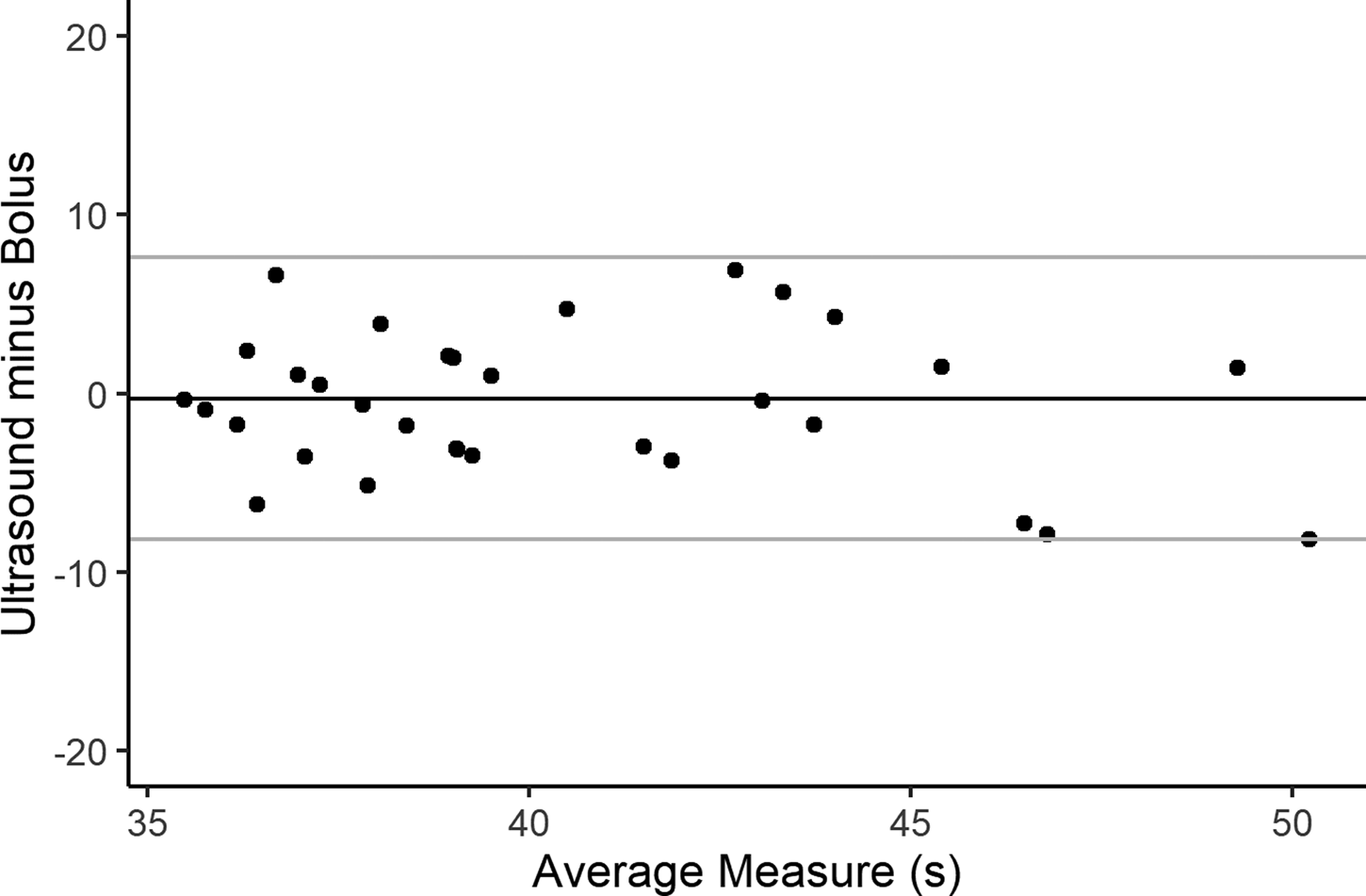
The Bland–Altman plot shows the indwelling reticuloruminal bolus agreement with the ultrasound examination (Fig. 1). Differences between ICI as assessed by ultrasonographic examination and indwelling boluses (USICI – BICI) are plotted against the mean of both estimates. The mean difference (bias) was −0.27 s and the 95% CI for the difference between the observations was −8.2 to 7.6 s. Additional comparisons are given in online Supplementary Fig. S1 (ICI values for individual cows measured during the clinical examination) and Fig. S2 (the same parameters comparing AM and PM time periods).
Bland–Altman plot agreement for indwelling boluses (smaXtec, Austria) and ultrasonography examination in the 10 min observational period. The x-axis shows mean values for bolus and ultrasound ICI, and the y-axis shows the difference in values (seconds) between the USICI and the BICI. The black horizontal line in the middle indicates the mean, and the horizontal grey lines represent the 95% CI.

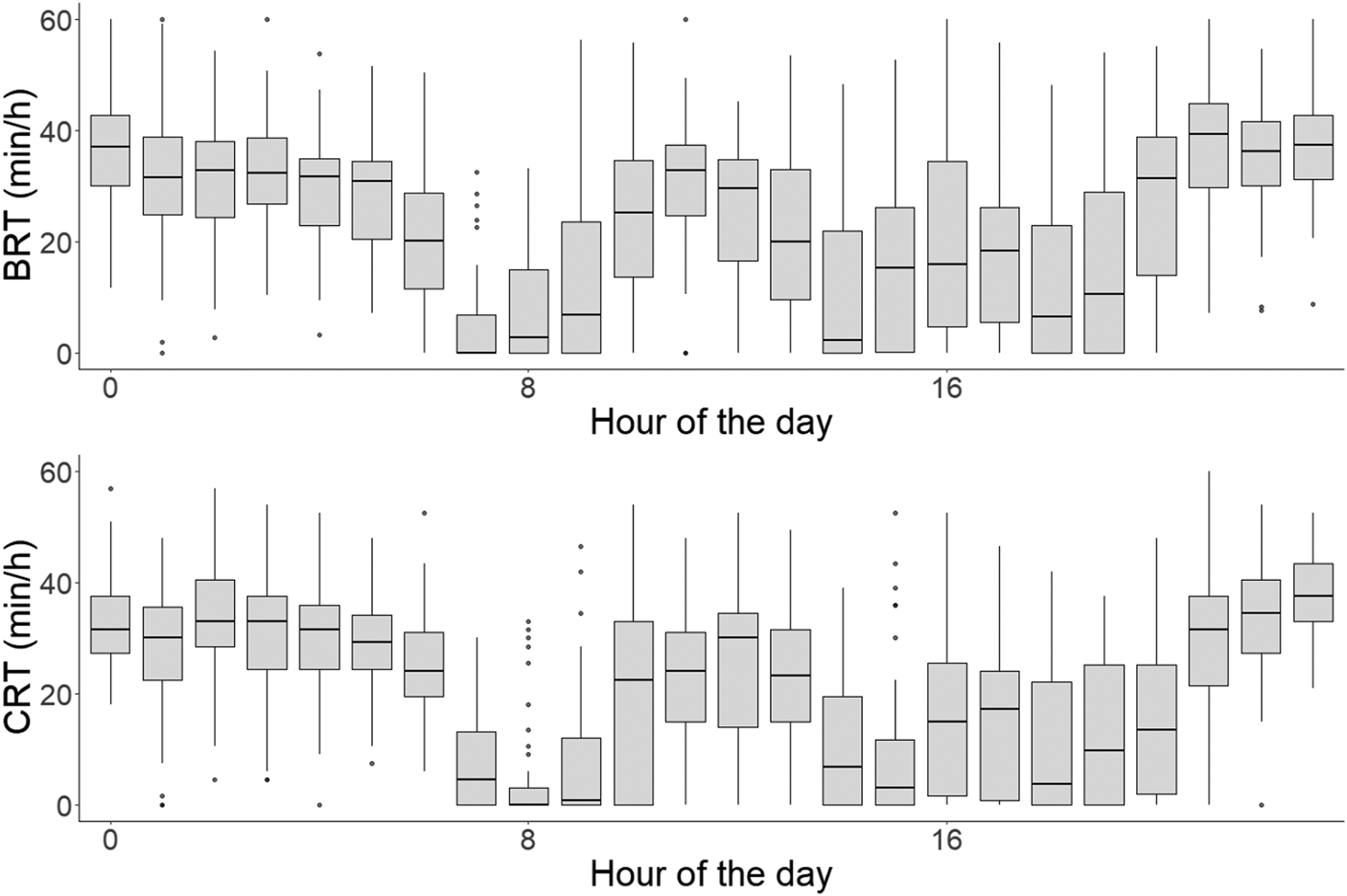
Figure 2 shows CRT and BRT for all the cows in the study period within 24 h. The Pearson correlation coefficient for time spent ruminating between the collar and the bolus was 0.72 (CI 95% 0.69–0.74; P < 0.001). The upper boxplot of Fig. 2 shows the BRT is at the higher end of its range from midnight to early morning, decreases sharply through the morning, then increases in the middle of the day before falling in the afternoon and increasing again late at night. The pattern for BRT appears congruent with that of the CRT. On average, the time spent eating measured by the collar (CET) was 8.8 h/d, and the eating pattern was approximately the inverse of the time spent ruminating (online Supplementary Fig. S3).
Boxplots showing the diurnal pattern of the BRT (upper plot) and the CRT (lower plot), measured in min/h over 24 h. The boxes’ bottoms and tops represent the first and third quartiles; the heavy black horizontal lines represent the median. The whiskers indicate 1.5 times the interquartile range, and the black dots are the outliers.

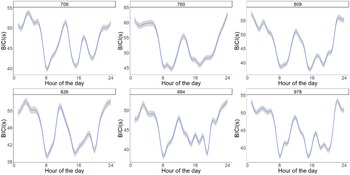
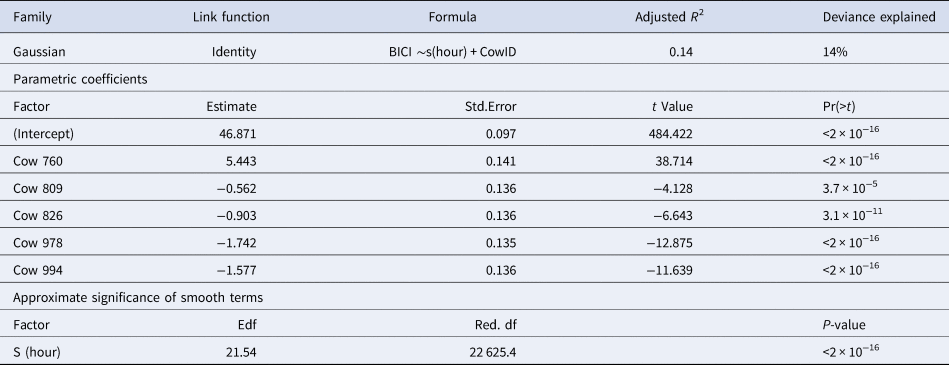
Figure 3 shows the diurnal pattern of reticuloruminal motility measured by the indwelling boluses for each individual cow. A common diurnal pattern can be seen for all the animals. The cyclic GAM is summarised in Table 2: The smoothed effect of time was significant and each cow had a significant effect on BICI. Despite all terms being significant, the model explained only 14% of the variance.
Cyclic generalised additive model (GAM) of the diurnal reticuloruminal inter-contraction interval measured by the indwelling boluses (y-axis) by hour of day (x-axis), for each cow for data from the entire study period.

Cyclic generalised additive model summary table for the bolus inter-contraction interval (BICI)

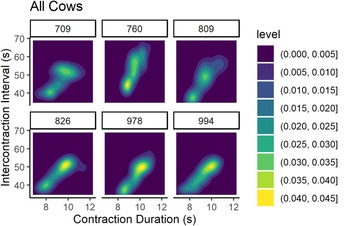
Figure 4 shows the relationship between BICI and BCD. Except for Cow 994, all cows showed two peaks in density, a major peak at contraction duration (CD) ~10 s and ICI ~50–60 s and a minor peak at CD ~8 s and ICI ~40–45 s. Cow 994 showed the same major peak, but the minor peak was less evident.
Density plot of data from the entire study period showing the bolus inter contraction interval (BICI, s) on y-axis and bolus contraction duration (BCD, s) in the x-axis. Each panel shows one of the cows in the study. For each of the cows there seem to be two points of higher density of observations, likely consistent with two distinct types of contraction: one with a relatively shorter contraction duration and period, and one with longer duration and period.

Discussion
We used an indwelling bolus and a neck collar, both equipped with a triaxial accelerometer, to characterise the diurnal pattern of time spent ruminating, and the bolus was also used to measure RRCR. The RRCR data provided by the indwelling boluses were consistent with the ultrasonographic examination, and there was an excellent correspondence between the diurnal patterns of the proportion of time ruminating from the indwelling boluses and the neck collars.
The first objective of our study was to determine whether the indwelling bolus provided observations on RRCR that were consistent with those obtained from clinical examination using auscultation and ultrasound. Although there is no recognised gold standard to measure RRCR, among the non-invasive methods, ultrasonography has been assessed as a valid method to measure the biphasic contractions of the reticulorumen (Braun and Schweizer, Reference Braun and Schweizer2015). Braun and Schweizer (Reference Braun and Schweizer2015) visualised the biphasic reticular and rumen atrium contractions of 45 cows over a 9 min observation period, estimating the CD and counting the number of contractions in this period. The CD of the first reticular, the second reticular and the ruminal atrial contractions were 2.0–3.2 s (2.5 ± 0.32), 4.1–6.7 s (5.3 ± 1.02), and 2.2–7.5 s (5.0 ± 0.83), respectively. The number of contractions in 9 min of examination for the first, second reticular, and rumen atrium contractions were 6–17 (11.0 ± 2.12), 6–17 (11.0 ± 2.12), 6–15 (10.7 ± 2.10), respectively. Calculating an ICI from these data suggests values of 49.1 s for the first and the second reticular contractions and 50.5 s for the ruminal atrial contractions. These results are broadly consistent with our study, in which the ICI measured by the indwelling boluses was ~47 s over the entire study. Two prototypes of accelerometer-based bolus have been described previously (Hamilton et al., Reference Hamilton, Davison, Tachtatzis, Andonovic, Michie, Ferguson, Somerville and Jonsson2019; Francesio et al., Reference Francesio, Viora, Denwood, Tulley, Brady, Hastie, Hamilton, Davison, Michie and Jonsson2020), but only one provided an estimate of ICI of approximately ~51 s (Francesio et al., Reference Francesio, Viora, Denwood, Tulley, Brady, Hastie, Hamilton, Davison, Michie and Jonsson2020), using the same cows as were used in the present study. The indwelling boluses used in our study provided information consistent with our clinical observations and with previous investigations. Regardless of our attempts to standardise the clinical observation period in our study, frequency spectrum resolution inevitably introduces potential for error in our clinical estimates of ICI. We attempted to estimate the period between contractions during a finite window of observation, commencing with the identification of a reticular contraction, and continuing for 600 s, meaning that from about 540 s onward, no contraction would be likely to be followed by another recorded contraction. This would likely lead to something like a 5–10% error in our clinical estimates. Frequency spectrum resolution is not commonly discussed in medical and biological sciences, although it is acknowledged as an issue with remote heart-rate estimation, and computational solutions to the problem are dependent on a larger volume of data than our clinical observations (Pan et al., Reference Pan, Zou and Gu2022).
Regarding the second objective of comparing estimates of time spent ruminating using the indwelling bolus and a collar-based accelerometer, a useful correlation of 0.72 (95% CI 0.69–0.64) was obtained for the time spent ruminating measured by the indwelling boluses and the neck collars, and the patterns of temporal variation were the same. The neck collars (Afimilk Silent Herdsman) were previously shown to identify rumination and eating with a sensitivity of 85%, and an accuracy of 90% (Konka et al., Reference Konka, Michie and Andonovic2014). The diurnal pattern of time spent ruminating measured by the neck collars in our study is consistent with published literature using similar devices: a recent study in the Netherlands evaluated five years of rumination data measured by a neck collar and showed a similar pattern to ours (Hut et al., Reference Hut, Kuiper, Nielen, Hulsen, Stassen and Hostens2022). The time spent ruminating has been extensively studied (Stangaferro et al., Reference Stangaferro, Wijma, Caixeta, Al-Abri and Giordano2016a, Reference Stangaferro, Wijma, Caixeta, Al-Abri and Giordano2016b, Reference Stangaferro, Wijma, Caixeta, Al-Abri and Giordano2016c; Stevenson, Reference Stevenson2022) because variation in time spent ruminating has been associated with subclinical and clinical diseases (Liboreiro et al., Reference Liboreiro, Machado, Silva, Maturana, Nishimura, Brandão, Endres and Chebel2015).
Our third objective was to characterise the diurnal pattern of time spent ruminating, which has previously been evaluated in non-lactating dairy cows with a neck collar (Schirmann et al., Reference Schirmann, Chapinal, Weary, Heuwieser and von Keyserlingk2012). The periods when the proportion of time spent ruminating was highest were between feed deliveries during the day and at night (it was positively associated with lying behaviour: Schirmann et al. Reference Schirmann, Chapinal, Weary, Heuwieser and von Keyserlingk2012). In our study, the indwelling boluses reported similar diurnal patterns of rumination and eating, consistent with the collars, and with previous work. The reticuloruminal motility was also consistent in all six cows. The BICI was shorter in the morning around feeding time, consistent with the literature (Balch, Reference Balch1952; Braun and Rauch, Reference Braun and Rauch2008). Although the hay was offered ad libitum and was replenished twice a day, the influence of this replenishment on the behavioural pattern of reticulorumen contractions cannot be completely ruled out (DeVries et al., Reference DeVries, Von Keyserlingk and Beauchemin2003).
The distributions of CD and ICI were polyphasic, and contour density plots of CD against ICI showed that most cattle had two peaks: a major peak at CD ~10 s and ICI ~50–60 s and a minor peak at CD ~8 s and ICI ~40–45 s. We propose that these two peaks represent different types of contractions. The primary contraction cycle begins with a biphasic contraction of the reticulum, followed by a contraction which passes through the rumen in a craniocaudal direction. During rumination, a reticular contraction precedes the usual bi-phasic contraction (Ruckebusch, Reference Ruckebusch and Church1993). In the study of Braun and Rauch, Reference Braun and Rauch2008, during eating, the ICI was ~39, and the CD ~7.3 s; during resting, the ICI was ~49.5 s, the CD was ~7 s, and during rumination, the CD was 9.4 s, and the ICI is 55 s; comparing our results to this study, the major peaks shown by the indwelling boluses (CD: 10 s, ICI: 50–60 s) appear similar to the rumination peaks of Braun and colleagues, and are consistent with the observations of Gasteiner et al. (Reference Gasteiner, Fasching, Astl and Steinwidder2022). They found that rumination-associated contractions had longer (12 s) CD than feeding-associated contractions (7 s). With regard to the minor peak shown in our study, the CD was ~8 s, and ICI was ~40–45 s, which are consistent with those obtained by Braun and colleagues for the eating and resting behaviour patterns. In a recent study, where the RRCR was measured with water filled open-tipped catheter (Scheurwater et al., Reference Scheurwater, Hostens, Nielen, Heesterbeek, Schot, van Hoeij and Aardema2021), the ICI for rumination was around 48 s, and for eating was 34 s; however, the large variation between the behaviours did not allow classification of the patterns by using a set threshold (Scheurwater et al., Reference Scheurwater, Hostens, Nielen, Heesterbeek, Schot, van Hoeij and Aardema2021).
The value of neck collar-mounted accelerometers has been demonstrated for the detection of changes in rate of rumination over time. Variation in rumination rate from accelerometers has been used to diagnose disease in cattle (Cook et al., Reference Cook, Pepler and Viora2021). Our data show similar performance from an indwelling bolus, using the commercially available data. However, it is possible that there is further potential for the bolus device to be exploited to provide precise indications of the ICI and the CD. With this information, it might be possible to achieve earlier and more consistent diagnosis and characterisation of disease states such as parturient hypocalcaemia. The extent to which the estimates of rumination rate are directly linked to the ICI and CD has not yet been made publicly available, if they have been determined.
In conclusion, we report a consistent characterisation of the diurnal pattern of RRCR using a commercial indwelling bolus, supporting the use of these devices to assess reticuloruminal motility. Further investigation of the relationship between ICI and CD in health and disease should enable early diagnosis of disease conditions using this technology.
Supplementary material
The supplementary material for this article can be found at https://doi.org/10.1017/S0022029923000134.
Acknowledgements
We thank smaXtec for the provision of their non-commercial data for use in the study, and Birgit Großschedl, Michael Astl and Stefan Rosenkranz from smaXtec for technical support with data and equipment, provided without restriction such that the authors declare no conflict of interest in this work. Thanks also to Malcom McColl and all the staff of Cochno farm for animal care. This project was supported by the University of Glasgow School of Veterinary Medicine residency training programme, which is partly funded by Harbro Limited.