Introduction
Neuropsychiatric symptoms (NPS) of dementia refer to a heterogeneous group of disturbances in perception, thought content, mood, personality, behavior, and basic functions (Finkel et al., Reference Finkel, Costa e Silva, Cohen, Miller and Sartorius1996; Gauthier et al., Reference Gauthier2010). NPS occur in 80–90% of patients in the course of Alzheimer's disease (AD) (Robert et al., Reference Robert2005; Gauthier et al., Reference Gauthier2010), and are more distressing for caregivers (Pinquart and Sörensen, Reference Pinquart and Sörensen2003; Torti et al., Reference Torti, Gwyther, Reed, Friedman and Schulman2004) and present far more challenges for disease management than the cognitive and functional decline in dementia (Gauthier et al., Reference Gauthier2010). Considerable attention has been given to the clustering of NPS for the purpose of diagnosis, treatment, and management (McShane, Reference McShane2000; Lyketsos et al., Reference Lyketsos, Steinberg, Tschanz, Norton, Steffens and Breitner2001; Robert et al., Reference Robert2005; Gauthier et al., Reference Gauthier2010). In a recent authoritative review, it has been suggested that clinical trials should identify clusters of symptoms responsive to specific treatment or treatment class (Gauthier et al., Reference Gauthier2010).
Clustering can be made on the basis of clinical observations or empirical investigations with, ideally, support from neurobiological evidence. Empirically, exploratory factor analysis (EFA) has been widely employed on the Neuropsychiatric Inventory (NPI) (Cummings et al., Reference Cummings, Mega, Gray and Rosenberg-Thompson1994; Cummings, Reference Cummings1997) to discover symptoms that are correlated with one another. Most researchers have performed EFA on the ten-item NPI (NPI-10; excluding sleep and appetite disturbances) (Frisoni et al., Reference Frisoni1999; Fuh et al., Reference Fuh, Liu, Mega, Wang and Cummings2001; Garre-Olmo et al., Reference Garre-Olmo, López-Pousa, Vilalta-Franch, de and Bulbena Vilarrasa2010; Spalletta et al., Reference Spalletta2010; Vilalta-Franch et al., Reference Vilalta-Franch2010), whereas others have done the same on the full 12-item version (NPI-12) (Aalten et al., Reference Aalten2003; Gauthier et al., Reference Gauthier, Wirth and Mobius2005; Cummings et al., Reference Cummings, McRae and Zhang2006; Hollingworth et al., Reference Hollingworth2006; Aalten et al., Reference Aalten2007; Kang et al., Reference Kang, Ahn, Kim and Kim2010).
The problems with EFA have been well documented. Statisticians call it a “garbage in, garbage out” procedure (Long, Reference Long1983). In the present context, one important limitation of EFA is that a latent factor (i.e. syndrome) is expressed as the mathematical property of all the observed variables (i.e. NPI items). This being the case, two issues can arise. First, the procedure is very sensitive to the list of variables being subject to analysis; the addition or removal of a variable may lead to rather different results. Therefore, it was not possible to compare the results yielded from factoring 10 versus factoring 12 items. Second, even if a symptom does not belong to a syndrome, it may still load on the factor representing the syndrome due to chance correlations with other relevant symptoms. Indeed, cross-loadings of NPI items on different factors were commonplace and researchers have used some arbitrary or ad hoc criteria (e.g. factor with the highest loading) to determine the final factor structure (also known as the measurement model). Because of the nature of EFA, researchers have failed to come up with a consistent factor structure for the NPI.
An ideal approach is to group the symptoms into theoretical or clinically meaningful entities, and then confirm these theoretical syndromes with confirmatory factor analysis (CFA). CFA allows a priori specification of factor structure and hypothesis testing of the degree to which the theoretical factor structure fits the data. It is therefore a more appropriate procedure for establishing neuropsychiatric syndromes. Two studies have conducted CFA on factor structures identified in EFA (Garre-Olmo et al., Reference Garre-Olmo, López-Pousa, Vilalta-Franch, de and Bulbena Vilarrasa2010; Kang et al., Reference Kang, Ahn, Kim and Kim2010). In a Korean sample, Kang and colleagues (2010) dropped the items euphoria and aberrant motor behavior based on EFA, and proposed a four-factor structure consisting of hyperactivity (agitation/aggression, disinhibition, and irritability), affect (depression and anxiety), psychosis (delusion and hallucination), and apathy/vegetative symptoms (apathy, sleep, and appetite). Nevertheless, this modified structure still failed to show good fit to the data (comparative fit index (CFI) = 0.87 and the Tucker–Lewis index (TLI) = 0.79). Garre-Olmo and colleagues (2010) performed EFA on the NPI-10 across five time points and found different factor structures across time. Based on commonalities across time, they proposed a three-factor structure (psychosis (delusion and hallucination), affect (agitation/aggression, irritability, depression, and anxiety), behavior (euphoria, disinhibition, aberrant motor behavior, and apathy)), which provided good fit to the data (χ2[39] = 44.9, p = 0.24). However, this goodness of fit was achieved at the expense of three correlated errors, one of these was correlation between the error terms of apathy and depression, items that were supposed to load on different factors in their model. The need to accommodate for correlated errors suggests that the latent factors could not account for interrelationships of the items; that is, the three-factor structure actually fit the data poorly. Moreover, their CFA was done on the same EFA sample; however, for CFA to confirm EFA results, the two samples should be independent. Finally, both studies used the maximum likelihood estimation, and although Garre-Olmo and colleagues (2010) had adjusted the χ2 statistic for non-normality using the robust maximum likelihood estimator, it is questionable whether maximum likelihood, even with adjustment, was the appropriate method, given how skewed the data were. In other words, both studies have committed flaws in their CFA procedure, and the factor structure of the NPI is still unclear.
The present study is concerned with syndromes that make “clinical sense” and use these hypothetical syndromes to guide CFA. Building on a recent review (Gauthier et al., Reference Gauthier2010), we propose a five-factor structure and test it in a sample of Chinese persons with AD in Hong Kong. Although the specific items that loaded on different factors sometimes varied (Frisoni et al., Reference Frisoni1999; Fuh et al., Reference Fuh, Liu, Mega, Wang and Cummings2001; Aalten et al., Reference Aalten2003; Hollingworth et al., Reference Hollingworth2006; Aalten et al., Reference Aalten2007; Garre-Olmo et al., Reference Garre-Olmo, López-Pousa, Vilalta-Franch, de and Bulbena Vilarrasa2010; Kang et al., Reference Kang, Ahn, Kim and Kim2010; Spalletta et al., Reference Spalletta2010; Vilalta-Franch et al., Reference Vilalta-Franch2010), the literature generally agrees on a large factor of behavioral disturbance (sometimes called hyperactivity) that is most distressing to caregivers. Other consistent factors include psychosis and mood. Gauthier and colleagues (2010) suggest that apathy should be an independent syndrome. Nevertheless, because of the frequent co-occurrence of depressed mood and apathy in people suffering from both major depressive episode and AD, the possibility that apathy and mood symptoms are loaded on a single factor cannot be ruled out. In addition, the two vegetative symptoms – sleep and appetite disturbances – are also part of the proposed diagnostic criteria for depression in AD (Olin et al., Reference Olin, Katz, Meyers, Schneider and Lebowitz2002). While these may be part of a depressive syndrome in AD, Kang and colleagues (2010) found a factor consisting of sleep, appetite, and apathy that was moderately correlated with – but independent of – depression. Thus, different models for apathy and vegetative symptoms were tested in this study. Finally, euphoria appears to be another stand-alone syndrome, as it is unusually low in prevalence (a few percent) regardless of dementia stages (Gauthier et al., Reference Gauthier2010). These syndromes by and large correspond to degeneration and neurotransmitter dysregulation in different brain regions (see reviews by Robert et al., Reference Robert2005; Meeks et al., Reference Meeks, Ropacki and Jeste2006; Gauthier et al., Reference Gauthier2010).
In summary, we proposed three alternative factor structures for the NPI-12. Model A specifies a five-factor model consisting of (1) behavioral problems (agitation/aggression, irritability, disinhibition, and aberrant motor behavior), (2) psychosis (delusion and hallucination), (3) mood disturbance (depression, anxiety, sleep, and appetite), (4) apathy, and (5) euphoria. Model B also has five factors but sleep and appetite are loaded together with apathy to form a factor of apathy/vegetative symptoms, while the mood factor contains only two items. Model C is a six-factor model in which apathy is a stand-alone factor (along with euphoria), while sleep and appetite are loaded on a factor of vegetative symptoms. Model D specifies a four-factor model, which differs from model A by incorporating apathy into the mood factor consisting of five items. We further tested these two models against a fourth, simplistic model (model E), in which all items are loaded on a single, overall factor of NPS. Subsequent to the factor solution, we will report prevalence rates of different symptom clusters (i.e. factors) as well as those of individual symptoms within each cluster in a sample of Chinese community-dwelling persons with mild to moderate AD. To the best of our knowledge, this is the first study to report prevalence rates of NPS separately for mild and moderate AD in community-dwelling Chinese.
Methods
Two samples were involved. Sample I was itself pooled from two groups of older adults with the NPI data, known diagnosis of AD, and Clinical Dementia Rating. The first group (n = 143), recruited for a study on caregiver burden, consisted of (1) 62 community-dwelling persons identified to have clinical AD in longitudinal studies of cognitive changes (Lam et al., Reference Lam2008) with diagnosis made from psychiatric assessment upon research participation using the National Institute of Neurological and Communicative Disorders and Stroke (NINCDS)–Alzheimer's Disease and Related Disorders Association (ADRDA) criteria for possible AD (McKhann et al., Reference McKhann, Drachman, Folstein, Katzman, Price and Stadlan1984); and (2) 81 family caregivers with known diagnosis of AD, who were referred by memory clinics, outpatient clinics, day hospitals, day care centers, or social service agencies, and were further screened by the research team for the NINCDS–ADRDA criteria for possible AD. The second group (n = 104) was a clinical sample with the NINCDS–ADRDA criteria for probable or possible AD. Participants were patients referred to the psychogeriatric clinics in the New Territories East region in Hong Kong, who were diagnosed with AD by psychogeriatricians. Referral to specialist psychogeriatric clinics indicated the presence of significant symptoms requiring intervention. The combined sample (n = 247) aimed to provide a more representative mix with a wide spectrum of behavioral manifestations of AD for analysis. Ethics approval for the study was obtained from the Joint CUHK–NTEC Clinical Research Ethics Committee and the Central Research Committee of the Hong Kong Institute of Education.
All participants and caregivers of sample I were administered the Clinical Dementia Rating (Morris, Reference Morris1993). Caregivers also responded to the Chinese version of NPI-12 (Leung et al., Reference Leung, Lam, Chiu, Cummings and Chen2001). Each of the 12 items was rated on a 4-point frequency scale (1 = occasionally or less than once a week; 2 = often, about once per week; 3 = frequently, several times per week but less than every day; and 4 = very frequently, once or more per day or continuously) and a 3-point severity scale (1 = mild, 2 = moderate, and 3 = severe), yielding a maximum score of 12; only the frequency scale was used in this study. Eight cases with Clinical Dementia Rating (CDR) scores = 0.5 and 15 with CDR = 3 were excluded, leaving 224 individuals (in 101 cases CDR = 1 and in 123 CDR = 2) for analysis. This final sample had a mean age of 80.5 years (SD = 6.68, range = 60–98), and 72.3% were women. Their average Mini-Mental State Examination (MMSE) was 16.3 (SD = 3.99, range = 7–27).
Another sample (sample II) was included to provide an independent verification of the factor structure of the NPI. This was selected from a larger community-dwelling sample of older adults and their caregivers who were recruited for a study on attitudes toward residential care (Chau et al., Reference Chau, Kwok, Woo, Chan, Hui and Chan2010). Out of 773 older adults screened, 266 had cognitive impairment as suggested by a score <6 on the Abbreviated Mental Test (AMT) – Hong Kong version (Chu et al., Reference Chu, Pei, Ho and Chan1995). Of these, 181 individuals (75.1% women; mean age = 81.3 years, SD = 6.06, range = 67–100) had complete NPI data obtained from their family caregivers, and constituted sample II. They had a mean AMT score of 3.64 (SD = 1.46, range = 0–5). They were recruited from clinical settings (psychogeriatric clinics, day hospitals, etc.; 56.9%), day care services (39.8%), and research units (3.3%), with known dementia status. Nevertheless, more specific diagnosis (e.g. AD) was not available for every participant. This sample was therefore best conceived of as a group with mixed conditions of dementia. Despite this, this sample was appropriate to serve the present research objective. Since the symptoms measured on the NPI are not only specific to AD but also apply to other forms of dementia with similar frequency distributions (Lyketsos et al., Reference Lyketsos, Lopez, Jones, Fitzpatrick, Breitner and DeKosky2002; Steffens et al., Reference Steffens, Maytan, Helms and Plassman2005; Martínez et al., Reference Martínez, Flores, de, Lekumberri, Menocal and Imirizaldu2008), and since AD is the dominant type in community samples, it is argued that such a mixed sample can reasonably be used to confirm a factor structure found among persons with AD. If a particular model fits the data in both samples, then there is rather strong evidence that speaks about the validity of the model.
Statistical analysis
NPI items are very skewed due to the nature of symptoms. When the assumption of multivariate normality is severely violated, an option would be to analyze the polychoric correlation matrix of dichotomous indicators using the weighted least squares with mean and variance adjustment (WLSMV) estimator in Mplus (version 6.1). This estimator for dichotomous variables requires only moderate sample sizes (~150–200) for medium size models (~15 indicators) (Brown, Reference Brown2006), and hence is suited to the present analysis. The frequency scale was thus recoded as 0 (no symptom) and 1 (with symptom).
We analyzed five models in sample I participants. In models A and C, the apathy and the euphoria items were each specified to have zero residuals and factor loadings of 1 on two separate factors. Other error variances, factor loadings, and factor covariances were freely estimated. To standardize the metrics of latent variables, factor variances were set to 1. Other than the factor pattern, the specifications for models B and D differed from those for models A and C in that the error variance and the factor loading of the apathy item were freely estimated, as apathy was no longer a stand-alone factor in these models. In model E, the error variances and the factor loadings of all the items (including euphoria) were freely estimated, and no factor covariance was estimated, as there was only one factor.
The models were evaluated using the χ2 test; p > 0.05 means that the model is a good fit to the data. As the χ2 statistic is sensitive to sample size, leading to inflated Type-I error (unnecessary rejection of the hypothesized model), the χ2 statistic is supplemented by other fit indices, including CFI, TLI, root mean square error of approximation (RMSEA), and weighted root mean square residual (WRMR). CFI and TLI > 0.95, RMSEA < 0.05, and WRMR < 1 suggest good fit to the data (Yu, Reference Yu2002). In addition, for nested models, we tested their relative fit using a modified χ2 difference test (Asparouhov and Muthen, Reference Asparouhov and Muthen2006). A p < 0.05 indicates that the model with the lower χ2 value is significantly superior to the other one. If the χ2 difference is nonsignificant, meaning that the models are equally fitting to the data, we shall adopt the most parsimonious model (i.e. the one with the simplest factor structure or the highest degrees of freedom). However, models A and B are not nested and there is no established method to evaluate the relative fit of non-nested models under the WLSMV estimator. However, this did not affect the decision-making, as will be evident.
The most fitting model in sample I would then be applied to sample II data. If the factor structure fits sample II data equally well, the same latent factors (i.e. syndromes) would be established in two independent samples. On the basis of support from CFA, we examined the prevalence of different syndromes and their constituent symptoms in sample I participants whose diagnostic information and level of dementia severity were available. We also compared the prevalence rates between mild and moderate AD using χ2 tests.
Results
Confirmatory factor analysis
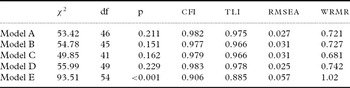
The fit indices of the models, based on sample I, are displayed in Table 1. Models A, B, C, and D resulted in nonsignificant χ2, indicating that these models provided good fit to the data. The χ2 statistics were corroborated by excellent fit indices. The χ2 values and fit indices were almost indistinguishable across the four models. Model E, however, yielded a significant χ2 as well as fit indices that were outside the acceptable range. Furthermore, the χ2 difference test showed that model E was significantly inferior to model A (Δχ2[8] = 37.80, p < 0.001), model B (Δχ2[9] = 36.40, p < 0.001), model C (Δχ2[13] = 42.31, p < 0.001), and model D (Δχ2[5] = 32.47, p < 0.001). However, models A (Δχ2[3] = 3.24, p = 0.356), B (Δχ2[4] = 4.49, p = 0.344), and C (Δχ2[8] = 7.17, p = 0.518) were not significantly different from model D. Models A (Δχ2[5] = 4.67, p = 0.457) and B (Δχ2[4] = 5.53, p = 0.237) were also not significantly different from model C. Although the χ2 difference test could not be applied to compare models A and B, this was not necessary (judging from the results for these two models in Table 1, they are unlikely to be different). Since model D was the most parsimonious model, it should be adopted as the model of choice, as more complex models (i.e. models A, B, and C) did not yield better fit indices.
Goodness-of-fit statistics of competing models, sample I

CFI = Comparative Fit Index; TLI = Tucker–Lewis Index; RMSEA = Root Mean Square Error of Approximation; WRMR = Weighted Root Mean Square Residual.
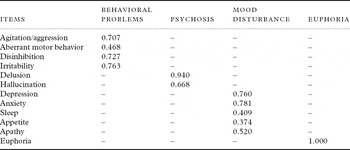
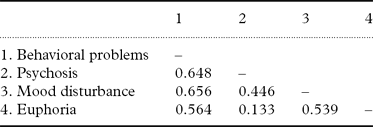
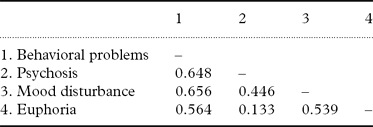
Results for model D showed that all the items were loaded on their respective factors (factor loading > 0.30; Table 2), including apathy, which had a loading of 0.520 on the mood factor. It is noteworthy that behavioral and mood disturbances were strongly correlated with all other factors (Table 3), suggesting that these two syndromes are central to the constellation of NPS assessed by the NPI. Psychosis was only weakly correlated with euphoria.
Standardized factor loadings for model B, sample I

Factor correlations based on model B, sample I
Next, we tested model D in sample II and found the model to fit the data as well (χ2[49] = 56.11, p = 0.226; CFI = 0.991, TLI = 0.988, RMSEA = 0.028, WRMR = 0.700). Hence, there was support for the validity and generalization of the four-factor model, laying foundation for examining the relative prevalence rates of different syndromes.
Prevalence rates
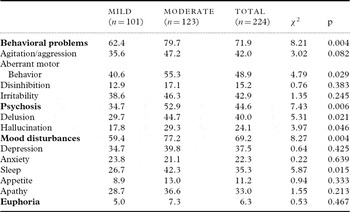
Table 4 shows the prevalence rates of four syndromes as well as the individual symptoms (for euphoria, the syndrome was equivalent to the item). Z-tests for proportions showed that both behavioral (Z = 6.11, p < 0.001) and mood (Z = 5.37, p < 0.001) syndromes were significantly more common than the psychotic syndrome in the whole sample, but their prevalence was not different from each other (Z = 0.62, p = 0.536). Subgroup analyses on the basis of dementia severity (i.e. mild or moderate) result in the same findings. In this community-dwelling sample, behavioral problems were present in 62% and 80% of persons with mild and moderate AD, respectively. Other than disinhibition, all behavioral problems, including agitation/aggression, irritability, and particularly aberrant motor behavior, were present in ~40% of mild cases, increasing to ~50% in those with moderate AD. Mood problems were present in 59% and 77% of mild and moderate cases, respectively. Depression, apathy, and sleep disturbances were the three most common features, whereas appetite disturbance was the least common. There was noticeable increase in the prevalence of sleep disturbance between mild (27%) and moderate (42%) cases, which appeared to contribute primarily to the overall increase in mood-related problems along with severity. The prevalence of anxiety remained at ~20% whether in mild or moderate AD. Although the prevalence of mood-related problems as a whole was not significantly different from that of behavioral problems, it is worth noting that other than depression, all mood symptoms were significantly less frequent than aberrant motor behavior, irritability, and agitation/aggression in the mild stage (with the exception of the difference between apathy and agitation/aggression). Z-tests for individual symptoms are available from the first author.
Prevalence (%) of neuropsychiatric syndromes by dementia severity, sample I

χ2 tests compared frequency data between mild and moderate cases; all df = 1.
Discussion
A four-factor model consisting of behavioral problems, psychosis, mood disturbance, and euphoria was found to provide good fit with the NPI data of Chinese persons with AD. Importantly, this four-factor structure was cross validated in an independent sample of persons with dementia. Note that despite much debate about apathy being an independent syndrome in AD (Starkstein et al., Reference Starkstein, Ingram, Garau and Mizrahi2005; Gauthier et al., Reference Gauthier2010; Spalletta et al., Reference Spalletta2010), our finding that apathy and depression are loaded together on the same factor was consistent with a number of studies in western countries (Frisoni et al., Reference Frisoni1999; Aalten et al., Reference Aalten2003; Cummings et al., Reference Cummings, McRae and Zhang2006; Hollingworth et al., Reference Hollingworth2006; Vilalta-Franch et al., Reference Vilalta-Franch2010). On the whole, this four-factor structure corresponded to clinical observations of characteristic behavioral manifestations associated with mild/moderate AD. Neuropsychiatric symptoms are behavioral manifestations resulting from complex interactions between external environment and neurochemical states, cognitive deficits, and physiological disturbances associated with progressive neuronal death. Degeneration of major neurotransmitter pathways precipitates the development of psychosis and mood disturbances. Relative imbalance of dopaminergic, glutaminergic, and cholinergic activities may be related to manifestations of delusions and hallucinations (Assal and Cummings, Reference Assal and Cummings2002; Lai et al., Reference Lai2003). Degeneration of serotoninergic, noradrenergic, and dopaminergic pathways help to explain why people with AD are prone to develop depression and apathy, and that the two were loaded on the same factor. Euphoria may represent loss of inhibitory response associated with frontal degeneration in AD, a relatively rare phenomenon.
It is interesting to note that the factors were correlated with each other. The behavioral problem factor consists of relatively elementary behaviors (irritability, agitation, aggression, and aberrant motor behavior) reflective of feelings of distress. Strong correlations between behavioral problems and other NPS factors suggest that this factor may be better conceptualized as secondary response to other psychopathology in AD such as psychosis and mood disturbances, and explain why this syndrome was so prevalent. The correlation between psychosis and mood factors might be related to the possibility that neurotransmitter disturbances associated with AD would impact both mood and perception (Assal and Cummings, Reference Assal and Cummings2002), and to the co-occurrence of such symptoms at the mild/moderate phases of AD. In persons with mild cognitive impairment and very mild AD, the relative prevalence of mood symptoms over psychosis would be much higher and the correlation may differ.
According to Western studies, the affective symptoms, namely depression, anxiety, and most notably, apathy, tend to be most common and to emerge early in the disease process (Lyketsos et al., Reference Lyketsos, Breitner and Rabins2000; Craig et al., Reference Craig, Mirakhur, Hart, Mcllroy and Passmore2005; Robert et al., Reference Robert2005). Although these symptoms were common in our Chinese sample, they were not the most common symptoms in the mild stage. By comparison, some of the behavioral problems were reported more frequently. An earlier study comparing NPS among samples of Hong Kong, Taiwan, and US patients with AD also showed a similar pattern, although it did not report prevalence broken down by levels of dementia severity (Chow et al., Reference Chow2002). Hong Kong Chinese caregivers reported higher rates of depression than apathy, and the apathy rate (36%) was significantly lower than that of the US caregivers (59%). (A similar but less obvious trend existed for the southern Taiwan sample as well.) However, Hong Kong caregivers reported higher rates (~60%) of aberrant motor behavior, agitation/aggression, and irritability than their Taiwan or US counterparts (40%–50%). The only difference with the present findings was that delusions and anxiety (both being 58%) were among the most prevalent symptoms, but caution is needed as the sample reported by Chow et al. (Reference Chow2002) might be a special one (31 psychogeriatric outpatients) with a lot of delusions triggering anxiety and vice versa. Without further research, it is difficult to ascertain why Hong Kong Chinese caregivers tend to report higher rates of behavioral problems than mood disturbance. Nevertheless, we speculate several reasons.
Irritability and agitation/aggression are also common in Western samples (Lyketsos et al., Reference Lyketsos, Breitner and Rabins2000; Craig et al., Reference Craig, Mirakhur, Hart, Mcllroy and Passmore2005; Robert et al., Reference Robert2005). Irritability can appear early as a reaction to a decline while the patient attempts to retain independent functioning. Irritability can also occur as a reaction to caregiver's attempt to help in ways that are unwelcome or even restrict activities, which are characteristics of Chinese caregivers' behavior. Care provided by foreign domestic helpers while the primary caregiver is at work, a phenomenon common in Hong Kong's families, might also contribute to patient irritability due to communication difficulties and incompatibility of expectations. These factors might explain the higher prevalence of irritability in Hong Kong Chinese patients. Irritability correlates highly with agitation (Senanarong et al., Reference Senanarong2003) and so it was not entirely surprising that irritability and agitation were prevalent in our Hong Kong Chinese sample. These overt behavioral problems are easily noticed whereas mood disturbance is covert unless openly expressed. It is well established that Chinese/Asian people are less likely to express dysphoria in emotional terms and therefore caregivers might be less aware of depression in patients.
In closing, we found a four-factor structure for the NPI among Chinese persons with mild/moderate AD. These factors represented neuropsychiatric syndromes that might become targets of intervention trials, as these might reflect the underlying pathological mechanisms more appropriately than individual NPS. Moreover, in comparison with the common practice of analyzing total scores, such factors suggested that certain items might be combined to form subscales on the NPI, thereby providing a more refined understanding of relative impacts of different NPS on caregivers. Nevertheless, the cross-cultural generalization of the current factor structure is not known. Moreover, like other studies, we used the overall rating of NPI items for factor analysis, with each symptom measured by one item only. The NPI also has seven to nine screening questions for each symptom that may also serve as indicators for data analysis, but such analysis would require a much larger sample size because of the large number of indicators overall. More research is needed to understand the generalization of the present factor structure across cultural and measurement contexts.
Conflict of interest
None.
Description of authors' roles
All authors were involved in the initial conceptualization, design, data collection, and writing. S.-T. Cheng, the principal investigator, performed data analysis, and led the write-up. L. C. W. Lam and S.-T. Cheng were responsible for data interpretation.
Acknowledgments
We thank John Lam for assistance with data analysis. This study was supported by General Research Fund No. HKIEd140609 of the Research Grants Council of Hong Kong.