On 15 December 1669 Johann Franz Khuen von Auer, a relative and agent of the bishop of Olmütz, Karl Count Liechtenstein-Castelcorno, sent a letter to the bishop's royal chamberlain (Kammermeister), Thomas Sartorius, concerning the delivery of instruments from the Austrian luthier Jacob Stainer (1617–1683) to the bishop's court at Kremsier.Footnote 1 After discussing a number of recently procured instruments, Khuen von Auer devotes his concluding paragraph to a particular acoustical problem:
Das die negstmal yberschickte paßgeigen etwas zu klain, auch die resonanz in velliger musica zu subtil, bevorab in ainer großen kürchen, berichtet er, geigenmacher, das, wan er solliches gewust, wollt er gröbere saiten aufzogen haben, und aber der quart-violon wirt soliches alles ersetzen und sich von ganzer music hören lassen, wie er dan verspricht, ain solich stuk zu machen, so sich sechen darf lassen aller orthen.Footnote 2
Since the recently dispatched string bass was too small, and its resonance in fully scored music too subtle, especially in a large church, the luthier reports that, had he been aware of this, he would have fitted on more robust strings. But the large Quartviolon will make up for all of this and be heard in large-scale music. He has promised to make an instrument that can be heard in all places.
A subsequent letter from Khuen von Auer to Sartorius (8 September 1670) again addresses this issue:
Wöll mich der herr mit wenigen avisiern; und zumahlen ich ihme, geigenmacher, dahin disponiert, das er ihr hochfürstlich gnaden zu gehorsambsten ehren und mir zu gefallen den großen violon oder octafviolon (welicher alberait 2mal größer sein wirt als die vormals yberschickte paßgeigen und sich aus aller musica in pleno hören wirt lassen) . . . Footnote 3
The Count has given me brief notice that, in particular, I should have the luthier do his Royal Grace the most obedient honour and favour, by providing a large Violon or Octafviolon (which is twice as large as the previously despatched string bass and allows all music to be fully heard) . . .
Both passages demonstrate the perceived necessity of a large sixteen-foot string-bass instrument for the proper performance of concerted music in a burgeoning musical establishment such as that at Kremsier during the late seventeenth century.Footnote 4
Similar praise for the use of the sixteen-foot string bass in concerted music can be found in a variety of sources. Consider the following description of the violone grosso from a 1706 treatise by the German organist and theorist Martin Fuhrmann:
Violone, Bass-Geige. Violone Grosso, eine Octav-Bass-Geige / darauff das 16 füßige Contra C. Eine solche grosse Geige solte billich in allen Kirchen vorhanden seyn und nicht nur beym Musiciren / sondern auch unter den Choral-Liedern immer mitgestrichen werden; Denn was diese grosse Geige von ferne vor einen durchdringenden und dabey süssen Resonanz wegen ihrer 16 füßigen Tieffe giebt / kan niemand glauben / als der sie gehöret.Footnote 5
Violone, Bass-Geige. Violone grosso, an Octav-Bass-Geige having the sixteen-foot contra C. Such a large string instrument should be found in all churches, and not only in concerted works, but always playing along in chorales as well. Nobody apart from those who have heard it can believe the penetrating and sweet resonance this large Geige produces from a distance as a result of its sixteen-foot register.
As we shall see, comparable statements concerning the use of sixteen-foot string instruments in a variety of venues and circumstances are common among the writings of seventeenth- and eighteenth-century performers and theorists from all over Europe.
Certain recent performance projects, however, have claimed that the now standard practice of sixteen-foot participation in concerted vocal and instrumental music from this period results from an incorrect interpretation of the musical sources. Recordings issued in 2007 by Jeffrey Thomas and the American Bach Soloists of the complete Brandenburg Concertos, for example, suggest that at least two of these works are better served by excluding sixteen-foot participation in the bass line. Thomas makes use of a six-string fretted instrument commonly referred to today as a ‘G violone’, with the tuning G1–C–F–A–d–g.Footnote 6 Even more categorical in the rejection of sixteen-foot sonority in the works of J. S. Bach is the Belgian violinist and conductor Sigiswald Kuijken, who has detailed his views on certain aspects of Bachian performance practice in a recent article.Footnote 7 His approach with respect to bass instrumentation, discussed below, appears to rest on an incomplete picture of the available historical information. But before we continue, a word about terminology is in order.
When referring to an instrument such as Thomas's G violone, Annette Otterstedt uses the term ‘twelve-foot double bass’ to indicate a bass instrument that is tuned in such a way that it can reach some, but not all, of the contrabass range.Footnote 8 Such an instrument reads notes of the bass line at pitch, as an eight-foot instrument such as a violoncello would. However, I shall borrow Otterstedt's useful terminology and employ it in the sense that she has, setting up a bass-instrument classification system according to three basic categories: eight-foot non-transposing instruments (violoncello, basse de violon and so on), twelve-foot non-transposing instruments (violone da gamba, basso di viola and so forth) and sixteen-foot transposing instruments (violone grosso, Octavviolon, große Quartviolon and so on). The chart provided below in the Appendix details various characteristics of the eight-, twelve- and sixteen-foot instruments – many called violone or some variant thereof – mentioned in numerous manuals from the early seventeenth to the mid-eighteenth century.
Although in the seventeenth century the word violone (Violon in German-speaking areas) was used in a variety of different contexts, by the turn of the eighteenth century it had come to designate either a twelve-foot non-transposing ‘double bass’ instrument or a sixteen-foot octave-transposing contrabass instrument in virtually all areas of Europe. From that time on, violone was not used to designate an eight-foot non-transposing instrument. The violoncello and French basse de violon, the most prominent among these latter instruments at the turn of the eighteenth century, were clearly designated by terminology that applied directly to them, both in treatises and in scores and parts. Thus the term violone is not to be understood as a synonym for eight-foot instruments after the first decades of the eighteenth century.
A good deal of modern confusion is a direct result of the eighteenth-century use of the term violone for twelve-foot members of string choirs, which were classified, more or less universally throughout Europe, as ‘double-bass’ instruments. When the term violone is encountered in a given work, the function of that particular instrumental line must be taken into consideration. Other factors that may help to determine the correct instrument to employ in a given situation include its presumed lower compass and certain aspects of voice leading that are affected by the presence of a sixteen-foot instrument. However, such factors cannot be relied upon to point decisively to the use of one instrument over another. Only a careful consideration of both contemporary terminology and the function of the bass line in question can provide adequate answers.
In order for us to understand bass-line scoring clearly, certain terminological issues must be clarified at the outset. As we have seen, contemporary treatises provide important clues as to how composers from this period might have employed instruments designated by the problematic term violone. Using such information as a starting-point, I shall consider works by representative composers of the period to see how their use of the term comports with terminology found in various writings. A careful examination of this data reveals that sixteen-foot participation in instrumental ensemble music and concerted vocal works was widely regarded during the late seventeenth and early eighteenth centuries as being essential for adding depth, resonance and grandeur to performances.
TERMINOLOGICAL ISSUES
The correspondence concerning Jacob Stainer's instruments cited above reveals much about the terminological bifurcation into small and large Violons found in sources of the period. Consider the following excerpt from another letter from Khuen von Auer to Sartorius (9 September 1669):
Allain wegen des großen violons stehe ich an, weil anstatt des klienern solicher gemacht soll werden, ob ihm, geigenmacher, die begerte 50 taler darumb zu bezalen. Zwar verspricht er ain solich instrumentum zu machen, so den maister lobt und mit den hall ain ganze kürchen anfillen solle, auch in die weite gehört werden, daryber dan, weil diß die lester arbeit, vernere resolution erwart wirt, ob diser große oder ain kliener violon, maßen der negste gewest, gemacht werden solle, doch ieder in sein pretio.Footnote 9
However, I am standing by concerning the large Violon, since, as opposed to the smaller ones to be made, the luthier requires a purchase price of fifty talers. To be sure, he promises to make an instrument that the Master will praise and that should fill an entire church and be heard from a distance. Furthermore, since this latest order awaits resolution as to whether the next instrument should be a large or small Violon, the price remains to be determined.
This clear differentiation between small and large Violons is reinforced by the detailed payment lists for instruments that frequently accompanied Khuen von Auer's correspondence with Sartorius. The list that supplements this letter includes a Violon for thirty talers and a contrabass Violon (Octafviolon) for fifty talers.Footnote 10 Thus the große Violon referred to in the letters is a sixteen-foot transposing instrument, and as such was highly desirable for performances in a spacious venue.
The distinction between small and large Violons is consistent throughout the letters and other Kapelle documents from Kremsier, as is terminological differentiation between the violin and viol families. A letter from Khuen von Auer to Sartorius (27 January 1670) lists, among other instruments, two violins (each at ten talers), four violen di braccia (each at twelve talers), one viol di gamba (sixteen talers), one Paßviolen or tenor-bass viola da gamba (thirty talers), one Violon (twenty-four talers) and one Octavviolon (forty-two talers).Footnote 11 It seems clear that the term Violon here refers to both a non-transposing bass-range instrument and, with the proper qualifier (große or octaf or octav), to a sixteen-foot octave-transposing contrabass. Further, much of the information in the following discussion demonstrates that the latter two instruments are members of the viol family. The Violon that cost twenty-four talers must have played in the twelve-foot register, embracing some, but not all, of the contrabass range. We will assume a six-string configuration for it, with a tuning of G1–C–F–A–d–g, as prescribed by contemporary treatises and seen in surviving instruments by Stainer.Footnote 12
The use of violone (or Violon) in this correspondence – with or without modifiers – is representative of the terminology from this period. The term violone can be traced to the sixteenth century, when it was used as a general designation for all instruments in the viol family.Footnote 13 However, in a 1609 treatise the Italian theorist and composer Adriano Banchieri narrowed the use of the term to include only the two lowest members of the da gamba family: the violone da gamba, a six-string instrument with the aforementioned twelve-foot tuning (G1–C–F–A–d–g), and the violone in contrabasso, which also employed six strings but was tuned a fourth lower (D1–G1–C–E–A–d), thereby embracing the true sixteen-foot range.Footnote 14 As members of the viol family, both instruments were fretted.
These are presumably the two types of violoni that Stainer was providing to the court at Kremsier, as may be inferred from surviving instruments. A six-string instrument with the G tuning, listed in the inventory of the Musikhistorisk Museum in Copenhagen as a ‘Baß-Viola da Gamba’, is representative of Stainer's kleiner Violon; it bears a printed label reading ‘Jacobus Stainer in Absam / prope Oenipontum 1652’.Footnote 15 An instrument of the type that Khuen von Auer referred to as Octavviolon can be found today in the Church of St Nikolaus in Murnau, Bavaria. This instrument is clearly a contrabass of the viol family, easily twice as large as the smaller Violon, with a string length of 114 centimetres. Though it has been converted to a four-string bass, it would originally have been a six-string instrument tuned D1–G1–C–E–A–d. This instrument bears a label reading ‘Jacobus Stainer in Absam / prope OEnipontum 16[49?]’.Footnote 16 The exact instrumental types are further clarified by terminology in the correspondence between Khuen von Auer and Sartorius, where a große Quartviolon refers to the larger Violon (the first term indicating an instrument that is tuned a fourth lower than the normal tuning, in this case a fourth lower than the G violone).Footnote 17
Throughout the course of the seventeenth century, the unmodified term violone coexisted in Italy alongside a plethora of composite designations, including basso di viola, violone basso, violone da brazzo and violone grosso. Stephen Bonta's excellent work in documenting the various sources in which these terms appear is most instructive.Footnote 18 Bonta points out that one use of the term violone was as an early designation for a large instrument tuned in the manner of the present-day violoncello.Footnote 19 He links this instrument terminologically to the basso di viola, on the strength of the definition for the term violone that appears in the 1729 Vocabolario degli Accademici della Crusca: ‘Violone. A large, low-pitched viola, which is also called basso di viola, and violoncello when of smaller size’.Footnote 20 This interpretation is substantiated by other contemporary designations. For example, the Bolognese composer and violoncellist Giovanni Battista Vitali (1632–1692) identifies himself on the title-page of his Sonate a due, tre, quattro, e cinque stromenti, Op. 5, as Musico di Violone da brazzo in S. Petronio di Bologna e Academico Filaschise.Footnote 21 This is the essence of the term that is expressed in the Vocabolario definition; thus the connection between the two instruments of differing sizes, and between the terms used to designate them (violone and violoncello), was quite strong.Footnote 22
Elsewhere in Europe, theorists were describing instruments similar in size and function to the large Italian bass violin (violone). In France, the term most utilized in the sixteenth and seventeenth centuries was basse de violon, literally the bass of the violin (French: violon) family. Philibert Jambe de Fer describes a four-string bass violin with the tuning B♭1–F–c–g.Footnote 23 This instrument is also described several decades later by Marin Mersenne.Footnote 24 The basse de violon was a usual member of the basse continue of the operas of Lully, often sharing the bass line with viols. However, like the large Italian bass of the violin family (violone), the French bass violin eventually succumbed to the vogue for the more nimble violoncello (violoncelle). It seems that the smaller violoncelle, with the standard C tuning, had replaced the basse de violon in French orchestras by the first decade of the eighteenth century.Footnote 25
An instrument similar to the one described by Jambe de Fer and Mersenne could also be found in the emerging violin ensembles in England during the sixteenth and seventeenth centuries. British sources from the late seventeenth century describe the bass member of the violin family as having the same B♭ tuning as the French basse de violon. This instrument was also replaced by the violoncello in the first decade of the eighteenth century, owing to the influx of Italian cellists recruited for the opera company at the Queen's Theatre in the Haymarket.Footnote 26
The eight-foot basse de violon is the instrument to which Kuijken refers in his article. He has used it for the violone parts on his recent recording of the Brandenburg Concertos,Footnote 27 and also for parts marked either basso or Violon in the series of Bach cantata recordings currently being issued. In the liner notes to a representative recording from the latter series he states:
The usual instrument given the general bass role (fondamento) was the ‘violone’, which means ‘large viola’. The viola family had two branches: the viola da gamba and the viola da braccio. Both were made in various sizes, from descant (soprano) to bass. Large instruments of both families were assigned the function of ‘violone’, often indiscriminately; in the absence of norms, general use was made of instruments of various sizes, forms, tunings and pitches (some sounding at ‘8-foot’ pitch as written, others sounded an octave lower at ‘16-foot’ pitch).
In the Italy of Corelli (Rome around 1700), the common 8-foot bass was called ‘violone’ and the octave bass ‘contrabasso’. In works demanding large orchestral forces, the instruments were listed as ‘violini, violette ( = violas), violoni, contrabassi’. The ‘violoncello’ clearly did not belong to the usual orchestral arsenal . . .
[S]mall forces (vocal and instrumental) [such as those used on this recording] are best served by an 8-foot ‘violone’ (but an instrument considerably larger than today's cello). For example, the 8-foot violone of the ‘braccio family’ was the instrument that was called ‘Basse de Violon’ in France; in other parts of Europe it was simply called ‘basso’ or ‘violone’. We use such instruments; the 8-foot violone of the gamba family is also used in some cantatas.Footnote 28
In these statements, Kuijken is proposing that the eight-foot basse de violon with a B♭ tuning may be equated with the term violone (or Violon) in music from the end of the seventeenth and the beginning of the eighteenth centuries. I would suggest, however, that there are basic flaws in his interpretation of the historical evidence. For example, Kuijken offers as an illustration of this organological equivalence (violone = eight-foot basse de violon) the lists of players in Corelli's Roman orchestras during the late seventeenth and early eighteenth centuries, which consistently provided string configurations using the terminology ‘violini – violette – violoni – contrabassi’, the contrabassi providing the sixteen-foot registration.Footnote 29 Kuijken's source for this information is John Spitzer and Neal Zaslaw's book The Birth of the Orchestra. Those authors are quick to point out that in the orchestras to which Kuijken refers, ‘the balance among [violon]cellos, violoni, and contrabasses varied considerably. The players of these instruments overlapped, and often it is hard to tell who was playing which instrument.’Footnote 30 Amidst this type of terminological uncertainty, it is more than possible that violone was sometimes used to designate violoncello participation, as suggested by the definitions in the Vocabolario. By the time of these Roman concerts, this equivalence (violone = violoncello) was taken for granted. However, even the larger eight-foot violone that Corelli would have employed had the C tuning in common with its smaller relative (C–G–d–a), and thus was not the ‘basse de violon’ that Kuijken is utilizing in his current ensemble.Footnote 31 Further, it should be noted that in Rome this equivalence persisted at least until the 1720s.Footnote 32 As the term violoncello began to emerge and take hold elsewhere in Europe during the latter part of the seventeenth century, the term violone, now no longer needed to designate the bass of the violin family, began to be used routinely as a synonym for contrabasso. It therefore became standard practice to designate the sixteen-foot instrument of the continuo bass line as violone throughout Europe.Footnote 33
The correct interpretation of terms for instruments was a matter of some importance during this period. The German composer and theorist Johann Mattheson (1681–1764) addressed such issues in his 1752 Philologisches Tresespiel.Footnote 34 His remarks pertaining to the term Violon are instructive. He advocates the retention of foreign (non-German) terminology for musical instruments to prevent any misunderstanding that translation might engender:
Die ausländischen Kunstwörter, deren es ja in allen Wissenschaften der Welt ungleich mehr giebt, als in der Tonkunst, wären den Verfassern schäckichter Bücher gerne zu Gute zu halten, als an deren Erklärung gar kein Mangel ist, wenn auch nur Brossard und Walther da wären. . . .
Violino nehmlich ist ein ausländisches Kunstwort, und heisset nimmer Violine. (Im Welschen und Französischen ist das Wort männlichen Geschlechts; die Deutschen machen ein Frauenzimmer daraus, wenn sie ihre Endigung e hinzusetzen, und die Violine sprechen.) Es bedeutet einzig und allein eine so genannte Diskantgeige. Denn Geige ist ein allgemeines Wort; und eine jede Geige kann nicht Violino heissen, welches ein diminutiuum ist. Wir haben wohl zehnerley Geigen: Violino piccolo; Poccetta; Violino; Viola d’Amore; Viola di Braccio; Viola di Gamba; Viola di Spala; Violoncello, Violone, Violone grosso &c. Klavir ist ebenfalls ein solches allgemeines und gemißbrauchtes Kunstwort: denn es bedeutet eigentlich nur die Tastenreihe, oder das Griffbret; nicht das ganze Instrument. Wir haben Klavikordien, Spinetten, Flügel, Positive, Orgeln u.
Violon soll die tiefe Geige heissen. Ja, vielmehr umgekehrt! Es bedeutet eben dasjenige Bogenspiel, welches die Italiener Violino und di Franzosen Violon nennen. Kein anders. Daß nun solches niemals einen besonders tiefen; sondern vielmehr fast den höchsten Klang habe, ist schon dargethan, Violone aber, als ein welsches Kunstwort, welches, einfältiger Weise, mit dem französischen Violon vermischet wird, ist auf Deutsch eine so genannte Baßgeige* (*Diskantgeige, Baßgeige u. sind lauter geflickte Wörter: das erste insonderheit ist unerträglich. Man muß die ausländischen beybehalten.) und auf Französisch: Basse de Violon.Footnote 35
Foreign coinages, of which there are incomparably more in all the world's sciences than in music, would serve the authors of silly books well, causing no difficulty in their explanation, if only Brossard and Walther were there. . . .
Violino is a foreign coinage, and is never called Violine. (In Italian and French the word is masculine; the Germans make a woman out of it if they attach an ‘e’ at its end and speak of the Violine.) This term designates nothing else than a so-called treble violin. For Geige is a generic word, and not every Geige can be called violino, which is a diminutive. Indeed, there are [at least] ten different kinds of Geigen: violino piccolo, poccetta, violino, viola d’amore, viola di braccio, viola di gamba, viola di spala, violoncello, violone, violone grosso, etc. Klavir is another generic and oft-misused coinage, for it refers only to the keyboard, not to the whole instrument. We have clavichords, spinets, harpsichords, positives, organs, etc.
It might be supposed that Violon means a low-range violin. Yet very much to the contrary! The term indicates the same string instrument that the Italians call violino and the French call violon. Nothing else. That such an instrument never has an especially low register, but instead has nearly the highest one, has already been established. But violone, an Italian coinage that is naively confused with the French violon, is in German the so-called Baßgeige (Diskantgeige, Baßgeige, etc., are awkward compound words: the first, in particular, is intolerable. One must retain the foreign [terms]) and in French, basse de violon.
As confusing as Mattheson's explanation may appear at first glance, his reasoning makes perfect sense. According to him, the term Violon is not used in Germany to denote a bass violin; rather, it means merely a normal treble violin. The term violone, however, retaining its Italian connotations, is equated with Baßgeige in Germany and with basse de violon in France.Footnote 36 These associations are completely consistent with the definition of violone given by Mattheson nearly forty years earlier in his Das neu-eröffnete Orchestre (1713), where he relied on the definition of the French theorist and lexicographer Sébastien de Brossard (1655–1730): ‘VIOLONE. This is our basse de violon or, more precisely, our double bass’.Footnote 37
Therefore, even if the term was translated (or, ‘in a simple-minded manner . . . confused with the French term Violon’) in German-speaking realms – as it clearly was in Kremsier and in other areas of Germany and Austria as well – the term retained its original Italian connotation, as in Banchieri, of either a twelve- or a sixteen-foot instrument.Footnote 38 Just as the term violone in Italy eventually came to be utilized primarily for sixteen-foot instruments, so the transplanted term violone in Germany came to do likewise, and quite consistently. Thus, as we shall see from various theoretical writings, the modern association of the term violone (or Violon) in Germany with the eight-foot French basse de violon or the eight-foot Italian violone is erroneous. These writings also tend to refer to both twelve- and sixteen-foot instruments by the term violone, much in the manner of the Kremsier instrumental-inventory lists (Violon and Octavviolon), but also differentiate between these instruments and those playing in the eight-foot range.
Brossard's definition of violone, which for him designates a contrabass instrument, has caused a good deal of confusion for modern readers as they attempt to interpret the various meanings of that term. The complete entry in his Dictionaire de musique (1705) offers the following:
VIOLONE. C’est nôtre Basse de Violon, ou pour mieux dire, c’est une Double Basse, dont le corps & le manche sont à peu prés deux fois plus grands que ceux de la Basse de Violon à l’ordinaire; dont les Chordes sont aussi à peu prés plus longues & plus grosses deux fois que celles de la Basse de Violon, & le Son par consequent est une Octave plus bas que celuy des Basses de Violon ordinaires. Cela fait un effet tout charmant dans les accompagnemens & dans les grands Choeurs, & je suis fort surpris que l’usage n’en soit pas plus frequent en France.Footnote 39
VIOLONE. This is our basse de violon or, more precisely, our double bass, of which the body and neck are nearly twice the size of our common basse de violon; its strings are also somewhat longer and nearly twice as thick as those of the basse de violon, and consequently the range is an octave lower than that of the common basse de violon. It produces a very charming effect in accompaniments and in the tuttis, and I am extremely surprised that it is not used more frequently in France.
Brossard is clearly describing the violone in France as an octave-transposing double-bass instrument. Despite the somewhat contradictory opening statement of the definition, it is perfectly clear from his detailed description that the instrument known in France as the basse de violon is not called violone; these are, in fact, two quite different instruments. Yet in an apparent effort to retain the regional terminology he felt was so important, Mattheson assigned the term basse de violon to an instrument known in Germany as the grosse Bass-Geige and in Italy as the violone – that is, the sixteen-foot double-bass. In any case, by the early eighteenth century, this contrabass violone was being routinely paired with the newly accepted violoncello in French concerted music to produce the ‘charming effect’ to which Brossard alludes.Footnote 40
In Italy, the violoni described in Banchieri's Conclusioni are an early adumbration of a tradition of differentiating between transposing bass-clef instruments that play in the true sixteen-foot range (as with his violone in contrabasso) and instruments in the twelve-foot range (violone da gamba) that read the bass clef as written but are capable of reaching notes in the contrabass range (to G1). At the beginning of the eighteenth century, treatises continued to emphasize this pairing of transposing and non-transposing bass instruments; however, as noted above, these were not necessarily from the same family of instruments. For example, under the term violone in Filippo Bonanni's Gabinetto armonico pieno d’istromenti sonori indicati e spiegati (1723) we find the following description: ‘Violone. One plays [this instrument] in the same manner as the others called violone, and it is equipped with six strings’ (‘Nella stessa forma suonasi l’altro detto Violone, e armato di sei corde’). This definition points to a collective term of violone for all viol instruments, and while the accompanying illustration is somewhat suspect with regard to organological detail, it none the less clearly shows a fretted instrument, and one that is too large to be anything other than a transposing double bass.Footnote 41 Bonanni identifies the unfretted viola as
un Istromento simile nella figura, ma di molto maggiore grandezza espresso nell’apposta immagine vien denominato Viola. Si suona sostenendolo dal pavimento; il suo manico è lungo la terza parte dell’Istromento, ed ha quattro corde come il Violino, ma di maggior grossezza, siccome l’arco ancora è più lungo.Footnote 42
an instrument similar in shape, but of much greater size than the [the other instruments] designated viola. It is played by placing it on the floor; its neck is one-third the size of the instrument and it has four strings like a violin, but it is much larger and its bow is also longer.
While no specific tuning is given, we can assume that it is the same as that of the modern violoncello. This, then, is the instrument that was also referred to as the large viola or violone, clearly not a sixteen-foot instrument.Footnote 43 The prominence of these instruments in Bonanni's treatise suggests that they had become the normal eight-foot/sixteen-foot pair in Europe. As we shall see, Italian musical works of the time reinforce this impression.
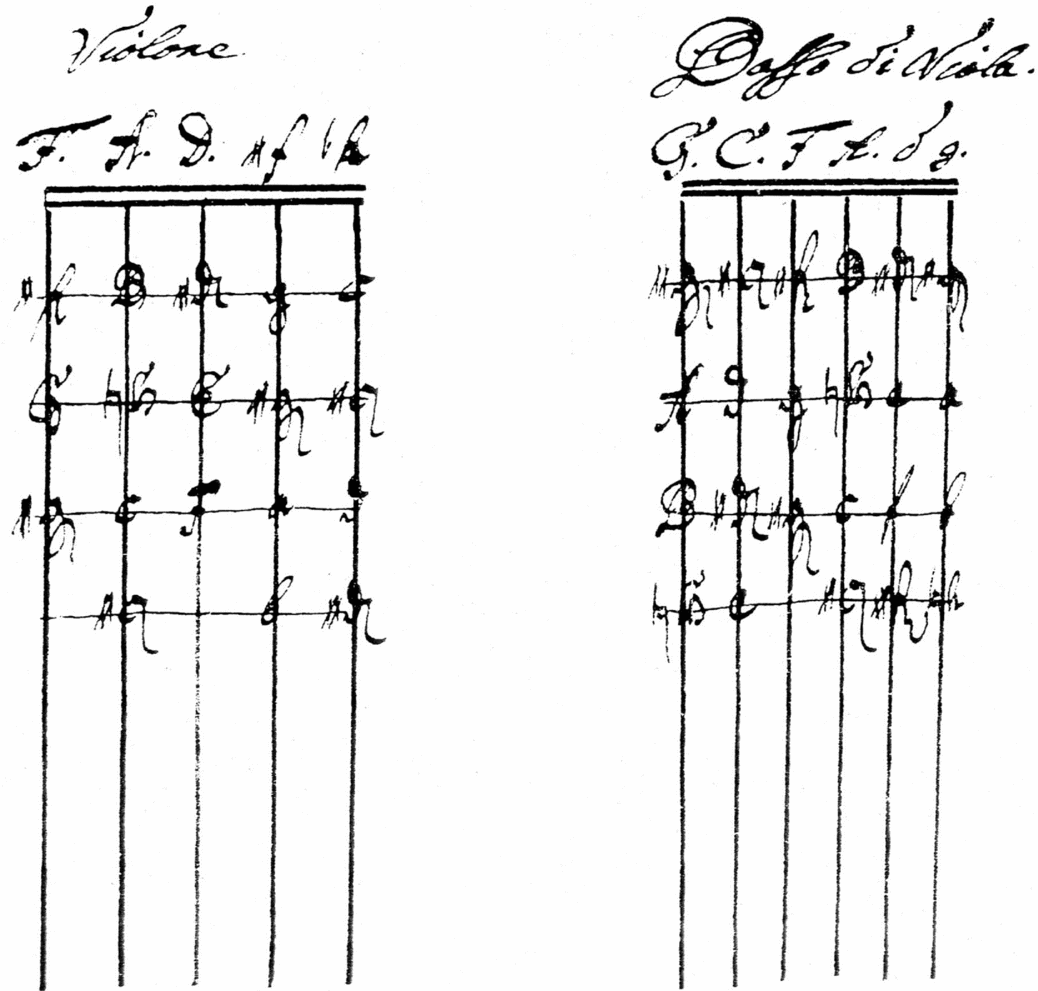
In Austria, the pairing of high and low string basses such as those referred to in the correspondence between Khuen von Auer and Sartorius was common, as indicated by a diagram from the Musicalischer Schlissl (1677) by Johann Jacob Prinner (1624–1694) (Figure 1).Footnote 44 Here the violone is a five-string instrument with the distinctive tuning F–A–D–f♯–b♮, an early variant of what is today commonly referred to as the Viennese tuning; contrabass instruments featuring a similar configuration would predominate in the musical establishments of Salzburg and Vienna in the mid- to late 1700s.Footnote 45 Prinner's violone tuning represents a departure from the traditional viol tuning for the octave-transposing contrabasses that Stainer was producing during this period in the Tyrol region. It would seem to reflect a shift that can also be seen in contemporaneous alterations to existing instruments. For example, the luthier Jakob Rauch (1680–1765), working in the Innsbruck area, converted an early Stainer six-string contrabass to five strings around 1713.Footnote 46 Though the pitch indications in Prinner's chart leave some doubt as to whether his violone was a true contrabass, his text makes this explicit:
Johann Jacob Prinner, Musicalischer Schlissl (Vienna, 1677), ‘Das Dreyzehnte Capitl: Von allerhandt Geigen’. US-Wc, 1677. Used by permission

Aus den fürgeschribenen Exemples sehet man, daß in dem Violon die erste sätten in das F. das ist daß erste als nemblich unter denen 5. lineas des ordinari rechten bass lähr muoß in die octav tüeffer gestimet werden, dan dise geigen vertritt daß petal oder den Sub Bass einer Orgl. da alles in der octav tüeffer hergehen muoß.Footnote 47
One can see from the foregoing examples that the first string of the Violon is F – that is, [the note] under the fifth line [of the staff], but which according to the proper bass teachings must be played an octave lower, since [the Violon] represents the pedal or sub-bass pedal of the organ, and therefore everything must function in this lower octave.
Thus, despite the five-string configuration, Prinner describes a twelve-foot/sixteen-foot (non-transposing/transposing) pairing.
An instrument similar to the one that Banchieri called violone da gamba and Prinner called basso di viola was known in English consort music as the twelve-foot ‘double bass’; Orlando Gibbons referred to it as ‘The great Dooble Basse’.Footnote 48 This instrument, whatever the regional terminology, consistently served as the lowest member of the viol consort. The music manuscript compiled by James Talbot (GB-Och: Music MS 1187) provides descriptions and tunings for a variety of instruments in Britain between 1685 and 1701. Talbot includes as members of the viol family a ‘Violone or Double Bass’ (six strings, tuned like Banchieri's violone da gamba, Gibbons's ‘great Dooble Basse’ and Prinner's basso di viola) and a ‘Double Bass’ (five strings, tuned in a similar manner to Prinner's violone). Talbot states that he obtained information pertaining to these instruments first hand from Gottfried Finger (c1655–1730).Footnote 49 Finger, a bass-viol virtuoso, spent many years in London; however, he was Moravian by birth and spent the early part of his career (prior to 1682) in the employ of the bishop of Olmütz, Karl Count Liechtenstein-Castelcorno. Considering his connections to the court at Olmütz, it is not surprising that Finger should describe the exact instruments listed in Prinner's manuscript, since the latter also had some associations with the court musical establishment.Footnote 50
For Prinner, the basso di viola is not the eight-foot bass of the viola da braccio family, as described in the Vocabolario, but rather the twelve-foot bass of the viola da gamba family, the lowest member of the viol consort.Footnote 51 Bonta observes that in Italian instrumental prints from the early seventeenth century, the term basso di viola – as opposed to the term basso di brazzo, also found in these publications – seems to call for the instrument we know today as the bass viola da gamba, with the standard D tuning. In Giovanni Battista Buonamente's Il Quarto Libro de Varie Sonate (1626), for example, the title-page calls for ‘Due Violini, & vn Basso di Viola’. His Il Settimo Libro, however, calls for ‘Basso di viola o da brazzo’.Footnote 52 Bonta rejects the notion that these parts could be for Prinner's basso di viola (the G violone); while the basso part in Buonamente's Quarto Libro descends to a low C, which the bass viola da gamba could access through scordatura,Footnote 53 it never violates that compass, as one would expect if the instrument could in theory descend to contra G.Footnote 54 Prinner's use of basso di viola – in contrast to that of the Vocabolario and of later theorists, particularly German ones – implies that he understood this instrument to be the bass member of the viol consort, literally the ‘basso’ of the ‘violas’ (da gamba). This is confirmed by the fact that both of Prinner's instruments are fretted, linking them, despite any terminological inconsistencies, to the viol family. In Prinner's configuration, as in Banchieri’s, these two instruments serve respectively as the contrabass continuo instrument and the low-bass ensemble instrument; this is the case whether the other instruments of the string consort are of the violin or viol family.Footnote 55
Thus the term violone was used fairly consistently throughout Europe, with only minor terminological variations, to apply to the two lowest members of the string consort: the non-transposing twelve-foot ‘double bass’ and the transposing sixteen-foot contrabass, used as a continuo instrument. Evidence for the instruments being employed in this manner can be found in the large-scale sacred vocal works of Heinrich Ignaz Franz von Biber. Biber was employed as a violinist at Kremsier from 1668 to 1670, in which capacity he was asked by the bishop to purchase from Stainer some of the instruments mentioned in the correspondence between Khuen von Auer and Sartorius.Footnote 56 Though Biber did not carry out this assignment, he was nevertheless personally and professionally acquainted with Stainer.Footnote 57 Biber was also acquainted with Prinner; the two served together at the court of Prince Johann Seyfried Eggenberg in Graz in the early 1660s.Footnote 58
Two of Biber's sacred vocal works are of particular interest here: the Vesperæ à 32 (1674) and the Missa Alleluja à 36 (c1690). In the latter work, the string contingent consists of two violins, three violas and a violone. On the title sheet from the only extant complete source of this work, the instruments are listed as ‘2 Violini, 3 Viole, [Organo con] Violone’. A separate violone part exists, along with parts for tiorba and organo.Footnote 59 Biber's autograph score of the Vesperæ à 32 calls for two violins, two violas and basso di viola, with the title-page specifying ‘5 Viol[æ] . . . Et 4: bassi Continui’.Footnote 60 In both works Biber is faithful to the terminology codified by his colleague Prinner. The violone of the Missa Alleluja is clearly a double-bass reinforcement of the organ line. It is the sixteen-foot continuo instrument and not a member of the string consort, hence ‘3 Viole’ and violone. But, in the Vesperæ à 32, the basso di viola – Prinner's twelve-foot fretted instrument – is listed as one of the ‘5 Viol[æ]’; it serves as the lowest member of that consort. We can assume that one of the four bassi continui parts is meant for a sixteen-foot violone, as dictated by the practice of the bishop's chapel outlined in the official correspondence cited above.
In Germany, the association of the term violone with contrabass instruments can be seen early in the seventeenth century. Michael Praetorius presents two such instruments, and several tuning configurations, in his Syntagma musicum.Footnote 61 In Plate V, Praetorius pictures a five-string fretted instrument that he labels ‘Groß Contra-Bas-Geig’; Plate VI depicts a six-string fretted instrument that he labels ‘Violone, Groß Viol-de Gamba Baß’. Tunings for both of these instruments are listed in a table containing configurations for members of the viole de gamba family.Footnote 62 Thus for Praetorius, the term violone is associated with instruments exhibiting characteristics of the viol family, including frets and tuning primarily in fourths. Under the heading ‘Klein Baß-Viol de Gamba’, Praetorius offers seven different tunings. The first three are variations on the G tuning given for Banchieri's violone da gamba, revealing that the distinction between small (twelve-foot) and large (sixteen-foot) bass gambas was already in effect around 1600.Footnote 63
On the other hand, the instrument that Praetorius labels Bas-Geig de bracio (that is, bass violin), shown in his Plate XXI, is a five-string bass violin. In a table providing its tuning (F1–C–G–d–a), he gives the instrument's name as Groß Quint-Baß.Footnote 64 This is the lowest member of the viole de braccio family listed by Praetorius. The qualifier Groß identifies it as the largest violin-family instrument (tuned in fifths), while Quint-Baß indicates that its range extends a fifth below the standard eight-foot violin-family bass instrument – just as the term ‘große quartviolon’ described Stainer's largest contrabass viol, tuned a fourth below the smaller Violon.Footnote 65 The same table provides tunings for two instruments called ‘Baß Viol de Braccio’, both four-string, eight-foot instruments, one with the standard modern violoncello configuration (the other is tuned F–c–g–d1).
The terminology used in German organological works from the late seventeenth and early eighteenth centuries reflects the gradual demise of the französische Bass, known in France as the basse de violon. In a 1695 tutorial on string instruments the composer and Kantor Daniel Merck (1650–1713) gives tunings for the six-string G violone we have discussed above, including one based a step higher (A1–D–G–B♮–e–a). Among the other bass instruments he lists is the ‘Französische Bass mit 4. Saiten’ with the standard B♭ tuning (Figure 2). He groups these instruments under the heading ‘Bass-Geigen’, in contrast to Praetorius's (and others’) organization according to family.Footnote 66 Merck claims that these are the three best types of string-bass tunings available.Footnote 67 He does not explicitly describe a sixteen-foot instrument; however, following the discussion of the other string basses, he mentions an instrument with three sheep-gut strings overwound with wire, producing a sound close to that of a bassoon. The tuning for this instrument is in fifths: D–A–e.Footnote 68
Daniel Merck, Compendium musicae instrumentalis Chelicae (Augsburg: Wagner, 1695). D-Mbs 4 Mus. Th. 1024. Used by permission
Mattheson's definition of the term violone in Das neu-eröffnete Orchestre was influential in the eighteenth century. In addition to adopting Brossard's terminology, he characterizes the violone as the rumbling (brummende) violone, an explicitly sixteen-foot instrument:
Der brummende Violone, Gall. Basse de Violon, Teutsch: Grosse Bass-Geige, ist vollenkommen zweymahl / ja offt mehrmahl so groß als die vorhergehenden / folglich sind auch die Sayten / ihrer Dicke und Länge nach / à Proportion. Ihr Tohn ist sechzehnfüßig / und ein wichtiges bündiges Fundament zu vollstimmigen Sachen / als Chören und dergleichen / nicht weniger auch zu Arien und sogar zum Recitativ auff dem Theatro hauptnöthig / weil ihr dicker Klang weiter hin summet / und vernommen wird / als des Claviers und anderer bassirenden Instrumenten. Es mag aber wol Pferde-Arbeit seyn / wenn eine diß Ungeheur 3. biß 4. Stunden unabläßlich handhaben soll.Footnote 69
The rumbling violone, French basse de violon, German: grosse Bass-Geige, is fully twice, often more [than twice], as large as the preceding [instrument discussed, the violoncello]. Consequently the strings are also proportionally thicker and longer. Its sound is [in the] sixteen-foot [range], and it provides an important basic foundation in fully scored works such as choruses and the like, no less importantly in arias and even in recitatives in the theatre, since its thick sound carries and is heard further than the keyboard and other bass instruments. One must be like a work-horse to continually handle this monster for three to four hours.
No specific tuning is given by Mattheson; the number of strings can be either five or six, as with Praetorius. This is established in the previous entry on the small bass instruments (kleine Bass-Geigen), ‘the excellent violoncello, bassa viola and viola di spalla are kleine Bass-Geigen, as opposed to the [grosse Bass-Geige] with five or six strings, on which one can execute with much less effort than on larger machines all manner of diverse fast passages, [such as] variations and ornaments’ (‘Der hervorragende Violoncello, die Bassa Viola und Viola di Spala, sind kleine Bass-Geigen / in Vergleichung der grössern / mit 5. auch wol 6. Sayten / worauff man mit leichterer Arbeit als auff den grossen Machinen allerhand geschwinde Sachen / Variations und Mannieren machen kan’).Footnote 70 Since the number of strings for Mattheson's sixteen-foot instruments corresponds to that given by Praetorius, we may assume that one or more of the tunings provided by the latter writer are applicable.Footnote 71 It should also be noted that, in using the term ‘Bassa Viola’ to describe an eight-foot string-bass instrument, Mattheson's terminology is in line with the contemporaneous Vocabolario.Footnote 72
By using grosse Bass-Geige as a synonym for violone, Mattheson links the latter term with the contrabass instruments mentioned by Praetorius; große was also used by Khuen von Auer and Sartorius in their correspondence to designate the contrabass Violon. Mattheson also considers basse de violon as an equivalent for the contrabass violone, a term that he never uses to describe the small, or eight-foot, bass. Thus the French term basse de violon had lost its eight-foot connotations as early as the second decade of the eighteenth century. This is confirmed by subsequent German writings, which offer similar descriptions of bass and contrabass instruments.
Like Banchieri's treatise, the Musicus autodidactos (1738) of Johann Philipp Eisel (1698–1756) distinguishes between types of Violons according to range. Eisel calls the first type ‘Bass-Violon’ and gives the following description:
Der ausfüllende Violon, Französisch, Basse de Violon, oder wie ihn die Teutschen nennen, die grosse Baß-Geige, ist unter den mit Saiten bezogenen Instrumenten, so mit Bogen gestrichen werden, das grösseste, und manchmal wol zweymal so groß als ein Violoncello, folglich müssen auch die Saiten darauf nach Proportion des Corps dicker und länger seyn. . . . Es hat derselbe wie eine Viola di Gamba ordentlich sechs Saiten. . . . Die unterste oder gröbste Saite wird ins contra G. die andre ins tiefe C. die dritte ins tiefe E. die vierte ins A. die fünffte ins D. und die sechste, oder oberste, ins hohe G. gestimmet.Footnote 73
The resonant violon, French, basse de violon, or as the Germans call it, the grosse Baß-Geige, is the largest among the string instruments played with a bow and is indeed sometimes twice as large as a violoncello. Consequently the strings must be thicker and longer in proportion to the body of the instrument. . . . It usually has six strings, like a viola [da] gamba, and is tuned [G1–C–F–A–d–g].
The second type is called simply Violon, and is a six-string instrument tuned like Banchieri's violone in contrabasso (D1–G1–C–E–A–d).Footnote 74 Eisel also mentions a third type of Violon with four strings and reaching contra C. He states that it is usually tuned in fourths, and that the Italians call it the violone grosso:
Dieser Violon führet gleichfalls ein so grosses doch breiteres Corpus, und hat nur 4. Saiten darauf das 16. Füßige Contra C. Wird von vielen wie ein Violoncello (eine Octave tiefer) von der mehresten aber per Quartam gestimmet, schneidet in der Music besser durch denn der 6. saitichte, will auch im spielen mehr Force als alle beyde erfordern, und wird von denen Italiänern Violone grosso genennet.Footnote 75
This Violon likewise has a larger and wider body, and has only four strings, of which one is the sixteen-foot contra-C. It is tuned by many like a Violoncello (an octave lower), but by most in fourths. It cuts through the musical texture better than the six-string instrument but requires more strength to play than both [of the other instruments], and the Italians call it violone grosso.
Eisel had earlier provided definitions for the eight-foot bass instruments he deemed worthy of inclusion. His description of small bass instruments – the violoncello, the bassa viola and the viola di spalla – echoes Mattheson almost word for word.Footnote 76 He does, however, explicitly link the bassa viola with the French tradition: ‘Die Bassa Viola ist ebenfalls eine Art einer kleinen Baß-Geige und sonderlich unter den delicaten Franzosen sehr gemein’ (The bassa viola is [like the viola di spala] a kind of small string bass, and is particularly common among the delicate French).Footnote 77 Eisel goes on to describe the characteristics of the violoncello in great detail: the number of strings (four, but occasionally five or, more rarely, six), its usual tuning (C–G–d–a) and aspects of playing technique.Footnote 78 The amount of space devoted to the violoncello, as opposed to the other two kleine Baß-Geigen, suggests that it was the one most commonly in use by this time. Eisel also uses the term basse de violon at the beginning of his description of the three instruments he designates Violon, thus in association with the twelve-foot Bass-Violon (G violone) and sixteen-foot Violons. Like Mattheson, he equates the French term with instruments outside the standard eight-foot range.
Also closely echoing Mattheson's treatise is the 1732 Museum musicum of Joseph Friederich Bernhard Caspar Majer (1689–1768).Footnote 79 Majer seems to been dependent on material from previous writers, including Mattheson, Johann David Heinichen and Johann Gottfried Walther.Footnote 80 His definition for violone is almost identical to Mattheson’s, even including the adjective ‘brummende’. But while Majer states in his text that this is a sixteen-foot instrument, the tuning he gives is for a six-string G-violone, like Banchieri's violone da gamba or Eisel's Bass-Violon.Footnote 81 He does not mention a true sixteen-foot instrument – that is, a transposing double bass. Majer's eight-foot basses are the ‘Violon Cello’, bassa viola and viola di spalla, and again the definitions are very close to those by Mattheson and Eisel. He provides only one tuning (C–G–d–a), implying that all three kleine Baß-Geigen share this configuration.Footnote 82 However, following his entry on the violone, Majer notes that
eine Fagott-Geige wird auf dem Arm gehalten, und wie eine Viola tractirt, auch ist die Stimung also eingerichtet, nur daß sie durchaus um eine völlige Octav tieffer, u. dieserhalben die Saiten alle starker darzu genommen werden. Deren Ambitus u. Application der Finger und Buchst. ist wie bey der Französ. Baß-Geige oder Violon cello.Footnote 83
A Fagott-Geige is held on the arm, and is set up like a viola, thus the tuning is arranged in this way as well, only a full octave lower, and because of this the strings are thicker. The range, fingering and note names are the same as for the French Baß-Geige or violoncello.
Here again, the französische Baß-Geige is equated with the eight-foot violoncello, while the term basse de violon is associated with the sixteen-foot instrument.
The entry for violone in Walther's Musicalisches Lexicon (1732) also includes the alternative terms grosse Baß-Geige and basse de violon, along with the G tuning.Footnote 84 However, for the octave-transposing instrument, the true contrabass, Walther offers the following: ‘Basse double, oder double Basse (gall.) ein doppelter Bass-Violon, deswegen also genannt, weil er fast zweymahl so groß, als ein ordinairer Französischer Bass-Violon ist, und folglich eine Octav tiefer klingt’ (Basse double or double bass (Fr.), a double Bass-Violon, so named because it is almost twice as large as an ordinary French bass-violon, and consequently sounds an octave lower).Footnote 85 This is clearly the sixteen-foot contrabass instrument of the orchestra, but what type of instrument it is remains unclear. Walther uses the term bass-violon here, but nowhere else in the dictionary. I consider this double bass to be a contrabass violone, as in Banchieri and Eisel.Footnote 86 In this interpretation, which comports with Eisel's definition of a contrabass Violon with six strings, the instrument is literally twice as big as the French bass viol (Bass-Violon meaning bass of the viol family) and sounds an octave lower (D1–G1–C–E–A–d). Walther's entry for the kleine Baß-Geigen, taken directly from Mattheson's Das neu-eröffnete Orchestre, compares the small bass instruments – again the violoncello, bassa viola and viola di spala – to larger ones (der grössern) with five or six strings.Footnote 87
It should be clear from the foregoing discussion of terminology in German dictionaries and treatises that basse de violon was considered the French equivalent of violone. Further, violone (or Violon) is associated with the contrabass register, either as an octave-transposing double-bass instrument, as in Mattheson and Eisel, or as a twelve-foot instrument that encompasses some of the contrabass register, as in Majer and Walther. In no instance is the term basse de violon equated with the smaller bass instruments in the eight-foot range. The contemporary term for the instrument that Kuijken now employs in his ensembles is consistently französische Bass-Geige, as in Merck and Majer. Further, it is clear from all the descriptions of smaller bass instruments that the violoncello was the dominant instrument during this period. The französische Bass-Geige, when mentioned at all, seems to be an afterthought in the examples after Merck, confirming that after 1700 this instrument began to die out in favour of the new violoncello/contrabass violone bass-line instrumentation.Footnote 88
The trend towards the violoncello/contrabass violone configuration in orchestras is clear during the first decades of the eighteenth century. In Italy, Antonio Vivaldi routinely made use of this instrumentation in the continuo lines of his operas.Footnote 89 His concerto instrumentation reflects similar practices: the partbooks for L’estro armonico, Op. 3 (1711), include separate folios for violoncello (non-figured, as part of the concertino) and violone e cembalo (a figured-bass part for the continuo).Footnote 90 It has been well documented that in Venice the term violone, not contrabasso, was used to designate a double-bass instrument.Footnote 91
In London, George Frideric Handel used this bass-line instrumentation for his Italian operas. Figure 3, from an autograph score of Handel's first London opera, Rinaldo, hwv7a (1711), clearly shows how these instruments were designated. An individual line is given to the violoncelli (fifth staff from the bottom of the page), while the bassoon (Keutholt; bottom staff) participates in a bass-line duet with the contrabass (violone grosso solo; second staff from the bottom).Footnote 92 A similar scoring can be seen nearly four decades later in the autograph score for Handel's Music for the Royal Fireworks, hwv351 (1749), where the lowest bass line is designated violoncelli e contra bassi.Footnote 93
George Frideric Handel, ‘Ah! crudel’, Rinaldo, hwv7a, Act 2 Scene 8. GB-Cfm, Mus. MS 254, folio 24r (47). Used by permission
In German-speaking areas, the connection between the term violone and transposing contrabass instruments evident in early eighteenth-century writings is borne out by the musical sources. Georg Muffat's Außerlesener mit Ernst- und Lust- gemengter Instrumental-Music (1701), a collection of works in the Corellian concerto-grosso mould,Footnote 94 offers valuable performance-practice instructions in the Foreword. Concerning instrumentation, Muffat suggests the following:
Hast du mangel an Geigern / oder beliebt nur mit wenigen dise Concert zu probieren / wirst auß den drey folgenden Stimmen / Violino 1. Concertino, Violino 2. Concertino, und Basso Continuo e Violoncino Concertino, ein vollkommen jederzeit nothwendiges Terzetl formiren. Diser Baß aber / wird auff einem französischen Bassetl besser als auff einem diser Orthen gebräuchigen Violone außkommen / zu welchem zur grössern Zier der Harmoni ein Instrument / oder Theorba (so eben auß der selbigen parte geschlagen wird) kan hinzugesetzt werden. . . .
Seynd aber noch mehr Musicanten verhanden / wollest zu allen vorgesagten Partibus annoch die drey übrige / nemblich Violino Primo, Violino Secondo / und Violone oder Cembalo vom Concerto grosso (oder grossen Chor) darzu nehmen / und derer jede nachdem die Zahl und Vernunfft dictiren werden / entweder ein- oder zwey-oder dreyfach besetzen lassen. Alsdann wird zu desto Majestätischer Harmoni des Bass ein grosser Violone gar wohl taugen.
If you have few violinists, or if you would prefer to try these concertos with only a few, then you will form a complete, indispensible [sic] trio from the following three parts: Violino 1. Concertino, Violino 2. Concertino and Basso Continuo e Violoncino Concertino. It is better to play this bass part on a small French bass than on the violone commonly used here; to this is added a harpsichord or theorbo (which is played from the same part), for the greater embellishment of the harmony. . . .
If still more musicians are available, you may add to those parts already named the remaining ones, that is Violino Primo, Violino Secondo and Violone or harpsichord of the Concerto grosso (or large choir), and assign whatever number of musicians per part seems reasonable, with either one, two or three players per part. In this case a large violone would serve the majestic harmony of the bass quite well.Footnote 95
The terminology and bifurcation according to function is clear: the large, orchestral contrabass instrument is the (grosser) violone, while the smaller, concertino continuo instrument is the eight-foot französischer Bassetl.Footnote 96
In the sonatas and concertos for four-part strings and continuo of Georg Philipp Telemann, all of which were apparently written before 1721 and survive in non-autograph manuscript sources, we find further references to a contrabass instrument designated violone.Footnote 97 Bass lines in manuscript parts at Dresden are generally given the heading ‘Basso’ or ‘Cembalo’. However, parts at Darmstadt are frequently labelled ‘Cembalo’ or ‘Violone’. That the bass-line scoring for these works is keyboard continuo with contrabass violone and a reinforcing eight-foot bass instrument is supported by the presence, in at least two different sources, of the word ‘Violoncello’ (meaning cello alone) in certain sections of the violone part.Footnote 98 Thus the widely accepted, by this time, pairing of violoncello and contrabass violone is again the preferred instrumentation in these works.
BACH’S VIOLONE
Considering the evidence presented so far, it would appear that the basse de violon was not the instrument Bach employed for his violone or Violon parts, for it seems reasonable to assume that he would have adopted current and widespread terminology and practices. If this was indeed the case, which instrument or instruments are the most likely candidates?
For the Brandenburg Concertos, the designation of bass instruments is quite clear. In the first concerto, the lowest bass staff is labelled ‘Continuo e Violono grosso’ and the staff directly above is labelled ‘Violoncello’. The remaining concertos use the term ‘Violone’ or ‘Violon’ without modifiers, with violoncello parts always notated on a separate staff.Footnote 99 Laurence Dreyfus has suggested that the violone parts in these concertos call for no fewer than three different types of violone: the G violone (as described by Banchieri, Eisel, Walther and others, with the tuning G1–C–F–A–d–g) for Concertos 2 and 6, the D violone (as described by Banchieri and Eisel and implied by Walther, Mattheson and others, with the tuning D1–G1–C–E–A–d) for Concertos 4 and 5, and the violone grosso reaching low contra C (described by Eisel) for Concertos 1 and 3.Footnote 100 Dreyfus's argument depends on the idea that Bach consciously avoided certain low pitches in some of the concertos and not others, suggesting that different instruments are needed to perform each part. For example, in Concerto No. 5, contra Ds are present (assuming an octave transposition) in the Violon[e] part, but Bach takes great care to avoid the contra C (Figure 4a, third staff from bottom). However, in Concerto No. 2 (Figure 4b, second staff from bottom), no effort is made to avoid the contra C.
Johann Sebastian Bach, Brandenburg Concerto No. 5/i, bars 117–125. Brandenburgische Konzerte: Faksimile der Autographen (Frankfurt am Main: Peters, 1996). Used by permission
Johann Sebastian Bach, Brandenburg Concerto No. 2/i, bars 24–31. Brandenburgische Konzerte: Faksimile der Autographen (Frankfurt am Main: Peters, 1996). Used by permission
But this view does not account for the possibility of retuning, which Bach may well have considered. Thus, rather than three different instruments, as Dreyfus has proposed, it seems more likely that only a single sixteen-foot instrument was used for all the concertos: the D violone, called violone in contrabasso by Banchieri and Violon by Eisel.Footnote 101 In this interpretation, the presence or absence of low Cs would indicate to the contrabassist the best tuning scheme to realize the violone part. Since Concerto No. 5 is in D major, the standard D tuning of this instrument (D1–G1–C–E–A–d) suffices. However, in Concerto No. 2, the F major tonality calls for a tuning a whole step lower (C1–F1–B♭1–D–G–c). This not only allows the instrument to access the contra C but also provides a tuning that will maximize the resonance of the tonality and its related key areas. Therefore, Concertos 1 (F major), 2 (F major) and 6 (B flat major) call for the C tuning. The tuning for the G major concertos (Nos. 3 and 4) varies: No. 4 avoids the low Cs, indicating the D tuning, while No. 3 embraces the low Cs, indicating the C tuning. Scordatura tuning of this nature can also explain the presence of the contra B♭ at the conclusion of the A section in the first movement of Concerto No. 6. An adjustment to the standard C tuning could easily support a tuning of B♭2–F1–B♭1–D–G–c.
Tuning viols to maximize resonance in a particular key by emphasizing open strings seems to have been an accepted practice as early as the sixteenth century.Footnote 102 Scordatura tunings for such purposes were an integral part of the solo double-bass literature for the five-string fretted Viennese Violon during the late eighteenth century.Footnote 10.3 So it is not unreasonable to imagine that the scordatura tunings suggested above were used by contrabassists during the seventeenth and early eighteenth centuries as well. The possibility also exists that Bach simply expected violone players to adjust the tuning of their lowest strings in the conventional D tuning to accommodate the low Cs in these works, as was often done with the eight-foot bass viola da gamba. However, this arrangement would seem less desirable, as it does not address the question of resonance within the work's key and related tonal areas.
Whatever the particular tuning scheme or schemes may have been for the Brandenburg Concertos, I believe an approach that posits the D violone as the only instrument used in these works is more logical than Dreyfus's proposal for a number of reasons. In addition to the points made above, Eisel's violone grosso is a problematic instrument. He states in his description of the instrument that ‘it is tuned by many like a violoncello (an octave lower), but by most in fourths’. This means that it is either a very large instrument tuned in fifths (like a cello), with all the concomitant problems of a larger instrument tuned in this manner, or it is tuned in fourths with a contra C as the lowest note.Footnote 104 If we take Eisel at his word, the latter possibility would indicate an extremely limited tuning scheme of C1–F1–B♭1–E♭, rendering some of Bach's parts in the higher register difficult to execute accurately.Footnote 105
There is another contemporary source that addresses the question of the contra C on a string-bass instrument. The Kurzgefaßtes musicalisches Lexicon (1737) by Johann Christoph and Johann David Stössel gives the following definition: ‘Violone, ist eine grosse Baß-Geige, Violone grosso, eine Octav-Baß Geige, darauf das 16. Füßige contra C. wird von den meisten per Qartam durch und durch gestimmet’ (Violone is a large Baß-Geige, violone grosso, a transposing string bass, on which the sixteen-foot contra C [is found], and which is usually tuned in fourths throughout).Footnote 106 While the number of strings for this instrument is not specified, the use of the phrase ‘throughout’ (durch und durch) is at least suggestive of more than four strings, and the terminological link to the Italian violone grosso certainly implies a six-string violone. Perhaps, then, Eisel's description of a four-string instrument is simply an error.Footnote 107
There are also problems associated with the use of the G violone in the Brandenburg Concertos. Dreyfus has argued for its use in Concertos 2 and 6, citing the presence of low Cs in No. 2 and, more importantly, the low B♭ in No. 6, along with some general issues of voice leading and registration.Footnote 108 What he does not consider is the role of the violone part in the orchestral configuration. Let us take Concerto No. 6 as an example and evaluate the function of the line designated ‘Violone e Cembalo’ in comparison to other works from roughly the same time and geographical area.
In early eighteenth-century Germany, the G violone described by Walther was still a widely used instrument. However, in keeping with its traditional role as the lowest member of the viol consort, as described by Banchieri, this instrument often functioned as a part of the string ensemble and not as a continuo instrument. Examples of this tradition can be found in the music of Dieterich Buxtehude. As Kerala Snyder notes:
The bass instrument in Buxtehude's ensemble was most often the violone. In this function it plays with the other instruments, deriving its pitches from the basso continuo part and its rhythm from the other strings. When they are silent, it, too is silent; it is by no means another continuo part. . . . There can be no doubt when Buxtehude called for the violone as the bass instrument in his ensemble, he had the 8′ instrument [that is, the G violone] in mind.Footnote 109
A representative composition by Buxtehude for our purposes is the dialogue Herr, ich lasse dich nicht, BuxWV36, the scoring of which appears on the autograph title-page: a bass voice and two violins (‘doi [sic] Violini’) juxtaposed with a tenor voice and three viols (‘tre Viole de gambe’).Footnote 110 The autograph parts for the viols are headed ‘Viola de gamba ô Braccie 1’, ‘Viola de gamba ô braccie 2’ and ‘Violon ô de gamba’. Thus the gamba parts can be performed alternatively by violas, while the Violon part can be performed by a bass gamba.Footnote 111
In addition to the eight-foot G violone, the musical establishment at the Marienkirche in Lübeck owned a sixteen-foot violone (großer Violon or große Octav-geige).Footnote 112 This last instrument appeared most often in Buxtehude's large-scale vocal compositions; its function in these works would have been to double the continuo line at the octave.Footnote 113 An example of such a composition is Buxtehude's Alles was ihr tut, BuxWV4, the extant parts for which indicate a scoring of Violino I, Violino II, Viola I, Viola II, Violone, Soprano, Alto, Tenor, Basso and Basso Continuo.Footnote 114 In this work, different sources yield two distinct violone parts. One functions much as in the previously discussed Buxtehude work: it is a separate and distinct bass line, not a doubling of the basso continuo. The other violone doubles the basso continuo part, and may have been copied directly from it.Footnote 115
Thus Buxtehude's terminology is clear: in Herr, ich lasse dich nicht, the Violon indicated in the autograph parts is the twelve-foot non-transposing ‘double bass’ of the viol consort, with an independent bass line that does not merely double the continuo line. However, in Alles was ihr tut, one violone serves as the twelve-foot bass of the string choir; the terminology used in the cover title for the parts is, in fact, similar to that used by Biber in this regard, calling for ‘C. A. T. B. Con 5 Viole’.Footnote 116 The other is the sixteen-foot continuo string bass (großer Violon or große Octav-geige), doubling the basso continuo in that range; the part for this Violone is clearly not included in the string group. Such contextual differentiations in terminology would have been very clear to contemporary composers and performers. How the instrument functions in any particular work determines which instrument is employed, even if they are both designated by the same term.
In Brandenburg Concerto No. 6, the instrumentation is reminiscent of Buxtehude's in Herr, ich lasse dich nicht. Bach writes for pairs of violas (Viola 1 & 2 da Braccio) and gambas (Viola 1 & 2 da Gamba), Violoncello and Violone e Cembalo (the last two parts given separate lines in the autograph score). The violoncello functions much as the Violon in Buxtehude's Herr, ich lasse dich nicht: it serves primarily as an accompaniment during solo episodes, functioning as the bass instrument of the concertino, as in the Muffat works discussed above. The violone plays only as part of the continuo; it is the bass of the entire ensemble, or concerto grosso. Thus the function of Bach's violone is not analogous to the general usage of the G violone in Germany at this time. Here, and indeed, in all of the Brandenburg Concertos, the violone is always the continuo instrument (the bass of the large ensemble), regardless of how bass lines are designated or arranged in the score.Footnote 117 It never functions as part of the solo group. The evidence points to this instrument as the sixteen-foot reinforcement to the tutti bass line; an eight- (or twelve-)foot doubling of this line seems superfluous, no matter the relative size of a particular instrument or the nature of its sound.Footnote 118
With regard to the violone parts in Bach's cantatas, Dreyfus is instructive.Footnote 119 A number of extant parts labelled ‘Violone’ or some variant thereof provide clues as to what instrument Bach had in mind. For certain early cantatas, particularly from Bach's time in Mühlhausen (1707–1708), Dreyfus argues that the G violone is indicated. He cites Gott ist mein König, bwv71 (1708), as a supporting example.Footnote 120 This work features four instrumental choirs, with the violone serving as the bass of the violin group (Violins 1 and 2, Viola and Violone) and the violoncello accompanying two recorders; the organ provides the keyboard continuo. While this configuration may suggest the use of a twelve-foot violone, as in Buxtehude's Herr, ich lasse dich nicht, an examination of the autograph parts suggests a different interpretation.Footnote 121 The autograph Violon[e] part (Figure 5) contains music for movements 1, 6 and 7 only; the other movements are marked ‘tacet’. While nominally a member of the violin choir, the violone plays only when all instruments of all choirs are involved. It is, in effect, the sixteen-foot continuo instrument of the entire orchestral configuration, never stepping outside that role. This function is reinforced in the fugal conclusion to the last movement, when the sixteen-foot violone makes its imitative entrance with the first appearance of the tutti vocal basses; the violoncello, on the other hand, enters four bars earlier with the tutti tenors and goes on to provide eight-foot reinforcement for the violone at its entrance, in the standard violoncello/contrabass pairing that was already commonplace throughout Europe at the time.
Johann Sebastian Bach, Gott ist mein König, bwv71, Violon part. D-B, Mus. ms. Bach St. 377, Faszikel 1. Used by permission
It is easy to imagine that the young J. S. Bach was familiar with the sixteen-foot violone that Buxtehude employed in his large-scale concerted vocal works. As is well known, the composer undertook a journey to Lübeck in the autumn of 1705, while employed as organist at the Neue Kirche in Arnstadt. According to the Nekrolog compiled by C. P. E. Bach and Johann Friedrich Agricola in 1751, J. S. Bach expressed ‘an overwhelming desire to hear Buxtehude’.Footnote 122 Bach's sojourn in Lübeck apparently lasted three months, providing him with ample opportunities to hear a variety of compositions by Buxtehude. It is likely that certain features of the the older composer's instrumentation, such as the employment of a sixteen-foot Violone in festive pieces, were absorbed by the young Bach as a result of this trip.
In addition to bwv71, Dreyfus discusses other extant autograph scores and parts; many of these unequivocally call for a contrabass violone, both early in Bach's career and well into his time at Leipzig. Dreyfus cites Cantata 208 (1713): in movement 11 of this work, the two bass staves of the autograph score are labelled ‘Violons e Bassons’ and ‘Cont. e Violono grosso’, again clearly differentiating between the eight- (or twelve-) and sixteen-foot Violons according to function.Footnote 123
Kuijken suggests that many of the bass parts in Bach's music contain passages that are simply too difficult to be performed accurately and effectively on a double-bass instrument.Footnote 124 But the violone in contrabasso with the standard D tuning or alternative C tuning, the instrument most appropriate for the Bach works discussed above, is an extremely nimble instrument capable of performing complex parts far more efficiently than the four-string double bass that is now standard. Its strings, particularly the top three, are of a thinner gauge, and this, combined with the employment of frets, gives the instrument a very warm and resonant presence in the ensemble. This is a very different effect from the one produced by using a fretless, four-string contrabass with gut strings. The six-string violone in contrabasso – in the sixteen-foot range – provides an excellent foundation for the concerted music that Bach and his contemporaries produced in the seventeenth and early eighteenth centuries.
Another argument frequently made by defenders of the eight-foot-only position concerns the registral gap that would occur between certain vocal and instrumental lines if a sixteen-foot instrument were employed. Kuijken, for example, posits that in cases where the (octave-transposing) violone line is notated an octave below the vocal bass line, the two-octave gap that results from this scoring casts doubt on the efficacy of a sixteen-foot instrument; Jeffrey Thomas has also cited this as a concern.Footnote 125
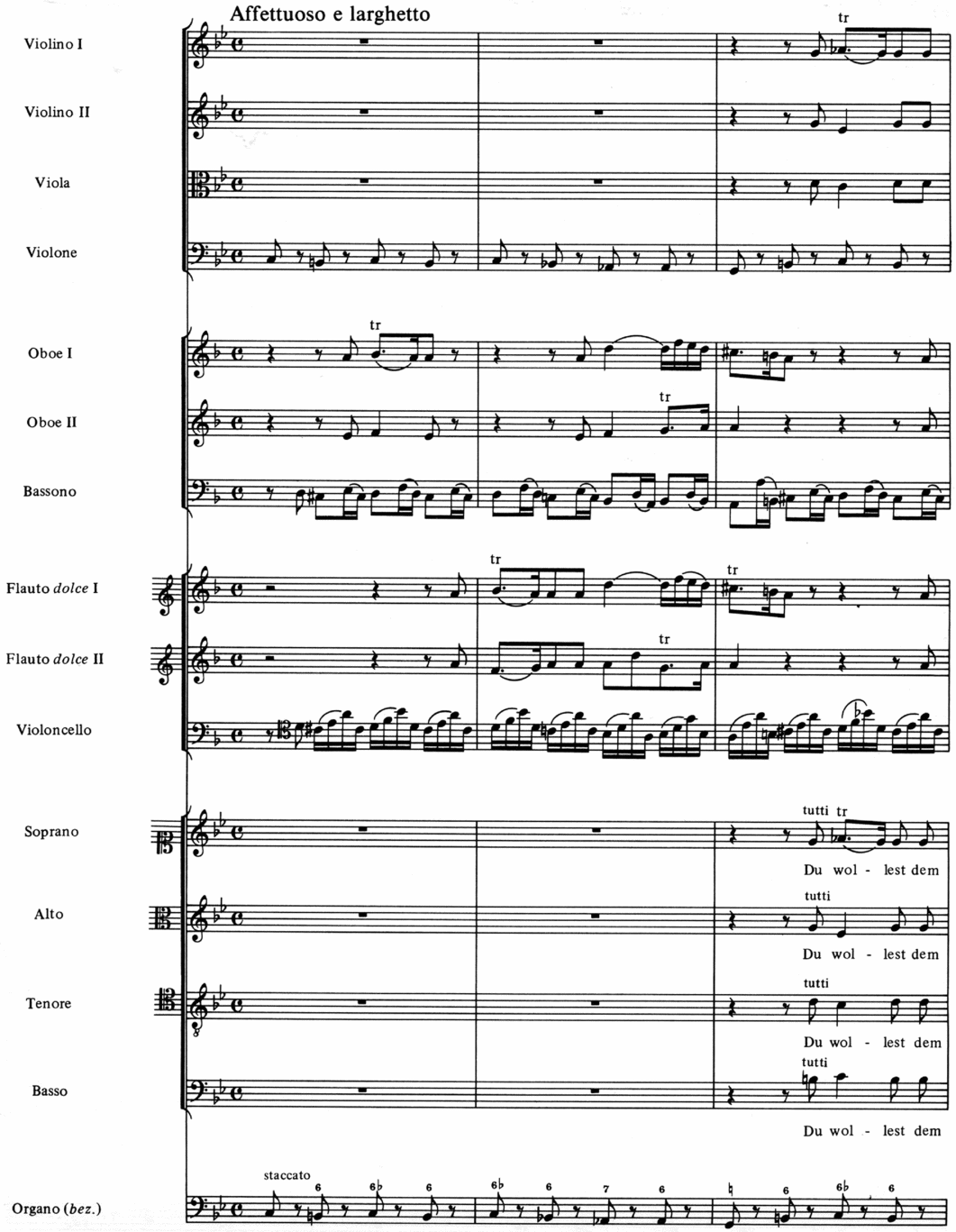
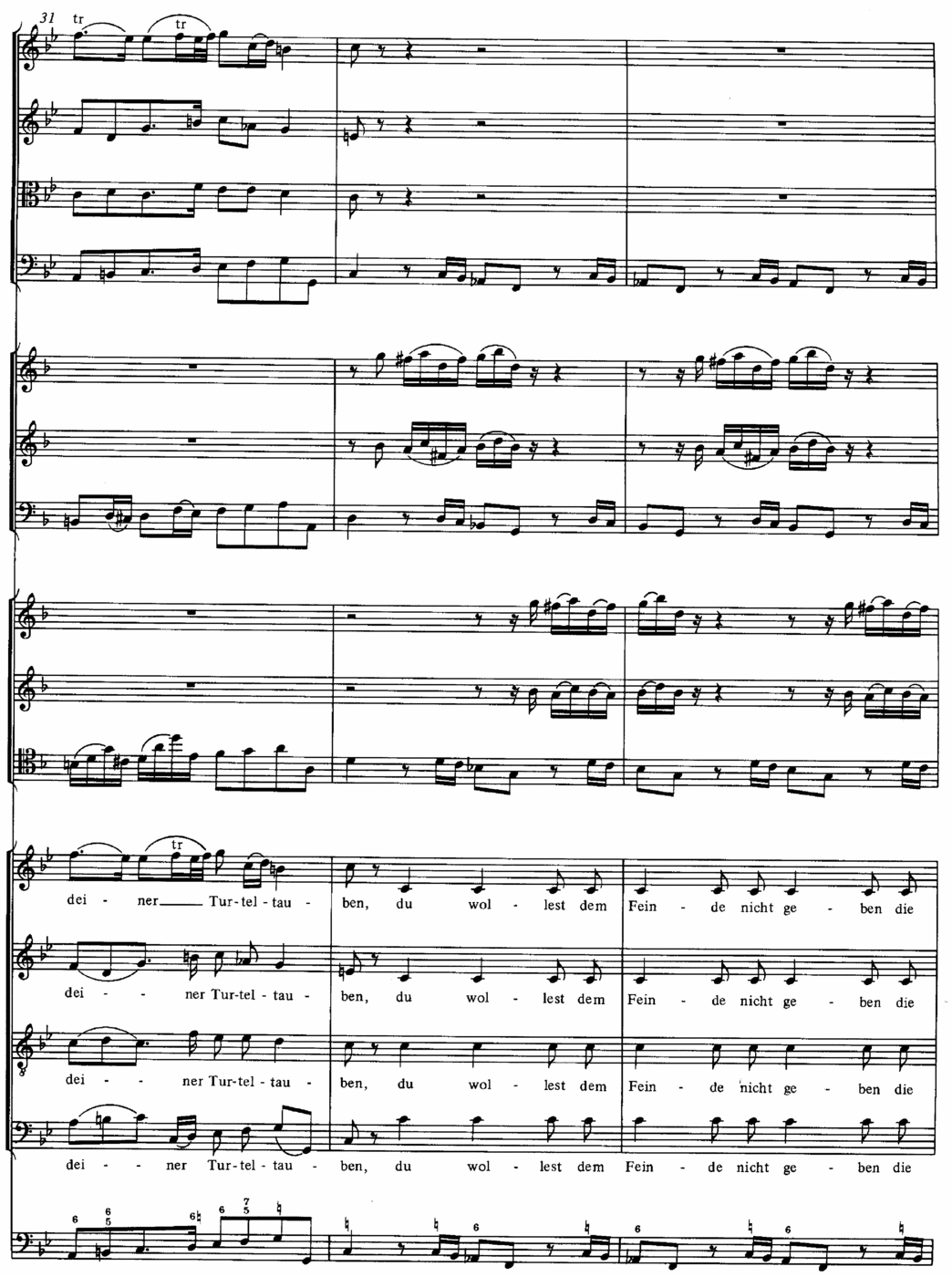
Let us again consider the cantata Gott ist mein König. In the sixth movement, all instrumental choirs and tutti voices participate. Recall that the Violone part does not reinforce the violin choir but doubles the basso continuo line (Organo) in the sixteen-foot register. The violoncello part functions as part of the recorder choir to which it is assigned, and the same is true of the eight-foot bassono part, which embellishes the figurations of the double-reed choir to which it belongs (Figure 6a).Footnote 126 Kuijken and Thomas would consider it a problem that there is a two-octave gap between the sixteen-foot violone part and the tutti bass voices. A dramatic moment occurs six bars from the end of this movement: while the tutti voices sing a unison middle C, all four bass instruments – violoncello, bassono, violone and organo – play the same figure (Figure 6b, bars 32–33). If we assume a sixteen-foot Violone, then at this point Bach has scored the same figure in three different octaves and four different instrumental timbres (including the keyboard continuo, which is primarily providing the eight-foot register). When played in this manner, the effect is striking, contrasting significantly with the unison Cs in the vocal parts and adding a depth to the texture that repetitive iterations of an eight-foot bass line in the bassono, (non-transposing twelve-foot) violone and organo would not produce.
Johann Sebastian Bach, Gott ist mein König, bwv71/vi, bars 1–3. Ratswahlkantaten I, ed. Christine Fröde, Johann Sebastian Bach: Neue Ausgabe Sämtlicher Werke, series 1, volume 32/1 (Kassel: Bärenreiter, 1992), 29. Used by permission
Johann Sebastian Bach, Gott ist mein König, bwv71/vi, bars 31–33
Even in works where the scoring is not this elaborate, the presence of an eight-foot organ part, not to mention an eight- (or twelve-)foot string bass in addition to the sixteen-foot violone, mitigates any gaps between the vocal bass line and the double-bass part. Manuscript parts seem to bear out this interpretation. Kuijken cites bwv48 as an example of a work where two-octave gaps between the instrumental and vocal bass lines are problematic. Extant sources for this piece, however, include three separate continuo parts (all labelled ‘Continuo’), one figured and two unfigured.Footnote 127 It seems likely that one of these was for a sixteen-foot violone, even if it is not specifically designated as such. Again, the duplication of the eight-foot bass line by several different instruments seems unlikely.
This type of scoring is found in a great deal of music involving double-bass instruments in a variety of genres throughout Europe in the eighteenth century. Mary Cyr points to instances of a two-octave separation between eight- and sixteen-foot instruments in the music of Jean-Philippe Rameau.Footnote 128 Indeed, this issue will no doubt sound particularly familiar to present-day contrabassists engaged with music for the Viennese Kontrabass in the mid- to late eighteenth century. A great deal of double-bass music from that time was routinely given over to the violoncello in the late nineteenth and early twentieth centuries by well-meaning scholars and performers. One famous example of this is the reassignment of the violone solos in the trios of Joseph Haydn's Symphonies Nos 6, 7 and 8 to the cello.Footnote 129 Often the justification for this change of scoring – particularly in regard to the ‘serenade quartet’ (two violins, viola and double bass) – was the presence of a ‘registral gap’ between the viola and contrabass in such a configuration.Footnote 130 This instrumentation is simply a reflection of the tastes and preferences of the time; it should not be viewed as some sort of aberration simply because we in the twenty-first century may find it unusual or ‘questionable’, as Kuijken puts it with reference to Bach's music.
Indeed, many of the views expressed by Kuijken, Thomas and Dreyfus concerning register, terminology, instrumental compass, technical difficulty and timbre were marshalled at various points during the twentieth century to discount the use of the contrabass in solo, chamber and orchestral works of the Viennese classical period. When the available evidence is viewed from a broadened perspective, the elimination of contrabass instruments from the works of Bach and his contemporaries appears similarly misguided.
APPENDIX
Descriptions of the violone in selected writings, 1556–1738