Introduction
The forests in NE Argentina are the tropical part of this country, including for example the famous Iguazú waterfalls on the border with Brazil. It comprises evergreen tropical rainforest in the eastern part (Misiones Province) and semi-deciduous subtropical forest to the west of this, as in the Chaco Province (Ferraro Reference Ferraro, Daniëls, Schulz and Peine1995). The non-foliicolous microlichens in this area are still incompletely known, unlike the foliicolous and foliose lichens (Ferraro Reference Ferraro1978, Reference Ferraro1997).
During a 10-day field trip by the authors in February 2013, special attention was paid to the pyrenocarpous lichens. Among the species found, no less than five appear to be undescribed. The purpose of this paper is to describe them so that they might also be recognized elsewhere, such as in adjacent Brazil, from where many other pyrenocarpous lichens have been recently described (Aptroot et al. Reference Aptroot, Sipman and Cáceres2013).
Material and Methods
Identification and descriptive work were carried out using an Olympus SZX7 stereomicroscope and an Olympus BX50 compound microscope with interference contrast, connected to a Nikon Coolpix digital camera. Sections were mounted in tap water, on which all measurements were taken. The chemistry of the type specimens was investigated by thin-layer chromatography (TLC) using solvent A (Orange et al. Reference Orange, James and White2001).
The Species
Aspidothelium submuriforme Aptroot, L. I. Ferraro & M. Cáceres sp. nov.
MycoBank No.: MB 805199
Corticolous Aspidothelium with globose, grey ascomata and ascospores mostly 7-septate with 0–2 oblique longitudinal septa, 25–28×8–10 µm.
Type: Argentina, Chaco Province, Parque Provincial Pampa del Indio, 26°16′20″S, 59°58′40″W, alt. c. 110 m, on twig bark in semi-deciduous subtropical forest, 26 February 2013, L. I. Ferraro, A. Aptroot & M. Cáceres 10732 (CTES—holotype; ABL—isotype).
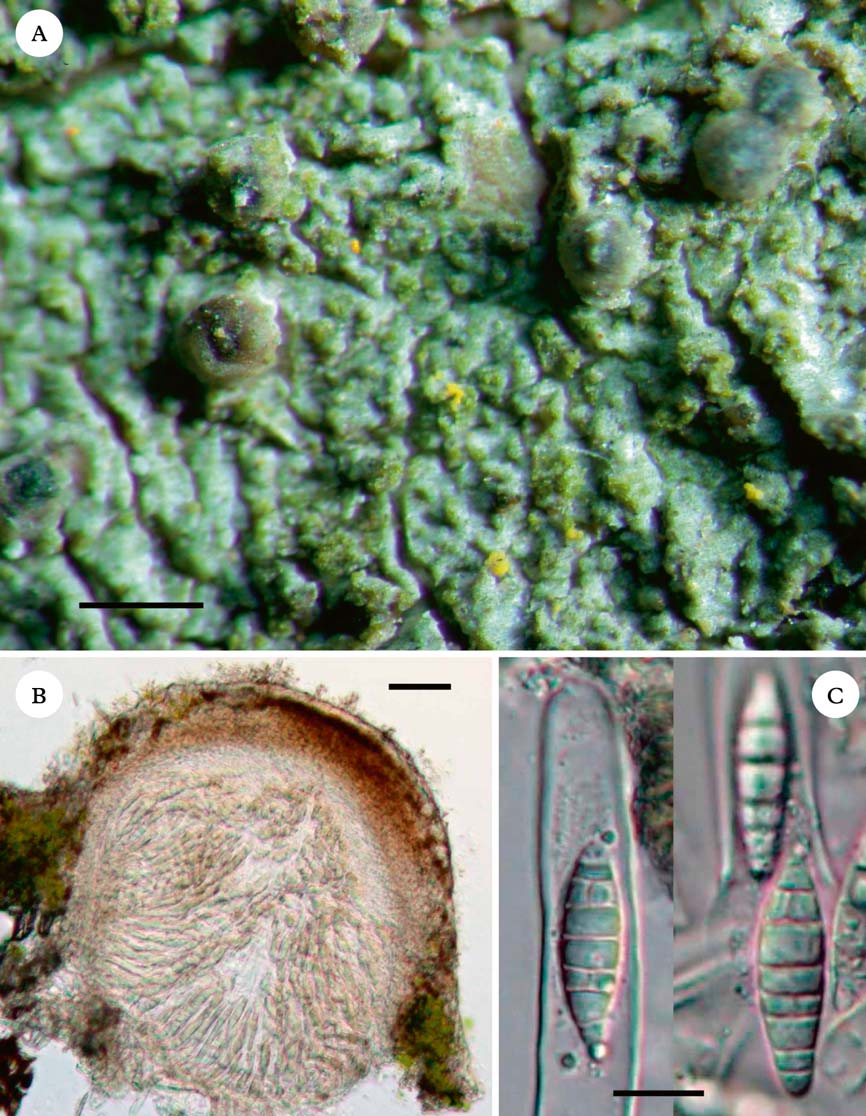
(Fig. 1)
Aspidothelium submuriforme (isotype). A, habit; B, section through ascoma; C, ascospores. Scales: A=0·5 mm; B=50 µm; C=10 µm. In colour online.
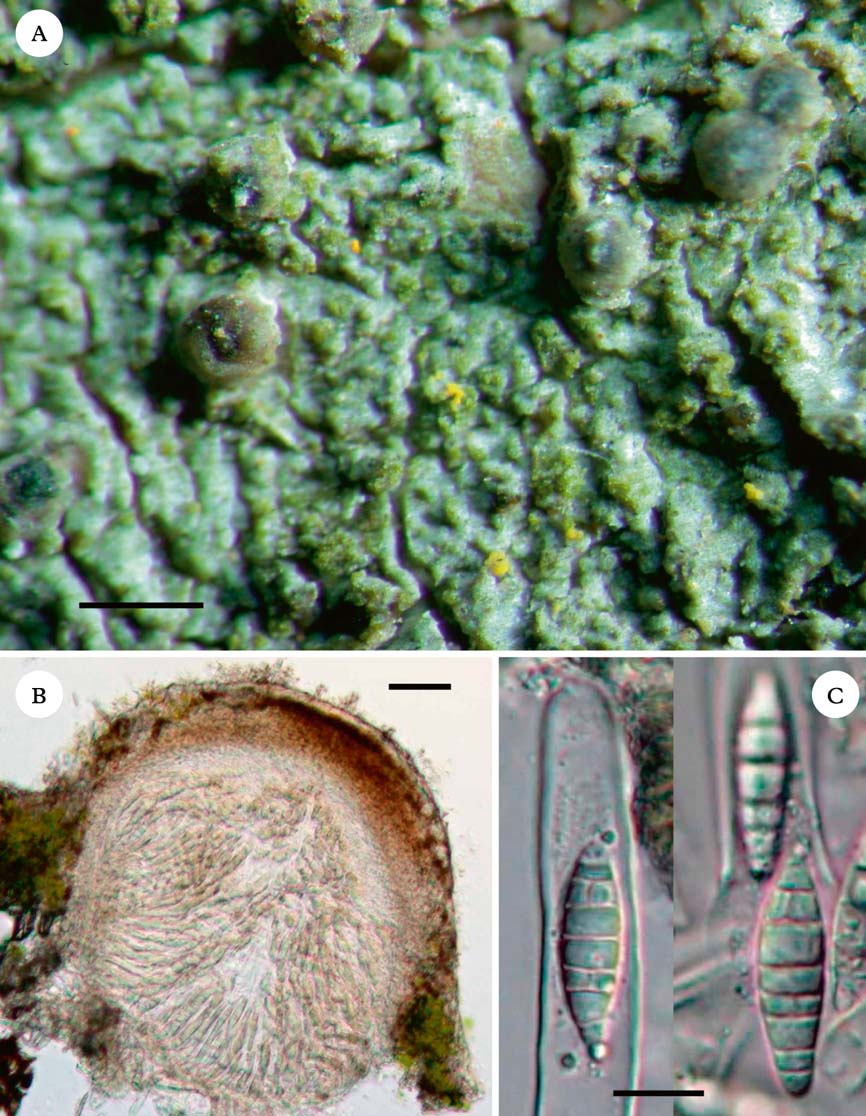
Thallus corticate, covering areas of up to 3 cm diam., smooth, continuous but consisting of isolated rounded patches towards the margin, thin, greyish, without prothallus. Algae chlorococcoid.
Ascomata perithecioid, sessile on the thallus, nearly globose, 0·3–0·4 mm diam. and height, sides greyish brown, top dark grey, without ornamentation. Wall carbonized only near the ostiole. Ostioles apical, dark grey. Hamathecium hyaline, not inspersed. Asci cylindrico-clavate, with 8 ascospores. Ascospores hyaline, submuriform, mostly 7-septate, rarely up to 11-septate, with 0–2 oblique longitudinal septa, asymmetrically clavate-fusiform, without constrictions, 25–28×8–10 µm, ends obtuse.
Pycnidia not observed.
Chemistry
Thallus UV−, C−, K−, KC−, P−. No substances detected by TLC.
Etymology
The epithet refers to the submuriform ascospores.
Ecology and distribution
On smooth bark of trees in semi-deciduous subtropical forest. Known only from Argentina.
Discussion
The genus Aspidothelium Vain. is a small genus with 12, mostly foliicolous, species (Lücking Reference Lücking2008). The new species has the smallest muriform ascospores known in the genus. All corticolous species known are keyed out in Aptroot et al. (Reference Aptroot, Lücking, Sipman, Umaña and Chaves2008). The new species is closest to Aspidothelium glabrum Lücking et al. (Aptroot et al. Reference Aptroot, Lücking, Sipman, Umaña and Chaves2008), which differs by the larger, densely muriform ascospores, and 4-spored asci. These differences, as well as the constant morphology of the richly fertile thalli of the new species, suggest that it is not merely young material of the latter.
Pyrenula inspersoleucotrypa Aptroot, L. I. Ferraro & M. Cáceres sp. nov.
MycoBank No.: MB 805200
Corticolous Pyrenula having thallus without pseudocyphellae, aggregated ascomata, inspersed hamathecium, and ascospores of 17–20×6·5–8·0 µm with diamond-shaped lumina.
Type: Argentina, Misiones Province, Puerto Iguazú, near Hotel Selvático Don Horacio, 25°36′20″S, 54°33′33″W, alt. c. 230 m, on tree bark in evergreen tropical rainforest, 22 February 2013, L. I. Ferraro, A. Aptroot & M. Cáceres 10533 (CTES—holotype; ABL—isotype).
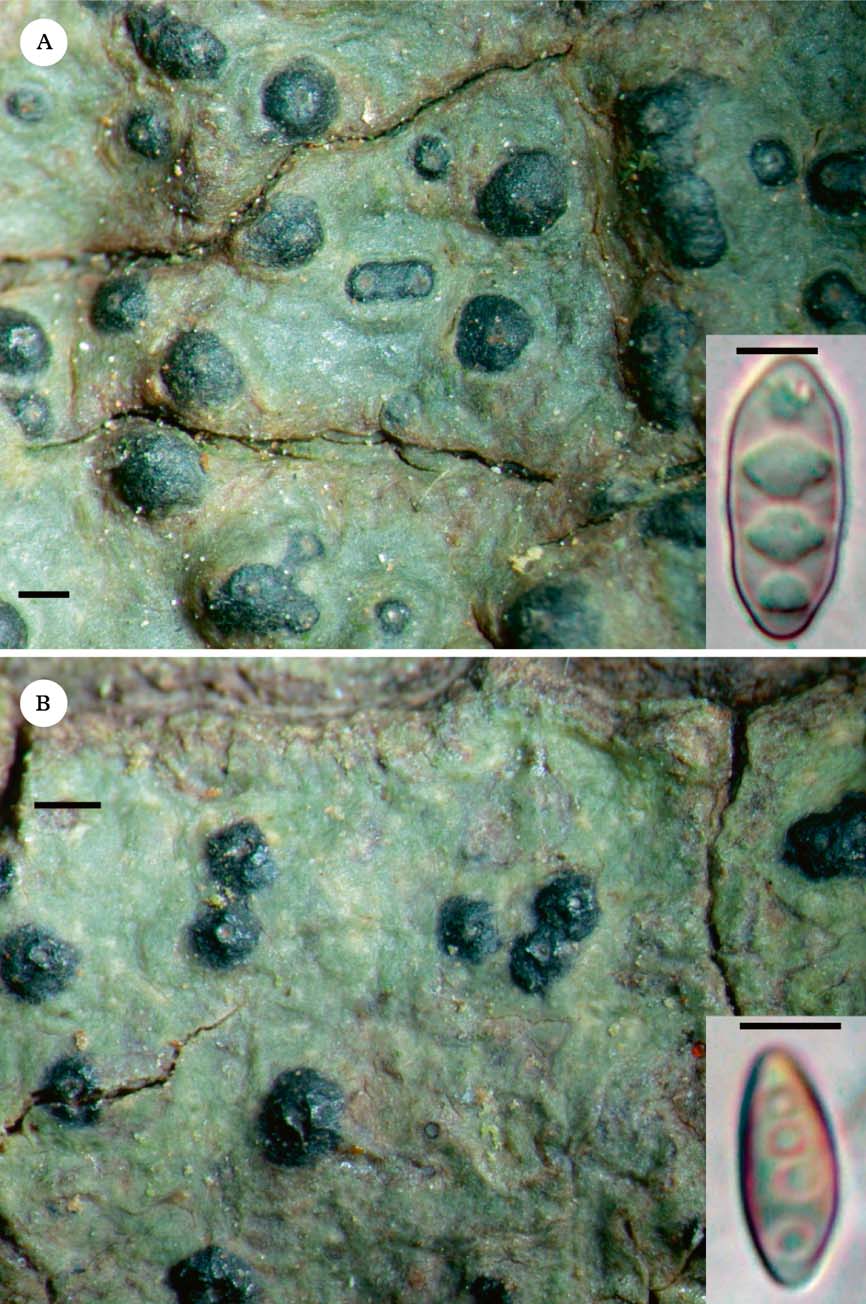
(Fig. 2A)
Pyrenula inspersoleucotrypa (isotype), habit; inset, ascospore. B, Pyrenula punctoleucotrypa (isotype), habit, inset, ascospore. Scales: A & B=0·5 mm; insets=5 µm. In colour online.
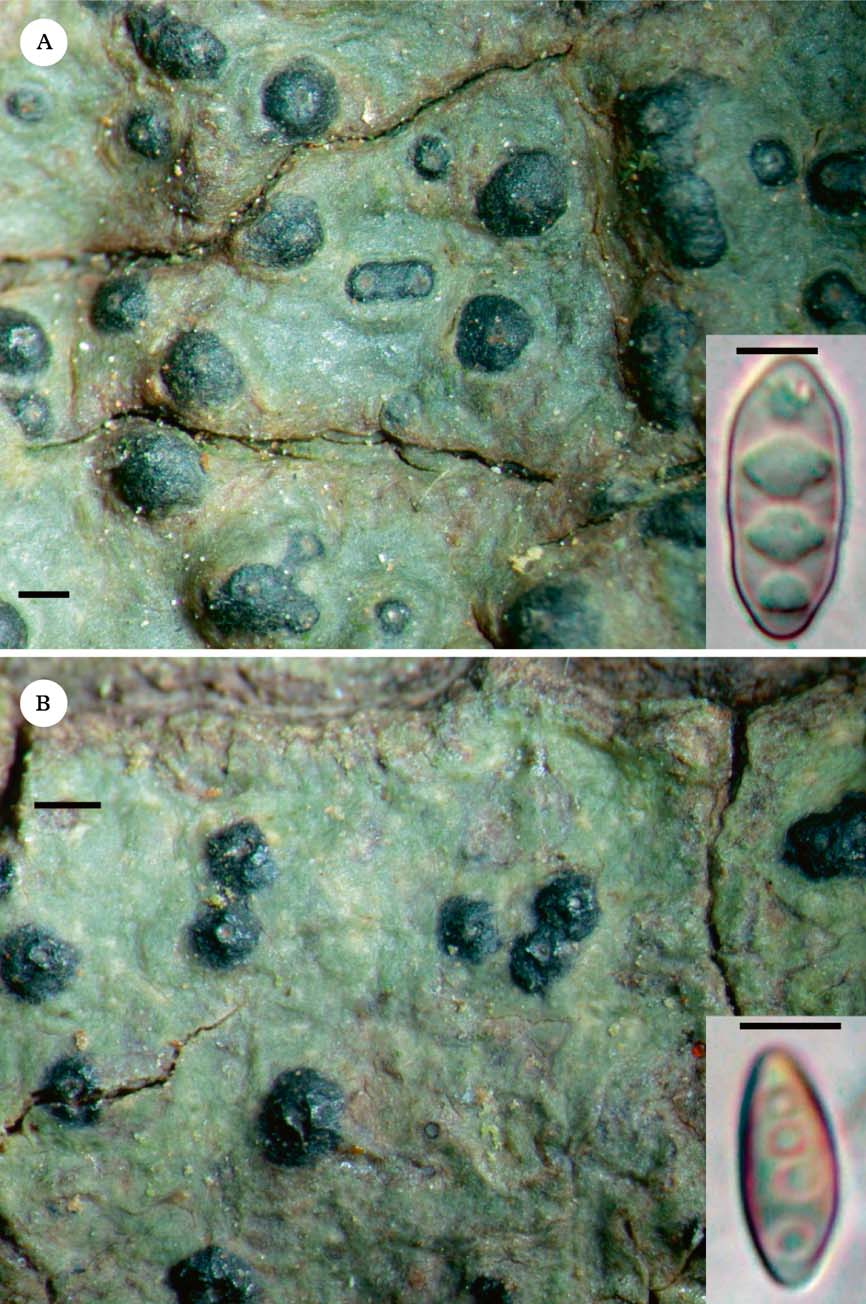
Thallus corticate, smooth, continuous, rather thin, olivaceous brown, without pseudocyphellae, surrounded by a black prothallus line. Algae trentepohlioid.
Ascomata perithecioid, erumpent, 0·4–1·2 mm diam., black, conical with flattened tips, mostly aggregated in groups or lines of 2–8, with partly fused walls but separate ostioles. Wall carbonized all around, up to c.100 µm thick. Ostioles pale brown, apical, flat. Hamathecium hyaline, inspersed with hyaline oil droplets. Asci cylindrico-clavate, with 8 ascospores. Ascospores brown, 3-septate, fusiform, without constrictions, 17–20×6·5–8·0 µm, ends obtuse but rather pointed, middle lumina broadly diamond-shaped, end lumina triangular, separated from the wall by thick endospore layer.
Pycnidia not observed.
Chemistry
Thallus UV−, C−, K−, KC−, P−. No substances detected by TLC.
Etymology
The name refers to the inspersed hamathecium and the superficial similarity to Pyrenula leucotrypa (Nyl.) Upreti.
Ecology and distribution
On smooth bark of trees in rainforest. Known only from Argentina.
Discussion
This species does not key out in the world key to the species of Pyrenula Ach. (Aptroot Reference Aptroot2012). The new species is close to Pyrenula infraleucotrypa Aptroot & M. Cáceres (Aptroot et al. Reference Aptroot, Sipman and Cáceres2013), which was found and described after the publication of the world key. It differs from the latter mainly by the inspersed hamathecium.
Pyrenula punctoleucotrypa Aptroot, L. I. Ferraro & M. Cáceres sp. nov.
MycoBank No.: MB 805201
Corticolous Pyrenula having thallus with pseudocyphellae, aggregated ascomata in a conical pseudostroma, with fused ostioles, not inspersed hamathecium, and ascospores 10–12×4–5 µm with rounded lumina.
Type: Argentina, Misiones Province, Puerto Iguazú, near Hotel Selvático Don Horacio, 25°36′20″S, 54°33′33″W, alt. c. 230 m, on tree bark in evergreen tropical rainforest, 22 February 2013, L. I. Ferraro, A. Aptroot & M. Cáceres 10530 (CTES—holotype; ABL—isotype).
(Fig. 2B)
Thallus corticate, smooth, continuous, rather thin, olivaceous green, with numerous pale pseudocyphellae, surrounded by a black prothallus line. Algae trentepohlioid.
Ascomata perithecioid, pyriform, c. 0·2–0·4 mm diam., immersed in erumpent, 0·4–1·2 mm diam., black, conical pseudostromata with flattened tips, which are formed by the fused walls of 2–6 ascomata with mostly fused ostioles. Wall carbonized mostly above and fusing to form an up to c.100 µm thick pseudostroma. Ostioles pale brown, lateral, but central in the conical pseudostroma, often concave and angular. Hamathecium hyaline, not inspersed. Asci cylindrico-clavate, with 8 ascospores. Ascospores brown, 3-septate, fusiform, without constrictions, 10–12×4–5 µm, ends obtuse, lumina rounded, separated from the wall by thick endospore layer.
Pycnidia not observed.
Chemistry
Thallus UV−, C−, K−, KC−, P−. No substances detected by TLC.
Etymology
The epithet refers to the pseudocyphellae and the superficial similarity to Pyrenula leucotrypa.
Ecology and distribution
On smooth bark of trees in rainforest. Known only from Argentina.
Discussion
This species would key out close to Pyrenula septicollaris (Eschw.) R. C. Harris in the world key to the species of Pyrenula (Aptroot Reference Aptroot2012). In the latter species however, the ascomata are generally fused together only with the ostioles, not the walls as in the new species, and the ascospores are always longer. The new species is in aspect closer to Pyrenula paraminarum Aptroot & M. Cáceres (Aptroot et al. Reference Aptroot, Sipman and Cáceres2013), which was found and described after the publication of the world key. It differs from the latter mainly by the smaller ascospores, the fused lateral ostioles and the presence of pseudocyphellae. The presence or absence of pseudocyphellae seems to be a rather fundamental character within the genus Pyrenula, as it is the only morphological character that is well correlated with the basal split within the genus following a preliminary phylogenetic reconstruction (Weerakoon et al. Reference Weerakoon, Aptroot, Lumbsch, Wolseley, Wijeyaratne and Gueidan2012). The ascospores in the new species are among the smallest known in the genus, with only Pyrenula minutissima Aptroot et al. (Aptroot et al. Reference Aptroot, Valadbeigi and Sipman2012) having smaller ascospores (7–10 µm long).
Strigula muriconidiata Aptroot, L. I. Ferraro & M. Cáceres sp. nov.
MycoBank No.: MB 805202
Corticolous Strigula with immersed pycnidia with hyaline, densely muriform, ellipsoid conidia of 90–103×32–35 µm.
Type: Argentina, Chaco Province, Parque Provincial Pampa del Indio, 26°16′20″S, 59°58'40″W, alt. c. 110 m, on tree bark in semi-deciduous subtropical forest, 26 February 2013, L. I. Ferraro, A. Aptroot & M. Cáceres 10781 (CTES—holotype; ABL—isotype).
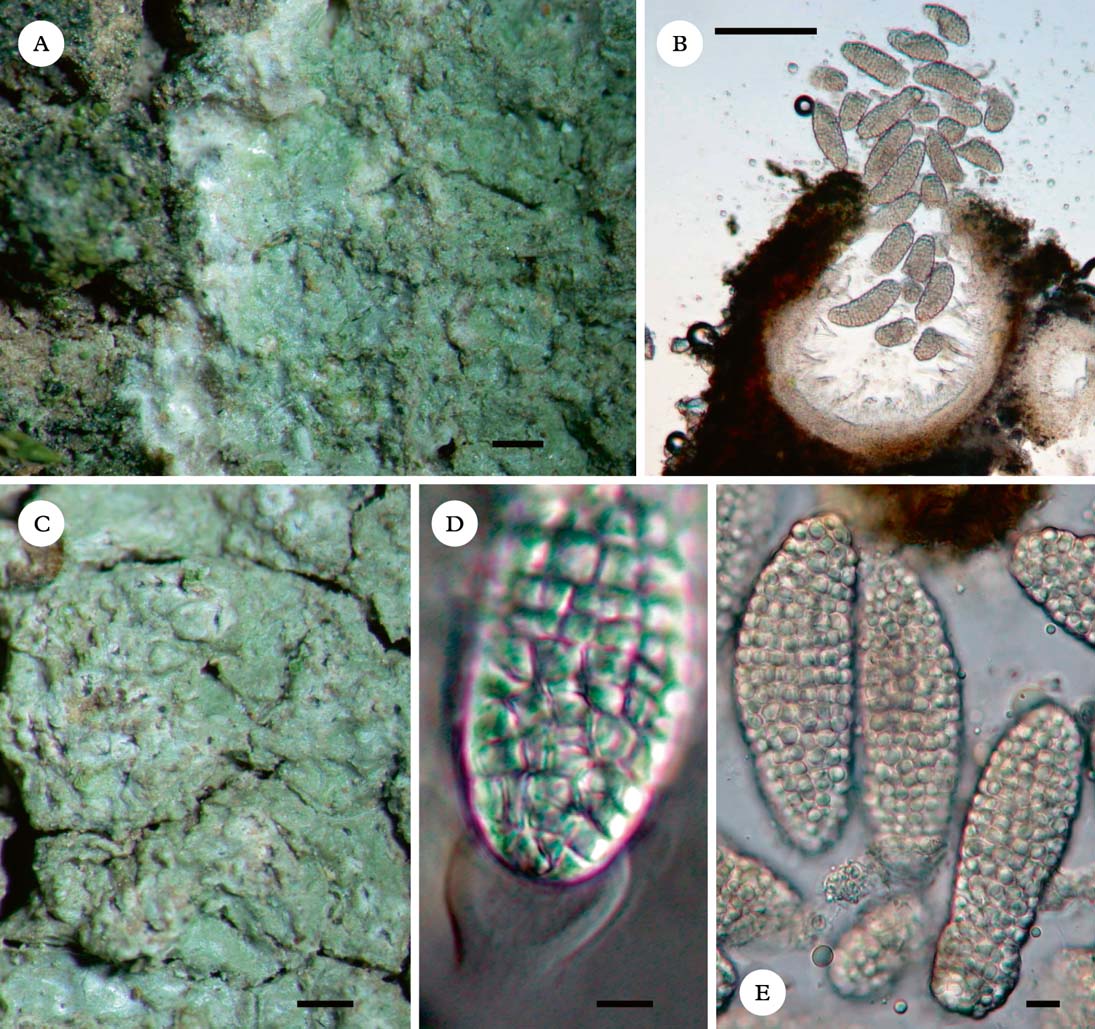
(Fig. 3)
Strigula muriconidiata (isotype). A, prothallus; B, section through pycnidium; C, habit; D & E, conidia. Scales: A & C=0·5 mm; B=50 µm; D=10 µm. In colour online.
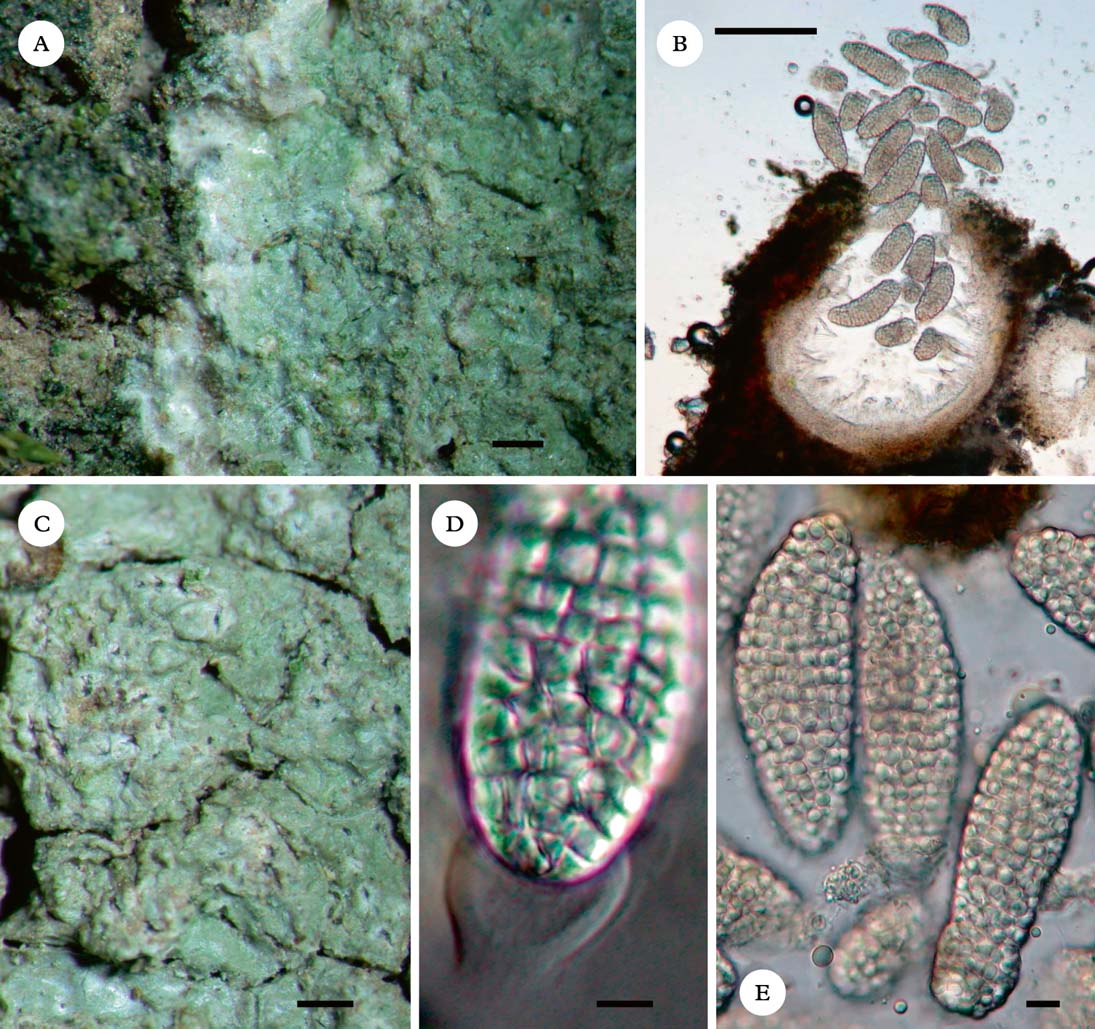
Thallus corticate, continuous, covering areas of up to 10 cm diam., thin, smooth and glossy towards the margin, dull and with an intricate pattern of small folds towards the centre, grey, with glossy whitish prothallus zone. Algae trentepohlioid.
Ascomata not observed.
Pycnidia immersed in the bark, 0·2–0·4 mm diam., hyaline, visible from above by a whitish ostiolar region. Conidiogenous cells hyaline, filamentous, 30–35×2–3 µm. Conidia hyaline, densely muriform, ellipsoid, 90–103×32–35 µm, some with triangular, 10–15 µm wide, 10–20 µm long gelatinous appendage at one end.
Chemistry
Thallus UV−, C−, K−, KC−, P−. TLC: atranorin, zeorin.
Etymology
The specific epithet refers to the muriform conidia.
Ecology and distribution
On smooth bark of trees in semi-deciduous subtropical forest. Known only from Argentina.
Discussion
The genus Strigula Fr. was long known to contain mostly tropical foliicolous lichens with tiny, 1-septate ascospores. Various tropical and temperate corticolous species, some with more septa, were gradually added to the genus. Harris (Reference Harris1995) and McCarthy (Reference McCarthy1995) expanded the scope of the genus by including species with muriform ascospores.
At present, it is not certain that these muriform taxa are really closely related to the core group of the genus, as no muriform taxa have yet been sequenced. This new species is attributed here to the genus Strigula as it fits the general profile, even though ascomata were not found, and especially because at least some conidia bear gelatinous appendages. Somewhat similar, large, muriform conidia are known only from this genus in lichenized fungi. Strigula muriformis Aptroot & Diederich (Aptroot et al. Reference Aptroot, Diederich, Sérusiaux and Sipman1997) is closest, but has smaller (57–63×16–20 µm) conidia that bear gelatinous appendages at both ends. Moreover, it is saxicolous and occurs in Papua New Guinea.
Even if the new species eventually turns out not to belong to this genus, it is still undoubtedly an undescribed species, as no lichen with such conidia has ever been reported.
This new species is common and abundant in two of the forests visited during the field trip. It differs from all known lichens by the large muriform conidia.
Additional specimens seen. Argentina: Chaco: same as the type, L. I. Ferraro, A. Aptroot & M. Cáceres 10780; 15 km W of Presidencia Roca, alt. 100 m, 26°06′28″S, 59°47′20″W, on tree bark in semi-deciduous subtropical forest, 2013, L. I. Ferraro, A. Aptroot & M. Cáceres 10884 & 10887 (all CTES, ABL).
Trypethelium globolucidum Aptroot, L. I. Ferraro & M. Cáceres sp. nov.
MycoBank No.: MB 805203
Corticolous Trypethelium forming sessile pseudostromata with black and whitish parts, inspersed hamathecium, ascospores 13–19-septate, (65–)83–97×11·5–14·5 µm, lumina rounded to lentiform and containing lichexanthone.
Type: Argentina, Misiones Province, Iguazú National Park, along railroad, 25°41′50″S, 54°26′50″W, alt. c. 200 m, on twig bark along path near evergreen tropical rainforest, 24 February 2013, L. I. Ferraro, A. Aptroot & M. Cáceres 10630 (CTES—holotype; ABL—isotype).
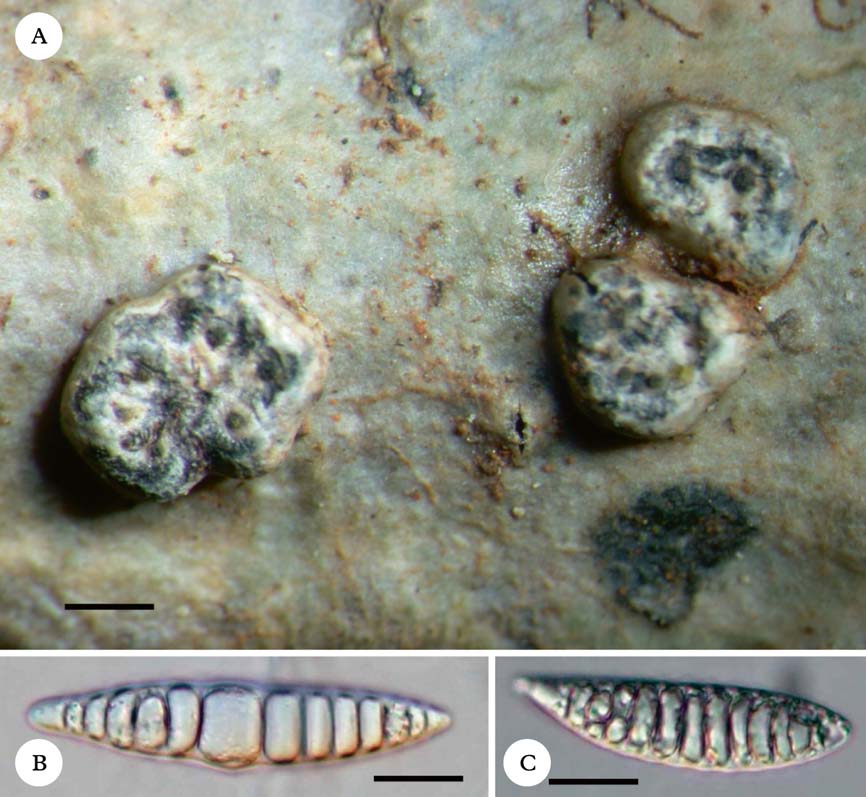
(Fig. 4)
Trypethelium globolucidum (isotype). A, habit; B, mature ascospore; C, young ascospore. Scales: A=0·5 mm; B & C=10 µm. In colour online.
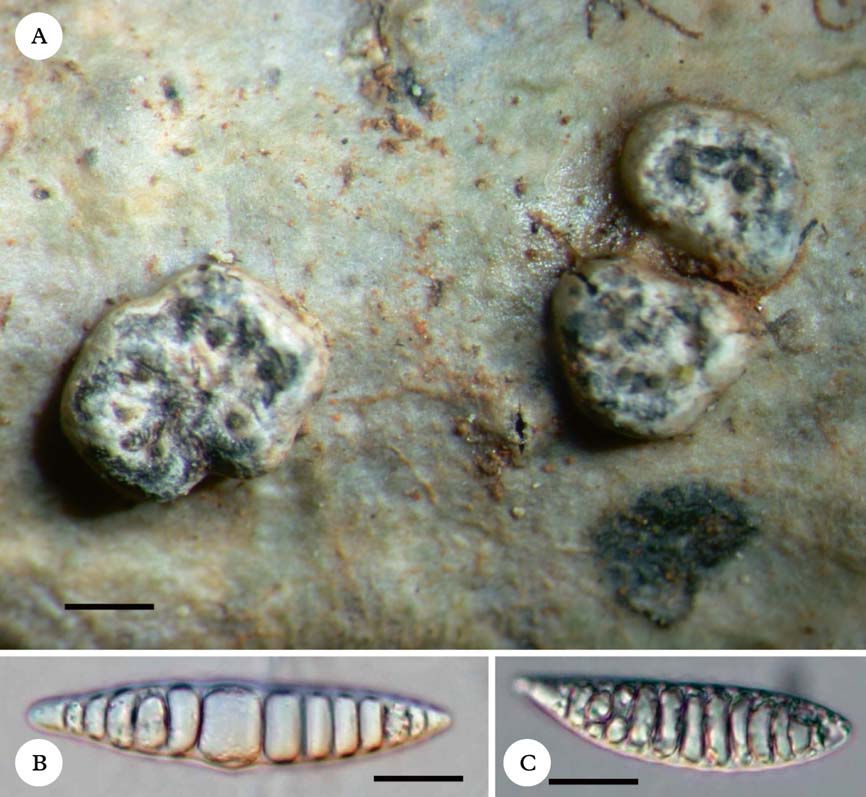
Thallus corticate, smooth, somewhat shiny, continuous, covering areas up to 10 cm long and encircling twigs, thin, olivaceous green to olivaceous brown, without pseudocyphellae, surrounded by a black prothallus line. Algae trentepohlioid.
Ascomata perithecioid, sessile, 0·4–0·8 mm diam., black, mostly aggregated with 2–12(–25) in pseudostromata. Wall carbonized all around, up to c. 100 µm thick. Ostioles apical, flat to usually papillate, red-brown to black. Pseudostromata lobate in outline, up to c. 3 mm diam. and 1·5 mm high, sessile with nearly vertical sides, partly or completely covered with whitish to cream tissue. Hamathecium hyaline, inspersed with hyaline oil globules. Asci cylindrico-clavate, with 8 ascospores. Ascospores hyaline, 13–19-septate, fusiform, with a slight constriction at the median septum, (65–)83–97×11·5–14·5 µm, ends rather pointed, lumina rounded to lentiform, surrounded by a gelatinous layer of up to 7 µm thick.
Pycnidia not observed.
Chemistry
Thallus UV−, C−, K−, KC−, P−; whitish parts of pseudostromata UV+ yellow. TLC: lichexanthone.
Etymology
The epithet refers to the sessile, nearly globose ascomata and the UV+ yellow (lucid) reaction.
Ecology and distribution
On smooth twig bark of trees along path near rainforest. Known only from Argentina.
Discussion
The genus Trypethelium Spreng. is a mostly tropical genus. So far, over 100 species have been described within it, but a significant proportion of those are synonyms or accepted in other genera. Phylogenetic studies of the family Trypetheliaceae (M. P. Nelsen, R. Lücking, A. Aptroot, C. J. Andrew, M. E. S. Cáceres, E. Rivas Plata, C. Gueidan, L. Da Silva Canez, A. Knight, L. R. Ludwig, et al. unpublished data) have shown that the type species of the genus, Trypethelium eluteriae Spreng., does not cluster with the majority of the species in the genus, and particularly not with the most common species. It forms a monophyletic group that is characterized by hyaline, multiseptate, transversely septate ascospores with rounded lumina. The lumen shape in Trypethelium is unique within the family, characterized mostly by diamond-shaped lumina due to thick endospore formation, and also species without endospore formation resulting in quadrangular lumina. In this restricted sense, the genus Trypethelium probably encompasses less than 10 species. The new species differs from all species in the family by the combination of 65–97 µm long ascospores with many (at least 13) septa and the presence of lichexanthone on the whitish pseudostromata, but absent in the thallus.
Additional specimens seen. Argentina: Misiones: Iguazú National Park, Paseos Superiores, 2003, L. I. Ferraro & O. Popoff 6792; Iguazú National Park, Senderos Macuco, 2003, L. I. Ferraro & O. Popoff 6601 (all CTES & ABL).
The Stichting Hugo de Vries-Fonds is warmly thanked for a travel grant to AA. The Subsecretaria de Recursus Naturales of the Provincia del Chaco granted a collection permit to the authors. The CNPq (Conselho Nacional de Desenvolvimento Científico e Tecnológico) is thanked for a research grant to MESC (Processo 501633/2009-0). We are grateful to Leo Spier (Amersfoort) for performing thin-layer chromatography.