Balloon aortic valvuloplasty and open surgical valvotomy are two well-described procedures to treat neonatal aortic stenosis, and there is controversy as to which method has superior outcomes.Reference Backer1 Comparative data between the two methods during the era of modern surgical techniques are lacking, and there have been no randomised control trials. The choice of method often depends on institutional preference. Balloon aortic valvuloplasty was first performed in 1982 for relief of obstruction at the aortic valve for congenital aortic stenosis.Reference Lababidi, Wu and Walls2 Balloon aortic valvuloplasty has the advantages of not requiring cardiopulmonary bypass or sternotomy and shorter recovery time. Historically, surgical valvotomy consisted of passing a dilator through the aortic valve from the left ventricular apex.Reference Brown, Ruzmetov, Vijay, Rodefeld and Turrentine3 Surgical valvotomy techniques have evolved resulting in improved outcomes by allowing direct visualisation of the aortic valve, splitting of fused aortic valve commissures, and resecting obstructive nodules in a controlled setting.Reference Hraska4 The aim of this study is to compare the outcomes of neonatal balloon aortic valvuloplasty and surgical valvotomy performed in the era of modern surgical techniques.
Materials and methods
We reviewed the medical records from 2000 to 2017 of all patients at our institution who had a balloon aortic valvuloplasty or surgical valvotomy at less than or equal to 60 days of age. The decision to perform a balloon aortic valvuloplasty or surgical valvotomy was at the discretion of the clinician. Patients were identified using institutional surgical and catheterisation databases. We excluded patients who did not have a biventricular repair and patients whose surgical valvotomy consisted of dilation with a Hegar dilator.
Our surgical techniques changed in 2011 from dilation of the aortic valve with a Hegar dilator to an open commissurotomy. Surgical valvotomy was performed through a median sternotomy using hypothermic cardiopulmonary bypass. Exposure of the aortic valve was established through an oblique aortic incision. Myocardial protection was provided with cold potassium blood cardioplegia and topical hypothermia. After oblique aortotomy, the aortic valve was inspected and a commissurotomy was carried out at true commissures to the level of the aortic annulus or to the extent permissible without detaching a leaflet. To avoid aortic insufficiency, the false raphe of the fused leaflets was rarely opened to any degree. Obstructive myxomatous and fibrinous nodules on the leaflet surfaces were shaved or thinned. Subvalvular obstruction was resected if present. Patch enlargement of the non-coronary aortic sinus was performed if primary aortic closure was thought to narrow the sinotubular junction or on occasion to give the thickened aortic leaflets more room to separate during systole.Reference Brown, Rodefeld, Ruzmetov, Eltayeb, Yurdakok and Turrentine5
Balloon aortic valvuloplasty was performed in the cardiac catheterisation laboratory using either retrograde femoral artery access or surgical carotid exposure. A variety of balloons were used and were carefully chosen not to exceed the balloon diameter–aortic annulus diameter ratio of 1:1. Two to three inflations were performed. Echo guidance was not used. All procedures were performed using general anesthesia.Reference Brown, Rodefeld, Ruzmetov, Eltayeb, Yurdakok and Turrentine5
Medical records reviewed included transthoracic echocardiogram and catheterisation reports, operative notes, discharge summaries, and clinic notes. The primary endpoint was freedom from re-intervention, including repeat balloon aortic valvuloplasty, surgical valvotomy, or aortic valve replacement including Ross procedure. Secondary endpoints included mortality, reduction in aortic valve gradient, development of aortic regurgitation, and length of hospitalisation. We reviewed the reports for transthoracic echocardiogram performed prior to and after procedure. We further looked at outcomes of patients who had critical aortic stenosis. We defined critical aortic stenosis as need for prostaglandin administration prior to procedure, which was at the discretion of the clinician. We also looked at the outcomes for patients who had significantly decreased left ventricular function, which we defined as left ventricular ejection fraction on transthoracic echocardiogram <35%. Student’s t-test was used to calculate p-values. Kaplan–Meier survival curves were made to calculate freedom from re-intervention for balloon aortic valvuloplasty and open surgical valvotomy.
Results
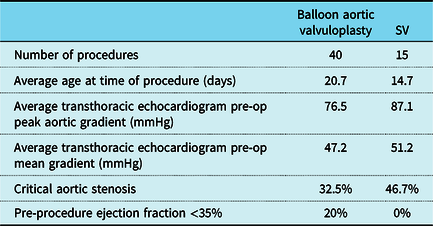
Forty patients had a balloon aortic valvuloplasty performed for neonatal aortic stenosis and 15 patients had an open surgical valvotomy. The average age at the time of procedure was 20.7 ± 18.5 days for balloon aortic valvuloplasty and 14.7 ± 13.9 days for surgical valvotomy. There was no difference in the pre-procedure peak aortic valve gradient by transthoracic echocardiogram between groups (76.5 mmHg for balloon aortic valvuloplasty and 87.1 mmHg for surgical valvotomy patients, p = 0.11). There was also no difference in the pre-procedure aortic valve mean gradient by transthoracic echocardiogram when comparing both procedures (47.2 mmHg for balloon aortic valvuloplasty and 51.1 mmHg for surgical valvotomy patients, p = 0.29). There were no patients with significant aortic insufficiency in either group pre-procedure. Critical aortic stenosis was present in 13 out of 40 patients (32.5%) in the balloon aortic valvuloplasty group and in 7 out of 15 patients (46.7%) in the surgical valvotomy group. Moderately or greater decreased left ventricular systolic function prior to procedure was present in 8 out of 40 patients (20%) in the balloon aortic valvuloplasty group and in no patients in the surgical valvotomy group (Table 1).
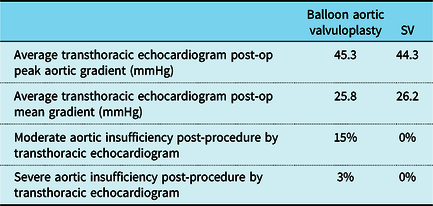
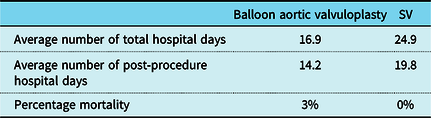
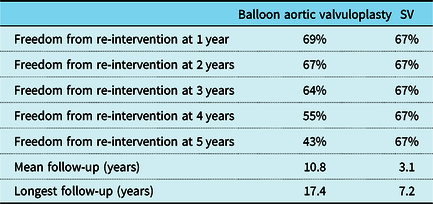
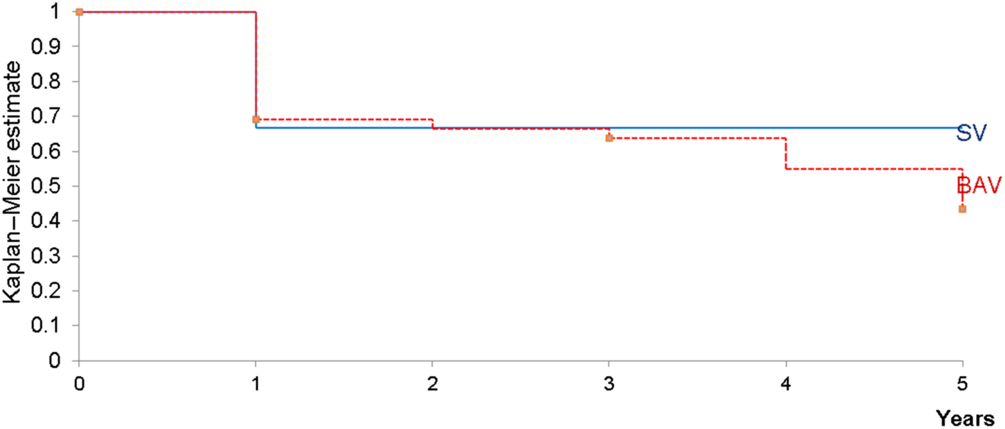
There was no difference in post-procedure peak aortic valve gradient by transthoracic echocardiogram (45.3 mmHg for balloon aortic valvuloplasty and 44.3 mmHg for surgical valvotomy, p = 0.82). There was also no difference in post-procedure aortic valve mean gradient by transthoracic echocardiogram (25.8 mmHg for balloon aortic valvuloplasty and 26.2 mmHg for surgical valvotomy, p = 0.87). Post-procedure, 15% of balloon aortic valvuloplasty patients had moderate aortic insufficiency and 2.5% of patients had severe aortic insufficiency, while no surgical valvotomy patients had moderate or severe aortic insufficiency (Table 2). When comparing patients who had balloon aortic valvuloplasty from 2000 to 2008 to those who had the procedure from 2008 to 2016, the average mean post-procedure peak and mean aortic gradients were similar in both eras. However, from 2000 to 2008, there was a 17.4% incidence of moderate or severe aortic insufficiency post-procedure, while from 2009 to 2016 there was only a 7.7% incidence of moderate or severe aortic insufficiency. We are not aware of any change in procedure technique between eras that would account for this difference. The average number of total hospital days was 16.9 days for balloon aortic valvuloplasty and 24.9 days for surgical valvotomy (p = 0.39). The average number of post-procedure hospital days was 14.2 days for balloon aortic valvuloplasty and 19.8 days for surgical valvotomy (p = 0.52) (Table 3). Freedom from re-intervention at 1 year was 69% for balloon aortic valuloplasty and 67% for surgical valvotomy. Freedom from re-intervention at 5 years was 43% for balloon aortic valvuloplasty and 67% for surgical valvotomy (p = 0.60) (Table 4 and Figure 1). Freedom from re-intervention for balloon aortic valvuloplasty was 27.6% at 10 years and 18.4% at 15 years. There were no significant procedure-related complications in either group other than the development of aortic insufficiency in some of the balloon aortic valvuloplasty patients. There were no mortalities in the surgical valvotomy group. One balloon aortic valvuloplasty patient died 22 days post-procedure from sepsis which was unrelated to the initial procedure (Table 3). The longest surgical valvotomy follow-up was 7.2 years and the longest balloon aortic valvuloplasty follow-up was 17.4 years. Average follow-up was 10.8 ± 4.4 years for balloon aortic valvuloplasty and 3.1 ± 1.7 years for surgical valvotomy (Table 4).
Patient demographics

Post-procedure measurements

Early outcomes

Late outcomes

Freedom from re-intervention for balloon aortic valvuloplasty and open surgical valvotomy.

Discussion
In our study, we found that balloon aortic valvuloplasty and open surgical valvotomy were equally effective in reducing the aortic valve gradient in neonatal aortic stenosis, as the pre-procedure and post-procedure peak and mean aortic valve gradients were not significantly different. Higher post-procedure aortic valve gradient is associated with increased rate of repeat intervention and aortic valve replacement.Reference Maskatia, Ing and Justino6–Reference Petit, Ing, Mattamal, Pignatelli, Mullins and Justino8 Balloon aortic valvuloplasty did have a higher rate of moderate or severe aortic insufficiency post-procedure, while no patients in the surgical valvotomy group had moderate or severe aortic insufficiency. Patients who had balloon aortic valvuloplasty in the later era had a lower rate of aortic insufficiency post-procedure. Our rate of post-procedure aortic insufficiency was comparable to prior studies.Reference Boe, Zampi and Kennedy9 Post-procedure aortic insufficiency has been identified as a significant risk factor for need for aortic valve surgery or replacement.Reference Sullivan, Rubio, Johnston and Jones7,Reference Rossi, Manica, Petraco, Scott, Piazza and Machado10 There were no procedure-related mortalities in either group. Patients in the balloon aortic valvuloplasty group had fewer total hospital days and post-procedure hospital days, which would be expected because balloon aortic valvuloplasty is less invasive than surgical valvotomy, but the difference was not significantly significant. Both groups had similar rates of freedom from re-intervention at 1-year post-procedure. Surgical valvotomy had a higher rate of freedom from re-intervention at 5-year post-procedure, but this difference was not statistically significant. A significant number of patients in the balloon aortic valvuloplasty group (20%) had at least moderately decreased ventricular systolic function pre-procedure with a left ventricular ejection faction <35%, while no patients in the surgical valvotomy group had at least moderately decreased systolic function pre-procedure.
Balloon aortic valvuloplasty and open surgical valvotomy have been shown to be effective therapies for the treatment of neonatal aortic stenosis.Reference Maskatia, Ing and Justino6–Reference Boe, Zampi and Kennedy9,Reference Torres, Vincent and Everett11 Neonatal balloon aortic valvuloplasty is a higher risk procedure than balloon aortic valvuloplasty in older patients, as neonates undergoing balloon aortic valvuloplasty have a greater chance of needing repeat interventions on left ventricular outflow tract than non-neonates.Reference Maskatia, Ing and Justino6,Reference Sullivan, Rubio, Johnston and Jones7 Balloon aortic valvuloplasty outcomes have improved over time with improved equipment and technique.Reference Boe, Zampi and Kennedy9,Reference Rossi, Manica, Petraco, Scott, Piazza and Machado10 Balloon aortic valvuloplasty can be performed under transesophageal echocardiogram guidance allowing continuous haemodynamic assessment of left ventricular function and aortic insufficiency.Reference Patel, Saini, Nair and Weber12 Balloon aortic valvuloplasty has been shown to be less effective in neonates with critical aortic stenosis, with higher rates of aortic regurgitation, higher aortic valve gradient post-procedure, more procedure-related complications, and mortality.Reference Sullivan, Rubio, Johnston and Jones7,Reference Torres, Vincent and Everett11 Longer freedom from re-intervention after balloon aortic valvuloplasty has been seen in patients with bicuspid aortic valves compared with non-bicuspid aortic valves, which may be due to ease of tearing the relatively soft commissural fusion in bicuspid aortic valves compared with the stiffer and more eccentric fusions seen in non-bicuspid aortic valves.Reference Rossi, Manica, Petraco, Scott, Piazza and Machado10
There is debate over whether balloon aortic valvuloplasty or open surgical valvotomy should be the treatment of choice for neonatal aortic stenosis, and most studies are limited to single centres. Benson reported no significant difference in freedom from re-intervention at 10 and 15 years post-procedure when comparing patients who underwent balloon aortic valvuloplasty or surgical valvotomy for neonatal aortic stenosis, and no significant difference in aortic valve replacement between both groups at 5 and 10 years. Freedom from re-intervention at 5 years was 52% for balloon aortic valvuloplasty and 78% for surgical valvotomy, but the number did not reach statistical significance, and at 10 years was 30% for balloon aortic valvuloplasty and 16% for surgical valvotomy.Reference Benson13 Siddiqui reported improved freedom from intervention in neonates undergoing surgical valvotomy compared to balloon aortic valvuloplasty, with 8-year freedom from re-intervention of 15% after balloon aortic valvuloplasty and 10-year freedom from intervention of 55% after surgical valvotomy.Reference Siddiqui, Brizard and Galati14 Patel reported similar 10-year freedom from re-intervention in neonates undergoing balloon aortic valvuloplasty of 55%.Reference Patel, Saini, Nair and Weber12
In our study, 20% of patients referred for balloon aortic valvuloplasty had at least moderately decreased left ventricular systolic function prior to procedure, while no patients in the surgical valvotomy group had at least moderately decreased left ventricular systolic function. At our institution, providers were likely to refer a patient with neonatal aortic stenosis for balloon aortic valvuloplasty if they had significantly decreased left ventricular function. Balloon aortic valvuloplasty has the advantage of relieving aortic stenosis without placing a neonate under cardiopulmonary bypass, as decreased left ventricular systolic function is a risk factor for mortality in neonates undergoing surgical valvotomy.Reference Agnoletti, Raisky and Boudjemline15 In patients who have had a balloon aortic valvuloplasty, depressed baseline left ventricular systolic fraction has been associated with worse outcomes including increased risk of death or transplantation, aortic regurgitation post-procedure, and repeat balloon aortic valvuloplasty or surgical valvotomy.Reference Maskatia, Ing and Justino6,Reference Petit, Ing, Mattamal, Pignatelli, Mullins and Justino8 There were more patients with decreased left ventricular systolic function in our balloon aortic valvuloplasty group, and this may explain the increased frequency of post-procedure aortic insufficiency and repeat intervention.
Our study was limited by limited number of patients and short duration of follow-up in the surgical valvotomy group, as well as lack of randomisation. Long-term comparisons cannot be made given the lack of long-term follow-up with modern surgical valvotomy techniques. Further study is needed with more patients and longer follow-up.
In patients with aortic stenosis requiring intervention within the first 2 months of life, balloon aortic valvuloplasty and surgical valvotomy via an open commissurotomy provide a similar short-term reduction in valve gradient. Balloon aortic valvuloplasty has a slightly shorter hospital stay compared to open surgical valvotomy, and surgical valvotomy has slightly higher 5-year freedom from re-intervention rate, but the differences are not statistically significant.
Acknowledgements
None.
Financial Support
This research received no specific grant from any funding agency, commercial or not-for-profit sectors.
Conflicts of Interest
None.
Ethical Standards
The authors assert that all procedures contributing to this work comply with the ethical standards of the relevant national guidelines on human experimentation and with the Helsinki Declaration of 1975, as revised in 2008.