


1. Introduction
In the United States, approximately 2.6 million young adults had co-occurring with mental illness (MI) and substance use disorder (SUD) in the past year (National Survey of Drug Use and Health [NSDUH], 2020). Co-occurrence of MI such as depression, anxiety, schizophrenia, bipolar disorder, and SUD typically ranges between 50% and 70% of the cases (Drake et al., Reference Drake, O’Neal and Wallach2008; Turner et al., Reference Turner, Muck, Muck, Stephens and Sukumar2004). Commonly abused substances include alcohol, marijuana, tobacco, prescription medicines, and illicit drugs such as cocaine, hallucinogens, inhalants, methamphetamines, and heroin (NSDUH, 2020). Co-occurring MI and SUD is often associated with significant functional impairments and adverse life outcomes (Horsman, Reference Horsman2018; Otasowie, Reference Otasowie2021). For instance, people with co-occurring MI and SUD have low employment rates and are likely to be unemployed in the absence of targeted vocational rehabilitation programs (Eklund et al., Reference Eklund, Jansson, Eklund, Pooremamali and Gunnarsson2021; Drake et al., Reference Drake, O’Neal and Wallach2008; Laudet et al., Reference Laudet, Magura, Vogel and Knight2002). Yet, the evidence is unclear on the vocational rehabilitation and outcomes for this unique population. The present study sought to examine the factors that influence vocational outcomes of youth with co-occurring MI and SUD who participated in the US state-federal vocational rehabilitation program.
1.1. Employment challenges and vocational rehabilitation programs
Employment is an effective intervention for promoting recovery among people with co-occurring MI and SUD (Donnell et al., Reference Donnell, Mizelle and Zheng2009; Xie et al., Reference Xie, Drake, McHugo, Xie and Mohandas2010). Among this population, employment is associated with reduced substance use, lower chances of relapse, better treatment participation, decreased symptoms, and hospitalization as well as improved quality of life (Harrison et al., Reference Harrison, Krieger and Johnson2020; Magura & Marshall, Reference Magura and Marshall2020). While people with co-occurring MI and SUD express the desire to work, they experience significant difficulties in finding and keeping employment (Laudet et al., Reference Laudet, Magura, Vogel and Knight2002). Difficulties may be due to substance use and functional impairments (Biegel et al., Reference Biegel, Beimers, Stevenson, Ronis and Boyle2009; Michell et al., Reference Mitchell, Betts and Epling2002; Sheidow et al., Reference Sheidow, McCart, Zajac and Davis2012). Stigma and attitudinal barriers are also potential contributors (Laudet et al., Reference Laudet, Magura, Vogel and Knight2002). Moreover, long history of unemployment, inadequate work experience, lack of specialized work skills, educational, and social deficits constitute significant impediments to obtaining employment (Harris et al., Reference Harris, Matthews, Penrose-Wall, Alam and Jaworski2014; Horsman, Reference Horsman2018).
In high-income countries such as Australia, United States, Canada, and the United Kingdom, vocational rehabilitation programs offer support to help people with MI and SUD to overcome employment barriers, obtain, and retain employment (Coribiere et al., Reference Corbière, Bond, Goldner and Ptasinski2005; Morris et al., Reference Morris, Waghorn, Robson, Moore and Edwards2014; Rinaldi et al., Reference Rinaldi, Perkins, McNeil, Hickman and Singh2010). In the United States, the State-Federal Vocational Rehabilitation (SFVR) program, managed by Rehabilitation Services Administration (RSA), oversees the provision of employment support services for people with disabilities including those with MI and SUD (Office of Special Education and Rehabilitation Services [RSA], 2013). Once determined eligible, SFVR clients can receive various types of services including vocational counseling, training, job search, placement support and placement services, on-the-job support, and referral for specialized services (RSA, 2013).
The SFVR program may be less equipped to provide services to the growing population of people with co-occurring MI and SUD (Lusk et al., Reference Lusk, Koch and Paul2016; White, Reference White2011). Moreover, vocational outcomes from the SFVR program have been found to vary by personal factors such race, age, gender, disability severity, level of educational attainment, living situation, length of time spent in the program, and the types of services received (Kaya, Reference Kaya2018; Kaya et al., Reference Kaya, Hsu, Rumrill, Hanley-Maxwell and Chan2021; Sánchez, Reference Sánchez2018). Notably, there is no published research about outcomes of youth with co-occurring MI and SUD from the SFVR program. Using national data from SFVR program from 2013 to 2015, our study aims to fill this void in literature. Greater knowledge of the components of SFVR program that are effective could inform the development and implementation of early intervention programs to meet the unique needs of this population. Not only will this knowledge enrich our understanding of factors that impact work functioning and outcomes for this population, but it will also help rehabilitation professionals acquire information about who is at risk of poor outcomes and to know important factors to target during vocational rehabilitation service delivery.
The current study aimed to investigate the role of personal factors and VR services received in the vocational rehabilitation outcomes of youth with MI and SUD who enrolled in the state-federal VR program. We addressed the following research questions:
-
1. What are the roles of personal factors in the vocational outcomes (i.e., competitive employment, weekly work hours, and income) of youth with co-occuring mental illness and substance use disorders?
-
2. What are the roles of vocational rehabilitation services in the vocational outcomes (i.e., competitive employment, weekly work hours, and income) of youth with co-occuring mental illness and substance use disorders?
2. Method
2.1. Data source
We accessed the US Department of Education’s Rehabilitation Service Administration Case Service Report (RSA-911) data for 2013, 2014, and 2015 fiscal years (FY) for this study. The data are on clients’ demographic information, disability type, benefit and employment services received, providers, cost of services provided, education, and employment outcome achieved (RSA, 2013). We chose the data set for 2013, 2014, and 2015 fiscal years for this study for their comprehensiveness, extracting data of youth (ages 16 to 26) with co-occurring MI (i.e., anxiety disorders, depressive disorders, other types of mental illness, and schizophrenia), and SUD. Our final sample (N = 4, 298) composed of youth with co-occurring MI and SUD whose VR cases were closed as employed or unemployed after receiving VR services.
2.2. Measures
2.1.1. Outcome variables
Outcome variables comprise three vocational outcomes that have been investigated by previous similar studies (e.g., Ji et al., Reference Ji, Schaller, Pazey and Glynn2015; Migliore et al., Reference Migliore, Timmons, Butterworth and Lugas2012): Competitive employment, weekly work hours, and income.
Competitive employment. According to RSA, a competitive employment is a part-time or full-time work in an integrated setting for at least 90 days (RSA-911 Manual, 2013).
Weekly work hours and income. Work hours and income are defined as the number of hours worked and the amount of money participants reported earning per week from employment.
2.1.2. Predictor variables
Predictor variables included the following personal factors and VR services:
Personal factors. Personal factors included gender, race/ethnicity (White, Black/African American, and Hispanic/Latino), disability severity (significant disability or not), and level of education (i.e., no high school diploma, high school credential, special education diploma, associate, college, and graduate degree).
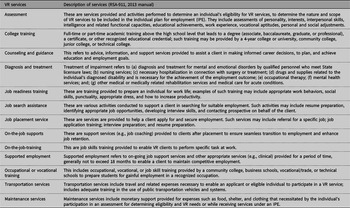
VR Services. This are 13 VR services predictors including guidance and counseling, job search assistance, assessment, job placement, supported employment, job readiness training, on-the-job support, on-the-job training, college training, occupational/vocational training, diagnosis/treatment, maintenance, and transportation services. Table 1 presents a detailed explanation of VR services included in this study.
VR Service Description

2.3. Data analysis
We analyzed the data using STATA (version 16.0). For research question 1, we performed Chi-square test and analysis of variance (ANOVA) to explore differences in vocational outcomes by mental health conditions. Next, we conducted logistic and multilinear regression analyses to explore the role of personal factors (i.e., gender, race, level of education, and severity of disability) on competitive employment, weekly hours worked, and income. To answer research question 2, we computed logistic and multilinear regression analyses to investigate the effects of VR service variables on competitive employment, weekly work hours, and income.
3. Results
3.1. Descriptive analysis
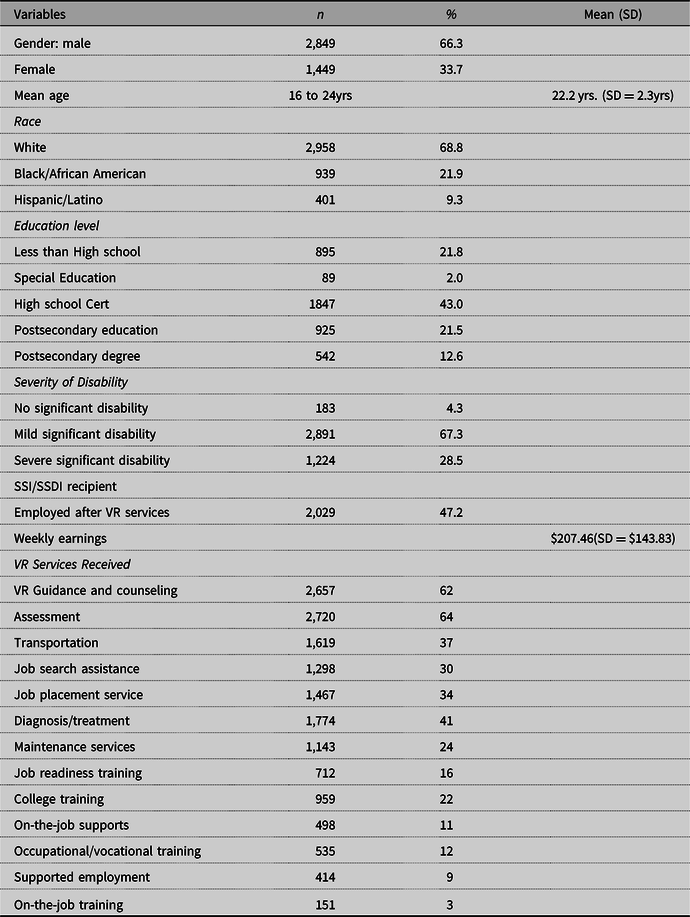
Results of descriptive analysis are presented in Table 2. The mean age in the sample was 22 years and 2 months (SD = 2 years, 3 months). Majority of the 4,298 participants were White (68.8%) and held high school diplomas (49.7%). On average, participants spent 24 months (SD = 20.4 months) in the VR service program. Approximately 47% (n = 2,029) of the participants who received VR services achieved competitive employment. Participants worked an average of 20 h (SD = 18 h) per week with about 48% working between 36 and 40 h per week. Among those employed, 50.6% were males. About 64% of the White participants had higher rate of competitive employment, followed by Black/African Americans (24.4%) and Hispanic/Latino (14.8%). Participants on average earned $207.46 (SD = $143.83) per week. Average expenditure for youth who achieved competitive employment was significantly higher than for unemployed youth, F (1, 4,297) = 77.3, p < 0.001. Those that achieved competitive employment spent significantly less days in the program, F (3, 4,297) = 90.6, p < 0.001. The most frequently used VR services are assessment (n = 2,720), VR guidance and counseling (n = 2,657), diagnosis/treatment of impairment (n = 1,774), transportation (n = 1,619), and job placement services (n = 1,467). The average number of services participants received was four (SD = 2); however, those without significant disability and those with anxiety disorders received more (n = 5, SD = 2) than those with significant disability and other mental health conditions.
Participants Characteristics

3.1.1. Personal factors and vocational outcomes (i.e., competitive employment, weekly work hours, and income)
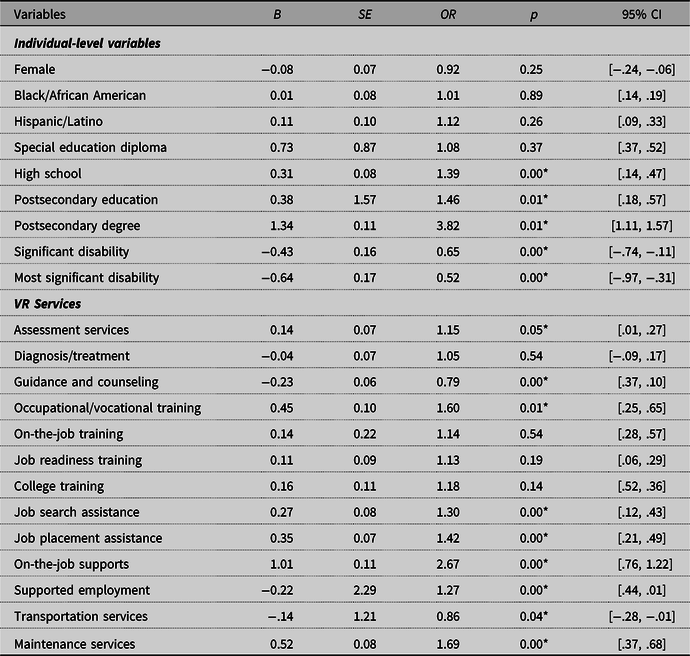
Chi-square analysis revealed significant differences in achieving a competitive employment outcome based on mental health conditions (χ2 = 43.1, p < 0.05). Individuals with depressive disorders (43. 5%) had the highest percentage of being employed, followed by individuals categorized as having other mental illness (36.5%), schizophrenia (12%), and those with anxiety disorder (7%). Similar observations were made for weekly income based on the ANOVA results. On average, individuals categorized as having other mental illness earned significantly more money, followed by those with anxiety disorder, depressive disorders, and schizophrenia F (3, 4,278) = 42, p = 0.00. No significant differences were observed in the number of hours worked per week based on mental health conditions (χ2 = 43.08, p = 0.95). Level of education and significant disability were identified as significant personal predictors of obtaining competitive employment. Youth in postsecondary education (OR = 1.46) and those with postsecondary degree (OR = 3.82) were more likely to achieve competitive employment than those without high school diplomas. Youth with significant disability (OR = 0.65; 0.52) were less likely to be employed. These results are presented in Table 3.
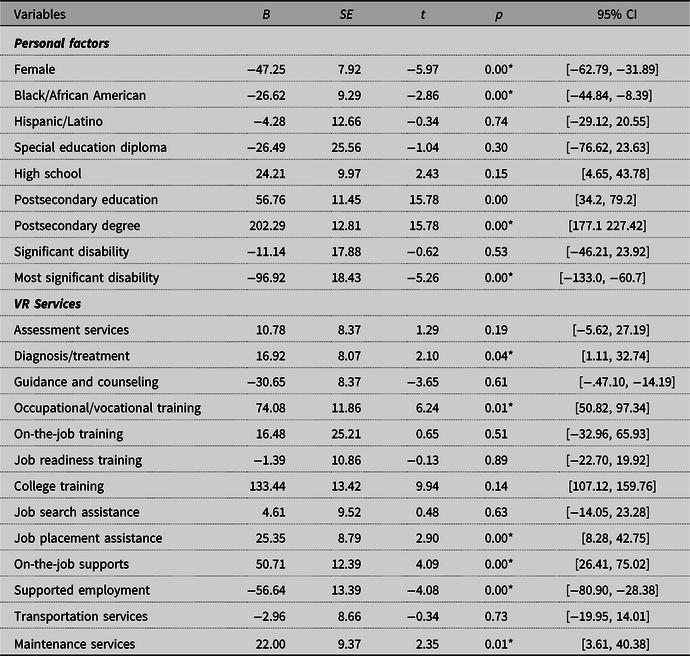
Weekly hours worked and income. For weekly hours worked, the regression analysis identified gender, race/ethnicity, level of education, and significant disability as predictors of hours worked. The strongest predictors of hours worked are postsecondary degree and enrollment in postsecondary education. Again, females and youth with significant disability were less likely to work more hours. For income, postsecondary degree (B = 202.2) was the strongest predictor of earning more money. Youth with significant disability (B = −96.92; −11.14), females (B = − 47.25), and Black/African Americans (B = −26.62) were less likely to make more money.
3.1.2. Vocational rehabilitation services and vocational outcomes (i.e., competitive employment, weekly work hours, and income)
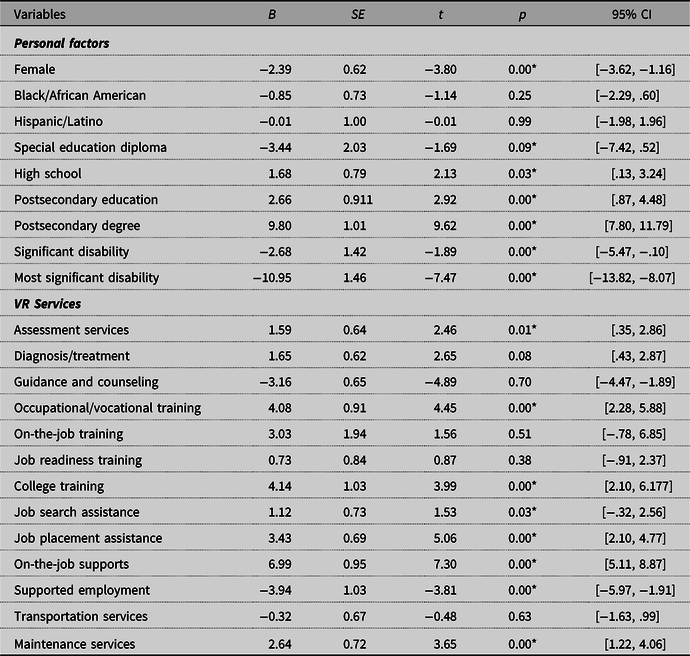
Tables 4 and 5 present the results for these analyses.
Regression of Associations Between Personal Factors, VR services, and Competitive Employment

Regression of Associations Between Personal Factors, VR services, and Weekly Income

Regression of Associations Between Personal Factors, VR services, and Weekly Work Hours

Competitive employment. Significant positive predictors of competitive employment were assessment services (B = 1.15), guidance and counseling (B = 0.79); vocational training (B = 1.60); supported employment (B = 1.27); job-search assistance (B = 1.30), job placement services (B = 1.42), on-the job supports (B = 2.67); transportation (B = 0.86); and maintenance services (B = 1.69).
Hours worked weekly. Eight VR services were found to have significant relationship with hours worked. Significant positive predictors of weekly hours worked were assessment services (B = 1.59), occupational training (B = 4.08); college training (B = 4.14); job-search assistance (B = 1.12), job placement services (B = 3.43), on-the-job supports (B = 6.99); and maintenance services (B = 2.64). Only supported employment (B = −3.94) had a significant negative relationship with hours worked.
Weekly Income. Six VR services were identified as significant predictors of earnings. Job placement services (B = 25.3), diagnosis/treatment services (B = 16.9), occupational training (B = 74.1), on-the-job support (B = 50.7), and maintenance (B = 22.0) showed positive association with higher weekly earnings. Supported employment services (B = −56.6) had negative relationship with weekly income. Regression results for earning and work hours are displayed in Tables 4 and 5.
4. Discussion
Results from regression analysis showed that youth with co-occurring MI and SUD have a greater probability of obtaining and maintaining gainful employment when they have a high school diploma or postsecondary education as well as when they receive pertinent services such as job training, job search, job placement services, and on-the-job support services. Predictors in this analysis corroborate past studies (e.g., Kaya Reference Kaya2018; Lusk, Reference Lusk2018; Sánchez, Reference Sánchez2018). However, the roles of other factors such as culture, interpersonal relationship, social skills, and social economic factors on these findings remain unclear. In addition, the odds of exiting VR program with a competitive employment, high work hours, or earnings were lower for youth with a significant MI and SUD in this study. This could be explained by the fact that people with MI and SUD experience significant barriers such as employer’s prejudice, inadequate work experience, discrimination, and limited access to vocational support when entering or rejoining the workforce (Harris et al., Reference Harris, Matthews, Penrose-Wall, Alam and Jaworski2014). Moreover, they may be perceived with higher risk for absenteeism, reduced work ability, motivation, and reduced productivity at work due to disability related factors (Vornholt et al., Reference Vornholt, Villotti, Muschalla, Bauer, Colella, Zijlstra and Corbiere2018).
Our results indicate that service predictors such as counseling, transportation support, treatment services, and vocational training are highly effective in increasing employment success. This adds to the collective body of research supporting the use of such services with youth with disabilities (e.g., Kaya et al., Reference Kaya, Hsu, Rumrill, Hanley-Maxwell and Chan2021; Migliore et al., Reference Migliore, Timmons, Butterworth and Lugas2012). Preemployment services increased the odds of achieving competitive employment outcomes, earning more money, and working for longer hours (see also Ji et al., Reference Ji, Schaller, Pazey and Glynn2015; Migliore et al., Reference Migliore, Timmons, Butterworth and Lugas2012). Contrary to our expectation, supported employment, an evidence based vocational rehabilitation intervention for people with significant disability, was associated with lower success.
Furthermore, a gender effect was that male participants were more likely to report significant higher earnings than females, even though females have favorable employment outcomes. Possible reasons behind this disparity may include persistent constructs of gender stereotype in society that allude to the need for males to secure employment to support their roles as heads of the households while women are regarded as having more parenting expectations. While the differences in earnings are disproportionate between gender and ethnicity, our findings do not allow us to identify whether differences observed are a result of external factors (e.g., discrimination, limited access to vocational services, or employment opportunities).
4.1. Implications for practice and research
The current study analyzed the RSA data set for 2013, 2014, and 2015 fiscal years to explore the effect of personal factors and services on vocational rehabilitation outcomes of youth with co-occurring mental illness and substance use disorders. In general, youth with disabilities have historically been shown to experience various significant barriers to employment (e.g., stigmatization, lack of training, and accommodation issues) resulting in poor employment outcomes when compared to their nondisabled peers. However, interventions and accommodations have been shown to improve employment outcomes of these youths (Akinola & Dunkley, Reference Akinola and Dunkley2019; Hanif et al., Reference Hanif, Peters, McDougall and Lindsay2017). A focus on youth with MI and SUD is particularly critical because despite the high prevalence of MI and SUD among this population, little information exist on vocational aspect of their recovery. Given the promise of pre-employment support services such as job search, placement, and on-the-job-support, vocational rehabilitation providers might consider making these services a standard package for youth with MI and SUD. Strategies to start vocational rehabilitation services, while youths are still in treatment for SUD especially, should be considered given reports of positive outcomes of such approach in the literature (McIntosh, Bloor, & Robertson, Reference McIntosh, Bloor and Robertson2008; Walton & Hall, Reference Walton and Hall2016).
4.2. Limitations and suggestions for future research
The current study has limitations commonly observed in the use of secondary data sets and their limitations regarding the choice of variables for analysis. First, factors we did not include in the analysis (e.g., family support, social skills, and socio-economic status) that might have contributed to outcomes achieved by youths in this study. Second, we pooled the data for the analysis and could not make any causal–effect relationships with the cross-sectional design we adopted. Third, VR services provided and possible service delivery variations across various states suggest a need for caution in the interpretation of findings from this study. Given these limitations, we recommend that future studies should explore how personal factors such as family support, social skills, work experience, and socioeconomic status impact vocational outcomes of youth with MI and SUD. Furthermore, service delivery variations across states should be accounted for in future studies. Overall, we recommend more research on this topic to advance our understanding of how to support youth with co-occurring MI and SUD in vocational rehabilitation.
4.3. Conclusion
Youth with co-occurring mental illness and substance use disorders are at higher risk for adverse vocational outcomes. Findings from this study provide additional evidence for the efficacy of job search support, job placement assistance, vocational training, and on-the-job intervention for promoting better vocational outcomes among this population. Personal factors such as race/ethnicity, level of education, and severity of disability also impacted participant’s outcomes. Youth with postsecondary education degrees had higher odds of gaining competitive employment and making higher income, while those with significant conditions had lower odds of having favorable outcomes. Rehabilitation practitioners can use this information by paying attention to clients who are at greater risk for poor outcomes as well as helping clients acquire skills and credential that might increase their chances for success. Future research should investigate the effect of other personal factors that impact outcomes and the long-term benefits of using these VR services.
Acknowledgments
None.
Financial support
This research received no specific grant from any funding agency, commercial, or not-for-profit sectors.
Conflicts of interest
The authors declare that they have no conflict of interest.