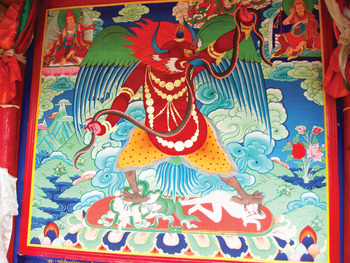
Here is the way to practice with accompanying music. Recite: Padmasambhava, the essence of the Buddhas of the three times, sits at the head of the assembled guests. In front of him, out of the center of dense rainbow light, comes a rocky mountain peak that is the head of the divine garuda bird…. On a lotus-sun throne sits the king of the regional deities Shachong Garuda, with beak and claws of heavenly iron, brandishing his two horns of wisdom and means…. There resides the extremely wrathful Lord of the Skies.
———Opening invocation of Jima village prayer entreating the mountain deity ShachongFootnote 1At the height of the summer of 2007, Dorje, Jima village's principal mountain deity medium (Tibetan lha pa), was, as usual, center stage at the village's annual harvest festival.Footnote 2 His ritual actions thereby kicked off the sixth lunar month festival season or, as it is called by Tibetans in the farming villages of Rebgong in China's mountainous northwestern province of Qinghai, “The Great Month of the Gods” (Tib. lha zla chen mo). Dorje's body had been occupied by the powerful mountain deity Amnye Shachong, Jima village's main protector, or “foundation lord” (Tib. gzhi bdag). King of all mountain deities in Rebgong, Shachong resides in the highest peak (about 15,500 feet) just southwest of Rebgong's central Rongwo valley on the Gu (Chinese Longwu) river
Amnye Shachong in his wrathful Garuda aspect. Exterior wall painting, Shachong temple, Jima village, Rebgong, summer 2005 (author's photo).

.
Just like the many other deity mediums at other villages' harvest festivals across the valley, Dorje's wild and unpredictable movements were the center of attention for villagers and visitors alike, attracting a scrum of Chinese and foreign photographers. Those photos would serve, in turn, to market the Rebgong region in China and abroad as a benign and colorfully ethnic tourist destination, a project explicitly promoted in the local government's recent development plans for the region.
Rebgong's central valley floor, now administered as Longwu town, population about twenty-three thousand, is the seat of the centuries-old Tibetan Buddhist monastery of Rongwo, erstwhile ruler of the region, as well as the seat of both Huangnan Tibetan autonomous prefecture (established 1952) and Tongren county (established 1928). Jima village in the 2000s was one of the wealthiest, most central, and rapidly urbanizing Tibetan villages in the valley, with over two thousand residents and three hundred households. Since the 1980s post-Mao reforms, Tibetans have vigorously revived once-banned Buddhist and lay ritual practices, and Jima village led the way in reviving to new splendor its three-day lay harvest festival, called Lurol (Tib. klu rol; literally, “entertainment for the Nagas”).Footnote 3 Most recently, the “Great Develop the West Campaign” (Ch. Xibu Da Kaifa), launched by the central government in 2000, has intensified development pressures locally. State officials in Rebgong plan for the Tibetan “culture industry” (Ch. wenhua chanye), along with the “folk culture” (Ch. minsu wenhua) of Lurol, to be a cornerstone of the Rebgong tourism brand and the driving force for the region's modernizing and “civilizing” development.
In 2007, the formal pageantry of Jima's Lurol festival, held in the courtyard of the village's gorgeously renovated temple, the largest in the valley, seemed to exemplify unchanged village folk tradition. As before, Lurol was staged just before harvest season, when oil-seed and barley crops were supposed to be ripening in farmers' fields. It consisted of all-day sequences of dances, repeated three times in as many days, in which men and women were recruited to perform as ideal village subjects under the watchful eyes of Dorje and a committee of elders. The dances were framed throughout as offerings to the village's protector deities, by the propitiation prayers of elder chantmasters and the array of sumptuous altar gifts and burnt offerings directed by Dorje and the elders.
Indeed, the culmination of the 2007 Lurol seemed to nicely demonstrate the harmonious coexistence of Tibetan villagers' and local state interests. After the final collective offerings were completed, photographers turned their lenses back to the center and the assembled villagers faced the village temple dressed in their festival finery. Dorje, entranced as Shachong, then shared the temple veranda with Tshering, Jima's Communist Party secretary, who proudly wore around his neck a white ceremonial scarf, redolent of welcome and legitimate presence. Both made final comments praising the proceedings and calling for continued village unity and prosperity.
During my three years of research in the valley, however, I discovered that beyond these images of harmony and cooperation Tibetan deity mediums in Rebgong were particularly problematic objects of state-sponsored promotion. State tourism portrayals of villagers' mountain deity practices in fact attempt to limit deity mediums' presence and thereby diminish and domesticate them because they are a fundamental threat to the post-Mao developmentalist state. They are a threat not just because their “exotic” practices flout the laws of the officially atheist Chinese Communist Party (CCP) against “superstition” (Ch. mixin); more importantly, at a time when the central government sees Tibetan separatism as a major threat to national security and a hindrance to prioritized economic development out west, Rebgong deity mediums publicly embody and voice powerful alternative authorities grounded in a legacy of jealously guarded Tibetan local autonomy.
Thus, as Dorje's writhing, puffing, and threatening gestures opened the 2007 Lurol season, the brute power and ferocity of Rebgong's mountain deities—and thus of ideal Tibetan communities and their male leaders—were clearly onstage. Further, by 2007 the semblance of state-local harmony as Dorje and Tshering shared the veranda at the climax of Jima's Lurol was a highly strained one, stretched thin over the increasingly problematic nature of the presence of both the deity and the state in the village, as development pressures raised the stakes for all involved.
A POLITICS OF PRESENCE: VOICE AND THE DEFERRAL OF AUTHOR(ITY)
Establishing Socialist Values: The Eight Honors and The Eight Shames
(2) To serve the people is honorable;
To depart from the people is shameful.
(6) To be honest and trustworthy is honorable;
To forget one's promises at first sight of profit is shameful.
———Excerpt from poster in Rebgong schools and state offices citing President Hu Jintao's 2006 speech on socialist values
In this article, I unpack some of the consequences of this strained silence and state-local ambivalence around the status of Tibetan deity mediums and their village jurisdictions in post-Mao Rebgong. I employ linguistic anthropological tools to take deity possessions seriously both as consequential forms of communication and as claims to local dominion that posed acute interpretive dilemmas for villagers and state officials alike. In this, I reject the statist categories of “religion” or “superstition” versus secular “modernity” that would relegate forms of possession to a marginalized and static realm of exotic “folk” experience. My linguistic anthropological approach to deity possession is inspired by Mikhail Bakhtin's perspective on the inherent dynamics of voice in a “contradictory and multi-languaged world” (1981: 275). Bakhtin famously insisted on the creative, even agonistic “dialogism” at the heart of any expression of authoritative personhood, a take he conceptualized, not coincidentally, under Soviet repression. His approach thus provides important analytic tools for rethinking modern states not as uniquely unitary and rational administrative orders encompassing discrete local realms, but rather as, in practice, contested claims to particular forms of supreme authority or sovereignty that require constant embodiment and invocation by situated people (see Das and Poole Reference Das, Poole, Das and Poole2004).
This perspective allows me to conceptualize both Dorje and Tshering's efforts to voice authoritative discourses as fundamentally commensurate processes in a high-stakes “politics of presence” (Boddy Reference Boddy1994) that erupted between 2005 and 2007 and deeply factionalized Jima village. At Jima's 2005 Lurol festival, villagers had been shocked when Dorje, entranced as Shachong, brutally evicted the group of prominent elders who had organized the festival that year without consulting the deity. Dorje's Shachong then appointed a group of Dorje's supporters instead. The evicted elders, along with Party Secretary Tshering, then publicly questioned Dorje's authenticity as a deity medium, thus raising doubts as to the legitimacy of his actions on behalf of the village. “What have we have done?” an elder reportedly yelled at Dorje, “Have we eaten [i.e., embezzled] the temple funds? Who are you? A ghost?” The elders' position was then strongly opposed by Dorje's supporters and Dorje refused to even show up the following year, at the 2006 Lurol. The conflict came to a head in 2007 when the leading Buddhist lama of Rongwo monastery, the young Shartshang, was invited to the village temple to authenticate Dorje in front of the assembled villagers. Only then, with Dorje back on his throne, did the 2007 Lurol resume its ideal appearance for tourists' cameras.
As I tried to make sense of the conflict in Jima, I came to see the presence of the deity as the crux of an unacknowledged struggle over the very nature and future of Tibetan land ownership, collectivity, and political representation in the valley. Historically, the voice of the divine ruler Shachong, publicly framed and managed in Lurol since the festival's inception in the nineteenth century, was supposed to re-author the landed grounds for Jima farmers' collective prosperity under male elders' guidance—development on Tibetan villagers' terms. Yet Jima's conflict over their deity medium in the 2000s came after a decades-long process of state-mandated urbanization that had annexed the vast majority of the village's valley floor farmlands to the burgeoning town of Longwu—by then, the agrarian festival was exceedingly anachronistic; no Jima household farmed anymore.
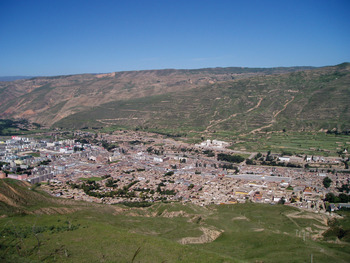
Longwu town, seat of Huangnan prefecture, surrounded by abandoned fields, July 2007 (author's photo).

Further, the conflict erupted at precisely the same time as prefecture officials, in line with central government campaigns to “construct a New Socialist Countryside” while rebuilding CCP presence at the grassroots, formally restructured most of the valley's erstwhile farming villages into landless urban neighborhoods or “communities” ostensibly under direct Party control. That top-down imposition, I discovered, rested uneasily over decades of unspoken resentment and suspicion as many Rebgong villagers came to experience post-Mao urbanization as the culmination of Tibetan disenfranchisement under Chinese rule.
In fact, under the watchful eye of the local police (PSB) and then the national guard (PAP), the much-touted return to Tibetan “autonomous” governance and the revival of Tibetan institutions and rituals in post-Mao Rebgong has relied on a silent stand-off between ordinary Tibetans and state officials. By that I mean there was an unspoken agreement not to publicly address the histories and political economic implications of specifically Tibetan sources of authority, while programs to “develop” (Ch. fazhan, kaifa) and commodify the region and its resources were pushed through under the auspices of distant Chinese CCP leaders. In this, the recent spate of structural-functionalist accounts of revived Lurol and deity medium practices in Rebgong, produced in collaborations between local Tibetans (themselves often low-level state officials) and foreign scholars, have in fact enabled the silent stand-off (see especially Nagano Reference Nagano, Karmay and Nagano2000; mkhar rtse rgyal 2006; 2009; Buffetrille Reference Buffetrille2008). Such accounts collude in keeping history at bay by depicting those post-Mao lay rituals as the simple revival of unchanged village tradition, an annual set of offerings that, as before, unproblematically function to please deities and thereby recreate a unified village as an abstract, indeed deterritorialized social order.
My approach here, by contrast, re-historicizes Lurol and deity mediumship by locating them within the exceedingly martial history of Rebgong Tibetan villages as first and foremost landholding units and arbiters of collective fortune and productivity (see Thomas and Humphrey Reference Thomas and Humphrey1994). In line with anthropologists' efforts to rethink the roles of religion and place-making in state-local relations in post-Mao China, my Bakhtinian focus on voice as contested presence turns our attention to the dynamics of human and divine subjectivity in ongoing battles for jurisdiction over land and resources, as the post-Mao rush to market-based development intensified long-simmering crises of authority in the valley (see Feuchtwang Reference Feuchtwang2004; Chau Reference Chau2005). Crucially, public speech, politicized since the Maoist years as the most important sign of the authentic, nationalist grassroots subject, held out particular risks for Tibetans as their loyalties came under increasing scrutiny into the 2000s (see Makley Reference Makley2005). Deferral and avoidance, not public avowal, was the art of living in Rebgong.
Linguistic anthropologists, more than others, have drawn on Bakhtin to operationalize his alternative ontology of language as an embodied and contested social process in everyday life (see Hill Reference Hill1986).Footnote 4 In Bakhtin's understanding of language, “voice” is decidedly not the disembodied speech of a singular self. Instead, it is a contested figure or presence most powerfully created and coordinated as interlocutors invoke hierarchically arranged speech genres. Bakhtin's approach to voice is thus one way to get at the cultural politics of authority, not as the actions of “charismatic” individuals (see Feuchtwang and Wang Reference Feuchtwang and Wang2001), but as an embodied dynamics of presence and absence, the ways in which people recognize and contest visible and invisible authorities and their relations to various presents (see Keane Reference Keane1997b; Reference Keane2008).
For Bakhtin, all linguistic forms are shot through with and index (or “dialogue with”) the competing cosmologies and moral stances they carry from their histories of use by people situated in stratified societies (1981: 271–72). Thus, in a fundamentally unequal and heteroglossic world, the speaking subject is never unitary but emerges as a variety of voices or “complexes of points of view” (Hill Reference Hill1986: 94). That is, particular forms are embodied and recognized in a person's speech as linguistically constructed social personas struggling for dominance, even within a single utterance (see Keane Reference Keane and Duranti2001; Hill Reference Hill, Mannheim and Tedlock1995). This approach, then, would seem to jibe in part with Tibetans' own highly agonistic theories of self and other, which posit contingent, partible, and violable subjects, and “life-forces” (Tib. bla) as extrinsic beings “contained” or “housed” in material bodies which must be then purified, protected, and strengthened (see da Col Reference Da Col2007; Makley Reference Makley2010).
But a Bakhtinian approach provides ways to understand the specific processes through which certain personas are rendered provisionally coherent and authoritative, or deliberately ambiguous across contexts. In this light, “presence” is not primarily bodily co-presence but instead a posited or claimed interlocutor status (an invisible or disembodied being can be strongly present, while certain personas can rely on their absence to remain powerful). Speakers attempt to use the stylistics of language choice, genre, register, intonation, and reported speech to position different voices and their sources relative to the current event, thereby attempting to render present certain moral personas for their interlocutors while keeping others absent. In Erving Goffman's terminology, all speakers assess the stakes of being held accountable for their messages, and work to project certain participant roles as producers of utterances: “author,” a speaker to be taken as the origin of the utterance; “animator,” a speaker to be taken as merely relaying the words of others; and “principal,” a speaker to be taken as responsible for the utterance's position (Reference Goffman1981: 144–46). A speaker can, for example, attempt to merely report (animate) the words of another without claiming to be responsible (a principal) for the moral stance they index.
Yet in the jostle of everyday interactions and interpretive politics, no speaker can guarantee which personas their interlocutors will recognize. As Bakhtin put it, in particular situations, the boundaries between a speaker's voices can be highly ambiguous, even deliberately so (Reference Bakhtin, Holquist, Emerson and Holquist1981: 308). Even against the will of the speaker, the presence of other voices and moral stances can “leak through” into the interaction (see Keane Reference Keane and Duranti2001: 269; Hill and Irvine Reference Hill, Irvine, Hill and Irvine1992: 13). Interlocutors thus often collaborate to clarify the boundaries between voices by drawing on local cultural and linguistic practices to mark the differences among social personas and their associated communicative events, appropriate behaviors, and scopes of authority and responsibility. From this angle, any discourse interpreted as clearly single-voiced (“monologic”) or authoritative is the provisional outcome of much social, linguistic, and political work, oftentimes through state disciplinary practices.
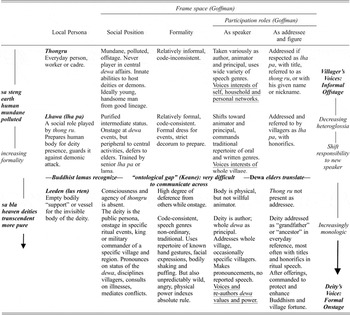
Tibetan deity possession from this perspective is a genre of communication in which the human speaker (if successful) is nothing but a physical animator for a uniquely present Other's voice—the normally invisible deity, like many other types of presence managed in interactions, becomes socially embodied as an author and principal of his communications and thus as an interlocutor (see Table 1). Just like other personas, deities' presence and intentions must be collaboratively interpreted by a culturally grounded “community of witnesses” (Irvine Reference Irvine and Parkin1982: 248). Thus far from being radically Other, we could see Tibetan deity possession as in fact exemplifying and dramatizing the inherently dialogic nature of all human communication, in which “no less than half [of uttered words] belong to someone else” (Bakhtin Reference Bakhtin, Holquist, Emerson and Holquist1981: 339).
Personas, participation roles, and voice in Rebgong Tibetan deity mediumship

From this perspective, the persistence of Tibetan deity possession in Rebgong in the face of state-sponsored modernization is best understood not as the ultimately unmanageable resistance of a heteroglossic “folk” (see Bakhtin Reference Bakhtin, Holquist, Emerson and Holquist1981: 273). Instead, among Tibetans the “performative breakthrough” to possession and especially to deity speech (Tib. lha skad), provides particularly compelling ways to transcend “the pragmatic present” (Keane Reference Keane1997b: 66). That is, any authorities, in order to be taken as representing broader collective interests and therefore as legitimately conveying directives and moral evaluations, must in public settings defer to authoring voices that transcend the petty interests of their own present situation and local personas. Their behavior and speech styles at those junctures must be taken to be extraordinary and representative even as their ordinary personas and interests threaten to leak through.
These dynamics have particular implications in Tibetan regions, where a ritualized demand for the embodied presence of a wide range of invisible divine beings has grounded humans' claims to power, causation, and legitimacy. In this, Tibetans historically valued the pragmatic power of speech (Tib. skad, voice or vocal sound) to both substantiate conscious personhood and cement collective agreements; speech is a key public marker of a direct link between “mouth” (Tib. kha) and a body's “interior” (Tib. khog), the locus of life-force (see Ekvall Reference Ekvall1939; Makley Reference Makley2005; Pirie Reference Pirie, Huber and Pirie2008). Sustained silence then could be read as a sign of absence and pollution, a dangerous evacuation leaving a person catatonic or landscapes devoid of divine interlocutors (see Diemberger Reference Diemberger, Gyatso and Havnevik2005: 126).
Importantly then, after mountain deity mediums rose to the fore with the advent of Lurol in the nineteenth century, deity speech was the main index of authentic divine presence in mediums' bodies.Footnote 5 Yet communication across the human-divine divide is extremely difficult, physically trying, and subject to interpretive doubt (see Table 1). Thus a prospective medium was authenticated only when the deity inhabiting him spoke before a prominent Buddhist lama, using the versified speech genres encoding traditional wisdom, to declare his identity and loyalties. The lama's omniscience and transcendent power, it is said, precluded all but the proper deity from speaking out in his presence. Jima's deity Shachong, for example, was said to have been tamed and made a virtuous god of the “white side” (Tib. dkar phyogs) by Rongwo monastery's head lama Shartshang, when he converted the monastery to the Geluk sect in the early seventeenth century.
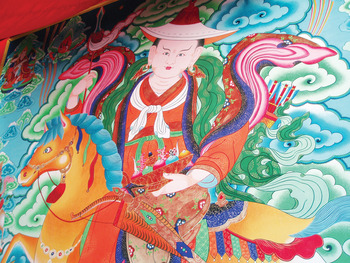
Amnye Shachong in his human hero and Buddhist vow-holder aspect. Exterior wall painting, Shachong temple, Jima village, Rebgong, summer 2005 (author's photo).

In this light, we should take public presence to be the capacity for an authoritative social persona to be voiced onstage unchallenged, and thereby to both claim a legitimate standing and embody the moral cosmology on which it depends. In post-Mao Rebgong, this was as applicable to Tshering, Jima's CCP secretary, as it was to Dorje, Jima's deity medium. So, for example, the legacy of the socialist state and the recent central government revival of socialist values propaganda (i.e., in the poster quoted in this section's epigraph) in the face of intensifying popular anger at official “corruption” meant that all local officials had to draw on sanctioned state authors (like President Hu) to voice the ideal altruism of an official working first and foremost to “serve the people” (Ch. wei renmin fuwu). Given the particularly institutionalized nature of deity possession in the Rongwo valley, we could then see both Tshering and Dorje in the mid-2000s as problematic mediums for competing sources of monologic speech.
But the recognition of their commensurate nature is precisely what post-Mao Chinese state rhetoric and discipline worked to preclude. Indeed, the legitimacy of both state voices and those of Tibetan deity mediums hung by a thread amidst the divisive allure of new forms of state-sponsored wealth in the marketizing valley. As we will see, the great danger of state-sanctioned deity possession in this context was that, even against the will of the participants, the very forms and voices of the practice would publicly reveal the actually amoral and hierarchical nature of the Chinese state and state-local relations in Rebgong under market reforms.
THE VOICES OF TSHERING: TOP-DOWN URBANIZATION AND THE DEMISE OF THE DEWA
The Longwu Town Street Party Organization is the leading core for all activities and organizations of the Jima Urban Community. The work of establishing the Party in the Jima Urban Community must … strictly revolve around the great goals of reform, development, and stability…. Officials must ceaselessly strengthen the capacity of the Jima Urban Community Party organizations to do battle, to consolidate, and to unite the broad masses of residents within the boundaries of the Party organizations.
———Poster in new Jima Urban Community office, summer 2007.Amidst this moral ferment, the conflict that erupted at Jima's 2005 Lurol threatened to unmask the increasingly absurd fiction of village unity and state-local harmony that buttressed the post-Mao silent stand-off in Rebgong. In this, Party Secretary Tshering was a lightening rod for villagers because he epitomized the crisis of Tibetan village elders' moral authority under CCP rule. As theorists of rural China have recently argued, grassroots officials like Tshering are increasingly situated at the crux of post-Mao politics (see Chau Reference Chau2005; Perry Reference Perry, Heilmann and Perry2011). I was able to interact with and interview many such officials in Rebgong. Here I draw on a method pioneered by Jane Hill (Reference Hill, Mannheim and Tedlock1995), in which she focused on the discourse of a particularly pivotal official to analyze the dialogic processes in which all were engaged. Further, the interview was a marked and familiar genre of interaction in Rebgong that required officials to take self-conscious stances vis-à-vis various outsiders (see Makley Reference Makley2005). As such, I found, it was an important and increasingly fraught occasion for the delicate politics of presence and absence, of deferral and disavowal.
I finally got to interview Tshering in August 2007, after he had shared the veranda with Dorje at the capping moment of that year's fateful Lurol. Despite himself, Tshering had been construed by Dorje's supporters as the deity medium's moral foil and chief opponent, even though Tshering had not been one of the routed elders in 2005. As it turned out, Jima villagers' enthusiastic revival of Lurol since the 1980s reforms was not just the reiteration of quaint “folk” custom. Instead the festival was at the very center of ongoing battles for jurisdiction over fortune on Tibetan terms.
Chinese nationalist planners took land in the western frontier zone to be abstract “nature” requiring heroic management (see Rohlf Reference Rohlf2003; Yeh Reference Yeh, Barnett and Schwartz2008). By contrast, Tibetan farmers in Rebgong experienced land as profoundly local and social, caught up in a moving cosmos of forces and beings impinging on human bodies and livelihoods (see Karmay Reference Karmay, Barnett and Akiner1994; Huber Reference Huber1999; Mills Reference Mills2003; da Col Reference Da Col2007). As farming communities settled in reciprocal relations with the expanding monastic complex, a community's principal mountain deity was figured as a sovereign of the basic unit of communal territory transcending households, the dewa (Tib. sde ba, translated here as “village”). All those born within it were his subjects (the principal deity is native villagers' “birth god,” Tib. skyes lha, thereby transcending any household-specific deities). In rites of passage and rituals marking the lunar year, villagers needed to cultivate and recruit mountain deities as divine avatars, addressing them as “ancestors” (Tib. a mnyes) and military commanders. Well-feasted deities ideally worked to fight demonic forces and secure or contain the all-important yet abstract force of vitality or fortune (Tib. g'yang) on behalf of collectivities (households, villages). Such dewa-deity relations are centuries old among rural Tibetans, but I found evidence that Jima dewa's elaborate Lurol festival emerged relatively recently, as a response to intensifying competition over local land and jurisdiction in the late nineteenth century (see Xirejiancuo 2008). In that context, Jima's Lurol staged dynamic “scenes of encounter” (see Keane Reference Keane1997a) among multiple interlocutors, highlighting above all the ideal dialogue between elders and the mountain deities inhabiting mediums' bodies. In the elders' prayers and the deity's speeches, the ultimate aim was to dramatize and substantiate the dewa, over and above individual households, as the main landholding unit arbiting collective fortune and productivity. In Lurol, the dewa for Rebgong farmers was ideally a communal life-giving territory and ancestral heritage (Tib. pha gzhis) under the joint rule of mountain deities and councils of village elders (see Carrasco Reference Carrasco1959; Blondeau Reference Blondeau1995).Footnote 6
Sovereignty as inviolable jurisdiction for Tibetans was thus a fundamentally dialogic process, constantly vulnerable to the whims of voracious mountain deities and the vicissitudes of human politics. In Lurol, a successful medium could voice the deity Shachong as the originating author of ancient wisdom, thereby transcending the petty interests of households and networks. But under the close management of elders, the deity's communications were supposed to ultimately index the collective dewa as the moral principal, with leading elders as the main interpreters—secondary mediums—for villagers. After all, Lurol was supposed to demonstrate elders' capacity to obligate and command divine response to their collective prayers: “You mountain deities and your retinues, eat! Then destroy all adversity facing our people and our wealth and provide us with all positive conditions. Do everything you can to fulfill all our wishes the way we want!” (offering section of Jima village prayer to Shachong). A successful festival was elders' battle victory in securing collective fortune for the dewa as a communal territory—over both demonic forces and the divisive heteroglossia of intra- and inter-dewa politics.
As Jima's Party secretary, however, Tshering had no such divine mandate. He voiced instead an abstract state (Tib. rgyal khab; Ch. guojia) that villagers experienced as both distant (based in Beijing) and problematically intimate (embodied in local leaders and lifeways) (see Mueggler Reference Mueggler1993).Footnote 7 Yet for many, the Chinese state was established in Rebgong only in 1958, through the world-shattering betrayal of militarily enforced collectivization (see HNGK 1985: 60). In Jima, the dewa and its leading elders were for the first time overthrown in favor of the commune and its Chinese-led “activist” leaders, an unprecedented valley-wide unit based in what would become Longwu town. Jima elders' moral authority was militarily annulled—Lurol was banned, Shachong's temple was destroyed, all mediums and most elders were sent to labor camps, and households lost use rights over their ancestral fields. This for most villagers was a devastating moral and ethnic assault, but one that had to remain unacknowledged for decades against ubiquitous state rhetoric that framed socialist transformation, and the new impunity of local officials, as the will of “the people.”
Thus, as both a Jima elder and The State's principal medium during the conflict in the 2000s, Tshering's difficult task was similar to that facing Dorje: in voicing The State, he had to come across as merely an animator (i.e., as just reporting policy), and not as an author or moral principal of his words. But unlike Dorje, whose authority turned on making the deity's presence in his body visible, Tshering's moral stature in the dewa depended on containing or erasing traces of The State's presence, even as he was required to speak publicly. During our interview, I glimpsed the many contending voices Tshering struggled to manage and present; the dialogue was not only with me, but also with his absent dewa critics.
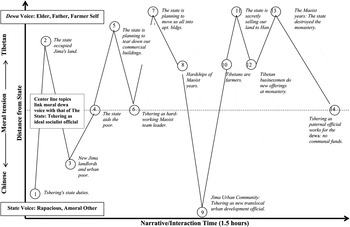
Even though I was explicitly interviewing him in his capacity as Party secretary, and kept returning to that status in my questions, Tshering insisted on adopting the moral voice of the dewa by framing himself first and foremost as a simple dewa elder and farmer (his household, like most in Jima, had not farmed in years) (see Figure 4). In this, Tshering's voices staged an epic battle in the valley between The State, associated with the encroaching Chinese city (as the Chinese loanword chengshi) and the dewa as an endangered Tibetan farming community (see Hill Reference Hill, Mannheim and Tedlock1995). Despite Tshering's best efforts, in the end I was not at all clear as to his ultimate moral status in the story; the presence of The State emerged in his speech as what Bakhtin called “internally persuasive discourse,” a voice he could not fully suppress (Reference Bakhtin, Holquist, Emerson and Holquist1981: 347). Tshering, after all, spoke not as Jima village's Party secretary, but as the recently promoted Party head of the Jima “Urban Community” (Ch. shequ). Tshering the official thus presided over the new administrative unit that since 2005 officially erased Jima dewa entirely, merging it with two other villages to form an urban neighborhood of Longwu town, and thereby culminating the very urbanization processes that Tshering the farmer so decried.
Tshering's voice shifts with topic and loanword use.

I came to realize that, in the Lurol conflict, Jima villagers were playing out the moral consequences of state-led urbanization processes that had been set in motion decades earlier. In the on-stage violence of the deity medium and the off-stage anger of villagers, I glimpsed villagers' profound rage and anguish at the loss of dewa jurisdiction over valley floor lands.Footnote 8 Urbanization for them was definitively not a natural process of socioeconomic “development,” but rather a top-down imposition that carried forward the disenfranchisement begun so brutally in 1958. Most elders knew that dewa unity was crucial for negotiating favorable terms in the post-Mao development projects pushed by prefecture officials. However, after the initial land allocations of the Household Responsibility System in the 1980s, Jima villagers had entered into a trade the terms of which they did not fully understand or control. That is, when all households were given official urban status (Ch. hukou) in the early 1990s, villagers were promised household autonomy and state-mediated cash income in exchange for the landed heritage that had grounded the dewa's autonomy as a collective entity.
Under China's uniquely complex and ambiguous property laws, all land designated “urban” comes under direct state ownership, and residents merely enjoy “use rights,” while “rural” land can be owned by a variety of officially recognized collectives. In many ways, Jima villagers were subject to a process playing out across China in the 1990s. As Peter Ho (Reference Ho2001) put it, rapid urbanization was in practice a kind of stealth scaling-up of property rights, in which villages' collective ownership rights were transferred to higher-level state units (see Guo Reference Guo2001; Cai Reference Yongshun2003). However, as Emily Yeh (Reference Yeh2004) points out, the specifically ethnic nature of state-local tensions in Tibetan regions meant that rural Tibetans had even less recourse to legal resistance than their Han Chinese counterparts did because any such moves are easily construed as anti-state ethnic separatism. The eighty-year-old former Jima village head Gabzang put it this way: “They said they needed the land [for government offices and enterprises] or else they would not be able to do the work of the state. We were forced to agree. If they saw us as forcibly stealing it back, the police would … they would say we were resisting and come here and arrest us. So we can't say anything. They will not call what they are doing ‘business!’ They will just say we are resisting the CCP.” Further, and similarly to the situation in Lhasa (see Yeh and Henderson Reference Yeh and Henderson2008; Fischer Reference Fischer2005), as valley floor land was increasingly commodified into the 1990s, Jima Tibetans found that their main sources of secure income, social mobility, and benefits (both on and under the table) were careers in local state bureaus. Beginning in the late 1980s, urban status for households whose land was expropriated for new state enterprises meant low monetary compensation and a few (menial) salaried positions in those units. By the 2000s, most households strove to place a least one member as an entry-level bureaucrat in the very offices that now stood on the dewa's former fields.
In the mid-2000s, despite state rhetoric pushing socialist altruism, Jima Tibetans' private rumors and jokes cast doubt on the motives of any villager with a plum state position, evoking the Chinese loanword fubai (literally “rotten”) from state anti-corruption campaigns to ironically voice the Chinese origins of such actions. Alternatively, the Tibetan phrase “eating money” (Tib. sgormo za) evoked the violation of dewa reciprocity by selfishly consuming communal funds. In this, the hierarchy of state bureaucracy allowed for convenient deferrals of responsibility up and down the ladder depending on the speaker's relative position within it, while the Tibetan term for The State (rgyal khab) allowed villagers to defer responsibility up and out of Rebgong altogether, to Beijing and faceless Chinese authorities. For Tibetan officials, the persona of “The State” could be a convenient scapegoat, but as the Chinese language increasingly pushed Tibetan speech genres off public stages (see Tournadre Reference Tournadre2003), Tibetan officials' unconscious use of Chinese loanwords and Tibetan neologisms indexed the voice of The State that they could never completely contain.Footnote 9 In this ferment, actual flows of land-compensation funds were obscured under layers of secrecy and rumor and local officials were the safest targets of dewa ire. I learned that all Jima leaders, like Gabzang, who had helped negotiate the reform-era land transfers and compensation funds were suspected by villagers of having “eaten money” to benefit their own households and networks.
Villagers' most intense rage, however, was directed at Party Secretary Tshering. For many, he epitomized the venal, corrupt state from which they themselves sought moral distance. Tshering (b. 1947) had become a Party member in 1967, and then a Jima production team leader under the elder Gabzang. Tshering's Party status brought him a promotion over Gabzang as Jima's Party secretary after reforms, but he rose to prominence and controversy only after he was urged by Longwu town officials to come out of retirement and take the post again in 1996. I was told that one night in the years just prior to the Lurol conflict a group of dewa men, enraged at rumors that Tshering was using his position to “eat” dewa land compensation funds, painted a damning black mark on his household door. “Your reputation never recovers from that!” one man insisted to me, his wife gravely nodding.
Thus, as the Lurol conflict heated up in 2005, for Dorje's supporters Tshering, who had close kin ties to several of the evicted elders, became the face of what one couple referred to as “the elders faction” (Ch. bangpai). Tshering's supposedly venal motives were then suspected of influencing otherwise good men, so that they themselves were rumored to have shared in eating dewa land funds. Now, leading dewa elders, instead of protecting collective fortune on behalf of all, were suspected of handing over the dewa's ancestral heritage to benefit their own households.
Tshering's impossible task during our conversation was therefore to contain the voice of The State even as he relied on its authority; he had to claim the dewa as his primary base even as he had no real mandate from “the people” or the deity (see Figure 4). Over the course of the conversation, Tshering repeatedly deflected my direct questions about his status as an official in favor of narrating Jima's fate after reforms. Those were the moments when the voice of the dewa emerged most prominently and The State rose to the fore as the agent responsible for the forced and unfair expropriation of Jima's farmlands, a process Tshering depicted as beginning in 1958. This deferral of responsibility to The State was almost immediate in our conversation. After I opened by asking Tshering about his duties as Jima Party secretary, he offered some awkward and halting explications of his job as merely a mouthpiece relaying The State's policies “down” to the grassroots and then made an abrupt topic shift:Footnote 10 “Those [officials] they … The State did … In the beginning, Jima had many fields…. It had over 2200 mu, but The State occupied (Ch. zhan) them all and now there is nothing left.” However, as the Chinese word “zhan” (“to occupy,” a legal term for land taken under state's right) indicates, Tshering's unconscious use of Chinese loanwords work against his efforts to distance himself from The State at key junctures; they index his deep entanglements as the principal local implementer of state policies. As Nicolas Tournadre (Reference Tournadre2003) observes, the vast majority of Chinese loanwords in Tibetans' speech are substantive nouns referring to state apparatuses, while verbs and modifiers are much less frequent and syntactic changes are extremely rare. Thus in Tshering's Tibetan speech, the voice of The State is increasingly present as the number of loanwords increases and Chinese verbs and modifiers creep in.
When Tshering continued his narrative, The State haunted his efforts to depict the unexpected vicissitudes of reform-era land transfers as a breach of the socialist social contract:
There were no more fields left. Then The State gave [us] bank accounts (Ch. zhezi, i.e., for compensation funds and subsidies) and we were changed to urban residents (Ch. jumin). When we were changed to urban residents then all our fields were taken. So [The State] took care of us (Ch. zhaogu) by making some former farmers into salaried workers (Ch. gongren) [in new state firms]. But these days, as for that ‘care’ (Ch. zhaogu), now [the state firms] have gone bankrupt (Ch. daobi) and every one … all those workers have been laid off (Ch. xiagang) and hang out at home.
Tshering was referring to the mid-1990s, when central authorities withdrew subsidies and left local state enterprises to compete with burgeoning Han Chinese and Muslim Chinese (Hui)-dominated businesses in town or go under. His portrayal echoed Jima villagers' experience of such marketization processes as The State's sleight of hand: the promised security in exchange for their land had evaporated as soon as market forces were given free rein.
This framing of The State and market forces as colluding against unsuspecting Jima villagers then allows Tshering to make perhaps his most important narrative move. In the mid-1990s, precisely the time that he was reappointed as Jima Party secretary, the prefecture's marketization efforts actually privileged a group of Jima households whose initial land allocations were close to town roads. Encouraged with low interest loans to build commercial buildings on their plots, by the late 1990s those households were bringing in substantial rental incomes, the majority of which were from new Han- and Hui-owned businesses.Footnote 11
Importantly, Tshering and most of the elders associated with him in the 2005 Lurol conflict, as commercial building owners, were members of that emergent class. In 1998, when Shachong, through Dorje, ordered the renovation and expansion of his temple, it was those landlord households who were the main dewa donors. Elders worked hard to complete the gorgeous temple by 2000, at the same time as the last of Jima households gave up farming altogether. Just as their donations and public voluntarism for the dewa moralized Jima landlords' newfound monetary wealth, in our conversation Tshering worked to distance himself from the moral implications of capitalist inequality by linking the voice of the dewa with that of himself as an ideal socialist official. These were the moments when Tshering allowed his voice to merge with that of The State because he appears as a loyal father figure working on behalf of the dewa (see Figure 4, dotted midline). He proudly described his work helping Jima's poor get welfare payments and proclaimed, “The State aids the poor (Ch. fupin), The State gives them help.”
This moral stance then grounded Tshering's most adamant dewa voice when he turned to narrating The State's most egregious breach of socialist ideals from the mid-1990s onward: the sale of Jima's former fields to outside investors and therein the planned demise of the dewa. Further, the vehemence of that critique worked to contain and morally neutralize the strongest and most problematic state voice that came across in our conversation: Tshering the Party secretary of the new Urban Community, whose career rose as the dewa declined (see Figure 4, topics 7–13).
Land for Tshering's dewa voice means essentially farm fields (Tib. sa zhing) as long-term household capital and security. In this, he depicts The State after 1958 as having been a swindler all along, even though it was only in the 1990s that central land policies allowed state officials to openly sell urban land-use rights. The State for Tshering the farmer thus comes across as an enduringly corrupt agent which, unlike the early 1950s CCP practice of “buying” (Tib. nyos dang) land with silver dollars, used socialist ideals to “take” land (Tib. blangs dang) from villagers after 1958 and then sell it off for large profits after reforms. For Tshering the farmer, the inexplicably rapid inflation of land prices mapped a covert shift from land as inalienably local to land as an impersonal commodity: the legalized land market is the final unveiling of The State's colonial endgame. For Tshering, The State (unlike new Tibetan landlords, who seek to keep urban land within Jima households) acts as a super-landlord that operates under translocal market principles, thereby reducing all Jima villagers, regardless of class, to servants of state-led urban development: “Now there are no fields left. We [elders] will be okay, but our children … in the future our children won't be able to get by. Having done this, as for our land, our Jima, The State has made plans (Ch. guihua), it has made thorough plans. So in the future, gradually it will be hard for us to continue living in our courtyard homes (Tib. khang pa)…. We will be made to live in apartment buildings (Ch. dalou), that's it (Ch. zai bu cheng)! It won't be long now!” Tshering's juxtaposition here of the Tibetan term for traditional courtyard homes with the Chinese loanword for apartment buildings voiced a dewa view of urbanization as planned sinification, and the high pitch and increasing speed of his words mirrored the speed of development in the valley—to which there are no longer any local impediments. In his most adamant indictment of The State, Tshering the farmer depicted this process as a secret collusion between The State (as prefecture officials) and Han Chinese bosses, and portrayed himself at meetings vainly advocating for the dewa: “When state firms are profitable, [the land] belongs to The State. When they are not profitable, they sell it again and it becomes private! That's how The State is these days, you know!… It is mostly Chinese bosses (Ch. laoban) they sell it to. There is so much [land] that was bought cheap from us and then sold away for a lot of money … [sighing] there is nothing we can do. These days if they want to force projects through they can.” Tshering's identification of The State with local urbanization officials in Rebgong reflects new realities in Tibetan regions since the Great Develop the West Campaign was launched in 2000.
That campaign in effect turned on the west the market-based development practices established in China's eastern cities, placing great pressure on provincial officials to compete for new central government and private investment funds. In this, officials in Tibetan regions have taken up and adapted the policy focus on urbanization as an ultimate good and engine of modernizing development, especially since the unprecedented, wide-scale “Construct a New Socialist Countryside” campaign, launched just months before my interview with Tshering (see Perry Reference Perry, Heilmann and Perry2011).Footnote 12 As Carolyn Cartier (Reference Cartier, Ma and Wu2005) and others have argued, China's post-Mao reforms have not meant a loss of state authority to market forces, but instead a rescaling of state authority to municipalities. Thus, since the 2000s, urbanization policies in Tibetan regions have targeted rural communities as a (legal) way to overcome ethnic autonomy and ensure “harmony” (Ch. hexie) or “social stability” on terms amenable to outside investors (see Yeh and Henderson Reference Yeh and Henderson2008). In Rebgong's Tongren county, with its fewer natural resources, the compulsory development drive has ironically focused on constructing a Tibetanized modern tourist town, complete with high-end hotels, restaurants, and retail stores.
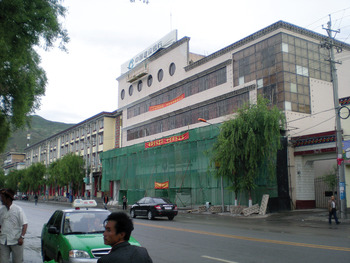
China Construction Bank gets a new “Tibetan” facade, to match painted facades of neighboring buildings. Longwu town main street, June 2008 (author's photo).

In my interview with Tshering, the most tension-wrought moments came when I asked him about the new Jima Urban Community (see Figure 4, topic 9). At that juncture, the voice of The State clearly overwhelmed Tshering's moral dewa voice. This is because, I argue, in addressing the topic with me, he had to embrace his status as a grassroots official whose local authority had expanded only as the last vestiges of rural dewa autonomy were definitively erased in favor of a new municipal system of governance. In striking contrast with the rest of our interaction, Tshering's neutral official voice here lapsed into a proliferation of Chinese loanwords and Tibetan neologisms as he located Jima in the new urban valley. Jima dewa, he explained, was now only one neighborhood of the larger Jima Urban Community, which included two other former farming dewa. Jima Urban Community in turn was one of three such units whose leaders were now directly appointed by Longwu town Party officials: “Now the Urban Community (Ch. shequ) has been established. Now that it has been established, I am the Party secretary (Ch. shuji) of the Urban Community (Ch. shequ). Now the masses … now, except for me, all leaders are The State's officials.” In fact, in recently rural Tibetan valleys like Rebgong's Longwu town, the Urban Community, an administrative unit developed in selected eastern Han cities in the late 1990s, was a particular adaptation. In large Han cities, the Urban Community was supposed to replace the old socialist work unit (Ch. danwei). Most importantly, the new unit addressed the perception among central leaders that the CCP urgently needed to rebuild its relevancy at the grassroots, especially after the unsettling rise of the Falungong movement. The Urban Community, then, was supposed to be a key grassroots site for “constructing” (Ch. jianshe) the presence of the Party and thus for countering other, less desirable local affiliations (see Kojima and Kokubun Reference Kojima and Kokubun2002). In Tibetan Rebgong however, the Urban Community worked to formalize top-down urbanization, complementing the market-based scaling up of land use rights with the (stealth) scaling up of management authority under CCP auspices. In this, Jima was again subsumed in an administrative unit not unlike the Maoist commune in its scale and function.
In 2005–2008 when I was there, the new Urban Community and its administrative aspirations seemed to be laughably irrelevant to the vast majority of Jima villagers. Few I spoke with had even heard of it, and its office was the former village residence committee office, a tiny one-room building next to the old, neglected village prayer temple. But Tshering's worldly loanwords as he described the new system exposed his insider access, so that even as he portrayed himself as a passive trainee in mandatory meetings and complained about his expanded duties, he came across as knowing what most villagers did not: the Jima Urban Community replaced the former post-Mao village residence committee altogether, obviating the need for any village-level representative (the old village head position) who, since reforms, was supposed to have been independently chosen by villagers as evidence of their grassroots autonomy. As such, Tshering's state authority was now translocal and urban-based, since he presided over non-local underlings in charge of land use management in the new district. Despite his caveat above, therefore, by the mid-2000s Tshering was most definitely The State's official. When he pronounced to me the end of Jima dewa as a rural administrative unit, his knowing and matter-of-fact tone in this context contrasted sharply with the dread and despair he had voiced throughout the rest of the interview as Tshering the farmer: “Now we have no [village status]. We have none, you know. Jima has none. Jima has been subsumed into the prefecture city (Ch. chengshi)…. Now it is the Urban Community (Ch. shequ).”
THE VOICES OF DORJE: THE RISE AND FALL OF THE ACTIVIST DEITY
All you attentive protector deities, we exhort you to stand up and get to work! Amnye Shachong, go to the enemy! Shachong's soldiers, go to the enemy! Expand your troops and brandish your weapons! … Fill up the enemies' lands with your troops! Destroy their fortress walls from the foundations! Pulverize the enemies' life force and chop it to bits! Feast on the enemies' blood and flesh! Cut off the enemies' lineages at the roots! Loot and feast on all their possessions!
———Exhortation section of Jima village prayer entreating the mountain deity ShachongI was never able to interview Dorje; in many ways he remained an enigma to me. However, as a singularly controversial deity medium, villagers I spoke to had closely observed him since he was chosen in 1991 to replace his father Lozang, the only Jima deity medium to have survived the Maoist labor camps. Dorje's on and offstage moves since then had shaped villagers' increasing ambivalence about the presence and implications of the deity Shachong in Jima. As we saw, by the 2000s it had become imperative for Party Secretary Tshering to distance himself from the state-business collusions that many villagers felt were responsible for the loss of Jima lands. He did that by positioning himself as a paternal figure working for and voicing the dewa—a moral commensurate with Amnye (literally “grandfather”) Shachong. But throughout the conflict, Dorje's Shachong countered Tshering by claiming the moral mandate of the collective dewa, of remaining, as he had been through Lozang in the triumphant early 1980s, the only real oppositional (and Tibetan) voice of truth.
However, like the young lama Shartshang who had first authenticated him, Dorje had grown up at the vanguard of the post-Mao generation of Tibetans. The profoundly compromised nature of local Tibetan institutions by then meant that monologic Tibetan voices were much harder to pull off. Dorje's impossible task as Jima's deity medium in the 1990s and 2000s was thus to come across onstage as merely a physical animator and never the author or principal of Shachong's voice. Otherwise, the presence of Dorje, the self-interested villager, would leak through. This, I contend, was even more difficult in the mid-1990s when Shachong emerged in new ways as an activist deity in defense of Jima's lands. As the medium for Rebgong's divine regional king, Dorje's dilemma encapsulated those facing all Tibetans under post-Mao reforms—he rose to singular prominence even as Shachong communicated in unprecedented silence.
In the early 1980s, the trauma of the Maoist years' appropriations had made the return of Shachong imperative for Jima villagers, not primarily as a symbol of familiar folk custom but as a ferocious “foundation owner,” whose favor authorized dewa elders to guard ancestral heritage and collective fortune grounded in the land. As provincial and prefecture officials flocked to Jima's revived Lurol to celebrate state support for local ethnic “folk” custom, Dorje's father Lozang rose to unprecedented prominence in the valley as Shachong's medium. As such, Lozang's Shachong fiercely claimed Jima's new post-Mao status as an “administrative village” (Ch. xingzheng cun) to be the triumphant return of the Tibetan dewa. After Lozang died, and as the pace of marketization quickened in the valley, villagers spoke of disturbing signs of inauspiciousness and disunity in the dewa. Thus, when the dewa held its first medium recognition rites in the temple since the 1940s, and Lozang's son Dorje was the one whom Shachong inhabited, villagers were greatly pleased and relieved, even though Shachong refused to speak through him.
In fact, the vast majority of new mediums in Rebgong do not speak. Instead, in what to an observer seems like a high-stakes game of charades, Dorje and others most often communicate using an elaborate repertoire of gestures, facial expressions, and body language addressed to certain elders, who then relay to spectators what the deity is saying. In post-Mao Rebgong, mountain deities have gone mute; their presence as divine sovereigns is thus always already weakened. Yet Dorje, as a replacement for the beloved Lozang, was nonetheless enthusiastically welcomed.
Shachong's new silence, however, marked the loss of Tibetan speech and ritual genres that had transformed post-Mao deity mediumship in the valley. Dorje grew up attending secular public schools and never enjoyed the long apprenticeship with other mediums or the close lama-disciple relationships that were common in the past. Perhaps despite himself, in his practice Dorje blurred all-important distinctions between mediums' different local personas and thus between the roles of animator and author onstage (see Table 1). In this way he raised the question of deity presence and proper dewa authority at a time when major changes were underway in Jima.
In the highly managed forms of Rebgong deity mediumship, mediums' shifts to formalized speech genres and behavior allow for the emergence of the deity as a uniquely monologic voice. Unlike Party Secretary Tshering, the deity, especially through his use of traditional speech styles, tropes, and allusions, claims authority as an author and never as an animator. Such processes of entextualization, as Keane (Reference Keane and Duranti2001; Reference Keane2008) and others have argued, are crucial for creating relatively durable forms that cross spaces and times and thereby distance a voice from present speakers. That is, mountain deities do not just protect, they re-author the Tibetan grounds for dewa collective fortune. Crucially, the split between author and animator, between the voice of the deity and that of the medium, is effected in the performative split between body and speech—the medium's body, aided by dewa men, is overwhelmed and out of control onstage. The deity's presence is said to so overmatch the mediums' physical capacity that his face and chest can swell enough to burst blood vessels and buttons. Emptied of the medium's consciousness, the body is nothing but a physical animator for the deity's authorship.
This shift to communication across the difficult human-divine divide is only credible, however, in the context of the medium's proper comportment and deference offstage. In practice, the ideal local personas for Rebgong deity mediums are tripartite: the thongru, the mundane villager offstage, the lhawa (Tib. lha pa), the specific social role he plays at particular events, and the leeden (Tib. lus rten; literally “bodily support”), the physical medium onstage.Footnote 13
For a person to be a credible and authoritative medium over time, all three personas must be performatively distinguishable and all three must be taken to be detached—in favor of the deity and elders' leadership—from decision-making in mundane village affairs. In this, the lhawa persona is crucial. As a liaison between mundane and transcendent realms who is not yet inhabited by the deity, the lhawa's relative formality for key events (abstaining from impure food and behavior, formal dress, long braid down, mastery of traditional oratory, deference to elders and lamas) signals both his capacity to purify and prepare his body for habitation by the proper deity and his status as representing dewa interests (and not his self-interests as the thongru) (see Irvine Reference Irvine1979).
Significantly, Dorje's mediumship all along narrowed the participation roles of the lhawa and the leeden in unprecedented ways, thereby blurring distinctions between his ordinary and extraordinary personas, and weakening the credibility of his communications as Shachong. By the mid-2000s, when the conflict erupted, many villagers routinely referred to him only by his given name, and not by any titles or honorifics that had once been due a respected lhawa. Of course, given the secularization of their upbringing, Dorje and other mediums of his generation could not but live more as thongru. In that light, his and others' incapacity for deity speech could appear as deliberate avoidance: without mastery of traditional oral speech genres, to speak as the deity risks sounding too ordinary, too much like the presence of the thongru. Given recent state anxieties about the threat of charismatic yet scheming “evil cult” (Ch. xiejiao) leaders, such a risk would be all too great (see Sun Reference Baohua2001).
However, due in part to the unprecedented state and dewa emphasis on Jima's Lurol after reforms, Dorje's mediumship pushed the envelope in ways his counterparts in other villages did not. As such, Dorje's Shachong accommodated state efforts to confine and tame deity presence within the “folk” ethnic spectacle of Lurol, even though he would eventually refuse that confinement in particularly threatening ways. For one thing, as a lhawa, Dorje increasingly focused his participation on Lurol only, eliminating traditional roles as consultant in household affairs and opting out of some traditional visits to other villages. For another, Shachong's status as a particularly tamed (Buddhist) deity of the “white side” allowed Dorje's Shachong to appear as less fierce and wild than other deities; he rarely disciplined or addressed specific villagers. Unlike other mediums, whose frightening wildness and feats of self-mutilation compensated for their lack of speech to establish the deities' presence, Dorje's leeden was the most subdued in body language, most often only shaking slightly and puffing rhythmically as he gestured commands. Finally, unlike all other mediums I witnessed, Dorje did not keep his thongru persona offstage during Lurol. Instead, he limited the exhausting times of possession to key ritual tasks only, frequently shifting from leeden to the casual thongru, slumping, spitting, and smoking in plain sight on the temple veranda, laughing along with others at the antics of comedy routines.
All along then, but increasingly into the 2000s, the necessary split between the voices of Dorje and that of the deity did not come across as well; the thongru, along with his special interests, was emerging onstage, even when he was supposedly fully inhabited by Shachong. Dorje's mediumship thus facilitated the overall shift in Jima to a more skeptical relationship with the deities that elders so lamented to me in the 2000s; people were less certain that Shachong voiced the moral interests of the collective dewa. However, Dorje's unprecedented prominence in the early reform years reflected Shachong's renewed mandate as an activist defender of Jima's revived claims to collective autonomy. After all, as the excerpt above suggests, in the ritual texts Shachong is exhorted to battle on behalf of the dewa as a move to (brutally) take and incorporate others' land and wealth. Villagers had watched helplessly as most of their valley floor farmlands were expropriated piecemeal during the 1970s. But the state's prominent support for Jima's Lurol in the 1980s opened the way to an activist deity to whom still-fearful villagers could defer that battle as urbanization pressures increased.
In this, Dorje's Shachong worked closely with dewa elders, claiming the rightful autonomy of a (rural) administrative village, even after villagers were officially given urban status. The deity's most significant salvo came in 1994, before Tshering was reappointed as Jima's Party secretary, and just as state enterprises began to fail and the fate of Jima's former lands was uncertain. On the annual day of dewa preparation for Lurol that summer, when the medium hosts Shachong in the temple to choose Lurol leaders, Dorje's Shachong for the first time also chose a new village head. That move effectively routed and humiliated Gabzang, whose career as Jima head had begun during the Maoist years, and replaced him with a respected Jima patriarch with no experience as a Maoist official.
I was told that villagers were stunned; this was the first time the deity had acted so independently of elders. Still, villagers strongly supported the shift as definitely the will of Shachong because it was taken as a righteous defense of Jima's lands. Gabzang, I learned, despite his protests was suspected of colluding with the state to sell off Jima's lands during his tenure before and after reforms. Dorje's move as Shachong was thus a collective effort to regroup the dewa against encroachment, to retake the village head position as a dewa representative morally cleansed of The State. Emboldened by dewa support, Dorje's career as Jima's medium peaked in the late 1990s in close concert with dewa elders, the new temple-keeper, and the new village head, just as the last Jima households gave up farming. That was when the new village head, along with Gabzang and Tshering, submitted petitions to the town government seeking the return of Jima lands from bankrupt state firms, to no avail. That was also when Dorje's Shachong called for and presided over the massive renovation of his temple, made possible by the incomes of Jima's new urban landlords.
The beautiful temple was finished in the summer of 2000, just as the “Great Develop the West” campaign was launched. By then, conditions were already in place for the fall of Jima's activist deity, a process that I would argue culminated in Jima's fateful conflict five years later. Despite Shachong's best efforts, Jima's farmland had been de-linked from the dewa's foundational heritage and transformed into a marketable commodity in sales to outsiders; in effect, the social contract with The State, under which the initial land transfers had occurred, was retroactively changed to a binding contract of sale. With that, the grounds for collective action in Jima and hopes for a return of dewa autonomy dissipated, pushing villagers to focus on the gains of their own households and networks and highlighting the relative wealth of new state officials and landlord households. The collective mandate of the 1990s, however, had insulated Dorje from criticism of the altered forms of his practice, allowing for generous interpretations of his communications as Shachong. Thus, when Jima faced a new vacuum of authority in the early 2000s, and Dorje's Shachong once again attempted to intervene in choosing a village head, he failed spectacularly—the presence of Dorje the thongru had become too evident for villagers and state officials alike.
The decisive moments had come several months before the showdown between Dorje's Shachong and the elders, at the 2005 Lurol, and all of them hinged on the waning credibility of the village head position as urbanization pressures intensified. The village head that Shachong had so startlingly chosen in 1994 had himself come under suspicion of using communal land to build a hotel in his own name. His resignation, followed by that of another village head, provided the ideal opening for county and town officials to put an end to Jima's de facto status as an administrative village and supercede dewa authority with the new Urban Community. Ironically, they did this by evoking the legal status of dewa collective autonomy.Footnote 14 In Gabzang's words:
The village head must be elected by “The People” (Tib. mi dmangs). That is the policy of the CCP (Ch. gongchandang), you know. But the medium [Dorje] chose him. The prefecture and county officials all said that the medium has no role in choosing the village head, The People have to vote. You need the agreement of the majority…. So they came to investigate in the temple, … and declared that the village head chosen by the medium was invalid. They said Jima had no village head! So in general they said Jima did not need a village head. They said this is because Jima is now an Urban Community under Longwu town.
In the name of democracy, state urbanization officials had challenged Shachong's collective mandate and eliminated Jima's village representative altogether, thereby attempting to put the deity back in his proper place in Lurol as merely a symbol of Jima's rural past. The loss of the village head made Tshering the de facto leader of all dewa affairs. Tshering was then rumored to have been the actual source of the criticisms that had led Shachong's village head to resign.
It was at this juncture in 2005 that a young Jima man, scion of a wealthy landlord family linked by marriage to Tshering, secured more foreign NGO funding to expand Shachong's temple yet again. In this ferment, the influx of outside capital brought long-simmering tensions to a head. We could see the next move of Dorje's Shachong as the last gasp of Jima dewa as a collective. On the day the temple expansion was to begin, Dorje came to be inhabited by the deity and gestured the construction to stop so that he could properly select leaders, and reappoint the village head—for the first time, and in defiance of state authorities, Shachong attempted to reclaim the village head position (as evidence of his collective mandate) to challenge the ascendant elders. But his open defiance of elders exposed the breakdown of collectivity in Jima and thus highlighted Dorje's mundane persona as a villager with networks of his own: he came from a less wealthy household, but his prominent uncles and nine siblings were strong supporters. Thus the wealthy elders interpreted his gestures not as the voice of Shachong but rather as the self-interested voices of the thongru and the men translating the deity, an opposing faction seeking control of the project. They ignored Shachong's instructions.
Dorje's most dangerous move came next. He retired to the temple with some of his supporters. Then, even though officials had ruled the village head obsolete, Shachong commanded them to go from household to household and collect votes on two candidates for village head. According to several witnesses, when his aides dutifully inquired at households, villagers recoiled in fear and confusion and refused to vote, counseling them that such a thing was inappropriate and dangerous. Thus the aides dropped the effort and an election was never held. In this case, the effort of Dorje's Shachong to re-legitimize the village head position by appropriating the state's election format blurred the voices of thongru and deity too much, and took him to the outer limits of his dewa mandate. Here Dorje's Shachong strayed so far beyond the realm of dewa ritual that he threatened the precarious silent standoff among Tibetans. Indeed, as Gabzang put it, officials' threats during their temple investigation a few months earlier had been indirect, but pointed: “If Dorje continues to be helpful during Lurol, then there is no problem. But he keeps getting mixed up in this and that … [investigators] said, ‘all you retired officials,’ (a few of them were involved, you know), ‘you state officials don't need to be here—leave! You don't need to be mixed up in such things, you get salaries from The State!’” Shachong's attempted election had defied such official attempts to separate state and dewa. Dorje thus teetered close to the edge of embodying the “evil cult” threat to the state, raising for the first time since the Maoist years the unacknowledged issue of the gap between Tibetan grassroots communities and Chinese state administrative units, the lie of Tibetan political autonomy under CCP rule.
The very public showdown between the wealthy elders and Dorje's Shachong at Lurol two months later was thus the deity's last-ditch effort to challenge a new Party-led urban landlord and official elite in Jima. By ejecting the elders, he denied the morality of their temple service and linked their wealth and authority to the venal motives of The State associated with Tshering. In this, he appealed once again to dewa autonomy, but the grounds for Dorje's capacity to voice that monologically were gone—the elders questioned the very presence of the deity onstage, leading to the collapse of Lurol entirely and Dorje's departure in a self-imposed exile. In the ensuing months, the loss of the deity and dewa collectivity meant the specter of The State haunted all involved; no one could claim to legitimately represent collective interests in the dewa: “The elder faction just wants the dewa's power,” asserted one supporter of Dorje, “There is a lot of dewa money and they are corrupt (Ch. fubai)!” Their accusations were met with the same: “The younger men just want to take power from the elders!” a supporter of the elders told me.
CONCLUSION
Welcome the Olympics; Establish a New Trend; Be Civilized; Promote Harmony
———Post-unrest slogan banner in Longwu streets, July 2008Jima's 2007 Lurol, two years after the conflict erupted, seemed to stage, once more, the triumphant return of Shachong. At Lurol, Dorje was again center stage as his medium, his silent gestures more wild and animated than I had ever seen him, an alluring spectacle for the hundreds of camera lenses pointed his way. The wife of one of the opposing elders I spoke with grumbled that nothing had changed, “It is just back to the way it was before” [i.e., with Dorje and his supporters in charge]. “They are just leaders for three days only” [i.e., Lurol],” replied her husband. His view pointed to the larger consequences for Tibetan villagers of the fundamentally altered conditions for public presence in Rebgong by the late 2000s.
In this paper, a Bakhtinian perspective on voice as contested presence allowed us to look beyond the freeze-frames of tourists' photos and scholars' ahistorical accounts of Lurol and Tibetan deity mediumship in the valley. Bakhtin's focus on the often-agonistic dialogism at the heart of any claim to single-voiced authority gave us tools for understanding the actual dynamism and high stakes of Tibetan cultural revival and state-local relations under post-Mao reforms. Dorje and Tshering, both Jima men operating against the traumatic history of the Maoist conquest of the dewa, emerged as commensurate, yet highly compromised mediums voicing competing sources of authority. Through them, the 2005–2007 conflict in Jima staged the presence, and thus the very existence, of the deity and the dewa against those of the CCP and the new Urban Community, as state-sponsored capitalism put Jima's ancestral lands into outsiders' hands. The contested revival of Jima's Lurol and deity mediumship was, in the end, part and parcel of what was essentially a military conflict. It was a renewed battle for fortune in which, true to the legacy of Tibetan frontier politics, Tibetans' efforts to best local opponents by drawing on outside sources of authority and military might resulted in the loss of the last vestige of Jima's local autonomy.
From this angle, the return of Shachong in Jima's 2007 Lurol was far from a triumph; it signaled instead the death of the dewa as a landed community under Tibetan elders' rightful rule. The fall of the activist deity offstage meant that Dorje's Shachong was now a particularly compromised divine agent, leading the way back to the silent stand-off that allowed urban Tibetans not to directly confront the sources of their disenfranchisement. When he returned in 2007, Dorje's Shachong had miraculously and for the first time spoken before the lama to evidence his presence, but his return to silence during most of the Lurol festival indexed a collective retreat from public presence on Tibetan terms. He was particularly wild onstage that summer, but his role in Jima had been tamed in the face of state sanction; he was put back within the proper “folk” confines of Lurol's ethnic pageantry. Unlike in 2005, this time the presence of Dorje's Shachong was not publicly challenged, but neither was that of Party Secretary Tshering. In 2007, Tshering, his neck adorned with a white ceremonial scarf, for the first time took up prominent positions on the temple veranda during Lurol. That scarf, I learned, spoke volumes to villagers on both sides of the conflict. When a deity, through his medium, places a scarf around the neck of an elder, he indexes for all to see the bestowal of his divine favor. Most villagers knew that Tshering's scarf faked that favor. One supporter of his proudly told me how he had watched as Tshering entered the temple unbidden at the opening of Lurol and bestowed himself with the scarf. “That was good,” said the supporter, “It showed them he's in charge!”
Thus when Dorje's Shachong capped Lurol with a triumphant closing speech, Tshering standing next to him, the Party secretary's scarf framed and diminished them both. Shachong's speech was brief and limited to general pronouncements about the success of the day and directives to villagers to stay unified and avoid “fighting.” Tshering claimed the last word; he re-voiced Shachong's speech for villagers, and his unprecedented presence there indexed the now-direct rule the CCP asserted over Jima. “Did you notice that no one whooped in response?” an opponent pointed out to me later. Still, no one openly challenged him. Jima's 2007 Lurol thus culminated in the open secret of a counterfeit elder-divine partnership. Despite villagers' efforts to voice The State as an extrinsic Other, the moral distance between it and the dewa had collapsed. Tshering's faked scarf indexed the loss of dewa elders' and the deity's mandate to protect collective fortune over the increasingly class-based interests of households. In this context, Dorje and Tshering's final dialogue onstage voiced The State above all; their speeches mirrored the silencing platitudes of state admonitions for citizens to remain “harmonious” while seeking middle-class comfort.
The triumph of The State in Jima had consequences that reached far beyond Lurol. As development pressures pushed rural Tibetans off lands they had once controlled, by summer 2007 rural regions across Rebgong were exploding with local skirmishes and protests, which police worked overtime to control—the ability of state officials to enforce local “harmony” had never been so fragile. Ironically, in Jima the state-enforced end of Shachong as the dewa's activist deity perhaps facilitated the final release of the deity from his role as a guardian of land-based collective fortune, freeing him to support the individual fortunes of the youth and businessmen clamoring for his attention in the Urban Community. The death of the dewa meant the loss of g'yang as the product of a Tibetan-controlled life-giving territory. This was not just a figurative death, but also the loss of long-term social vitality on Tibetan terms.
When a few months later young Tibetan men across Rebgong participated in unprecedented mass riots and public protests during the tense run-up to the 2008 Beijing Olympics, and National Guard troops were called in to enforce (de facto) martial law in town, Jima elders and officials were called upon to be vanguard agents of the state. The 2008 military crackdown, the first in Rebgong since 1958, shocked Tibetans across the valley, strengthening a sense of prideful ethnic identity. In those tense months, I heard some privately grumble that Jima men had refused to participate in the demonstrations; Jima was now the heart of “Chinese Rebgong” (Tib. rgya gi reb gong), they said. But Jima elders were cornered; they had to demonstrate their loyalty in their control over dewa youth. I watched on prefecture television as Tshering and other elders were admonished by prefecture officials. The elders' faces were shocked and grim, seemingly swollen as if possessed with all that they could not say. Tshering stood to speak, as if proud: “Jima Urban Community has a lot of officials; this is our advantage in conducting work. Our officials worked hard to influence people and thus no Jima person participated in the riots.” Jima had done its part to uphold harmony.