Introduction
Older persons are particularly susceptible to adverse drug events (ADEs) due to age-related physiological changes, declining homeostatic reserve, and the influence of comorbid diseases (McLachlan et al., Reference McLachlan, Hilmer and Le Couteur2009). Age-related changes in pharmacokinetics and pharmacodynamics mean that older persons may be particularly susceptible to ADEs associated with sedative drugs. These ADEs may include daytime drowsiness, depressive symptoms, psychomotor retardation, and falls and fractures (Madhusoodanan and Bogunovic, Reference Madhusoodanan and Bogunovic2004).
While there is good evidence that acute exposure to sedatives may induce memory impairment, there is mixed evidence that long-term sedative use may result in incident cognitive decline (Barker et al., Reference Barker, Greenwood, Jackson and Crowe2004). Persons at high risk of cognitive decline include those using high doses of sedatives, males, those who consume alcohol, and users of multiple central nervous system (CNS) and/or anticholinergic drugs (Stewart, Reference Stewart2005; Wright et al., Reference Wright2009). A meta-analysis has suggested that cognitive impairment may persist after withdrawal of long-term benzodiazepine treatment (Barker et al., Reference Barker, Greenwood, Jackson and Crowe2004).
There are a range of possible mechanisms for the association between sedative use and incident cognitive decline. First, cognitive effects may result from agonist action at gamma-aminobutyric acid (GABA) receptors (Fastbom et al., Reference Fastbom, Forsell and Winblad1998). Secondly, benzodiazepine use may precede the development of depressive symptoms, which in turn may be linked to cognitive decline (van Vliet et al., Reference van Vliet, van der Mast, van den Broek, Westendorp and de Craen2009). In addition, the observed association may be due to protopathic bias where benzodiazepines are prescribed for prodromal symptoms of dementia (Lagnaoui et al., Reference Lagnaoui2002).
Relatively few population-based longitudinal studies have investigated the association between sedative use and incident cognitive decline. The objective of this longitudinal study was to prospectively investigate the association between use of sedative drugs and cognitive decline among persons aged 75 years and older.
Methods
Study sample
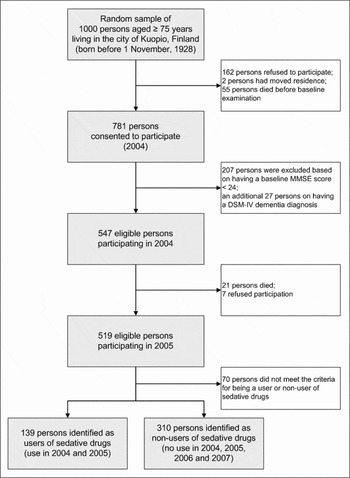
This study analyzed data from the Geriatric Multidisciplinary Strategy for the Good Care of the Elderly (GeMS) study. The GeMS study was a randomized comparative study which evaluated a model for geriatric assessment, care and rehabilitation between 2004 and 2007 in Kuopio, Finland (Rikala et al., Reference Rikala, Korhonen, Sulkava and Hartikainen2011). The study sample (n = 1000) was randomly selected from all persons aged ≥75 years (born before 1 November 1928) living in the city of Kuopio, Finland. Of these 1000 persons, 781 (700 community-dwelling, 81 institutionalized) provided written informed consent to participate (162 persons refused participation, 2 persons had moved residence, and 55 persons died before the scheduled baseline examination) (Figure 1). The study was approved by the Hospital District of Northern Savo ethics committee.
Inclusion and exclusion of participants in the study.

The study group allocation did not impact the evolution of psychotropic drug use (Rikala et al., Reference Rikala, Korhonen, Sulkava and Hartikainen2011). Therefore, participants in both the intervention and comparison groups were considered in the present analyses. Persons were excluded from the present analyses based on having a baseline Mini-Mental State Examination (MMSE) score lower than 24 (n = 207). In a second step, persons with dementia based on the DSM-IV criteria at baseline (an additional 27 persons) were excluded from the analyses. This was because persons with dementia and subthreshold levels of dementia may have a different risk of further cognitive decline.
Data collection
Trained nurses conducted annual participant interviews between 2004 and 2007. Participants were interviewed to elicit data on sociodemographic factors, health status and drug use. If a community-dwelling participant was unable to visit the outpatient study clinic the nurse interview took place in the participant's home. Institutionalized participants were interviewed in their place of residence. Participant self-reported drug use was verified from prescription forms and drug packages, and by using medical records from the municipal health center, home nursing service, local hospitals and the Kuopio University Hospital. If a participant was unable to report their drug use, this information was sought from that participant's caregiver.
Drug exposure
The use of prescription and non-prescription drugs was recorded and classified using the Anatomical Therapeutic Chemical (ATC) Classification System. Drug use was categorized as regular if the drug was being taken daily or at regular intervals during the preceding two weeks, or as-needed if there was an irregular pattern of use. This categorization was based on each participant's actual pattern of use rather than the clinician's prescribed or intended pattern of use. Sedative drugs were defined as those belonging to ATC classes N05B and N05C, which included zolpidem and zopiclone.
A participant was defined as a user of sedative drugs if he or she was a regular or as-needed prevalent user of one or more sedative drugs in 2004 and 2005. A participant was considered a non-user of sedative drugs if he or she did not use sedative drugs on a regular or as-needed basis in 2004, 2005, 2006 or 2007. Participants who did not meet the criteria for being a user and non-user of sedative drugs were excluded from the analyses.
Cognitive function
The main outcome measure was change in cognitive function assessed using the 30-item MMSE from 2005 to 2007. The MMSE has been used previously to assess the severity of cognitive impairment and to assess change in cognitive function over time (van Vliet et al., Reference van Vliet, van der Mast, van den Broek, Westendorp and de Craen2009).
Covariates
Covariates were selected on the basis of previous research about cognitive decline in older people. These covariates were sociodemographic factors, depressive symptoms (yes/no), study group allocation (intervention/comparison group), and concomitant drug use. Sociodemographic factors used as covariates were gender (Azad et al., Reference Azad, Al Bugami and Loy-English2007), age at baseline examination (years) (Kidd, Reference Kidd2008), and educational level (number of years) (Stern, Reference Stern2006). The presence of depressive symptoms (yes/no) was assessed using the 15-item Geriatric Depression Scale (GDS-15), with scores ≥5 considered indicative of depressive symptoms (Paterniti et al., Reference Paterniti, Verdier-Taillefer, Dufouil and Alpérovitch2002b). Regular or as-needed use of antipsychotic drugs (ATC class N05A) was selected as a covariate because antipsychotics have been associated with deleterious cognitive effects in older persons (Byerly et al., Reference Byerly, Weber, Brooks, Snow, Worley and Lescouflair2001). All analyses were performed using covariate data collected in 2004 prior to the period over which drug exposure was defined.
Statistical analyses
Descriptive statistics were expressed as means and standard deviations for continuous variables, and as proportions for nominal variables. Student's t-tests were used to compare continuous variables, and χ2 tests for nominal variables. P-values <0.05 were considered statistically significant. A linear mixed model was used to examine change in MMSE scores from 2005 to 2007. Users of sedative drugs in 2004 and 2005 (n = 139) were compared to non-users of sedative drugs (n = 310) in 2004, 2005, 2006 and 2007. Mixed models are a statistical technique that considers data for drop-outs using a missing-at-random assumption (Verbeke and Molenberghs, Reference Verbeke and Molenberghs2000). There were no significant differences in MMSE scores between participants and dropouts from 2005–2006 (P = 0.073). However, participants had lower MMSE scores than non-drop-outs from 2006 to 2007 (P<0.001). The mixed model was adjusted for the covariates described in the previous section. Use of antidepressant drugs was not included as a covariate in the final model because it was strongly correlated to the presence of depressive symptoms. The final model included a random slope, random intercept, an auto-regressive covariance matrix, and interaction term between exposure and time. The REML (Restricted Maximum Likelihood) estimation was used (Verbeke and Molenberghs, Reference Verbeke and Molenberghs2000). Secondary analyses were conducted to compare the adjusted marginal mean MMSE scores among users and non-users of sedative drugs in 2005 and 2007 only. Secondary analyses are recommended when using mixed models with more than two observations to indicate where statistically significant associations exist or do not exist. All analyses were performed using the Statistical Package for the Social Sciences (SPSS) Version 17.0 for Windows (SPSS Inc., Chicago, IL).
Results
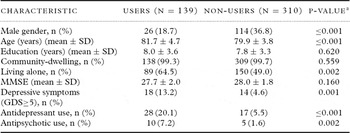
The baseline demographic characteristics of the 139 users and 310 non-users are summarized in Table 1. Users of sedative drugs were older (P ≤ 0.001), more likely female (P ≤ 0.001), more likely to live alone (P = 0.002), had a higher prevalence of depressive symptoms (P = 0.001), and were more likely to be concomitant users of antidepressant (P ≤ 0.001) and antipsychotic drugs (P = 0.002) than non-users. However, MMSE scores were not statistically significantly different among users and non-users (P = 0.160). Of the 139 users in 2005, 128 (92.1%) participated in 2006 and 122 (87.8%) participated in 2007. Of the 310 non-users in 2005, 300 (96.8%) participated in 2006 and 291 (93.9%) participated in 2007. The most prevalent regular or as-needed sedative drugs among the 139 users in 2005 were zopiclone (n = 75), temazepam (n = 33) and oxazepam (n = 18).
Descriptive characteristics at baseline (2004) for users and non-users of sedative drugs

SD = standard deviation; MMSE = Mini-Mental State Examination; GDS = Geriatric Depression Scale.
a Student's t-tests were used to compare continuous variables, and χ2 tests for nominal variables.
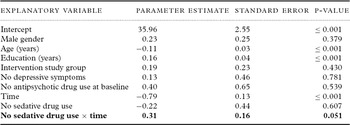
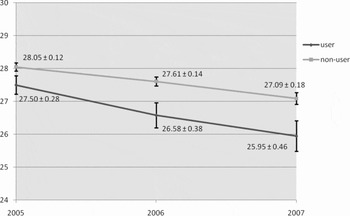
The unadjusted mean MMSE scores among users of sedative drugs were 27.50 in 2005, 26.58 in 2006, and 25.95 in 2007 (Figure 2). In comparison, the unadjusted mean MMSE scores among non-users of sedatives were 28.05 in 2005, 27.61 in 2006, and 27.09 in 2007. In the final adjusted model, MMSE scores were 0.31 points lower in 2005, 0.62 points lower in 2006, and 0.93 lower in 2007 among users compared to non-users of sedative drugs. The difference in MMSE scores over time (2005–2007) between users and non-users just failed to reach statistical significance (P = 0.051) (Table 2). In secondary analyses, pairwise comparison of the estimated marginal means of MMSE scores obtained in 2005 and 2007 between users and non-users showed an overall difference of 0.69, with a standard error of 0.29 (P = 0.019) when adjusted for all covariates.
Linear Mixed Model for change in MMSE score (2005–2007) as a function of non-use of sedative drugs in an Finnish population sample aged 75 years and older

Change in mean MMSE scores (with standard error bars) among users and non-users of sedative drugs.

Discussion
The main finding of our study was that the association between use of sedative drugs and incident cognitive decline was not statistically significant when assessed using MMSE scores collected from 2005 to 2007. However, in secondary analyses conducted using only those MMSE scores obtained in 2005 and 2007, use of sedative drugs was associated with statistically significant cognitive decline.
Our findings were consistent with a number of previous studies into the use of benzodiazepines and cognitive decline. Allard et al. (Reference Allard, Artero and Ritchie2003) reported no association between long-term benzodiazepine use and cognitive decline in a population-based sample of 372 older persons (mean age 76 years) in France. Hanlon et al. (Reference Hanlon1998) reported that current and previous benzodiazepine use was unrelated to level of cognitive functioning among 2765 community-dwelling participants aged 65 years and older. Similarly, van Vliet et al. (Reference van Vliet, van der Mast, van den Broek, Westendorp and de Craen2009) reported that use of benzodiazepines was not associated with cognitive decline in the Leiden 85+ Study. However, van Vliet et al. found that persons who discontinued taking benzodiazepines had a 4.0 point lower MMSE score in the year prior to discontinuation compared to those who continued taking benzodiazepines. This was interpreted as evidence of a “depletion of susceptibles effect” whereby physicians ceased prescribing benzodiazepines to persons with impaired cognitive function (Moride and Abenhaim, Reference Moride and Abenhaim1994). Similarly, Lagnaoui et al. (Reference Lagnaoui2009) reported a non-significant increased risk of cognitive impairment (odds ratio (OR) 1.5; 95% confidence interval (CI) 0.6–3.4) among former, but not among current benzodiazepine users (OR 1.0; 95% CI 0.5–2.0). We investigated the use of sedative drugs in 2004 and 2005, and incident cognitive decline between 2005 and 2007. However, we cannot exclude the possibility that our non-significant results were also due in part to the “depletion of susceptibles effect”.
Our findings were also in contrast to several previous studies. Paterniti et al. (Reference Paterniti, Dufouil and Alperovitch2002a) reported an increased risk of dementia among chronic but not episodic users in a four-year longitudinal study of 1398 persons aged from 60 to 70 years. Lagnaoui et al. (Reference Lagnaoui2002) reported that former use of benzodiazepines was associated with a significantly increased risk of dementia (OR 2.3; 95% CI 1.2–4.5) among 3777 persons aged 65 years and older. Conversely, two studies have reported a lower risk of cognitive decline among former (Dealberto et al., Reference Dealberto, McAvay, Seeman and Berkman1997) and ever (Fastbom et al., Reference Fastbom, Forsell and Winblad1998) users of benzodiazepines.
Although the incident cognitive decline was not statistically significant between users and non-users of sedative drugs, users of sedative drugs had lower absolute MMSE scores in 2005, 2006 and 2007. This may be partly explained by acute exposure to sedative drugs among participants who continued to use sedatives. In addition, the absolute decline in mean MMSE scores among users of sedative drugs between 2005 and 2007 was 1.55. A decline of more than three MMSE points for a given individual over a 1–4 year period has been described as indicative of “substantial” cognitive deterioration unlikely to have resulted from chance fluctuation (Tangalos et al., Reference Tangalos1996).
There are a number of methodological similarities and differences between our study and previous longitudinal studies. Our analyses were adjusted for concomitant use of antipsychotic drugs. This was important because antipsychotic drugs may accelerate the rate of cognitive decline (McShane et al., Reference McShane, Keene, Gedling, Fairburn, Jacoby and Hope1997). Many previous studies have not adjusted for use of other psychotropic drugs (Fastbom et al., Reference Fastbom, Forsell and Winblad1998; Hanlon et al., Reference Hanlon1998; Lagnaoui et al., Reference Lagnaoui2002), or have adjusted for use of psychotropic drugs as a single covariate (Dealberto et al., Reference Dealberto, McAvay, Seeman and Berkman1997; Paterniti et al., Reference Paterniti, Dufouil and Alperovitch2002a). Treating use of other psychotropic drugs as a single covariate may be problematic because antidepressant drugs may be protective against cognitive decline in older persons with depressive symptoms (Mossello et al., Reference Mossello2008). However, like most previous studies, our analyses were not adjusted for concomitant use of anticholinergic, antihypertensive or antidiabetic drugs that may have possible direct or indirect effects on cognition. The use of mixed models meant that we were able to account for persons who dropped out of the study during the two-year follow-up period. This was important because sedative use and cognitive decline have been associated with increased mortality in previous studies (Dewey and Saz, Reference Dewey and Saz2001; Belleville, Reference Belleville2010). Despite often considerable attrition rates, most previous analyses have been restricted to subsamples of study participants alive at the end of the follow-up period.
Strengths and limitations
There are a number of additional methodological strengths of our study. First, the longitudinal design meant that we were able to investigate cognitive decline prospectively among users and non-users of sedative drugs in a well-characterized cohort of older persons. Secondly, drug exposure was ascertained though nurse interviews. This method captured actual patterns of drug use rather than prescribed or intended patterns of use. Thirdly, the MMSE is a widely used and validated instrument for assessing cognitive function among older persons. Our study also had a number of methodological limitations. First, sedative use was defined according to prevalent use at consecutive clinical examinations in 2004 and in 2005. For the purpose of the analyses, we assumed that a prevalent user at consecutive clinical examinations was a continuous user between these time points. One year was a relatively short period over which to define long-term use but this period was longer than in many previous epidemiological studies on long-term benzodiazepine use (Lagnaoui et al., Reference Lagnaoui2004; Fortin et al., Reference Fortin2007; Assem-Hilger et al., Reference Assem-Hilger, Jungwirth, Weissgram, Kirchmeyr, Fischer and Barnas2009). Secondly, as with most previous studies, we did not explore the possibility of a dose-response relationship between sedative use and incident cognitive decline. This may have been important because cumulative exposure to CNS drugs has been associated with cognitive decline.
Conclusions
Use of sedative drugs was not associated with a statistically significant incident cognitive decline when assessed using MMSE scores collected from 2005 to 2007. Nevertheless, clinicians should maintain a judicious approach to prescribing sedative drugs given the association with a range of potential ADEs, including incident cognitive decline.
Conflict of interest
None.
Description of authors' roles
FD and JSB drafted the paper. FD and PL conducted the statistical analyses. SH and RS were involved in conducting the GeMS study. All authors revised the paper for important intellectual content, and approved the version of the paper submitted for publication.
Acknowledgments
The authors thank the Social Insurance Institution of Finland and City of Kuopio for supporting the GeMS study. The authors also thank Professor Gert Laekeman and the K.U. Leuven “Fonds Apotheker en Mevrouw Ysebaert-Devos” for providing a travel grant to Franciska Desplenter.