Introduction
Although the importance of social networks for the subjective wellbeing of older people is well established in the literature (Cornwell and Waite Reference Cornwell and Waite2009; Fiori, Antonucci and Cortina Reference Fiori, Antonucci and Cortina2006; Ha Reference Ha2010; Mechakra-Tahiri et al. Reference Mechakra-Tahiri, Zuzunegui, Preville and Dube2009; Merz and Huxhold Reference Merz and Huxhold2010; Newsom et al. Reference Newsom, Rook, Nishishiba, Sorkin and Mahan2005; Zunzunegui, Beland and Otero Reference Zunzunegui, Beland and Otero2001), there is still much to be learned as to how social networks impact the quality of life in late life. This is especially relevant in relation to the older component of the older cohort, that is, persons aged 80 and older. Without sufficient differentiation by age group in gerontological social network research, properties that characterise the associations between social networks and states of subjective wellbeing among younger-old persons, those aged 60–79, may mistakenly be assumed to prevail among the older-old as well. More attention is required, in particular, to the possible age and/or cohort-based differences in the associations that exist between social networks and subjective wellbeing among persons aged 80 and older, a steadily increasing segment of the elderly population (Herrmann, Michel and Robine Reference Herrmann, Michel and Robine2010).
The study reported in this article addresses this gap in the gerontological literature. It considers the relationships of core social network indicators vis-à-vis two subjective wellbeing measures: perceived quality of life (the CASP-12 Scale) and life satisfaction. Moreover, it views these associations through the lens of age-based interaction terms. The analysis is based upon a large sample of older European adults who were queried in the Survey of Health, Ageing and Retirement in Europe (SHARE; Börsch-Supan and Jürges Reference Börsch-Supan and Jürges2005). The SHARE data are examined with the aim of clarifying whether the social networks of the older-old work in the same way that they seem to work among younger-old people. Stated differently, the current study considers whether social networks matter in very old age in the same way that they matter among older persons in general.
Literature review
The construct of social network, frequently referred to as social capital, reflects the collection of interpersonal contacts that people variously maintain and which provide them with access to social, emotional and practical support (Gray Reference Gray2009). Definitive research in this area of inquiry has described social networks as clusters of significant others who accompany individuals as they move through the lifecourse. The nature of such ‘convoys’ of support tends to vary across different people, and the convoy of any given person may change over time (Antonucci and Akiyama Reference Antonucci and Akiyama1987). Accordingly, the convoy model of social support allows investigators to map and to follow the interpersonal entourage with whom one exchanges support and services in late life. Socio-emotional selectivity theory adds additional insights into the dynamics of social networks in very late life. The theory maintains that the older-old tend to modify their collection of social ties, focusing on the more meaningful of the relations and disassociating themselves from peripheral contacts (Lang, Staudinger and Carstensen Reference Lang, Staudinger and Carstensen1998). The theory suggests a trend toward network reduction or diminution in very old age.
Different facets of social networks are variously associated with health and wellbeing (Berkman et al. Reference Berkman, Glass, Brissette and Seeman2000). A state of wellbeing in late life may stem from various conditions that extend from objective functional health to subjective perceptions of life quality (George Reference George2010). Subjective wellbeing is seen as a positive orientation toward life, and is expressed in such measures as positive affect, morale, feelings of happiness and life satisfaction. The core aspects of social networks most frequently addressed in respect to wellbeing include features of network structure and measures of interaction within the network (Cornwell et al. Reference Cornwell, Schumm, Laumann and Graber2009; de Leon et al. Reference de Leon, Gold, Glass, Kaplan and George2001; Zunzunegui et al. Reference Zunzunegui, Alvarado, Del Ser and Otero2003), social exchange variables (Chen and Silverstein Reference Chen and Silverstein2000; Fritzell and Lennartsson Reference Fritzell and Lennartsson2005; Grundy Reference Grundy2005; Liang, Krause and Bennett Reference Liang, Krause and Bennett2001) and indicators of social engagement (Everard et al. Reference Everard, Lach, Fisher and Baum2000; Litwin and Shiovitz-Ezra Reference Litwin and Shiovitz-Ezra2006).
A number of studies reported in the literature have examined social network attributes and wellbeing among the older-old. First, in relation to network structure and interaction, several studies indicate that lack of a spouse or partner is associated with lesser wellbeing in a variety of settings. Those without a spouse were found to have had lower life satisfaction, especially among the men (Berg et al. Reference Berg, Hoffman, Hassing, McClearn and Johansson2009), lower quality of life (Jakobsson, Hallberg and Westergren Reference Jakobsson, Hallberg and Westergren2004) and higher mortality. Relations with children among the older-old show more mixed associations with wellbeing. A study of Swiss octogenarians found that ties with children were related to disability (Guilley et al. Reference Guilley, Pin, Spini, d'Epinay, Herrmann and Michel2005). In contrast, an American study found that those with children were more active, especially when they also had grandchildren (Johnson and Troll Reference Johnson and Troll1992). In comparison, a longitudinal Swedish study found no association between support from children and life satisfaction (McCamish-Svensson et al. Reference McCamish-Svensson, Samuelsson, Hagberg, Svensson and Dehlin1999).
Ties with friends also show some varied results. The Swiss study found friendship ties to be related to survival (Guilley et al. Reference Guilley, Pin, Spini, d'Epinay, Herrmann and Michel2005), and another study found friendship ties related to better cognitive functioning (Keller-Cohen et al. Reference Keller-Cohen, Fiori, Toler and Bybee2006). Among African Americans, older women were helped more by friends (and by relatives), but the men were helped more by immediate family members (Perry and Johnson Reference Perry and Johnson1994). Interestingly, the Swedish study found that the number of those with no friends at all increased significantly from aged 80–83, but that those retaining close friends actually increased their contact with them (McCamish-Svensson et al. Reference McCamish-Svensson, Samuelsson, Hagberg, Svensson and Dehlin1999).
Fewer sources directly address aspects of exchange among the older-old and their associations with wellbeing. A comparative study of intergenerational transfers in Germany and in Israel found that persons aged 50–79 years in both countries gave more help than they received, but this was not the case among those aged 80 and older (Litwin et al. Reference Litwin, Vogel, Künemund and Kohli2008). An American study of residents of assisted living, aged 85 and older, found that the ability to provide support to others diminished with age, but that the desire to reciprocate remained (Beel-Bates, Ingersoll-Dayton and Nelson Reference Beel-Bates, Ingersoll-Dayton and Nelson2007). Data from the Assets and Health Dynamics Among the Oldest Old study showed that older parents who moved in with their children were more frequently the recipients of help rather than the providers (Choi Reference Choi2003).
The literature on social engagement and wellbeing in very late life suggests that there may be a gap between theory and research. In their now classic definition of ‘successful ageing’, Rowe and Kahn (Reference Rowe and Kahn1997) identified active engagement with life as one of three cornerstones of ageing well. They defined engagement with life as involvement in social networks and in productive activity. However, as Dodge et al. (Reference Dodge, Kita, Takechi, Hayakawa, Ganguli and Ueshima2008) contend, there is still little known about the normative levels of leisure activities in very late life. In their study of Japanese elders, they found that when compared to the youngest-old, the oldest-old had lower frequency scores on all the activity measures. Horgas, Wilms and Baltes (Reference Horgas, Wilms and Baltes1998) similarly found, in a study of persons aged 70–105 in Berlin, that the oldest-old had lower levels of activity engagement.
Two studies further reinforce this gap between theory and research regarding active engagement in later life with findings suggesting that activity is not clearly associated with improved survival risk. The first, an analysis of Swedish older adults, found little connection between activity and survival. Active but solitary engagement was associated with reduced mortality among the men, but none of the activity domains were correlated with survival among the women (Lennartsson and Silverstein Reference Lennartsson and Silverstein2001). The investigators concluded that it may well be the non-social aspects of activities that promote longevity in late old age. The second study examined mortality among the oldest-old in China, and here too it was found that solitary activities were correlated with lower mortality risk (Sun and Liu Reference Sun and Liu2006). The researchers reached the conclusion that the expected effect of social activities on mortality is reversed in very late life.
One piece of evidence for Rowe and Kahn's (Reference Rowe and Kahn1997) formulation was found, nevertheless, in a study of older Swedes. The multivariate analysis revealed that people who increased their activity participation across a number of domains perceived an improvement in their life conditions (Silverstein and Parker Reference Silverstein and Parker2002). The effect was especially evident among those who became widowed and among those who had little family contact.
The literature reviewed thus far suggests that there may indeed be differing effects of social networks on wellbeing among older adults in very late life. The current study examines three hypotheses drawn from this review. First, drawing partially on socio-emotional selectivity theory in the sense of network diminution among the older-old, we posit that the effects of social network measures on the subjective wellbeing of older-old people will be smaller. Second, based upon the convoy model and the changing character of social networks over time, we hypothesise that the nature of the effects of social networks on the subjective wellbeing of older-old people will differ from those found among the younger-old. Third, in relation to the successful ageing paradigm, we postulate that the scope of activity among the older-old respondents will be less associated with wellbeing than it is among younger-old respondents.
Study methodology
This study analysed data from SHARE (Börsch-Supan, Hank and Jürges Reference Börsch-Supan, Hank and Jürges2005). Countries that participated in the second wave of the SHARE survey, collected in 2006, were included in the study analyses. The SHARE respondent base includes a representative household sample of the community-dwelling population age 50 and older (N=33,281). The SHARE questionnaire elicits information on a wide range of variables that extend from physical functioning through financial planning as well as social environments in which respondents are embedded.
We limited the current analysis to the individual respondent in each household who was designated as the ‘family respondent’. As in the Health and Retirement Study, after which it is modelled, the SHARE questionnaire queries only the family respondent on most of the social relationship questions. Other relevant household information supplied by another respondent from within the same household, as for example data provided by the financial respondent, was copied to the family respondent as well.
The focus of our analysis examined the social relationship dynamics within the older segment of the population. We therefore also limited the study sample to community-residing respondents aged 60 and older (N=14,728), representative of when the majority of older Europeans have retired from their main employment. Sampling design weights, constructed as the inverse of the probability of being included in the sample, were applied to the analysis sample. Respondents with missing values on one or more of the measures were excluded from the multivariate analyses (CASP-12 Model: missing cases=878; Life Satisfaction Model: missing cases=849). The final sample used in the analysis of the CASP-12 quality of life wellbeing measure was comprised of 13,850 respondents. For the life satisfaction wellbeing measure analysis, the final sample included 13,879 respondents.
Variables
The analysis addressed the three main categories of social network variables, namely family structure and interaction, social exchange and social engagement. The family structure and interaction measures included having a spouse or partner in the household (0–1), number of children (0–6+), co-residence with one or more adult child(ren) (0–1), number of grandchildren (0–10+) and frequency of contact with the most contacted child [from never (1) to daily (7)]. Social exchange was measured by the provision and/or the receipt in the past year of three kinds of assistance. These included help with personal care tasks within the household, help of personal or practical assistance outside the household, and transfer of financial assistance to the sum of €250 or more. Each exchange measure received a score of one if it occurred and a score of zero if it did not occur.
Social engagement was measured by three indicators. We looked first at current work status (yes=1, no=0), because attendance at a work place at the age by which most Europeans have retired may provide an important source of social involvement. We also addressed the number of activities engaged in the previous month (0–5+), from a listing of up to seven different activities that ranged from voluntary work and attendance at social clubs to taking part in religious or political organisations. The frequency of the most frequent activity [from never (0) to daily (3)] was also taken into account.
The outcome variables of interest in this inquiry were two measures of wellbeing: the CASP quality of life scale and a global measure of life satisfaction. Both have been used widely in cross-national research and have been found to constitute robust indicators. The CASP scale examines significant aspects of wellbeing in late life, including sense of control, autonomy, self-realisation and pleasure (Hyde et al. Reference Hyde, Wiggins, Higgs and Blane2003; Wiggins et al. Reference Wiggins, Netuveli, Hyde, Higgs and Blane2008). The SHARE questionnaire employs a validated 12-item version of the CASP scale (total score range: 12–48) with high scores indicting better quality of life. Mean values were imputed for respondents with missing values for the CASP-12 score when more than 80 per cent of the count variable data information was available. Life satisfaction was measured on a single probe that ranged from ‘very dissatisfied’ (1) to ‘very satisfied’ (4).
We controlled for several background characteristics in this study; age group, gender, education level, household income and wealth. Age group was identified as a dummy variable, distinguishing between respondents age 60–79 (0) and those aged 80+ (1). Education was coded according to the International Standard Classification of Education (ISCED-1997). The income measure was self-report of income received from any source (e.g. employment, pension). Wealth was computed as the combined values of assets less liabilities. The income and wealth variables, reported in euros, were adjusted for relative purchasing power parity and standardised to household size square root. The income and wealth data were grouped in quintiles, as calculated on weighted data prior to sample selection.
We also controlled for health status. It was measured on four different self-reported indicators, including the extent of difficulties in activities of daily living (ADL; 0–6), the extent of difficulties in instrumental activities of daily living (IADL; 0–7), a count of chronic illnesses (0–10), such as diabetes and osteoporosis, and a count of health condition symptoms (0–11), for example, back pain and breathlessness.
Finally, we took European region into effect to account for regional differences on the associations between selected aspects of social network and wellbeing. Controlling for region minimises potential bias due to different cultural contexts. The region variable employed in the analyses had four values: (1) Northern region [Sweden and Denmark], (2) Western region [France, Germany, Austria, Switzerland, Belgium and the Netherlands], (3) Southern region [Spain, Italy and Greece], and (4) Eastern region [Poland and the Czech Republic].
Modes of analysis
The relationship between the social network variables and the two wellbeing outcome variables of interest in this study, CASP-12 quality of life scores and life satisfaction, were examined in separate analyses. Each analysis was carried out in three stages. Initially, ordinary least-squares regressions were performed for each wellbeing outcome on the background, socio-economic status, health and region variables. The Western European countries served as the regional reference category in these analyses. This was followed by regressions for each wellbeing outcome on the set of social network variables, controlling for background, health and region. In the last phase of the hierarchical regressions, we entered interaction terms for the 80 years old and older age group and each of the social network indicators. This permitted examination of the presence of age group differences in the associations between each of the social network variables and the respective wellbeing outcome measures.
Results
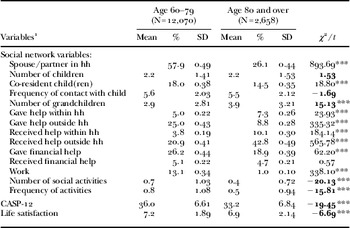
Table 1 displays the univariate descriptives and bivariate comparisons of the wellbeing outcome measures and social network variables according to age group. The table reveals that more than half the respondents aged 60–79 had a spouse or partner in the household compared to only a quarter of those aged 80 and over. No difference was discerned by age group, on the other hand, as to the number of children or the frequency of contact with them. However, a larger proportion of younger-old co-resided with one or more children in comparison to the older-old sample. Older-old respondents also had more grandchildren. In terms of exchange, younger-old respondents gave more help outside the household than the older-old and more financial assistance. Older-old respondents received more help from both within and without the household, and gave more help at home as well. Receipt of financial assistance was infrequent in both age groups. As for social engagement, about an eighth of the younger respondents were employed, compared to only 1 per cent of those aged 80 and above. Older-old respondents also had lower mean counts and frequency of activity. Finally, the older age group reported poorer subjective wellbeing, that is, lower CASP-12 scores and less life satisfaction.
Social network variables, CASP-12 quality of life scores and life satisfaction among older Europeans, by age group: univariate descriptions and bivariate comparisons

Notes: Values shown in bold represent the t scores. 1. Variable score ranges: number of children=0–6+; frequency of contact with child=1–7; number of grandchildren=0–10+; number of social activities=0–5+; frequency of activities=0–3; CASP-12=12–48; life satisfaction=1–4. hh: household. SD: standard deviation.
Significance level: ***p<0.001.
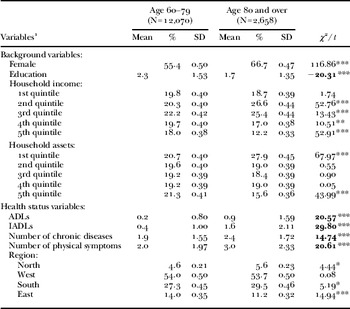
The univariate descriptives and bivariate comparisons of the control variables, inclusive of demographic, health characteristics and geographical region by age group are presented in Table 2. In terms of background and health, older-old respondents included more women than their younger-old counterparts. They were also less highly educated and had fewer members in the upper household income quintiles. In terms of household assets, those aged 80+ had greater representation in the lowest wealth quintile and lower representation in the highest quintile. They also reported worse health on all measures. As for region, respondents aged 80 and above were slightly more concentrated in the North and the South than respondents aged 60–79, and they were less represented in the East.
Background variables, health status and region among older Europeans by age group: univariate descriptions and bivariate comparisons

Notes: Values shown in bold represent the t scores. 1. Variable score ranges: education=0–6; activities of daily living (ADLs)=0–6; instrumental activities of daily living (IADLs)=0–7; number of chronic diseases=0–10; number of physical symptoms=0–11. SD: standard deviation.
Significance levels:*p<0.05
** p<0.01
*** p<0.001.
CASP-12 multivariate regression
The first model in the multivariate analysis of the CASP-12 scores revealed that higher socio-economic status, measured by education and economic status, is positively related to better quality of life, and that indicators of poorer health, such as greater dependency with ADLs or more chronic conditions, is negatively related. Regional differences also emerged, with respondents residing in Southern European nations reporting poorer quality of life and respondents residing in Scandinavian countries reporting higher quality of life, in comparison to Western European respondents. Model 1 accounted for 35.5 per cent of the variance in the CASP-12 scores. The introduction of the social network variables in Model 2 and age interaction effects in Model 3 added 2 per cent to the explained variance and had minimal impact on the relationships between control variables and CASP-12 scores. (Tables available upon request.)
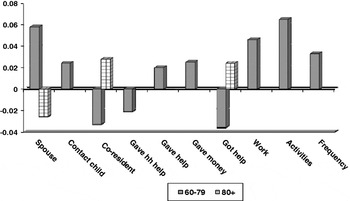
The associations between the social network variables and the CASP-12 wellbeing outcome after entry of the age-based interaction terms in Model 3 of the analysis are presented graphically in Figure 1. The dark bars reflect the associations between social network and the CASP-12 scores among those aged 60–79. The figure presents all the network variables found to be significantly related to the quality of life outcome among the younger-old group, net of other factors. The light bars with the check pattern show the corresponding significant associations between quality of life and the network variables among the older-old group, those aged 80 and older.
Statistically significant social network correlates of CASP-12 quality of life scores in older Europeans: beta coefficients.

Figure 1 shows stronger effects between social network and the CASP-12 wellbeing outcome among respondents aged 60–79, in comparison to those in the older-old age category. Better quality of life among the younger age group was related to having a spouse or partner, frequency of contact with the most contacted child, giving financial aid to one or more other persons, and providing personal or practical care assistance to someone living outside the respondent's household. In addition, social engagement was positively related with higher quality of life, as measured by work and frequency of activities in this analysis. Quality of life was negatively associated when younger-old respondents lived with one or more children, provided assistance with personal care to someone living in the same household, or received personal or practical help from someone outside the household.
In comparison, only a few significant associations were found between social network and quality of life among the respondents who were aged 80 and older. Living with a spouse or partner was negatively associated with the quality of life outcome. Co-residing with one or more adult children had the opposite effect and was found to have a positive association with the CASP-12 scores. Receiving personal or practical assistance from someone living outside the household was also related to higher CASP-12 scores.
Life satisfaction multivariate regression
The first model in the multivariate analysis of the life satisfaction scores revealed that higher socio-economic status improved life satisfaction and poorer health led to lower self-reports of life satisfaction. In addition, being in the older-old age category increased life satisfaction scores. Similar regional differences to those found in the CASP model were also found, with respondents residing in Scandinavian countries reporting higher life satisfaction and those living in the Southern region reporting lower life satisfaction in comparison to persons in the Western European countries. The first model accounted for 18.4 per cent of the variance in life satisfaction. Social network variables were added to the analysis in Model 2 and age interaction terms were added in Model 3, explaining an additional 2 per cent of the variance. (Tables available on request.)
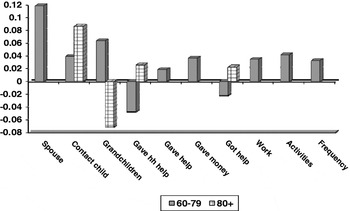
The associations between the social network variables and the life satisfaction scores after entry of the age-based interaction terms are presented graphically in Figure 2, following the same rationale of presentation employed in the previous figure. Here too, the dark bars reflect the significant associations among the younger-old age group and the light checked bars reflect the corresponding relationships among the older-old group.
Statistically significant social network correlates of life satisfaction in older Europeans: beta coefficients.

As may be seen in the figure, having a spouse, frequency of contact with children among the younger-old group and having more grandchildren were all significantly associated with greater life satisfaction. Needing to provide personal care assistance to someone within the same household was associated with lower life satisfaction. Providing assistance with personal or practical care to someone outside the household increased life satisfaction while receiving such care lessened this same outcome. Providing financial help was positively associated with life satisfaction. In addition, all three social exchange variables were positively related: working, being involved with a greater number of activities, and being more frequently involved with these activities.
Examination of these same variables among respondents age 80 years or older revealed fewer associations between social network and life satisfaction. Specifically, greater frequency of contact with children was positively associated with life satisfaction, but having more grandchildren was negatively related. Providing personal care assistance to someone inside the household had a positive association with life satisfaction, as did receiving assistance from outside the household for personal and practical needs.
Discussion
This study examined whether social network variables are associated with subjective wellbeing in similar ways among younger-old and older-old Europeans. Subjective wellbeing in this study was identified with two distinct measures, self-reported life satisfaction and CASP-12 quality of life scores. The CASP-12 and life satisfaction regression analyses performed in this research both provided empirical support of the first hypothesis of the research that posited that the effects of social networks would be smaller among those age 80 or older in comparison to the younger-old, aged 60–79. The results presented in Figures 1 and 2 display the findings when age category interaction terms were introduced into the regression analyses. These results suggested that there were many more such associations among respondents aged 60–79 than among those aged 80 and older, after adjusting for background characteristics, health status and region.
Among the younger-old respondents, many similar associations were found to exist between social network variables and both of the subjective wellbeing outcomes. Life satisfaction and quality of life were positively influenced when the respondent lived with a spouse or partner, had more frequency of contact with children, and provided personal or practical assistance to someone outside their home. In addition, all three of the social engagement variables were found to be positively associated with positive wellbeing. Respondents, who were employed, involved with a greater number of activities and with higher frequency of involvement in those activities reported higher levels of life satisfaction and better quality of life. Negative associations between social network and both of the subjective wellbeing outcomes among the younger-old study participants were found when respondents indicated they provided or received personal or practical care assistance to someone outside the household. Differences were seen in the following two associations: co-residency with one or more children was negatively associated with quality of life (but not with life satisfaction) and having more grandchildren was associated with greater life satisfaction (but not with quality of life).
However, as we had hypothesised, examination of the significant associations between social network and subjective wellbeing was notably different for respondents in the older-old age category. Compared to the extensive number of associations revealed among the younger-old sample, only a handful of the social network variables were found to correlate with wellbeing outcomes in respondents aged 80 or older. Receiving personal or practical care from someone outside the home improved life satisfaction and increased self-perceptions of quality of life as measured by the CASP-12 score. Quality of life increased when the older-old respondent co-resided with one or more adult children but lessened when a spouse or partner was present in the home. Life satisfaction improved with greater frequency of contact with adult children and when respondents provided personal or practical assistance to someone outside the household. Interestingly, even though living with a spouse, partner or adult child did not influence life satisfaction outcomes, having a greater number of grandchildren was found to reduce life satisfaction among the older-old group.
The findings show that subjective wellbeing among the older-old respondents was related mainly to interactions with family members, including a spouse/partner, children or grandchildren. The social exchange variables that reflect ties also inclusive of other relatives and/or friends had limited association with wellbeing among the older-old study participants. Additionally, the engagement variables which typically allow a variety of social ties to come into play were also unrelated to wellbeing among the older-old in the study sample. In comparison, the significant associations between social network and wellbeing among respondents aged 60–79 crossed all three categories of social network; social network structure and interaction, social exchange and social engagement. We interpret this trend as partial support for the socio-emotional selectivity thesis, in that the significant ties among the older group were from the most intimate and long-lasting of relationships, those with one's adult children. But, additional inquiry is warranted in order to further substantiate this claim.
The findings of this research also provided empirical support of the second hypothesis in which we assert that the nature of the effects of social networks on subjective wellbeing outcomes would differ when comparing across age categories. Among the few social network variables that were found to be associated with wellbeing among those aged 80 or older, the direction of the associations were opposite that found among the younger-old sample. Surprisingly, living with a spouse or partner was found to decrease quality of life among the oldest-old while this living arrangement improved quality of life scores of those aged 60–79. Co-residency with adult children also had opposite effects for both age categories. Younger-old respondents who lived with an adult child had lower quality of life scores, while older-old respondents' quality of life improved with this type of living arrangement. This distinction also emerged for how the receipt of personal or practical assistance from someone outside the home impacted quality of life; improving scores for the older-old but decreasing scores among the younger-old. The findings suggest that quality of life in the latest stages of life is positively associated with interaction with close persons other than a spouse, within or outside the home.
Similar patterns appeared in the analysis of life satisfaction and social network. Even though increased contact with adult children improved life satisfaction in both age categories, a greater number of grandchildren actually resulted in poorer life satisfaction in respondents aged 80 or older compared to the positive association for the younger-old. Providing personal care within the home or receiving assistance from someone outside the home was negatively associated with life satisfaction when younger but improved scores for the older-old.
The consistency of this pattern across both of the subjective wellbeing outcomes provides empirical support of the convoy model assertion that the composition of supportive ties and their relationship with one's self-perceived wellbeing may not be stable or consistent over the lifecourse. However, in order to confirm fully the contention that these age-related differences reflect lifecourse changes rather than cohort-effects, longitudinal research is required.
The third hypothesis in the analysis postulated that activity among the older-old respondents would be less associated with wellbeing than it is among younger-old respondents. The findings in the study supported this hypothesis by showing that none of the relevant activity variables were correlated with either of the wellbeing measures among the older-old. In contrast, the activity variables were positively associated with life satisfaction and CASP-12 scores among the younger-old respondents. This result thus goes beyond the findings from previous research that has shown a diminished involvement in activity among the older-old (Dodge et al. Reference Dodge, Kita, Takechi, Hayakawa, Ganguli and Ueshima2008). In contrast to the claims of the successful ageing paradigm, moreover, the current findings underscore a lack of association between engagement and self-reported wellbeing among older-old adults.
Despite the advantages of access to a large data set, a few limitations of the current inquiry should be noted. First, the analysis was based upon cross-sectional data with its inherent limitations for drawing conclusions about lifecourse dynamics. Longitudinal analysis is required in order to rule out cohort effects in explaining age-related differences. The SHARE survey is designed to be longitudinal, but at the time of the present analysis a longitudinal analysis of the data was limited to a two-year hiatus. We also opted to limit our analysis to data from the second wave, despite its cross-sectional limitations, because of the inclusion of two former Eastern bloc countries that were not part of the first wave of SHARE.
The second limitation relates to the relative paucity of specific measures addressing friendship ties in the SHARE questionnaire. Although all of the exchange measures in the survey allow citation of friends as recipients or as providers of help, there were no counts of the number of friends maintained by respondents or the frequency of contact with them. This limitation might not be of major importance insofar as some previous research reports a major decline in the number of friends that people report having after the age of 80 (McCamish-Svensson et al. Reference McCamish-Svensson, Samuelsson, Hagberg, Svensson and Dehlin1999). Nevertheless, the lack of explicit variables measuring friendship ties is still a drawback.
There is a final limitation regarding the potential constraints of our outcome indicators. Some investigators maintain that such measurement scales may not sufficiently account for the changing and contextual nature of wellbeing (Bond and Corner Reference Bond, Corner, Vincent, Phillipson and Downs2006; Taylor Reference Taylor2011), or that they might not reflect what older people themselves consider important for their quality of life (Bowling Reference Bowling2009). Therefore, future inquiry in this area should explore the associations that were found here by means of additional wellbeing indicators.
In conclusion, this study has found that social networks still matter in very old age, but not in the very same way that they matter among younger-old persons. The analysis showed that frequency of contact with one's children was the main social network correlate of wellbeing among those aged 80 and over. It could well be that this finding is but one indication of the differences that seem to emerge between persons in the third and fourth ages (Gilleard and Higgs Reference Gilleard and Higgs2010; Jopp, Rott and Oswald Reference Jopp, Rott and Oswald2008). Third-agers among the new elderly, the younger-old in the current research endeavour, appeared to fit Rowe and Kahn's (Reference Rowe and Kahn1997) visions of successful ageing in which engagement with social networks is a key component. The current study underscored the multiplicity of associations that exist between social network variables and wellbeing in this particular age group. However, among those approaching the fourth age, the older-old respondents in this inquiry, state of wellbeing was apparently explained more by other factors controlled for in the analysis, particularly health status. Additional study is recommended to further disentangle age-related differences in the interpersonal milieus of older people and to better understand how they may affect subjective wellbeing at different points in the latest part of life.
Acknowledgements
This work was supported primarily by the European Commission through the 5th Framework Programme (project QLK6-CT-2001-00360 in the thematic programme Quality of Life). Further support was received by the European Commission through the 6th Framework Programme (projects SHARE-I3, RII-CT-2006-062193, as an Integrated Infrastructure Initiative, COMPARE, CIT5-CT-2005-028857). Substantial co-funding came from the US National Institute on Aging (U01 AG09740-13S2, P01 AG005842, P01 AG08291, P30 AG12815, R21 AG025169, Y1-AG-4553-01, IAG BSR06-11 and OGHA 04-064). Austria, Belgium, France, Spain, Sweden and Switzerland provided national co-funding.