Annual bluegrass is a problematic weed in golf course putting greens due to its impact on utility and aesthetics, as well as its ability to survive and thrive at low mowing heights (Beard et al. Reference Beard, Rieke, Turgeon and Vargas1978; Mitch Reference Mitch1998). Furthermore, there are no selective POST herbicides currently registered in the United States for annual bluegrass control in creeping bentgrass putting greens (Brosnan et al. Reference Brosnan, Henry, Breeden, Cooper and Serensits2013a). PRE herbicide options are limited to bensulide and fenarimol. However, PRE control is complicated by the long germination period of annual bluegrass and the presence of perennial biotypes (Beard et al. Reference Beard, Rieke, Turgeon and Vargas1978; Callahan and McDonald Reference Callahan and McDonald1992; Itoh et al. Reference Itoh, Kobayashi and Ueki1997; Kaminski and Dernoeden Reference Kaminski and Dernoeden2007; McElroy et al. Reference McElroy, Walker, Wehtje and van Santen2004). Application of the growth regulators paclobutrazol and flurprimidol have resulted in suppression of annual bluegrass, and these chemicals are registered for use in putting greens (Johnson and Murphy Reference Johnson and Murphy1995; Johnson and Murphy Reference Johnson and Murphy1996; Woosley et al. Reference Woosley, Williams and Powell2003). Other agrochemicals, such as amicarbazone and ethofumesate, have been studied for use in creeping bentgrass, but are not registered for putting green use and have resulted in inconsistent control and intolerable turfgrass injury in some cases (Anonymous 2014; Kohler and Branham Reference Kohler and Branham2002; McCullough et al. Reference McCullough, Hart, Weisenberger and Reicher2010).
Methiozolin is a herbicide that selectively controls annual bluegrass in creeping bentgrass and hybrid bermudagrass (Cynodon dactylon × C. transvaalensis Burtt-Davy) (Askew and McNulty Reference Askew and McNulty2014; Brosnan et al. 2013Reference Brosnan, Henry, Breeden, Cooper and Serensitsa; Hwang and Koo Reference Hwang and Koo2009; Koo et al. Reference Koo, Hwang, Jeon, Kim, Lim, Lee and Cho2014; McCullough and Gómez de Barreda Reference McCullough and Gómez de Barreda2012; McCullough et al. Reference McCullough, Gómez de Barreda and Yu2013). Methiozolin is currently registered for this use in South Korea and Japan, and registration is being pursued in the United States (Moghu Research Center 2017). Methiozolin controls annual grasses both PRE and POST (Brosnan et al. Reference Brosnan, Henry, Breeden, Cooper and Serensits2013a; McCullough et al. Reference McCullough, Gómez de Barreda and Yu2013). PRE control is reportedly limited by relatively quick aerobic soil microbe metabolism; methiozolin has a reported half-life of 49 d under such conditions (Hwang et al. Reference Hwang, Lim, Kim, Chang, Kim, Koo and Kim2013). Methiozolin is absorbed by the roots and foliage of annual bluegrass, but root exposure is required for efficacious annual bluegrass control (Brosnan et al. Reference Brosnan, Henry, Breeden, Cooper and Serensits2013a; Flessner et al. Reference Flessner, Wehtje and McElroy2013; Koo et al. Reference Koo, Hwang, Jeon, Kim, Lim, Lee and Cho2014; McCullough et al. Reference McCullough, Gómez de Barreda and Yu2013). Selectivity between annual bluegrass and creeping bentgrass has been attributed to differential absorption and translocation (McCullough et al. Reference McCullough, Gómez de Barreda and Yu2013; Yu and McCullough Reference Yu and McCullough2014).
Annual bluegrass control with methiozolin requires multiple sequential applications that total 2.0 to 3.36 kg ai ha−1 (Brosnan et al. Reference Brosnan, Henry, Breeden, Cooper and Serensits2013a; McCullough et al. Reference McCullough, Gómez de Barreda and Yu2013). Sequential applications are more efficacious than single applications (Brosnan et al. Reference Brosnan, Henry, Breeden, Cooper and Serensits2013a). Fall application has been reported to be more efficacious than spring applications (Koo et al. Reference Koo, Hwang, Jeon, Kim, Lim, Lee and Cho2014). Greater control in fall may be due to greater methiozolin foliar and root absorption and greater translocation from root tissues at higher temperatures (McCullough et al. Reference McCullough, Gómez de Barreda and Yu2013).
Golf course managers frequently tank-mix herbicides with fertilizers to reduce time and labor expenditures (Fearis Reference Fearis2017). Tank-mixing fertilizers with herbicides can influence the efficacy of the herbicide application or have no effect. Chelated iron was found to have no influence on bispyribac-sodium efficacy on annual bluegrass (McCullough and Hart Reference McCullough and Hart2009). Similarly, iron and nitrogen tank-mixed with bispyribac-sodium did not reduce annual bluegrass control efficacy, but effectively masked creeping bentgrass discoloration relative to bispyribac-sodium alone (McDonald et al. Reference McDonald, Dernodeden and Kaminski2006). Iron tank-mixed with ethofumesate plus fluprimidol resulted in transient improved creeping bentgrass quality and reduced discoloration (Johnson and Carrow Reference Johnson and Carrow1995). Iron sulfate tank-mixed with MSMA resulted in reduced large crabgrass [Digitaria sanguinalis (L.) Scop.] control and bermudagrass [Cynodon dactylon (L.) Pers.] injury relative to MSMA alone (Massey et al. Reference Massey, Taylor, Chambers, Coats and Henry2006). Ammonium sulfate is commonly added to spray solutions to reduce the antagonistic effects of hard water on weak acid herbicides, including 2,4-D and glyphosate, by reducing interactions in spray solution with metal cations present in hard water, such as calcium (O’Sullivan et al. Reference O’Sullivan, O’Donovan and Hamman1981; Roskamp et al. Reference Roskamp, Chahal and Johnson2013). Tank-mixing ammonium sulfate with glufosinate increased the speed of sethoxydim absorption in large crabgrass (Jordan et al. Reference Jordan, York and Corbain1989) and increased glufosinate efficacy, absorption, and translocation in several weed species (Maschhoff et al. Reference Maschhoff, Hart and Baldwin2000).
Assessing methiozolin efficacy for annual bluegrass control when tank-mixed with common fertilizers has not been done. The objectives of this research were to evaluate methiozolin for annual bluegrass control and creeping bentgrass safety when tank-mixed with ammonium sulfate and iron sulfate.
Materials and Methods
General Experimental Information
Field research was conducted at the Auburn University Turfgrass Research and Education Center in Auburn, AL (32.34°N, 85.29°W), on a ‘Crenshaw’ creeping bentgrass putting green infested with annual bluegrass. Soil was a Marvyn sandy loam (fine-loamy, kaolinitic, thermic Typic Kanhapludult) with a pH of 6 and 1.1% organic matter. Fertility, irrigation, disease control, and pest control practices were conducted according to standard practices for the region (McCarty Reference McCarty2011). The turfgrass was mowed three times per week during the growing season at 0.32 cm. Three separate experiments were conducted according to experimental objectives and each was repeated in time. Each experiment was conducted as a randomized complete block design with a minimum of three replications. All treatments were applied in a water carrier at a rate of 280 L ha−1 with a handheld four-nozzle boom (TeeJet TP8002VS nozzles on 25-cm spacing; Spraying Systems Company, Wheaton, IL) to 1.5- by 1.5-m plots. Data collected varied by experiment, but all experiments visually assessed annual bluegrass control relative to the nontreated check on a 0% (no control) to 100% (complete plant death) scale. Creeping bentgrass injury was evaluated using a similar 0% to 100% scale, with a score of 20% representing the maximum level of creeping bentgrass injury considered commercially acceptable (Johnson and Murphy Reference Johnson and Murphy1995). Statistical analysis was conducted using SAS® PROC GLM (SAS Institute version 9.1, Cary, NC). Effects were considered significant when P<0.05. When subsequent regression analysis was necessary, SigmaPlot software was used (SigmaPlot® 11, Systat Software Inc, San Jose, CA) using linear or, in some cases, nonlinear plateau models:
 $${\rm Annual}\;{\rm bluegrass}\;{\rm control}\left( \,\%\, \right)\,{\equals}\,Y_{{0\,}} {\plus}a\left( {1-e^{{-b \cdot {\rm rate}}} } \right)$$
 $$\hskip -5pt{\rm Creeping}\;{\rm bentgrass}\;{\rm injury}\left( \,\%\, \right)\,{\equals}\,Y_{{0\,}} {\plus}a \cdot e^{{-b \cdot {\rm rate}}} $$
where Y 0 is the y-intercept, a and b are constants, and rate is methiozolin rate in kg ai ha−1.
Methiozolin Tank-Mixed with Ammonium Sulfate
Methiozolin (MRC-01; Moghu Research Center, Daejeon, Korea) was applied at 0.84, 1.68, and 3.36 kg ai ha−1 with and without ammonium sulfate at 12.2 kg N ha−1. An ammonium sulfate only treatment at 12.2 kg N ha−1 was also included, as well as a nontreated check. Ammonium sulfate rate was selected to mimic golf course management practices in the local area for N fertility. All treatments were applied three times sequentially, with the second application 2 wk after the initial application and the third application 4 wk after the second application. Application dates were January 18, January 31, and March 1, 2012, for experimental run one, and January 15, February 1, and February 27, 2014, for experimental run two. Annual bluegrass control and creeping bentgrass injury were evaluated 2, 5, 8, and 10 wk after initial treatment (WAIT).
Methiozolin Tank-Mixed with Iron Sulfate
Methiozolin was applied at 0.28 and 0.56 kg ai ha−1 with and without iron sulfate heptahydrate (Ferromec® Liquid Iron 15-0-0; PBI/Gordon Corporation, Kansas City, MO) at 0.96 kg Fe ha−1. Paclobutrazol (Trimmit® 2SC; Syngenta Crop Protection LLC, Greensboro, NC) was applied at 0.28 kg ai ha−1 with and without iron sulfate at 0.96 kg Fe ha−1 as a comparison treatment, as well as iron sulfate alone at 0.96 kg Fe ha−1. This Fe rate was similar to that used by McDonald et al. (Reference McDonald, Dernodeden and Kaminski2006). A nontreated check was also included. All treatments were applied twice sequentially, 24 d apart. Application dates were November 8 and December 2, 2010, for the first experimental run and January 14 and February 6, 2014, for the second experimental run. Annual bluegrass control and creeping bentgrass injury were evaluated 1, 2, 4, 8, 12, and 16 WAIT.
Results and Discussion
Methiozolin Tank-Mixed with Ammonium Sulfate
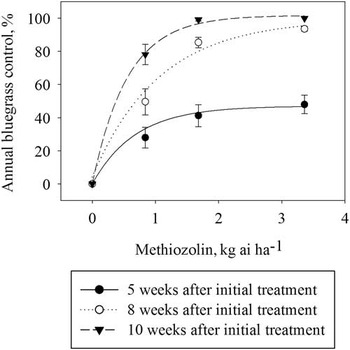
Symptoms of methiozolin injury in annual bluegrass were characterized by mild chlorosis and growth reduction leading to eventual death. Symptoms were not evident until 5 WAIT, the first rating date on which control was observed. For this reason, data analysis and presentation excluded data prior to 5 WAIT. Data were pooled across experimental runs as a significant run by treatment interaction was not detected. Similarly, a significant ammonium sulfate by methiozolin rate interaction and an ammonium sulfate main effect were not detected, indicating that the addition of ammonium sulfate did not influence annual bluegrass control with methiozolin. Time after treatment was a significant effect; as time after treatment increased, control increased (Figure 1). Also, nonlinear regression analysis indicated that as methiozolin rate increased, annual bluegrass control also increased. Control was greatest 10 WAIT and was 78%, 99%, and 100% from methiozolin applied three times sequentially at 0.84, 1.68, and 3.36 kg ai ha−1, respectively. In previous research, Brosnan et al. (Reference Brosnan, Henry, Breeden, Cooper and Serensits2013a) and McCullough et al. (Reference McCullough, Gómez de Barreda and Yu2013) reported annual bluegrass control (up to 90% depending on soil type and methiozolin rate) from multiple sequential applications totaling 2.0 to 3.4 kg ai ha−1 of methiozolin. In the presented study, a total of 2.5, 5.1, and 10.2 kg ai ha−1 of methiozolin was applied, resulting in 78%, 99%, and 100% control, respectively, at the final evaluation 10 WAIT. These results indicate that greater methiozolin rates may be required to obtain >90% control than previously reported. Regression analysis predicts that 7.32 kg ai ha−1 of methiozolin is necessary to obtain 90% control 10 WAIT (following the application regime used in this research). The difference between previous and current research results is likely due to cooler temperatures at application. Koo et al. (Reference Koo, Hwang, Jeon, Kim, Lim, Lee and Cho2014) reported that fall applications are more efficacious than spring applications, likely due to greater methiozolin translocation from root tissues at higher temperatures; however, McCullough et al. (Reference McCullough, Gómez de Barreda and Yu2013), reported annual bluegrass injury to be similar across temperatures from 10 to 30 C. This variability, seemingly due to seasonal application effects, may be related to plant growth stage.
Annual bluegrass control from methiozolin applied three times sequentially at 0.84, 1.68, and 3.36 kg ai ha−1 from two combined field experiments in Auburn, AL, in 2012 and 2014. Each rate was applied with and without ammonium sulfate at 12.2 kg N ha−1, but data were pooled as the effect of the ammonium sulfate was not significant. Points on the graph are means surrounded by their standard error. Lines represent nonlinear regression with the following model: Control=Y 0 + a(1 − e −b·rate). Y 0=−0.09, 4.11, and 0.00; a=49.98, 95.29, and 101.8; and b=1.00, 0.95, and 1.79 for 5, 8, and 10 weeks after initial treatment, respectively.

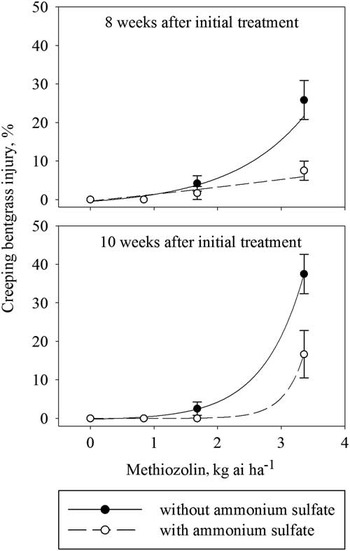
Creeping bentgrass injury was observed visually in the form of growth reduction, followed by chlorosis, followed by necrosis. Mild injury (<20%) was observed 5 WAIT, but most injury was observed 8 and 10 WAIT (Figure 2). For this reason, only data from 8 and 10 WAIT are presented. Data were pooled across experimental runs, as a significant run by treatment interaction was not detected. Time after treatment was a significant effect. Generally, as time after treatment increased creeping bentgrass injury also increased. However, recovery from injury was observed from methiozolin applied sequentially at 0.84 kg ai ha−1 without ammonium sulfate and at 1.68 kg ai ha−1 with and without ammonium sulfate. Initial injury was 4% to 10% for these treatments 5 WAIT (data not shown) and the creeping bentgrass recovered to ≤3% injury by 10 WAIT. Recovery from injury was not observed from methiozolin applied sequentially at 3.36 kg ai ha−1 with or without ammonium sulfate at up to 10 WAIT. A significant methiozolin rate by ammonium sulfate interaction was observed 8 and 10 WAIT, which can also be observed in the nonlinear regression analysis (Figure 2). The addition of ammonium sulfate significantly reduced visible creeping bentgrass injury from methiozolin applied sequentially at 3.36 kg ai ha−1; injury was reduced from 26% to 8% 8 WAIT and 38% to 17% 10 WAIT. Methiozolin has been reported to be noninjurious to creeping bentgrass (Koo et al. Reference Koo, Hwang, Jeon, Kim, Lim, Lee and Cho2014). However, some creeping bentgrass injury has been reported. Brosnan et al. (Reference Brosnan, Henry, Breeden, Cooper and Serensits2013a) reported <2% injury from treatments up to 3.0 kg ai ha−1. Other research indicates that 2.0 kg ai ha−1 resulted in 10% injury 4 wk after treatment (Brosnan et al. Reference Brosnan, Calvache, Breeden and Sorochan2013b). Research also indicates that reseeding of creeping bentgrass should be delayed 2 wk after methiozolin application at ≤1.12 kg ai ha−1 and 6 wk after methiozolin application at 2.24 g ai ha−1, owing to reductions in new turfgrass cover (McCullough and Gómez de Barreda Reference McCullough and Gómez de Barreda2012). Yu and McCullough (Reference Yu and McCullough2014) reported that methiozolin >6.72 kg ai ha−1 would be necessary to result in 50% creeping bentgrass injury. Therefore, this research agrees with previous research, which indicates that methiozolin applied at 1.0 kg ai ha−1 is very safe to creeping bentgrass, but rates greater than 2.0 kg ai ha−1 can result in creeping bentgrass injury. The January initial application timing likely exacerbated creeping bentgrass injury relative to warmer application timings. Previous research indicates that injury was 2- and 4-fold greater at 10 C compared to 20 and 30 C, respectively, in growth chamber experiments (McCullough et al. Reference McCullough, Gómez de Barreda and Yu2013).
Creeping bentgrass injury from methiozolin applied three times sequentially at 0.84, 1.68, and 3.36 kg ai ha−1 with and without ammonium sulfate at 12.2 kg N ha−1 from two combined field experiments in Auburn, AL, in 2012 and 2014. Points on the graph are means surrounded by their standard error. Lines represent nonlinear regression with the following model: Injury=Y 0 + a·e b·rate. Nonlinear regression models are as follows: Injury=−1.82+1.32e 0.86·rate for 8 weeks after initial treatment (WAIT) without ammonium sulfate, Injury=−23.98+23.57e 0.07·rate for 8 WAIT with ammonium sulfate, Injury=−0.45+0.21e 1.54·rate for 10 WAIT without ammonium sulfate, and Injury=−0.03 + 0.0004e 03.18·rate for 10 WAIT with ammonium sulfate (note that this model did not satisfy convergence criteria).

Ammonium sulfate has been shown to increase herbicidal activity of weak acid herbicides when mixed in hard water (O’Sullivan et al. Reference O’Sullivan, O’Donovan and Hamman1981; Roskamp et al. Reference Roskamp, Chahal and Johnson2013). However, methiozolin is not a weak acid, which accounts for the lack of this observation in this research. Ammonium sulfate has also resulted in increased speed of absorption and translocation when tank-mixed with herbicides (Jordan et al. Reference Jordan, York and Corbain1989; Maschhoff et al. Reference Maschhoff, Hart and Baldwin2000), but this effect was not tested in this research. Overall, research indicates that methiozolin can be tank-mixed with ammonium sulfate without reductions in annual bluegrass control, while reducing visible injury to creeping bentgrass in some cases.
Methiozolin Tank-Mixed with Iron Sulfate
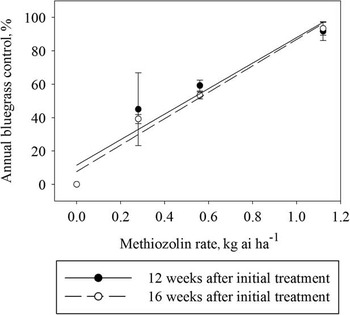
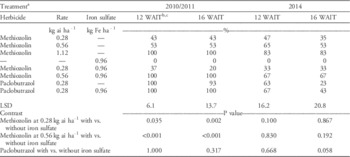
Annual bluegrass symptoms of methiozolin treatment were similar to those previously described. Annual bluegrass control analysis was limited to 12 and 16 WAIT. A significant experimental run by treatment interaction was detected, so data for each experimental run are presented separately. Iron sulfate and time after treatment were also detected to have significant interactions with treatment, so data were analyzed and presented accordingly (Table 1). Annual bluegrass control increased as methiozolin rate increased without iron sulfate, and was 100% and 83% from methiozolin applied twice at 1.12 kg ai ha−1 at the final ratings in 2010/2011 and 2014, respectively (Figure 3). Contrast comparisons between methiozolin with or without iron sulfate were significant in 2010/2011 and indicated that control significantly increased when iron sulfate was added to methiozolin at 0.28 and 0.56 kg ai ha−1 (Table 1). These same contrasts were not significant in 2014. Therefore, the influence of iron sulfate on control with methiozolin was variable. Paclobutrazol resulted in highly variable control between experimental runs. Annual bluegrass control was ≥93% with or without iron sulfate in 2010/2011 but ≤67% in 2014. Contrasts between paclobutrazol with or without iron sulfate were not significant in either experimental run, indicating that iron sulfate did not influence control with paclobutrazol. Paclobutrazol resulted in similar annual bluegrass control as did methiozolin at 1.12 kg ai ha−1 and methiozolin at 0.56 kg ai ha−1 with iron sulfate in 2010/2011, but less control in 2014, 16 WAIT. Therefore annual bluegrass control with paclobutrazol was similar to or less than control with methiozolin at appropriate rates.
Annual bluegrass control from methiozolin without iron sulfate, applied three times sequentially at 0.28, 0.56, and 1.12 kg ai ha−1. Data are from two combined field experiments in Auburn, AL, in 2010/2011 and 2014. Points on the graph are means surrounded by their standard error. Lines represent simple linear regression with the following models: Control=11.50+76.45(Rate) for 12 weeks after initial treatment, and control=7.67+79.17(Rate) for 16 weeks after initial treatment.

Annual bluegrass control, rated at various weeks after initial treatment (WAIT), from herbicide and iron sulfate tank-mixes from two field experiments conducted in Auburn, AL, in 2010/2011 and 2014.

a Treatments were applied twice, sequentially, 24 days apart. Initial treatments were November 8, 2010, and January 14, 2014.
b Abbreviations: WAIT, weeks after initial treatment.
c Means within a column followed by the same letter do not differ according to Fisher’s protected LSD(0.05).
Total methiozolin alone application rates were 0.56, 1.12, and 2.24 kg ai ha−1 in this study, and resulted in 35% to 47%, 53% to 65%, and 83% to 100% control, respectively (Table 1). This research corroborates previous research in creeping bentgrass fairways indicating that 85% or more annual bluegrass control can be obtained; however, six monthly applications at 0.28 kg ai ha−1 were necessary to achieve this result (Woosley et al. Reference Woosley, Williams and Powell2003). This research also found differences in control between experimental runs, similar to current research. Control in putting greens is more difficult than control in fairways. Research on creeping bentgrass putting greens found that three sequential paclobutrazol applications at 0.28 kg ai ha−1 on 14 d intervals resulted in 29% and 46% control 8 and 12 WAIT, respectively (Jefferies et al. Reference Jefferies, Yelverton and Gannon2013). Johnson and Murphy (Reference Johnson and Murphy1996) reported ≤57% control 12 WAIT. Therefore, research conducted in 2010/2011 resulted in abnormally high control with paclobutrazol relative to previous research, but research conducted 2014 found similar control.
Differences detected between experimental repetitions are likely due to the difference in initiation timing. The 2010/2011 experiment was initiated November 8, while the 2014 experiment was initiated January 14. Methiozolin has been reported to be more efficacious for annual bluegrass control when applied in the fall compared to the spring and when applied at higher temperatures (Brosnan et al. Reference Brosnan, Henry, Breeden, Cooper and Serensits2013a; McCullough et al. Reference McCullough, Gómez de Barreda and Yu2013). Additionally, annual bluegrass was at the one- to two-leaf stage for the first application in 2010/2011, whereas 50% of the annual bluegrass plants were at the three-tiller growth stage and 35% of the plants were flowering at the time of the first application in 2014. Larger, more mature plants result in less control relative to smaller, less mature plants (Flessner et al. Reference Flessner, Wehtje and McElroy2013). This same effect is likely true for paclobutrazol, although research is lacking in this regard.
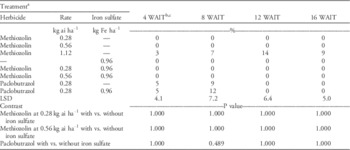
A significant treatment by experimental run interaction was not detected for creeping bentgrass injury, so data were pooled for analysis and presentation. Creeping bentgrass injury was ≤14% from any treatment at any time during this study, which is considered commercially acceptable (Table 2). No injury was detected until 4 WAIT, so earlier data are not presented. Creeping bentgrass injury symptoms were visually observed as growth reduction and mild chlorosis for methiozolin, and growth reduction with off-coloring for paclobutrazol. Contrast statements investigating iron sulfate inclusion were not significant, indicating that iron sulfate did not influence creeping bentgrass response to methiozolin or paclobutrazol.
Creeping bentgrass injury, rated at various weeks after initial treatment (WAIT), from herbicide and iron sulfate tank-mixes from two combined field experiments conducted in Auburn, AL, in 2010/2011 and 2014.

a Treatments were applied twice, sequentially, 24 days apart. Initial treatments were November 8, 2010, and January 14, 2014. Data were pooled across experimental repetition.
b Abbreviations: WAIT, week after initial treatment.
c Means within a column followed by the same letter do not differ according to Fisher’s protected LSD(0.05).
Previous research has shown that creeping bentgrass responds with no to mild injury (<10%) to methiozolin treatment (Brosnan et al. Reference Brosnan, Henry, Breeden, Cooper and Serensits2013a, Reference Brosnan, Calvache, Breeden and Sorochan2013b; Koo et al. Reference Koo, Hwang, Jeon, Kim, Lim, Lee and Cho2014). Paclobutrazol is reported to be noninjurious (Jefferies et al. Reference Jefferies, Yelverton and Gannon2013) to mildly injurious to creeping bentgrass, with injury characterized by growth reductions (Woosley et al. Reference Woosley, Williams and Powell2003). Johnson and Murphy (Reference Johnson and Murphy1995, Reference Johnson and Murphy1996) reported <20% injury following spring applications, but approximately 30% injury following fall applications. Therefore, this research agrees with previous research.
There is no previous research examining the effects of paclobutrazol tank-mixed with iron sulfate for annual bluegrass control or creeping bentgrass injury. However, Han (Reference Han2012) examined the effects of the plant growth regulators trinexapac-ethyl and flurimidol with iron sulfate for annual bluegrass cover and found that there was not a significant interaction, which agrees with this research. Creeping bentgrass response was characterized by turfgrass quality and color evaluations, which were mostly similar but in some instances improved when iron sulfate was added.
Other research reported that chelated iron was found to have no influence on bispyribac-sodium efficacy on annual bluegrass (McCullough and Hart Reference McCullough and Hart2009). Similarly, iron and nitrogen tank-mixed with bispyribac-sodium did not reduce annual bluegrass control efficacy, but effectively masked creeping bentgrass discoloration (McDonald et al. Reference McDonald, Dernodeden and Kaminski2006). Iron tank-mixed with ethofumesate plus fluprimidol resulted in transient improved creeping bentgrass quality and reduced discoloration (Johnson and Carrow Reference Johnson and Carrow1995).
While some differences were observed, overall annual bluegrass and creeping bentgrass response to methiozolin was not affected by the presence of a tank-mix nutrient partner.
Acknowledgements
The authors are grateful for the help of Jim Harris and his staff at the Auburn University Turfgrass Research and Education Center (Auburn, AL) for their help in conducting this research. The authors also thank Dr. S. J. Koo of the Moghu Research Center (Yuseong, Daejeon, Korea) for the donation of methiozolin.