Introduction
There is a great deal of research dedicated to the acquisition of relative clauses, in particular to the comparison of subject-extracted relatives (SR) and object-extracted relatives (OR). In a SR (1) the noun phrase modified by the relative clause, also called the head noun (‘The horse’), is extracted from the relative clause's subject position; in an OR (2), the head noun is extracted from the embedded object position. The extraction site is marked in the examples with an underscore.
(1) The horse that __ is catching the rhino
(2) The horse that the rhino is catching __
(3) The horse that you are catching __
Previous work has shown that SRs emerge earlier than ORs in children's spontaneous speech (Diessel & Tomasello, Reference Diessel and Tomasello2000) and that across languages children find ORs harder to process than SRs (e.g., English: Adani, Forgiarini, Guasti, & van der Lely, Reference Adani, Forgiarini, Guasti and van der Lely2014; Hebrew: Arnon, Reference Arnon2010; German: Adani & Fritzsche, Reference Adani, Fritzsche, Grillo and Jepson2015; Italian: Adani, van der Lely, Forgiarini, & Guasti, Reference Adani, van der Lely, Forgiarini and Guasti2010; Chinese: Hu, Gavarró, Vernice, & Guasti, Reference Hu, Gavarró, Vernice and Guasti2016). Interestingly, difficulties with ORs are reduced when the embedded subject is a pronoun, as in (3). This facilitation has been attested in ORs whose embedded subject is a first or second person pronoun (‘I’ / ‘you’) (Arnon, Reference Arnon2010; Brandt, Lieven, & Tomasello, Reference Brandt, Lieven and Tomasello2016; Haendler, Kliegl, & Adani, Reference Haendler, Kliegl and Adani2015), as well as in the case of third person pronouns like ‘he’ or ‘they’ (Brandt, Kidd, Lieven, & Tomasello, Reference Brandt, Kidd, Lieven and Tomasello2009; Lassotta, Adelt, Stadie, Burchert, & Adani, Reference Lassotta, Adelt, Stadie, Burchert and Adani2015).
One explanation for the facilitation of ORs with embedded pronouns is related to general expectations concerning pronoun usage. Pronouns typically refer to an entity, or referent, that is cognitively highly accessible, when the mental representation of that entity is easily retrievable from memory (Allen, Hughes, & Skarabela, Reference Allen, Hughes, Skarabela, Serratrice and Allen2015; Ariel, Reference Ariel, Sanders, Schilperhood and Spooren2001; Arnold, Reference Arnold2010; Bock & Warren, Reference Bock and Warren1985; Fukumura & van Gompel, Reference Fukumura and van Gompel2012; Gundel, Hedberg, & Zacharski, Reference Gundel, Hedberg and Zacharski1993). When a referent is less accessible, more information about it is needed and a more explicit form is used, for instance, a lexical noun phrase (NP). By contrast, more accessible referents are referred to with less explicit forms like pronouns (Arnold & Griffin, Reference Arnold and Griffin2007; Fukumura, van Gompel, Harley, & Pickering, Reference Fukumura, van Gompel, Harley and Pickering2011; Fukumura, van Gompel, & Pickering, Reference Fukumura, van Gompel and Pickering2010; Serratrice, Reference Serratrice2013). Since grammatical subjects tend to be highly accessible by virtue of their topic-hood, reference to them is generally made with pronouns. Thus, ORs are facilitated when their embedded subject is a pronoun, satisfying the discourse-pragmatics expectations concerning pronoun usage (Mak, Vonk, & Schriefers, Reference Mak, Vonk and Schriefers2008; Reali & Christiansen, Reference Reali and Christiansen2007; Roland, Mauner, O'Meara, & Yun, Reference Roland, Mauner, O'Meara and Yun2012). We will term this approach the discourse-pragmatics approach.
Another explanation for the facilitation of ORs with embedded pronouns is provided by the syntax-based intervention locality approach (Belletti, Friedmann, Brunato, & Rizzi, Reference Belletti, Friedmann, Brunato and Rizzi2012; Friedmann, Belletti, & Rizzi, Reference Friedmann, Belletti and Rizzi2009; Grillo, Reference Grillo2009; Rizzi, Reference Rizzi2013). According to this account, difficulties with ORs arise when both the head noun and the embedded subject are marked with an NP-feature – that is, when they are lexical NPs (‘The horse’ and ‘the rhino’ in (2)). When one of these constituents is not a lexical NP, as in the case of an embedded pronoun, ORs are expected to be easier. In addition to the studies cited above that tested ORs with different kinds of embedded pronouns, Friedmann et al. (Reference Friedmann, Belletti and Rizzi2009) found evidence for this idea in Hebrew-speaking five-year-olds’ improved comprehension of ORs with an embedded arbitrary subject pronoun (henceforth, ASP), an unpronounced pronoun with arbitrary interpretation (glossed as pro in example (4), where acc = accusative marker; pl = plural; masc = masculine).
(4) Tare li et ha-sus she- mesarkim oto.
show to-me acc the-horse that-pro-comb.pl.masc him
Literally: ‘Show me the horse that (they) are combing.’
Actual meaning: ‘Show me the horse that someone is combing.’
Results from production studies in Hebrew support Friedmann et al.’s (Reference Friedmann, Belletti and Rizzi2009) comprehension study. Friedmann, Aram, and Novogrodsky (Reference Friedmann, Aram and Novogrodsky2011) used a definition task to elicit three- to eight-year-old children's production of relative clauses. They found that, from early on, children often use ASP as the embedded subject in ORs. Moreover, in studies that explicitly elicit the production of ORs with two lexical NPs, children often produce ORs with ASP to avoid the targeted ORs (Arnon, Reference Arnon2010; Guenzberg-Kerbel, Shvimer, & Friedmann, Reference Guenzberg-Kerbel, Shvimer and Friedmann2008; Novogrodsky & Friedmann, Reference Novogrodsky and Friedmann2006).
Both theoretical accounts under consideration can explain the facilitation of ASP, either because of the fulfilled expectation of a pronoun referring to a subject, or because of the mismatch in NP-feature between the head noun and the embedded pronoun. Crucially, however, there are alternative explanations. One possibility is that the facilitation is caused by the mismatch in overtly marked grammatical features, like Number or Gender, on the head noun and the embedded subject (Rizzi, Reference Rizzi2013). Recent findings show that children are highly accurate on ORs that contain such a feature mismatch. In particular, facilitated OR comprehension was observed when the head noun was singular and the embedded subject plural, or vice versa, as compared to when both were singular or plural (Adani et al., Reference Adani, van der Lely, Forgiarini and Guasti2010, Reference Adani, Forgiarini, Guasti and van der Lely2014; Contemori & Marinis, Reference Contemori and Marinis2014). Belletti et al. (Reference Belletti, Friedmann, Brunato and Rizzi2012) found a similar effect in Hebrew ORs containing a match or mismatch in the grammatical feature Gender. Children's comprehension improved significantly on ORs in which the head noun was masculine and the embedded subject feminine, or vice versa.
Children's enhanced performance on Hebrew ORs with ASP could therefore be driven by the Number mismatch between the singular head noun (‘the horse’) and the inherently plural ASP. The grammatical features characterizing this pronoun are evident in the agreement marking (plural, masculine) on the embedded verb mesarkim ‘comb.pl.masc’ in (4). Similarly, the facilitation of ORs with an embedded first or second person pronoun (Arnon, Reference Arnon2010; Brandt et al., Reference Brandt, Lieven and Tomasello2016; Haendler et al., Reference Haendler, Kliegl and Adani2015) might be explained as due to a mismatch in Person, another overtly marked grammatical feature that is different on the head noun (third person) and on the embedded pronoun (first/second person).
Thus, in previously tested ORs with ASP, first or second person pronouns, we do not know whether the observed high accuracy is because of the fulfillment of discourse-pragmatics expectations concerning pronoun usage, because the head noun and the embedded subject differ in terms of the NP-feature, or because they differ in terms of the grammatical features Number or Person. The first goal of the current study is to test whether Hebrew ORs with ASP remain easy for children when other potentially facilitating grammatical features on the head noun and the embedded pronoun, such as Person, Number, and Gender, are controlled. In other words, we want to see whether the mere presence of ASP facilitates OR comprehension, as predicted both by the discourse-pragmatics approach and by the intervention locality approach (albeit for different reasons).
Yet another potential source of facilitation of ORs with ASP is related to the referential properties of this specific pronoun. As mentioned, ASP has an arbitrary interpretation, and it is therefore defined as a non-referential pronoun (Shlonsky, Reference Shlonsky2014). It refers to an arbitrary subject, and is used when the identity of the agent is not, or does not need to be, known. Note that ASP is invariable: although it takes a plural and masculine agreement marking, the agent that is performing the action does not necessarily need to be plural or masculine. To better capture the property of non-referentiality, ASP can be compared to a referential third person pronoun like hem ‘they’ (or ‘he’, ‘she’, and so on, for that matter). A referential pronoun takes as discourse referent a specific entity that is highly salient in the discourse, for example by having appeared previously as a subject or topic (Fukumura & van Gompel, Reference Fukumura and van Gompel2015; Song & Fisher, Reference Song and Fisher2005). This is illustrated in (5b), where the pronoun hem refers to the people mentioned in (5a). By contrast, the non-referential ASP does not relate to any specific discourse referent. Hence, its referent does not need to be mentioned in a previous context, as shown in (6). In fact, if a context sentence like (5a) preceded the sentence in (6) it would sound odd, or at least the two sentences would be perceived as completely unrelated. Since (5a) establishes a specific agent referent, ASP cannot be used to refer to it.
(5a) Yesh anashim baxuc.
there (are) people outside
‘There are people outside.’
(5b) Hem dofkim badelet.
they knock.pl at-the-door
‘They are knocking at the door.’
(6) Dofkim badelet.
pro knock.pl at-the-door
Literally: ‘(They) are knocking at the door.’
Actual meaning: ‘Someone is knocking at the door.’
The different referential properties of these two pronouns are assumed to differently influence the cognitive load associated with their processing. A referential pronoun like hem ‘they’ can only be correctly interpreted with the identification of a specific referent, and this pronoun–referent linking might demand more cognitive resources. By contrast, the correct interpretation of a non-referential pronoun like ASP does not depend on the identification of a specific referent. Therefore, this pronoun is likely to burden the language parsing system to a lesser extent.
The idea that sentence processing – and relative clause processing in particular – is constrained by the referential properties of pronouns is suggested by several studies. Previous research has mainly concentrated on the different effect of first and third person pronouns. Both adults (Warren & Gibson, Reference Warren and Gibson2002) and children (Haendler et al., Reference Haendler, Kliegl and Adani2015) process ORs more accurately when the embedded pronoun is a first person, as compared to a third person pronoun. This first/third person pronoun asymmetry has been explained in relation to the level of difficulty with which the referents of the pronouns are identified and retrieved from discourse. The cognitive operation of searching and retrieving a discourse referent is less costly in the case of a first person pronoun, whose referent is part of the linguistic act (the speaker), than for a third person pronoun, whose referent is external to the linguistic act and is therefore retrieved less straightforwardly (Ariel, Reference Ariel, Sanders, Schilperhood and Spooren2001; Carminati, Reference Carminati2005; Köder & Maier, Reference Köder and Maier2016). Thus, it seems that sentence processing is affected by the referential properties of different types of pronouns, to which young children are sensitive (see also Hartshorne, Nappa, & Snedeker, Reference Hartshorne, Nappa and Snedeker2015; Hughes & Allen, Reference Hughes and Allen2013; Legendre & Smolensky, Reference Legendre and Smolensky2012; Song & Fisher, Reference Song and Fisher2005). Therefore, the possibility that children find ORs with ASP easy because of the non-referentiality properties of the pronoun needs to be assessed. Testing this possibility constitutes another goal in the present study.
As explained above, the asymmetrical effect of first and third person pronouns on OR processing could also be due to a mismatch in the grammatical feature Person. In ORs with an embedded first person pronoun (‘The horse that I am catching’), the head noun is marked with third person and the embedded pronoun with first person. By contrast, in ORs with an embedded third person pronoun (‘The horse that she is catching’), both constituents are marked with third person. Thus, the comparison of first and third person pronouns in terms of their referential properties could in fact be confounded with the (mis)match in the Person feature. In the present study, we take care of this potential confound by comparing two pronouns that are marked with the same grammatical features – Person, Number, and Gender – and differ only with respect to their referential properties.
To sum up, although there is evidence that children perform well on ORs with an embedded ASP, we do not know what causes this facilitation. It could be the discourse-pragmatics expectation, the feature specification on the pronoun, or its undemanding referential properties. In this study we address this open question. First, we test whether children are more accurate on ORs with ASP than on ORs with two lexical NPs. Contrary to previous studies, we structure the ORs in a way that controls for potential effects that are due to grammatical features like Person, Number, and Gender. We compare ORs with an embedded lexical NP, like (7), to ORs with ASP, like (8). In both conditions, both the head noun (Ha-susim ‘the horses’) and the embedded subject (ha-karnafim ‘the rhinos’ / pro) are marked as third person, plural, and masculine. Both the discourse-pragmatics approach and the intervention locality approach predict children to be more accurate on ORs with ASP than on ORs with a lexical NP, despite the matching features. For the discourse-pragmatics approach, this is because of the fulfilled expectation that a pronoun is used to refer to a subject; for the intervention locality approach, the facilitation should occur because in the OR with ASP there is a mismatch in the NP-feature.
ORs with an embedded lexical NP
(7) Ma ha-ceva shel ha-susim she-ha-karnafim tofsim (otam)?
what the-color of the-horses.3p.pl.masc that-the-rhinos.3p.pl.masc catch (them)
‘What color are the horses that the rhinos are catching?’
ORs with an embedded non-referential ASP
(8) Ma ha-ceva shel ha-susim she- tofsim otam?
what the-color of the-horses.3p.pl.masc that- pro .3p.pl.masc- catch them
Literally: ‘What color are the horses that (they) are catching?’
Actual meaning: ‘What color are the horses that someone is catching?’
ORs with an embedded referential pronoun hem
(9) Ma ha-ceva shel ha-susim she-hem tofsim?
what the-color of the-horses.3p.pl.masc that-they.3p.pl.masc catch
‘What color are the horses that they are catching?’
Second, we test whether the non-referentiality of ASP affects OR comprehension. To do this, we compare ORs with ASP (8) to ORs with an embedded referential pronoun hem ‘they’ (9). Again, all relevant grammatical features were controlled. Here there are different predictions. According to the discourse-pragmatics approach, ORs with ASP should be easier than ORs with hem, because referents of null pronouns are typically more accessible than referents of overt pronouns (Ariel, Reference Ariel, Sanders, Schilperhood and Spooren2001). Such an asymmetry would also support the idea that ASP facilitates comprehension more than hem because its referential characteristics are cognitively less demanding. By contrast, the intervention locality approach predicts no difference between the two pronoun conditions, because in both ORs the embedded subject is a pronoun lacking an NP-feature.
A note concerning the tested conditions
A referential third person pronoun is typically linked to a referent in a situation in which the attention of all participants is directed to that referent. When such joint attention on the referent is for some reason absent, the pronoun–referent linking is likely to fail and the pronoun might not be interpreted correctly (Salazar Orvig & Morgenstern, Reference Salazar Orvig, Morgenstern, Serratrice and Allen2015). For this reason, when presented without a context (‘out of the blue’), ORs with a referential pronoun like hem might sound unnatural. Normally, the pronoun's referent should be provided either by a linguistic context, for instance in a preceding sentence, or by a visual context (De Cat, Reference De Cat, Serratrice and Allen2015; Fukumura et al., Reference Fukumura, van Gompel and Pickering2010; Serratrice, Reference Serratrice2013). But visual contexts are not always sufficient to establish reference, and both adults and children often rely more on the linguistic context for this purpose (De Cat, Reference De Cat, Serratrice and Allen2015; Grodner, Dalini, Pearlstein-Levy, & Ward, Reference Grodner, Dalini, Pearlstein-Levy and Ward2012; Vogels, Krahmer, & Maes, Reference Vogels, Krahmer and Maes2013). We therefore expect children to have difficulties with ORs with hem (9) that stem, at least partly, from the fact that the sentence is not preceded by a linguistic context. Concerning adults, even if they do not have difficulties with ORs with hem, we still expect them to express at least some uncertainty regarding the interpretation of the pronoun (for a related issue of adults’ occasional failure to distinguish other people's discourse representation from their own, see Brown-Schmidt, Reference Brown-Schmidt2009; De Cat, Reference De Cat, Serratrice and Allen2015; Epley, Morewedge, & Keysar, Reference Epley, Morewedge and Keysar2004; Keysar, Barr, Balin, & Bruauner, Reference Keysar, Barr, Balin and Bruauner2000; Keysar, Lin, & Barr, Reference Keysar, Lin and Barr2003).
Let us now assume that a context sentence like (10a), which introduces the referential pronoun's referent (two rhinos), precedes every item in the three conditions, as would be required in order to compare the conditions. In this case, the relative clause with ASP would have two possible interpretations. One interpretation is of an OR with ASP (10b), in which otam k ‘themk’ is a resumptive pronoun referring to the head noun ‘the horsesk’ (in the ‘Method’ section we address the issue of resumption in Hebrew relative clauses). The second interpretation is of a SR (10c), in which ‘the horses’ are the subject, and otam j ‘themj’ is an embedded object pronoun referring to karnafim j ‘rhinosj’, the referent first mentioned in (10a). Thus, a linguistic context would be problematic for our ORs with ASP. Importantly, though, when a linguistic context like (10a) is not provided, the SR interpretation in (10c) is excluded. The reason is that under this reading otam j ‘themj’ is analyzed as a referential pronoun that is linked to some referent j. Without a linguistic context that introduces referent j, the only possible interpretation for otam is that of a resumptive pronoun referring to the horses. Thus, only the reading of an OR with ASP (10b) could be possible in this case.
(10a) Hine shnei karnafimj.
here (are) two rhinosj
(10b) Ma ha-ceva shel ha-susimk she- tofsim otamk?
what the-color of the-horsesk that-pro- catch themk
‘What color are the horses that someone is catching?’
(10c) Ma ha-ceva shel ha-susimk she- tofsim otamj?
what the-color of the-horsesk that- catch themj
‘What color are the horses that are catching themj?’
Neither of these two experimental designs (with or without a linguistic context) is optimal. As we have seen, if a linguistic context is provided, this yields two possible interpretations for relatives with ASP. But if a linguistic context is not provided, the interpretation of hem might become difficult. Crucially, though, the second option, which we eventually adopted, does not change the predictions. The absence of a linguistic context does not compromise the appropriateness of ORs with an embedded lexical NP and those with ASP. Thus, we can still compare these two conditions. As for the comparison of the two pronouns, an asymmetry between ASP and hem would in fact emphasize the role of the referential properties of these two pronouns: hem, whose referentiality is more demanding because its interpretation depends on a pronoun–referent linking process, should, in the absence of a linguistic context, be more error-prone than the non-referential ASP.
Method
Participants
Thirty-six children (18 girls, age range = 3;11–6;4, mean age = 5;1) were recruited among personal acquaintances or in private kindergartens in the area of Jerusalem. Six children (of which two were girls) were excluded from the sample for the following reasons: one child failed to understand the task, three children were growing up as bilinguals, and two children received speech therapy around the period of testing. The remaining 30 children were all growing up as monolingual speakers of Hebrew, without history or evidence of language, hearing, or other communication disorders. This information was obtained through a questionnaire signed by the parents, or by the teachers with parental authorization. In addition, parents signed a consent form to allow the participation of their child. We also tested a control group of 30 adults (21 women; age range = 22–35 years; mean age = 29), all of whom had grown up as monolingual speakers of Hebrew and without a history of developmental language or cognitive disorders. Adults signed a consent form in which they also confirmed the correctness of their personal information.
Materials
For each of the three OR types (7)–(9) we constructed seven items. As can be seen in the examples, the head noun (Ha-susim ‘The-horses’) and the embedded subject (ha-karnafim ‘the-rhinos’ / ASP / hem ‘they’) always had the same grammatical features of Person (third person), Number (plural), and Gender (masculine).
It can be noted that ORs with ASP and with hem differ with respect to the appearance of the resumptive pronoun otam ‘them’ at the end of the sentence. This pronoun is resumptive in the sense that, while referring to the raised head noun, it is stranded within the relative clause (Boeckx, Reference Boeckx2003; Friedmann et al., Reference Friedmann, Belletti and Rizzi2009). Such a resumptive pronoun is obligatory in ORs with an embedded ASP, but it substantially degrades the acceptability of ORs with hem, based on the judgment of three native speakers. In ORs with two lexical NPs, by contrast, a resumptive pronoun at the end of the sentence is optional, resulting in a grammatically correct sentence either way (Doron, Reference Doron1982; Shlonsky, Reference Shlonsky1992). Nevertheless, ORs with two lexical NPs containing a resumptive pronoun are less frequent in natural speech (Ariel, Reference Ariel1999), and they are harder to process than comparable ORs without a resumptive pronoun, even for adults (Meltzer-Asscher, Fadlon, Goldstein, & Holan, Reference Meltzer-Asscher, Fadlon, Goldstein and Holan2015). Similarly, in the Hebrew study with the definitions task (Friedmann et al., Reference Friedmann, Aram and Novogrodsky2011), children produced ORs with a resumptive pronoun to a lesser extent than without it. In order to account for any potential effects of the resumptive pronoun otam, four of the ORs with two lexical NPs contained it and the remaining three did not.
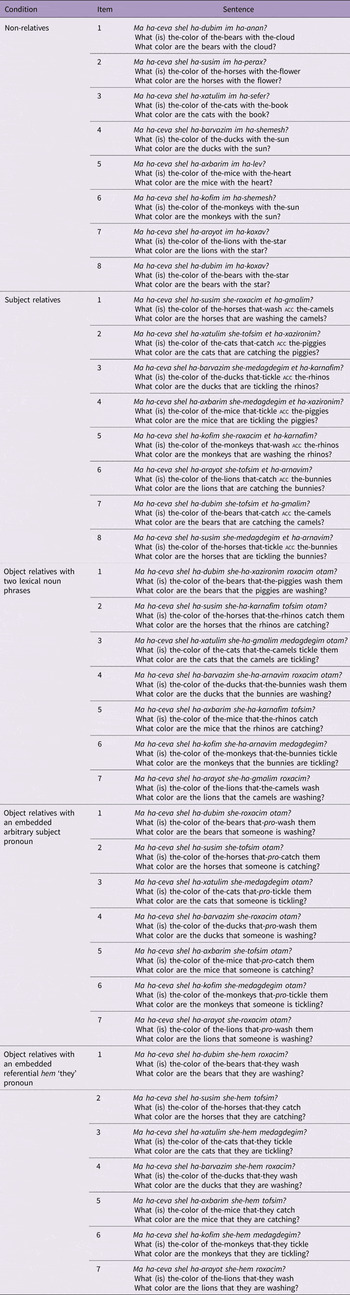
In addition to ORs, there were eight subject relative clauses (e.g., Ma ha-ceva shel ha-susim she-tofsim et ha-karnafim? ‘What color are the horses that are catching the rhinos?’) and eight non-relatives (e.g., Ma ha-ceva shel-hasusim im ha-perax? ‘What color are the horses with the flower?’), used as fillers with the aim of preventing participants from developing response strategies during the experiment. Each utterance was embedded within a matrix sentence repeated equally for each item, which asked about the color of a pair of animals (Ma ha-ceva shel … ‘What is the color of …’). Adapted from Arnon (Reference Arnon2010), this method allowed us to introduce the task as a color-naming game and mask the actual goal of the experiment, at least to some extent. All the noun phrases were animals familiar to young children. We used three verbs – rxc ‘wash’ (using a brush), dgdg ‘tickle’ (using a feather), and tfs ‘catch’ (using a net). Each of these verbs appeared an equal number of times throughout the experiment. The sentences, recorded with a female native speaker of Hebrew, were integrated into the accompanying visual scene using Adobe Flash.
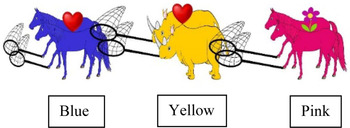
The visual scenes were animated videos that depicted animals performing the described action (cf. Figure 1). We defined the patient pair of animals, on which the middle animals performed the action, as Target response in all OR types (blue horses in Figure 1). The agent pair of animals, which performed the action on the middle animals, was defined as Distractor response in the ORs (pink horses in Figure 1). The middle pair of animals was defined as Middle response (rhinos in Figure 1). On half of the trials the direction of the action was from the right to the left side of the scene, and on the other half it was from left to right. The items were arranged in two pseudo-randomized lists. All items appeared in both lists, but in a different order, such that no two consecutive trials were of the same condition. Half of the children were exposed to the first list and the other half to the second list. A full list of the items is provided in ‘Appendix 1’.
A snapshot from an example video (the color names indicated in the boxes did not appear in the original videos).

Procedure
Two children were tested in their private homes, with one or both parents present in the room. The remaining children were tested in a quiet room in their kindergartens, either in the presence of the experimenter alone or together with a teacher. The testing session was approximately 20 to 25 minutes long. Children, who received colorful stickers as a thank-you gift, were generally happy to participate and very much engaged in the task. Adults were tested in a quiet room in which only the experimenter and the participant were present, either at a university lab, or in the experimenter's or participant's private home. They received €5 for taking part in the study.
Prior to the experiment, children were engaged in a preparation game designed to make sure they were familiar with the ASP, given its specific function and lack of phonological realization. Although children's active use of ORs with ASP is attested from age 3;6 in experimental settings that elicit relative clause production (Arnon, Reference Arnon2010; Friedmann et al., Reference Friedmann, Aram and Novogrodsky2011; Guenzberg-Kerbel et al., Reference Guenzberg-Kerbel, Shvimer and Friedmann2008; Novogrodsky & Friedmann, Reference Novogrodsky and Friedmann2006), their comprehension of this pronoun has not been widely investigated in Hebrew. As far as we know, at the time of conducting this study only Friedmann et al.’s (Reference Friedmann, Belletti and Rizzi2009) Experiment 4 tested the comprehension of ASP in ORs. The goal of the preparation game was to assess children's awareness of ASP in general, rather than in the particular context of relative clauses. For this reason, and in order to avoid influencing children's performance in the experiment, no relative clauses were used in the game. Moreover, the verbs/actions in the game were different from those used in the experiment. Children's successful performance in the game was not a precondition for their participation in the experimental task. Rather, we aimed to create a context in which the ASP was used, to make sure children understand and use it appropriately, and this was confirmed by the game. The procedure of the preparation game is detailed in ‘Appendix 2’.
For the experiment, participants were seated in front of a DELL laptop with a screen resolution of 1600 × 900. The SMI Experiment Center software was used to display the videos.Footnote 1 The experimenter, sitting next to the participant, pressed a button to move from one trial to the next. After each question, the participant named aloud the color of the pair of animals she thought were the correct ones, and the experimenter noted down the response on a sheet. After each 9–10 trials there was a short break of approximately 1–2 minutes in which the experimenter briefly interacted with the participant, and children were given positive feedback.
At the beginning of the experiment, participants watched an introduction video on the computer, in which a dog named Guli appeared and explained the task. He said he would like to have the participant's help in learning the names of the colors. The narrator then showed examples of the three actions that were about to appear in the experiment – wash, tickle, and catch – and named them. Five practice trials were integrated into the introduction video and the experimenter, when necessary, provided feedback for the response to them (but not during the actual experiment). The animals that appeared in these practice trials did not appear later in the test items. At the end of the introduction, Guli presented and named each of the animals that were going to participate in the experiment: Dov ‘bear’, sus ‘horse’, xatul ‘cat’, barvaz ‘duck’, axbar ‘mouse’, kof ‘monkey’, arye ‘lion’, karnaf ‘rhino’, gamal ‘camel’, xaziron ‘piggy’, and arnav ‘bunny’. The trials with the questions then followed. Adults did not do the preparation game, but the rest of the procedure was the same as for the children.
Results
All adults and children were 100% accurate on the non-relative sentences. On subject relatives, adults’ accuracy was 99% and children's 94%. Table 1 summarizes the proportion of accurate responses on ORs for both participant groups. Adults were at ceiling on ORs with an embedded lexical NP and on ORs with ASP, and about 50% accurate on ORs with hem. Children were most accurate on ORs with two lexical NPs (58%), followed by ORs with ASP (28%), and least accurate on ORs with hem (9%).
Adults’ and children's proportion of correct responses on object relatives, divided by the type of embedded subject constituent (95% confidence intervals in parentheses)

Notes. NP = noun phrase; ASP = arbitrary subject pronoun.
Before the analysis, we checked whether there was a difference between ORs with two lexical NPs with and without the resumptive pronoun otam. This pronoun led to a slightly lower accuracy rate on this OR type. Adults were more accurate on ORs with two lexical NPs without the resumptive pronoun (.99) than on those with (.96), a non-significant difference (t = –1.49, p = .14). Children were also more accurate on ORs with two lexical NPs without the resumptive pronoun (.63) than on those with (.54), another difference that was not significant (t = –1.02, p = .31). Although not statistically significant, this effect of the resumptive pronoun is in line with previous studies on Hebrew relative clauses (Ariel, Reference Ariel1999; Friedmann et al., Reference Friedmann, Belletti and Rizzi2009 Experiment 2, results of the picture task; Friedmann et al., Reference Friedmann, Aram and Novogrodsky2011; Meltzer-Asscher et al., Reference Meltzer-Asscher, Fadlon, Goldstein and Holan2015). Since the presence or absence of the resumptive pronoun in ORs with two lexical NPs did not matter for the comparison to the pronoun conditions, the items with and without a resumptive pronoun were collapsed together.
Due to the pattern of the adult data, with two conditions at ceiling and only one statistically meaningful comparison between the two pronoun conditions, we compared adults’ accuracy on ORs with ASP to their accuracy on ORs with hem with a paired t-test. The difference resulted as significant (t = –5.77, p < .001). Adults’ confusion or uncertainty with ORs with hem was to some extent expected. However, a closer look at their individual accuracy scores reveals an interesting pattern that is masked by the 50% group performance. This pattern is visible when dividing the adult group into three categories: adults who were consistently accurate on ORs with hem, with all trials correctly answered or with only one error (N = 14); adults who were consistently inaccurate on this condition, with either all trials incorrectly answered, by giving a Distractor response, or with only one correct answer (N = 11); and adults who answered on some trials correctly and on some incorrectly (N = 5). This division, shown in Figure 2, reveals that the majority of adults in fact did not perform at a 50% accuracy rate on this condition.
Adults’ proportion of correct responses on the three types of object relatives, with 95% confidence intervals. On the x-axis, adults are grouped according to their responses on object relatives with hem ‘they’. Adults in the ‘consistently correct’ group gave either six or seven correct responses out of seven items in this condition; adults in the ‘consistently incorrect’ group gave either none or one correct response on this condition; the rest of the adults are included in the ‘half-correct/half-incorrect’ group. Black bars indicate performance on object relatives with an embedded lexical noun phrase (NP); dark gray bars on object relatives with a non-referential arbitrary subject pronoun (ASP); light gray bars on object relatives with a referential pronoun hem ‘they’.

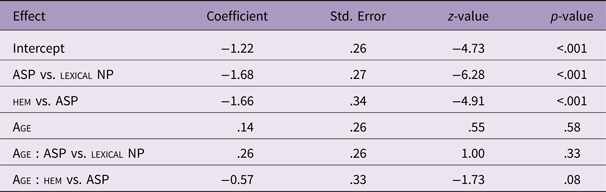
The analysis of the children's data also included their age as a covariate. The age range and its mean in our child group roughly correspond to those in previous studies on relative clause comprehension in Hebrew (Belletti et al., Reference Belletti, Friedmann, Brunato and Rizzi2012; Friedmann et al., Reference Friedmann, Belletti and Rizzi2009; Friedmann & Novogrodsky, Reference Friedmann and Novogrodsky2004). Nevertheless, with this relatively wide age range we wanted to control for possible effects of age, hence the inclusion of this covariate in the statistical model. The children's data were analyzed with a generalized linear mixed-effects model with a logistic link function (Baayen, Davidson, & Bates, Reference Baayen, Davidson and Bates2008; Jaeger, Reference Jaeger2008), using the lme4 package version 1.1-13 (Bates, Maechler, Bolker, & Walker, Reference Bates, Maechler, Bolker and Walker2015) in R (R Core Team, 2017). The dependent variable was the correct or incorrect response, defined as 1 or 0 respectively. The fixed effects part included the ORs with the three types of embedded subject constituent, to which we applied sliding contrast coding in the following manner: ASP was compared to lexical NP, and hem was compared to ASP. In addition, we included in the fixed effects part the age in months as a scaled and centered continuous covariate (without group division). All the main effects and interactions of Embedded subject constituent and Age were estimated. In the random effects part, we included an intercept over subjects and one over items. We did not include random slopes, following the discussion advanced by Matuschek, Kliegl, Vasishth, Baayen, & Bates (Reference Matuschek, Kliegl, Vasishth, Baayen and Bates2017). We used the most complex model which was appropriate for the amount of data at hand (30 subjects; 21 items), keeping in mind that overparameterization is likely to result in an uninterpretable model outcome. Table 2 provides a summary of the fixed effects part in the model.
Children's data: a summary of the fixed effects part in the generalized mixed-effects model

Notes. ASP = arbitrary subject pronoun; lexical NP = lexical noun phrase; HEM = referential pronoun hem ‘they’.
The first comparison we were interested in is between ORs with ASP and ORs with an embedded lexical NP. Children's accuracy on ORs with two lexical NPs was significantly higher, as indicated by the main effect (z = –6.28, p < .001). The comparison between the two pronoun conditions was also significant: Children were more accurate on ORs with ASP than on ORs with hem (z = –4.91, p < .001). As for Age, neither its main effect nor its interaction with Embedded subject constituent were significant.
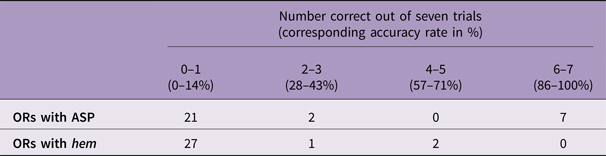
The asymmetry between the two pronouns is further highlighted by the fact that, while almost the entire group of children (N = 27) had an extremely low accuracy rate on ORs with hem, with 0 or 1 correct answers out of 7 trials, several children (N = 7) performed at ceiling (92%) on ORs with ASP, with 6 or 7 correctly answered trials (cf. Table 3). Figure 3 shows the performance on the three OR types separately for the seven high-ASP children (who have an age range (4;2–6;4) and mean age (5;3) representative of the entire sample) and for the remaining 23 children. It emerges that, unlike the high-ASP children's performance on the ASP condition, their performance on the other two conditions does not differ much from that of the low-ASP children. In particular, the high-ASP children's accuracy rate on ORs with hem remains very low (24%).
Children's proportion of correct responses on the three types of object relatives, with 95% confidence intervals. On the x-axis, children are grouped according to their responses on object relatives with a non-referential arbitrary subject pronoun (ASP). Children in the high-ASP group gave either six or seven correct answers on this condition; the low-ASP group includes the remaining children. Black bars indicate performance on object relatives with an embedded lexical noun phrase (NP); dark gray bars on object relatives with ASP; light gray bars on object relatives with a referential pronoun hem ‘they’.

The number of children who answered correctly on trials of object relatives with a non-referential arbitrary subject pronoun and with the referential pronoun hem ‘they’

Notes. ORs = object relatives; ASP = arbitrary subject pronoun.
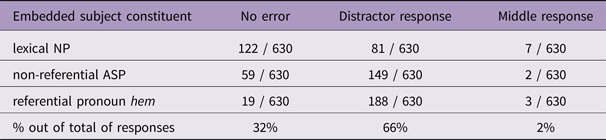
Finally, we checked children's response types, which are summarized in Table 4. Out of a total of 630 responses across conditions, children gave a Target response (blue horses in Figure 1) 32% of the time, a Distractor response (pink horses in Figure 1) 66% of the time, and a Middle response just a mere 2% of the time. Thus, when answering incorrectly on the various OR types, children overwhelmingly chose the agent pair of animals.
The number and percentage of children's response types on object relatives, out of a total of 630 responses for the group, divided by the type of embedded subject constituent

Notes. NP = noun phrase; ASP = arbitrary subject pronoun; No error = naming the color of the patient pair of animals (Target response); Distractor response = naming the color of the agent pair of animals; Middle response = naming the color of the middle pair of animals.
Discussion
The first goal of the study was to see whether children comprehend ORs with an embedded ASP accurately, after controlling for other facilitating factors that potentially affected the results in previous research. Several studies have found that children comprehend and produce ORs with ASP more accurately than ORs with two lexical NPs (Friedmann et al., Reference Friedmann, Belletti and Rizzi2009, Reference Friedmann, Aram and Novogrodsky2011; Guenzberg-Kerbel et al., Reference Guenzberg-Kerbel, Shvimer and Friedmann2008; Novogrodsky & Friedmann, Reference Novogrodsky and Friedmann2006). This pronoun facilitation is predicted by the discourse-pragmatics approach, since pronoun referents are cognitively highly accessible, and because pronouns typically pick subject referents, as is the case in ORs with embedded pronouns (Allen et al., Reference Allen, Hughes, Skarabela, Serratrice and Allen2015; Ariel, Reference Ariel, Sanders, Schilperhood and Spooren2001; Arnold, Reference Arnold2010; Arnold & Griffin, Reference Arnold and Griffin2007; Fukumura & van Gompel, Reference Fukumura and van Gompel2012; Fukumura et al., Reference Fukumura, van Gompel and Pickering2010, Reference Fukumura, van Gompel, Harley and Pickering2011; Gundel et al., Reference Gundel, Hedberg and Zacharski1993; Mak et al., Reference Mak, Vonk and Schriefers2008; Reali & Christiansen, Reference Reali and Christiansen2007; Roland et al., Reference Roland, Mauner, O'Meara and Yun2012; Serratrice, Reference Serratrice2013). The ASP facilitation in ORs is also expected under the intervention locality approach because of the mismatch in NP-feature between the head noun and the embedded pronoun (Belletti et al., Reference Belletti, Friedmann, Brunato and Rizzi2012; Friedmann et al., Reference Friedmann, Belletti and Rizzi2009; Grillo, Reference Grillo2009; Rizzi, Reference Rizzi2013). Importantly, hitherto tested ORs with ASP were structured with a mismatch in Number between the head noun and the embedded pronoun, possibly facilitating sentence comprehension with this grammatical feature mismatch (Adani et al., Reference Adani, van der Lely, Forgiarini and Guasti2010, Reference Adani, Forgiarini, Guasti and van der Lely2014; Contemori & Marinis, Reference Contemori and Marinis2014).
In the present study, we controlled for the possibility that ORs with ASP are facilitated because of a mismatch in Number, or in other grammatical features like Person and Gender. We compared ORs with ASP to ORs with two lexical NPs in which these features were the same on the head noun and on the embedded subject constituent. Once these features matched, we found that ORs with ASP were not easier than ORs with two lexical NPs. In fact, children were most accurate on the latter condition. This finding is in line neither with the discourse-pragmatics approach nor with the intervention locality approach.
This result highlights the role of feature mismatch in OR processing. What differentiates our ORs with ASP from those tested previously is the similarity in grammatical features of the head noun and ASP. Thus, previously attested high accuracy on ORs with ASP is most probably due to the mismatch in those features, rather than to the presence of the pronoun per se, independently of whether the discourse-pragmatics or the intervention locality explanation is considered. Importantly, the accuracy rate we found on ORs with two lexical NPs (58%) is roughly comparable to those found in previous studies with Hebrew-speaking children of similar age (e.g., around 65% in Friedmann et al.’s (Reference Friedmann, Belletti and Rizzi2009) picture task; 67% in Belletti et al., Reference Belletti, Friedmann, Brunato and Rizzi2012). We thus replicated previous findings on this OR type. The failure to replicate the facilitation of ORs with ASP (28% in our study vs. 90% in Friedmann et al.’s (Reference Friedmann, Belletti and Rizzi2009) picture task, on the group level) is therefore most likely because in our material there was no mismatch in grammatical features.
Children's error pattern suggests that they interpreted ORs with ASP mostly as SRs, by naming the Distractor color. By contrast, adults’ 100% accuracy on these ORs shows that such a SR interpretation is excluded. As argued at the end of the ‘Introduction’, the ORs with ASP that we used cannot be interpreted as SRs because the pronoun otam ‘them’ would have to be analyzed as a referential pronoun whose referent has not been mentioned in a preceding linguistic context. If ORs with ASP were hard for children due to the matching grammatical features, it would suggest they were more sensitive to the feature (mis)match than to the infelicitous use of a referential pronoun in the SR interpretation. This possibility is supported by research showing that syntax-level information is acquired earlier than discourse-level information (Sekerina, Reference Sekerina, Serratrice and Allen2015). Nevertheless, we also found that some children were highly accurate on ORs with ASP, an adult-like pattern that is completely absent in the other pronoun condition.
The lack of pronoun facilitation in the present study is related to more than the effect of ASP. The claim that embedded pronouns facilitate OR comprehension has also been made on the basis of studies that looked at ORs with first or second person pronouns (Arnon, Reference Arnon2010; Brandt et al., Reference Brandt, Lieven and Tomasello2016; Haendler et al., Reference Haendler, Kliegl and Adani2015; Kidd, Brandt, Lieven, & Tomasello, Reference Kidd, Brandt, Lieven and Tomasello2007). However, just like the mismatch in Number might have facilitated ORs with ASP, the mismatch in the feature Person could have caused the facilitation in ORs with first and second person pronouns. Thus, more broadly, we do not find supporting evidence for the idea advanced by the discourse-pragmatics and the intervention locality approaches that ORs are always and in any case easier to comprehend with whatever kind of embedded pronoun.
Some studies, however, did test ORs with an embedded third person pronoun, whereby the mismatch in Person is eliminated. The results of these studies are mixed. Some found that third person pronouns facilitate OR comprehension (Brandt et al., Reference Brandt, Kidd, Lieven and Tomasello2009; Lassotta et al., Reference Lassotta, Adelt, Stadie, Burchert and Adani2015). Other studies (Coyer, Reference Coyer2009; Haendler et al., Reference Haendler, Kliegl and Adani2015), in line with the present one, found that ORs with a referential third person pronoun are harder than ORs with an embedded lexical NP.
So what could explain the third person pronoun facilitation in some cases? Children's performance on those ORs could have been enhanced by discourse effects that are due to task-specific characteristics. Contrary to the present study, in these studies the pronoun was not encountered for the first time in the test sentence. Rather, each test sentence was preceded by a context in which the pronoun had been mentioned in relation to its referent (the context corresponded to the visual material in the experiment). For instance: “Look, here's Pater again. Let's see what he’s doing now … He’s washing this frog’ (Brandt et al., Reference Brandt, Kidd, Lieven and Tomasello2009). Similarly, the items in Lassotta et al. (Reference Lassotta, Adelt, Stadie, Burchert and Adani2015) were preceded by an introductory phrase such as “Here is a chick, here is another chick and here are two frogs; they both have a flower”. In both studies, the explicit mention of the pronoun in the preceding context could have made its referent highly salient in the discourse context. This in turn might have facilitated the processing of the pronoun and the sentence in which it was embedded (Arnold, Reference Arnold2010; Foraker & McElree, Reference Foraker and McElree2007). In addition, the sentences in the study by Lassotta et al. (Reference Lassotta, Adelt, Stadie, Burchert and Adani2015) were also characterized by a Number mismatch between a singular head noun (e.g., ‘a chick’) and a plural embedded pronoun (e.g., ‘they’). This is another factor that might have improved children's accuracy, as compared to the present study. In sum, it seems that referential third person pronouns can also facilitate ORs, but only in some circumstances, such as when the pronoun's referent is particularly salient.
Another goal of this study was to test whether ASP affects OR comprehension by virtue of its special referential properties. To this end, we compared ASP, which is arguably less costly for processing, to a referential pronoun (hem ‘they’) that is cognitively more resource-demanding. Despite the overall low accuracy rate on the two pronoun conditions, we found that children were more accurate on ORs with ASP than on ORs with hem. Interestingly, several children performed at ceiling on ORs with ASP, while their performance on ORs with hem remained very low. This result does not support the intervention locality approach, since both OR types had a pronoun in the embedded subject position and all the relevant constituents had the same features. This pronoun asymmetry is predicted, though, by the discourse-pragmatics approach. Null pronouns are expected to be processed more easily than overt pronouns, because the referents of the former are characterized by higher cognitive accessibility (Ariel, Reference Ariel, Sanders, Schilperhood and Spooren2001; Arnold, Reference Arnold2010; Foraker & McElree, Reference Foraker and McElree2007).
However, this argument does not fit entirely with the referential properties of ASP. Although a null pronoun, it does not have a more accessible referent; it is simply not linked to any specific referent (Shlonsky, Reference Shlonsky2014). Therefore, the difference between the two pronoun conditions in our study cannot be attributed to an asymmetry in the cognitive accessibility of the referents of the two pronouns. Rather, it reflects a distinction in terms of the requirement for a pronoun–referent linking process. The referential pronoun hem can be interpreted only if its referent in the discourse context is correctly identified and processed. By contrast, the interpretation of ASP does not depend on any pronoun–referent linking process. The idea that discourse-related properties of pronouns – specifically, how easy or hard it is to retrieve the pronoun's referent from discourse – is supported by previous work that has looked at the difference between first and third person pronouns (Ariel, Reference Ariel, Sanders, Schilperhood and Spooren2001; Carminati, Reference Carminati2005; Haendler et al., Reference Haendler, Kliegl and Adani2015; Köder & Maier, Reference Köder and Maier2016; Legendre & Smolensky, Reference Legendre and Smolensky2012; Warren & Gibson, Reference Warren and Gibson2002). These studies have argued that less demanding pronoun–referent linking (first person pronouns) facilitates processing to a greater degree than more demanding pronoun–referent linking (third person pronouns). The present study extends this idea by pointing to different effects between a case of demanding pronoun–referent linking (hem) and a case in which there is no such linking whatsoever (ASP). In fact, the present results provide even more straightforward evidence for the idea that pronouns’ referential properties constrain OR processing, since we avoided the Person mismatch that is present in the first/third person pronoun comparison.
It could be argued that children's striking difficulties with ORs with hem do not reflect the cognitively demanding referential properties of the pronoun, but rather the fact that the sentence – without a preceding linguistic context – was infelicitous. But it is important to recall that in some studies children had difficulties with ORs with a third person pronoun, even though the sentences were preceded by a linguistic context that introduced a referent (Coyer, Reference Coyer2009; Haendler et al., Reference Haendler, Kliegl and Adani2015). This shows that difficulties with third person pronouns do not arise only in the absence of a linguistic context. Moreover, as explained in the ‘Introduction’, any comparison between ASP and hem in Hebrew would raise the question of what context can be used in order to compare these two pronouns, or whether a comparable context exists at all. Of course, testing these two conditions with different contexts, or one with and one without a context, would make any comparison methodologically unreliable. Crucially, though, the lack of context further highlights the constraints that the referential properties of the two pronouns impose on processing. In the absence of a referent that is explicitly mentioned in a linguistic context, the interpretation of the referential pronoun hem was more error-prone than that of the non-referential ASP.
The adults’ 50% accuracy rate on ORs with hem might be regarded as due to the degraded naturalness of these items. Recall, however, that most adult participants were not at all undecided about the interpretation of these ORs. Rather, they named either the Target or the Distractor color, but nevertheless, they did so consistently. We therefore see that many adults (nearly half the tested group) can overcome the infelicitous usage of a referential pronoun and interpret the sentence correctly. By contrast, almost all the children have difficulties with this condition (90% of the children gave either 0 or 1 correct answer). At any rate, to exclude the possibility that the low performance of the adult group is due to problematic material, one would need to compare ORs with ASP and with hem in a context that is felicitous for both pronouns. Although virtually impossible in Hebrew, this was done in German, a language in which a non-referential pronoun (man) can be presented following a linguistic context. Haendler (Reference Haendler2017) conducted a self-paced reading experiment with adults, in which ORs were presented either with a referential or with a non-referential embedded pronoun. In both cases, the same context sentence preceded the OR. In some trials, the context sentence provided a referent that made the usage of the referential pronoun felicitous, and in some trials the pronoun's usage was infelicitous because the context sentence lacked a referent. The non-referential pronoun was always appropriate, independently of the type of context. The author found that the referential pronoun caused slower reading times than the non-referential pronoun, regardless of whether the referent was presented in the preceding context. In other words, the same asymmetry between the referential and the non-referential pronouns that we found in Hebrew was replicated in German, even after eliminating the problem of the infelicitous use of the referential pronoun. This is another piece of evidence that referential pronouns are costly for processing, also when the referent is presented in a linguistic context. This processing cost is therefore best ascribed to the demanding cognitive process of pronoun–referent linking. How German-speaking children perform on sentences such as those in Haendler's (Reference Haendler2017) study remains to be tested in future research.
In conclusion, in this study we found that pronouns do not facilitate OR processing across the board. We argue that facilitation effects of embedded pronouns in previous studies could be driven by the mismatch in features like Number or Person. Therefore, the main cause underlying children's low performance on both pronoun conditions in the present study is likely the match in grammatical features. Neither the cognitive accessibility of pronoun referents nor the pronouns’ lack of an NP-feature were sufficient to facilitate ORs with pronouns in our experiment. Therefore, these findings cannot be explained by the discourse-pragmatics approach or by the intervention locality approach. In the case of ASP, its non-referentiality was also not enough to make the ORs easier, except for some children. Nevertheless, the cognitively undemanding referential properties of ASP did have a facilitating effect relative to the referential pronoun hem ‘they’. Together, these findings point to the possibility that OR processing is influenced not only by grammatical factors, such as feature specification on the head noun and the embedded subject constituent, but also by discourse-related factors like the referential properties of the embedded pronoun.
Acknowledgements
We thank all the children who participated, their parents, and the staff at Gan Halom kindergarten in Jerusalem, as well as Gan Rimon and Gan Dror in kibbutz Ramat Rachel. Thanks also to Reut Mirom for her help in material preparation, and to Sharon Armon-Lotem for good advice and material sharing. This paper has benefited from useful comments given by attendees of the workshop ‘Sentence complexity at the boundary of grammatical theory and processing’ at the 38th Annual Conference of the German Linguistic Society (DGfS), University of Konstanz, by audience members at the 41st Boston University Conference on Language Development (BUCLD), and by Maja Stegenwallner-Schütz and Romy Lassotta. Finally, we thank the reviewers and editors for their insightful comments and suggestions. All remaining errors are our own. The reported research was funded through a scholarship granted to the first author by the Ernst Ludwig Ehrlich Studienwerk (Grant PF123).
Appendix 1
A list of the items, divided by sentence type

Appendix 2
Procedure of the game that preceded the experiment
The preparation game consisted of three trials, always in the same order: act-out, passive listening, and elicited production of an arbitrary subject pronoun (ASP).
First trial: Act-out
The experimenter shows the child toy animals (e.g., a tiger and a monkey) and says a sentence like Tari li she-menashkim et ha-namer ‘Show me that pro are kissing the tiger’.
The child then has to act-out the scene based on the instruction.
Second trial: Passive listening
The experimenter acts out a scene with the toy animals, saying a corresponding sentence like Ani roe she-doxafim et ha-dov; at roa she-doxafim et ha-dov? ‘I see that pro are pushing the bear; do you see that pro are pushing the bear?’
The child has to watch and listen.
Third trial: Elicited production
The experimenter acts out a scene with the toy animals, saying a corresponding sentence like Tiri ma osim axshav l-a-pil; ma osim l-a-pil? ‘Look what pro are now doing to the elephant; what are pro doing to the elephant?’
The child is expected to answer something like Menashkim oto ‘pro are kissing it’.
In the third trial, children sometimes produced a sentence that does not contain an ASP, for example Ha-kof menashek oto ‘The monkey is kissing it’. In other instances, the child uttered an answer that was inappropriate given the question, like Neshika ‘A kiss’. In any case, when an ASP was not produced the trial was repeated once. If the child also did not produce an ASP in the second attempt the experimenter provided the answer and moved on to start the experiment.