Introduction
Addressing existential and emotional concerns is a fundamental aspect of comprehensive palliative care; yet, we struggle to find ways to intervene that produce consistent changes in outcomes. The few standardized trials that do exist typically evaluate, pre–post, anxiety and depression as well as spiritual well-being constructs of faith, meaning, and purpose or similar constructs (Chochinov et al., Reference Chochinov, Hack and Hassard2005, Reference Chochinov, Kristjanson and Breitbart2011; Steinhauser et al., Reference Steinhauser, Alexander and Byock2008; Breitbart et al., Reference Breitbart, Rosenfeld and Pessin2015, Reference Breitbart, Pessin and Rosenfeld2018).
Three current interventions to address these concerns include Dignity Therapy, Meaning-Centered Psychotherapy, and Outlook. To date, clinical trials of these approaches have demonstrated overwhelmingly positive qualitative reviews, but mixed results of quantitative outcomes measures when compared with attention control conditions. Understanding this paradox, and potential factors contributing to mixed quantitative results, will help refine our approaches and improve our evidence base regarding efforts to reduce existential and emotional suffering during life-limiting illness.
The goal of Outlook, Dignity Therapy, and Meaning-Centered Psychotherapy is to allow patients to integrate their current illness experience into their lives through reflection on the past, present, and future, exploring its meaning and placing it in context of a larger life lived. Typically, the active intervention condition is compared with an attention control condition such as supportive psychotherapy (vs. Dignity Therapy), therapeutic massage or supportive therapy (vs. Meaning-Centered Psychotherapy), or relaxation meditation (RM) (vs. Outlook). The trials testing these interventions usually are designed to target any person (all-comers) with specific advanced diseases, regardless of existing needs and resources or current levels of existential distress. In a departure from the norm, Meaning-Centered Psychotherapy (MCP) requires a moderate distress level (4 out of 10 on the distress thermometer) (Breitbart et al., Reference Breitbart, Pessin and Rosenfeld2018). Quantitative outcomes (e.g., anxiety, depression, well-being, etc.), assessed pre- and post-intervention, are supplemented by subsets of qualitative interviews evaluating satisfaction with participation.
We first conducted the Outlook intervention as a pilot trial among hospice eligible patients (Steinhauser et al., Reference Steinhauser, Alexander and Byock2008). Enrolled participants were randomized to the Outlook intervention (active intervention), RM (attention control), or a third arm, usual care (true control). Patients in the Outlook intervention arm met with a social worker three times over a 1-month period, following standardized sessions focusing on life review (session #1), forgiveness and regrets (session #2), and future goals and legacy (session #3). Participants assigned to RM also met with a social worker three times over the course of 1 month and listened to the RM audio recording. Those assigned to usual care had no contact during the 1-month period. We conducted assessments at baseline and one and two weeks post-intervention, measuring participants’ anxiety, depressive symptoms, functional status, life completion, and preparation for end of life. Intervention guide and questions have been reported elsewhere (Steinhauser et al., Reference Steinhauser, Alexander and Byock2008). Relative to RM, the Outlook intervention showed improvements in anxiety, depression, preparation, and functional status.
Based on these positive results, we conducted a similarly designed trial in upstream palliative care settings including veterans with advanced illness, but who were not yet hospice eligible. The objective was to determine if the results found in late stages of illness could be replicated at earlier points in the disease trajectory, thus improving outcomes for longer periods of time. In that trial, veterans randomized to Outlook did not demonstrate significant differences as compared with those receiving RM; however, outcomes in both arms appeared improved from those of participants in usual care (the true control arm) (Steinhauser et al., Reference Steinhauser, Alexander and Olsen2017). Similar to other trials, it enrolled subjects according to clinic specialty, or stage or type of illness, rather than level of distress or identifying characteristics of need related to the content of the intervention. As a result, baseline data showed a wide variety in levels of anxiety, depression, and the extent to which participants felt “at peace.” At mean levels, participants met criteria for sub-clinical symptoms of anxiety and depression (Roberts and Vernon, Reference Roberts and Vernon1983; Shacham, Reference Shacham1983).
Simultaneous to the trial among veterans, we conducted a similar trial among persons receiving care at a private university medical center, allowing us to examine the trial efficacy among women and a broader socio-economic group (Bailey et al., Reference Bailey, Steinhauser and Hendrix2011). The trial was designed only to test the active intervention as compared with an attention control arm; a third, true control arm, was not included. The purpose of this paper is to examine the main results of an Outlook trial conducted among patients in a community setting with advanced life-limiting illness to determine (1) efficacy in a non-VA medical center population, including significant numbers of female participants, with advanced but not-hospice eligible stage illness, (2) explore the qualitative evaluations of that trial, and (3) discuss potential discrepancies between qualitative and quantitative outcomes and explore their implications for future standardized approaches to addressing existential and emotional needs.
Methods
Design
A two-arm, randomized clinical trial tested the effect of Outlook compared with an attention control (RM) on patient quality-of-life, functional status, and emotional well-being (clinical trials ID#NCT00939146).
Participants
We recruited patients in a 3-year period from inpatient and clinic hospital settings. Eligible patients had advanced life-limiting illness as determined by clinical criteria indicative of advance disease. Experience from previous and ongoing serious-illness studies suggests selection via clinical criteria vs. clinician prognostication will enhance the likelihood of enrolling patients with advanced illness, but who are not imminently dying (i.e., not in the last few weeks of life) (Steinhauser et al., Reference Steinhauser, Bosworth and Clipp2002, Reference Steinhauser, Clipp and Hays2006). We focused on three advanced illnesses: Stage IV metastatic cancer, New York Heart Association Class III or IV, Congestive Heart Failure with LVEF < 20, and End-Stage Renal Disease. In addition, eligible patients were English speaking, cognitively capable, and lived within a 35-mile radius of Durham, NC.
Procedures
We worked with clinic staff to identify potential study participants who met the previously described clinical criteria. After reviewing clinical rosters for clinically and geographically eligible participants, we asked hospital personnel if there was any reason we should not approach potential participants. Reasons included dementia or current mental health crisis.
Eligible and consented patients were randomized in a 1:1 allocation to one of two active treatment arms. The block randomization scheme (size = 4) was generated via a uniform random-number generator and was stratified within illness severity strata [Palliative Performance Scale (PPS)11 ≥ 60% or <60%]. Participants were randomized and informed of their assignment when the interventionist called to schedule their first session.
Participants completed follow-up telephone surveys five- and seven-week post-baseline (see "Measures" section), with the research assistant blinded to participants' study arm. The Outlook intervention was designed to address emotional and existential concerns by fostering guided conversations related to issues of life completion and preparation. Selection of these topics was guided by previous qualitative and quantitative inquiry of factors considered important to patients and families with life-limiting illness (Steinhauser et al., Reference Steinhauser, Clipp and McNeilly2000a, Reference Steinhauser, Christakis and Clipp2000b). The comparison arm included an RM recorded on a CD and administered, also in person, by the interventionist. The primary hypothesis was that Outlook intervention participants would have improved levels of preparation and completion at fiveweeks, and thus improved existential well-being, as compared with those in the RM arm. Participants in each arm met with the interventionist three times for approximately 45 minutes; sessions were scheduled approximately one week apart, all to be completed within a month from baseline assessment.
Measures
At baseline, we assessed demographics including gender, age, marital status, living situation, number and composition of people living in household, employment status, income, education, race, religious affiliation, and self-rated religiosity and spirituality. At baseline and at five- and seven-week post-baseline, we assessed the following outcomes:
Primary outcomes
Preparation and Completion from the Quality Of Life At The End Of Life: QUAL-E (Steinhauser et al., Reference Steinhauser, Clipp and Bosworth2004): 31-item validated measure of quality of life at the end-of-life assessing five domains: life completion, relationship with health care providers, preparation for death, physical symptoms, and affective social support. We used the 4-item preparation subscale and the 7-item life completion subscales from the QUAL-E as primary outcomes. Higher scores indicate greater preparation and completion.
Secondary outcomes
Anxiety — five items from the tension/anxiety subscale from the modified Brief Profile of Mood States (POMS) (Shacham, Reference Shacham1983). To reduce the respondent burden associated with repetition, we did not include one item, “I feel nervous,” that overlapped with the FACT-G. Higher scores indicate greater anxiety.
Depression — The 10-item Center for Epidemiological Studies–Depression Scale (CES-D) (Roberts and Vernon, Reference Roberts and Vernon1983). Higher scores indicate greater depression. Scores ≥10 are indicative of need for treatment, by conservative standards; other studies use 16 as a treatment threshold.
Quality of Life in Chronic Illness — The FACT-G (Functional Assessment of Cancer Therapy–General) a 27-item survey, assessing physical, social/family, emotional, and functional well-being (Cella et al., Reference Cella, Tulsky and Gray1993). The social subscale includes an item assessing satisfaction with one's sex life, which produced a high missing response rate. Due to the high rate of missingness, the social subscale was calculated excluding the satisfaction with sex life item. Higher scores indicated greater well-being. We also include a single-item measure of quality of life, part of the QUAL-E.
Spirituality was assessed using two measures. First, the Daily Spiritual Experience Scale (Underwood and Teresi, Reference Underwood and Teresi1999), a 16-item scale assessing the inner experience of spirituality and awareness, was given at baseline only. We also administered the FACIT-Sp spirituality subscale (Peterman et al., Reference Peterman, Fitchett and Brady2002) a 12-item measure spiritual well-being including three subscales of faith, meaning, and peace. Higher scores indicate greater well-being.
Post-evaluation interviews
We conducted post-intervention qualitative evaluation interviews, among a subset of participants, to assess their perspectives on: the purpose of the conversations, what they found helpful, what was not helpful or not liked, what they learned, the extent to which it helped address emotional needs, the extent to which it helped address the changes in role and identity resulting from serious illness and functional decline, and the appropriateness of intervention timing. The interview sample was derived in a purposeful framework where we intentionally sought perspectives that varied by gender, race, age, and illness type. The framework targeted 10% of the total participants with equal allocation across groups.
Analyses
We estimated sample size based on the primary hypothesis that patients assigned to the Outlook intervention would have the larger improvements in the “preparation” subscale of the QUAL-E (the QUAL-Ep) as compared to the RM arm. The five-week follow-up (first post-assessment) was our primary endpoint. We defined the clinically relevant difference as a one-point change on over half of the four QUAL-Ep items (i.e., differential improvement of 2.5 points). Data from preliminary studies, in a hospice eligible population, showed the standard deviation of the baseline to follow-up change as 4.5 (Steinhauser et al., Reference Steinhauser, Alexander and Byock2008). To detect a between-arm difference in the baseline to follow-up change of 2.5 with 80% power, and a type I error rate of 5%, 50 patients in each arm were needed; however, to account for dropout, we enrolled and randomized 135 eligible patients.
For both the primary and secondary outcomes, we used constrained longitudinal data models (PROC MIXED in SAS, version 9.2, SAS Institute, Inc., Cary, North Carolina) to test for differences in Outlook relative to RM. Final models included dummy coded time (first follow-up and second follow-up, with baseline as a referent), RM interacted with each follow-up, and the centered stratification variable (PPS score). An unstructured covariance matrix was fit to account for the correlation of patients’ repeated measures over time. We estimated mean differences from baseline to each follow-up between Outlook relative to RM, along with corresponding 95% confidence intervals (CIs), using SAS ESTIMATE statements. In a post hoc sensitivity analysis, the constrained model assumption of equal means at baseline was dropped.
Primary and secondary outcomes were identified a priori, and no adjustments for multiple comparisons were made. A p-value less than 0.05 was considered statistically significant. All measurements from all eligible, randomized patients, including those who subsequently discontinued the study, were used for the analyses (n = 135 patients).
Results
Sample description
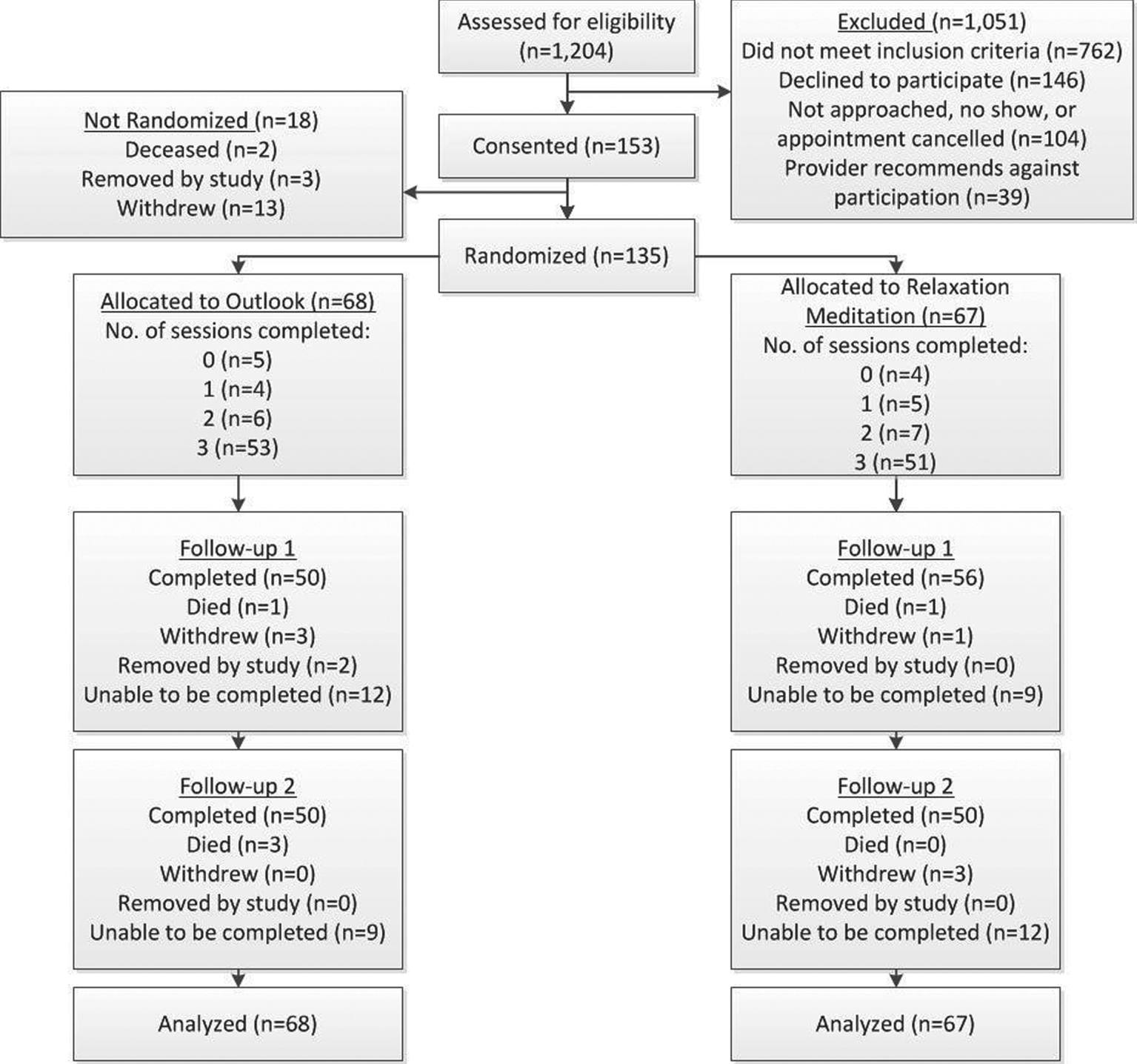
Of 299 patients approached, 153 (51%) consented to participate. Following consent, an additional 18 withdrew were removed by the study team, or died prior to randomization (Figure 1). One hundred thirty-five participants were randomly assigned to the two groups described above. Seventy-eight percent and 76% of participants completed all three intervention or relaxation sessions, respectively. One-hundred and six (79%) completed the first post-assessment and 100 (74%) the second post-assessment.
CONSORT diagram.

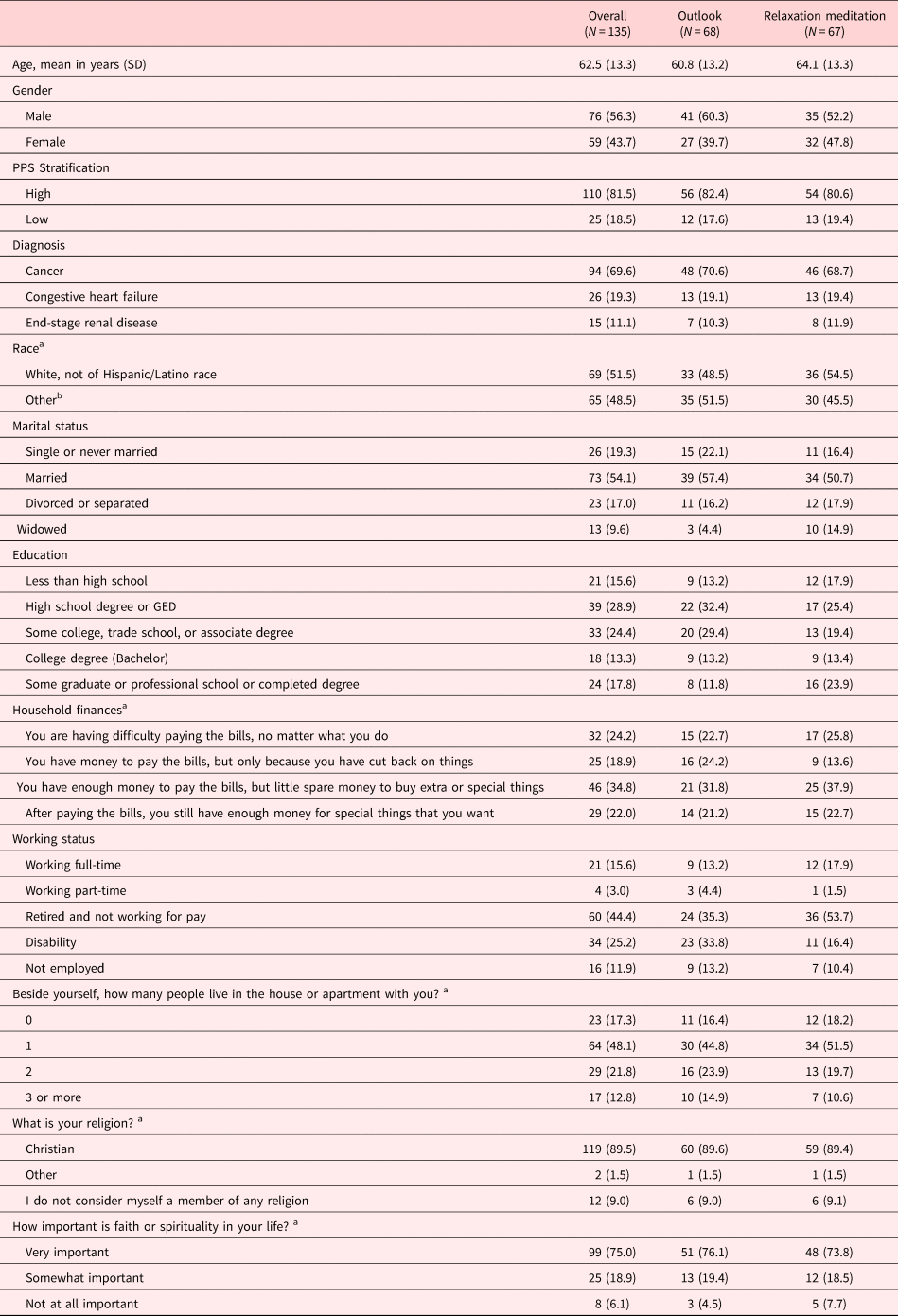
Participants in the study averaged age 62.5 (SD = 13.3). Fifty-six percent had a post-high school education, 54% were married, 51% were white, 44% female, and 70% had a cancer diagnosis (Table 1). At baseline, participants, on average demonstrated sub-clinical levels of anxiety and depression. The mean sample preparation score was 14.0 (SD = 4.0); mean sample life completion score was 27.3 (SD = 5.1); mean on the anxiety items was 4.3 (SD = 4.8), mean CES-D depression score was 8.8 (SD = 6.1). The mean scores for the FACIT-Sp Faith, Meaning, and Peace subscales were 11.8 (SD = 4.0), 12.6 (SD = 3.0), and 11.1 (SD = 3.4).
Sample characteristics

Note: n (%) unless otherwise indicated. SD, standard deviation; PPS, Palliative Performance Scale; GED, General Education Diploma. Group percentages may not total 100% due to rounding.
a Missing data: Race (n = 1) Household finances (n = 3), importance of faith (n = 3), number of people living with patient (n = 2) — these have a special living situation, religion (n = 2).
b Other race includes 60 patients reporting Black or African American, two Asian, two more than one race, and one with race unknown or not but reported but responding affirmative to Hispanic/Latino ethnicity.
Primary and secondary analyses
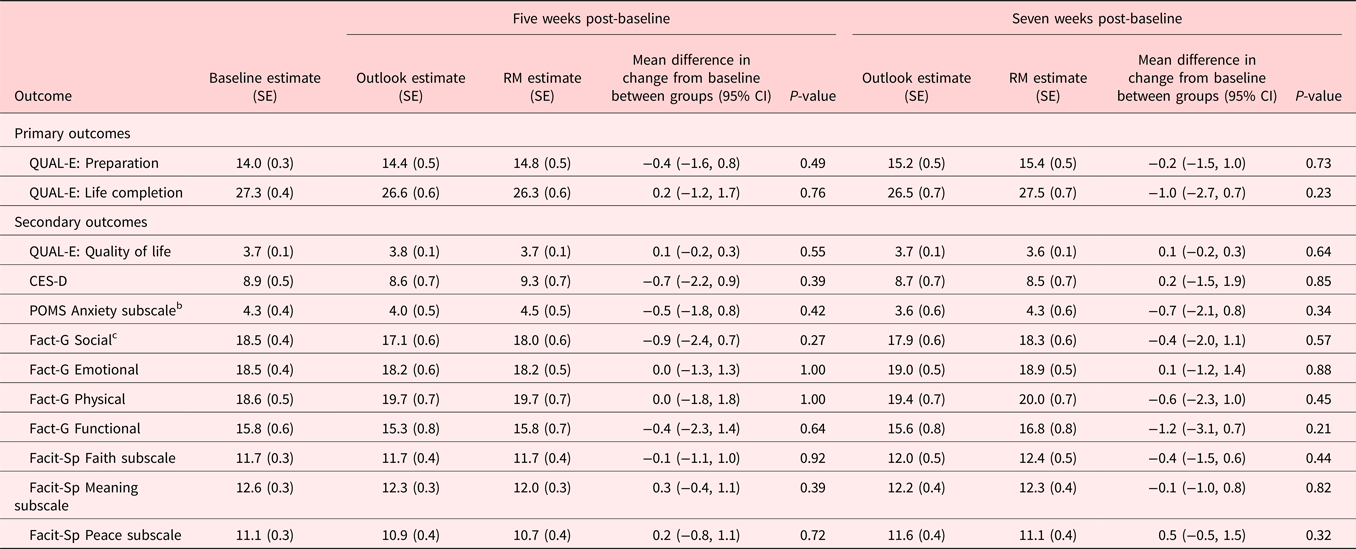
Results of the primary analysis revealed no significant differences in mean Preparation by treatment arm at five weeks (14.4 Outlook vs. 14.8 RM; between-group difference −0.4 [95% CI, −1.6, 0.8], p = 0.49) or seven weeks (15.2 vs. 15.4; between-group difference −0.2 [95% CI, −1.5, 1.0], p = 0.73). There were also no significant differences in mean Life Completion by treatment arm between at five weeks (26.6 Outlook vs. 26.3 RM; between-group difference 0.2 [95% CI, −1.2, 1.7], p = 0.76) or seven weeks (26.5 vs. 27.5; between-group difference −1.0 [95% CI, −2.7, 0.7], p = 0.23). Dropping the assumption of equal baseline Preparation and Life Completion mean scores did not meaningfully change the results at five weeks (between-group difference 0.1 [95% CI, −1.1, 1.4], p = 0.83 and 0.03 [95% CI, −1.5, 1.6], p = 0.97, respectively), or at seven weeks (between-group difference 0.6 [95% CI, −0.9, 2.0], p = 0.45 and −1.2 [95% CI, −2.9, 0.6], p = 0.18).
Similarly, as compared with the relaxation arm, Outlook intervention participants did not have significant differences over time in the secondary outcomes of overall quality of life, anxiety, depression, FACT-G subscales, and FACIT-Sp subscales (Table 2).
Model estimateda primary and secondary outcomes

SE, standard error; CI, confidence interval; QUAL-E, Quality Of Life At The End Of Life; CES-D, Center for Epidemiological Studies–Depression Scale; POMS, Profile of Mood States; Fact-G, Functional Assessment of Cancer Therapy–General; FACIT-Sp, Functional Assessment of Chronic Illness Therapy–Spiritual Well-Being.
a Constrained longitudinal data models were used to compare mean differences in outcomes between Outlook and RM groups.
b Calculated using 5 out of 6 POMS Anxiety subscale items.
c Calculated omitting the question pertaining to satisfaction with sex life.
Qualitative results
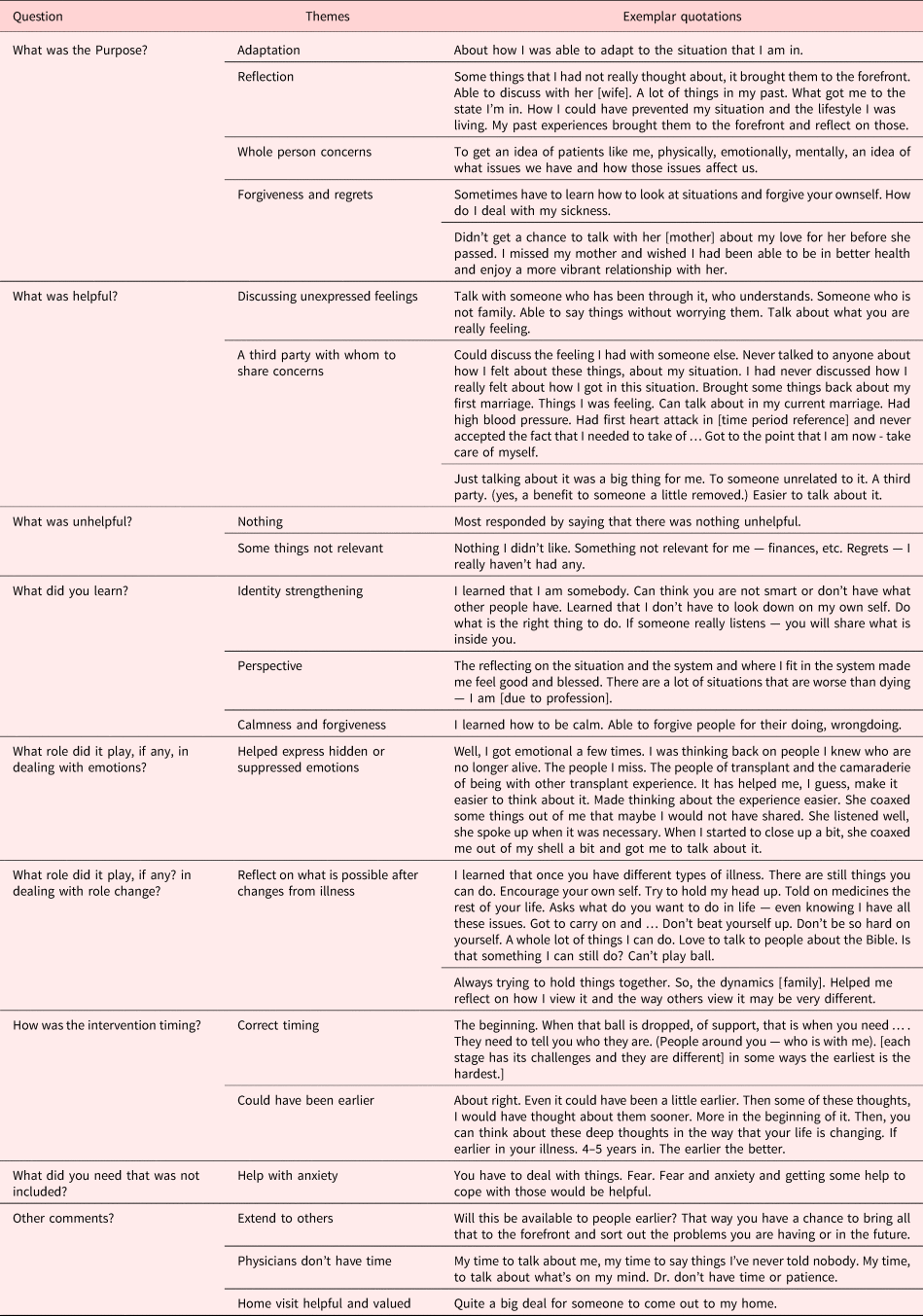
Nine participants (13% as compared with the 10% targeted) completed post-intervention qualitative interviews; seven were male and two were female. Five were African American and four Caucasian. Their illnesses included: cancer (3), end-stage renal disease (4), and heart failure (2). Among other themes, qualitative interviews show participants were able to express suppressed emotions, place the illness in a broad context, reflect on adaptations following illness, and strengthen identity. See Table 3 for a summary of themes.
Qualitative themes from evaluation interviews

Discussion
The study results demonstrate that Outlook and relaxation arms did not differ from one another for primary or secondary outcomes in this upstream palliative care population. Results also reveal low levels of anxiety and depression and higher levels of quality of life, relative to previous trial results in hospice eligible patients, who were further advanced in their disease trajectory. In the previous study of hospice eligible population, we saw a wider variation in levels of emotional and existential outcomes and higher averages of anxiety and depression as compared with this upstream sample (Steinhauser et al., Reference Steinhauser, Alexander and Olsen2017). Our qualitative results suggested that respondents found the intervention to be useful by allowing them to (1) reflect on the functional changes brought about living with a serious illness, (2) consider past experiences that created anger or other strong, previously unexpressed emotions, and (3) think about goals for the future. Each of these occurred within the supportive relationship of the interventionist who offered non-judgmental listening and reflection techniques. These qualitative reports were in contrast to the equivocal results of the quantitative outcomes. Below, we explore the implications of the main quantitative findings and a variety of potential explanations and approaches to deciphering the contradictory findings.
Psychosocial approaches to improving emotional and existential well-being in the context of serious illness are in their infancy. Each of the interventions mentioned earlier, Outlook, Dignity Therapy, and Meaning-Centered Psychotherapy, have distinct yet overlapping approaches to care of this essential aspect of human experience, each with an opportunity to explore meaningful moments, insights, and/or goals for the future.
Dignity Therapy offers a meaning-centered interview promoting patients’ sense of purpose, self-worth, and desire to live in the face of chronic, life-threatening, or terminal illness. Through narration, this treatment helps patients identify and share meaningful aspects of their past and current lives. Sessions address illness-related concerns (e.g., physical and psychological distress, medical uncertainty, and death anxiety) and level of independence from a dignity-conserving perspective. It emphasizes continuity of self, role-preservation, hopefulness, autonomy, acceptance, resilience, legacy, and pride, and a collaboratively narrated generativity document (Chochinov, Reference Chochinov2002; Chochinov et al., Reference Chochinov, Hack and Hassard2005, Reference Chochinov, Kristjanson and Breitbart2011). Meaning-Centered Psychotherapy, rooted in the principles of Viktor Frankl's logotherapy (Frankl, Reference Frankl1985), seeks to enhance patients’ sense of meaning and purpose through a combination of didactics on sources of meaning (e.g., choosing one's attitude toward life's limitations, viewing life as a living legacy) and experiential exercises that help patients identify and connect with a personal sense of meaning (Breitbart, Reference Breitbart2002; Breitbart et al., Reference Breitbart, Rosenfeld and Gibson2010, Reference Breitbart, Poppito and Rosenfeld2012, Reference Breitbart, Rosenfeld and Pessin2015, Reference Breitbart, Pessin and Rosenfeld2018). Outlook explores meaningful moments from the past, present, and future, making sense of issues of reconciliation and forgiveness and identifying lessons learned and future goals. None of the interventions uses specific activating techniques of cognitive-behavioral therapy (a gold standard in anxiety and depression care), for example, to reduce symptoms of anxiety or depression.
Each of the trials may have targeted anxiety and depression as key outcomes because health systems tend to value them as cost generating psychopathologies that align with the medical model. Yet, this is likely not the mechanism of action to be measuring as a main outcome in meaning-based interventions with seriously ill upstream populations. Using measures of anxiety and depression as proxies for existential distress does not allow us to elucidate the factors that may be unique to these interventions, namely meaning-making, self-disclosure, and identity reconciliation, that may be crucial to addressing existential distress. As a result, patient-centered outcomes efforts should include assessment of those domains of existential experience relevant to adjustment to serious illness and changing function. Recent meta-analyses, for example in heart failure, recommend attention to measurement and intervention related to adjustment to a role change, for patients and family members, spawned by physical functioning decrements (Kavalieratos et al., Reference Kavalieratos, Gelfman and Tycon2017). More appropriate outcomes may include “positive meaning in life,” adjustment to change, and assessment of ease with uncertainty (measures cited).
In recent meta-analyses, meaning therapies (n = 6 studies) showed moderate effects on positive meaning in life immediately post-intervention (0.65) and at follow-up (0.57) (Fulton et al., Reference Fulton, Newins and Porter2018). They had more moderate effects on psychological distress (0.47) (i.e., anxiety and depression and self-efficacy (0.48) at post-intervention). They did not have significant effects on self-reported physical well-being (n = 1 study). Supportive-expressive therapy (n = 5), the comparison condition in trials of Dignity Therapy, had small effects at post-treatment and follow-up on psychopathology (0.20 and 0.18, respectively) in the form of anxiety and depression. Supportive-expressive therapy also had no significant effects on self-efficacy (1 study) and self-reported physical well-being (4 studies). Of note, experiential-existential (n = 2) and cognitive-existential therapies (n = 1) had no significant effects on psychological distress.
While our sample of patients earlier in the course of their life-limiting illness did not demonstrate the difference between arms, we glean important information about sub-populations. In a previous trial among veterans, sub-population analyses showed that the Outlook intervention was more likely to be beneficial for those with baseline cancer and low sense of peace (Steinhauser et al., Reference Steinhauser, Alexander and Olsen2017). Additionally, it is likely that some participants respond better to one test condition vs. another. In a less controlled and more pragmatic setting, participants could be free to choose a therapeutic approach. Outlook trial participants often remarked to the interventionist that they had a clear preference for one treatment arm, despite their randomization to a given arm. For example, would those with better overall communication skills prefer Outlook (a conversational intervention) because of a proclivity for an interactive verbal approach? If researchers have a large enough sample size, variable response to different modalities can be assessed. And, in a clinical or pragmatic trial setting, tailored and preference-sensitive options are possible.
In analyses not shown, we conducted exploratory, post hoc analyses of such sub-populations using QUINT methodology for exploring the possibility of each of these conditions (RM and Outlook) working variably for patient sub-populations (Olsen et al., Reference Olsen, Stechuchak and Steinhauser2019). This methodology partitions the sample into which treatment is best for particular sub-populations. The exploratory study suggested that heterogeneity of treatment effects exist in this sample upstream palliative care population with low levels of distress, on average, at baseline. However, small sample size and variable results on key outcomes associated with distress prohibited definitive findings. Further work should be done to validate these findings.
This population complexity reveals the importance of testing potential moderators (e.g., patient characteristics) and theory-driven mechanisms (e.g., increased sense of meaning) driving variable intervention effects. We know, clinically, that one size does not fit all in caring for patients across the continuum illness severity, yet our science in the area of existential care has not yet progressed to permit targeting particular interventions for patients with particular existential needs at particular stages of illness. Understanding what treatment works best for whom would permit a more refined approach to treatment in this under-researched domain of palliative care. We must also ensure that our measurement tools align and match with how we define the constructs we are targeting (e.g., existential distress) in interventions.
Additionally, the results of this and similar trials conducted among populations selected for their level of physical illness or disease burden suggest the importance of screening for distress in the form of anxiety and depression. Rather than assume distress because of stage of illness, screening for it must become standard in intervention, particularly in earlier stages of illness. Most recently Breitbart and colleagues included this in the trial of individual MCP, to positive end (Breitbart et al., Reference Breitbart, Pessin and Rosenfeld2018). Subsequently, in measuring distress as an outcome, we have a poorly specified understanding of the different kinds of distress most operative and lack a gold standard approach to measuring that. Our qualitative results stressed issues like adjustment to illness and shifting role identity. Future studies that examine our ability to delineate, existential, spiritual, religious, and psychological distress would serve clinical and research efforts.
Finally, future approaches to addressing existential distress may combine the narrative expressive approaches outlined in interventions described above with a combination of activating techniques found in Cognitive Behavioral Therapy and Acceptance and Commitment Therapy along with exploration of existential concerns, meaning, life review, and future hopes and other intervention techniques such as those found in Outlook, may be helpful. If not experiencing clinical levels of emotional distress, participants may choose such reflective approaches which appear to assist with adjustment to role changes that accompany serious illness and changes in function. Learning how to properly assess those changes in role adjustment is the next step in this area of palliative care intervention. However, as more classic anxiety and depression are paired with those concerns, a combination of modalities could be beneficial. Early work in this area can be exemplified in recent pilot work combining MCP with traditional pain-coping skills (Winger et al., Reference Winger, Ramos and Steinhauser2020).
This trial, completed in an upstream community sample, showed similar results to the veteran population. While this sample was slightly more educated, more likely to have cancer (70% vs. 42%), and had a greater proportion of women (44% vs. 4%). We also saw no differences in outcomes between RM and Outlook. Qualitative themes between the two settings, VA and non-VA, were very similar, with the exception that combat veteran's discussions of forgiveness were more likely to include concerns of moral injury (Steinhauser et al., Reference Steinhauser, Alexander and Olsen2017).
Limitations
This study includes several limitations. First, because the sample was not screened for distress and did not demonstrate, on average, high levels of emotional or existential distress, we have less understanding of Outlook's efficacy among large samples of upstream palliative care patients experiencing distress. Additionally, because the follow-up interviews were assessed one and three weeks post-intervention, we were not able to assess potential later impact on patients or families of having opportunities for reflection.
Conclusion
When addressing emotional and existential needs, clinicians must have increased knowledge of which treatments may be best candidates for which patients. This process may be especially critical in upstream palliative care populations in which patients may experience a wider range of emotional responses as they represent broader ranges of stages of illness and related or unrelated levels of distress. Identifying appropriate measures of existential distress and growth, beyond anxiety and depression, is crucial for advances in our ability to adequately assess the mechanisms that decrease existential suffering.
Funding
This work was supported by a research grant from the National Institute of Nursing Research (NIH/NINR: P01 NR010948). Portions of investigators salaries, in general, were supported by the Durham Center of Innovation to Accelerate Discovery and Practice Transformation (ADAPT), (CIN 13-410) at the Durham VA Health Care System, Office of Research and Development Health Services Research and Development Service, Department of Veterans Affairs.
Disclosures
The views expressed in this article are those of the authors and do not necessarily represent the views of the Duke University, the Department of Veterans Affairs or the United States Government.