

Introduction
Limestone karst habitats have long been flagged as of high conservation concern (“biodiversity arks”; Vermeulen and Whitten Reference Vermeulen and Whitten1999, Clements et al. Reference Clements, Sodhi, Schilthuizen and Ng2006). Discontinuously scattered across landscapes, they possess a high representation of endemic and plant and animal taxa, among which a great many remain still undescribed (Chin Reference Chin1977, MacKinnon and MacKinnon Reference MacKinnon and MacKinnon1986; Egli Reference Egli1991, Schilthuizen Reference Schilthuizen2004, Clements et al. Reference Clements, Sodhi, Schilthuizen and Ng2006). Moreover, karst habitats may be particularly sensitive to ecological imbalance through loss of species and incremental loss of habitat area through quarrying activities (Hughes Reference Hughes2017). No fewer than twelve new species of Cyrtodactylus geckos (Reptilia: Fam. Gekkonidae) were recently found from just 19 karst sites in south and east Myanmar (Grismer et al. Reference Grismer, Wood, Thura, Zin, Quah, Murdoch, Grismer, Lin, Kyaw and Lwin2018). Even among such relatively conspicuous and well-known vertebrate taxa as birds (Class Aves) two hitherto unknown species, the Bare-faced Bulbul Nok hualon and the Limestone Leaf Warbler Phylloscopus calciatilis were newly described from Indochinese limestone karsts (Woxvold et al. Reference Woxvold, Duckworth and Timmins2009, Alström et al. Reference Alström, Davidson, Duckworth, Eames, Le, Nguyen, Olsson, Robson and Timmins2010, Fuchs et al. Reference Fuchs, Pasquet, Stuart, Woxvold, Duckworth and Bowie2018). Additionally, in widespread taxa inhabiting scattered karst outcrops, high levels of local, site-specific genetic differentiation have been recorded within populations of the same species, adding a further dimension to the assessment of biotic diversity within such habitats (Latinne et al. Reference Latinne, Waengsothorn, Herbreteau and Michaux2011a, Reference Latinne, Waengsothorn, Herbreteau and Michauxb).
Limestone karsts cover over 400,000 km2 throughout South-east Asia (Clements et al. Reference Clements, Sodhi, Schilthuizen and Ng2006). While their rugged, inhospitable terrain has largely spared them from the large-scale transformation to agricultural land that has so badly impacted lowland forest landscapes throughout the region (Namkhan et al. Reference Namkhan, Gale, Savini and Tantipisanuh2021), increasing demand for cement and concrete used in construction and economic development has already damaged large areas. On average, 5.7% of the limestone karsts was annually lost from quarrying between 1999 and 2003 in this region, the highest annual rate of loss throughout the world (Clements et al. Reference Clements, Sodhi, Schilthuizen and Ng2006). In Thailand, over 20% of the total limestone karst areas have been impacted by quarrying (World Bank 2004). During 2012 to 2018 cement demand in Thailand increased by 3.0 million tonnes per annum (Mt/a) or (11 %), and cement production increased by 4.0 Mt/a (13 %). Other South-east Asian countries were expected to experience cement demand growth of 4% during 2021 (ZKG Cement 2021).
The “Saraburi Group Limestones” at the south-west margin of the Khorat Plateau, Thailand, constitute a key limestone karst in South-east Asia (Ponta et al. Reference Ponta, Memon, LaMoreaux, Julawong and Wongsawat2013). The area supports endemic or restricted range plants, invertebrates, and vertebrates, and encompasses the entire world range of the endemic taxon Gypsophila [crispifrons] calcicola (Aves: Fam. Pellorneidae). A recent review placed the Limestone Wren Babbler G. crispifrons in the genus Gypsophila together with Streaked Wren Babbler G. brevicaudata and Mountain Wren Babbler G. crassus (Cai et al. Reference Cai, Cibois, Alström, Moyle, Kennedy, Shaoh, Zhang, Irestedt, Ericson, Gelang, Qua, Lei and Fjeldså2019). These three species form a discrete clade within Pellorneidae.
The populations of G. crispifrons (sensu lato) which show a close association with limestone karst throughout their range (Collar and Robson Reference Collar, Robson, Hoyo, Elliott and Christie2007) were usually recognized as a single polytypic species by most authorities (e.g. Gill et al. Reference Gill, Donsker and Rasmussen2020, though see del Hoyo and Collar Reference del Hoyo and Collar2016). An integrated study that has since examined both molecular phylogeny and vocalisations of the three allopatric Limestone Wren Babbler taxa, G. c. crispifrons (southern and south-eastern Myanmar, western Thailand), G. c. annamensis (southern China and north Indochina, probably extending into northern Thailand) and G. c. calcicola (extreme south-west of Thailand’s eastern plateau; Deignan Reference Deignan1963, Dickinson and Christidis Reference Dickinson and Christidis2014), indicated that they constituted deeply diverged lineages that displayed >5% mitochondrial divergence (Gwee et al. Reference Gwee, Lee, Mahood, Manh, Tizard, Eiamampai, Round and Rheindt2021). We henceforth refer to these three as G. annamensis, G. crispifrons and G. calcicola following Gill et al. (Reference Gill, Donsker and Rasmussen2021).
This study was undertaken to (1) identify potential habitat of G. calcicola, or “Rufous Limestone Babbler”, in the Saraburi Group Limestones karst complex; (2) calculate the areas that have been lost to quarrying activities; (3) determine the present rate of habitat loss, and (4) project future habitat loss. G. calcicola is an endemic bird listed as ‘Vulnerable’ (BirdLife International 2021) and of conservation concern, particularly as its highly restricted core range is at risk from intensive quarrying, in which limestone is mined for cement production.
Methods
The world range of G. calcicola (BirdLife International 2021, Deignan Reference Deignan1963) lies within the Permian limestone of the Saraburi Group, shared among the Thai provinces of Saraburi, Lopburi and Nakhon Ratchasima (Ponta et al. Reference Ponta, Memon, LaMoreaux, Julawong and Wongsawat2013). This contiguous limestone area of 3081.32 km2, (derived from a shapefile supplied by the Thai Department of Mineral Resources 1999) comprises mostly more or less level agricultural land, and some urbanized areas, among which outcrops of (mainly forested) limestone karst are scattered.
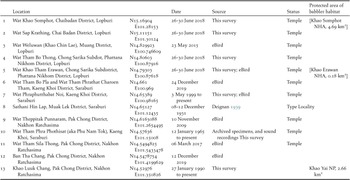
We identified all principal sites from which records of G. calcicola are known by specimens, verifiable sight records and sound recordings, both those archived on eBird and our own, collected opportunistically since September 1982, with additional surveys implemented during February 2017 to June 2020 (Table 1). Inappropriately georeferenced or otherwise implausible records on eBird were discarded from the dataset.
Known site records of the Rufous Limestone-babbler Gypsophila calcicola

Note: Under Protected Area of babbler habitat, those shown in parentheses [Non-Hunting Areas] lack rigorous habitat protection
We identified suitable habitat areas for G. calcicola based on slope and land use (forest cover), using an ASTER Global Digital Elevation Model (GDEM), with 30 m resolution, downloaded from https://asterweb.jpl.nasa.gov/gdem.asp. This map was then used to generate a slope map using the ‘Slope’ toolbox in ArcGIS 10.6 (ESRI 2011). The earliest available forest cover shapefile, for year 2000, was obtained from the Department of National Parks, Wildlife and Plant Conservation (DNP). The map was manually drawn from a Landsat 5 satellite image and was validated by each DNP local station. The percentage accuracy was not available, but as the difference between forest and non-forest areas was quite distinct, the classification error was low. Since the first quarrying concessions long pre-dated the year 2000 forest shapefile, it was compared with fine-scale satellite images for the year 1984 (the oldest available) in Google Earth and manually edited to generate a forest cover shapefile for that year. We selected forested areas with a slope of 20° or greater as best indicating the extent of karst outcrops, thus representing the suitable habitat for the species, which favours boulders and steep slopes, including in some cases sheer rock faces. While the babbler descends to the hill-foot, in narrow forested valleys between crags, it does not appear to disperse any significant distance away from karst outcrops. The minimum slope at 20° was chosen based on the existing bird locations. Areas with slope lower than 20° could potentially include other areas that were not bird habitat such as agricultural land.
Shapefiles of quarry areas from 1980 to 2020 were obtained from the Thai Department of Primary Industries and Mines (DPIM). The map was created by locating X and Y geographical co-ordinates at key boundary points around each polygon. The polygons were then manually adjusted with reference to the satellite images. The shapefiles of future proposed quarrying concessions were not made available to us and therefore the boundaries of the additional proposed quarrying areas were manually digitized from the online map in the Department of Primary Industries and Mines of Thailand (DPIM) web page (https://gisweb.dpim.go.th/main/GISPage.aspx). We then assessed the cover of rock quarries at five points in time: already in existence in 1980 (the year for which the earliest satellite images were available); and then subsequently in 1990, 2000, 2010 and 2020 in order to estimate the rate of loss of karst habitat for the babbler over time. Moreover, to evaluate the legal protection of land areas, core babbler habitat and quarry area shapefiles were overlaid on a 2019 map of protected areas provided by DNP.
Results
Distribution
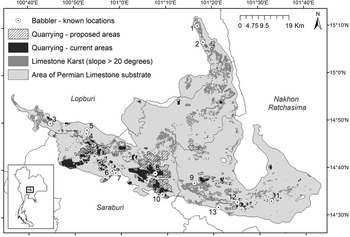
The northernmost site where G. calcicola was identified was Wat Khao Somphot, Chaibadan District, Lopburi Province (N15.16904, E101.28153); the westernmost at Wat Weluwan, Muang District, Lopburi Province (N14.829923 E100.746609); the southernmost at Khao Luuk Chang, (N14.52976 E101.350826) and the easternmost at Wat Tham Sila Thong (N14.5494825 E101.5433478). The latter two sites both lie in Pak Chong District, Nakhon Ratchasima Province (Table 1, Fig 1).
The study area, showing the distribution of limestone karst, existing and proposed quarrying concessions, and known locations of the Rufous Limestone Babbler Gypsophila calcicola.

Habitat status
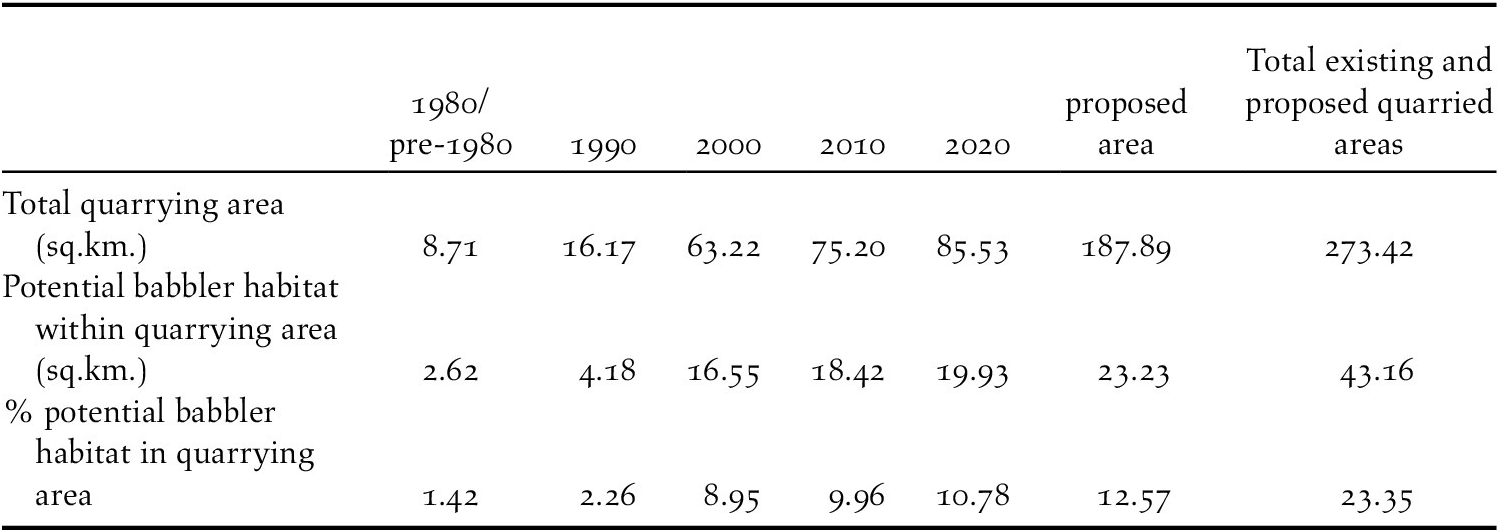
We assessed the total area of suitable G. calcicola habitat as 184.85 km2 in 1980. The areas of suitable karst within the study area were highly scattered, with only 25 patches that were larger than 1 km2. The area of quarried land occupied 8.87 km2 by 1980, of which almost one-third (2.62 km2) was formerly suitable babbler habitat. By 1990, the quarrying area had nearly doubled (16.17 km2) of which 4.18 km2 (25.8%) was former babbler habitat.
There was a fourfold increase in both total quarried areas and loss of suitable babbler habitat during 1990–2000 (quarried area 63.22 km2, and loss of babbler habitat 16.55 km2). The accumulated areas quarried had increased to 85.53 km2, of which 19.93 km2 was babbler habitat, by 2020. This represents a loss of more than 10% of the area of habitat of the Rufous Limestone Babbler (Table 2). The total quarried area may give a better representation of actual conservation impact since, some quarried areas, which appear as less than 20° slope, were likely to be steep land before they were quarried. Also, access roads, noise and dust from blasting undoubtedly impact remaining babbler habitat further. The existing quarry areas were disproportionately concentrated in the south and west of the study area, in Saraburi Province (Figure 1).
Existing and proposed quarrying areas within the world range of the Rufous Limestone Babbler Gypsophila calcicola

Future proposed concession areas covered a further 187.89 km2, of which 23.23 km2 constitute our babbler habitat. This could potentially mean an accumulated loss of 43.16 km2 (23.3%) of babbler habitat, with the total area eventually impacted by quarrying 273.42 km2, or one and a half times greater than our (conservative) estimate of babbler habitat (Figure 1).
The type locality of G. calcicola, at Hin Lap Railway Station (Table 1), where the first three specimens were collected in December 1931 (Riley Reference Riley1938, Deignan Reference Deignan1939), was the site of a major limestone quarry and cement processing plant when visited in June 2018 and has been largely destroyed.
Status of habitat protection
Only one of the 13 known babbler sites, Khao Luuk Chang, enjoys formal habitat protection as national park: it occupies 2.66 km2 (0.1%) within the 2,168 km2 area of Khao Yai National Park. G. calcicola is certainly absent from the remainder of Khao Yai which otherwise lacks any significant karst areas.
Wat Khao Somphot and Khao Tham Erawan are temples (Buddhist monasteries), both designated as Non-Hunting Areas (NHAs) that together contain approximately 2.19 km2 of babbler habitat. Another 12.17 km2 of potential babbler habitat lies inside two other NHAs, Kaeng Khoi NHA and Namtok Chet Sao Noi NHA. Although neither has yet been surveyed for the presence of the babbler, its occurrence at both appears plausible. However, NHAs receive no formal habitat protection. Indeed, our assessment shows that 2.18 km2 in Kaeng Khoi NHA was lost to quarrying during 1992–1998.
While eight other sites lie at least partly within the grounds of established Buddhist monasteries these likewise lack formal protected area status. By 2016–2017 a quarrying operation had encroached to within 2 km of Wat Tham Phra Photisat, one of our known Rufous Limestone Babbler sites. Ten of the 13 babbler sites so far identified therefore receive only a measure of informal protection, while one (the type locality) has already been lost.
Discussion
Our assessment of the conservation status of the Rufous Limestone Babbler accords with its present listing as ‘Vulnerable’ (BirdLife International 2021) on the basis of its small global range and limited area of occurrence and occupancy (Criteria B1b, B2b); and Criterion C1 (10% reduction in habitat that implies a proportionate reduction in its population; IUCN 2012). Other than the 2.66 km2 at Khao Luuk Chang, at the extreme north-west margin of Khao Yai National Park, part of the Dong Phaya Yen-Khao Yai-UNESCO World Heritage Site (UNESCO 2020), the steep land karst habitat of the Rufous Limestone Babbler, including that inside temple grounds and in NHAs, is potentially vulnerable to future quarrying since it lacks formal habitat protection status.
Future work should incorporate a broader survey of the occurrence of G. calcicola in accessible habitats to develop a population estimate and formulate recommendations for the conservation of the biodiversity of its important limestone karst habitat. However, the Saraburi Group limestones of Thailand’s Lower North-East are of perhaps even greater importance for a range of other endemic, similarly restricted, vertebrate and invertebrate taxa. They support an endemic murid rodent, Niviventer hinpoon (Waengsothorn et al. Reference Waengsothorn, Nabhitabhata and Moonchan2007, Latinne et al. Reference Latinne, Waengsothorn, Rojanadilok, Eiamampai, Sribuarod and Michaux2013). At least five species of geckos, and three species of skink (Reptilia: Fam Scincidae) are endemic to the limestone karsts of this same area (Heyer Reference Heyer1972, Bauer et al. Reference Bauer, Sumontha and Pauwels2003; Panitvong et al. Reference Panitvong, Sumontha, Konlek and Kunya2010, Chan-ard et al. Reference Chan-ard, Parr and Nabhitabhata2015). Taxa of endemic and restricted range invertebrates that occur there include millipedes (Pimvichai et al. Reference Pimvichai, Enghoff and Panha2014, Reference Pimvichai, Enghoff, Panha and Backeljau2018) and land snails (Tongkerd et al. Reference Tongkerd, Lee, Panha, Burch and Ó Foighil2004, Siriboon et al. Reference Siriboon, Naggs, Wade, Jeratthitikul, Tongkerd, Jirapatrasilp, Panha and Sutcharit2020), while among plants, there is an endemic cycad (Hill Reference Hill2010). Given the discontinuous nature of the limestone karst habitat, the potential for discovering new endemic smaller vertebrate and invertebrate taxa limited to single outcrops is high (Hughes Reference Hughes2017, Grismer et al. Reference Grismer, Wood, Thura, Zin, Quah, Murdoch, Grismer, Lin, Kyaw and Lwin2018, Liu and Wynne Reference Liu and Wynne2019). Some arthropods and land snails in South-east Asian karsts are apparently even restricted to single caves or outcrops (Vermeulen and Whitten Reference Vermeulen and Whitten1999). Such species would be at much greater risk from any further extension of quarrying than is the babbler, which may enjoy greater mobility. Even so, understorey babblers in common with many other resident tropical forest birds generally avoid crossing significant non-forested gaps in fragmented landscapes (Laurance et al. Reference Laurance, Stouffer and Laurance2004; Thinh et al. Reference Thinh, Doherty, Trinh and Huyvaert2012) and are therefore unlikely to colonize or recolonize disjunct habitat patches.
The importance of the Saraburi Group limestones for biodiversity conservation and the threats to this area should be recognized, both nationally and internationally. While G. calcicola deserves recognition as an iconic indicator species for this limestone group, focusing on conservation of the babbler alone might cause important sites for other species to be overlooked. Therefore, an integrated approach to conservation management should draw together current knowledge and distribution information on all endemic plant and animal taxa of the Saraburi Group limestones to identify key sites for biodiversity conservation while providing renewed impetus for future biological surveys. This would ensure that this unique karst area is not compromised by unregulated development.
Acknowledgements
We are grateful to Skon Chulapha, Director, Concession and Permit Bureau, Department of Primary Industries and Mines, for his kindness in assisting us with access to information on the extent of quarrying activities. Patchara Danaisawatuen, Kasetsart University, Somsak Panha, Chulalongkorn University, and Nonn Panitvong, Bird Conservation Society of Thailand, provided information on endemic non-avian taxa in the study area. We thank Alice Hughes for sharing her immense knowledge on the importance of karsts and their conservation. Nisarat Songjaruen, Waraphon Panomwongkasem, Watcharin Pasatsee, Sakchai Sonthirak. Sunthorn Manthaeo, Wisanu Panchusri and Charoey Phromtaeng of the Department of National Parks, Wildlife and Plant Conservation participated in surveys of the babbler. Pattarapon Promnun and Pathom Yimkao also assisted in the field. George A. Gale kindly read a draft of this manuscript. Philip Round is supported by The Wetland Trust, UK.