On March 9, 2020, Louisiana identified its first presumptive positive case of coronavirus disease 2019 (COVID-19) in the New Orleans Metro region. 1 Within 5 d, the Louisiana Department of Health (LDH) reported an additional 76 individuals as “presumptive positive” cases and recorded the state’s first death attributed to the virus. 2 At the time, the New Orleans Metro area drew attention as the locale second in the nation in presumptive cases per capita. Reference Zurik and Lillich3 Nearing the end of March, Louisiana enacted a statewide stay-at-home order as cases topped 1000 and concerns regarding bed capacity plagued health-care systems. 4 As bed availability thinned within hospitals, LDH leadership hosted initial discussions surrounding the opening of an alternative care site in the New Orleans region. By March 27, LDH had secured the Ernest N. Morial Convention Center in Downtown New Orleans for Louisiana’s alternative care site. This site became known as the Medical Monitoring Station (MMS) and prepared to open by April 6.
Conceptually, the MMS aimed to provide basic care for up to 2000 nonacute COVID-19 patients. The intent was for hospitals to transfer stable patients requiring low acuity care to the MMS, freeing their resources to care for the more acutely ill. With this purpose in mind, the MMS was designed and staffed for ambulatory patients capable of activities of daily living (ADLs).
The MMS’s Medical Operations (MedOps) team directed the implementation of safe, patient-focused care at the facility and coordination with local health-care partners. Among the early priorities of the group was a set of admission criteria that promoted maximum utility of the MMS, while still remaining within its anticipated capabilities. During this process and throughout the opening days of the site, hospital leadership pushed back on the MMS’s initial criteria. Citing examples of patients unable to perform ADLs but whose viral contagiousness prevented their return to nursing homes and other congregate settings, hospitals posed that the MMS may not alleviate their internal pressure as hoped. Within days, MedOps restructured staffing plans, acquired additional equipment, and released a revised edition of its admission criteria better aligned with the needs of regional hospitals.
This manuscript describes the first 250 patients cared for at the MMS and explores how their health conditions and the collection of demographic and clinical data drove a continued evolution of medical operations at the MMS.
Methods
Chart reviews were conducted for the first 250 patients admitted to the MMS. Clinicians in patient areas used paper charting that included hospital records and other records from referring centers, intake demographic surveys, medical histories, medication records, and daily care notes. An electronic tracking system known as Web Based Emergency Operations Center (WebEOC), was used to track incoming, active, and discharged patients. Limited demographic and clinical information was maintained in the WebEOC system.
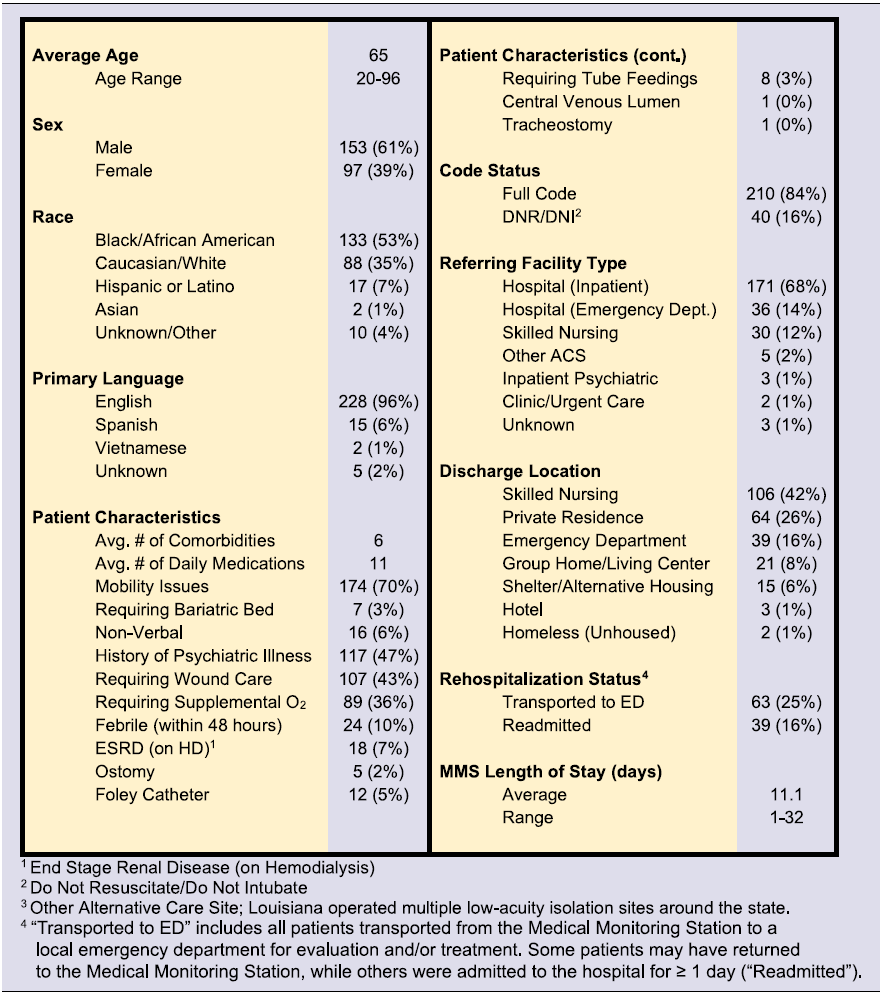
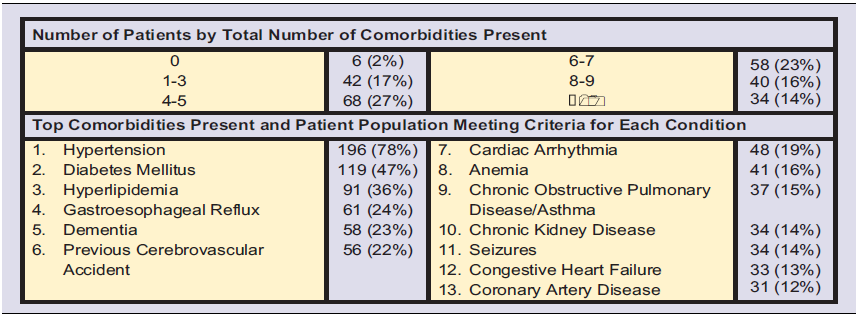
Researchers reviewed both paper charts and WebEOC charts for each patient. If conflicting information was found between WebEOC and the paper chart, the paper chart was considered the more reliable source of information. From these chart reviews, patient demographics and clinical needs were obtained (see Tables 1 and 2).
Patient characteristics at the Medical Monitoring station (n = 250)

Patient comorbidities (n = 250)

Patients with a documented need for continuous oxygen on arrival or during their admission at the MMS were identified as having an oxygen requirement. Chronicity of the oxygen requirement was specified. Patients started on oxygen and transported to the emergency department (ED) due to acute decompensation were not included in the total number of patients with an oxygen requirement and were not considered to have a new oxygen requirement on discharge.
Patient comorbidity information was obtained from MMS patient charts and paperwork sent from transferring facilities. The purpose of collecting comorbidity data was to assess the overall complexity of patients in the facility. Acute issues diagnosed in the hospital setting that had improved and were unlikely to affect care in the MMS were not included. Therefore, conditions such as acute kidney injury, urinary tract infection, rhabdomyolysis, hypernatremia, pneumonia, hyperglycemia, hallucinations, generalized weakness, delirium, encephalopathy, anorexia, and hyperemesis gravidarum were excluded. Issues of unclear chronicity that were unlikely to have an impact on care at the MMS, such as hepatitis A, urinary retention without mention of foley, cholelithiasis, nephrolithiasis, pleural effusion, herpes simplex virus, diverticulitis, hernias without acute issue, Bell’s palsy, and heart murmur were also excluded. Acute surgical histories and injuries were included, while nonacute surgical histories were not. Several conditions were suspected to be grossly underreported in documented patient histories so were excluded to avoid presenting an inaccurate prevalence. These included constipation, osteopenia, incontinence, seasonal allergies, falls, contractures, smoking, eczema, osteoarthritis, vitamin D deficiency, vitamin B12 deficiency, chronic pain, back pain, transient ischemic attacks in patients with a history of ischemic stroke, generalized weakness, and malnutrition.
Substance abuse, alcohol abuse, depression, anxiety, bipolar disorder, schizophrenia, schizoaffective disorder, paranoia, shared psychotic disorder, borderline personality disorder, multiple personality disorder, attention-deficit/hyperactivity disorder, posttraumatic stress disorder, suicidal ideations, and homicidal ideations were counted as psychiatric illnesses. Dementia was not counted as psychiatric illness.
Documented chronic wounds and chart notes written by wound care teams were used to determine patient wound status. Conditions such as dry skin or rash were not included. Decubitus ulcers, healing surgical wounds, and recent trauma were all considered wounds.
A medication administration record (MAR) was maintained in each patient chart. Only medications documented with specific administration times and dates at the MMS were counted toward patient medication totals. Medications documented in histories but not administered were not included.
If a patient was transferred to the ED and returned, the patient’s final date of discharge from the MMS was used. The day of transfer and return were counted as days spent at the MMS and included in the patient’s total MMS length of stay, while any days in between were not.
For quality assessment of data extraction from the chart review, 30 charts (12% of total) were selected at random for audit. During this review, the number of medications was underestimated in 6/30 (20%) charts and overestimated in 3/30 (10%). The chart review error was due to the presence of multiple MARs within each chart as new medications were added over the course of stay, or when medications requested during admission were not available or otherwise substituted. The audit also revealed inconsistencies in recording patient comorbidities. After removal of diagnoses for which standardized inclusion was deemed unlikely (eg, seasonal allergies), 6/30 (20%) of audited charts were missing at least 1 significant patient comorbidity. One additional chart had 1 comorbidity incorrectly listed and another that needed to be added (no net change in number of comorbidities). Discrepancies came when admit diagnosis lists were expanded over the course of the patient’s stay. Many of these diagnoses were unable to be independently validated from available records. Therefore, it is expected that the total number of comorbidities is likely underestimated for the patient population.
Results
Patient ages ranged from 20 to 85 y old (mean 65; median 59; SD 15), they were predominantly male (153 [61%] male/97 [39%] female), and breakdown by race/ethnicity demonstrated the following: 133 (53%) of patients were African American/Black, 88 (35%) Caucasian/White, 17 (7%) Hispanic/Latino, 2 (1%) Asian, and 10 (4%) unknown/other. English was the preferred language for 229 (91.6%) of patients, Spanish for 15 (0.6%), Vietnamese for 2 (0.008%), and 4 patients (0.016%) did not have a primary language documented in their chart.
Patient length of stay ranged from 1 to 32 d with an average of 11 d. The majority of patients (171 [68%]) were transferred from an inpatient setting, 36 (14%) from the ED, 30 (12%) were sent directly from a nursing home, and 10 (4%) arrived from another clinical setting (other alternative care site, inpatient psych, clinic).
Patients had an average of 6 comorbidities each and took an average of 11 medications daily. A total of 117 (47%) patients had a psychiatric history with 107 (43%) required wound monitoring and treatment. Several patients presented with specialized medical equipment needs outlined in Table 1.
Eighty-nine patients (36%) had an oxygen requirement. Of the 89 patients requiring supplemental oxygen at the MMS, 77 (87%) had no history of chronic oxygen use. Seventy-two of these patients were successfully weaned over the course of their stay, while 5 (6%) were discharged with a new home oxygen requirement.
A total of 18 (7.2%) patients required regular dialysis. Seventeen (94.4%) of these patients had a documented history of dialysis that predated their diagnosis with COVID-19.
At some point during the course of their stay, 90 patients (36%) were able to ambulate independently, while 75 (30%) ambulated with assistance, 72 (29%) required a wheelchair, and 91 (36%) were bedbound. Sixty-five patients (26%) were listed in more than 1 mobility category. A total of 26/56 patients (46%) who received physical therapy (PT) were in more than 1 mobility category compared with 38/194 (20%) who were not. Fifty-six patients (22%) received PT, which became available on day 36 of the operation. Due to late initiation, PT was not available for the first 177 patients.
A total of 106 patients (44%) were discharged to nursing homes, 64 (26%) to a personal residence, 39 (16%) to an ED, 21 (8%) to assisted living facilities/group homes/rehab facilities, 15 (6%) to a shelter or housing alternate, 3 (1%) to a hotel, and 2 (1%) remained homeless despite offered resources.
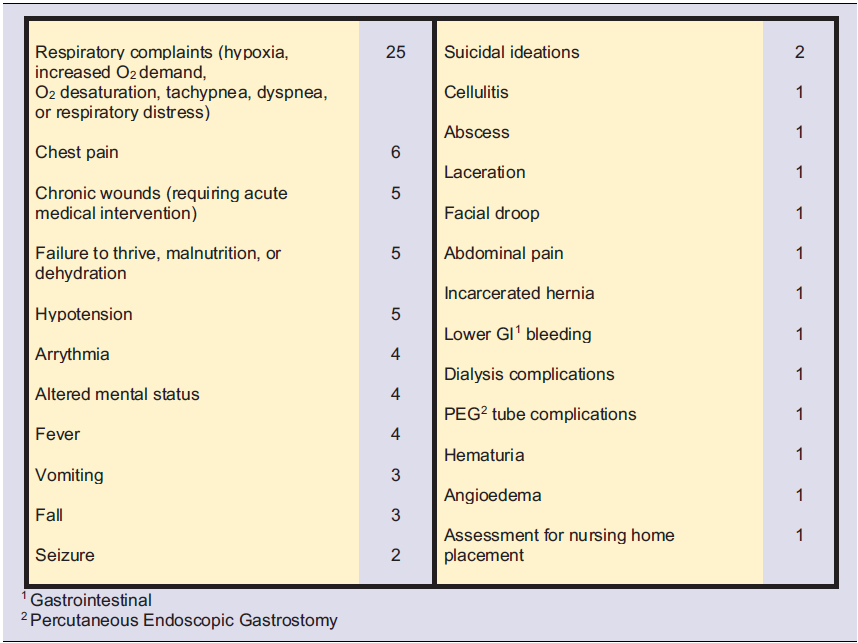
Sixty-one patients (24%) required transport to the ED from the MMS; 39 of these patients never returned to the MMS (16%). Two patients (3%) were transported on 2 separate occasions, for a total of 63 transports. Thirty-seven patients (61%) transported to the ED did not return to the MMS. Patients who did return to the MMS stayed at the hospital for an average of 2 days. Twenty-five transports (41%) involved a respiratory complaint. The remainder of complaints listed as reasons for transport are described in Table 3. Of the 61 patients requiring transport to the ED by means of emergency medical services (EMS), 34 (56%) had an oxygen requirement during their stay at the MMS. Twelve patients (20%) were febrile in the first 48 h of their stay. Forty-three patients (70%) arrived at the MMS from the inpatient setting, 11 (18%) were admitted directly from the ED, 5 (8%) were admitted directly from a nursing home, 1 (2%) from an inpatient psychiatric facility, and 1 (2%) from an unknown origin.
Reasons for EMS transport from the Medical Monitoring Station

The MMS had zero onsite fatalities. Mortality was not tracked after patient discharge. Mortality is unknown for patients emergently transported to the ED for acute decompensation if the patient did not return to the MMS (16%).
Discussion
Demographics data demonstrated a predominantly older population with extensive comorbidities and complex medical needs (see Tables 1 and 2). Most patients were received from the inpatient setting and were discharged to nursing homes. While the original design of the MMS was to care for low-acuity patients needing minimal support during their period of isolation, the MMS instead cared for patients who, at baseline, required care from a skilled nursing facility. The heightened level of care provided by the MMS required the facility to invest further resources and planning into the following areas.
Supplemental Oxygen
It was anticipated that a majority of MMS patients would require supplemental oxygen, because up to 75% of hospitalized COVID-19 patients require this resource. Reference Wiersinga, Rhodes and Cheng5 The MMS initially opened with a cache of E and H oxygen tanks and portable oxygen concentrators, with further plans to build a fixed oxygen system within the facility. But with only 36% of patients requiring supplemental oxygen, plans for the costly fixed system were halted. All oxygen dependent patients were placed on an oxygen concentrator on admission and portable oxygen tanks were kept on hand for emergencies and possible power outages. The MMS never experienced an oxygen supply shortage for the duration of its operation.
Dialysis
After Hurricane Katrina, national policy changed in response to poor outcomes for hemodialysis patients. Reference Kleinpeter6 Because of this disaster planning, LDH worked to ensure that all MMS patients needing dialysis had access to area dialysis clinics set up to care for COVID positive patients. During the first week of MMS operations, several near misses and errors related to dialysis care highlighted the need for a more organized approach to coordinate these services, including the selection of a designated dialysis coordinator. This individual acted as a liaison between dialysis clinics, the patient’s regular nephrologist, and the EMS transport crew. Under this system, coordination improved, and patients were transported to and from their outpatient dialysis appointments during the duration of their stay at the MMS.
Dietetics
Using hurricane shelters as a model and anticipating a generally healthy population capable of ADLs, a disaster response agency was contracted by the state to provide 3 low-fat meals to all patients daily. However, this standard meal plan did not properly serve the patient population that was ultimately accepted into the MMS. Patients with advanced age, poor oral intake, special needs, and comorbidities requiring special diets are at increased risks for poor outcomes if specific dietary needs are not met. Underlying diseases may worsen, malnutrition and/or dehydration can occur, or an aspiration event could hinder recovery and lead to new illness or rehospitalization. Reference Tashiro, Kawakami and Oka7 The food contractor was receptive to this need and worked with MedOps leadership and the LDH dieticians to ensure diabetic, cardiac, renal, mechanical soft, puree, and liquid diets were made available to MMS patients. Ensure/Glucerna was procured for patients with malnutrition. Tube feeds and associated equipment were obtained from sending facilities or through the state pharmacist. Oral intake and input/output was monitored by clinical staff to identify patients at high risk for dehydration and/or failure to thrive. Patient feedback was sought and used to update menu items, modify snack and drink options, and obtain heaters for meals to optimize patient experience.
Pharmacy
MMS patients were administered an average of 11 different medications daily while in the facility, necessitating a robust plan for acquiring, storing, administering, and maintaining pharmaceuticals. Both acute and chronic medications were administered at the MMS and required separate plans. Reference Cantrill, Bonnett, Pons and Phillips8
A Federal Medical Station (FMS) cache was provided to the MMS, but lacked the quantity and variety of medications needed to support patients’ chronic medication needs. Therefore, hospitals transferring patients from the inpatient setting were asked to send the patient with a 14-d supply of all medications and any needed nondurable medical equipment (eg, Foley catheters). Nursing homes were asked to send patients with all on-hand medications. EDs, clinics, and group homes were asked to ensure a 14-d supply of all patient prescriptions was sent to a designated local commercial pharmacy before transfer. If patients ran low on medications while in the MMS, refills were obtained through the commercial pharmacy. Patients held and managed their own medications, unless they were unable to do so safely or were prescribed controlled substances. Controlled substances were stored in a locked safe and administered as prescribed. Clinical staff administered medications to patients requiring assistance with prescription management.
Select medications from the FMS cache were used to create an onsite supply of acute care medications. This supply was augmented with additional medications from local pharmacies and was used to treat minor acute issues such as fever, nausea, diarrhea, and allergic reactions. Advanced cardiac life support (ACLS) medications were available only through EMS, who remained onsite for the duration of the operation to respond to medical emergencies and provide transport to the ED.
Emergency Medical Services
A total of 24% of patients required EMS transport to a local ED for evaluation of an acute or worsening chronic condition. While it was initially anticipated that patients admitted directly from the ED or nursing home setting would have a higher likelihood of decompensating over the course of their stay, this was not the case. Most patients (70%) requiring EMS transport to the ED were admitted to the MMS from the inpatient setting. Patients with an oxygen requirement were more likely to require EMS transport to an ED and most patients transported had a respiratory complaint.
To manage medical emergencies, 1 to 2 staffed and equipped advanced life support (ALS) units were staged onsite. In the event a patient acutely decompensated, EMS was tasked to provide advanced life support measures. The patient was stabilized by EMS personnel and transported to a local ED for further evaluation.
Wound Care
Wound care services were essential to care for a predominantly elderly population in which more than half resided in nursing homes and more than one-third were described as bedbound. Considering these demographics, MMS patients were more likely to arrive with active wounds requiring care and were more prone to developing skin breakdown with a potential for poor healing. Reference Lavalee, Gray and Dumville9 To address this, wound prevention and wound care measures were implemented and prioritized.
Wound status was assessed for all patients on arrival to the MMS, and patients were frequently reassessed for changes during their stay. A wound care team was established to conduct daily rounds and provide management for all patients with wounds. Almost half of all patients received care from this team. Nursing staff also conducted daily skin assessments that were documented in a quality assurance tool designed to rapidly identify new or worsening wounds. All bedbound patients were placed in hospital-grade beds (as opposed to cots), and wound prevention supplies, such as heel pillows and barrier creams, were acquired.
Physical Therapy
With only 36% of MMS patients capable of independent ambulation, MedOps leadership quickly recognized a need for PT to reduce the risk of skin breakdown and address deconditioning due to illness. Mobility was also essential to help reduce the incidence of delirium, given the MMS was operated in a space devoid of windows, natural light, or total darkness. Reference Gual, Garcia-Salmones and Britez10 Despite early attempts to acquire PT services, PT staff were not available until 30 d after opening. Once PT was acquired, an assessment was offered to every patient, and 75% received PT services.
Patient Engagement
The average length of stay was 11 d in a space devoid of natural light. During this time, patients were unable to leave the facility or receive outside visitors. Concerned that a lack of stimulation and their physical environment could exacerbate cognitive decline or underlying mental health illness, MedOps decided to implement a patient engagement program. Reference Haslam, Cruwys and Haslam11 Because the population was predominantly elderly and from a nursing home setting, the team met with local nursing home representatives to seek recommendations on how to approach the task of better engaging patients physically, mentally, and socially. A position was created to lead patient engagement. This individual created and implemented a schedule of structured activities in which patients could participate, such as chair yoga, religious readings, and stretching. Patient engagement resources were also acquired and included televisions and tablets, board games, coloring books, and crafting supplies. Staff reported an almost immediate improvement of mood among the patient population.
Quality Assurance
Patient complexity, prolonged length of stay, the use of paper charts, and the use of full personal protective equipment (PPE) in all clinical areas contributed to an increased possibility for errors that could affect patient outcomes. To combat this, the MMS needed a way to gather and track individual patient information in a clear, efficient manner. A visual scoring tool was developed to document key individual capabilities/needs, including mental status, personal/oral hygiene, skin/wound status, communications barriers, ability to self-administer medications, nutrition/diet status, toileting abilities, and ambulation capabilities. Baseline scores were established on patient arrival and reassessed each shift to identify negative trends. The chart was color coded to ensure the tool was user-friendly and easy for staff to read while operating in PPE.
Language Interpretation
Seven percent of MMS patients did not speak English as a primary language. Language barriers put patients at risk for negative outcomes and exacerbate pre-existing health disparities. Reference Green and Nze12 Addressing potential communication barriers was paramount in the setting of an unlicensed alternate care site where patients were removed from their social supports and surrounded by care providers outfitted in layers of PPE. The MMS team contracted a video interpreter service for both spoken and signed languages to reduce communication barriers. Additionally, the contracted medical staffing agency brought many multilingual staff as an unplanned benefit.
Supplies
A major complexity of standing up the MMS involved the logistics of materials management. The initial cache of supplies came from requested FMS assets and State prepositioned shelter supplies. It was quickly noted that there was a need for logistics specialists as the assigned personnel (from LDH and the Louisiana National Guard) lacked both medical product knowledge, and more importantly, an inventory management system. This was ultimately solved by contracting a professional warehouse team as well as a subcontracted medical logistics team to interpret the nuances of medical supply nomenclature.
The MMS was initially set up for generalized, low-acuity care and was stocked with this population in mind. As chronically ill and more complex patients from area nursing homes arrived, more specialized equipment and supplies (feeding pumps, pressure relief and wedge pillows, wound dressing supplies, etc.) were necessary. These items were procured against competition with national medical supply chain interruptions. For this reason, sending facilities were asked to provide as much preprescribed patient-specific durable medical equipment (DME) and supplies as were available to reduce gaps in care. Other necessary materials were either purchased, borrowed from the sending long-term care facility, or requested from local hospitals. Any newly prescribed DME or supplies were ordered and coordinated through home health providers during the discharge planning process conducted by contracted medical case managers.
Case Management
A screening tool was developed to document each patient’s medical and social needs upon arrival to the MMS. Case management would screen patients upon arrival to the MMS, communicate with their primary contact on arrival and throughout their stay at the MMS, and coordinate anticipated discharge needs. These discharge needs included medical items, such as oxygen, home services, and mobility equipment, that would also be coordinated with their insurer. Case management also secured/supported nonmedical needs, such as new facility placement, homelessness resources, and transportation. In addition, they actively worked with staff, patients, and housing facilities to ensure appropriate COVID-19 clearance before and following discharge, per Centers for Disease Control and Prevention guidelines.
Fatality Management
The MMS developed a fatality management plan, 4-fold in its priorities: appropriate storage and medicolegal protections for the decedent, notification to and support for the decedent’s next of kin, coordination with the local coroner’s office, and adherence to biological safety precautions for medical staff. 13 Under this plan, decedents would be stored in an onsite refrigerated truck before retrieval by the local coroner’s office. This plan was never used as no fatalities occurred at the MMS; however, the plan was deemed necessary due to a concurrent overburdening of coroner’s offices in Southeast Louisiana due to COVID-19. While the greatest expense involved in this plan was the refrigerated truck (approximately $40,000 per month), this part of the plan likely would not have been necessary without regional mass fatality concerns. In that case, minimal supplies, such as human remains pouches and toe tags, are the primary needs for fatality management at an MMS-like facility.
Conclusions
Despite its limited resources and temporary nature, the MMS never stopped evolving to better meet the needs of its community and patients. The change in scope of the MMS allowed hospitals to discharge patients that could not be safely isolated within communal living facilities. Thus, beyond the direct care provided to the patients, the MMS served as a public health intervention to protect vulnerable populations. Meanwhile, the continual assessment, revision, and implementation of operational processes enabled this alternative care site to continue to evolve and improve throughout the duration of its existence while dedicated, flexible staff and leadership worked diligently to ensure that safe, quality care remained the ultimate focus and priority of MMS.
Acknowledgments
We thank the Louisiana Department of Health for their leadership and support of this endeavor.