Introduction
Despite a growing interest in the role of adverse childhood experiences in the later development of psychotic disorders, the majority of studies have been methodologically limited (Morgan & Fisher, Reference Morgan and Fisher2007; Bendall et al. Reference Bendall, Jackson, Hulbert and McGorry2008). One problem has been the use of composite measures of adversity (e.g. Wexler et al. Reference Wexler, Lyons, Lyons and Mazure1997; Weber et al. Reference Weber, Rockstroh, Borgelt, Awiszus, Popov, Hoffmann, Schonauer, Watzl and Pröpster2008; Romero et al. Reference Romero, Birmaher, Axelson, Goldstein, Goldstein, Gill, Iosif, Strober, Hunt, Esposito-Smythers, Ryan, Leonard and Keller2009), or a focus on just one or two forms of adversity (e.g. Neria et al. Reference Neria, Bromet, Sievers, Lavelle and Fochtmann2002; Kim et al. Reference Kim, Kaspar, Noh and Nam2006; Houston et al. Reference Houston, Murphy, Adamson, Stringer and Shevlin2008), thus preventing assessment of the independent effects of different types of adversity. Even those studies that have included a range of adverse childhood experiences have not considered either the timing or frequency of exposure or both (Heads et al. Reference Heads, Taylor and Leese1997; Schäfer et al. Reference Schäfer, Harfst, Aderhold, Briken, Lehmann, Moritz, Read and Naber2006; Rosenberg et al. Reference Rosenberg, Lu, Mueser, Jankowski and Cournos2007; Rubino et al. Reference Rubino, Nanni, Pozzi and Siracusano2009). Moreover, no studies to date have investigated the role of different perpetrators of childhood abuse in relation to psychosis. These over-generalizations may mask true associations and jeopardize future attempts to uncover the mechanisms involved in such aetiological pathways.
Previous research emphasizes the importance of taking into account these specific aspects of childhood adversity, as they may vary in their impact on subsequent mental well-being. For instance, a recent study highlighted that severe maltreatment perpetrated by the main mother figure during childhood has a more central aetiological role in depression than abuse committed by a father figure (Brown et al. Reference Brown, Craig, Harris, Handley and Harvey2007). Given the hypothesized key role of mother–child attachment bonds in psychological well-being (Bowlby, Reference Bowlby1951, Reference Bowlby1977), evidence from cohort studies of mothers' perceptions and care of the child being related to adult schizophrenia (Jones et al. Reference Jones, Rodgers, Murray and Marmot1994; Myhrman et al. Reference Myhrman, Rantakallio, Isohanni, Jones and Partanen1996; McNeil et al. Reference McNeil, Schubert, Cantor-Graae, Brossner, Schubert and Henriksson2009), and the greater absence of fathers in the childhoods of individuals with psychosis (Agid et al. Reference Agid, Shapira, Zislin, Ritsner, Hanin, Murad, Troudart, Bloch, Heresco-Levy and Lerer1999; Morgan et al. Reference Morgan, Kirkbride, Leff, Craig, Hutchinson, McKenzie, Morgan, Dazzan, Doody, Jones, Murray and Fearon2007), it seems plausible to hypothesize that abuse perpetrated by mothers will also have a greater association with psychotic disorders. More intrusive forms of adversity such as physical, sexual and emotional abuse have also been postulated to have aetiological significance for psychosis (Harris, Reference Harris and Cooper1987). Indeed, higher rates of these types of maltreatment have been found amongst psychosis patients than neglect (Hlastala & McClellan, Reference Hlastala and McClellan2005; Schenkel et al. Reference Schenkel, Spaulding, DiLillo and Silverstein2005), though the results are mixed (Heads et al. Reference Heads, Taylor and Leese1997; Schäfer et al. Reference Schäfer, Harfst, Aderhold, Briken, Lehmann, Moritz, Read and Naber2006; Beattie et al. Reference Beattie, Shannon, Kavanagh and Mulholland2009). Therefore, further exploration is required of the differential associations with clinical disorder controlling for appropriate confounders and other forms of adversity.
Exposure to adversity at a very young age has also been shown to have more detrimental consequences than later exposure for other disorders (Keiley et al. Reference Keiley, Howe, Dodge, Bates and Petti2001; Blaauw et al. Reference Blaauw, Arensman, Kraaij, Winkel and Bout2002). Furthermore, studies on non-clinical samples have indicated a greater risk of psychotic-like symptoms following occurrence of multiple versus single adverse experiences (Janssen et al. Reference Janssen, Krabbendam, Bak, Hanssen, Vollebergh, de Graaf and van Os2004; Whitfield et al. Reference Whitfield, Dube, Felitti and Anda2005; Spauwen et al. Reference Spauwen, Krabbendam, Lieb, Wittchen and van Os2006; Shevlin et al. Reference Shevlin, Houston, Dorahy and Adamson2008). Consequently, before the research focus can be shifted to the mechanisms underlying the association between childhood adversity and psychosis, it seems imperative to establish more precisely what aspects of adversity are driving this association.
We therefore investigated the prevalence of different forms of childhood adversity amongst cases with first-presentation psychosis and catchment-based healthy controls. We hypothesized that there would be (i) associations between more intrusive forms of childhood adversity and psychotic disorder; and (ii) the associations would be stronger in those exposed to maternally perpetrated, more frequent or earlier experiences of adversity.
Method
Participants
The sample was drawn from the Aetiology and Ethnicity in Schizophrenia and Other Psychoses (AESOP) study conducted in 1997–2000 (for full details, see Morgan et al. Reference Morgan, Dazzan, Morgan, Jones, Harrison, Leff, Murray and Fearon2006). Briefly, all patients aged 16–65 years who presented to psychiatric services for the first time with a psychotic disorder [codes F20-29 and F30-33 from the International Classification of Diseases (ICD-10); WHO, 1992] within tightly defined catchment areas in Southeast London and Nottingham were approached. Exclusion criteria included: organic psychosis; intelligence quotient (IQ) under 50; previous contact with services for psychosis; and transient psychotic symptoms resulting from acute intoxication (ICD-10; WHO, 1992). ICD-10 diagnoses were determined on the basis of consensus meetings involving one of AESOP's principal investigators (J.L., R.M., P.J.) using data from the Schedules for Clinical Assessment in Neuropsychiatry (SCAN; WHO, 1994). Diagnoses were made masked to ethnicity and abuse history (see Kirkbride et al. Reference Kirkbride, Fearon, Morgan, Dazzan, Morgan, Tarrant, Fung, Holloway, Mallett, Harrison, Leff, Jones and Murray2006).
For the control group a random sample of individuals aged 16–64 years was recruited from the population of the same geographical areas as the cases. The sampling procedure was adapted from that used by the Office of Population and Census Statistics Psychiatric Morbidity Survey (Jenkins & Meltzer, Reference Jenkins and Meltzer1995). To ensure that a sufficient number of people of Black Caribbean ethnicity were recruited, we purposely over-sampled this population by continuing recruitment for a longer period. The Psychosis Screening Questionnaire (PSQ; Bebbington & Nayani, Reference Bebbington and Nayani1995) was administered to all potential control group participants; individuals were excluded if they screened positive and were found to have a psychotic disorder.
Measures
Data on age, gender, ethnicity and parental occupations during the participants' childhood were obtained during face-to-face interviews using the Medical Research Council Sociodemographic Schedule (Mallet, Reference Mallett1997). Ethnicity was self-ascribed and standardized using the 16 categories employed by the UK Census in 2001. The most senior occupation that participants' fathers had held was converted into ‘highest ever parental social class’ using the Office of National Statistics' (2002) Socio-Economic Classification system.
The Childhood Experience of Care Abuse Questionnaire (CECA.Q; Bifulco et al. Reference Bifulco, Bernazzani, Moran and Jacobs2005) was used to retrospectively elicit information from participants concerning childhood experiences before the age of 16 years. These include changes in parental living arrangements (lasting at least 1 year each), being taken into local authority care, physical abuse, antipathy or neglect by mother and father figures, sexual abuse by any adult or an individual at least 5 years older than the recipient, and lack of a support figure. Both the physical and sexual abuse sections of the CECA.Q begin with screening questions and then positive responses are followed up with more detailed questions. The antipathy and neglect items are rated on a five-point scale from ‘yes, definitely’ (1) to ‘no, not at all’ (5) for the mother and father figure that the respondent lived with for the longest or had the most difficulties with. Antipathy refers to hostility, rejection or coldness as well as ‘scapegoating’ behaviour and overlaps with the concept of emotional abuse (see Bernstein & Fink, Reference Bernstein and Fink1998). Neglect comprises a distinct lack of interest in the child's physical care (e.g. food, shelter, clothing and health), friendships, schoolwork and whereabouts. Full details of the questionnaire are provided in Bifulco et al. (Reference Bifulco, Bernazzani, Moran and Jacobs2005). The CECA.Q has been shown to have good internal consistency (Smith et al. Reference Smith, Lam, Bifulco and Checkley2002), satisfactory levels of test–retest reliability over 2 and 3 years in depression samples (Smith et al. Reference Smith, Lam, Bifulco and Checkley2002; Bifulco et al. Reference Bifulco, Bernazzani, Moran and Jacobs2005) and 7 years in this psychosis sample (Fisher et al. Reference Fisher, Craig, Fearon, Morgan, Dazzan, Lappin, Hutchinson, Doody, Jones, McGuffin, Murray, Leff and Morgan2009b), and reasonable concurrent validity with the CECA interview and Parental Bonding Instrument (Smith et al. Reference Smith, Lam, Bifulco and Checkley2002; Bifulco et al. Reference Bifulco, Bernazzani, Moran and Jacobs2005; Fisher et al. Reference Fisher, Craig, Fearon, Morgan, Dazzan, Lappin, Hutchinson, Doody, Jones, McGuffin, Murray, Leff and Morgan2009b). This questionnaire was read out to all participants to improve the accuracy of the fixed category responses obtained.
Analysis
The most conservative cut-off points published by Bifulco et al. (Reference Bifulco, Bernazzani, Moran and Jacobs2005) were used to dichotomize responses on the CECA.Q into severe and non-severe categories for each adversity variable. Briefly, physical abuse was rated separately for the main mother and father figure (usually but not necessarily the biological parents) with at least three positive responses to the four follow-up probes required to warrant categorization as severe. Sexual abuse was not limited to family members and was considered severe if at least two of the seven follow-up questions were answered positively for either the first or second experience. The ratings for the antipathy and neglect items were totalled for each parent and the following scores were classified as severe: ⩾28 maternal antipathy; ⩾30 paternal antipathy; ⩾25 maternal neglect; and ⩾26 paternal neglect. The total number of parental arrangements was recoded into those with one or two arrangements as 0 (no/minimal disruption) and those with three or more arrangements as 1 (disrupted living arrangements). Individuals who reported being placed in local authority care for any length of time were rated as 1 (taken into care) whilst those who reported no institutional care or being in other forms of institutions were coded as 0 (no care). Lack of a support figure was classed as not being able to identify either an adult or a peer who the respondent could confide in or discuss their problems with prior to 16 years of age.
A ‘total adversity’ score was created by summing the dichotomous CECA.Q subscale scores (range 0–10) and then recoding the total into 0 (none), 1 (single adverse experience) and 2 (multiple adverse experiences). Frequency variables for physical abuse, antipathy and neglect were created using codes of 0 (neither parent), 1 (maltreated by one parent) and 2 (maltreated by both parents). The following codes were employed to reflect frequency of sexual abuse experience: 0 (no abuse); 1 (abuse from one individual); and 2 (abuse from two separate individuals). Additionally, the reported age of first severe sexual abuse and commencement of severe physical abuse from mother and father were grouped into ‘childhood’ (0–11 years) and ‘adolescence’ (12–16 years) in accordance with the conventions employed by Thornberry et al. (Reference Thornberry, Ireland and Smith2001) and Widom et al. (Reference Widom, Czaja and Dutton2008).
Logistic regression was used to analyse the relationship between each form of adversity and case-control status. All analyses were weighted to correct for the over-sampling of Black Caribbean controls (see Morgan et al. Reference Morgan, Kirkbride, Leff, Craig, Hutchinson, McKenzie, Morgan, Dazzan, Doody, Jones, Murray and Fearon2007). In the final logistic regression models, gender (male or female), age (16–35 or 36–64 years), ethnicity [White British, White other, Black Caribbean, Black African, Asian (all), or other], study centre (London or Nottingham) and highest ever parental social class (managerial/professional, intermediate, or routine/manual) were controlled. All analyses were conducted using Stata release 10.1 (StataCorp LP, USA).
Results
Sample description
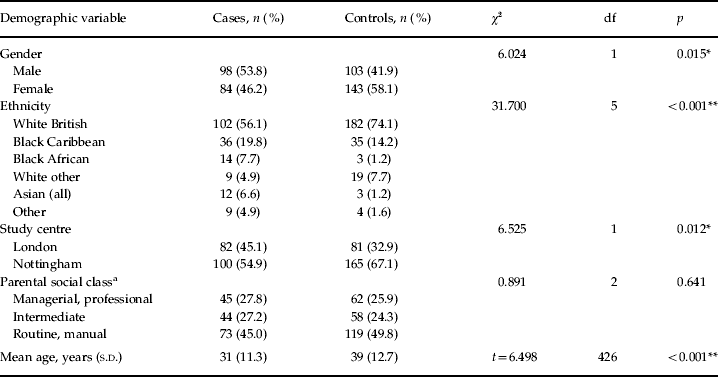
A total of 390 psychosis cases and 391 healthy controls were successfully recruited to the case-control arm of the AESOP study in the Southeast London and Nottingham sites (Morgan et al. Reference Morgan, Dazzan, Morgan, Jones, Harrison, Leff, Murray and Fearon2006). Of these, 182 cases and 246 controls completed the CECA.Q and were included in the analyses. Those who completed the CECA.Q did not differ significantly from those who did not in terms of gender, age, ethnicity, duration of untreated psychosis or length of psychosis at interview (data, not shown, are available from the authors). Moreover, as the CECA.Q appeared near the end of the assessment battery it is likely that the length of the assessment period rather than these specific demographic factors influenced the likelihood of it being completed. The majority of cases (61.0%) who completed the CECA.Q had a non-affective psychotic diagnosis (narrowly defined schizophrenia: 39.0% of full sample; 7.2% brief reactive psychosis; 5.5% schizo-affective; 5.5% delusional disorder; 2.7% unspecified non-organic psychosis; and 1.1% substance-induced psychosis), with the rest split between depressive (20.3%) and manic (18.7%) psychoses. The basic demographic data by case and control status for those included in the analyses are presented in Table 1.
Basic demographic characteristics of psychosis cases (n=182) and controls (n=246)

df, Degrees of freedom; s.d., standard deviation; t, t test statistic.
a Missing values: cases=20 (11.0%); controls=7 (2.8%).
* p<0.05, ** p<0.01.
Compared with controls, and in line with what would be expected, cases were younger, more often men, and more often of non-White ethnicity. There were also more controls from Nottingham than London. Hence, all these variables were controlled for in the adjusted analyses. There was no significant difference between cases and controls in terms of parental social class but this was also included as a confounder, as it has previously been correlated with childhood adversity and psychosis (Croudace et al. Reference Croudace, Kayne, Jones and Harrison2000; Sidebotham et al. Reference Sidebotham and Heron2006).
Characteristics of childhood adversity
Type of exposure and perpetrator
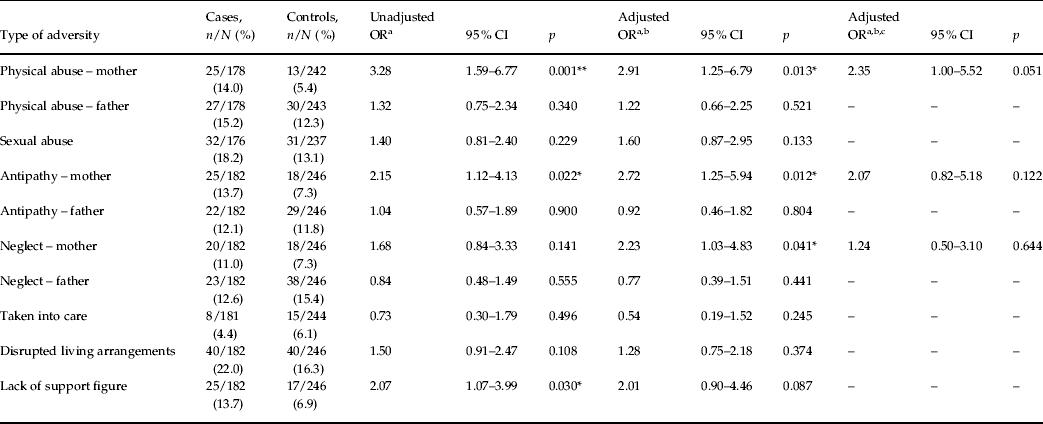
The prevalence of each type of childhood adversity for psychosis cases and healthy controls is provided in Table 2. Psychosis cases were approximately three times more likely than healthy controls to report severe physical abuse from their mother during childhood and this association held after adjustment for potential confounders. Reported maternal antipathy and neglect were each around twice as common amongst psychosis patients as controls. Furthermore, not having a supportive adult or peer was twice as prevalent in the psychosis group but this failed to reach conventional levels of statistical significance after adjustment. Sexual abuse was marginally more common in cases than controls but again was not statistically significant. Restricting this to incidents involving intercourse also failed to demonstrate a significant association with psychotic disorder [odds ratio (OR)=1.68, 95% confidence interval (CI) 0.75–3.79, p=0.209]. Moreover, no associations were found between case status and having more than three family living arrangements, being taken into local authority care or reports of physical abuse, antipathy or neglect from the main father figure (Table 2).
Association between type of adversity and psychotic disorder

OR, Odds ratio; CI, confidence interval.
a OR calculated using weighted data.
b OR adjusted for gender, age, ethnicity, study centre and highest parental social class.
c OR adjusted for other significant adversities.
* p<0.05, ** p<0.01.
Further adjusting for the other significant types of adversity reduced the ORs for all three maternally perpetrated adversities, suggesting overlap between experiences. The association between maternal physical abuse and psychotic disorder was slightly attenuated and just failed to reach significance (p=0.051) whilst a non-significant trend remained for maternal antipathy. No association remained for maternal neglect, probably due to a significant overlap with maternal antipathy (63.2%, χ2=130.17, p<0.001) and maternal physical abuse (31.6%, χ2=25.78, p<0.001).
Frequency of exposure
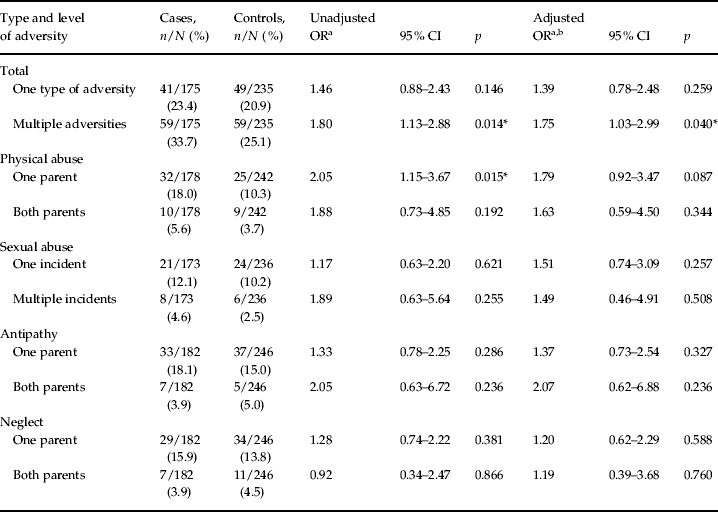
The proportions of psychosis cases and controls reporting one or more experiences from any of the above list (total) along with specific adversities from one or two perpetrators are presented in Table 3. The association with psychotic disorder was similar for participants who reported single and multiple adverse childhood experiences. Visual inspection of the ORs indicated that these were not significantly different, as the CIs overlapped and included the point estimates (Table 3). For the individual abuse variables, similar odds were found for frequency of exposure to physical abuse and neglect. However, there appeared to be an increasing association with psychosis from one to two severe sexual abuse experiences. A score test for trend did not provide evidence, though, for a linear trend (χ2=1.74, p=0.187). Similarly, reported severe antipathy from both parents appeared to be more strongly associated with psychosis than antipathy from just one parent, but no evidence was found for a trend (χ 2=2.07, p=0.150).
Association between frequency of exposure to adversity and psychotic disorder

OR, Odds ratio; CI, confidence interval.
a OR calculated using weighted data.
b OR adjusted for gender, age, ethnicity, study centre and highest parental social class.
* p<0.05.
Age of exposure
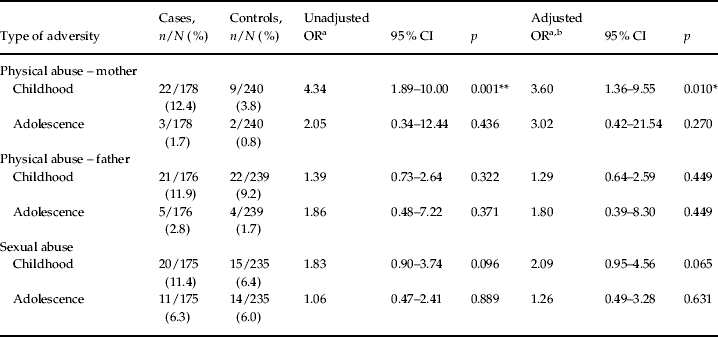
Table 4 displays the proportion of cases and healthy controls initially exposed during childhood (0–11 years) or adolescence (12–16 years) to physical or sexual abuse. The size of the unadjusted OR for maternal physical abuse reported as starting during childhood was approximately twice that for adolescent-onset abuse. In other words, the effect of maternal physical abuse appeared stronger when it commenced during childhood than during adolescence. However, the overlapping CIs for these ORs, which also included each point estimate, indicated that this was not a significant difference (Table 4). The OR for sexual abuse before the age of 12 years was also marginally larger than that for adolescent-onset experiences but again not to a significant degree. No significant association was found between paternal physical abuse and psychosis regardless of timing.
Association between timing of adversity and psychotic disorder

OR, Odds ratio; CI, confidence interval.
a OR calculated using weighted data.
b OR adjusted for gender, age, ethnicity, study centre and highest parental social class.
* p<0.05, ** p<0.01.
Following adjustment for all confounders, severe physical abuse from the main mother figure that commenced in childhood was the only adversity that remained statistically precise with regards to association with psychotic disorder. A trend was also evident for around a two-fold greater prevalence of reported childhood sexual abuse amongst psychosis cases compared with controls but this failed to reach statistical significance and was further attenuated after adjustment for maternal physical abuse and antipathy (OR=1.60, 95% CI 0.70–3.62, p=0.263). However, the association between maternal physical abuse that started before the age of 12 years and psychotic disorder remained after controlling for all confounders, childhood sexual abuse, maternal antipathy and neglect (OR=3.01, 95% CI 1.02–8.89, p=0.046).
Discussion
Initially, several adverse experiences related to the main mother figure were found to be significantly associated with psychotic disorder following adjustment for demographic confounders. However, further analysis revealed that reports of severe physical abuse from the mother that started prior to 12 years of age had the most robust association with psychotic disorder. Severe antipathy from mother demonstrated a non-significant trend for approximately a two-fold association with psychosis, independent of maternal physical abuse. In absolute terms, though, the vast majority of psychosis cases (86%) and controls (93%) in this study did not report maternal physical or emotional abuse. No associations with psychotic disorder were evident for maltreatment by the main father figure during childhood, nor for the other forms of adversity. There was also no clear evidence of a dose–response effect in this sample in terms of total number of adversities experienced or exposure to individual types of childhood adversity by different perpetrators.
Comparisons with previous research
Prevalence rates
Previous studies of individuals diagnosed with psychotic disorders have reported huge variations in prevalence rates of adversity, probably reflecting vast differences in the way abuse is defined, length of illness, size and selection of the sample, demographic and diagnostic composition, etc (Morgan & Fisher, Reference Morgan and Fisher2007; Bendall et al. Reference Bendall, Jackson, Hulbert and McGorry2008; Fisher & Craig, Reference Fisher, Craig, Morgan, McKenzie and Fearon2008). If comparisons are restricted to the largest previous study of first-episode psychosis patients (Neria et al. Reference Neria, Bromet, Sievers, Lavelle and Fochtmann2002), then the rates reported in the current study are slightly lower for physical abuse (21.6% v. 14.0–15.2%) but fairly similar for sexual abuse (15.0% v. 18.2%). The discrepancy for physical abuse rates could potentially be due to the broader definition used in the Neria et al. (Reference Neria, Bromet, Sievers, Lavelle and Fochtmann2002) study that may have resulted in the inclusion of less severe abuse than the present study, thus potentially rendering the current estimate more conservative.
It is reassuring to note, though, that the prevalence of physical and sexual abuse reported by healthy controls in this study (5.4–12.3% and 13.1%, respectively) is similar to that found in a recent UK general population survey (7–14% physical, 11% sexual; May-Chahal & Cawson, Reference May-Chahal and Cawson2005) despite the comparatively lower parental social class of our participants. Our rates are also within the range of international abuse estimates (WHO, 2002: 5–20% sexual abuse; Gilbert et al. Reference Gilbert, Widom, Browne, Fergusson, Webb and Janson2009: 4–16% physical abuse). Therefore, the associations found in the current study do not simply seem to be the result of under-reporting amongst controls and indeed our control sample appears reasonably representative of the general population in terms of abuse prevalence.
Specific types of adversity associated with psychotic disorder
Childhood-onset severe maternal physical abuse was the most robust risk indicator of psychosis in this sample. This is in contrast to previous research which has shown associations primarily between childhood sexual abuse and adult psychosis (Heins et al. Reference Heins, Gray and Tennant1990; Briere et al. Reference Briere, Woo, McRae, Foltz and Sitzman1997; Hammersley et al. Reference Hammersley, Dias, Todd, Bowen-Jones, Reilly and Bentall2003). Nevertheless, physical abuse has been found to have stronger associations than sexual abuse with other mental health problems, when the two forms of abuse have been clearly distinguished from each other (Mulder et al. Reference Mulder, Beautrais, Joyce and Fergusson1998; Coid et al. Reference Coid, Petruckevitch, Chung, Richardson, Moorey and Feder2003). Furthermore, Rubino et al. (Reference Rubino, Nanni, Pozzi and Siracusano2009) reported an almost six-fold greater prevalence of physical abuse amongst schizophrenia patients than controls but only a non-significant trend for sexual abuse. Hence, it is possible that previous associations between sexual abuse and psychosis may have been inflated by overlap with physical abuse. Moreover, Shevlin et al. (Reference Shevlin, Dorahy and Adamson2007a) reported that physical abuse produced the most robust association with psychosis, as was the case in our clinical sample, with a similar three-fold elevation in risk.
Maternal antipathy was also found to have a reasonably independent association with psychotic disorder. This is consistent with previous studies in which reports of emotional abuse were significantly more prevalent amongst individuals diagnosed with psychosis than general population (Rubino et al. Reference Rubino, Nanni, Pozzi and Siracusano2009) or medical (Schofield & Balian, Reference Schofield and Balian1959) controls. Higher rates of psychotic symptoms have also been found in those exposed to emotional forms of abuse (Sommer et al. Reference Sommer, Daalman, Rietkerk, Diederen, Bakker, Wijkstra and Boks2008; Colins et al. Reference Colins, Vermeiren, Vreugdenhil, Schuyten, Broekaert and Krabbendam2009). This ‘active’ type of maltreatment in combination with maternal physical abuse has been demonstrated to be of central aetiological significance in depression (Brown et al. Reference Brown, Craig, Harris, Handley and Harvey2007). Therefore, contrary to Harris' (Reference Harris and Cooper1987) original proposition about the importance of such intrusive experiences for psychosis rather than depression it may actually be the case that the same types of adversity are key for both disorders. Further exploration of this potential overlap is required, though initial findings indicate that the effect may simply be greater in psychosis (Rubino et al. Reference Rubino, Nanni, Pozzi and Siracusano2009).
Relationship to perpetrator
Early severe abuse from mothers rather than fathers demonstrated the greatest association with psychotic disorder in this sample. This is reasonably consistent with a recent study in depression (Brown et al. Reference Brown, Craig, Harris, Handley and Harvey2007) but is contrary to Parker et al. (Reference Parker, Fairley, Greenwood, Jurd and Silove1982) who found stronger associations between schizophrenia and fathers' parenting style. However, as to our knowledge no research has investigated differential parental effects of severe abuse in psychosis, these comparisons are limited. Nevertheless, the importance of the mother in the psychological development of the child has long been advocated, as she is usually the main attachment figure in infancy (Bowlby, Reference Bowlby1951, Reference Bowlby1977). Although fathers often develop significant bonds with their children (Cohen & Campos, Reference Cohen and Campos1974; Steele et al. Reference Steele, Steele and Fonagy1996), their greater absence during childhood amongst individuals who later develop psychosis (Agid et al. Reference Agid, Shapira, Zislin, Ritsner, Hanin, Murad, Troudart, Bloch, Heresco-Levy and Lerer1999; Morgan et al. Reference Morgan, Kirkbride, Leff, Craig, Hutchinson, McKenzie, Morgan, Dazzan, Doody, Jones, Murray and Fearon2007) may mean that they have less opportunity to directly inflict abuse upon their offspring. Nonetheless, in the current study maternal abuse is still only present in a minority of participants with clinical disorder, indicating that several other risk factors must be involved. Careful replication of these findings is required along with prospective longitudinal and adoption studies to investigate causality.
Dose–response effect
This study did not provide evidence of a dose–response effect for multiple versus single adversity experiences in childhood on development of psychosis nor were there significant effects for number of perpetrators. This is in contrast to previous studies that have demonstrated a cumulative effect of trauma on risk for psychosis in the general population (Janssen et al. Reference Janssen, Krabbendam, Bak, Hanssen, Vollebergh, de Graaf and van Os2004; Whitfield et al. Reference Whitfield, Dube, Felitti and Anda2005; Spauwen et al. Reference Spauwen, Krabbendam, Lieb, Wittchen and van Os2006; Shevlin et al. Reference Shevlin, Dorahy and Adamson2007a, Reference Shevlin, Dorahy and Adamsonb, Reference Shevlin, Houston, Dorahy and Adamson2008) and one study in patients with schizophrenia (Rubino et al. Reference Rubino, Nanni, Pozzi and Siracusano2009). However, as formal tests of trend have rarely been conducted it is difficult to draw definitive conclusions from the existing research. Moreover, the current findings are consistent with Schilling et al. (Reference Schilling, Aseltine and Gore2008) who concluded that the severity of childhood trauma experienced was more important in terms of later mental health outcomes than a simple cumulative adversity score. Similarly, Clausen & Crittenden (Reference Clausen and Crittenden1991) argued that single instances of certain types of abuse (e.g. physical or sexual) may be traumatic enough to produce detrimental effects whilst other adverse experiences may require repeated exposure to cause harm to the child.
Timing of exposure
The results of the current study tentatively indicated that the timing of some adverse events may be important in terms of later development of psychosis. Childhood-onset adversity has previously been linked with more severe and persistent mental health difficulties (e.g. Keiley et al. Reference Keiley, Howe, Dodge, Bates and Petti2001; Blaauw et al. Reference Blaauw, Arensman, Kraaij, Winkel and Bout2002), even when affected individuals are subsequently exposed to more beneficial environments (van der Vegt et al. Reference van der Vegt, van der Ende, Ferdinand, Verhulst and Tiemeier2009). The evidence is sparse though and therefore further research is essential. It is also plausible that stronger effects in childhood are just a proxy for more prolonged abuse or higher risk of exposure to other adverse experiences. Indeed, Thornberry et al. (Reference Thornberry, Ireland and Smith2001) determined that only childhood-onset abuse that persists through adolescence had a significant impact on later outcomes. Unfortunately, in the current study no information was available about the length of maltreatment exposure and therefore we were not able to investigate this possibility.
Methodological considerations
One potential limitation is the reliance on retrospective reporting of abuse, which may be particularly problematic in psychosis patients (Howard, Reference Howard1993; Young et al. Reference Young, Read, Barker-Collo and Harrison2001). The childhood adversity data obtained on this psychosis sample, though, has been demonstrated to have reasonable levels of test–retest reliability, convergent and concurrent validity, and no measurable impact of current symptoms was found (Fisher et al. Reference Fisher, Craig, Fearon, Morgan, Dazzan, Lappin, Hutchinson, Doody, Jones, McGuffin, Murray, Leff and Morgan2009b). Nevertheless, the possibility of false positives or negatives cannot be entirely ruled out. Moreover, retrospective dating of the timing of abuse is thought to be fairly unreliable (Hardt & Rutter, Reference Hardt and Rutter2004). Although the use of broad age periods (childhood v. adolescence) should minimize the impact of such memory biases, it seems prudent to only draw tentative conclusions about the relative importance of adversities occurring prior to age 12 years in the later development of psychosis.
Despite reasonable sample sizes for psychosis patients and healthy controls for a clinical study in this field, a large number of analyses were performed on this data, giving rise to the possibility of spurious statistical associations. Moreover, there was insufficient power to detect all potential associations with adversity, especially after adjusting for all confounders. Consequently, the results presented here should be interpreted with caution and require replication in an even larger epidemiological sample.
Furthermore, there was insufficient power to investigate associations with specific diagnoses, individual symptoms, or potential mediators or moderators of the association between childhood abuse and psychosis. For instance, substance misuse (Whitfield et al. Reference Whitfield, Dube, Felitti and Anda2005; Houston et al. Reference Houston, Murphy, Adamson, Stringer and Shevlin2008), adult victimization (Briere et al. Reference Briere, Woo, McRae, Foltz and Sitzman1997) and co-morbid psychiatric disorders, such as anxiety, depression or post-traumatic stress disorder (Kilcommons & Morrison, Reference Kilcommons and Morrison2005; Garety et al. Reference Garety, Bebbington, Fowler, Freeman and Kuipers2007; Shevlin et al. Reference Shevlin, Dorahy and Adamson2007a), could have confounded the results of the current study and should be taken into account in future research in this area. It is also possible that an undetected gene–environment correlation (Plomin et al. Reference Plomin, DeFries and Loehlin1977) may underlie the results, though recent research suggests that controlling for parental mental illness does not attenuate associations between childhood adversity and psychosis (Kelleher et al. Reference Kelleher, Harley, Lynch, Arseneault, Fitzpatrick and Cannon2008; Fisher et al. Reference Fisher, Morgan, Dazzan, Craig, Morgan, Hutchinson, Jones, Doody, Pariante, McGuffin, Murray, Leff and Fearon2009a).
Additionally, utilization of the CECA.Q in this study meant that other potentially predictive forms of childhood adversity were not measured, such as bullying, psychological abuse, domestic violence and family discord (see Bebbington et al. Reference Bebbington, Bhugra, Brugha, Singleton, Farrell, Jenkins, Lewis and Meltzer2004; Lataster et al. Reference Lataster, van Os, Drukker, Henquet, Feron, Gunther and Myin-Germeys2006; Campbell & Morrison, Reference Campbell and Morrison2007; Rosenberg et al. Reference Rosenberg, Lu, Mueser, Jankowski and Cournos2007; Kelleher et al. Reference Kelleher, Harley, Lynch, Arseneault, Fitzpatrick and Cannon2008). Moreover, the reliance on self-reported adversity using a questionnaire format rather than an in-depth interview may have resulted in under-reporting of adversity. Therefore, future research needs to include comprehensive assessments of an even wider range of adverse childhood experiences to fully explore the associations with clinically diagnosed psychosis.
Summary
In conclusion, reports of severe childhood physical abuse from the main mother figure were found to have the most robust association with psychotic disorders, particularly when the abuse began prior to 12 years of age. Paternal maltreatment was not shown to have any clear aetiological significance for psychotic disorders in adulthood. Therefore, specific characteristics of childhood adversity appear to be important in relation to clinical psychosis. If replicated, these findings have potentially important implications for future research into the aetiological mechanisms operating between childhood adversity and later psychosis. Moreover, the elevated frequency of childhood abuse amongst psychosis patients in this sample supports recent guidance for mental health services in the UK that requires clinicians to routinely assess all patients for early abusive experiences and provide suitable interventions (NHS Confederation, 2008).
Acknowledgements
We thank all staff members and students past and present who were involved in the AESOP study. We are also indebted to all individuals who participated in the study and were essential for its successful completion. This work was supported by the UK Medical Research Council (MRC) and the Stanley Medical Research Institute. H.L.F. is jointly funded by the MRC and the Economic and Social Research Council.
Declaration of Interest
None.