1. Introduction
The conundrum of whether Patagonia was an allochthonous, autochthonous or even para-autochthonous terrane has been responsible for a considerable increase in geological knowledge about the North Patagonian Massif (NPM); however, interpretations of its tectonic evolution and origin still vary widely (e.g. Ramos & Naipauer, Reference Ramos and Naipauer2014; Castillo et al. Reference Castillo, Fanning, Pankhurst, Hervé and Rapela2017; Vizán et al. Reference Vizán, Prezzi, Geuna, Japas, Renda, Franzese and Van Zele2017; Luppo et al. Reference Luppo, Martínez Dopico, Rapalini, López de Luchi, Miguez and Fanning2019; López de Luchi et al. Reference López de Luchi, Martínez Dopico and Rapalini2020; Marcos et al. Reference Marcos, Pavon Pivetta, Benedini, Gregori, Geraldes, Scivetti, Barros, Varela and Dos Santos2020; Ramos et al. Reference Ramos, Lovecchio, Naipauer and Pángaro2020). Over the past three decades, the hypothesis that northern Patagonia could have been an exotic terrane during most of the Palaeozoic, which would have been accreted to the SW margin of Gondwana in the early Permian, has been strongly debated (e.g. Ramos, Reference Ramos1984, Reference Ramos2008; Pankhurst et al. Reference Pankhurst, Rapela, Fanning and Márquez2006, Reference Pankhurst, Rapela, De Luchi, Rapalini, Fanning and Galindo2014; Gregori et al. Reference Gregori, Kostadinoff, Strazzere and Raniolo2008; Rapalini et al. Reference Rapalini, López de Luchi, Martínez Dopico, Lince Klinger, Giménez and Martínez2010; Ramos & Naipauer, Reference Ramos and Naipauer2014, Castillo et al. Reference Castillo, Fanning, Pankhurst, Hervé and Rapela2017; Martínez Dopico et al. Reference Martínez Dopico, Antonio, Rapalini, López de Luchi and Grillo Vidal2020; Ramos et al. Reference Ramos, Lovecchio, Naipauer and Pángaro2020).
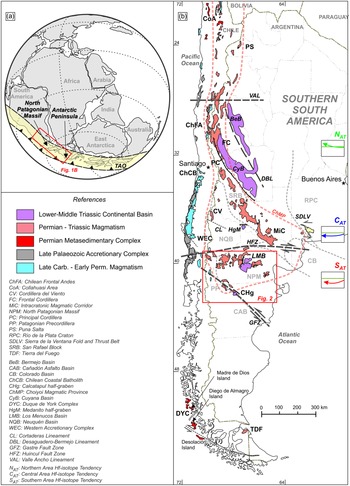
Evidence presented in favour of the accretion of northern Patagonia onto the SW margin of Gondwana includes: (i) NE vergence of the within-plate late Palaeozoic Sierra de la Ventana fold-and-thrust belt (Fig. 1a), (ii) the Permian magmatism of the NPM, (iii) the SW-verging thrust system of the eastern NPM, and (iv) Neopalaeozoic metamorphism (e.g. Ramos, Reference Ramos2008; Rapalini et al. Reference Rapalini, López de Luchi, Martínez Dopico, Lince Klinger, Giménez and Martínez2010; Ramos et al. Reference Ramos, Lovecchio, Naipauer and Pángaro2020). Moreover, the occurrence of Cambrian archaeocyathids in the eastern part of the NPM (González et al. Reference González, Sato, Naipauer, Varela, Basei and Sato2018) was proposed as evidence that northern Patagonia could have been a conjugate margin to the Transantarctic Mountains of Southern Victoria Land in the region of the Pensacola Mountains (Ramos & Naipauer, Reference Ramos and Naipauer2014). As discussed by Ramos et al. (Reference Ramos, Lovecchio, Naipauer and Pángaro2020, and references therein), this accretion could have occurred along the Huincul Fault Zone (at c. 39° S; Fig. 1).
(a) Palaeogeographic map of the Gondwana Supercontinent during the Early Mesozoic showing the location of the Terra Australis Orogen (TAO; Cawood, Reference Cawood2005). (b) Geographical map of southern South America showing main areas with late Carboniferous–Triassic outcrops, including the Los Menucos Basin.

Martínez Dopico et al. (Reference Martínez Dopico, López de Luchi, Rapalini, Wemmer, Fanning and Basei2017) suggested that the accretion would have occurred after c. 260 Ma; this proposition shifted the focus onto the upper Permian to Middle Triassic magmatism (c. 260–244 Ma). In the eastern NPM, a NW–SE-trending dike swarm of Middle Triassic age was interpreted as evidence of extensional relaxation of the Permian Gondwanide orogen (González et al. Reference González, Greco, González, Sato, Llambías, Varela and Basei2014, Reference González, Greco, González, Sato, Llambías and Varela2016). The upper Permian to Middle Triassic magmatism of the central–eastern NPM has been related to westward-directed subduction that ultimately resulted in the collision of northern Patagonia with South America and the Antarctic Peninsula, as well as South Africa (Castillo et al. Reference Castillo, Fanning, Pankhurst, Hervé and Rapela2017). This event was considered responsible for the deformation of the Gondwanide fold belt of the Sierra de la Ventana fold-and-thrust belt, extending into the Cape Fold Belt of South Africa, and the NPM. Finally, palaeomagnetic data have indicated a 30° anticlockwise rotation of the NPM, potentially linked to the final stages of a collision of the allochthonous or para-autochthonous Patagonia terrane with Gondwana (Luppo et al. Reference Luppo, Martínez Dopico, Rapalini, López de Luchi, Miguez and Fanning2019; Martínez Dopico et al. Reference Martínez Dopico, Antonio, Rapalini, López de Luchi and Grillo Vidal2020).
In contrast, the apparent absence of a suture between Patagonia and South America and the continuity of the pre-Permian basement on both sides of the interpreted crustal discontinuity have been challenges for the hypothesis of an allochthonous origin of Patagonia (e.g. Gregori et al. Reference Gregori, Kostadinoff, Strazzere and Raniolo2008; Martínez Dopico et al. Reference Martínez Dopico, López de Luchi, Rapalini and Kleinhanns2011; Rapalini et al. Reference Rapalini, López de Luchi, Tohver and Cawood2013; Pankhurst et al. Reference Pankhurst, Rapela, De Luchi, Rapalini, Fanning and Galindo2014; Rapela & Pankhurst, Reference Rapela and Pankhurst2020). Gregori et al. (Reference Gregori, Kostadinoff, Strazzere and Raniolo2008) suggested an ‘escape’ tectonic model for anticlockwise-rotated blocks limited by mylonitic belts in the eastern NPM. They advocated that a crustal block in the NPM acted as a NW-directed indenter associated with westward-directed movement; this indenter would have displaced several small blocks, triggering deformation of the Sierra de la Ventana fold-and-thrust belt and of the NPM. Other scenarios, not initially favoured, considered that relatively shallower subduction during the late Palaeozoic could explain the within-plate Gondwanide deformation in the Sierra de la Ventana and Cape fold belts (Fig. 1; Lock, Reference Lock1980; Dalziel et al. Reference Dalziel, Lawver and Murphy2000). Marcos et al. (Reference Marcos, Pavon Pivetta, Benedini, Gregori, Geraldes, Scivetti, Barros, Varela and Dos Santos2020) proposed the existence of shallow eastward-directed subduction along the NPM during the transition from the Carboniferous to the early Permian, based on prograde to retrograde metamorphism of basement rocks in the western NPM. López de Luchi et al. (Reference López de Luchi, Martínez Dopico and Rapalini2020) pointed out that a possible cause for the middle to late Permian deformation in the NPM might have been eastward-directed flat-slab subduction.
Finally, the idea of a para-autochthonous origin has persisted, as it can reconcile at least part of the evidence. Rapalini et al. (Reference Rapalini, López de Luchi, Martínez Dopico, Lince Klinger, Giménez and Martínez2010) proposed that Patagonia rifted from Gondwana during the Early Palaeozoic but later collided back, closing the Colorado Ocean during Permian–Triassic transition (see also Luppo et al. Reference Luppo, Martínez Dopico, Rapalini, López de Luchi, Miguez and Fanning2019; Martínez Dopico et al. Reference Martínez Dopico, Antonio, Rapalini, López de Luchi and Grillo Vidal2020). However, none of these hypotheses has been able to satisfactorily explain the geological configuration involving complex deformation styles, remagnetization, block rotations, and changes in the geochemical signatures of Permian to Middle Triassic rocks.
A key to understanding whether Patagonia was or was not an exotic terrane during the Late Palaeozoic is to evaluate the widespread Permian to Triassic magmatism around the supposed suture zone (∼39° S). Part of this magmatism is included in the so-called Choiyoi Magmatic Province (e.g. Bastias-Mercado et al. Reference Bastias-Mercado, González and Oliveros2020, for a recent synthesis) that has been recognized from northern Chile to the Antarctic Peninsula (see Section 2.a). In this sense, in the central part of the NPM, the volcano-sedimentary Los Menucos Basin (LMB) constitutes a unique volcano-sedimentary record. This basin has been correlated to the north with the Triassic basins of western Argentina (Fig. 1), such as the Cuyana and Ischigualasto basins, which postdate the Choiyoi Magmatic Province (Falco et al. Reference Falco, Bodnar and Del Río2020).
The present work is aimed at constraining the age of the volcanic sequence of the LMB and involves analysis of magmatic sources, using new U–Pb zircon geochronology on five ignimbrite samples from the Los Menucos Basin, together with Hf isotope data. These results are then integrated with the U–Pb–Hf data available for the SW margin of Gondwana to evaluate the crustal evolution of the NPM and adjacent regions through Permian and Middle Triassic times. The integrated data and derived tectonic model allow us to explain the Permian – Middle Triassic evolution of the NPM related to different tectonic phases, which contributes to the discussion of the Patagonia conundrum.
2. Geological background
2.a. The Choiyoi Magmatic Province on the SW margin of Gondwana
During Permian–Triassic times, voluminous intermediate to felsic magmatism occurred at the SW margin of Gondwana in the form of plutonic and volcanic belts (Fig. 1). Over 2000 km, in southern South America, from northern Chile to the NPM (21–41° S), this magmatism constitutes the Choiyoi Magmatic Province (ChMP in Fig. 1) (Llambías, Reference Llambías and Caminos1999). It covers an area of ∼910 000 km2 and was developed over a c. 35–40 Ma interval from 288 to 247 Ma (Sato et al. Reference Sato, Llambías, Basei and Castro2015), or to 252 Ma (Rocher et al. Reference Rocher, Vallecillo, Castro de Machuca and Alasino2015). This magmatic sequence has been interpreted as a Silicic Large Igneous Province (Bastias-Mercado et al. Reference Bastias-Mercado, González and Oliveros2020), and it was suggested that this magmatic phase could have contributed to the Permian–Triassic mass extinction (e.g. Spalletti & Limarino, Reference Spalletti and Limarino2017). Coeval magmatism is also known from Tierra del Fuego Island and Antarctica (Fig. 1; Castillo et al. Reference Castillo, Fanning, Hervé and Lacassie2016, Reference Castillo, Fanning, Pankhurst, Hervé and Rapela2017; Nelson & Cottle, Reference Nelson and Cottle2019).
The main exposures of the ChMP are in the Frontal Cordillera, Precordillera and the San Rafael Block, where the sequence is constrained between the Permian San Rafael compressional phase and the Lower Triassic Huárpica extensional phase, which starts the development of several continental sedimentary basins (Azcuy & Caminos, Reference Azcuy, Caminos and Archangelsky1987; Sato et al. Reference Sato, Llambías, Basei and Castro2015). The ChMP was divided into two sequences (Llambías, Reference Llambías and Caminos1999) known as the Lower and Upper Choiyoi. The Lower Choiyoi comprises rocks of the calc-alkaline magmatic series, which have been related to a N–S-trending continental subduction setting (Llambías, Reference Llambías and Caminos1999; Strazzere et al. Reference Strazzere, Gregori and Distas2006; Kleiman & Japas, Reference Kleiman and Japas2009; Del Rey et al. Reference Del Rey, Deckart, Arriagada and Martínez2016, Reference Del Rey, Deckart, Planavsky, Arriagada and Martínez2019). The Upper Choiyoi is transitional to the Lower and has been associated with a calc-alkaline subduction-related magmatism in the proto-Andean segment, whereas a calc-alkaline to intraplate tectonic setting was proposed for the contemporaneous magmatism into the continental interior in conjunction with the collapse of the Gondwanide orogen at c. 265 Ma (Llambías, Reference Llambías and Caminos1999; Strazzere et al. Reference Strazzere, Gregori and Distas2006; Kleiman & Japas, Reference Kleiman and Japas2009). The origin of this high volume of silicic magma, estimated at 950 000 km3 (Bastias-Mercado et al. Reference Bastias-Mercado, González and Oliveros2020), has been related to crustal extension, accompanied by anomalously high heat flow into the base of the continental lithosphere, as a result of a tear of, or removal of, the subducted slab (Kleiman & Japas, Reference Kleiman and Japas2009), or steepening of subduction (Ramos & Folguera, Reference Ramos, Folguera, Murphy, Keppie and Hynes2009; Oliveros et al. Reference Oliveros, Vásquez, Creixel, Lucassen, Ducea, Ciocca, González, Espinoza, Salazar, Coloma and Kasemann2020).
2.b. Major E–W structural systems of SW Gondwana
Several regional structures crossing northern Patagonia, transverse to the Andes (Fig. 1), have been identified from geophysical data and field investigations (Chernicoff & Zappettini, Reference Chernicoff and Zappettini2004; Gregori et al. Reference Gregori, Kostadinoff, Strazzere and Raniolo2008). Important regional structures are, from south to north, the Gastre Fault Zone, the Huincul Fault Zone, the Cortaderas Lineament and the Valle Ancho Lineament (GFZ, HFZ, CL and VAL, respectively, in Fig. 1b). Common features along these structures are the exhumation of basement rocks, varied deformation styles, and compositional differences of the Cenozoic to Quaternary volcanism on both sides of the respective structures.
In particular, the Huincul Fault Zone, located at ∼39° S, is an intraplate structure formed by the selective inversion of Late Triassic half-grabens and primary reverse structures associated with variable strike-slip displacements during Early Jurassic to Early Cretaceous times (Mosquera et al. Reference Mosquera, Silvestro, Ramos, Alarcón, Zubiri, Leanza, Arregui, Carbone, Vallés and Danieli2011, and references therein). This fault zone has been regarded as the northern geological boundary of the Patagonia terrane (Ramos et al. Reference Ramos, Riccardi and Rolleri2004).
Whereas the influence of this structural system through time is well understood, its origin is still under discussion (e.g. Gregori et al. Reference Gregori, Kostadinoff, Strazzere and Raniolo2008; Silvestro & Zubiri, Reference Silvestro and Zubiri2008; Ramos & Naipauer, Reference Ramos, Naipauer, Heredia Carballo, Colombo Piñol and García Sansegundo2012, Reference Ramos and Naipauer2014). The origin was initially seen as a consequence of reactivation of the suture zone that developed during accretion of the northern Patagonia terrane in the late Palaeozoic, parallel to an E–W-trending late Palaeozoic magmatic belt (Ramos et al. Reference Ramos, Riccardi and Rolleri2004; Mosquera et al. Reference Mosquera, Silvestro, Ramos, Alarcón, Zubiri, Leanza, Arregui, Carbone, Vallés and Danieli2011; Heredia et al. Reference Heredia, García-Sansegundo, Gallastegui, Farias, Giacosa, Giambiagi, Busquets, Colombo, Charrier, Cuesta, Rubio-Ordóñez and Ramos2018). González et al. (Reference González, Naipauer, Sato, Varela, Basei, Cábana, Vlach, Arce and Parada2020) proposed that the Huincul Fault Zone would have tectonically juxtaposed two metamorphic belts during the Early Palaeozoic by dextral strike-slip motion of an outboard low-P / high-T belt (northern Patagonia terrane), and a parallel inboard medium-P/T belt of Barrovian type (Gondwana margin). Recently, Gianni et al. (Reference Gianni, Navarrete and Spagnoto2019) suggested that the Huincul Fault Zone could have still played a role in segmenting the Late Triassic – Early Jurassic subduction zone.
2.c. The Permian to Middle Triassic stratigraphic framework for the NPM
The NPM is a crustal block of c. 150,000 km2 located between 39° and 44° S. The Neuquén Basin bounds this block to the NW (Upper Triassic – Neogene) and the Colorado Basin delimits it to the NE (Upper Triassic – Neogene) (Fig. 1). To the south and west, the NPM is limited by the Patagonian Precordillera that exposes Upper Triassic to Lower Jurassic rocks, and the Jurassic–Cretaceous Cañadón Asfalto Basin, respectively (Figs 1 and 2). The pre-Permian stratigraphy of the NPM comprises Cambrian plutonic and metasedimentary rocks, as well as Ordovician S- and I-type granitoids, all of which are covered by a Late Silurian to Carboniferous sedimentary succession (Pankhurst et al. Reference Pankhurst, Rapela, Fanning and Márquez2006; Rapalini et al. Reference Rapalini, López de Luchi, Martínez Dopico, Lince Klinger, Giménez and Martínez2010, Reference Rapalini, López de Luchi, Tohver and Cawood2013; Marcos et al. Reference Marcos, Pavon Pivetta, Benedini, Gregori, Geraldes, Scivetti, Barros, Varela and Dos Santos2020). Parts of these sequences have been included in the Colohuincul and Mina Gonzalito complexes, and the Cushamen, Mamil Choique, Nahuel Niyeu and El Jagüelito formations (Fig. 2).
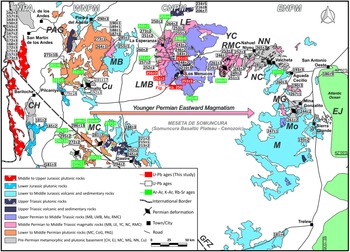
Simplified geological map for Palaeozoic to Jurassic outcrops of northern Patagonia. Compiled U–Pb ages in zircon crystals are indicated in white boxes, the red boxes indicate new U–Pb ages from this study, and the green ones indicate Rb–Sr, K–Ar and 40Ar–39Ar ages. Note that early to middle Permian magmatism was mainly developed in the western NPM (WNPM). In contrast, the middle Permian to Middle Triassic magmatism is restricted to the central (CNPM) and eastern parts of the NPM (ENPM).

Voluminous Permian to Middle Triassic magmatic rocks, which were recently related to the ChMP (Bastías-Mercado et al. Reference Bastias-Mercado, González and Oliveros2020), crop out along a broad E–W belt from the Andes foothills to the Atlantic Coast. In the western NPM, most of the plutons yielded Cisuralian U–Pb in zircon ages and were assigned to the Mamil Choique Formation, Comallo Granite, Piedra del Águila Granite and Mencué Batholith (e.g. Pankhurst et al. Reference Pankhurst, Rapela, Fanning and Márquez2006; López de Luchi & Cerredo, Reference López de Luchi and Cerredo2008; Varela et al. Reference Varela, Sato, González, Sato and Basei2009, Reference Varela, Gregori, González and Basei2015; Gregori et al. Reference Gregori, Strazzere, Barros, Benedini, Marcos and Kostadinoff2020). In the central and eastern NPM, ages of Permian plutons and lavas are mostly constrained between the Guadalupian and Lopingian (Wuchiapingian) and correspond to the La Esperanza, Yaminué, Navarrete and Ramos Mexía complexes (Pankhurst et al. Reference Pankhurst, Rapela, Fanning and Márquez2006, Reference Pankhurst, Rapela, De Luchi, Rapalini, Fanning and Galindo2014; Martínez Dopico et al. Reference Martínez Dopico, López de Luchi, Rapalini, Wemmer, Fanning and Basei2017, Reference Martínez Dopico, López de Luchi, Rapalini, Fanning and Antonio2019; Lopez de Luchi et al. Reference López de Luchi, Martínez Dopico and Rapalini2020). Recently, the Permian magmatism along the entire NPM has been interpreted as the result of arc subduction (e.g. Varela et al. Reference Varela, Gregori, González and Basei2015, Gregori et al. Reference Gregori, Strazzere, Barros, Benedini, Marcos and Kostadinoff2020; López de Luchi et al. Reference López de Luchi, Martínez Dopico and Rapalini2020).
The Changhsingian to Anisian (c. 253–244 Ma) magmatism in the NPM is bounded at the bottom by the Huárpica phase (e.g. Falco et al. Reference Falco, Bodnar and Del Río2020), which involved exhumation, basin development, and changes in the geochemistry and isotope composition of magmatic rocks (e.g. Castillo et al. Reference Castillo, Fanning, Pankhurst, Hervé and Rapela2017; Gregori et al. Reference Gregori, Strazzere, Barros, Benedini, Marcos and Kostadinoff2020). These rocks were also grouped into the Mencué Batholith in the western NPM (Gregori et al. Reference Gregori, Strazzere, Barros, Benedini, Marcos and Kostadinoff2020), the La Esperanza Complex (Martínez Dopico et al. Reference Martínez Dopico, López de Luchi, Rapalini, Fanning and Antonio2019), and the Los Menucos Group (Luppo et al. Reference Luppo, López de Luchi, Rapalini, Martínez Dopico and Fanning2018; Falco et al. Reference Falco, Bodnar and Del Río2020) in the central NPM, and the Monasa Formation (González et al. Reference González, Greco, Sato, Llambías, Basei, González and Díaz2017) and Ramos Mexía Complex in the eastern NPM (Lopez de Luchi et al. Reference López de Luchi, Martínez Dopico and Rapalini2020) (Fig. 2).
The Upper Triassic to Middle Jurassic magmatism and sedimentation intrude and cover the older units. Products of Upper Triassic magmatism and sedimentation occur as a N–S belt in the central NPM; the Jurassic magmatism represents a widespread silicic flare-up event, known as the Chon Aike Province, and has been related to the break-up of Gondwana (see Navarrete et al. Reference Navarrete, Gianni, Encinas, Marquez, Kamerbeek, Valle and Folguera2019).
2.c.1. Permian crustal shortening and metamorphism in the NPM
Through the entire NPM, most country rocks and even some Cisuralian to Guadalupian plutons registered diachronous Guadalupian–Lopingian and Triassic resetting of the 40Ar–39Ar, K–Ar and Rb–Sr isotope systems (Fig. 2, Table 1). This resetting has been related to geodynamic processes associated with subduction along the proto-Pacific margin of Gondwana (e.g. Oriolo et al. Reference Oriolo, Schulz, González, Bechis, Olaizola, Krause, Renda and Vizán2019; Marcos et al. Reference Marcos, Pavon Pivetta, Benedini, Gregori, Geraldes, Scivetti, Barros, Varela and Dos Santos2020).
Summary of the upper Palaeozoic crustal deformation and metamorphism recognized in northern Patagonia

Note: Late Palaeozoic metamorphic stages in the North Patagonian Massif modified after Greco et al. (Reference Greco, González, Sato, González, Basei, Llambías and Varela2017), Oriolo et al. (Reference Oriolo, Schulz, González, Bechis, Olaizola, Krause, Renda and Vizán2019), González et al. (Reference González, Naipauer, Sato, Varela, Basei, Cábana, Vlach, Arce and Parada2020) and Marcos et al. (Reference Marcos, Pavon Pivetta, Benedini, Gregori, Geraldes, Scivetti, Barros, Varela and Dos Santos2020).
In the western NPM, along the Andean foothills, at least three episodes of Palaeozoic crustal shortening have been recognized, which produced folding and thrusting of the country rocks (Marcos et al. Reference Marcos, Pavon Pivetta, Benedini, Gregori, Geraldes, Scivetti, Barros, Varela and Dos Santos2020, for a synthesis). The oldest phase was dated to the Carboniferous–Permian transition (c. 300 Ma), the second was linked to the late Cisuralian (c. 272 Ma), and the third to the late Guadalupian (c. 265 Ma). In particular, the oldest event was related to subduction-related crustal thickening (Oriolo et al. Reference Oriolo, Schulz, González, Bechis, Olaizola, Krause, Renda and Vizán2019; Marcos et al. Reference Marcos, Pavon Pivetta, Benedini, Gregori, Geraldes, Scivetti, Barros, Varela and Dos Santos2020).
To the east, around Valcheta town (Fig. 2), the early Palaeozoic metasediments of the Nahuel Niyeu and El Jagüelito formations and the Mina Gonzalito Complex experienced a later folding and thrusting event at c. 260 Ma (Greco et al. Reference Greco, González, Sato, González, Basei, Llambías and Varela2017; González et al. Reference González, Naipauer, Sato, Varela, Basei, Cábana, Vlach, Arce and Parada2020). Chernicoff et al. (Reference Chernicoff, Zappettini, Santos, McNaughton and Belousova2013) dated a c. 261 Ma lower amphibolite facies metamorphic stage in the Yaminué Complex. In agreement with Marcos et al. (Reference Marcos, Pavon Pivetta, Benedini, Gregori, Geraldes, Scivetti, Barros, Varela and Dos Santos2020), Lopez de Luchi et al. (Reference López de Luchi, Martínez Dopico and Rapalini2020) suggested that crustal shortening in the NPM is best explained by flat-slab subduction associated with major plate reorganization.
2.c.2. Stratigraphy of the Los Menucos Basin (LMB)
The LMB is part of the E–W Permian–Triassic magmatic belt recognized in the NPM (Figs 1 and 2). This basin unconformably covers the La Esperanza Complex, and its development has been associated with the occurrence of the Huárpica Extensional Phase (Falco et al. Reference Falco, Bodnar and Del Río2020) (Fig. 3a). The LMB is formed by dacitic to rhyolitic ignimbrites up to 70 m thick, associated dacitic lavas, and interbedded sedimentary deposits (Labudia & Bjerg Reference Labudia and Bjerg2001; Lema et al. Reference Lema, Busteros, Giacosa and Cucchi2008; Luppo et al. Reference Luppo, López de Luchi, Rapalini, Martínez Dopico and Fanning2018; Falco et al. Reference Falco, Bodnar and Del Río2020). Recently, U–Pb zircon ages between 257 and 248 Ma (Luppo et al. Reference Luppo, López de Luchi, Rapalini, Martínez Dopico and Fanning2018) showed that the LMB has a Lopingian to Early Triassic age. Dicroidium-type fossil flora imprints and tetrapod ichnites were described from different localities in the basin, leading to the assignation of a Changhsingian(?) to Olenekian (Lower Triassic) age (Bodnar et al. Reference Bodnar, Coturel, Falco and Beltran2021; Citton et al. Reference Citton, De Valais, Díaz-Martínez, González, Grecco, Cónsole-Gonella and Leonardi2021).
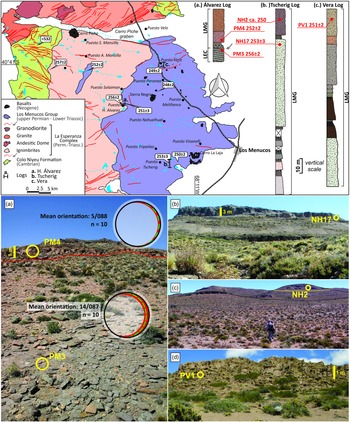
Simplified geological map of the study area, complemented with logs for the three main localities in the Los Menucos Basin. Sample positions, and field images for the analysed rocks are also shown. LMG: Los Menucos Group; LEC: La Esperanza Complex. (a) Outcrops of sample PM3 of the La Esperanza Complex and PM4 of the Sierra Colorada Fm. from the H. Álvarez log. The red line indicates the basal angular unconformity of the Los Menucos Basin. (b) Location of sample NH17 in the Tscherig log, representing the Barrancas Grandes Member of the Puesto Tscherig Formation. (c) Outcrop sampled for sample NH2, in Sierra Colorada Formation of the Tscherig log. (d) Photo of the sampled ignimbrite of the Vera log (upper part of the Sierra Colorada Formation).

The stratigraphic scheme for the basin is under discussion. The sequence was proposed as either the Los Menucos Group (Falco et al. Reference Falco, Bodnar and Del Río2020) or the Los Menucos Complex (Lema et al. Reference Lema, Busteros, Giacosa and Cucchi2008). The Los Menucos Group (Table 2) was recently divided into three formations based on detailed log correlation, namely the Puesto Tscherig, Puesto Vera and Sierra Colorada formations (Falco et al. Reference Falco, Bodnar and Del Río2020). The Puesto Tscherig Formation is up to 70 m thick at its homonymous type locality. The lower part, the Cerro La Laja Member, is dominated by sandstone, mudstone, conglomerate and breccias resulting from the reworking of unconsolidated pyroclastic deposits. Debris flows dominate the proximal zones, and distal zones are characterized by settling in ephemeral swamps (Falco et al. Reference Falco, Bodnar and Del Río2020). The upper part of the Puesto Tscherig Formation, the Barrancas Grandes Member, is composed of a poorly welded dacitic ignimbrite. The Puesto Vera Formation is up to 20 m thick and has been divided into the Aguada de la Mula and El Pilquin members. The lower Aguada de la Mula Member is dominated by gravelly sandstone, medium to fine sandstone, and mudstone, deposited in fluvial channels and on floodplains (Labudía & Bjerg, Reference Labudia and Bjerg2001). The upper El Pilquin Member is exclusively composed of ash fall deposits, which contain Dicroidium-type flora and ichnites (Bodnar et al. 2021; Citton et al. Reference Citton, De Valais, Díaz-Martínez, González, Grecco, Cónsole-Gonella and Leonardi2021). The upper Sierra Colorada Formation is composed of three ignimbritic pulses, the first one only recognized at Puesto Vera, and the upper two well developed throughout the basin.
Stratigraphic scheme for the Los Menucos Group after Falco et al. (Reference Falco, Bodnar and Del Río2020). A brief description of each stratigraphic unit is given, and the samples presented in this paper are referenced to each unit. U–Pb and Lu–Hf isotope results of this study are summarized

Note: The U–Pb data analyses for each sample are provided in the online Supplementary Material at https://doi.org/10.1017/S0016756822000450.
3. Material and methods
3.a. Logs and sampling
In this work, we follow the basin stratigraphy proposed by Falco et al. (Reference Falco, Bodnar and Del Río2020; see Table 2; Fig. 3). For this study, five ignimbrite samples were collected from different stratigraphic units and type localities of the basin. A sample from the Permian La Esperanza Complex (PM3) and a sample from the Sierra Colorada Formation (PM4) were collected in the Puesto H. Álvarez log. Samples from the Barrancas Grandes Member – Puesto Tscherig Formation (NH17) and Sierra Colorada Formation (NH2) correspond to ignimbritic layers of the Puesto Tscherig log. Finally, a sample from the Sierra Colorada Formation (PV1) was collected at the top of the Puesto Vera log. A detailed description of each log and a petrographic characterization of the sampled rocks, together with field and microscopic photos, is presented in the online Supplementary Material at https://doi.org/10.1017/S0016756822000450.
3.b. U–Pb and Lu–Hf isotopic analysis in zircon
Zircon grains were separated using standard crushing, magnetic and hand-picking procedures, and then cast into epoxy mounts. U–Pb and Lu–Hf isotopic compositions were measured using a Thermo-Fisher Neptune MC-ICP-MS coupled with an Nd:YAG UP213 New Wave laser ablation system at the Laboratory of Geochronology and Isotope Geochemistry of the University of Brasilia, Brazil. Analyses were carried out by the standard-sample bracketing method described by Bühn et al. (Reference Bühn, Pimentel, Matteini and Dantas2009) and Matteini et al. (Reference Matteini, Dantas, Pimentel and Bühn2010), using the GJ-1 and 91500 reference zircons. Further detail about analytical techniques and the data tables for the analysed samples are presented in the online Supplementary Material at https://doi.org/10.1017/S0016756822000450.
The proposed depositional ages of the five analysed samples were determined with the TuffZirc algorithm of Ludwig & Mundil (Reference Ludwig and Mundil2002) for extracting reliable ages and age errors from suites of 206Pb/238U dates on complex single-zircon populations.
4. Results: U–Pb and Lu–Hf isotope data for the Los Menucos Basin
4.a. H. Álvarez log
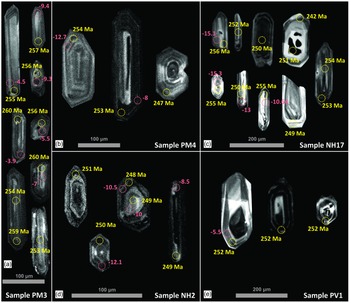
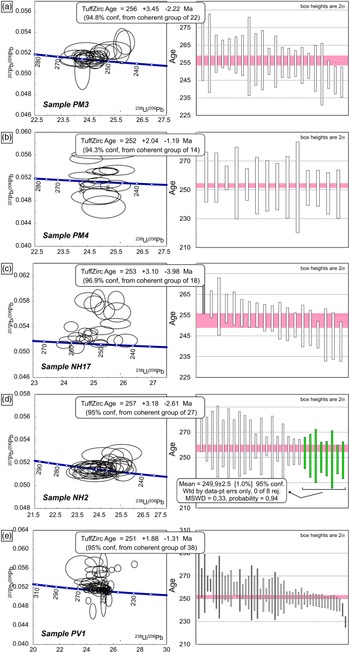
Sample PM3 (40° 45′ 9.37″ S, 68° 22′ 45.55″ W): Zircon grains are mostly prismatic, up to 400 μm long (Fig. 4a), and show typical magmatic zonation. Thirty analyses were performed on 27 zircon crystals. Twenty-two analyses with concordant ages between 244 and 262 Ma give a TuffZirc age of 256 ± 3 Ma (Fig. 5a). The Th/U ratio of these zircons is higher than 0.3, which suggests a magmatic origin. This age is interpreted as the eruption age for the lower ignimbrite of the H. Álvarez log (Table 2), which is assigned to the La Esperanza Complex.
Cathodoluminescence images of zircon crystals showing the magmatic internal structure for grains from the five samples analysed in this study. The dashed yellow and pink circles on the crystals show the position for the U–Pb and Hf analyses, respectively. The obtained 206Pb/238U apparent age is shown in yellow and the ε Hf(t) values are shown in pink (where available).

Tera–Wasserburg and TuffZirc diagrams for the Los Menucos ignimbrites. Samples PM3 (a) obtained from the top of the lower ignimbrite in the H. Álvarez log and PM4 (b) from the top of the same log. (c) Sample NH17 corresponds to the top of the lower ignimbrite of the Tscherig log, and sample NH2 (d) to the top of the Tscherig log. (e) Sample PV1 was collected from the top of the Vera log. All errors given are 2σ.

Eight zircon crystals with ages between 253 and 260 Ma yielded negative ε Hf(t) values between −3.9 and −9.5 and Meso- to Palaeoproterozoic T DM between 1.4 and 1.8 Ga (Table 1; Fig. 6).
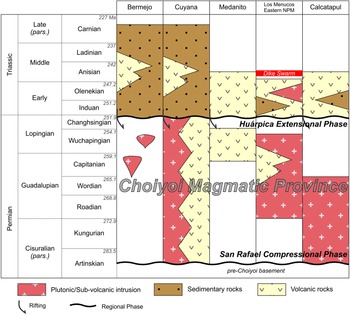
Comparative scheme of the Changhsingian–Triassic basins of Argentina. The San Rafael compressional phase and the Huárpica extensional phase are the regional surfaces that bound the Choiyoi Magmatic Province. Modified after Sato et al. (Reference Sato, Llambías, Basei and Castro2015).

Sample PM4 (40° 45′ 7.95″ S, 68° 22′ 33.48″ W): Twenty-nine prismatic zircon crystals were analysed; they show magmatic zonation and are up to 350 μm long (Fig. 4b). Fourteen analyses with Th/U ratios >0.3 gave concordant ages between 247 and 259 Ma. The obtained TuffZirc age of 252 ± 2 Ma (Fig. 5b) is interpreted as the eruption age for the upper ignimbrite of the H. Álvarez log.
Eight zircon crystals with ages between 251 and 259 Ma yielded negative ε Hf(t) values between −8 and −19 and Palaeoproterozoic T DM between 1.7 and 2.4 Ga (Table 2; Fig. 6).
4.b. Tscherig log
Sample NH17 (40° 52′ 0.62″ S, 68° 15′ 37.54″ W): Twenty-eight analyses were performed on 22 zircon crystals. The crystals are prismatic, up to 250 μm long, and show magmatic zonation (Fig. 4c). Eighteen analyses on grains with Th/U ratios >0.3 yielded a TuffZirc age of 253 ± 3 Ma, which is regarded as the eruption age for the lower ignimbrite of the Tscherig log.
Eight zircon crystals with ages between 246 and 263 Ma yielded negative ε Hf(t) values between −8.6 and −15.9 and Palaeoproterozoic T DM between 1.7 and 2.2 Ga (Table 2; Fig. 4).
Sample NH2 (40° 51′ 44.72″ S, 68° 13′ 32.21″ W): The zircon crystals are mostly prismatic, have magmatic zonation, and Th/U ratios >0.3, which indicates magmatic origin. These crystals are up to 200 μm long (Fig. 4d). Twenty-eight U–Pb isotope analyses were performed on 26 zircon crystals. The data are concordant, with ages between 248 to 269 Ma. The TuffZirc age for this sample is 257 ± 3 Ma, which may represent inherited crystals and not the true age of the sample, as, based on stratigraphic heights, the age should be younger than 253 Ma (sample NH17). The eight younger analyses (<253 Ma) give a mean age of 250 ± 3 Ma (MSWD = 0.33), which is interpreted as a likely eruption age for the upper ignimbrite of the Tscherig log (see further discussion in Section 6.a.).
Four of the eight zircon crystals that gave the average age of 250 ± 3 Ma yielded negative ε Hf(t) values between −8.5 and −12, and Palaeoproterozoic T DM between 1.7 and 1.9 Ga (Table 2; Fig. 6). Four analyses of what we consider inherited crystals (ages between 259 and 261 Ma) gave less negative ε Hf(t) values between −3 and −9.5, and Meso- to Palaeoproterozoic T DM between 1.4 and 1.8 Ga.
4.c. Vera log
Sample PV1 (40° 41′ 10.14″ S, 68° 16′ 40.07″ W): The analysed zircon crystals are prismatic, with magmatic zonation, and up to 250 µm length (Fig. 4e). Sixty-nine analyses were performed on 58 crystals. Fifty-one of these analyses gave concordant to moderately discordant ages between 230 to 267 Ma (Fig. 5e); all analyses yielded Th/U ratios >0.3, suggesting a magmatic origin for these crystals. The TuffZirc age for this sample is 251 ± 2 Ma (n = 38) and is interpreted as the best estimation of the eruption age for the upper ignimbrite from the Vera log. This age is coincident, within errors, with the 248 ± 1 Ma age obtained by Luppo et al. (Reference Luppo, López de Luchi, Rapalini, Martínez Dopico and Fanning2018) for their sample M252. Both these sampled outcrops were considered as being part of a correlative layer through the basin (Falco et al. Reference Falco, Bodnar and Del Río2020).
A first group of four zircon crystals (ages between 253 and 259 Ma) yielded negative ε Hf(t) values between −8.5 and −11, and Palaeoproterozoic T DM between 1.8 and 1.6 Ga. A second group of four crystals (ages between 250 and 252 Ma) yielded negative ε Hf(t) values between −2 and −7, and Meso- to Palaeoproterozoic T DM between 1.3 and 1.6 Ga (Table 2; Fig. 6).
5. Discussion
5.a. The age of the Los Menucos Basin: regional correlation
These new U–Pb results, together with basin stratigraphy after Falco et al. (Reference Falco, Bodnar and Del Río2020), are mostly in agreement with the idea that the basin evolved since the Changhsingian (c. 253 Ma). Only sample NH2 of the Tscherig log gave a TuffZirc age that seems inconsistent with basin stratigraphy (see Fig. 3), as this age should be younger than the 253 Ma obtained for the lower sample of this log (sample NH17). For the NH2 sample, a c. 250 Ma average age was obtained using eight analyses younger than 253 Ma, which represents a likely age that fits with the basin stratigraphic knowledge. In this sense, and based on previous U–Pb zircon ages (Luppo et al. Reference Luppo, López de Luchi, Rapalini, Martínez Dopico and Fanning2018), it can be concluded that the age of the LMB is constrained between the Changhsingian (upper Permian) and Olenekian (Lower Triassic), to c. 253–248 Ma (Fig. 3).
This basin overlies a Wuchiapingian ignimbrite succession that has been assigned to the La Esperanza Complex, whose age is constrained between c. 257 Ma at the bottom (sample M265 in Luppo et al. Reference Luppo, López de Luchi, Rapalini, Martínez Dopico and Fanning2018) and c. 256 Ma at the top (sample PM3, this study). A lava intrusion between samples M265 and PV3 (Fig. 3) was dated to 252 ± 2 Ma (sample M82 in Luppo et al. Reference Luppo, López de Luchi, Rapalini, Martínez Dopico and Fanning2018), which most likely represents a subvolcanic body intruded during the first stages of the development of the LMB (see petrographic details of this lava in Lema et al. Reference Lema, Busteros, Giacosa and Cucchi2008).
The oldest zircon crystals registered in the LMB ignimbrites are Permian, with ages between 272 and 255 Ma. Taking into account that the La Esperanza Complex constitutes the basement onto which the LMB was emplaced, these relatively oldest zircons likely represent the inherited material incorporated from the wall of the magmatic chamber or from accidental lithic clasts included during and/or after the eruption.
The new ages presented in this study are consistent with recent studies on the palaeontological content of the LMB. The finding of Dicynodontipus sp. ichnites at several basin localities confirms a Changhsingian (upper Permian) to Olenekian age for the fossiliferous strata (see Citton et al. Reference Citton, De Valais, Díaz-Martínez, González, Grecco, Cónsole-Gonella and Leonardi2021). Moreover, a recent review on the Dicroidium-type flora in Argentina suggests that the recovery of the vegetation after the end-Permian crisis in the Changhsingian was carried by representatives of the Dicroidium-type flora during the Early Triassic, most of which are preserved in the Los Menucos basin (Bodnar et al. 2021).
5a.1. Continental basins of SW Gondwana: correlations and evolution
The angular unconformity at the bottom of the LMB recognized at Puesto H. Álvarez has been associated with the Huárpica Extensional Phase (Azcuy & Caminos, Reference Azcuy, Caminos and Archangelsky1987). This unconformity separates the Choiyoi Magmatic Province and the extensional event that could be recognized as having been involved in the formation of the Cuyana and Bermejo basins (∼32° S), the Medanito half-graben (∼38° S), and the Calcatapul half-graben (∼42° S) (Figs 1 and 6).
To the north of the Huincul Fault Zone, the Medanito half-graben succession (Fig. 1) represents a volcanic depocentre in the Neuquén Basin. The top of this basin infill was dated to 246 ± 1 Ma. These rocks unconformably overlie a 261 ± 1 Ma volcanic sequence (Barrionuevo et al. Reference Barrionuevo, Arnosio and Llambías2013). Further to the north, the Cuyana and Bermejo rift basins (Fig. 1) developed in Lower Triassic times above Permian intrusive and volcanic rocks (see Sato et al. Reference Sato, Llambías, Basei and Castro2015). In the Cuyana Basin, the top of the basal Rio Mendoza Formation was dated to 243 ± 5 Ma (Ávila et al. Reference Ávila, Chemale, Mallmann, Kawashita and Armstrong2006), suggesting that sedimentation began in Early Triassic times. In the Bermejo Basin, the Talampaya Formation yielded a 252 ± 1 Ma age (Gulbranson et al. Reference Gulbranson, Ciccioli, Montañez, Marenssi, Limarino, Schmitz and Davidov2015), so that sedimentation would have occurred across the Permo-Triassic boundary.
In the NPM, erosive surfaces that could be associated with the Huárpica Extensional Phase were also recognized (Fig. 6); and in the eastern NPM, the Monasa Formation (247 ± 1 Ma) covers an erosive surface above the Permian granites (González et al. Reference González, Greco, Sato, Llambías, Basei, González and Díaz2017). From the central NPM (Fig. 2), Luppo et al. (Reference Luppo, Martínez Dopico, Rapalini, López de Luchi, Miguez and Fanning2019) mentioned an erosive surface between the Collinao dacite and Prieto granodiorite, dated to 253 ± 2 and 255 ± 2 Ma, respectively. This surface between the Collinao dacite and the Prieto granodiorite was interpreted as a consequence of local readjustments of the volcanic edifice (Martínez Dopico et al. Reference Martínez Dopico, López de Luchi, Rapalini, Fanning and Antonio2019). However, the recognition of analogue examples in the NPM leads us to suggest that this discontinuity could be derived from regional tectonics rather than from local factors (e.g. Llambías & Rapela, Reference Llambías and Rapela1984). To the south of the NPM, the Calcatapul half-graben, developed above the Yancamil Granite (c. 272 Ma), was recently dated to 245 ± 4 Ma (González et al. Reference González, Giacosa, Lagorio, Ballivian Justiniano, Sato, Cábana, Basei, Busteros and Silva Nieto2021).
5.b. Geochemistry and Hf isotopes of the Permian – Middle Triassic igneous rocks in Patagonia
5.b.1. Whole-rock geochemistry
Several studies have focused on the geochemistry of Permian to Middle Triassic rocks of the NPM (e.g. Varela et al. Reference Varela, Gregori, González and Basei2015; González et al. Reference González, Greco, González, Sato, Llambías and Varela2016, Reference González, Greco, Sato, Llambías, Basei, González and Díaz2017; Martínez Dopico et al. Reference Martínez Dopico, López de Luchi, Rapalini, Fanning and Antonio2019; Gregori et al. Reference Gregori, Strazzere, Barros, Benedini, Marcos and Kostadinoff2020; López de Luchi et al. Reference López de Luchi, Martínez Dopico and Rapalini2020). The results of these studies suggest that the Asselian to Wuchiapingian(?) rocks (299–256 Ma) are mostly related to arc-type magmatism, whereas the Changhsingian(?) to Anisian rocks (253–244 Ma) are related to post-orogenic and intraplate tectonic settings.
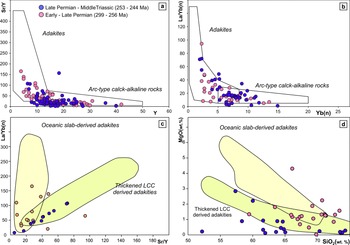
Based on a compilation of all the available data, we find that part of the Permian to Middle Triassic magmatism in the NPM is characterized by low Y and Ybn values and high (La/Yb)n and Sr/Y ratios, and most of the samples have SiO2 > 56 wt %, Al2O3 > 15 wt % and MgO < 6 wt %, which is consistent with an adakitic composition (Zhang et al. Reference Zhang, Shichao and Zhao2019) (Fig. 7a, b). However, both Permian and Triassic samples do not belong to the same type of adakites. Most of the Asselian to Wuchiapingian samples are akin to the adakites derived from the melting of a subducted oceanic slab, whereas the younger samples seem to be consistent with adakites derived from continental crust (Fig. 7c, d).
(a, b) Sr/Y vs Y and (La/Yb)n vs Ybn adakite discrimination plots. (c, d) (La/Yb)n vs Sr/Y and MgO vs SiO2 plots showing the oceanic and the thickened lower continental crust derived adakite fields. In (c) and (d) only samples of adakitic signature are plotted.

The Asselian to Wuchiapingian adakites (299–256 Ma) are consistent with the initial definition of adakites by Defant & Drummond (Reference Defant and Drummond1990), the so-called HSA (high-silica adakites) (Fig. 7d). Although the adakite signature has been explained by several petrogenetic processes (e.g. Zhang et al. Reference Zhang, Shichao and Zhao2019), Moyen (Reference Moyen2009) suggested that the HSA are in fact the ‘true adakites’, therefore limiting adakite petrogenesis to a relationship with slab melting.
Conversely, those adakites derived from the continental crust in the NPM are represented mainly by the trachyandesite dikes in the eastern NPM with Middle Triassic age, that have been related to anorogenic magmatism (González et al. Reference González, Greco, González, Sato, Llambías and Varela2016). These dikes have a chemical affinity to C-Type or Type-II adakites derived from melting of continental crust. They have low Mg# and are supposed to be derived from partial melting of lower crustal rocks that are underplated by basalts in inland regions (e.g. Zhang et al. Reference Zhang, Shichao and Zhao2019; see also González et al. Reference González, Greco, González, Sato, Llambías and Varela2016).
5.b.2. Hf isotopes
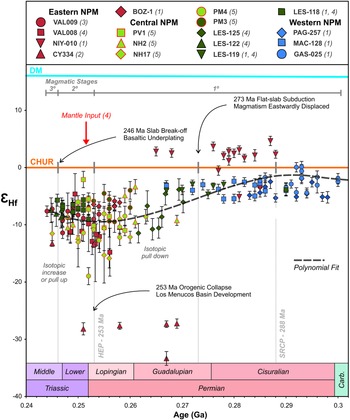
The new Hf data for samples from the LMB suggest that magma generation involved a significant contribution from Meso- to Palaeoproterozoic (1.4–2.2 Ga) crust, as the ε Hf(t) values are consistently negative. Similar results were previously obtained for samples from the La Esperanza Complex, Yaminué granodiorite, Rincón de Treneta granodiorite, Boca de la Zanja granite and Yaminué Complex tonalitic orthogneiss (Fig. 8 – data from Fanning et al. Reference Fanning, Hervé and Pankhurst2011; Chernicoff et al. Reference Chernicoff, Zappettini, Santos, McNaughton and Belousova2013; Pankhurst et al. Reference Pankhurst, Rapela, De Luchi, Rapalini, Fanning and Galindo2014; Castillo et al. Reference Castillo, Fanning, Hervé and Lacassie2016, Reference Castillo, Fanning, Pankhurst, Hervé and Rapela2017). Regarding the evolution of the isotopic composition of the NPM, the calculation of polynomial fits highlights changes in the Hf isotope signature through time, which is consistent with regional tectonic phases (Figs 2 and 8).
Age (Ga) vs ε Hf plot showing the Hf isotope evolution of the North Patagonian Massif (NPM) during the early Permian to Middle Triassic. The black dashed line represents the isotopic evolution trend obtained with a polynomial fit (Sundell et al. Reference Sundell, Saylor, Pecha, Horton and Folguera2019): the isotopic pull-down after the proposed flat-slab subduction at 273 Ma and the isotopic increase or pull-up at 253 Ma related to an extensional tectonic setting. Data sourced from (1) Fanning et al. (Reference Fanning, Hervé and Pankhurst2011), (2) Chernicoff et al. (Reference Chernicoff, Zappettini, Santos, McNaughton and Belousova2013), (3) Pankhurst et al. (Reference Pankhurst, Rapela, De Luchi, Rapalini, Fanning and Galindo2014), (4) Castillo et al. (Reference Castillo, Fanning, Pankhurst, Hervé and Rapela2017), (5) this study. Data for the western NPM are for the Piedra del Aguila granite (PAG-257), Mamil Choique granodiorite (MAC-128), and Gastre granodiorite (GAS-025). Data for the central NPM are for the ignimbritic layers of the Los Menucos Group (samples PV1, NH2, NH17 and PM4), and the La Esperanza Complex: Calvo granite (LES-118), Prieto granodiorite (LES-119), a rhyolitic dike (LES-122), and a felsic dome (LES-125). Data for the eastern NPM are for the Yaminué granodiorite (VAL008), Rincón de Treneta granodiorite (VAL009), Navarrete granite (NIY-010), Boca de la Zanja granite (BOZ-1), and Yaminue Complex tonalitic orthogneiss (CY334). SCRP: San Rafael Compressional Phase; HEP: Huárpica Extensional Phase.

Based on the trend line in Fig. 8, we recognize that after the San Rafael compressional phase (c. 288 Ma), the ε Hf(t) values become progressively more negative, which could be interpreted as an ‘isotopic pull-down’ (in the sense of Decelles et al. Reference Decelles, Ducea, Kapp and Zandt2009; Chapman et al. Reference Chapman, Ducea, Kapp, Gehrels and Decelles2017; Nelson & Cottle, Reference Nelson and Cottle2018). This means that ε Hf(t) values shift from mixed positive and negative values to strongly negative data. This indicates a more evolved magmatism, most likely in response to longer crustal magmatic residence, possibly together with crustal thickening (Kemp et al. Reference Kemp, Hawkesworth, Foster, Paterson, Woodhead, Hergt, Gray and Whitehouse2007; Chapman et al. Reference Chapman, Ducea, Kapp, Gehrels and Decelles2017; Nelson & Cottle, Reference Nelson and Cottle2018).
Conversely, after the Huárpica extensional phase (c. 253 Ma), the trend line goes slightly upward. After c. 253 Ma, ε Hf(t) values are progressively less negative and indicate an ‘isotopic increase’ (after Nelson & Cottle, Reference Nelson and Cottle2018) or ‘isotopic pull-up’ (after Decelles et al. Reference Decelles, Ducea, Kapp and Zandt2009), signalling a change in the source for the magmatism at about the time of the P–T boundary, most likely during the Changhsingian (c. 253 Ma; Fig. 9). Nelson & Cottle (Reference Nelson and Cottle2019) suggested that isotopic increase could be the result of an extensional setting, caused by slab roll-back and/or gravitational collapse. The post-orogenic to intraplate geochemistry and the mantle-like O isotope composition of these rocks in the NPM support this interpretation (González et al. Reference González, Greco, González, Sato, Llambías and Varela2016; Castillo et al. Reference Castillo, Fanning, Pankhurst, Hervé and Rapela2017; López de Luchi et al. Reference López de Luchi, Martínez Dopico and Rapalini2020).
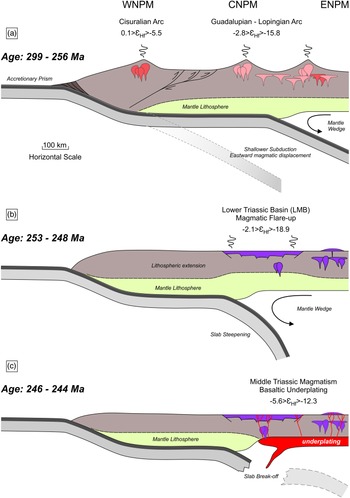
Schematic model for the evolution of the North Patagonian Massif in Permian and Middle Triassic times. Three stages of magmatism are differentiated: (a) a middle Permian shallow subduction event that can explain the eastward expansion of the arc series; (b) a Changhsingian – Lower Triassic flare-up that terminated the Permian contractional deformation and occurred at the climax of the eastward migration of the arc and crustal thickening; and (c) an extensional stage characterized by crustal stretching, slab break-off and basaltic underplating. WNPM: western North Patagonian Massif; CNPM: central North Patagonian Massif; ENPM: eastern North Patagonian Massif; LMB: Los Menucos Basin.

Although ε Hf(t) > 0 values are expected after an extensional setting, the melting of an enriched mantle lithosphere beneath northern Patagonia would not necessarily produce positive Hf values (e.g. Castillo et al. Reference Castillo, Fanning, Pankhurst, Hervé and Rapela2017; Schilling et al. Reference Schilling, Carlson, Tassara, Conceição, Bertotto, Vásquez, Muñoz, Jalowitzki, Gervasoni and Morata2017). In this sense, Nelson & Cottle (Reference Nelson and Cottle2018) suggested that the mostly negative ε Hf(t) values in Patagonia (and southern South America) may be due to the melting of an enriched lithospheric mantle. Evidence for an enriched lithospheric mantle below the NPM is preserved in Permian zircons obtained on granites; these crystals have enriched Hf-isotope and mantle-like O-isotope compositions (Castillo et al. Reference Castillo, Fanning, Pankhurst, Hervé and Rapela2017). Similarly, Re/Os data from Patagonian mantle xenoliths demonstrate the existence of a Proterozoic enriched lithospheric mantle source that was likely present in the Permian (Schilling et al. Reference Schilling, Carlson, Tassara, Conceição, Bertotto, Vásquez, Muñoz, Jalowitzki, Gervasoni and Morata2017; Nelson & Cottle, Reference Nelson and Cottle2019).
5.c. Proposed model: from Permian flat slab to Triassic slab steepening in Patagonia
5.c.1. Asselian–Wuchiapingian (299–256 Ma): arc broadening, HSA adakites and crustal shortening
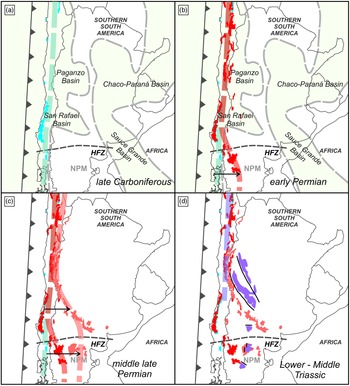
The evidence for Permian times includes a likely thickened crust since the San Rafael compressional phase (c. 288 Ma), eastward-younging Permian crustal shortening, broadening arc-type magmatism of adakitic to normal calc-alkaline signature to the east, and a progressive Hf-isotope pull-down tendency. This leads us to support the hypothesis that an eastward-directed shallower subduction may have produced this magmatism (e.g. Varela et al. Reference Varela, Gregori, González and Basei2015; Gregori et al. Reference Gregori, Strazzere, Barros, Benedini, Marcos and Kostadinoff2020; Marcos et al. Reference Marcos, Pavon Pivetta, Benedini, Gregori, Geraldes, Scivetti, Barros, Varela and Dos Santos2020) (Fig. 9). Modern and ancient examples show that shallow or horizontal subduction broadens the arc to the continental interior, producing adakitic magmatism together with shortening on the upper plate caused by coupling and thermal weakening (e.g. Ramos & Folguera, Reference Ramos, Folguera, Murphy, Keppie and Hynes2009; Yan et al. Reference Yan, Chen, Xiong, Wang, Xie and Hsu2020; Gianni & Pérez, Reference Gianni and Pérez2021). The compiled ages highlight that the Permian arc became broader after c. 273, as the Guadalupian to Lopingian (273–256 Ma) magmatism is mostly displaced to the central and eastern NPM (Figs 2, 9 and 10). As evidenced by the magmatism, shortening in the upper crust is also younger to the east.
Reconstruction of the SW margin of Gondwana. The grey dashed lines in (a) and (b) indicate the boundaries of the late Carboniferous to early Permian basins after Limarino & Spalletti (Reference Limarino and Spalletti2006). This figure highlights how the Guadalupian and Lopinginan magmatic belts are displaced eastward in Patagonia. NPM: North Patagonian Massif; HFZ: Huincul Fault Zone.

Our calculation suggests that the inland migration of the arc would have reached at least ∼820 km, considering that c. 750 km is the distance between the actual trench and the easternmost sample of the NPM (Fig. 2), another 50 km of continental crust is considered to have been lost by Neogene subduction erosion on the southern Pacific coast of South America (Ramírez de Arellano et al. Reference Ramírez de Arellano, Putlitz, Müntener and Ovtcharova2012), and the Cenozoic shortening of the North Patagonian Andes amounted to 18 km (Orts et al. Reference Orts, Folguera, Giménez, Ruiz, Rojas Vera and Lince Klinger2015).
Although the cause of arc migration has been associated with multiple geodynamic processes at convergent margins, it could also be explained by shallow subduction or by subduction erosion (e.g. Yan et al. Reference Yan, Chen, Xiong, Wang, Xie and Hsu2020; Gianni & Pérez, Reference Gianni and Pérez2021). However, pure subduction erosion rarely explains arc migration in excess of 200 km (see Gianni & Pérez, Reference Gianni and Pérez2021, and references therein). Conversely, flat-slab subduction has been invoked for larger inland migration of arc-type magmatism, even above 1000 km (Yan et al. Reference Yan, Chen, Xiong, Wang, Xie and Hsu2020; Gianni & Pérez, Reference Gianni and Pérez2021). Shallow subduction in the NPM would have been responsible for an over-thickened crust and the crowding of older continental lithosphere beneath the arc, resulting in a crustal source and more evolved magmatic Hf isotopic compositions for the younger magmatic products (Decelles et al. Reference Decelles, Ducea, Kapp and Zandt2009; Chapman et al. Reference Chapman, Ducea, Kapp, Gehrels and Decelles2017; Chapman & Ducea, Reference Chapman and Ducea2019; Figs 8 and 9). The proposed slab shallowing in the NPM could represent the southern extension of a flat-slab configuration, previously recognized by Ramos & Folguera (Reference Ramos, Folguera, Murphy, Keppie and Hynes2009), Kleiman & Japas (Reference Kleiman and Japas2009), and Del Rey et al. (Reference Del Rey, Deckart, Arriagada and Martínez2016), although of possibly greater magnitude. Furthermore, the proposed shallow subduction could also constitute a younger prolongation of the flat subduction envisaged by Marcos et al. (Reference Marcos, Pavon Pivetta, Benedini, Gregori, Geraldes, Scivetti, Barros, Varela and Dos Santos2020) for the Carboniferous – early Permian transition. Thus, the sub-horizontal subduction in the region of the NPM could have been a long-lived process lasting almost for the entire Permian Period of some 50 Ma duration.
Several mechanisms have been invoked to explain the occurrence of a flat-slab subduction setting (for recent syntheses see Schellart, Reference Schellart2020; Yan et al. Reference Yan, Chen, Xiong, Wang, Xie and Hsu2020). Schellart (Reference Schellart2020) proposed that flat slabs preferentially occur at old (>∼80–100 Ma) and extensive (≥6000 km) subduction zones; this is consistent with earlier works advocating the role of forced trench retreat, large wedge suction, and a thick or cratonic overriding plate in promoting flat-slab subduction (e.g. Yan et al. Reference Yan, Chen, Xiong, Wang, Xie and Hsu2020). Taking into account these hypotheses about flat-slab configuration, it is proposed that subduction below Patagonia would have started during the Devonian (c. 390–350 Ma; Hervé et al. Reference Hervé, Calderón, Fanning, Pankhurst, Fuentes, Rapela, Correar, Quezada and Marambio2016; Rapela et al. Reference Rapela, Hervé, Pankhurst, Calderón, Fanning, Qezada, Poblete, Palape and Reyes2021), which means that the flat-slab setting in the NPM at the Carboniferous–Permian transition (c. 290 Ma) occurred about 90 Ma later, coincident with a rather old subduction zone. Furthermore, according to recent palaeogeographic reconstruction (e.g. Young et al. Reference Young, Flament, Maloney, Williams, Matthews, Zahirovi and Müller2019; see also Cawood, Reference Cawood2005), the width of the subduction zone in SW Gondwana during the late Palaeozoic would have been greater than 7000 km, also fulfilling the second premise of Schellart’s (Reference Schellart2020) proposal.
No less important, Young et al. (Reference Young, Flament, Maloney, Williams, Matthews, Zahirovi and Müller2019) and Oliveros et al. (Reference Oliveros, Vásquez, Creixel, Lucassen, Ducea, Ciocca, González, Espinoza, Salazar, Coloma and Kasemann2020) proposed a shift in the absolute motion of the South American continental plate during the Guadalupian, from northeastward to southwestward, whereas the oceanic plate maintained its northeastward motion. Thus, it is possible that compression or increasing convergence took place, resulting in a thickened crust, forcing trench retreat and increasing the hydrodynamic suction that finally could have led to a slab shallowing (e.g. Oliveros et al. Reference Oliveros, Vásquez, Creixel, Lucassen, Ducea, Ciocca, González, Espinoza, Salazar, Coloma and Kasemann2020; Schellart, Reference Schellart2020; Yan et al. Reference Yan, Chen, Xiong, Wang, Xie and Hsu2020). The occurrence of a shallower or flat-slab subduction during the Permian on the SW margin of Gondwana, and particularly in northern Patagonia, could have been derived from a series of global and local causes that helped to sustain this movement for almost 50 Ma.
5.c.2. Changhsingian–Anisian (253–244 Ma): enriched mantle-sourced magmatism, C-type adakites
The evidence for the magmatism after the Huárpica extensional phase (253–244 Ma) suggests that it constitutes a post-orogenic to intraplate magmatism (e.g. González et al. Reference González, Greco, González, Sato, Llambías and Varela2016, Reference González, Greco, Sato, Llambías, Basei, González and Díaz2017; Castillo et al. Reference Castillo, Fanning, Pankhurst, Hervé and Rapela2017; Gregori et al. Reference Gregori, Strazzere, Barros, Benedini, Marcos and Kostadinoff2020). A likely thinner crust, together with less evolved magmatism after the Huárpica extensional phase, could have been the result of slab steepening and crustal extension, which favoured the rapid exhumation of Permian plutons during the Huárpica extensional phase (Fig. 9). This slab steepening at c. 253 Ma would have been responsible for the O–Hf isotope changes recognized at the P–Tr boundary (also by Castillo et al. Reference Castillo, Fanning, Pankhurst, Hervé and Rapela2017).
This magmatism could have been accompanied by an ∼9 km uplift during the Middle Triassic in the NPM (e.g. López de Luchi et al. Reference López de Luchi, Martínez Dopico and Rapalini2020). Part of this Middle Triassic magmatism is of adakitic signature, involving melting of the lower continental crust together with basaltic underplating (Fig. 9). González et al. (Reference González, Greco, González, Sato, Llambías and Varela2016) suggested two possible mechanisms that could have led to basaltic underplating in an extensional setting: delamination or slab break-off. Additionally, Zhang et al. (Reference Zhang, Shichao and Zhao2019) recognized that adakites produced by delamination are characterized by high Mg#; these are the so-called HMA adakites. Indeed, the Middle Triassic adakites of the NPM have relatively lower Mg# (González et al. Reference González, Greco, González, Sato, Llambías and Varela2016). We suggest that the most likely mechanism for the uplift and C-type adakitic magmatism is a break-off on the subducted oceanic slab. If this was the case, then the c. 244 Ma Rb–Sr and K–Ar cooling ages noted on the NPM (Fig. 2) could reflect regional exhumation as suggested for that time by Martínez Dopico et al. (Reference Martínez Dopico, López de Luchi, Rapalini, Fanning and Antonio2019). This was likely caused by the isostatic/dynamic rebound and unloading of the subducted slab.
5.d. The Hf isotope record of Patagonia in the context of the Choiyoi Magmatic Province: magmatic segmentation in a tear-slab model
Several studies have been conducted to characterize the Hf isotope composition of the Permian – Middle Triassic magmatism of the central–north Chile and Argentina (e.g. Chilean coastal Batholith, Frontal and Principal cordilleras) and North Patagonian regions (Figs 1 and 11). Bastias-Mercado et al. (Reference Bastias-Mercado, González and Oliveros2020) postulated that the Permian to Triassic magmatism of both regions is equivalent; for that reason, we evaluate it through the Hf isotope composition, including the anorogenic magmatism of the Intracratonic Magmatic Corridor (Chernicoff et al. Reference Chernicoff, Zappettini, Santos and McNaughton2019). Although this magmatism would not be strictly linked to the Choiyoi Magmatic Province (Bastías-Mercado et al. Reference Bastias-Mercado, González and Oliveros2020), it is coeval and emplaced in between the central–north Chile and Argentina, and the North Patagonian regions (see Fig. 1).
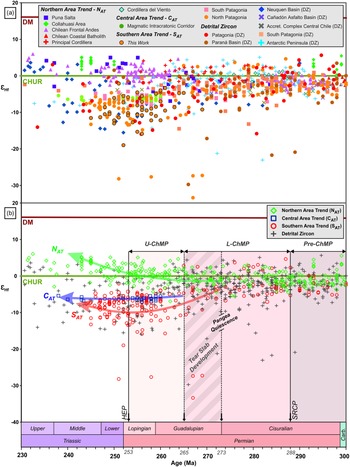
Age vs ε Hf plots. (a) Diagram showing all the data from the literature and this study. This includes all data available for the region from the Antarctic Peninsula to northern Chile. DZ: Detrital zircon. Data for the Neuquén Basin are from Tunik et al. (Reference Tunik, Folguera, Naipauer, Pimentel and Ramos2010), Balgord (Reference Balgord2017) and Naipauer et al. (Reference Naipauer, García Morabito, Manassero, Valencia, Ramos, Folguera, Contreras-Reyes, Heredia, Encimas, Iannelli, Oliveros, Dávila, Collo, Giambiagi, Maksymowicz, Iglesia Llanos, Turienzo, Naipauer, Orts, Litvak, Álvarez and Arriagada2018). Data for the Cañadón Asfalto Basin from Hauser et al. (Reference Hauser, Cabaleri, Gallego, Monferran, Silva Nieto, Armella, Matteini, Aparicio González, Pimentel, Volkheimer and Reimold2017). Data for the Chilean Coastal Batholith from Deckart et al. (Reference Deckart, Hervé, Fanning, Ramírez, Calderón and Godoy2014). Data for the Magmatic Intracratonic Corridor from Castillo et al. (Reference Castillo, Fanning, Pankhurst, Hervé and Rapela2017) and Chernicoff et al. (Reference Chernicoff, Zappettini, Santos and McNaughton2019); for Puna Salta from Poma et al. (Reference Poma, Zappettini, Quenardelle, Santos, Kouhharsky, Belousova and McNaughton2014); and for the Collahuasi Area from Munizaga et al. (Reference Munizaga, Maksaev, Fanning, Giglio, Yaxley and Tassinari2008). Data for the Chilean Frontal Andes are from Hervé et al. (Reference Hervé, Fanning, Calderón and Mpodozis2014) and Del Rey et al. (Reference Del Rey, Deckart, Arriagada and Martínez2016), and for the Principal Cordillera from Jones et al. (Reference Jones, Kirstein, Kasemann, Dhuime, Elliott, Litvak, Alonso and Hinton2015). Data for Patagonia are from Pepper et al. (Reference Pepper, Gehrels, Pullen, Ibañez-Mejia, Ward and Kapp2016); for the Antarctic Peninsula from Fanning et al. (Reference Fanning, Hervé and Pankhurst2011) and Castillo et al. (Reference Castillo, Fanning, Hervé and Lacassie2016). Data for the Accretionary Complex of Central Chile from Hervé et al. (Reference Hervé, Calderón, Fanning, Pankhurst and Godoy2013). Data for South Patagonia from Fanning et al. (Reference Fanning, Hervé and Pankhurst2011) and Castillo et al. (Reference Castillo, Fanning, Hervé and Lacassie2016). Data for North Patagonia from Fanning et al. (Reference Fanning, Hervé and Pankhurst2011), Chernicoff et al. (Reference Chernicoff, Zappettini, Santos, McNaughton and Belousova2013), Pankhurst et al. (Reference Pankhurst, Rapela, De Luchi, Rapalini, Fanning and Galindo2014), Castillo et al. (Reference Castillo, Fanning, Pankhurst, Hervé and Rapela2017), and this study. Data for the Paraná Basin are from Canile et al. (Reference Canile, Babinski and Rocha-Campos2016), and for the Cordillera del Viento from Hervé et al. (Reference Hervé, Calderón, Fanning, Pankhurst and Godoy2013). (b) Plot showing the age vs ε Hf evolution for the NAT, CAT and SAT regions from 265 Ma onward. The crustal evolution trends represent the bulk-rock trends for Mesoproterozoic juvenile crust, calculated using the 176Lu/177Hf ratio of 0.0113 (Taylor & McLennan, Reference Taylor and McLennan1985; Wedepohl, Reference Wedepohl1995). Pre-ChMP: previous magmatism in the Choiyoi Magmatic Province; L-ChMP: Lower Choiyoi Magmatic Province; U-ChMP: Upper Choiyoi Magmatic Province; SRCP: San Rafael Compressional Phase; HEP: Huárpica Extensional Phase.

The Hf isotope record for zircon from the magmatic rocks associated with the Permian and Triassic of the SW margin of Gondwana (including data for detrital zircon grains) leads to the recognition of several regional trends (Fig. 11). The isotope composition of Cisuralian to Guadalupian rocks (c. 299 to 265 Ma), which includes the formation of the Lower Choiyoi, indicates a continuous trend, with most ε Hf(t) values close to CHUR. This trend follows that of the NPM during this time (Fig. 8). This Hf isotope composition is consistent with a magma source involving a mantle reservoir that assimilated different degrees of crust in a subduction setting under orogenic conditions during the Gondwanide orogeny (Sato et al. Reference Sato, Llambías, Basei and Castro2015; Bastias-Mercado et al. Reference Bastias-Mercado, González and Oliveros2020; Gregori et al. Reference Gregori, Strazzere, Barros, Benedini, Marcos and Kostadinoff2020; López de Luchi et al. Reference López de Luchi, Martínez Dopico and Rapalini2020; Marcos et al. Reference Marcos, Pavon Pivetta, Benedini, Gregori, Geraldes, Scivetti, Barros, Varela and Dos Santos2020; Oliveros et al. Reference Oliveros, Vásquez, Creixel, Lucassen, Ducea, Ciocca, González, Espinoza, Salazar, Coloma and Kasemann2020).
All rocks related to this interval conform to N–S-trending units along the SW margin of Gondwana (Figs 1 and 10). However, from northern Chile to the NPM, outcrops become more displaced to the east during the middle Permian. In the northern area, the studied outcrops emerge on the Chilean side and in the Principal Cordillera, whereas to the south, early to middle Permian rocks from the Cordillera del Viento to the NPM are in an extra-Andean position. This eastward magmatic displacement has been interpreted as the result of progressive slab shallowing south of 32° S during this time (e.g. Kleiman & Japas, Reference Kleiman and Japas2009; Ramos & Folguera, Reference Ramos, Folguera, Murphy, Keppie and Hynes2009; Del Rey et al. Reference Del Rey, Deckart, Arriagada and Martínez2016; Marcos et al. Reference Marcos, Pavon Pivetta, Benedini, Gregori, Geraldes, Scivetti, Barros, Varela and Dos Santos2020; Poole et al. Reference Poole, Kemp, Hagemann, Fiorentini, Jeon, Williams, Zappettini and Rubinstein2020).
After c. 265 Ma, three Hf isotope trends can be discerned, which can also be linked with different geographical positions of this magmatism (Fig. 11). The three Hf isotope trends are termed the Northern Area Trend (NAT, between ∼22° and 37.5° S), the Central Area Trend (CAT, between ∼37.5° and 39° S), and the Southern Area Trend (SAT, below ∼39° S). We define these three trends based on their associated ε Hf(t) values and the geographical location of the samples.
The NAT includes the Collahuasi Area, Puna Salta, Chilean Frontal Andes and Principal Cordillera (Fig. 11). The Hf isotope values for these areas after 265 Ma become progressively more positive, suggesting a mantle-like source (Hervé et al. Reference Hervé, Fanning, Calderón and Mpodozis2014; Poma et al. Reference Poma, Zappettini, Quenardelle, Santos, Kouhharsky, Belousova and McNaughton2014; Del Rey et al. Reference Del Rey, Deckart, Arriagada and Martínez2016; Poole et al. Reference Poole, Kemp, Hagemann, Fiorentini, Jeon, Williams, Zappettini and Rubinstein2020). This interval is coeval with the occurrence of the Upper Choiyoi and the development of the Cuyana and Bermejo basins, all related to an extensional tectonic setting. The increase in zircon ε Hf(t) values could be indicative of crustal extension and thinning, reducing assimilation due to magma ascent through a thinner crust, and/or melting of upwelling depleted asthenospheric mantle (Kemp et al. Reference Kemp, Hawkesworth, Collins, Gray and Blevin2009; Del Rey et al. Reference Del Rey, Deckart, Arriagada and Martínez2016; Chapman et al. Reference Chapman, Ducea, Kapp, Gehrels and Decelles2017; Nelson & Cottle, Reference Nelson and Cottle2018; Poole et al. Reference Poole, Kemp, Hagemann, Fiorentini, Jeon, Williams, Zappettini and Rubinstein2020).
The CAT includes the southern part of the Intracratonic Magmatic Corridor (Chernicoff et al. Reference Chernicoff, Zappettini, Santos and McNaughton2019) and the Medanito half-graben (Barrionuevo et al. Reference Barrionuevo, Arnosio and Llambías2013) (Fig. 11). The related Hf isotope values for the 265 to 240 Ma interval vary between −5 and −7, and the whole-rock geochemistry supports a strongly anorogenic signature (Chernicoff et al. Reference Chernicoff, Zappettini, Santos and McNaughton2019; Bastias-Mercado et al. Reference Bastias-Mercado, González and Oliveros2020). This homogeneous isotopic trend may indicate a contribution from recycled Meso- to Palaeoproterozoic crust (TDM = 1.5–1.6 Ga), mixing with a juvenile source that reworked a continental crust, or even the melting of a highly evolved asthenospheric mantle.
Finally, the SAT is integrated into the Patagonia region (Fig. 11) and characterized by the Hf isotope data discussed above in the context of the NPM. The Hf isotopes suggest a crustal magma source, with the transition to less evolved magmatism at 253 Ma. It is worth noting that CAT and SAT have similar isotopic characteristics, with negative values. However, the CAT trend does not show the isotopic pull-down recognized for the Patagonia trends. Moreover, the whole-rock chemistry of the samples related to the different trends supports a differentiated magmatic history (for discussion, see Chernicoff et al. Reference Chernicoff, Zappettini, Santos and McNaughton2019; Bastias-Mercado et al. Reference Bastias-Mercado, González and Oliveros2020).
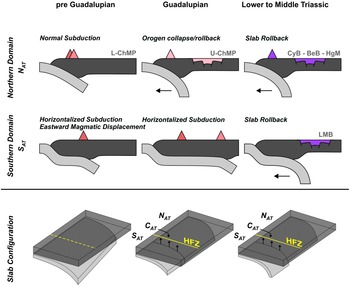
The isotopic differences recognized for the SAT, CAT and NAT domains could be explained through the occurrence of diachronous roll-back on the NAT and SAT domains (Fig. 12). Tearing would have occurred at the moment when the arc in Patagonia broadened, which could have been coeval with the orogenic collapse in the NAT domain (c. 270–265 Ma, Kleiman & Japas, Reference Kleiman and Japas2009; Del Rey et al. Reference Del Rey, Deckart, Arriagada and Martínez2016; Oliveros et al. Reference Oliveros, Vásquez, Creixel, Lucassen, Ducea, Ciocca, González, Espinoza, Salazar, Coloma and Kasemann2020) that triggered the emplacement of the Upper Choiyoi. These two distinctive subduction styles to the north and south of the Huincul Fault Zone could have been the driving forces for the tearing, which also triggered segmentation of the overriding continental plate (e.g. Govers & Wortel, Reference Govers and Wortel2005; Rosenbaum et al. Reference Rosenbaum, Gasparon, Lucente, Pecerillo and Miller2008; Kundu & Santosh, Reference Kundu and Santosh2011).
The evolution model proposed for the northern, central and southern blocks along the SW margin of Gondwana. L-ChMP: Lower Choiyoi Magmatic Province; U-ChMP: Upper Choiyoi Magmatic Province; CyB: Cuyana Basin; BeB: Bermejo Basin; HgM: Medanito half-graben; LMB: Los Menucos Basin; HFZ: Huincul Fault Zone; SAT: Southern Area Trend; CAT: Central Area Trend; NAT: Northern Area Trend.

A consistent roll-back setting up to the Permian–Triassic boundary in the NAT caused more positive Hf isotope values through time, as the space left by the retreating slab may have been filled by asthenospheric mantle (e.g. Del Rey et al. Reference Del Rey, Deckart, Arriagada and Martínez2016; Oliveros et al. Reference Oliveros, Vásquez, Creixel, Lucassen, Ducea, Ciocca, González, Espinoza, Salazar, Coloma and Kasemann2020). Conversely, in the SAT, flat-slab subduction continued until the Permian–Triassic boundary, and arc-type magmatism moved eastwards during a phase of crustal shortening, whereby the isotope trend experienced pull-down (Fig. 11).
A last stage in the proposed evolution of SW Gondwana is related to the global geodynamic reorganization during the break-up of Pangaea at the Permian–Triassic transition. Part of this final stage was the Huárpica extensional phase, indicating the end of Choiyoi magmatism (e.g. Rocher et al. Reference Rocher, Vallecillo, Castro de Machuca and Alasino2015). The continuation of the extensional tectonic setting to the north of the Huincul Fault Zone, related to a slab-steepening process (Del Rey et al. Reference Del Rey, Deckart, Arriagada and Martínez2016; Oliveros et al. Reference Oliveros, Vásquez, Creixel, Lucassen, Ducea, Ciocca, González, Espinoza, Salazar, Coloma and Kasemann2020; Poole et al. Reference Poole, Kemp, Hagemann, Fiorentini, Jeon, Williams, Zappettini and Rubinstein2020), triggered the development of the Cuyana and Bermejo rift-type basins, likely with support from pre-existing zones of weakness (e.g. Ramos & Kay, Reference Ramos, Kay, Harmon and Rapela1991; Kleiman & Japas, Reference Kleiman and Japas2009). At the same time, arc-type magmatism was developed close to the palaeotrench (Oliveros et al. Reference Oliveros, Vásquez, Creixel, Lucassen, Ducea, Ciocca, González, Espinoza, Salazar, Coloma and Kasemann2020; and references therein). To the south of the Huincul Fault Zone, in northern Patagonia, the initiation of the extensional tectonic setting is represented by the basal angular unconformity on the LMB and Calcatapul half-graben.
In the context of a tear-slab model, differential roll-back to the north of the Huincul Fault Zone since the Guadalupian (c. 270 to 265 Ma) would have allowed lateral influx (toroidal flow) from the mantle (e.g. Kundu & Santosh, Reference Kundu and Santosh2011). With this new tectonic perspective, it could be inferred that the consistently negative ε Hf(t) values recognized for the CAT, together with a strongly anorogenic geochemical signature, support a source dominated by enriched lithospheric mantle and with minor crustal reworking. An enriched lithospheric mantle below northern Patagonia (Castillo et al. Reference Castillo, Fanning, Pankhurst, Hervé and Rapela2017; Schilling et al. Reference Schilling, Carlson, Tassara, Conceição, Bertotto, Vásquez, Muñoz, Jalowitzki, Gervasoni and Morata2017; Nelson & Cottle, Reference Nelson and Cottle2018), which was likely emplaced through a slab tear, could have produced anorogenic magmatism but with Hf isotope values below CHUR, as seen for CAT. Furthermore, the slab-tearing proposal could also help to explain the variable petrogenesis between arc and within-plate magmatism of Permian rocks in central Argentina (e.g. San Rafael block; see Kleiman & Japas, Reference Kleiman and Japas2009), and particularly those emplaced far into the foreland (for discussion see Bastias-Mercado et al. Reference Bastias-Mercado, González and Oliveros2020; Oliveros et al. Reference Oliveros, Vásquez, Creixel, Lucassen, Ducea, Ciocca, González, Espinoza, Salazar, Coloma and Kasemann2020). A buoyant northerly-directed asthenospheric flow induced by the slab roll-back could have contributed to the development of anorogenic magmatism into the foreland (e.g. Llambías, Reference Llambías and Caminos1999; Kleiman & Japas, Reference Kleiman and Japas2009), at the same time that calc-alkaline subduction-related magmatism was being generated on the proto-Andean subduction zone (e.g. Oliveros et al. Reference Oliveros, Vásquez, Creixel, Lucassen, Ducea, Ciocca, González, Espinoza, Salazar, Coloma and Kasemann2020). Furthermore, a trench-parallel flow model induced by slab roll-back should be considered in future research (e.g. Mullen & Weis, Reference Mullen and Weis2015). Numerical simulations suggest that trench-parallel flow can extend several hundred kilometres into the mantle wedge before the flow is diverted by coupling to the down-going plate (Kneller & van Keken, Reference Kneller and van Keken2008), which could likely produce both within-plate magmatism in the foreland and contemporaneous subduction-related magmatism close to the subduction axis. Anyway, this hypothesis needs to be further investigated, considering temperature and pressure of emplacement that certainly would have played an important role in the geochemical variations (composition, alkalinity or isotope composition) along the proto-Andean axis, and also transverse to it.
On the other hand, regarding the CAT domain that is spatially related to the Huincul Fault Zone, we interpret that it would have acted as a mobile belt between the northern and southern domains during the Permian, due to this slab tearing, similarly to the proposal of Vizán et al. (Reference Vizán, Prezzi, Geuna, Japas, Renda, Franzese and Van Zele2017). These authors proposed that differential displacements between the Gondwana domains caused localized deformation along their borders, representing weakened zones due to the transmission of mantle toroidal flow induced by strike-slip movements along these focused, self-lubricated, weak lithospheric zones. Therefore, we suggest that the CAT domain acted as a ‘deformation buffer zone’, in which the Sierra de la Ventana fold-and-thrust belt was deformed at least until the Guadalupian.
This model of a mobile belt above slab tears is similar to the İzmir–Balıkesir and Uşak–Muğla transfer zones in western Anatolia (Turkey), which are thought to be derived from the segmentation of the oceanic slab that accommodated deformation between crustal blocks (e.g. Karaoğlu & Helvaci, Reference Karaoğlu and Helvaci2014). In Italy, between the Tuscan Province and Sicily Island, several tear faults were proposed to explain different geochemical and isotopic trends and segmented structural styles (e.g. Rosenbaum et al. Reference Rosenbaum, Gasparon, Lucente, Pecerillo and Miller2008, and references therein). Indeed, some of these gaps in the subducted slab are expressed in the overriding continental slab as fault zones, like the South Alfeo Fault and the North Alfeo Fault, in which the Etna volcano was emplaced (Gutscher et al. Reference Gutscher, Dominguez, de Lepinay, Pinheiro, Gallais, Babonneau, Cattaneo, Faou, Barreca, Micallef and Rovere2016). Several other examples of the influence that tears in a subducted slab have on overriding continental crust were summarized and discussed by Govers & Wortel (Reference Govers and Wortel2005), Rosenbaum et al. (Reference Rosenbaum, Gasparon, Lucente, Pecerillo and Miller2008) and Kundu & Santosh (Reference Kundu and Santosh2011).
Finally, this tear-slab model may solve, at least in part, the differences and complexities observed along the SW margin of Gondwana for Permian–Triassic times. It may also reconcile some of the discussions around the relationship between the NPM and SW Gondwana. The recognition of analogous pre-Permian basement on both sides of the inferred suture between Patagonia and Gondwana, the apparent absence of a suture zone along the Huincul Fault Zone, and the contemporaneity recognized for Permian – Middle Triassic times along the SW margin of Gondwana are solid evidence for a common geological evolution. Eastward subduction (actual position) along the SW margin of Gondwana agrees with the Terra Australis orogen (e.g. Cawood, Reference Cawood2005). Following all lines of evidence discussed in this contribution, northern Patagonia does not necessarily have had to be an allochthonous or para-autochthonous terrane.
6. Conclusions
New U–Pb–Hf analyses for Los Menucos ignimbrites (northern Patagonia), together with reassessment of the whole-rock geochemistry, regional Hf isotope records, and recognized deformational phases, provide new insights into the origin of the North Patagonian Massif (NPM) and its relationship with SW Gondwana. All these features are consistent with an eastward subduction process. The main conclusions from this work are, in temporal order:
• Permian: the NPM experienced shallower subduction with a slab configuration that involved arc broadening, HSA adakitic magmatism, evolved (bsed on Hf isotope data) magmatism, and contractional deformation occurring into the continental interior.
• Permian–Triassic transition: steepening of the subducted slab produced the Huárpica extensional phase and the development of the Los Menucos Basin (253–248 Ma), which postdate the Choiyoi Magmatic Province. This stage was accompanied by changes in geochemistry and Hf isotope record, which is interpreted as the result of extensional relaxation of the Gondwanide orogen.
• Middle Triassic (246 – 244 Ma): slab detachment produced basaltic underplating, and, as a consequence of the latter, melting of the lower continental crust led to C-type adakitic magmatism.
The Hf isotope data for the NPM and the rest of SW Gondwana highlight a coeval and strikingly common geological history between Patagonia and central–north Argentina and Chile. However, the differentiation of three isotope trends along the SW margin of Gondwana is possible. These trends are in agreement with a tear-slab model, whereby two domains can be distinguished that are bounded by a regional megastructure, the Huincul Fault Zone, which was likely developed during the Guadalupian due to differential slab roll-back.
This tectono-magmatic model supports an autochthonous origin for Patagonia and contributes to the understanding of the overall evolution of the SW margin of Gondwana between Permian and Middle Triassic times. Furthermore, it reconciles a significant part of the Patagonia paradigm discussion, Permian deformation, and variation of magmatic styles during the assemblage and break-up of the Pangaea supercontinent.
Supplementary material
To view supplementary material for this article, please visit https://doi.org/10.1017/S0016756822000450
Acknowledgements
This work was part of the PhD thesis of the first author, which was supported by a grant from the National Scientific and Technical Research Council of Argentina (CONICET) and with financial support from the Universidad Nacional del Sur (Argentina), Instituto Geológico del Sur (CONICET-UNS – Argentina), and Laboratorio de Geocronologia e Geoquimica Isotópica (UnB – Brazil); N.H. and W.U.R. have been supported by the Brazilian National Council for Scientific and Technological Development (CNPq) fellowships (grants 309878/2019-5 and 305761/2019-6, respectively). Part of their research is financed by the Coordenação de Aperfeiçoamento de Pessoal de Nivel Superior – Brasil (CAPES) under Finance Code 001. All these institutions are gratefully acknowledged. Thanks are also extended to A Irastorza, F Bechis and L Dimieri for discussions at the writing stage. J.I.F. wants to especially thank those who gave support during the PhD studies: J Cresevic, R Schillizzi, L Luna, B Gutierrez Téllez, Sala de Becarios UNS, E de Oliveira Bomfim, A Fidalgo Castro, and R Schwantes Marimon. Reviews from an anonymous reviewer, Veronica Oliveros and Associate Editor Kathryn Goodenough are greatly appreciated and significantly improved the manuscript.
Conflict of interest
The authors declare that there is no conflict of interest.