



Changing climatic and environmental conditions, and their strong bidirectional association with the food system( Reference Reisch, Eberle and Lorek 1 ), necessitates both the creation of climate-resilient food systems and ensuring food systems mitigate further environmental degradation. There are various sectors and subsystems that constitute the food system as a whole. Each stage of the food system – from production through manufacturing and processing, to retail and consumption – has the potential to be affected by and contribute towards environmental degradation( Reference Larsen, Ryan and Abraham 2 ). Food systems also, generally, comprise three subsystems which are associated with different scales of operation: highly industrial globalised supply chains (anchored by transnational and national food commodity producers, supermarket chains, food-service sector) sit alongside ‘alternative commercial’ national and localised food chains (producer co-ops, community supported agriculture, artisanal farms), as well as civic agriculture chains based on household and community gardens( Reference Mason, Dixon and Isaacs 3 ). Each of these subsystems draws differently on ecosystem services (water, soil, energy) and human capacities, generating potentially wide variability in their environmental and human health consequences( Reference Roggeveen 4 ).
Urban food security in the context of environmental change is gaining prominence internationally as an important health and health equity concern. Issues of availability, accessibility, affordability and acceptability of food within cities appear to be being intensified by environmental change, compounding existing pressures arising from ongoing urbanisation, including the movements of people into cities, as well as population increases. This increase of urban populations necessitates larger urban food supplies, and urban sprawl and its progressive depletion of local agricultural lands is leading to the need to bring food into the city from other areas( Reference Dixon, Omwega and Friel 5 – Reference Friel 8 ). With more than half of the world’s population now living in urban and suburban locations( 9 ) and urban growth rates expected to climb in the coming decades, there are significant implications for urban food demand, population health and the environment( Reference Friel, Marmot and McMichael 6 ). This urban phenomenon creates an opportunity, and an urgency, to consider the environmental as well as the health and equity aspects of urban food supplies and food systems more broadly.
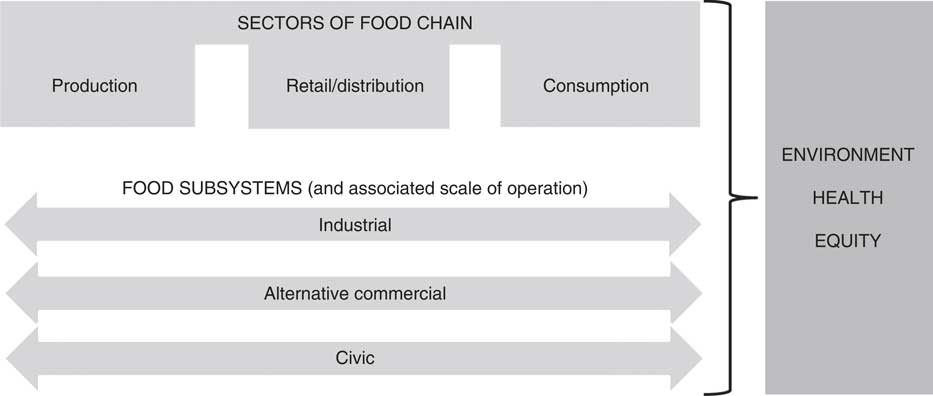
To do this arguably requires understanding and acting on the whole food system. To date, however, the lack of research that takes a whole-of-system perspective means that there is not an empirical basis on which to ascertain how best to intervene in an integrated manner. To help address this evidence gap, the present paper takes a whole-of-food-system perspective, investigating the food supply chain from production to distribution and consumption and through the various food subsystems (industrial, alternative commercial and civic) to determine their efficacy in achieving improved environmental, health and equity outcomes in an urban setting (summarised in Fig. 1).
A whole-of-system approach to understanding the interrelationship between food sectors, subsystems, environmental change, health and equity
The paper begins by briefly examining the contemporary literature on food systems, climate change and human health. This review illustrates the siloed nature of current empirical research and the privileging of particular food subsystems and their associated scales of operation in current agendas for change. We then present an overview of empirical evidence generated through a 3-year, Australia-based research project concerned with climate change adaptation, cities, food systems and health( 10 ).Footnote * To incorporate the often disparate themes of food and sustainability, food and health, and food and health equity, the project comprised three interconnected aims: (i) assess the environmental footprint of an urban food supply; (ii) identify the availability and affordability of nutritious and environmentally friendly foods; and (iii) assess the acceptability of environmentally friendly foods across a range of socio-economic groups. A key goal of the study was to provide an empirical evidence base on which to interrogate the prevailing conceptual and fragmented arguments for food system change. As the capstone to the research project, the present paper undertakes this meta-analysis, synthesising findings from the three domains of the research to provide an integrated overview of Sydney’s urban food system. Drawing on this analysis, the final section of the paper discusses key entry points for action across the whole food system. This suite of measures is intended to assist national and local governments and city planners create urban food systems that are adaptive to climate pressures and help ensure nutritious food is available and accessible to all communities in ways that mitigate further environmental harm.
Beyond scales and sectors – an assessment of the literature
The lack of whole-of-systems perspectives in current food research can partly be attributed to the complexity of food systems( Reference Malhi, Karanfil and Merth 11 ). This complexity in food systems is evident both horizontally, across sectors in the supply chain from production (producers and manufacturers) to distribution (retailers and food services) to consumption (consumers), and vertically, as these systems work across local, regional, national and global scales.
The multitude of factors operating within any food system means that creating environmentally resilient, equitable and healthy food systems requires the identification of strategic points at which intervention would be the most effective. To date, however, the small but growing body of work examining the need for whole-of-system change has been largely conceptual. Empirical research has focused predominantly on specific sectors (production, distribution and consumption) and/or scales of the food chain (local, regional, national and global)( Reference Ruge and Mikkelsen 12 – Reference Porter, Dyball and Dumaresq 18 ).
Sectors: the siloing of health and environmental food research
Environmental and health concerns have been the primary drivers of the renewed attention to food systems in the last decade. There is a substantial disconnect between these two research streams, however, as each has focused on different sectors of the food chain. This has contributed to a siloing of advocacy and policy in each area, with a lack of attention to the interrelated nature of health and environmental issues across the food system.
In the environmental sustainability literature, the emphasis has largely been on the production phase of the food chain( Reference Castellini, Boggia and Cortina 19 – Reference Lal 21 ). Agricultural production accounts for an estimated 14 % of greenhouse gas emissions worldwide( Reference Barker, Bernstein and Bogner 22 ). Certain aspects of production, such as the farming of ruminants (i.e. cows, goats and sheep) for meat, are considered particularly problematic due to their high greenhouse gas output( Reference Yip, Crane and Karnon 23 , Reference Gerber, Steinfeld and Henderson 24 ). The predicted drop in global agricultural production due to climate change and a parallel rise in world population have generated fears of future food insecurity and even, in the view of some, ‘a coming famine’( Reference Cribb 25 ). Other predicted changes, including a decline in fossil fuels needed for the global trade of foodstuffs and a rise of food-borne diseases, have exacerbated these concerns( Reference Edwards, Dixon and Friel 26 ).
Conversely, health-related food research, which incorporates equity concerns on issues such as food availability, accessibility, affordability and acceptability, has largely focused on the distribution and consumption sectors of the food chain( Reference Black, Macinko and Dixon 27 – Reference Lee and Lim 29 ). This research is often concerned with the dietary options available to urban populations, especially lower-income populations, through the industrial food system( Reference Gittelsohn, Franceschini and Rasooly 30 ).
To create resilient urban food systems for population health in a changing climate, however, it is necessary to move beyond this traditional siloed approach. Research instead needs to focus on the interconnections between health and environmental issues across the food system as a whole.
Scale: globalised industrial food subsystem through to localised civic subsystems
One common thread between environmental- and health-related food research and advocacy is that both areas have focused on the localisation of food production and distribution as a means to address the perceived problems of the prevailing industrial food subsystem( Reference McMichael and Friedmann 31 , Reference Dubbeling and Zeeuw 32 ).
The industrial food subsystem, with its focus on transnational food commodity producers, supermarket chains and the food-service sector, is the dominant system in most developed countries( Reference Burton, Lyons and Richards 33 ). Few would question the efficiencies introduced by this type of food system due to the scale and technological sophistication of the supply chain of producers, processors and logistics enterprises( Reference Roggeveen 4 ). However, the industrial model is associated with widespread land degradation and pollution, and stresses the ecosystem services that society is reliant upon for sustaining production for future generations( Reference Naylor, Steinfeld and Falcon 34 , Reference McMichael, Powles and Butler 35 ). Industrial food systems have also increasingly produced large volumes of highly processed foods. When over-consumed, these foods are associated with adverse health and environmental impacts due to their typically energy-dense and nutrient-poor compositions and the additional environmental resources (water and energy) required for production( Reference Monteiro 36 ). Due to these traits the industrial system is viewed by many as the least resilient of the three food subsystems, being most vulnerable to economic and social disruptions and potentially to environmental disruptions caused by climate change( Reference Dahlberg 37 ).
The ethical, social and environmental problems associated with the industrial food subsystem have led to a championing of local, alternative options such as urban agriculture as a solution to food system problems( Reference Dubbeling and Zeeuw 32 , Reference Harris 38 ). In these discourses, civic and alternative commercial subsystems are associated with local or regional scales and the industrial subsystem is associated with the global and sometimes national scale( Reference Morgan, Marsden and Murdoch 39 ). The underlying assumption within much of this literature that local and/or alternative food systems create better environmental, health and equity outcomes has, however, been challenged by recent research( Reference Brodt, Kramer and Kendall 40 – Reference Born and Purcell 42 ). Furthermore, the apparent conflation of scale and subsystems is not necessarily accurate: industrial subsystems operate at the geographically local level and ‘alternative’ subsystems can operate at national and global levels.
These considerations bring into question whether focusing on localised alternative subsystems is the most effective approach for creating resilient urban food systems. The lack of empirical research examining the relative efficacy of different subsystems in achieving environmental, health and equity outcomes within a whole-food-system framework, however, means that it is difficult to ascertain how best to intervene( Reference Edwards-Jones, Milà i Canals and Hounsome 43 ).
Methods
The present paper addresses the identified evidence gap of whole-of-system perspectives by drawing together empirical research generated through a 3-year, Australia-based mixed-methods research project (led by one of the authors of this paper, S.F.) focused on climate change adaptation, cities, food systems and health( 10 ). The aims of the project were to scope the existence of urban food subsystems in a location in Australia; examine their relationship with population health, equity and environmental health; and describe possible policy options to ensure climate-resilient urban food systems that protect human and environmental health. An overarching goal of the project was to provide an empirical evidence base on which to interrogate the prevailing conceptual and fragmented arguments for food system change. To achieve this goal, the project comprised three interconnected but distinct domains of research on Sydney’s food chain encompassing production, distribution and consumption, and focused on the following research questions.
-
1. Domain 1: Environmental footprint of food subsystems: how do they differ?
-
2. Domain 2: Sustainable and healthy food consumption: issues of availability, affordability and access from urban food subsystems.
-
3. Domain 3: Creating a demand for sustainable and health food consumption: citizens’ views, practices, and access to healthy and sustainable foods.
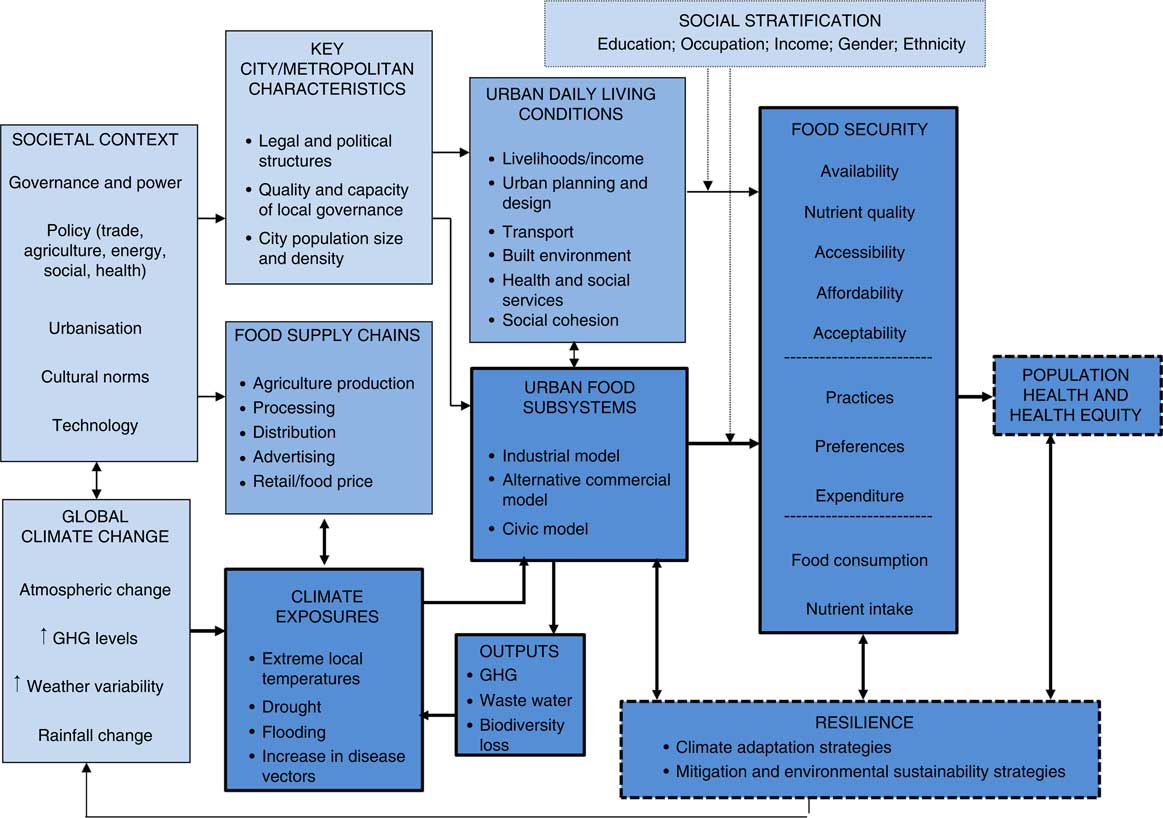
Figure 2 provides a diagrammatic representation of the intersections between climate change, cities, food systems and population health and provides the context for these three domains.
(colour online) Interplay between climate change, cities, food security and population health (GHG, greenhouse gas)
The key research findings from these three domains form the foundation for the present paper. As the capstone to this research, the paper aims to synthesise these key findings and present a whole-of-systems perspective on Sydney’s food system. The paper uses the higher-order results from the three research domains to provide the empirical evidence base for this whole-of-systems analysis. In illustrating the interconnected and interdependent nature of the food system, this whole-of-systems perspective allows our research to move beyond the siloed nature of previous research in the food, environment and health area. This is critical in enabling the identification of key points for intervention across the system as a whole identified in our discussion.
Location of study
The study was located in Greater Western Sydney (GWS) in the state of New South Wales, Australia. This region was selected as the primary geographic area of reference as it defines a political, social and economic area that demonstrates many issues regarding the problems of sourcing a healthy and sustainable diet for a large and growing urban population in a developed nation( Reference Mason, Dixon and Isaacs 3 ). New South Wales has the largest proportion of urban dwellers in Australia, with more than 60 % of the 7 million urbanites living in Sydney, the State capital. GWS is characterised by high levels of social disadvantage( 44 ). Despite the fact that the Sydney Basin has fertile soils, agricultural land in the region has been declining steadily for years and GWS is heavily reliant on food produced elsewhere( Reference Malcolm and Fahd 45 ). Currently, only four out of forty-one Local Government Areas in the region consider food production in local council legislation( Reference Noble 46 ). GWS is also likely to be adversely impacted over the long term by climatic changes that will produce conditions that are warmer and drier, with associated increases in evaporation and heat waves, further threatening regional food production( 47 ).
Main findings from the research project domains
The following sections presents the headline results from the three domains of the research project. These findings provide the empirical basis for the subsequent integrated analysis and discussion of Sydney’s food system as a whole.
Domain 1: Environmental footprint of food subsystems: how do they differ?
The environmental impact of production is a key focus of current international research concerned with identifying ways to reduce greenhouse gas emissions and supporting adaptive capacity to address food security concerns( Reference Alder, Barling and Dugan 48 ). Domain 1 of the project examined the environmental footprints of a selection of foods from different urban food production systems. Assessing the vulnerability and opportunities for mitigation in food subsystems can be done using life-cycle analysis (LCA)( Reference Garnett 49 ). In the present study, LCA was performed on two food commodities (chicken meat and lettuce) produced from two food subsystems (industrial and civic).
For a detailed description of the study design and results, see Hall et al.( Reference Hall, Rothwell and Grant 50 ). In brief, the two food commodities chosen were important in dietary terms regarding quantity consumed and nutritional value, as well as significant production in Sydney by different food systems. The LCA undertaken were: (i) compare the environmental health impact of the production of 1 kg of chicken meat in the industrial subsystem and the civic system; and (ii) compare the environmental health impact of the production of 1 kg of lettuce in the industrial system and the civic system.
In both the chicken and lettuce LCA, the most environmentally influential stages of the supply chain were found to be the production and processing stages, with retail and food preparation/cooking having relatively little environmental impact.
Chicken
From the LCA it appears that industrial chicken is less CO2 intensive than civic production, due to lower land use per chicken, shorter life spans (which means less feed is required per chicken compared with civic system) and less feed per chicken (feed is the key component of CO2 emissions for chicken production).
Lettuce
The results of the LCA identified that civic production of lettuce is less environmentally intensive than industrial lettuce, with the main influence on carbon efficiency being the use of commercial fertiliser, cow manure and industrially produced seed.
Domain 2: Sustainable and healthy food consumption: issues of availability, affordability and access from urban food subsystems
The importance of integrating environmental considerations into people’s food choices is now recognised as a significant component of both adaptation and mitigation policy responses concerned with sustainability, food security and health( Reference O’Halloran, Fisher and Rab 51 – 60 ). Adoption of sustainable diets among urban populations has at least two important benefits: (i) stresses on ecosystem services may be reduced, which in turn helps reduce food-related climate change impacts; and (ii) such a mantra helps foster the consumption of healthy and nutritious foods, which in turn fosters a reduction in chronic disease. There are, however, gaps in the evidence base concerning which type of food subsystem (industrial, alternative commercial and civic) best provides consumers with a healthy and sustainable diet (hereafter ‘H&S diet’) and the cost of the H&S diet from different food subsystems relative to a typical diet.
In Domain 2 of the project we first outlined what an H&S diet might contain based on three principles: (i) reducing overconsumption; (ii) reducing consumption of discretionary foods; and (iii) eating less animal-derived foods and more plant-based foods. Second, we assessed the availability, affordability and accessibility of an H&S diet across different food subsystems in GWS in five different socio-economic neighbourhoods, surveying eighty-two food provisioning outlets. For a detailed description of the study design and results, see Friel et al. and Barosh et al.( Reference Friel, Barosh and Lawrence 61 , Reference Barosh, Friel and Engelhardt 62 ).
Retail outlets and issues of availability and accessibility of a healthy and sustainable diet
The survey found the total number of food provisioning subsystems was higher in the more socio-economically disadvantaged study sites. However, availability of alternative food systems compared with industrialised outlets increased with the socio-economic status of the neighbourhood. There was a large discrepancy in the availability of food items between the food provisioning subsystems: overall, the availability of the typical and H&S diet food items was very limited in alternative and civic food provisioning systems. In each study site, the travel distance to each food outlet via a road network was outside the ideal, a maximum walking distance (500 m)( Reference Bostock 63 ). Given the lack of walkability to food outlets in the study sites, accessibility by distance and car ownership were found to favour advantaged areas( Reference O’Dwyer and Coveney 64 , Reference Coveney and O’Dwyer 65 ).
Affordability of a healthy and sustainable diet
The cost of the H&S diet was greater than the typical basket in all five socio-economic neighbourhoods, with the most disadvantaged neighbourhood having to spend relatively more (30 %) to purchase the healthy and sustainable basket. When analysed according to household income, households in the lowest income quintile would have to spend up to 48 % of their weekly income to purchase the healthy and sustainable basket, while households in the highest income quintile would have to spend significantly less of their weekly income (9 %).
Domain 3: Creating a demand for sustainable and health food consumption: citizens’ views, practices, and access to healthy and sustainable foods
Consumers are increasingly encouraged to become ecological citizens and much literature exists on alternative communities’ transition to sustainable living( Reference Sherriff 66 ). Mainstream consumers are less understood in this regard, particularly the experience of people in socio-economically disadvantaged urban areas. The creation of climate-resilient urban food systems requires an H&S diet not to be considered only ‘yuppie chow’( Reference Guthman 67 ); rather it must be adopted by the mainstream population. In Domain 3 of the study, we undertook qualitative research in three different socio-economic areas of Sydney, with the aim of uncovering mainstream consumers’ views towards sustainable and healthy diets. For a detailed description of the study design and results, see Dixon and Isaacs( Reference Dixon and Isaacs 68 ). In brief, interviews were undertaken with households in a low, middle and high socio-economic status area in Western Sydney to investigate the food provisioning practices. Many participants indicated a discrepancy between the food practices they wished to practise, such as buying more Australian produce, and the reality of what actually occurred. This discrepancy was attributed at least in part to cost. Even in terms of the practices people would like to implement, however, the environment did not rate highly in the concerns of the majority and a low priority was accorded to the purchase of sustainably credentialed foods. How mainstream consumers construe nutritious (as fresh food, preserving family ties, entertainment and pleasure, rather than nutritionally recommended food groups) and local foods (Australian made) appears to be at odds with the definitions set out in official public health guidelines, by council food planners and the local food movement( Reference Dixon and Isaacs 68 ).
A whole-food-system approach to climate adaptation, resilient food systems and urban population health
Moving along the food chain, from production to distribution to consumption, the findings from this three-domain research project created a cumulative picture of the points of pressure and possibility to improve climate resilience equity and population health within the urban food chain. The key findings were as follows: (i) While it has been the focus of much work around the environmental sustainability of the food system, addressing the production sector alone will not create a more resilient urban food system. The results of our study affirm the significance of the production sector in terms of greenhouse gas output and therefore for reducing environmental impact. They do not indicate, however, that localised, alternative subsystems are necessarily more sustainable than the industrial production. Illustrating that there is not a particular mode or subsystem of production that is always more sustainable, our findings suggest it is not only how food is produced but also what types of food are produced, and in what volume, that needs to be considered for environmental sustainability. LCA also, critically, does not incorporate health or equity concerns and so cannot be relied upon as primary indicator of the resilience of urban food systems when incorporating these concerns. Such an objective requires a more comprehensive view of the food chain that includes the distribution and consumption sectors. (ii) It is important then to determine a diet that is both healthy and sustainable. It is also necessary for the consumer to be able to attain it. In this regard, the study findings illustrate the need to improve access, affordability and availability of H&S diet options in urban areas. This is a complex process, requiring an increase in the diversity of retail outlets across neighbourhoods, greater diversity of sustainable food items available within the outlets and consideration of the real cost of healthy and sustainable living. (iii) Finally, our research indicates that it is not enough to simply have healthy and sustainable options available to urban consumers in order to ensure healthy and sustainable consumption. The consumer desire and ability to take up the options in the context of other daily activities and needs are critical. It is therefore necessary to identify from a consumer perspective the key barriers to, and opportunities for, consumption of an H&S diet.
Our analysis of the GWS food system illustrates that issues of urban population health and sustainability cannot be addressed with a focus on just one sector or scale of the food system. The interrelationship and interconnectedness of the various sectors and subsystems indicates that they must all be engaged to improve outcomes across the food chain. In summary, the requirements for achieving a climate-resilient food system for population and environmental healthy are (at least) threefold: there must be healthy and environmentally sustainable food options produced, consumers must be able to easily attain these goods and they must also want to buy them.
In terms of the transferability of the study results, Sydney is a ‘global’ city. It has a similar food system to many other large industrialised countries such as North America or the UK. It is characterised by a dominant industrial subsystem with a concentration of food retail in supermarket chain stores served by long, global supply chains. It also features growing alternative food systems including civic and commercial alternatives. In this regard the conceptual framework on which our analysis is based (Figs 1 and 2), as well as the implications of our research findings, are transferable to other industrialised cities. Furthermore, the transferability of our findings is evidenced by the fact that the findings from each of the research domains are complementary and comparable to international evidence. In terms of the cost of an H&S diet as studied in Domain 2, for example, the capacity to afford healthy and sustainable food products was tested across all social gradients. Such social gradients occur in other developed countries across the world( Reference Mooney 69 , Reference Darmon and Drewnowski 70 ), therefore our findings in this regard are transferrable and comparable for other similar cities.
Based on our analysis of the food system at different scales and in different sectors, the following actions, we believe, are necessary to achieve these goals and improve the resilience of urban food systems for population and environmental health.
1. Develop multiple food subsystems: beyond local v. industrial
There has been much emphasis on localisation of food production to increase resilience of urban food systems( Reference Ruge and Mikkelsen 12 , Reference Hawkes 71 ). This has been supplemented by a view of the industrial system as problematic environmentally, ethically and health-wise( Reference Horrigan, Lawrence and Walker 72 ). Our study has found that the industrial system is efficient at producing two core dietary items (chicken and lettuce) and at least in the case of chicken, in a way that is less environmentally damaging than civic production. In terms of retail/distribution, the conventional outlets of large supermarket chains provided the greatest number of healthy and sustainable options, operating often in a vacuum of alternative retail outlet options.
Climate change is, however, likely to challenge many of the current efficiencies of the industrial system. Predictions suggest that as temperatures increase so will the requirement for inputs such as fertilisers, water and fuel to sustain production( Reference Larsen, Turner and Ryan 73 ). In distribution, there may be an even greater emphasis on energy-intensive cold chains and highly processed foods with a long shelf-life for food safety( Reference Lobstein, Friel and Dowler 74 ), with flow-on implications for food prices and the types of foods stocked by retailers and food vendors( Reference Lobstein, Friel and Dowler 74 ). A critical step for climate adaptation is to increase resilience and reduce vulnerability by incorporating diversity and flexibility within systems( Reference Edwards, Dixon and Friel 26 ). Adaptive capacity combined with ongoing mitigation provides major protection against vulnerability. Development of multiple sustainable food subsystems is therefore a strategic mechanism to increase resilience.
Our findings suggest that the different food subsystems should be seen as complementary, rather than conflicting, in creating resilient urban food systems. While alternative and local food subsystems may have the capacity to provide new and potentially more environmentally sustainable options across all sectors of the food chain, our research illustrates that this potential has not yet been realised. To contribute to a more resilient urban food system, alternative systems of production, distribution and consumption need to be strengthened and improved in a number of ways (see Table 1).
Summary of key action areas and policy directions for a whole-of-food-system approach to creating climate-resilient urban food systems improving sustainability, equity and population health

GHG, greenhouse gas; H&S diet, healthy and sustainable diet; SES, socio-economic status.
2. Improve health, equity and environmental sustainability across all sectors of the food system
Our findings also indicate that production itself is not the only, or even the most, important sector in the food chain in creating a more environmentally resilient and healthy food system. All sectors of the food system must be addressed, and improved, to reach this goal, specific strategies for which are detailed in Table 1. In addition to addressing production, the retail, distribution and consumption aspects of the food chain must be improved as they are the conduit through which consumers can access what has been identified as a H&S diet. Equity is a key concern here, with the need to ensure that healthy and sustainable food items are not only available but also accessible and affordable across the different geographic and socio-economic communities that comprise the urban population.
In addition to reducing structural barriers, consumers themselves have a critical role to play in the transformation of the urban food system. The small but expanding body of literature on H&S diets focuses primarily on the impact of particular dietary items and the need to change consumption habits in relation to these food items( Reference Saxe, Larsen and Mogensen 75 , Reference Vieux, Darmon and Touazi 76 ). The emphasis, therefore, is principally on individual consumer choices. The findings of our consumer research in Domain 3 support this conclusion to the extent that it affirmed the importance of consumer choice in moving towards an H&S diet. It is clear that unless consumers think it is sufficiently important to change their current shopping habits they will not move to an H&S diet.
Addressing the barriers identified by consumers to consumption of an H&S diet, such as equity concerns around cost and accessibility, cannot be left purely to the marketplace. Taking locally produced fresh food as an example, when left to market demand farmers’ markets often struggle to survive in lower-income neighbourhoods( Reference Markowitz 77 , Reference Colasanti, Conner and Smalley 78 ). People in higher socio-economic neighbourhoods have more discretionary income and so can more easily afford healthy and sustainable items such as farm fresh fruit and vegetables. In addition, among many people in middle to high income groups, purchasing local food has become a social more( Reference Zukin 79 ). To shift the perception of healthy and sustainable food as the domain of wealthy, middle-class consumers and encourage greater consumption across the urban population requires addressing the systemic barriers around access, affordability and availability. This requires a comprehensive approach encompassing all sectors of government.
3. Whole-of-government approach
In Australia there is no government department for food. Instead responsibilities for different aspects of the food system sit with a wide range of departments( Reference Crammond, Van and Allender 80 ). Creating comprehensive food system change and encouraging the consumption of an H&S diet would require the engagement of departments as diverse as agriculture, health, the environment, climate change, trade, regional development, and community and family services. It would also require integrated action across the different levels of government in Australia – local, state and federal – as they all have responsibility for different aspects of the food system( Reference Shill, Mavoa and Allender 81 ).
Rather than rely on one measure to create change, a whole-of-government approach would require a range of policy actions working together to achieve a common goal–policy coherence( Reference Crammond, Van and Allender 80 ). This suite of policies could include regulatory, information and/or market based options, as outlined in Table 1.
Conclusion
The present research has illustrated the need to move beyond a scales-and-sectors approach to one that embraces the whole food system, if climate-resilient and healthy urban food systems are to be achieved. While there are specific actions that can be undertaken in each sector of the food chain and at difference scales in the system, these need to be undertaken as part of a comprehensive agenda to address the food system as a whole.
In asserting the need for a whole-of-systems perspective, these findings bring into question the assumption that going ‘local’ and rejecting the industrial food system addresses many of the current environmental and health problems of the urban food system. In contrast, our research indicates that all food subsystems have benefits and limitations in achieving better food-related environmental and health outcomes for our cities.
Acknowledgements
Acknowledgements: The authors would like to thank Clare Lawlor for her contribution to earlier drafts on the paper and Gillian Hall and Jane Dixon for their contributions as leads for research domains 1 and 2. Financial support: This research received support from the Climate and Health Cluster which is funded by the CSIRO Flagship Collaboration Fund. The funder had no role in the design, analysis or writing of this article. Conflict of interest: None. Authorship: S.F. and S.W.J. contributed to the conception and design, analysis and interpretation of data, and drafting of the article. Ethics of human subject participation: The study was approved by the Australian National University Ethics Committee.



