INTRODUCTION
Isoflavones, genistein in particular, present in the crude peel extract of Flemingia vestita (Rao and Reddy, Reference Rao and Reddy1991), act as a vermifugal, if not a vermicidal, against several intestinal trematodes and cestodes (Roy and Tandon, Reference Roy and Tandon1996; Tandon et al. Reference Tandon, Pal, Roy, Rao and Reddy1997). These isoflavones, as shown from earlier studies, cause flaccid paralysis in trematodes and cestodes, deformity and alterations in the tegumental architecture, and activation of several enzymes that are associated with the tegument (Tandon et al. Reference Tandon, Pal, Roy, Rao and Reddy1997; Pal and Tandon, Reference Pal and Tandon1998a, Reference Pal and Tandonb). The changes in the tegumental architecture are attributed to the permeability changes in the tegument due to an alteration in the Ca2+ homeostasis of the parasite (Das et al. Reference Das, Tandon and Saha2006). The activity of the enzymes associated with the co-ordination system, non-specific esterases and acetylcholine esterease in particular, was also shown to be influenced by these isoflavones (Pal and Tandon, Reference Pal and Tandon1998c), as was the activity of nitric oxide synthase (NOS), the free amino acid pool and tissue ammonia (Tandon et al. Reference Tandon, Pal and Saha1998; Kar et al. Reference Kar, Tandon and Saha2002, Reference Kar, Tandon and Saha2004). The plant-derived isoflavones also affected the carbohydrate metabolism in Rallietina echinobothrida (Tandon and Das, Reference Tandon and Das2007).
Recent studies have shown that nitric oxide (NO) – synthesized from L-arginine and molecular oxygen by the enzyme NOS (Nelson and Cox, Reference Nelson and Cox2004) – has anti-leishmanial (Holzmuller et al. Reference Holzmuller, Cavaleyra, Moreaux, Kovacic, Vincendeau, Papierok and Lemesre2005), anti-malarial (Cramer et al. Reference Cramer, Nussler, Ehrhardt, Burkhardt, Otchwemah, Zanger, Dietz, Gellert, Bienzle and Mockenhaupt2005) and anthelmintic effects (Mahmoud and Habib, Reference Mahmoud and Habib2003). The biological effects of NO are generally assumed to be attributable to the activation of soluble guanylyl cyclase by nitrosation of its haem moiety, leading to cGMP accumulation (Ignarro, Reference Ignarro1990; Lincoln and Cornwell, Reference Lincoln and Cornwell1993; Hobbs, Reference Hobbs1997). The subsequent increase in cGMP level is involved in many cellular functions by altering mainly three target proteins, the cGMP-regulated ion channels, cGMP-regulated phosphodiesterases and protein kinase G (Schmidt et al. Reference Schmidt, Lohmann and Walter1993; Hofmann, Reference Hofmann2005). Besides NO, some hormones, e.g. insulin and oxytocin, as well as acetylcholine and biogenic amines like serotonin and histamine, cause an increase in the cGMP levels (Tremblay et al. Reference Tremblay, Gerzer and Hamet1988). Stimulators of guanylate cyclase such as the vasodilators, namely, nitroprusside, nitroglycerin and sodium nitrate also stimulate cGMP levels (Collier and Vallance, Reference Collier and Vallance1989). Peptides such as atrial natriuretic factors (ANF) that relax smooth muscle also stimulate cGMP, which acts as secondary messenger for ANF (Sarcevic et al. Reference Sarcevic, Brookes, Martin, Kemp and Robinson1989). By cGMP immunostaining, the target cells for NO have been located in adult and larval stages of some platyhelminth parasites (Gustafsson et al. Reference Gustafsson, Terenina, Reuter and Movsessian2003; Terenina and Gustafsson, Reference Terenina and Gustafsson2003).
In furtherance of our objective to find out the plausible mode of the anthelmintic action of isoflavones form F. vestita, we studied the effect of these isoflavones on the accumulation of cGMP. In the present study, the isoflavones from the crude peel extract of F. vestita were tested in R. echinobothrida with respect to the NOS activity, NO efflux and cGMP concentration.
MATERIALS AND METHODS
Plant extract and its fractions
The alcoholic crude peel extract of F. vestita and its hexane (non-polar), ethyl acetate (semi-polar) and n-butanol (polar) fractions were obtained following the procedure as described earlier (Tandon et al. Reference Tandon, Pal, Roy, Rao and Reddy1997). Crude peel extract and its different fractions were collected and tested against the cestode parasite.
Chemicals and reagents
Genistein (G 6649) and the enzyme immunoassay cGMP kit (CG-201) were obtained from Sigma Chemicals (St Louis, USA). The required enzymes and co-enzymes were from either Sigma or Roche (Germany), whereas the reference drug, praziquantel (PZQ), was from Bayer (India). Other necessary chemicals were of analytical grade and from Sisco Research Laboratory (India). For all chemical preparations deionized double-distilled water was used.
In vitro treatments
Live parasites from the intestine of freshly slaughtered domestic fowl (Gallus domesticus) were collected in 0·9% phosphate-buffered saline (PBS, pH 7·2) and immediately exposed to various treatments. Parasites, approximately 0·2 g wet weight, were incubated in 10 ml of PBS at 38±1 °C with defined concentrations of various treatments, i.e. 5 mg/ml each of (i) the crude peel extract, (ii) its hexane-, (iii) ethyl acetate- and (iv) n-butanol-fractions, (v) 0·2 mg/ml genistein, (vi) 1·5 mg/ml sodium nitroprusside (SNP) and (vii) 1 μg/ml PZQ, dissolved in 1% dimethylsulfoxide (DMSO), with maintenance of respective controls containing only 1% DMSO in PBS. Parasites from a single host were taken for each set of treatments and the treated parasites and their respective controls were retrieved from the incubation media at the time when paralysis started to set in and were processed for assay of NOS activity and estimation of the cGMP concentration in the parasite tissue, and NO release into the culture medium from the incubated parasites.
NOS assay
A 10% (w/v) homogenate of the treated parasites as well as their respective controls was prepared in a homogenizing buffer containing HEPES buffer (20 mm, pH 7·2), mannitol (250 mm), EDTA (1 mm), DTT (1·5 mm) and PMSF (0·1 mm) using a Potter-Elvehjem glass homogenizer. The homogenate was treated with 0·5% (v/v) Triton X-100 at a 1:1 ratio for 30 min and sonicated for 30 sec using a sonicator (Soniprep 150, UK) and centrifuged for 10 min at 10 000 g. The supernatant was used for the measurement of NOS activity. All the steps were carried out at 4°C.
NOS activity was assayed following the method of Salter and Knowles (Reference Salter, Knowles and Titheradge1998) with certain modifications. The reaction mixture (1 ml) contained potassium phosphate buffer (50 mm, pH 7·2), L-arginine (50 mm), MgCl2 (1·2 mm), CaCl2 (0·25 mm), NADPH (0·15 mm), urease (20 U) and enzyme source (0·05 ml). The reaction mixture was incubated at 38°C for 15 min and 1 ml of 10% perchloric acid (PCA) (v/v) was added to stop the reaction. The reaction mixture was centrifuged to precipitate out the protein. The citrulline concentration, formed in the reaction mixture, was estimated spectrophotometrically at 490 nm against a reagent blank, in which 10% PCA (v/v) was added before addition of the enzyme source, following the method of Moore and Kauffman (Reference Moore and Kauffman1970). One unit of enzyme activity is the amount of enzyme catalysing 1 μmole of citrulline formation/h at 38°C.
NO estimation
Cestode parasites were incubated in 10 ml of PBS at 38±1°C with different concentrations of treatments, with maintenance of respective controls, as described in the section ‘In vitro treatments’. At every hour, 1 ml of incubation medium was removed until the paralysis time for estimation of NO released by the parasite was reached, and was then centrifuged at 600 g for 10 min to precipitate out the debris, if any. NO is oxidized mainly to nitrite (NO2−) with little or no formation of nitrate in oxygenated aqueous solution in the absence of oxyhaemoglobin (Ignarro et al. Reference Ignarro, Fokoto, Griscarage, Rogers and Byrns1993). NO2− concentration in the incubation medium, which is equivalent to NO efflux by the cestode parasite, was estimated spectrophotometrically at 540 nm following the Griess reaction as described by Sessa et al. (Reference Sessa, Pritchart, Seyedi, Wang and Hintz1994). NO2− concentration in the incubation medium was calculated against the standard curve of sodium nitrite.
cGMP estimation
For quantitative determination of the cGMP concentration in the parasite tissue, the enzyme immunoassay cGMP kit (CG-201, Sigma) was used.
Immediately after paralysis, the treated parasites and the controls were frozen. A 10% homogenate was made in 5% cold TCA using a motor-driven Potter-Elvehjem glass homogenizer. The homogenate was centrifuged for 10 min at 600 g and the supernatant was collected in 3 volumes of water-saturated ether. After drying the aqueous extracts, the reconstituted samples were taken for quantitative estimation of cGMP.
Each sample of 100 μl, in duplicate, was placed into microtitre plate wells coated with goat anti-rabbit IgG and 50 μl of alkaline phosphatase conjugated with cGMP was added to each well. The plate was incubated on a plate shaker for 2 h at room temp after adding 50 μl of rabbit IgG to cGMP. The wells were washed 3 times with washing buffer, and then 200 μl of p-nitrophenyl phosphate were added to each well and the plate was incubated for 1 h at room temperature without shaking. The reaction was stopped by adding 50 μl of trisodium phosphate to each well and the plate was read immediately at 405 nm using an ELISA plate reader (Multiskan Ex Primary EIA V. 2.1-0). The intensity of the colour is inversely proportional to the concentration of cGMP in the samples.
The concentration of cGMP in the parasite tissue was calculated against the standard curve of cGMP on 5 Cycle Log-Log paper.
Data analysis
Data are presented as the means±s.e.m. (n=4) and a value of P⩽0·05 was taken to be statistically significant. Using Student's t-test, comparisons of the paired mean values were calculated between the treatments and the respective controls.
RESULTS
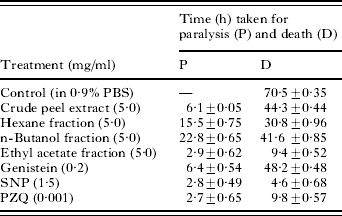
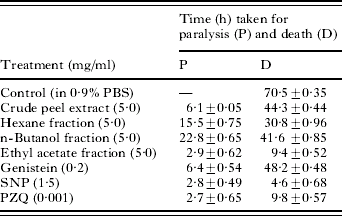
Table 1 shows the paralysis time in the cestode parasite under different treatment conditions. At the defined concentrations of various treatments, a flaccid paralysis takes place in the parasite in about 6 h in the case of crude peel extract and genistein and in about 3 h in the case of the ethyl acetate fraction, SNP and PZQ. Hexane and n-butanol fractions of the crude peel extract of F. vestita had lesser effects. The control parasites, survived in vitro for about 71 h.
Efficacy of different test materials on Raillietina echinobothrida in vitro
(Values are expressed as means±s.e.m. (n=5).)
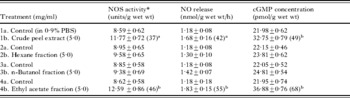
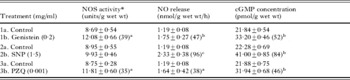
The tissue activity of NOS (Tables 2 and 3) was found to be significantly increased in the parasites exposed to various treatments except for the hexane and n-butanol fractions of the crude peel extract. In the control parasites, the tissue activity of NOS was found to be approximately 8–9 units/g wet wt. The activity increased by 37% and 46% after exposure to the crude peel extract and its ethyl acetate fraction, respectively, while there was no significant increase in treatments with the other fractions. Treatments with pure genistein and PZQ resulted in an increase of the NOS activity by 39% and 35%, respectively, in comparison to their respective controls.
Effects of different test materials on NOS tissue activity (units/g wet wt), NO release (nmol/g wet wt/h) into the culture medium and cGMP concentration (pmol/g wet wt) in Raillietina echinobothrida in vitro at the time of paralysis
(Values are expressed as means±s.e.m. (n=4). Percentage increase of NOS tissue activity, NO release and cGMP concentration compared to respective controls are given within parentheses, only if significant.)

* One unit of enzyme activity is the amount of enzyme catalysing 1 μmole of citrulline formation/h at 38°C.
a, b : P values significant at <0·05 and <0·01, respectively.
Effects of different test materials on NOS tissue activity (units/g wet wt), NO release (nmol/g wet wt/h) into the culture medium and cGMP concentration (pmol/g wet wt) in Raillietina echinobothrida in vitro at the time of paralysis
(Values are expressed as means±s.e.m. (n=4). Percentage increase of NOS tissue activity, NO release and cGMP concentration compared to respective controls is given within parentheses, only if significant.)

* One unit of enzyme activity is the amount of enzyme catalysing 1 μmole of citrulline formation/h at 38°C.
a, b, c : P values significant at <0·05, <0·01 and <0·001, respectively.
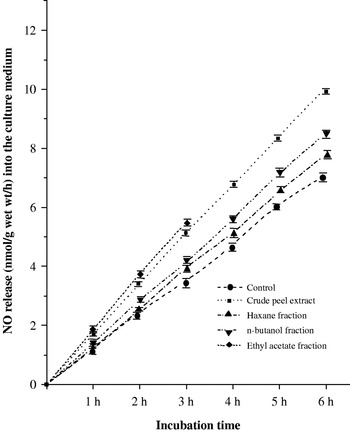
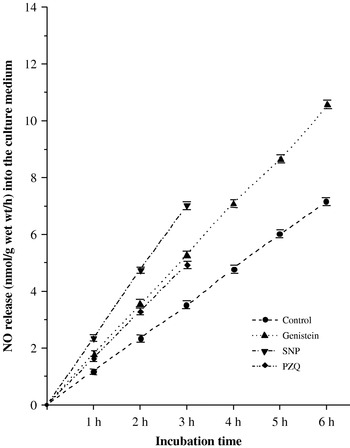
The increased NOS activity in the treated parasites was accompanied by a significant increase in the NO efflux into the incubation medium (Tables 2 and 3, Figs 1 and 2). Though there was a continuous NO efflux (about 1·19 nmol/g wet wt/h) into the medium by the control parasites, there was a significant increase in the NO efflux (38–96%) in the treated parasites, excluding hexane and n-butanol fractions of the crude peel extract.
Effect of crude peel extract of Flemingia vestita and its fractions on NO release (nmol/g wet wt) by Raillietina echinobothrida into the culture medium at the time of paralysis. NO release, which is equivalent to the NO2− formation in the culture medium, was estimated spectrophotometrically at 540 nm following the Griess reaction.

Effect of genistein, sodium nitroprusside and praziquantel on NO release (nmol/g wet wt) by Raillietina echinobothrida into the culture medium at the time of paralysis. NO release, which is equivalent to the NO2− formation in the culture medium, was estimated spectrophotometrically at 540 nm following the Griess reaction.

The concentration of cGMP, which is the mediator of the NO action in several cells, was found to be about 22 pmol/g wet wt in the control parasite tissue. At the paralysis time, the cGMP concentration in the parasite tissue increased significantly (P<0·001) by 84% after the SNP treatment, and by 49%, 68%, 52% and 46% after incubation in the crude peel extract, ethyl acetate fraction, genistein and PZQ, respectively.
DISCUSSION
With exposure to the defined concentrations of the crude peel extract and genistein, the onset of paralysis occurred in the parasite, R. echinobothrida, after ∼6 h of incubation, whilst in the case of the ethyl acetate fraction, SNP and PZQ it occurred in ∼3 h. These treatments caused rapid muscular contraction followed by paralysis; however, the mode of action of paralysis is not well understood. Serotonin is reported to also induce a dose-dependent, heterologous flaccid paralysis in Schistosoma mansoni (Blair et al. Reference Blair, Bennett and Pax1993).
Different workers have demonstrated the presence of NOS in various helminth groups. The first indication of the occurrence of nitregic mechanisms in the nervous system of parasitic flatworms was provided in Hymenolepis diminuta, in which NADPH-d positive neurons were demonstrated (Gustafsson et al. Reference Gustafsson, Lindholm, Terenina and Reuter1996). Thereafter, neuronal NOS (nNOS) activity was observed in Fasciolopsis buski, H. diminuta, Fasciola hepatica and some free-living flatworms (Gustafsson et al. Reference Gustafsson, Lindholm, Mäntylä, Reuter, Lundström and Terenina1998; Tandon et al. Reference Tandon, Kar and Saha2001; Terenina et al. Reference Terenina, Onufriev, Gulyaeva, Lindholm and Gustafsson2000, Reference Terenina, Onufriev, Gulyaeva, Moiseeva and Gustafsson2003). Recently, NOS activity or immunoreactivity was demonstrated in S. mansoni (Kohn et al. Reference Kohn, Moroz, Lea and Greenberg2001, Reference Kohn, Lea, Moroz and Greenberg2006). In the present study, the activity of NOS was observed in the whole worm homogenate of R. echinobothrida.
The production of NO from L-arginine by NOS is regulated by various modulators (Nelson and Cox, Reference Nelson and Cox2004). In the present study, the NOS activity in the cestode R. echinobothrida, was found to be approximately 8–9 units/g wet wt in the control parasites, whilst it was significantly (P<0·05) increased by 35–46% when the parasites were exposed to the crude peel extract of F. vestita and its ethyl acetate fraction, which is known to contain genistein (Rao and Ready, Reference Rao and Reddy1991). The increase in the NOS activity was comparable when the parasites were treated with pure genistein and PZQ. In mammals, constitutive enzymes (eNOS and nNOS) are calcium dependent (Nathan and Xie, Reference Nathan and Xie1994) and an increase in the activity of NOS in the PZQ-treated parasites could be explained in the light of PZQ-mediated calcium efflux in the cestode parasite, R. echinobothrida. The crude peel extract of F. vestita, genistein and PZQ caused a dose-dependent calcium efflux in the parasite (Das et al. Reference Das, Tandon and Saha2006). The activation of NOS could be perhaps due to the covalent modification of the enzyme, as it seems unlikely to be due to induction of the enzyme in the very short span of time (Stuehr, Reference Stuehr1999). The increase in the NOS activity in the parasite was accompanied by an increase in the NO efflux into the incubation medium by the treated parasites in comparison to the respective controls. It is known that oestrogen induces endothelium-dependent vasodilation, which is likely to be mediated, in part, by augmentation of NO release (Imthurn et al. Reference Imthurn, Rosselli, Jaeger, Keller and Dubey1997; Best et al. Reference Best, Berger, Miller and Lerman1998). Genistein is a phytoestrogen and in the present study it was shown to increase the NO efflux significantly (P<0·01) by 47% in the treated parasite; the NO efflux in the PZQ-treated parasite was also increased by 38% (P<0·05).
NO, being a sufficiently non-polar molecule, diffuses through cell membranes (Moncada et al. Reference Moncada, Palmer and Higgs1989) and its cellular functions are mediated by cGMP (Lincoln and Cornwell, Reference Lincoln and Cornwell1993; Hobbs, Reference Hobbs1997). As expected, the cGMP concentration became accumulated with an increased NO production in the treated parasites. An elevation in the intracellular concentration of cGMP in neutrophils is dependent on increased NO formation (by lipopolysaccharide) and is responsible for downstream signal transmission (Browning et al. Reference Browning, Windes and Ye1999). However, interestingly NO production caused a decline in the cGMP levels in H. diminuta (Onufriev et al. Reference Onufriev, Gulyaeva, Terenina, Tolstenkov and Gustafsson2005). Genistein has been shown to stimulate the osteoblastic proliferation and differentiation by increasing NOS activity, NO formation, and cGMP accumulation in BMSCs cultures (Pan et al. Reference Pan, Quarles, Song, Yu, Jiao, Tang, Jiang, Deng, Li, Zhou and Xiao2005). In the present study, genistein increased the NOS activity, NO efflux and cGMP concentration. However, beneficial effects of genistein have also been reported on atherosclerosis and chronic inflammatory diseases by way of inhibiting NO production (Sheu et al. Reference Sheu, Lai and Yen2001). Serotonin, which induces a dose-dependent, heterologous flaccid paralysis in S. mansoni, also causes an increase in the cGMP levels (Tremblay et al. Reference Tremblay, Gerzer and Hamet1988). Increased cGMP levels by NO mediate signalling pathways by opening Ca2+ channels (Breer and Shephard, Reference Breer and Shepherd1993). One of the important functions of the elevated cGMP by NO is to relax muscle contractions (Toda, Reference Toda and Vincent1995). Occurrence of flaccid paralysis due to rapid muscle contractions and changes in the Ca2+ homeostasis in R. echinobothrida, as observed during the treatments with crude peel extract of F. vestita (Das et al. Reference Das, Tandon and Saha2006), also supplement the action of elevated cGMP concentration in the parasite tissue. These results show that isoflavones, genistein in particular, from F. vestita, elevate the cGMP level, which plays a major role in the downstream signal pathways in the parasite, and might also account for the various detrimental effects in the parasite under the resultant anthelmintic stress.
Financial support to B. D. through the DST-SERC Fast Track Scheme (SR/FT/L-107/2004 dated May 04, 2005), GOI, is gratefully acknowledged. We thank the Head, Department of Zoology, and Coordinator, Bio-informatics Centre, NEHU, for providing the infrastructure and on-line facilities, respectively.