





For my sisters far and near
1. The world’s casita/home
As I viewed Super Bowl LX from Down Under in February 2026, I was like millions of viewers worldwide floored by the jubilant carnival of Latin American culture showcased by Bad Bunny (aka, Benito Antonio Martínez Ocasio). The Puerto Rican superstar evinced that “local audiences are for music that transcends language” by smashing attendance records for his Spanish-only shows in Sydney, Australia’s largest city.Footnote 1 Yet this trend travelled far beyond Oz: Bad Bunny’s performance garnered over 4.157 billion views in 24 hours through global broadcast, YouTube, and social media platforms.”Footnote 2 The colourful spectacle featured agricultural workers, street vendors, streetwise friends, and other familiar staples of the Puerto Rican barrio-pueblo. According to Kiki Intarasuwan, Bad Bunny paid “tribute to his homeland” with the pop star breezing “through palm trees, sugar cane and other vegetation native to Puerto Rico” and emerging atop the roof of a cozy structure called la casita, or small house/home, to sing “Yo Perreo Sola.”Footnote 3
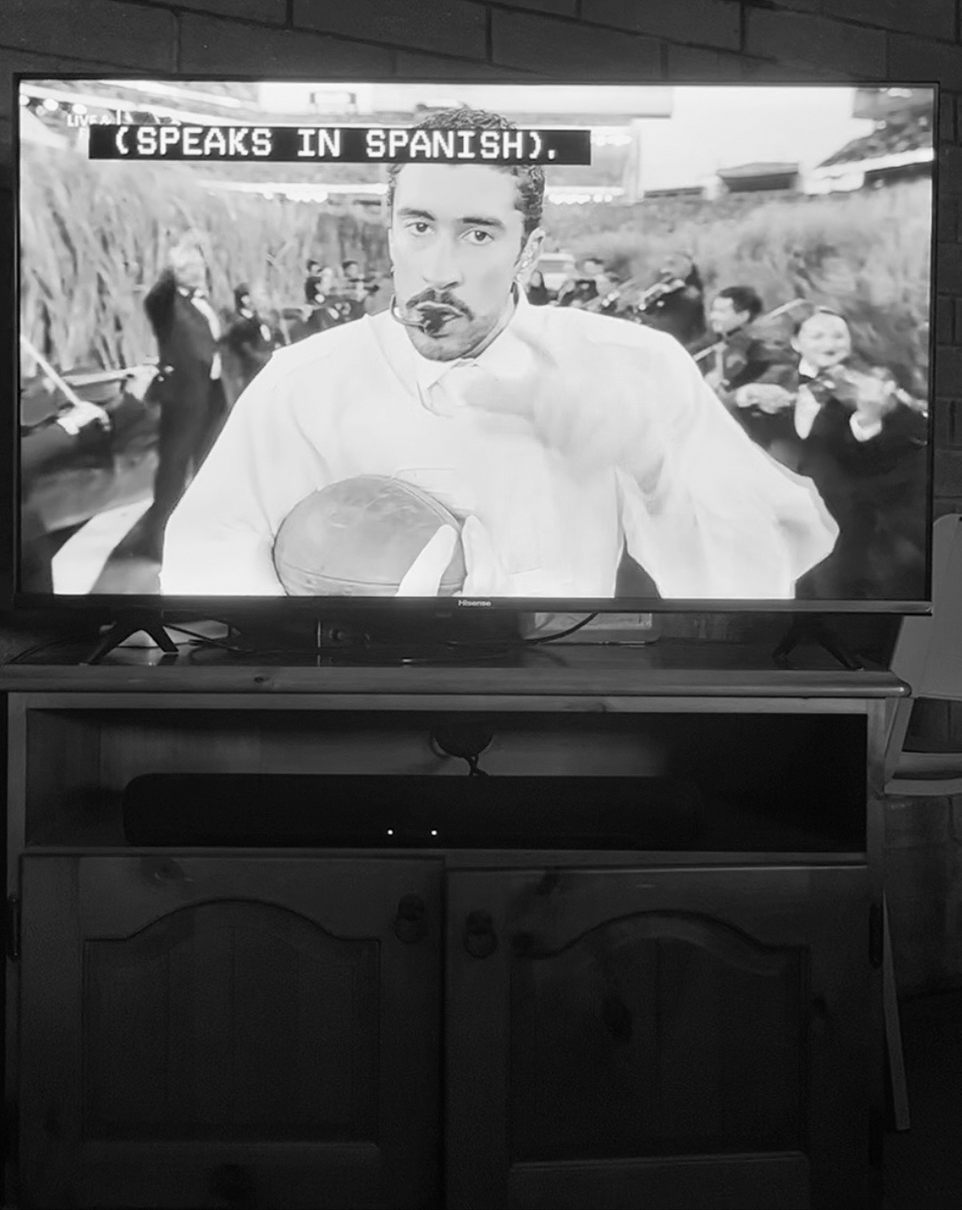
This song was followed by guest appearances by Lady Gaga and Ricky Martin, the latter who covered Benito’s melancholic indictment of U.S. imperialism and gentrification in “Lo Que Le Pasó a Hawaii.”Footnote 4 Upon returning to the stadium floor, Benito augmented for millions of viewers the geographically reductive identity of “America” by clearly articulating nations in the Caribbean and South, Central, and North Americas.Footnote 5 In singing then listing those countries, Benito inclusively deployed the Spanish language as a vehicle to correct the dominant assumption of “America” as “the United States” (see Figure 1). In People magazine online, Natalia Senanayake explains that the set piece, replicated from a real structure in Humacao, is “a nod to traditional Puerto Rican homes” and a “cultural emblem, reflecting a traditional house style found across the island both in urban and rural areas.”Footnote 6 In viewing Benito’s performance, we thus encounter what Fredrick Aldama, founder-director of the LatinX Pop Lab at the University of Texas, Austin, heuristically describes as a “brown optic.”Footnote 7
Benito makes eye contact with the camera whilst listing all of the countries that constitute “America” – here, we might note that the singer listed these nations’ names in English. Screenshot Courtesy of Rahul K. Gairola.

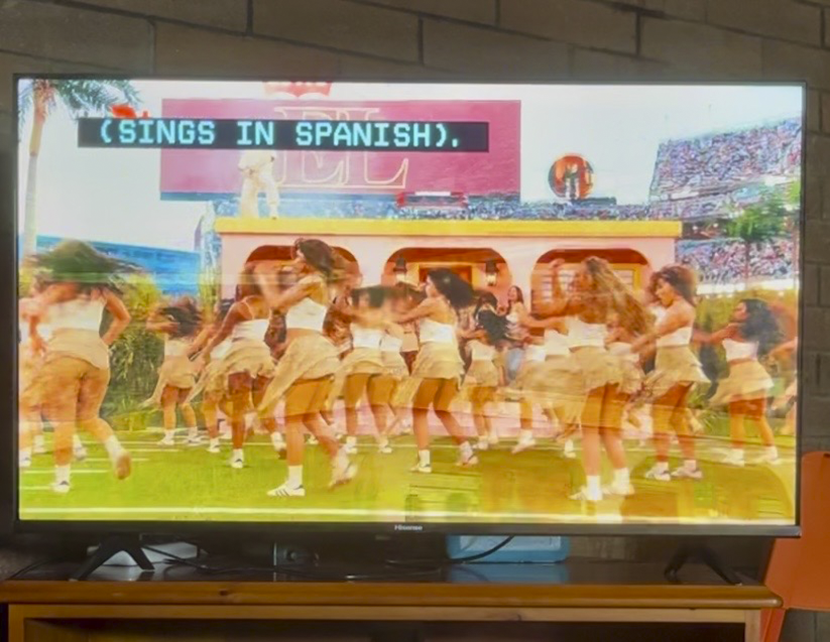
Aldama’s “brown optic” advocates viewing pop culture and story worlds through the specific, lived, and culturally grounded experiences of Latinx people. When a story deploys a brown optic, it does not stop to explain, translate, defend, or apologise for its culture to outsiders. Instead, Latinx cultural life, joy, and perspectives become the nexus that drives forward counternarratives and world making. In Aldama’s words, “The casita on the field wasn’t a house. It was a thesis statement about who gets to be home on American television.”Footnote 8 In my view, Benito’s brown optic is symbolically compelling: He fell from the roof to the ground floor of la casita, demonstrating to global viewers a vertical, “digital spatiality,” wherein the location of “home” includes movement from top to bottom (See Figure 2).Footnote 9 In doing so, he welcomed viewers by gifting us, without xenophobic fuss, what felt like a breezy travel visa to Puerto Rico and the United States in the greater hood of “America.” The reggaeton superstar’s unexpected fall from atop la casita to the ground floor offered viewers worldwide the visual of returning down to earth, the land upon which we all coexist.Footnote 10
Bad Bunny, aka Benito, performs atop la casita/ home with dancers in the foreground on the playing field below him. Screenshot Courtesy of Rahul K. Gairola.

For me, Benito’s “brown optic” broadcast a feeling of being “at home,” welcomed to the country by community members in one’s mother tongue. This was a visual that signified resistance, for me and many others, to the centuries of colonialism experienced by Puerto Rico, first by the Spanish and then by the United States.Footnote 11 As the broadcast mesmerised me from Australia, I felt a sense of déjà vu whereby the vertical movement of a celebrity from a global stage to the ground floor rang a bell. Benito’s vertical drop from the roof of la casita to the streets below struck within me a chord of dynamic, decolonial resistance. My heart paused upon a thought, and I suddenly recalled another global stage of grandiose privilege miles away from Australia and the U.S. Bad Bunny’s emergence unto a horizontal plane hosting a vibrant street party reminded me of a critical account offered by Gayatri Chakravorty Spivak, fondly “Gayatri-di,” a year earlier in her acceptance speech for The Holberg Prize on June 5, 2025, at the University of Bergen, Norway (see Figure 3).
Gayatri Chakravorty Spivak accepts the 2026 Holberg Award following her plenary address titled “Imperatives to Reimagine the Future” at the University of Bergen, Norway, on June 5, 2025. Photo Courtesy of Rahul K. Gairola.

2. Learning from below as decolonial homeschooling
In her acceptance speech, Gayatri-di described learning through difference as an urban practice on the streets of her neighbourhood: “In New York City, I return empty plastic soda bottles to big machines for 5¢ back on each, in order to hang out with subalterns from many ethnicities, female, male and trans, without seeming engaged in top-down philanthropy.”Footnote 12 Gayatri-di’s sidewalk account, ironically delivered here in a forum saturated with European privilege, reminded me of Bad Bunny also moving through his home and out into the barrio-pueblo. Her account of the neighbourhood invokes a similar crowd, I think, as those represented by Benito: working class, agricultural and hospo workers, tradesfolk, youth, students, queer folx, a wedding party, etc.—communities that often feel, or have been made to feel, outcast by those in power who normalise xenophobia, racism, misogyny, queerphobia, gun violence, and/ or sexual predation.
In contrast, both global events on privileged stages seemed to espouse human “contact,” as conceptualised by Samuel Delaney, with strangers through serendipitous interactions fuelled by interclass difference in public spaces.Footnote 13 That is, Benito’s highly stylised, amplified depictions of the everyday of the barrio-pueblo produce a “brown optic” that is characterised by “contact” with those who have often been excluded and felt neglected. For example, Bad Bunny’s performance of “El Apagón” (“The Power Outage”) visually and lyrically references the damage inflicted upon Puerto Rico by U.S. colonial power while reenacting the energy crisis and prolonged power outages long after Hurricane Maria destroyed the power grid in 2017. This is one “brown optic” shared by the work done by Benito and Gayatri-di which, quite literally, “grounds” humanity worldwide. While speaking from different spaces, both performances suggest to me that their global, celebrity stages entail what Gayatri-di described in her speech as “learning to learn from below.”Footnote 14
I would here offer that the process of “learning to learn from below” is moreover braided throughout “home” with additional socio-historical factors including colonialism, race, class, and language.Footnote 15 Benito and Gayatri-di’s “brown optic” on those grand stages demonstrate for spectators that home and homeland, or both, are the heart and soul of belonging, family, citizenship, exclusion, and more.Footnote 16 Like Benito’s rockstar status, Gayatri-di too is globally respected for diligently interrogating the functions of class, gender, race, sexuality, colonialism, subalternity, agency, etc., which she is widely recognised for examining in “Can the Subaltern Speak?”Footnote 17 Yet in addition to “speaking,” Gayatri-di has also written with Judith Butler about the resistance demonstrated by undocumented immigrants who publicly sing the U.S. anthem in Spanish. In Who Sings the Nation-State?: Language, Politics Belonging, Gayatri-di and Judith Butler analyse the performance of the national anthem in the streets as a reclamation of ethnic agency.Footnote 18
In her observations, Butler appears to describe the streets on which the elite and the homeless meet, as a geopolitical, as well as social, locale for contact. She recognises, in other words, the street as “a place where those who are not free to amass, freely do so…this is precisely the kind of performative contradiction that leads not to impasse but to forms of insurgency. For the point is not simply to situate the song on the street, but to expose the street as the site for free assembly.”Footnote 19 I would add that “learning to learn from below” on the streets also occurs in the context of language, diaspora, home, and homeland, wherein restrictions at national borders are routinely reproduced, block by block, throughout urban cityscapes.Footnote 20 That is, each block of the city contains a microcosm of “home” that reflects larger geopolitical sites worldwide: resistance to gentrification of one’s hood echoes resistance to gentrification of the borders.Footnote 21
Another “brown optic” is the figure and demeanour of a humorous Gayari-di clad in a bright pink sari in contrast to Benito’s “gender-bending, sartorial performance,” where both suggest that conflict is a part of contact.Footnote 22 As if in response to the call earlier issued by Butler and Gayatri-di, Benito arguably staged “unlearning one’s privilege as one’s loss” not only in subjective relations of human being, but also in spatial relations on the global stage of Super Bowl LX.Footnote 23 In Aldama’s appraisal, Bad Bunny’s performance “gave Super Bowl LX the most radical Brown optic makeover in the history of television. Not a makeover as in a cosmetic touch-up. A makeover as in a total restructuring of who gets to organize story, language, and viewpoint when over 135 million people are watching…the organizing principle of narrative itself.”Footnote 24 Spivak’s urban praxis in New York City resonates with the moment that Bad Bunny descended from roof to the ground floor, where he engaged with his neighbourhood’s commerce and community.Footnote 25
3. Conclusion: top-down empathy as critical intimacy
In engaging in “contact” with strangers, Gayatri-di offered bottles on the street and Benito offered “contact” Easter eggs throughout the digital broadcast which I viewed from Australia.Footnote 26 Upon reflecting on why my mind invoked Gayatri-di’s acceptance speech from Holberg Week 2025 in Norway while viewing Benito’s 2026 performance in the San Francisco Bay area, it seemed that both stages demonstrated a kind of “homeschooling” of one’s consciousness that is steeped in collaborative learning that centres difference. A world making, a homelanding of sorts, wherein it is here crucial to ask who exactly is learning to learn from below?Footnote 27 Bad Bunny’s halftime show was a spectacular “brown optic” for contact sport fans encouraged to contact strangers through critical intimacy. The Spanish-only performance was designed, it seems, to enthusiastically resonate with millions of viewers while soliciting a demand to unlearn from others. One of the most striking aspects of this dynamic, as a viewer watching from Australia, is revealed by the captions of the broadcast.
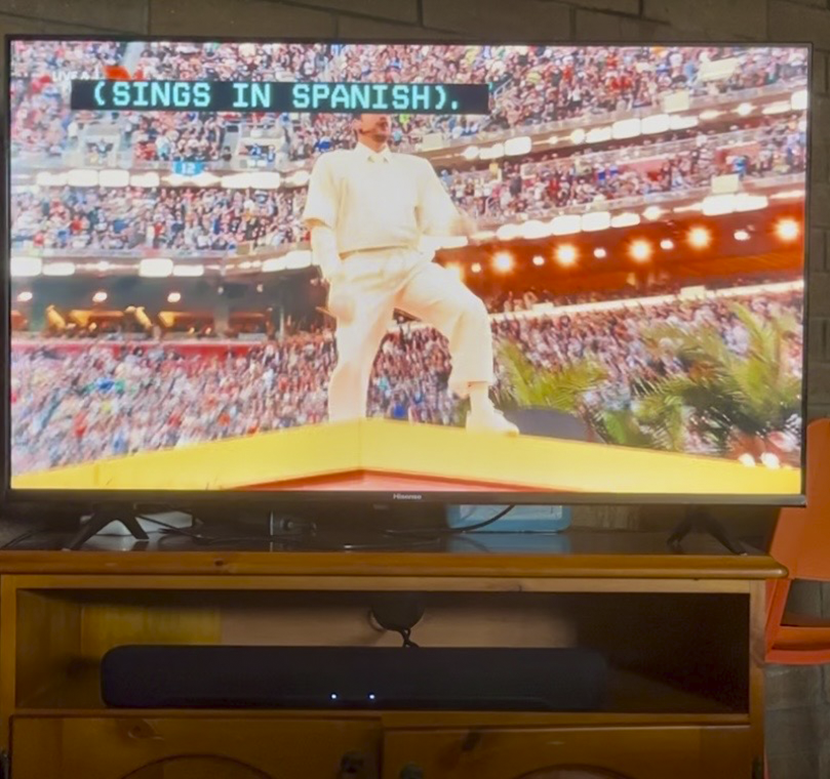
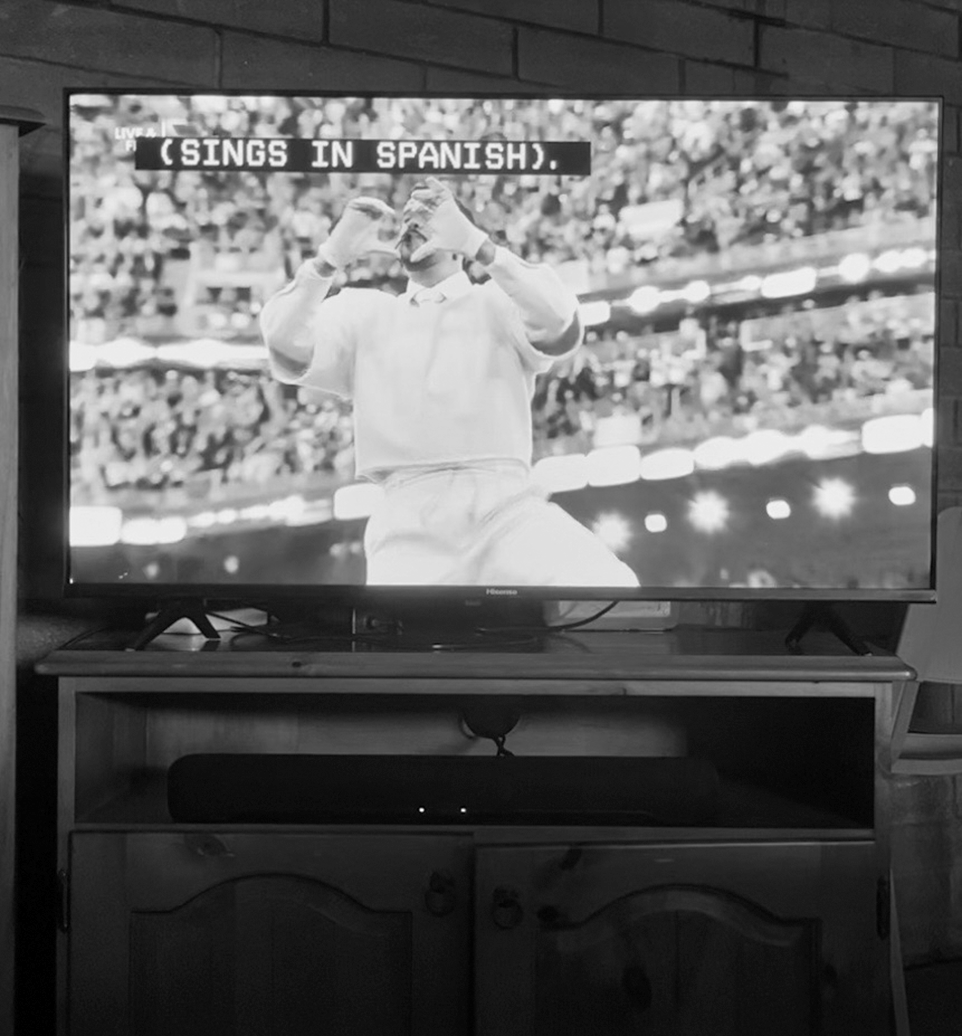
That is, the captioned bit (“Sings in Spanish”) betrayed the international telecast’s inclination to privilege the English language as it routinely privileges the United States as “America” as viewed from Down Under (see Figure 4). Would viewers require such a caption (“Sings in Italian”) when watching opera? While Benito’s act of singing in Spanish without subtitles indeed demonstrates resistance to the hegemonic lexicon of the digital broadcast, the very “explanatory” intention of the caption strikes an awkward tone that feels as if the lyrics are irrelevant since Benito “sings in Spanish.” The broadcast altruism here seems, to me, to be a tokenistic gesture wherein we would not encounter a similar caption reading “Sings in English” during Lady Gaga’s performance on the same stage. Conversely, Bad Bunny and Ricky Martin on this occasion warmly invited a global audience into their neighbourhood, their music, their community, their language—into their “home” (see Figure 5).
Bad Bunny performs at Super Bowl LX on February 8, 2026, at Levi’s Stadium in Santa Clara, California, with captions displayed here as broadcast to Australia the following day. Screenshot Courtesy of Rahul K. Gairola.

Bad Bunny performs at Super Bowl LX on February 8, 2026, at Levi’s Stadium in Santa Clara, California, while forming a heart with his hands, thus clearly mediating against the notion that the star’s show “made no sense.” Screenshot Courtesy of Rahul K. Gairola.

I thus critically read “la casita” as a community-based home where family, friends, and Spanish literally spill onto the streets and consequently catalyse art-based unlearning at an intersection of multiple performative avenues. According to Ilaria Bonvicini, “La Casita reaffirms the emotional and cultural value embodied by this modest dwelling. Though ephemeral, these reproductions remain a living, recognizable fragment of Puerto Rico’s architectural heritage, a means of reclaiming a shared sense of belonging and rediscovering one’s roots.”Footnote 28 Benito’s casita broadcasts not only a brown optic as suggested by Aldama but moreover models a safe space of disidentification in the spirit of queer of colour critique rooted in a pink house surrounded by celebrants and socio-historical Easter eggs.Footnote 29 As such, Gayatri-di and Benito demonstrate that strangers are not “bad hombres,” criminals, deviants, illiterates, “illegals,” etc., as currently caricatured by institutional xenophobia in the United States.
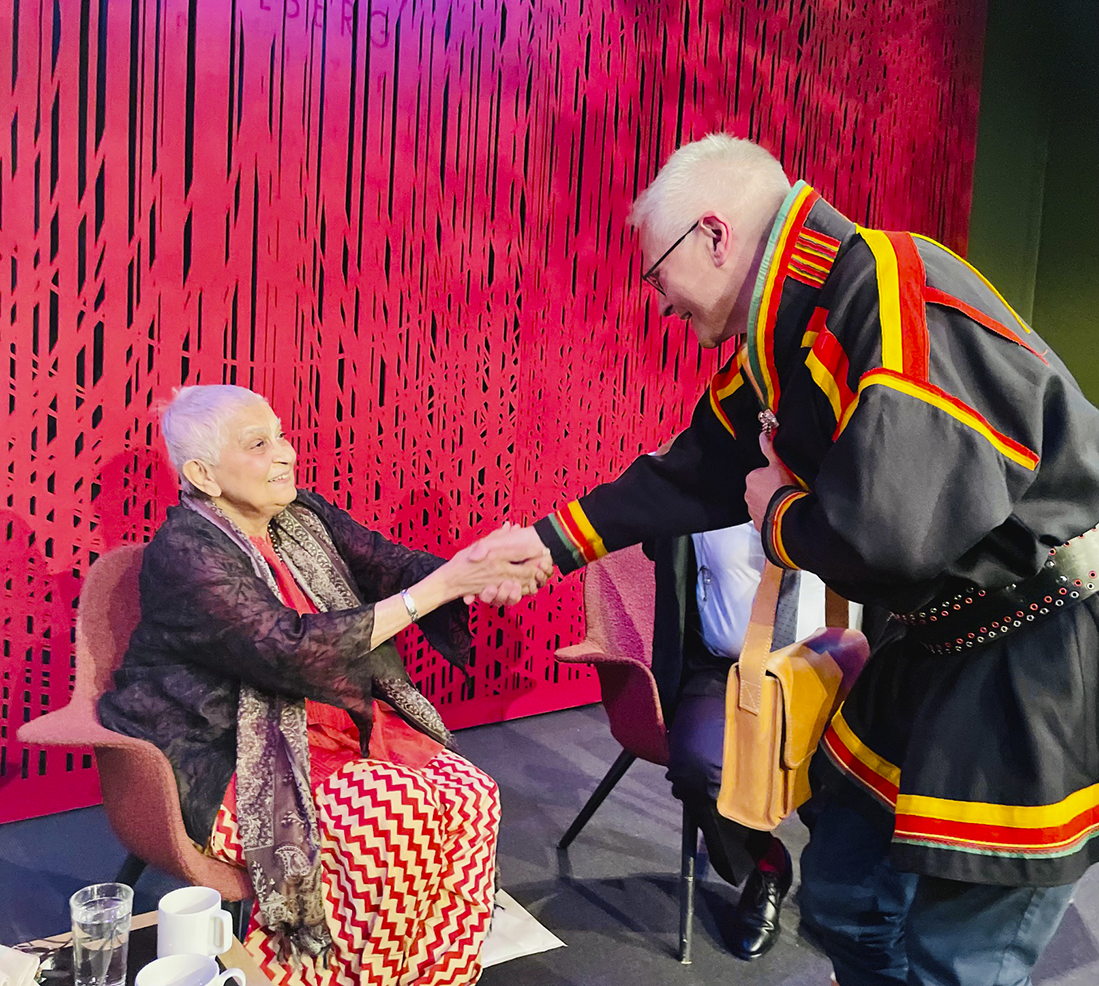
Rather, they promote homeschooling over doomscrolling, humanistic empathy over incendiary fearmongering. They encourage visceral reflection and critical intimacy of the subject as a means for securing deeper understanding and representational agency as social action (see Figure 5).Footnote 30 The formalistic aspects of the digital broadcast to Australia show thus: circular camera movements blended with long and close shots to establish transnational, critical intimacy that is proudly Puerto Rican. Such a critical intimacy, in my view, constitutes a judicious reflexivity wherein we consciously resolve to cease viewing our sisters and brothers as enemies of home and homeland. Let us consider, for a moment, the radically different message transmitted by Benito’s jumbotron-projected statement “The Only Thing More Powerful Than Hate is Love” and the caption reading “sings in Spanish.”Footnote 31 For many of us in all corners of the globe, this is what it could mean to be “at home” with Gayatri Chakravorty Spivak and Bad Bunny (see Figure 6). The latter’s record-breaking performance of la casita, in other words, advocated a pluralistic, United State of Americas rather than a singular United States of America. This is certainly something to feel at home about around the world (see Figure 7).
Gayatri-di greets an indigenous Norwegian dressed in a traditional Sami gákti following her "Learning from Below" public discussion with Bodhisattva Chattopadhyay at the House of Literature in Oslo, Norway, on June 6, 2025. Photo Courtesy of Rahul K. Gairola.

Benito holds up an American football displaying the words “Together, we are America” in all caps with appropriate comma usage. Screenshot Courtesy of Rahul K. Gairola.

Acknowledgements
I thank editor Jeff Wilson and my anonymous peer reviewers for their incisive comments and kind enthusiasm. I also thank Professor Bjørn Enge Bertelsen and his Holberg Prize colleagues, and Dr. David Thomas Henry Wright and Professor Scott Rettberg of the Center for Digital Narrative, University of Bergen, for kindly inviting me to Holberg Week 2025 and to deliver a lunchtime time talk previous to Gayatri-di’s keynote speech; these colleagues generously facilitated the publication of this article.
Author contribution
Conceptualization: R.K.G.; Investigation: R.K.G.; Methodology: R.K.G.; Writing - original draft: R.K.G.; Writing - review & editing: R.K.G.
Conflict of interests
The author confirms no competing interests.



 Open access

