Introduction
Adverse childhood experiences are common (Thompson & Cui, Reference Thompson and Cui2000) and have been associated with many unfavourable psychological and physiological outcomes such as depression (Bernet & Stein, Reference Bernet and Stein1999; Heim & Nemeroff, Reference Heim and Nemeroff2001; Hovens et al. Reference Hovens, Wiersma, Giltay, Van Oppen, Spinhoven, Penninx and Zitman2010; Nelson et al. Reference Nelson, Baldwin and Taylor2012; Colman et al. Reference Colman, Garad, Zeng, Naicker, Weeks, Patten, Jones, Thompson and Wild2013), post-traumatic stress disorder (PTSD) (Widom, Reference Widom1999; Heim & Nemeroff, Reference Heim and Nemeroff2001; Moffitt et al. Reference Moffitt, Caspi, Harrington, Milne, Melchior, Goldberg and Poulton2007; Hovens et al. Reference Hovens, Wiersma, Giltay, Van Oppen, Spinhoven, Penninx and Zitman2010), cardiovascular disease (Dong et al. Reference Dong, Giles, Felitti, Dube, Williams, Chapman and Anda2004) and chronic pain. Despite the accumulation of evidence on the adverse long-term effects of such experiences, controversy exists around the validity of information from the retrospective reports largely used to generate these findings (Widom & Morris, Reference Widom and Morris1997). Suggested problems in establishing accuracy in the retrospective recall of childhood adverse experiences include the fallibility of memory for such experiences (Williams, Reference Williams1994; Widom & Morris, Reference Widom and Morris1997; Brennen et al. Reference Brennen, Hasanović, Zotović, Blix, Solheim Skar, Prelić, Mehmedović, Pajević, Popović and Gavrilov-Jerković2010), measurement bias (Fergusson et al. Reference Fergusson, Horwood and Woodward2000) and intentionally false reporting (Widom & Morris, Reference Widom and Morris1997). Despite these criticisms of the reliability and validity of retrospective reporting, several studies have found it to be accurate for assessing childhood maltreatment (Paivio, Reference Paivio2001; Hardt & Rutter, Reference Hardt and Rutter2004). However, individual characteristics and experiences may influence the reporting of adverse experiences – a concept with potentially serious implications for reporting accuracy. For example, it has been shown that current mood can influence the likelihood of a negative experience being recalled (Clark & Teasdale, Reference Clark and Teasdale1982; Dalgleish & Watts, Reference Dalgleish and Watts1990). In particular, depression has been associated with a tendency to recall more negative experiences (Gotlib & Joormann, Reference Gotlib and Joormann2010; Whalley et al. Reference Whalley, Rugg and Brewin2012).
A handful of studies have assessed cross-temporal stability in retrospective reports of adverse childhood experiences (Hardt & Rutter, Reference Hardt and Rutter2004). Overall, these studies suggest a good deal of variability between retrospective reports at different times (e.g. 50–73% stability in reporting of separation from parents; Finlay-Jones et al. Reference Finlay-Jones, Scott, Duncan-Jones, Byrne and Henderson1981), but have not found evidence of an association between inconsistency of reporting and mental state at the time of recall (Hardt & Rutter, Reference Hardt and Rutter2004). However, these studies are limited by relatively small sample sizes and short follow-up periods (i.e. 18 months, Finlay-Jones et al. Reference Finlay-Jones, Scott, Duncan-Jones, Byrne and Henderson1981; 3 years, Fergusson et al. Reference Fergusson, Horwood and Woodward2000).
The objective of this study was to examine the association between inconsistencies in reporting of childhood adverse experiences and several mental health factors, using a large longitudinal study of Canadian adults with a follow-up time of 12 years. We hypothesized that increases in adversity during adulthood, particularly depression and psychological distress, would be associated with new reports of childhood adversity that had not been previously reported 12 years earlier.
Method
Study population
This study used data from the Canadian National Population Health Survey (NPHS), which is a nationally representative cohort of 17 276 Canadians followed by Statistics Canada every 2 years between 1994 and 2010. The response rate was 83.6% in the 1994/1995 cycle of data collection. In the seventh cycle (2006/2007), 63.6% of participants from the original cohort were still involved in the study (Statistics Canada, 2007). The study sample included members of the NPHS who were over 18 years of age in 1994/1995, and who reported on childhood adverse experiences in both 1994/1995 and 2006/2007. The final study sample included 7466 participants.
Childhood adverse experiences
A seven-item index asked whether participants had experienced the following as a child or teenager: (1) 2 weeks or longer in hospital; (2) parental divorce; (3) parental unemployment; (4) a frightening experience that was thought about for years after; (5) being sent away from home for wrongdoing; (6) family problems due to parental substance abuse; and (7) physical abuse by someone ‘close’ (Thompson & Cui, Reference Thompson and Cui2000).
The primary outcome measure was consistency of recall for childhood adverse experiences. We examined consistency in two subcohorts. The first subcohort consisted of those who did not report an adverse childhood experience in 1994/1995. Among participants who did not report a childhood adverse experience in 1994/1995, inconsistency was defined as reporting a new childhood adverse experience in 2006/2007 (‘new remembering’). The second subcohort consisted of those who reported an adverse childhood experience in 1994/1995. For this subcohort, inconsistency was defined as failing to report the same experience in 2006/2007 (‘forgetting’).
Mental health factors potentially associated with consistency of recall
Several measures of mental health and stress were investigated for their association with consistency of reporting of childhood adverse experiences. Mental health measures assessed included depression, psychological distress, mastery, work stress and chronic stress. The presence of a major depressive episode was assessed using the Composite International Diagnostic Interview Short Form for Major Depression (CIDI-SFMD) (Kessler et al. Reference Kessler, Andrews, Mroczek, Ustun and Wittchen1998). Depression was separated into four time-sensitive categories for analysis: those who reported depression at both time points, those who were depressed only in 1994/1995 (remitted depression), those who reported depression only in 2006/2007 (developed depression), and those who were not depressed at either time point.
Distress was assessed at both time points using the Kessler K6 psychological distress score (Statistics Canada, 2007). Mastery was measured by a seven-item scale based on the work of Pearlin & Schooler (Reference Pearlin and Schooler1978) in which a higher value indicates a stronger sense of mastery. Work stress was measured by 13 questions that assess job security, autonomy, conflict and satisfaction (Karasek et al. Reference Karasek, Brisson, Kawakami, Houtman, Bongers and Amick1998). Chronic stress was measured by 18 questions that assess stress in personal life, with a primary focus on relationship and family strife (Colman et al. Reference Colman, Garad, Zeng, Naicker, Weeks, Patten, Jones, Thompson and Wild2013). Both stress measures were operationalized on continuous scales. Baseline levels (1994/1995) and changes (i.e. increases or decreases) in these factors between 1994/1995 and 2006/2007 were assessed, in line with our hypothesis that changes in mental health factors would be associated with increased likelihood of inconsistency in reporting adverse childhood experiences from one time point to the next.
Covariates
We included as covariates several demographic factors including old age (above age 60 years), gender, socio-economic status (ratio of family income to Statistics Canada's low-income cut-off score), employment status (currently unemployed or not), education (high school completed or not), marital status and immigration status (immigrant or Canadian-born). As with depression, time-sensitive categories were created to capture differences in employment status, education level and marital status between the two time points (e.g. married at both time points, married only in 1994/1995, married only in 2006/2007, or unmarried at both time points).
Statistical analysis
Logistic regression was used to investigate the association between each of the mental health factors outlined above and consistency in the reporting of childhood adverse experiences. Separate models were run to predict ‘new remembering’ in the first subcohort (with those who consistently reported no adverse experiences as the reference category) and ‘forgetting’ in the second cohort (with consistent reporters of adverse experiences in both 1994/1995 and 2006/2007 as the reference category).
Secondary analyses were also conducted to examine the consistency of reporting for individual events. For each event, logistic regression was used to predict ‘new remembering’ (with those who did not report that specific event at either time point as reference) and ‘forgetting’ (with consistent reporters of that event as reference) from mental health variables. All analyses included demographic factors as covariates.
The NPHS used a multi-stage sampling design with unequal selection probabilities. Normalized sampling weights were used to adjust for unequal selection probabilities and cluster sampling. SAS 9.2 (USA) was used for the analyses. This study was approved by the University of Alberta Health Research Ethics Board.
Results
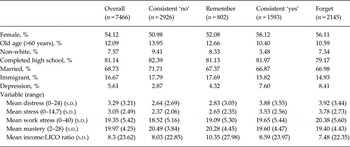
Of the 3728 participants who reported no adverse experiences in 1994/1995, 802 reported a new event in 2006/2007. Of the 3738 who reported at least one childhood adverse experience in 1994/1995, 2145 responded ‘no’ to the same event in 2006/2007. Of the sample, 54% of the sample was female, and 81% attained a greater than high school level of education (Table 1). At study baseline in 1994/1995, 5.6% of the sample was depressed.
Baseline characteristics of study participants in 1994/1995 a

s.d., Standard deviation; LICO, low-income cut-off.
a Means and percentages are weighted.
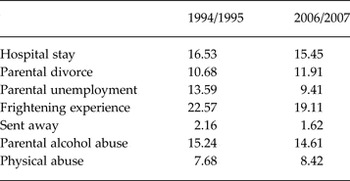
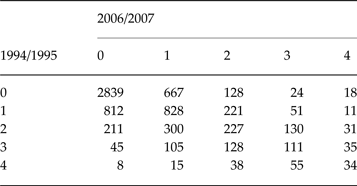
The proportion of participants reporting each adverse experience in 1994/1995 and 2006/2007 is reported in Table 2. Long hospital stays, parental divorce, frightening experiences that were thought about for years after and family problems due to substance abuse were reported by more than 10% of the sample at both time points. The numbers of adverse events reported at each time point are compared in Table 3. It was not uncommon for the number of childhood adverse experiences reported to vary by two or more.
Percentage of participants reporting adverse childhood experiences at each time point (weighted percentage)

Number of adverse childhood experiences reported in 1994/1995 v. 2006/2007 (weighted frequencies) a

a Data for participants reporting more than four adverse childhood experiences have been suppressed due to low cell sizes.
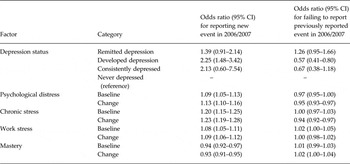
In subcohort 1 (i.e. those not reporting a childhood adverse experience in 1994/1995), depression status was associated with reporting a new childhood adverse experience in 2006/2007 (χ2 = 17.33, p < 0.001). Participants who were depressed in 2006/2007 but not in 1994/1995 had increased odds of reporting a new adverse childhood experience [odds ratio (OR) 2.25, 95% confidence interval (CI) 1.48–3.42]. Baseline psychological distress, chronic stress and work stress were associated with increased odds of reporting a new adverse childhood experience, as were increases in these three variables over time (Table 4). Baseline mastery and increases in mastery were associated with reduced odds of reporting a new childhood adverse experience.
Associations between mental health factors and consistency in reporting of childhood adverse experiences a

CI, Confidence interval.
a Models adjusted for gender, age, race, immigration status, socio-economic position, marital status and education.
The converse was observed in subcohort 2 (i.e. those who reported a childhood adverse experience in 1994/1995). The development of depression was associated with reduced odds of answering ‘no’ in 2006/2007 to any previously reported experience (χ2 = 16.20, p < 0.01; OR 0.57, 95% CI 0.41–0.80). Baseline levels and increases in psychological distress, as well as increases in chronic stress, were associated with reduced odds of ‘forgetting’ any event (Table 4). An increase in mastery was associated with increased odds of answering ‘no’ in 2006/2007 to a previously reported adverse childhood experience.
Associations between mental health variables and consistency of reporting for individual events are presented in online Supplementary Tables S1 and S2. Predictors of inconsistency were similar across the individual events.
Discussion
This study prospectively assessed a range of psychological factors potentially associated with recall of childhood adverse experiences, and found several indications that concurrent mental health may influence the recall of childhood adversity. Notably, depression and psychological distress appeared to explain a tendency towards reporting of childhood adverse experiences that had not been reported 12 years earlier, as were increases in work and chronic stress. Conversely, those with an improved sense of mastery appeared less likely to report childhood adverse experiences that had not been previously reported 12 years earlier. In contrast, the development of depression, and increases in psychological distress and chronic stress, were associated with decreased odds of responding ‘no’ to a previously reported event.
These findings run counter to the few studies which have assessed associations between mental state and temporal stability of retrospective reporting of adverse childhood experiences (Hardt & Rutter, Reference Hardt and Rutter2004); however, these studies have been limited by relatively small sample sizes and short follow-up periods.
Depression has been previously associated with negative memory bias, especially for information that is emotionally toned (Dalgleish & Watts, Reference Dalgleish and Watts1990); both clinical depression and induced negative mood have been found to lead to a higher probability of recalling negative personal memories (Clark & Teasdale, Reference Clark and Teasdale1982; Dalgleish & Watts, Reference Dalgleish and Watts1990; Whalley et al. Reference Whalley, Rugg and Brewin2012). This is known as the mood-congruency hypothesis, which posits that mood-congruent information is more readily recalled than mood-incongruent information (Blaney, Reference Blaney1986; Lewis et al. Reference Lewis, Critchley, Smith and Dolan2005). In line with this hypothesis is our finding that individuals who developed depression, or reported increased psychological distress, were more likely to report an adverse childhood experience in 2006/2007 that was not previously reported.
A similar pattern was observed in this study in relation to stress; participants who recalled new childhood adverse experiences in 2006/2007 were significantly more likely to have suffered increases in either work or chronic stress during the reporting period. Stress may contribute to high state anxiety (Meijer, Reference Meijer2001), which may in turn facilitate retrieval of negative memories (Richards & Whittaker, Reference Richards and Whittaker1990). Anxiety, like depression, has been associated with biases in memory, favouring recall of threat-related information (Mitte, Reference Mitte2008).
Mastery, a psychological concept defined as a sense of control over one's life circumstances (Smeets, Reference Smeets2011), has been found to reduce stress (Wallace & Swaney, Reference Wallace and Swaney2008) and the negative psychiatric effects of stress (Mausbach et al. Reference Mausbach, Patterson, von Känel, Mills, Ancoli-Israel, Dimsdale and Grant2006; Ben-Zur, Reference Ben-Zur2008). Notably, in our assessment of the impact of mastery, those with higher levels of mastery, and who increased their levels of mastery by 2006/2007, were found to be more consistent in their reporting of childhood adversity.
Of those who reported at least one childhood adverse experience in 1994/1995, the majority failed to report the same experience(s) 12 years later. This ‘forgetting’ of negative experiences may in fact be psychologically adaptive (Anderson & Levy, Reference Anderson and Levy2009). Indeed, the persistence of negative memories has been associated with major depression (Joormann et al. Reference Joormann, Nee, Berman, Jonides and Gotlib2010). Results from the present study support this notion – those who developed depression, or experienced increased stress and psychological distress were less likely to ‘forget’ previously reported adverse experiences.
Chronic stress has also been associated with impairments in the extinction of negative memories and fear responses to traumatic events (Miracle et al. Reference Miracle, Brace, Huyck, Singler and Wellman2006; Milad et al. Reference Milad, Pitman, Ellis, Gold, Shin, Lasko, Zeidan, Handwerger, Orr and Rauch2009). Consistent with these findings, increases in chronic stress in the present study were associated with reduced odds of ‘forgetting’ a previously reported adverse experience.
The childhood adverse experiences reported in the NPHS were varied in terms of severity. One possibility is that consistency of recall may be influenced by different factors depending on the severity of the event. Analyses of individual events revealed similar patterns of association between psychological variables and consistency of recall, lending support to our conclusions regarding the impact of these psychological variables on recall. However, relatively low sample sizes for certain events may have limited power to detect effects, and we therefore urge caution in interpreting discrepancies in results between specific events.
Another important methodological concern in the present study is that the age at which an adverse experience occurs has also been found to have an impact on the recall of such experiences (Hardt & Rutter, Reference Hardt and Rutter2004), as well as on the presence of depression and PTSD (Schoedl et al. Reference Schoedl, Costa, Mari, Mello, Tyrka, Carpenter and Price2010). Since childhood adverse experiences were retrospectively assessed in this survey, and participants were not asked about the time at which the adverse experience occurred, we could not assess the impact of age at the time of the experience on recall consistency.
In the present study, it is unknown whether new events reported in 2006/2007 represent real recovered memories or false memories. Research suggests that false memories may differ qualitatively from real ones – for example, in vividness, detail and confidence (Porter et al. Reference Porter, Yuille and Lehman1999). Participants in the NPHS were asked to report whether each event had occurred, but did not supply further details about the event.
Our study also had several notable strengths. It was conducted using longitudinal data from a large, nationally representative sample, and controlled for both baseline levels of and changes over time in key explanatory variables. Importantly, we also controlled for old age, which may have confounded the assessment of predictive factors in the consistency in the recall of childhood adverse experiences in previous studies, due the effect of older age on memory deficits (Nielsen et al. Reference Nielsen, Lolk and Kragh-Sørensen1998; Ros & Latorre, Reference Ros and Latorre2010).
In conclusion, these results show that cross-temporal inconsistencies in the reporting of adverse childhood events are common, and may be associated with factors describing concurrent mental state. These findings have important implications for studies conducted to date, many of which have relied on the recall of adverse childhood experiences without controlling for factors associated with current mental state in adulthood.
Supplementary material
To view supplementary material for this article, please visit http://dx.doi.org/10.1017/S0033291715002032
Acknowledgements
This work was supported by the Norlien Foundation. This research was undertaken, in part, with funding from the Canada Research Chairs programme for I.C. The authors would like to thank Ms Irene Wong of Statistics Canada for her assistance with data access and use, and Dr Sonja Swanson for her advice regarding the analytical approach. The research and analysis are based on data from Statistics Canada and the opinions expressed do not represent the views of Statistics Canada.
Declaration of Interest
None.