1. Introduction
Permian carbonate platforms are extensive worldwide and have distinctive supersequences (second-order, duration 5–20 Ma) and composite sequences (third-order, duration 0.5–5 Ma) (Dercourt, Ricou & Vrielynck, Reference Dercourt, Ricou and Vrielynck1993; Weidlich & Bernecker, Reference Weidlich and Bernecker2003). The study of Guadalupian deposits is significant because: (1) they mark the transition from icehouse to greenhouse mode (Montañez et al. Reference Montañez, Tabor, Niemer, Dimichele, Frank, Fielding, Isbell, Birgenheier and Rygel2007; Retallack, Reference Retallack2013); (2) they are enriched with organic carbon burials, which are reported from Japan (Isozaki, Kawahata & Ota, Reference Isozaki, Kawahata and Ota2007; Isozaki, Kawahata & Minoshima, Reference Isozaki, Kawahata and Minoshima2007), the Phosphoria Formation in North America (Wardlaw & Collinson, Reference Wardlaw and Collinson1986; Johnson, Reference Johnson2005), Permian cherts in the Canadian Arctic (Beauchamp & Baud, Reference Beauchamp and Baud2002) and the Gufeng Formation in South China (Kametaka et al. Reference Kametaka, Takebe, Nagai, Zhu and Takayanagi2005; Shi et al. Reference Shi, Feng, Shen, Itob and Chen2016); (3) they show high positive carbon isotopic values in the Capitanian known as the Kamura cooling event, which is recognized for the first time in a mid-Panthalassan palaeo-atoll limestone in Japan (Isozaki, Kawahata & Ota, Reference Isozaki, Kawahata and Ota2007); (4) the Guadalupian–Lopingian (G–L) boundary represents a biodiversity change and a mass extinction which precedes the major mass extinction at the Permian–Triassic boundary (Wignall et al. Reference Wignall, Sun, Bond, Izon, Newton, Vedrine, Widdowson, Ali, Lai, Jiang, Cope and Bottrell2009; Bond et al. Reference Bond, Wignall, Wang, Izon, Jiang, Lai, Sun, Newton, Shao, Védrine and Cope2010); (5) the G–L boundary is characterized by the lowest sea level in the Phanerozoic (Haq & Schutter, Reference Haq and Schutter2008), a negative carbon isotope excursion (Heydari, Hassandzadeh & Wade, Reference Heydari, Hassandzadeh and Wade2000; Kaiho et al. Reference Kaiho, Chen, Ohashi, Arinobu, Sawada and Cramer2005; Shen et al. Reference Shen, Cao, Zhang, Bowring, Henderson, Payne, Davy-dov, Chen, Yuan, Zhang, Wang and Zheng2013; Liu et al. Reference Liu, Wang, Shen, Gorgij, Ye, Zhang, Furuyama, Kano and Chen2013) and the lowest 87Sr/86Sr ratio in the Phanerozoic (Korte et al. Reference Korte, Jasper, Kozur and Veizer2006; Kani et al. Reference Kani, Fukui, Isozaki and Nohda2008).
The Middle to Upper Permian carbonates in east-central Iran are known as the Jamal Formation (Stöcklin, Eftekhar-Nezhad & Hushmand-Zadeh, Reference Stöcklin, Eftekhar-Nezhad and Hushmand-Zadeh1965). The best outcrops of these carbonates are exposed at the Shotori section in the Shotori Range, southern promontory of the Kuh-e Jamal and at the Bagh-e Vang section, in the Bagh-e Vang Mountains. The Jamal carbonates are composed of second- and third-order shallowing-upward sequences in which local tectonics and global eustasy controlled the cyclicity (Arefifard & Isaacson, Reference Arefifard and Isaacson2011). The fusulinid and small foraminifer biostratigraphy of these two Middle to Upper Permian sections demonstrates a Roadian to early Wuchiapingian age for the Jamal Formation at the Shotori and Bagh-e Vang sections (Leven & Vaziri Moghaddam, Reference Leven and Vaziri Moghaddam2004; Arefifard & Davydov, Reference Arefifard and Davydov2004; Arefifard et al. Reference Arefifard, Adabi, Khosrow Tehrani, Shemirani, Aghanabati and Davydov2006). The Middle Permian deposits in these two sections have completely different lithological and faunal characteristics: at the Shotori section they are mostly characterized by alternating fusulinid small foraminifera grainstone-packstone and ooid grainstone, and in their coeval deposits at the Bagh-e Vang section, they are composed of radiolarian sponge spicule small foraminifera mudstone-wackestone associated with nodular cherts.
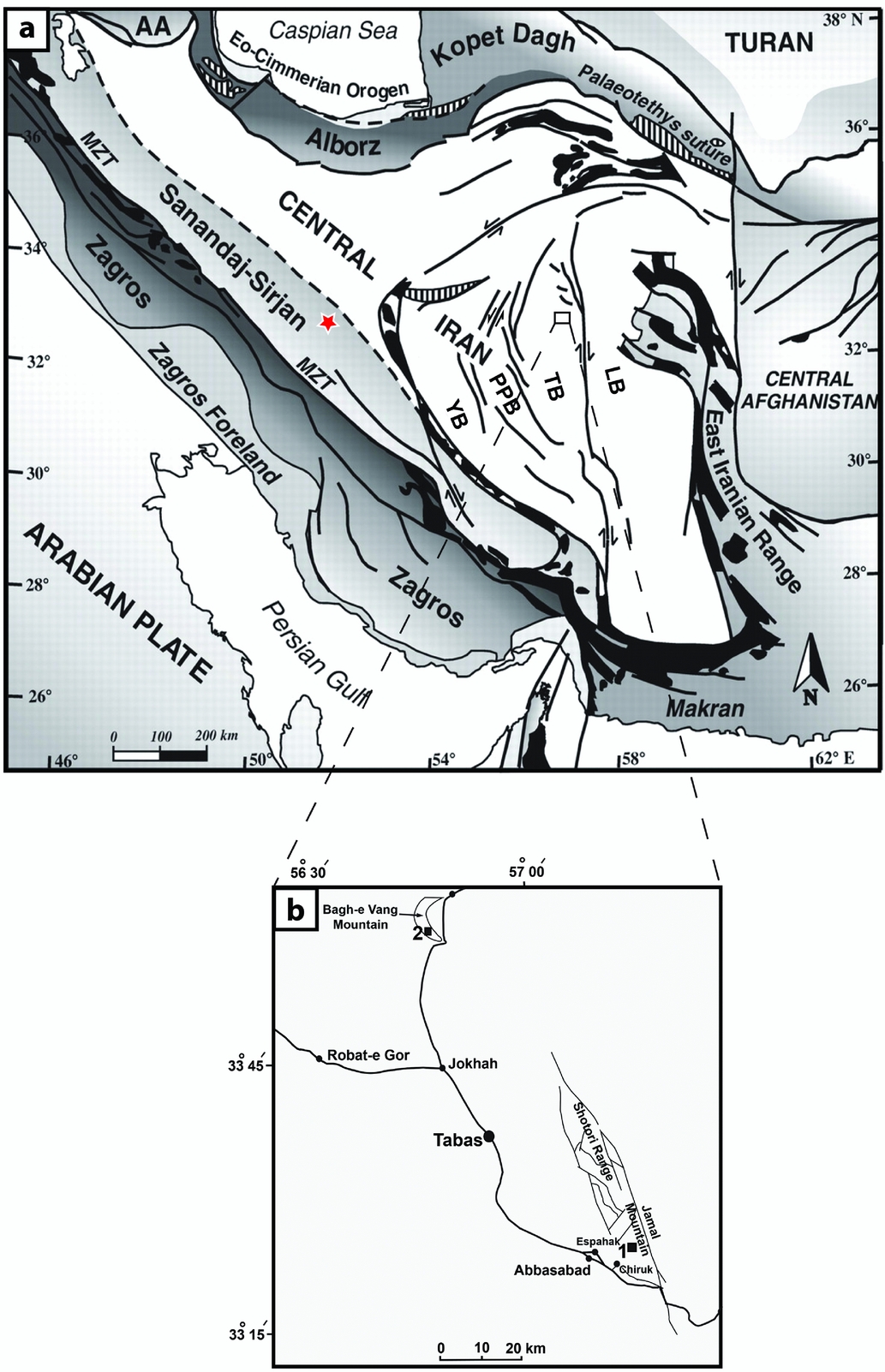
The goals of this contribution are to (1) summarize the lithostratigraphy and biostratigraphy of the Middle Permian deposits in both the Shotori and Bagh-e Vang sections and compare them with their well-known coeval deposits at the Abadeh section in central Iran (Fig. 1); (2) report on their geochemical compositions (elemental and δ18O and δ13C values) to understand their original carbonate mineralogy and diagenetic properties; (3) evaluate palaeoceanic productivity using δ13C value plots in the Guadalupian sections in east-central Iran and previous records of δ13C values at the Abadeh section in central Iran to understand the possible steering mechanisms which stimulated palaeo-productivity in the region.
(a) Generalized tectonic map of Iran (slightly modified after Angiolini et al. Reference Angiolini, Gaetani, Muttoni, Stephenson and Zanchi2007). Red star shows the location of the Abadeh section. Abbreviations: AA – Astara-Azerbaijan Block; LB – Lut Block; MZT – Mesozoic ophiolites along Main Zagros Thrust; TB – Tabas Block; YB – Yazd Block; PPB – Posht-e Badam Block. (b) Enlarged map showing the studied sections in the Tabas area, central Iran. 1 –Shotori section; 2 – Bagh-e Vang section.

2. Geological setting
The area under study is located in the Tabas Block, part of the central Iran province which is considered to be a microcontinent (Takin, Reference Takin1972). The Tabas Block is separated from western and eastern blocks by long strike-slip dextral faults known as the Kalmard and Naybandan faults, respectively (Fig. 1). Guadalupian carbonates of the Jamal Formation are described from two stratigraphic sections, one at the Shotori section in the Shotori area, c. 52 km southeast of the town of Tabas, and the other at the Bagh-e Vang section c. 60 km north of Tabas (Fig. 1).
3. Methods
A total of 260 samples were chosen from the carbonates of the Jamal Formation at the Shotori section in the Shotori Mountains and at the Bagh-e Vang section in the Bagh-e Vang Mountains, central Iran. Two hundred thin-sections were prepared for microfacies, sedimentary environment and sequence stratigraphy analyses, the results of which have been published in Arefifard & Isaacson (Reference Arefifard and Isaacson2011). Twenty-five powdered bulk samples were analysed by atomic absorption spectrometer for Sr at the Geology Department of Shahid Beheshti University, Tehran, Iran. Precision was ± 5 ppm for Sr (Robinson, Reference Robinson1980). Twenty powdered samples, ten samples for each section, which had been previously analysed for Sr values, were analysed with a Micromass 602D for oxygen and carbon isotopes at the Central Science Laboratory, University of Tasmania, Australia. Precision of data is ±0.1 ‰ for both δ18O and δ13C, and these values were reported relative to PDB (Peedee belemnite).
4. Litho- and biostratigraphy of the Jamal Formation
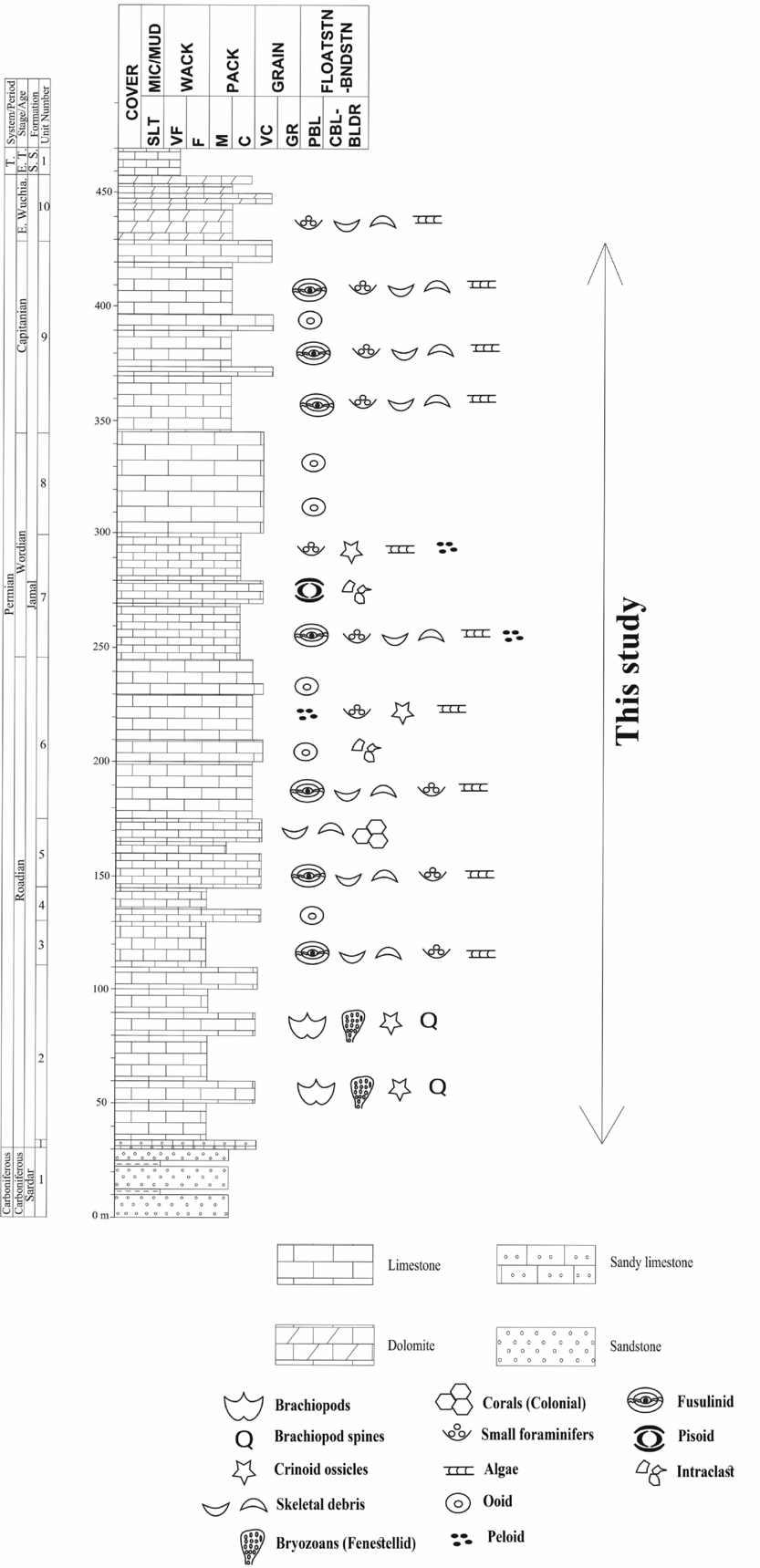
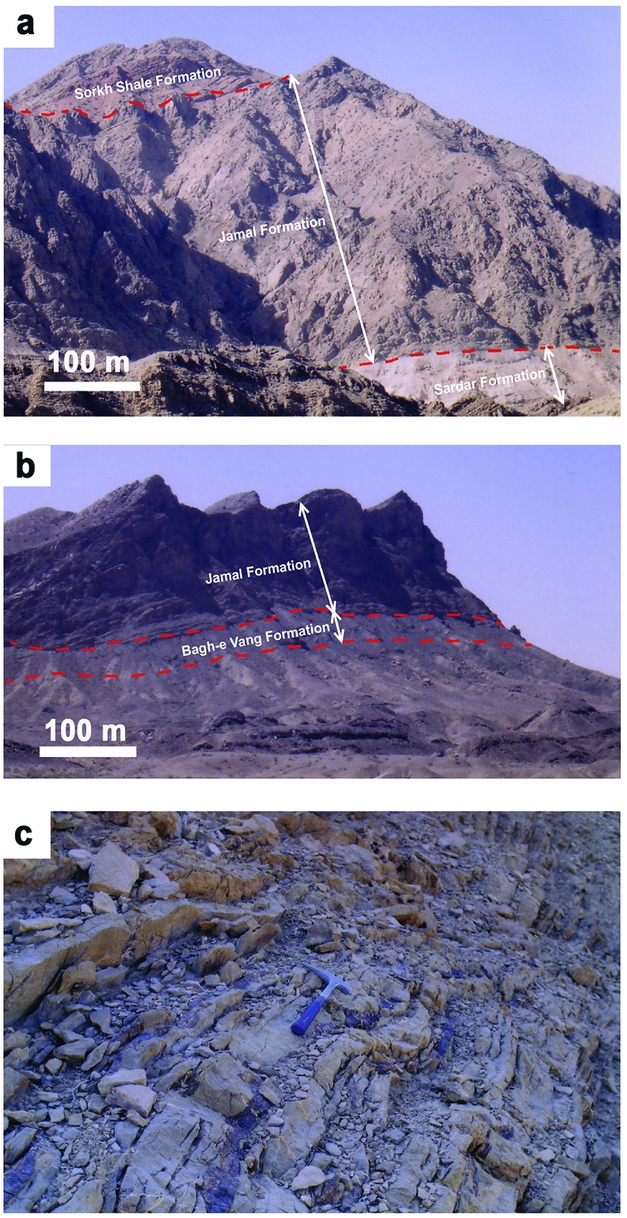
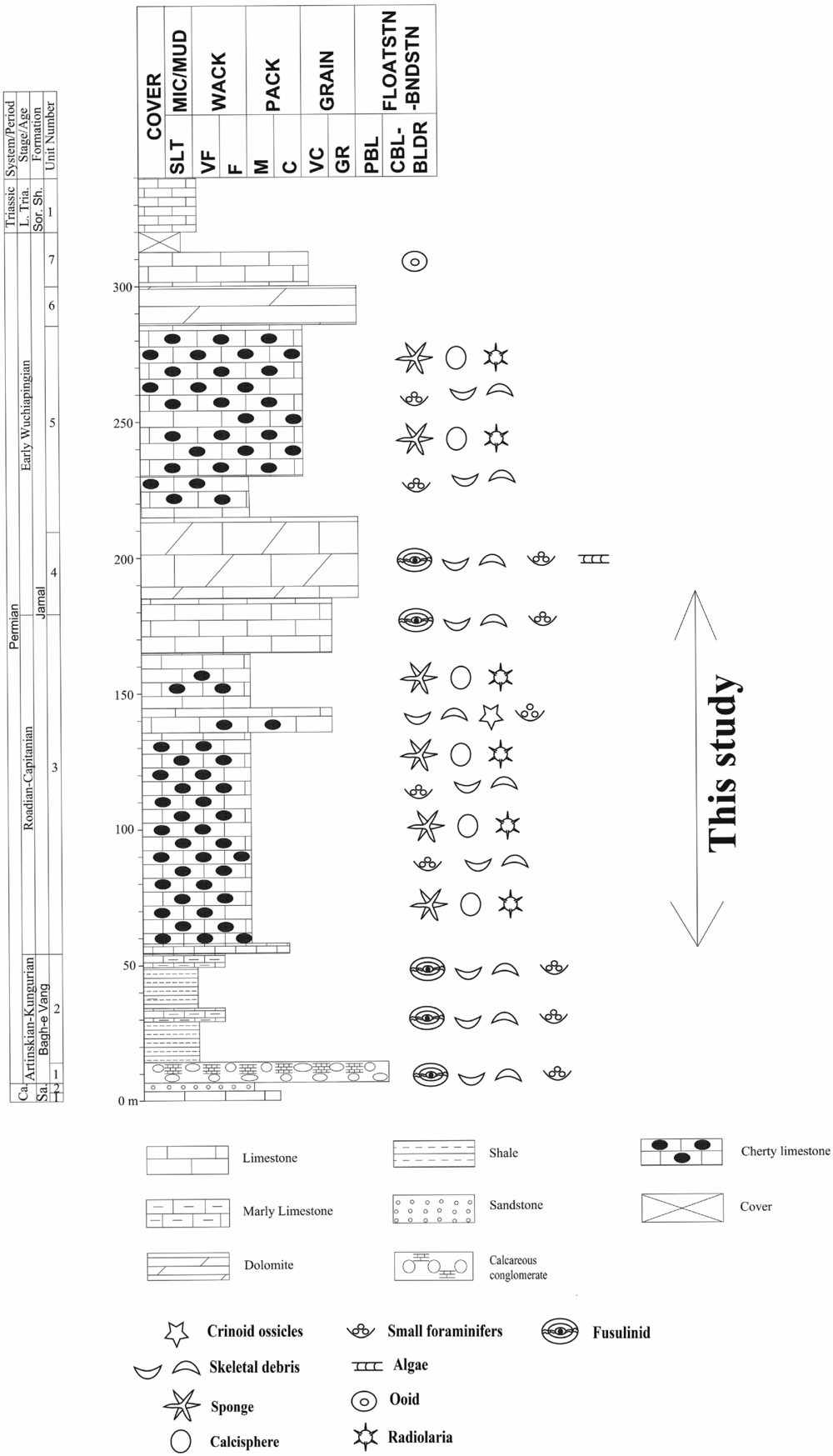
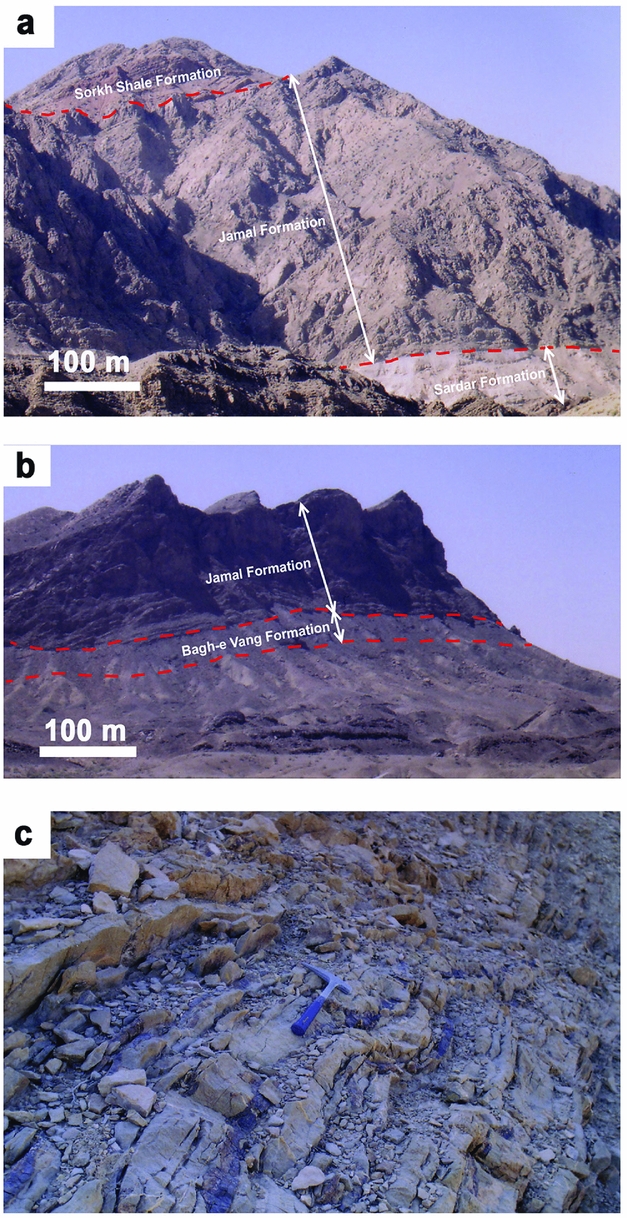
The lower boundary of the Jamal Formation at the Shotori section, Shotori Range, is unconformable with the Upper Carboniferous sandstones of the Sardar Formation, and at the Bagh-e Vang section, the Jamal Formation conformably overlies the Lower Permian Bagh-e Vang Formation (Leven & Vaziri Moghaddam, Reference Leven and Vaziri Moghaddam2004; Arefifard et al. Reference Arefifard, Adabi, Khosrow Tehrani, Shemirani, Aghanabati and Davydov2006; Balini et al. Reference Balini, Mandrioli, Nicora, Angiolini, Vuolo, Sohrabi and Bahramanesh2015) (Figs 2, 3). The Jamal Formation is conformably overlain by the Lower Triassic yellow platy micritic limestones of the Sorkh Shale Formation both at the Shotori and Bagh-e Vang sections.
Stratigraphic log of the Jamal Formation at the Shotori section showing its faunal compositions. Abbreviations: C – coarse; Carboni. – Carboniferous; CBL-BLDR – cobble-boulder; E. T. – Early Triassic; E. Wuch. – early Wuchiapingian; F – fine; FLTSN-BNDSTN – floatstone-boundstone; GR – granular; GRAIN – grainstone; M – medium; MIC/MUD – micrite/mudstone; PACK – packstone; PBL – pebble; SL – siltstone; S. S. – Sorkh Shale; T. – Triassic; VC – very coarse; VF – very fine; WACK – wackestone.

Photographs of the Jamal Formation at the Shotori and Bagh-e Vang sections, Tabas area, central Iran: (a) carbonates of the Middle to Upper Permian Jamal Formation at the Shotori section and its lower and upper boundaries; (b) carbonates of the Jamal Formation at the Bagh-e Vang section and its lower boundary; (c) close-up view of the cherty limestones of the Middle Permian lower part of the Jamal Formation at the Bagh-e Vang section. Hammer for scale is 33 cm long.
The Jamal Formation at the Shotori section is 427.5 m thick and its basal part consists of grey medium- to thick-bedded wackestone and packstone with abundant brachiopods and bryozoans, which are followed by light grey fusulinid bioclastic packstone-grainstone (Fig. 2). The middle and upper parts of the Jamal Formation in this section are mostly composed of bioclastic packstone interbedded with mudstone and ooid grainstone, which in some parts, especially in its upper portions, are dolomitic limestone. Fusulinids are not evenly distributed in the entire Shotori section, as there are only two fusulinid horizons in the lower part of this section with a low abundance upsection. Corals are also rare, but green algae are abundant throughout the section. The lower part of the Jamal Formation at the Shotori section contains fusulinid assemblages such as Cancellina cutalensis, C. primigena, Neofusulinella saraburiensis, Misellina termieri, M. claudiae, Armenina asiatica, A. pamirensis and Chusenella chihsiaensis, which are assignable to the Roadian (Arefifard et al. Reference Arefifard, Adabi, Khosrow Tehrani, Shemirani, Aghanabati and Davydov2006). In Arefifard & Isaacson (Reference Arefifard and Isaacson2011) the Jamal Formation is divided into two parts composed of the Roadian lower part and the Wordian–Capitanian upper part. In a re-evaluation of the Jamal Formation, especially its upper part, by Arefifard (Reference Arefifard2017), the previously Wordian–Capitanian part of the Jamal Formation is divided into two parts, creating a Wordian–Capitanian middle part and Wuchiapingian upper part. The low-abundance fusulinid assemblage in the middle part of the Jamal Formation includes Neoschwagerina simplex, Staffella shaerica, S. quinglongensis, Nankinella hunanensis, Yangchienia haydeni, Sumatrina annae, Dunbarula nana and D. tumida, which are Wordian to Capitanian in age (Arefifard, Reference Arefifard2017). The upper part of the Jamal Formation is composed of dolomitic limestone with no fusulinids and its dating is based on small foraminifera including Dagmarita chanackchiensis, Ichtyolaria latilimbata, Frondina permica, Frodicularia sp., Paraglobivalvulina mira, Pachyphloia iranica and P. pedicula indicative of a Late Permian probably Wuchiapingian age (Arefifard, Reference Arefifard2017).
The Jamal Formation at the Bagh-e Vang section is 241 m thick and mainly consists of grey to black medium- to thick-bedded cherty micritic limestone with small foraminifera, bivalves, ostracodes and rare occurrences of fusulinids. Then very thick to massive limestone replaces cherty limestone, and finally the Jamal Formation is capped by oolitic grainstones and dolomite (Figs 3, 4).
Stratigraphic log of the Jamal Formation at the Bagh-e Vang section showing their faunal compositions. Abbreviations: Artin.-Kung. – Artinskian–Kungurian; Ca. – Carboniferous; L. Tr. – Lower Triassic; S. – Sardar; S. Sh. – Sorkh Shale; Tria. – Triassic. For other abbreviations see the caption of Figure 2.

The lower part of the Middle to Upper Permian Jamal Formation at the Bagh-e Vang section mainly contains medium-bedded dark grey to black cherty bioclastic limestone with few fusulinids including Neoschwagerina sp. and Sumatrina sp. in its uppermost portion (Leven & Vaziri Moghaddam, Reference Leven and Vaziri Moghaddam2004; Arefifard et al. Reference Arefifard, Adabi, Khosrow Tehrani, Shemirani, Aghanabati and Davydov2006). Small foraminifers, radiolarians and sponge spicules are abundant in this part of the Jamal Formation, and its age determination is based on small foraminifers including Globivalvulina vonderschmitti, Neodiscus sp., Climacammina sphaerica, Geinitzina taurica, G. postcarbonica, Langella conica, Langella perforata, Pachyphloia sp., Paleotextularia sumatrensis and Protonodosaria sp. together with rare fusulinids including Sumatrina sp. and Neoschwagerina sp. (Leven & Vaziri Moghaddam, Reference Leven and Vaziri Moghaddam2004; Arefifard et al. Reference Arefifard, Adabi, Khosrow Tehrani, Shemirani, Aghanabati and Davydov2006). The age of the lower part of the Jamal Formation in Arefifard & Isaacson (Reference Arefifard and Isaacson2011) is considered Roadian to Capitanian in which the stage boundaries appear to be well constrained. In a re-examination of the Middle Permian part of the Bagh-e Vang section in this study, based on rare fusulinids including Sumatrina sp., Neoschwagerina sp. and Dunbarula nana in the uppermost portion of the lower part of the Jamal Formation at this section, the age of the lower part of the Jamal Formation is assigned to the Roadian to lower Capitanian without separation of stage boundaries.
The upper part of the Jamal Formation is composed of cream-coloured, thick-bedded to massive dolomitic limestone yielding Reichelina pulchra, Rauserella sp. and Schubertella sp. in its basal portion followed by medium-bedded grey bioclastic cherty limestone with rare fusulinids, including Schubertella sp. and Rauserella sp., and small foraminifers such as Dagmarita changhsingiensis, Colaniella parva, Frondina permica and Hemigordius sp. (Arefifard et al. Reference Arefifard, Adabi, Khosrow Tehrani, Shemirani, Aghanabati and Davydov2006). The uppermost part of the Jamal Formation is unfossiliferous medium-bedded brownish dolomite. The age of this part is inconclusive based on its foraminiferal contents, but it appears to be Late Permian probably Wuchiapingian (Arefifard et al. Reference Arefifard, Adabi, Khosrow Tehrani, Shemirani, Aghanabati and Davydov2006). In Arefifard & Isaacson (Reference Arefifard and Isaacson2011), the basal portion of the upper part of the Jamal Formation has been considered as the uppermost portion of the lower part of this formation, but re-examination of this section in this study led to designation of this portion as the basal beds of the upper part of the Jamal Formation with an early Wuciapingian age.
I. Vuolo (unpub. Ph.D. thesis, Univ. Degli Studi Di Milano, 2014) identified conodonts Mesogondolella siciliensis and transitional forms between M. siciliensis and M. omanensis, and Pseudohindeodus ramovsi in the lower part of the Jamal Formation at the Bagh-e Vang section and assigned them to the Roadian to Wordian–Capitanian boundary.
4.a. Comparative section at Abadeh
Since in this contribution the environmental changes and geochemistry analyses of the Guadalupian deposits in east-central Iran are compared with their correlative units in central Iran, a litho- and biostratigraphic summary of Middle Permian strata at the Abadeh section (Fig. 1) is explained here. In Hambast Valley, about 60 km southeast of the town of Abadeh, there are well-known Permian and Triassic deposits in central Iran named the Abadeh section. Seven lithostratigraphic units (1–7) in the Permian and five units (a–e) in the Triassic are recognized in this section (Taraz, Reference Taraz1969, Reference Taraz1971, Reference Taraz1973; Iranian–Japanese Research Group, 1981). The seven Permian units are grouped into three formations, namely, the Roadian–lower Capitanian Surmaq (units 1–3), the middle–upper Capitanian Abadeh (units 4 and 5) and the Wuchiapingian–Changhsingian Hambast (units 6 and 7) in ascending order. The Roadian to lower Capitanian Surmaq Formation is divided into three units (Iranian–Japanese Research Group, 1981; Heydari, Hassandzadeh & Wade, Reference Heydari, Hassandzadeh and Wade2000). Unit 1 (500 m) of the Surmaq Formation is composed of dark grey, thick-bedded mudstone to wackestone with chert nodules, fusulinids, corals, calcareous algae and brachiopods (Iranian–Japanese Research Group, 1981; Heydari, Hassandzadeh & Wade, Reference Heydari, Hassandzadeh and Wade2000). Unit 2 (80 m) consists of alternations of chert and dolomitic limestone containing crinoids, sparse fusulinids, small foraminifers and many radiolarians and sponge spicules in chert nodules and bands. Unit 3 (75 m) is a thick-bedded to massive wackestone-packstone with diverse small foraminifers, fusulinids, brachiopods, bryozoans and bivalves (Iranian–Japanese Research Group, 1981; Heydari, Hassandzadeh & Wade, Reference Heydari, Hassandzadeh and Wade2000). Kobayashi & Ishii (Reference Kobayashi and Ishii2003) studied and reported five fusulinid zones from the Surmaq Formation. Most parts of unit 1 of the Surmaq Formation include the Pseudofusulina quasifusuliniformis, Eopolydiexodina persica, Afghanella schencki and Neoschwagerina occidentalis zones in ascending order and are assigned an age from Roadian to Wordian. The Chusenella abichi Zone corresponds to the uppermost part of unit 1 and units 2 and 3 of the Surmaq Formation and is dated as early Capitanian. The middle to upper Capitanian Abadeh Formation (units 4 and 5) at the Abadeh section is characterized by two fusulinid zones: Sphaerulina sp. for unit 4 and Codonofusiella kwangsiana for unit 5. Unit 4 of the Abadeh Formation includes a basal thin-bedded yellow gypsiferous mudstone that grades upwards into dark grey, thin-bedded, organic-rich mudstone-wackestone interbedded with packstone. This unit contains abundant small foraminifers, calcareous algae, brachiopods, conodonts and fusulinids. Unit 5 of the Abadeh Formation is mostly composed of thick-bedded skeletal packstone with some chert nodules and contains small foraminifers, fusulinids and conodonts. The Hambast Formation is divided into units 6 and 7. Wuchiapingian unit 6 is composed of thin-bedded light green lime mudstone and is rich in cephalopods and conodonts. Changhsingian unit 7 contains red, nodular lime mudstone with abundant cephalopods and conodonts.
5. Original carbonate mineralogy
Petrographic and geochemical methods are employed to identify the original mineralogy of carbonates (Sandberg, Reference Sandberg1983; Adabi & Rao, Reference Adabi and Rao1991; Rao & Adabi, Reference Rao and Adabi1992; Adabi, Reference Adabi2004; Adabi & Asadi Mehmandosti, Reference Adabi and Asadi Mehmandosti2008). The Jamal Formation limestones at the Shotori section include both skeletal (fusulinid, green algae, small foraminifera, bryozoan, coral, brachiopod and crinoid) and non-skeletal (ooid, pisoid, peloid and intraclast) components. Low-Mg calcite elements are resistant to diagenetic-related alteration and preserve their original microstructure and chemical composition. In contrast, aragonitic and high-Mg calcite components will lose their original microfabric during diagenesis and reprecipitation (Sandberg, Reference Sandberg1983; Oti & Müller, Reference Oti and Müller1985; Hover, Walter & Peacor, Reference Hover, Walter and Peacor2001; Flügel, Reference Flügel2010). There is incorporation of organisms with aragonite and high- and low-Mg calcite compositions in the Jamal Formation at the Shotori section, but there is pervasive recrystallization in all thin-sections of this formation. The alteration of micrite to recrystallized microspar and the occurrence of ooid moulds are all indicative of an original aragonite mineralogy. Even though recrystallization of aragonite results in the loss of Sr (Brand & Veizer, Reference Brand and Veizer1980), limestones with aragonitic composition normally have higher Sr values than limestones with a calcite origin (Veizer & Demovic, Reference Veizer and Demovic1974; Perrin et al. Reference Perrin, Prestimonaco, Servelle, Tilhac, Maury and Cabrol2014).
In contrast, the Middle Permian part of the Jamal Formation at the Bagh-e Vang section is micritic limestone and composed of skeletal grains (including small foraminifers, radiolarians, sponge spicules and rare crinoid stems) with no non-skeletal grains. These limestones contain small crystals with no indication of recrystallization suggestive of an original calcite mineralogy.
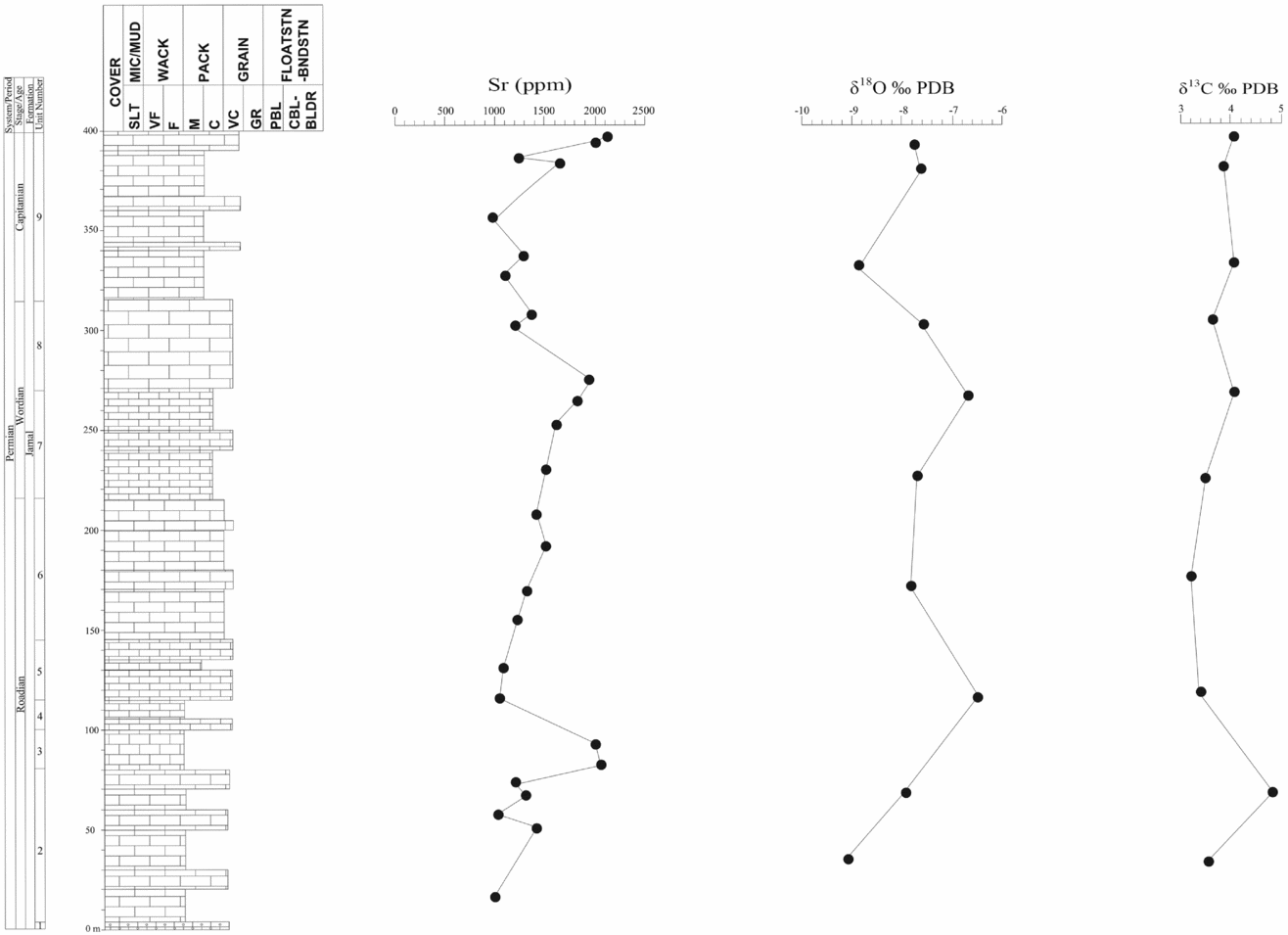
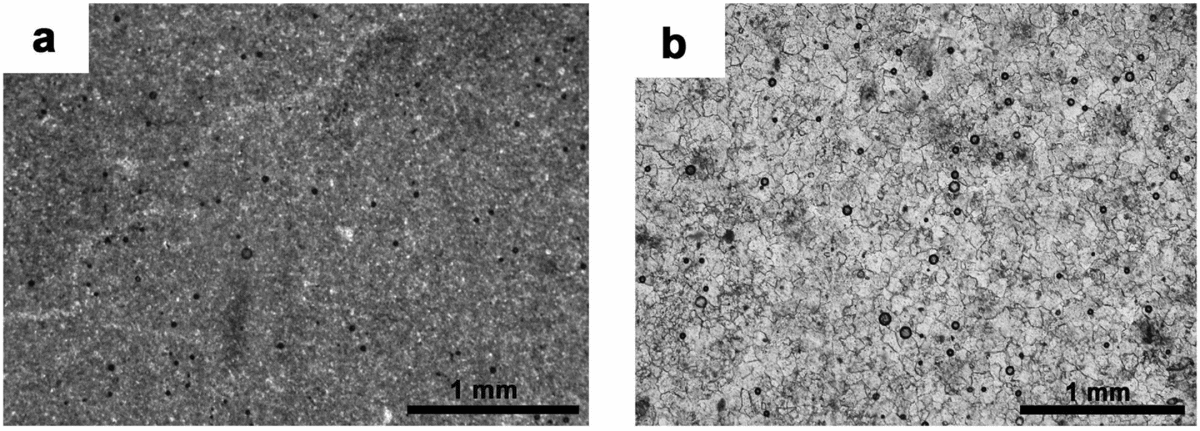
Sr concentration and mineralogy composition of carbonates have a direct relationship, as Sr values increase with aragonite increase and decrease with calcite increase (Rao & Adabi, Reference Rao and Adabi1992; Rao & Amini, Reference Rao and Amini1995; Rao, Reference Rao1996; Adabi, Reference Adabi2004). Sr values range from 8000 to 10 000 ppm in recent tropical bulk carbonate samples (Milliman, Reference Milliman1974), while in recent temperate bulk carbonates it reduces and ranges from 1500 to 4500 ppm (Rao, Reference Rao1991; Rao & Adabi, Reference Rao and Adabi1992; Hood, Nelson & Kamp, Reference Hood, Nelson and Kamp2004). The values of Sr in low-Mg calcite, high-Mg calcite and aragonite are 1000 ppm, 3000 ppm and up to 10 000 ppm, respectively (Kinsman, Reference Kinsman1969; Carpenter & Lohmann, Reference Carpenter and Lohmann1992; Rao, Reference Rao1996; Rao et al. Reference Rao, Amini, Ferguson, Camoin and Davis1998). The concentration of Sr in the Jamal Formation limestone samples at the Shotori section ranges from 1010 to 2175 ppm (average 1425 ppm) (Fig. 5). Considering the high Sr values of these samples and their recrystallized nature (Fig. 6), it suggests that they had an original aragonite mineralogy. This conclusion is also consistent with the previous idea that Permian oceans were aragonitic because of low PCO2 levels or a high Mg/Ca ratio (Sandberg, Reference Sandberg1983; Wilkinson, Owen & Carroll, Reference Wilkinson, Owen and Carroll1985; Berner, Reference Berner1990).
Bulk carbonate Sr, δ18O and δ13C values of the Jamal Formation at the Shotori section. High Sr concentrations imply an original aragonite mineralogy. Low δ18O values are suggestive of diagenetic alteration. Higher δ13C values of the bulk carbonates of the Jamal Formation at the Shotori section compared to those of the Bagh-e Vang section are indicative of their aragonite mineralogy. The plot of δ13C changes at this section does not display a definite decreasing or increasing trend making the interpretation of δ13C changes difficult.

Photomicrographs of the Jamal Formation at the Shotori and Bagh-e Vang sections. (a) The limestone of the Middle Permian lower part of the Jamal Formation at the Bagh-e Vang section consists of small crystals lacking recrystallization fabrics, which is another criterion along with its low Sr values showing the original calcite mineralogy; sample B-14. (b) The limestones of the Jamal Formation at the Shotori section show large calcite crystals which obliterated the original fabric; sample J-60. These limestones also have high Sr values. This evidence indicates that their original mineralogy was aragonite.

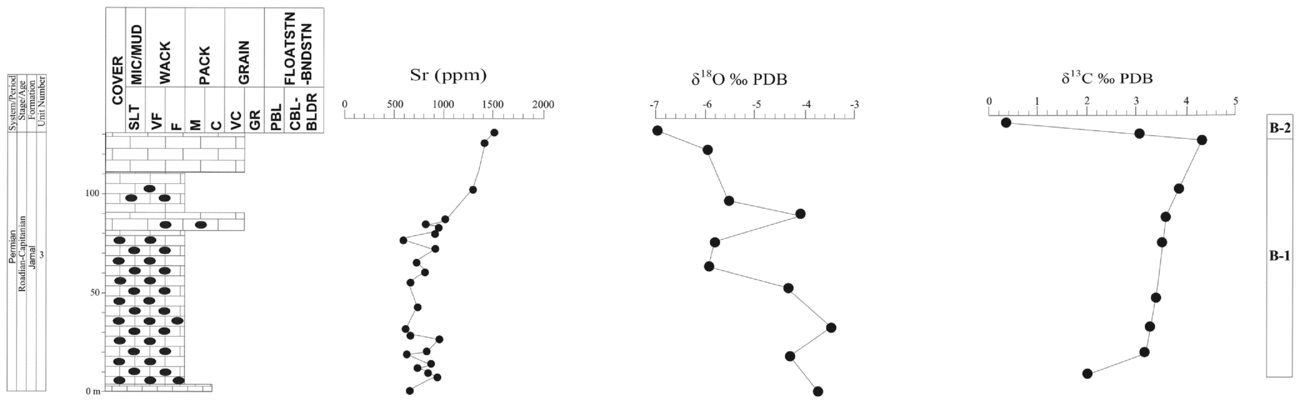
However, the carbonates in the lower part of the Middle Permian of the Jamal Formation at the Bagh-e Vang section have Sr values which range from 580 to 1500 ppm (mean 884.56 ppm) (Fig. 7). Sr concentration for most of these carbonates is low and ranges from 580 to 970 ppm (mean 770.85 ppm). However, only at the topmost portion of these carbonates, where the typical Tethyan fusulinids appear, do the Sr values start to increase and range from 1009 to 1500 ppm (average 1311 ppm). The non-recrystallized character of these carbonates (Fig. 6) along with the low Sr values for its most part, imply an original calcite mineralogy with a change to aragonite for its uppermost portion. The Bagh-e Vang section is located c. 120 km northwest of the Shotori section, and based on both petrographic and geochemical evidence, two different original mineralogies are inferred for the Middle Permian carbonates of the Jamal Formation. This is achieved despite being deposited under the same tectonic setting, PCO2 levels and global sea level stand.
Bulk carbonate Sr, δ18O and δ13C values of the Jamal Formation at Bagh-e Vang section. Low Sr concentrations suggest an original calcite mineralogy. The heavier δ18O values of these carbonates are explicable by their original calcite mineralogy as aragonite is more susceptible to recrystallization than calcite. Lighter δ13C values of the bulk carbonates of the Jamal Formation at the Bagh-e Vang section compared to those at the Shotori section are indicative of their calcitic mineralogy. The constantly upward-increasing pattern of the δ13C record in the Roadian–Wordian cherty limestone at the Bagh-e Vang section (segment B-1) suggests a cooling event associated with high bioproductivity, which is well documented with an extreme increase of δ13C of c. 4.3 ‰ PDB in the upper Wordian around the Wordian–Capitanian boundary. Close to the high positive excursion of δ13C values in segment B-1, there is a major negative excursion of δ13C values of c. 3.7 ‰ PDB (segment B-2) indicating a decline in bioproductivity and a change in climate into warm conditions at the end-Guadalupian.

According to previous work, aragonite was the prevalent mineralogy during Permian time (Sandberg, Reference Sandberg1983; Hardie, Reference Hardie1996; Stanley & Hardie, Reference Stanley and Hardie1999; Demicco et al. Reference Demicco, Lowenstein, Hardie and Spencer2005), but these findings are not in agreement with this concept. The Upper Jurassic Mozdoran limestone, in Kopet-Dagh in NW Iran, is another example of coexisting aragonite and calcite, which represents aragonite mineralogy in the shallow part of the basin and dominant calcite mineralogy in the deeper setting (Adabi & Rao, Reference Adabi and Rao1991, Reference Adabi and Rao1996; M. H. Adabi, unpub. Ph.D. thesis, Univ. Tasmania, 1997; Adabi, Reference Adabi2004). Some researchers argued that variation in carbonate mineralogy in geologic time is not supported only based on global sea level, change in seafloor spreading rates, PCO2 level and Mg/Ca ratios related to spreading rate (Nelson, Reference Nelson and Nelson1988; Adabi, Reference Adabi2004). They suggested that the variation in mineralogy through the Phanerozoic entails re-evaluation pertaining to seawater temperature or palaeo-latitudes. Therefore, the occurrence of two different mineralogies in Middle Permian carbonates of the Jamal Formation at the Shotori and Bagh-e Vang sections can be explained by changes in water temperature and depth. This is supported by both petrographic and geochemical evidence.
6. Middle Permian carbonate δ18O and δ13C compositions of the Jamal Formation
The δ18O values of the bulk carbonates are influenced by several factors including carbonate mineralogy, salinity, temperature, δ18O values of the sea water and diagenetic effects (Veizer, Fritz & Jones, Reference Veizer, Fritz and Jones1986; Grossman & Ku, Reference Grossman and Ku1986; Rao, Reference Rao1996; Veizer et al. Reference Veizer, Bruckschen, Pawellek, Diener, Podlaha, Carden, Jasper, Korte, Strauss, Azmy and Ala1997; Grossman, Reference Grossman, Ivany and Huber2012). On the other hand, many factors control the δ13C values of the bulk carbonates, among which are carbonate mineralogy, the δ13C composition of ambient seawater and evaporation of seawater (Stiller, Rounick & Shasha, Reference Stiller, Rounick and Shasha1985; Kroopnick, Reference Kroopnick1985; Gonzalez & Lohmann, Reference Gonzalez and Lohmann1985; Romanek, Grossman & Morse, Reference Romanek, Grossman and Morse1992; Rao, Reference Rao1996). The δ18O values of bulk carbonates in the Jamal Formation at the Shotori section range from −6.6 ‰ to −9.1 ‰ PDB (mean −8.08 ‰ PDB), whereas those of the Jamal Formation at the Bagh-e Vang section range from −3.5 ‰ to −6.9 ‰ PDB (mean −5.04 ‰ PDB) (Figs 5, 7). It is noteworthy that the uppermost portion of the Middle Permian part of the Jamal Formation at the Bagh-e Vang section has lighter δ18O values, ranging from −6.05 ‰ to −6.9 ‰ PDB (mean −6.52 ‰ PDB), and δ18O values for its most part range from −3.5 ‰ to −5.52 ‰ PDB (mean −4.7 ‰ PDB).
The δ18O values of bulk carbonates at the Shotori section are lighter than those of the Bagh-e Vang section, suggesting diagenetic alteration at the Shotori section. The Jamal Formation carbonates at the Shotori section were originally composed of aragonite, but at the Bagh-e Vang section they show an original calcite composition. This different original carbonate mineralogy in both sections can be explained by heavier δ18O values (about 3.04 ‰ PDB) of the bulk carbonates at the Bagh-e Vang section, as aragonite is more susceptible to recrystallization than calcite. The lighter δ18O values of the bulk carbonates in the topmost portion of the Middle Permian deposits at the Bagh-e Vang section are due to the changing of the original mineralogy from calcite to aragonite and their recrystallized nature.
Bulk carbonate δ13C compositions of the Jamal Formation at the Shotori section range from 3.2 ‰ PDB to 4.1 ‰ PDB (mean 3.56 ‰ PDB), whereas those of the Middle Permian carbonates of the Jamal Formation at the Bagh-e Vang section range from 0.3 ‰ to 4.3 ‰ PDB (mean 3.04 ‰ PDB) (Figs 5, 7). The δ13C value of aragonite is 1.7 ‰ PDB higher than that of calcite (Gonzalez & Lohmann, Reference Gonzalez and Lohmann1985; Romanek, Grossman & Morse, Reference Romanek, Grossman and Morse1992). The lower average of δ13C values for the Middle Permian carbonates of the Jamal Formation at the Bagh-e Vang section compared to their counterparts at the Shotori section can be justified owing to their original calcite mineralogy.
7. Grain associations of the Jamal Formation at the Shotori and Bagh-e Vang sections
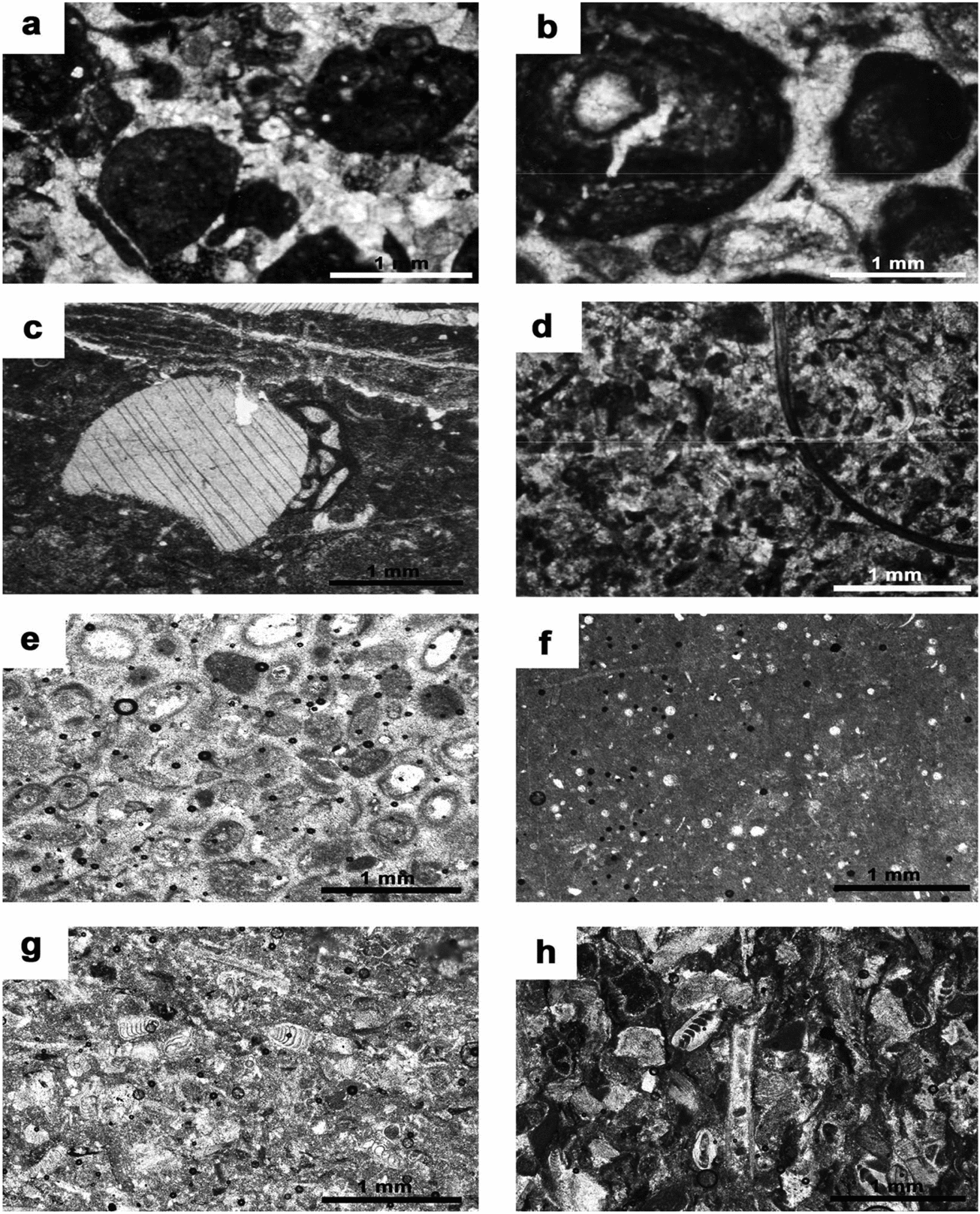
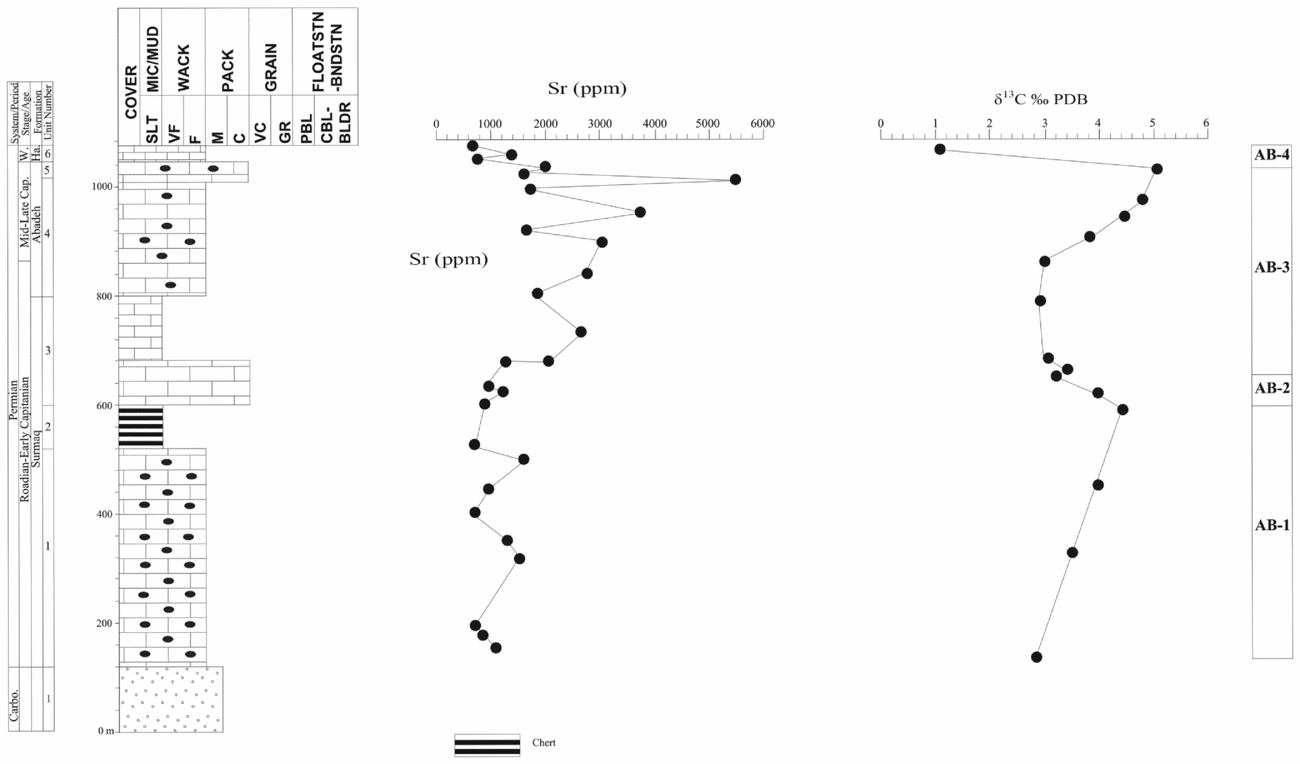
Microfacies analyses of the Middle Permian part of the Jamal Formation carbonates, both at the Shotori and the Bagh-e Vang sections, have been studied by Arefifard & Isaacson (Reference Arefifard and Isaacson2011). The skeletal grains of the Middle Permian carbonates of the Jamal Formation contain fusulinids, small foraminifers, calcareous algae, brachiopods, crinoids, ostracodes, bryozoans and corals with ooids, peloids, intraclasts and pisoids as their non-skeletal grains (Fig. 8). Conversely, Guadalupian carbonates of the Jamal Formation at the Bagh-e Vang section include small foraminifers, crinoids, sponge spicules and radiolarians as skeletal grains in a lime-mud matrix without any non-skeletal grains. Therefore, the Middle Permian at the Shotori section is dominated by warm shallow water carbonate, but its coeval counterparts at the Bagh-e Vang section are represented by cool deep water carbonates. The faunal assemblages of the Middle Permian deposits of the Jamal Formation at both studied sections are in agreement with carbonate mineralogy variations. It assumes that varying seawater chemistry prevailed in the Middle Permian of east-central Iran. The variation in carbonate mineralogy, despite there being no departure from the same PCO2 level, global sea level and tectonic setting is also reported in the Middle Permian deposits at the Abadeh section. The deep water unit 2 of the Roadian–lower Capitanian Surmaq Formation at the Abadeh section shows the lowest Sr compositions (600–800 ppm), and the shallow warm water units (1, 3, 4 and 5) have average Sr compositions of 1019, 1300, 2480 and 2455, respectively (Heydari, Hassandzadeh & Wade, Reference Heydari, Hassandzadeh and Wade2000).
Photomicrographs of skeletal and non-skeletal grains of the Jamal Formation at the Shotori and Bagh-e Vang sections, Tabas area, central Iran; scale for all photos is 1 mm. (a) Intraclast packstone-grainstone, Shotori section, sample J-79. (b) Intraclast oncoid grainstone, Shotori section, sample J-82. (c) Bioclast wackestone, Shotori section, sample J-52. (d) Peloid packstone-grainstone, Shotori section, sample J-40. (e) Ooid grainstone showing ooid moulds, Shotori section, sample J-90. (f) Radiolarian sponge spicule wackestone, Bagh-e Vang section, sample B-20. (g) Foraminifer wackestone-packstone, Bagh-e Vang section, sample B-35. (h) Bioclastic grainstone, Bagh-e Vang section, sample B-45.

8. Carbon isotope changes and palaeo-productivity
The correlation between δ13C and δ18O of both the Bagh-e Vang and Shotori sections (Figs 5, 7) shows no parallel relationship indicating that despite the influence of diagenetic alteration on δ18O values, δ13C values were probably not affected by secondary alteration. In fact, these δ13C values reflect the record of isotopic composition changes in inorganic carbon in the Middle Permian ocean where carbonates of both the Bagh-e Vang and Shotori sections were deposited. At the Bagh-e Vang section, the δ13C values range between 0.3 ‰ and 4.3 ‰ PDB. According to the δ13C values, the Bagh-e Vang section is divided into two parts, i.e. segment B-1 and the overlying segment B-2 (Fig. 7). Segment B-1 is identified by a gradual increase in δ13C values, whereas segment B-2 is characterized by a relatively sharp decrease in δ13C values. This δ13C analysis at the Bagh-e Vang section reveals that the δ13C values increased from the Roadian through Wordian beds (segment B-1), but the lower Capitanian uppermost beds (segment B-2) display a decreasing trend in δ13C values. The δ13C values at the Shotori section range between 3.2 and 4.1 ‰ PDB. In contrast to the Bagh-e Vang section, the plot of δ13C changes at this section does not exhibit any overall decreasing or increasing trend. In the Bagh-e Vang section, δ13C values have the most variations because of high organic matter while in the Shotori section low organic matter results in low or no change in δ13C values.
The constantly upward-increasing pattern of the δ13C record in the Roadian–Wordian strata at the Bagh-e Vang section indicates the change in palaeo-oceanographic conditions to a cooling event, which is evident, with a sharp increase in δ13C in the upper Wordian around the Wordian–Capitanian boundary. Unfortunately, the middle and upper Capitanian strata at the Bagh-e Vang section are missing, thereby preventing the tracking of detailed changes in δ13C values during this time interval.
Heydari, Hassandzadeh & Wade (Reference Heydari, Hassandzadeh and Wade2000) reported the δ13C profile of the Middle Permian Surmaq and Abadeh formations at the Abadeh section. Their results show a significant positive excursion of δ13C values over 3 ‰, fluctuating between 2 ‰ and 5 ‰ PDB (Fig. 9). In terms of δ13C values, these deposits are divided into four segments, i.e. segments AB-1 to AB-4. In segment AB-1 (including units 1–3), δ13C values increase from 2 ‰ to about 4.2 ‰ PDB. In segment AB-2, there is a very short-term decrease in δ13C values at the base of unit 4 by 2 ‰ PDB, which is due to the presence of gypsum crystals that indicate limited evaporation of sea water in marginal marine conditions that contributed to low δ13C values (Heydari, Hassandzadeh & Wade, Reference Heydari, Hassandzadeh and Wade2000). Segment 3 (the most part of unit 4) shows another increase in δ13C values which reaches to 5 ‰ PDB. Segment 4 (the uppermost portion of unit 4) represents a sharp decrease in δ13C values by 4 ‰ PDB.
Bulk carbonate Sr and δ13C values of the Surmaq and Abadeh formations at the Abadeh section. The deep water unit 2 of the Roadian–lower Capitanian Surmaq Formation shows the lowest Sr compositions (600–800 ppm), and the shallow warm water units (1, 3, 4 and 5) have average Sr compositions of 1019, 1300, 2480 and 2455, respectively (Heydari, Hassandzadeh & Wade, Reference Heydari, Hassandzadeh and Wade2000). An important positive excursion of δ13C values over 3 ‰ PDB fluctuating between 2 ‰ and 5 ‰ PDB is shown in segment AB-3, indicative of a cooling event and high palaeo-productivity. Next to the high positive excursion of δ13C values in segment AB-3, there is a major δ13C values depletion of c. 4.2 ‰ PDB (segment AB-4) suggesting low bioproductivity and a transition from cool to warm conditions at the Guadalupian–Lopingian boundary. Abbreviations: Cap. – Capitanian; Carbo. – Carboniferous; Ha. – Hambast; W. – Wuchiapingian.

The gradual and long-term increases in δ13C values from the Roadian to the Wordian–Capitanian boundary at the Bagh-e Vang section in east-central Iran and from the Roadian to the lower Capitanian in the Surmaq Formation and the most part of the Abadeh Formation can be explained by high primary productivity in the ocean and abundant nutrient availability. The presence of organic-rich lime mud and cherts in Middle Permian deposits at both the Bagh-e Vang and Abadeh sections confirms high δ13C values.
9. Cause of high palaeo-productivity in Middle Permian deposits in central Iran
Isozaki, Kawahata & Ota (Reference Isozaki, Kawahata and Ota2007) recognized a high positive δ13C excursion plateau from the late Middle Permian (Capitanian) in a palaeo-atoll limestone in Kamura, southwestern Japan. They considered this remarkable positive carbon isotope excursion as a result of a global cooling which lasted 3–4 million years during Capitanian time. It is named the Kamura cooling event, which ended before the Guadalupian–Lopingian boundary. They also postulated that the demise of warm water faunas including large fusulinids and bivalves was because of the Kamura cooling event. Later, Isozaki, Kawahata & Minoshima (Reference Isozaki, Kawahata and Minoshima2007) reported a major negative excursion in δ13C values immediately after the Kamura event at the Kamura section indicating consequential global warming and the ending of high bioproductivity at the Guadalupian–Lopingian boundary. Isozaki, Kawahata & Ota (Reference Isozaki, Kawahata and Ota2007) considered the early Capitanian to be the beginning of the Kamura cooling event.
The Kamura cooling event was linked to the ELIP (Emeishan Large Igneous Province) in SW China as a major cause of the Guadalupian–Lopingian extinction (Isozaki, Reference Isozaki2009; Isozaki, Aljinović & Kawahata, Reference Isozaki, Aljinović and Kawahata2011), but the coincidence of these two events is doubtful because of the radiometric age of the clay tuff at the Middle–Upper Permian boundary at Chaotian (260 ± 5 Ma) across the Maokou–Wujiaping boundary (He et al. Reference He, Xu, Huang, Luo, Shi, Yang and Yu2007, Reference He, Xu, Zhong and Guan2010). The eruption of the Emeishan flood basalts is a boundary event that happened at the Guadalupian–Lopingian boundary and is contemporaneous with the end-Guadalupian mass extinction suggesting there may be a causal similarity for both (Zhang et al. Reference Zhang, Mahoney, Mao and Wang2006a,b; Shellnutt, Denyszyn & Mundil, Reference Shellnutt, Denyszyn and Mundil2012; Wei et al. Reference Wei, Chen, Yu and Wang2012). For the time being, the origins of the Kamura cooling event are difficult to ascertain. However, regardless of the driving mechanism for this cooling event, the high positive δ13C values denote, at this time, increased bioproductivity and sequestration of organic matter in organic-rich mudstone. The primary productivity itself is controlled by nutrient availability, and long-lasting oceanic productivity requires a constant supply of limiting elements such as P and N (Saltzman, Reference Saltzman2005). A unique signal of the Kamura cooling event is reported in the Capitanian Velebit Formation from Croatia in the western Tethys with unusually high δ13C values (+4 to +6 ‰) suggesting the global context of the event and its application for chemostratigraphic correlation (Isozaki, Aljinović & Kawahata, Reference Isozaki, Aljinović and Kawahata2011). In South China, the Kamura event is reported from the uppermost Capitanian at the Penglaitan section (Wang, Cao & Wang, Reference Wang, Cao and Wang2004; Chen et al. Reference Chen, Joachimski, Sun, Shen and Lai2011). The Kamura event is also evident from Capitanian strata in southern Primorie, Russian Far East (Kossovaya & Kropatcheva, Reference Kossovaya, Kropatcheva, Gąsiewicz and Słowakiewicz2013), in which carbon isotopes show an increase from 1.2 to 4 ‰ PDB. Similar high positive δ13C values were reported from East Greenland (Scholle, Stemmerik & Ulmer, Reference Scholle, Stemmerik and Ulmer1991), West Spitsbergen (Mii, Grossman & Yancey, Reference Mii, Grossman and Yancey1997), in the Yığılıtepe Formation at the Köserelik Tepe section, in the Adana Province of Turkey (Jost et al. Reference Jost, Mundil, He, Brown, Altiner, Sun, DePaolo and Payne2014) and the Delaware basin in West Texas (Korte et al. Reference Korte, Jasper, Kozur and Veizer2005). At the Bagh-e Vang section the maximum δ13C values were reached in the Wordian cherty limestones and lower Capitanian bioclastic grainstones. At the Abadeh section it happened in the upper Capitanian. These high positive excursions of carbon isotopes in Middle Permian deposits at both the Bagh-e Vang and Abadeh sections and other coeval regions indicate the Middle Permian as one of the significant periods of high bioproductivity during the Phanerozoic (Large et al. Reference Large, Halpin, Lounejeva, Danyushevsky, Malsennikov, Gregory, Sack, Haines, Long, Makoundi and Stepamov2015).
There might be two possible ways to explain such high oceanic productivity in central Iran. One explanation is to find the proof of volcanism around the time when the cooling event occurred. In fact, there is no indication of volcanic activity like the ELIP in Middle and Late Permian time in central Iran which could have increased continental weathering rates and enhanced nutrient flux from the continent to the oceans, stimulating primary production and leading to high primary productivity.
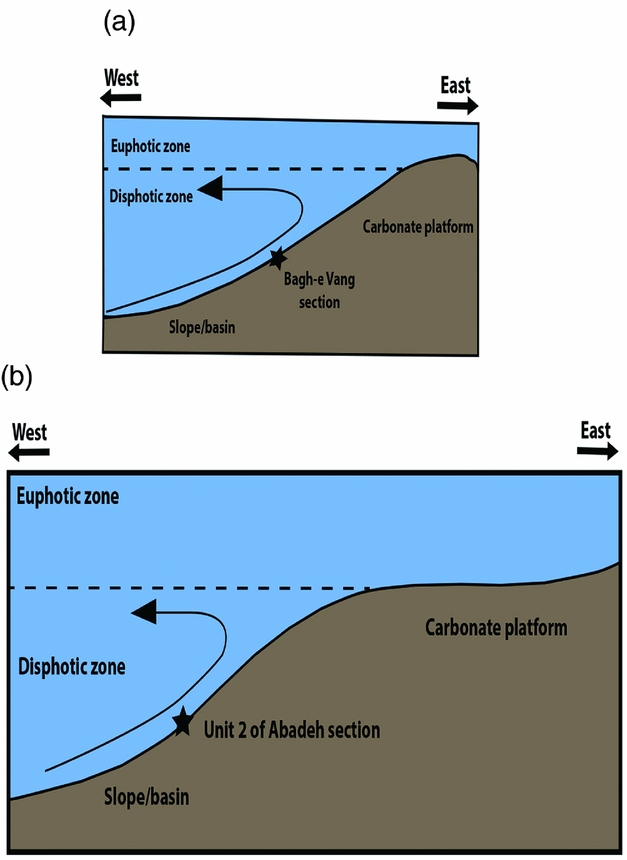
Another possible explanation for this high productivity is active oceanic circulation related to an upwelling along the slopes of the continental margin. This might have brought nutrients from the deep oxygen-depleted slope basin in the disphotic zone to the shallow euphotic zone and induced planktonic producers and increased palaeo-productivity (Isozaki, Aljinović & Kawahata, Reference Isozaki, Aljinović and Kawahata2011; Saitoh et al. Reference Saitoh, Isozaki, Ueno, Yoshida, Yao and Ji2013) during late Guadalupian time in central Iran (Fig. 10).
Schematic diagram showing local upwelling along the slopes of the continental margin which might have brought nutrients from the deep slope basin in the disphotic zone into the shallow euphotic zone in Middle Permian deposits at the (a) Bagh-e Vang and (b) Abadeh sections.

The Roadian to Wordian deposits at the Bagh-e Vang section consist of medium- to thin-bedded dark grey mudstone-wackestone with abundant nodular cherts yielding abundant radiolarians, sponge spicules and small foraminifers. Unit 2 of the Surmaq Formation (Fig. 9) is composed of alternating chert nodules and bands containing sponge spicules and radiolarians with grey dolomitic limestone yielding small amounts of fusulinids and crinoids. The rare to complete absence of shallow water faunas and the abundant occurrence of radiolarians and sponge spicules that are common in an open marine setting suggest that they accumulated on a relatively deep slope/basin environment under oxygen-depleted conditions except for its uppermost, shallow water setting (Fig. 10). At the Abadeh section, the Middle Permian units (1, 3–5) contain abundant large and small fusulinids and calcareous algae indicating deposition in shallow water and within the euphotic zone (Fig. 10).
In the middle to upper Capitanian Abadeh Formation large fusulinids are absent, and small fusulinids are rare. The disappearance of large fusulinids belonging to Verbeekinidae and Neoschwagerinidae is characteristic of the Abadeh Formation. The extinction of these large fusulinids appears to be related to the Kamura cooling event.
These changes in facies trends during Middle Permian time are also reported in Middle Permian deposits in South China. For instance, most parts of the Middle Permian Maokou Formation at Chaotian in northern Sichuan, South China are composed of shallow water dark grey bioclastic limestone yielding abundant fossil fragments such as algae, corals, brachiopods, bryozoans, fusulinids and ostracodes. The topmost part of this formation contains lower-middle Capitanian black calcareous chert and black chert with radiolarians, conodonts and ammonoids which are indicative of a deep/slope basin setting (Saitoh et al. Reference Saitoh, Isozaki, Ueno, Yoshida, Yao and Ji2013). The Wuchiapingian Wuchiaping Formation is composed of shallow water dark grey bioclastic limestone with brachiopods, calcareous algae and conodonts. The basal beds of the Wuchiaping Formation are non-carbonate beds of volcaniclastic origin (He et al. Reference He, Xu, Zhong and Guan2010) called the Wangpo beds with a latest Capitanian age. There are also other localities in South China where the same facies changes have been observed from shallow water bioclastic limestones to deep water cherty limestones in the upper part of the Maokou Formation and a return to shallow water bioclastic carbonates in the basal part of the Wuchiaping Formation in South China, e.g. the Xiongjiachang and Gouchang sections in western and central Guizhou (Wignall et al. Reference Wignall, Sun, Bond, Izon, Newton, Vedrine, Widdowson, Ali, Lai, Jiang, Cope and Bottrell2009) and the Nanjiang section in northeastern Sichuan (Zhang, Zhang & Xia, Reference Zhang, Zhang and Xia2008). In western Hubei Province in South China, Middle Permian deposits are composed of lowermost Roadian shallow water carbonates at the topmost part of the Qixia Formation, deep water Roadian–Capitanian cherts and muddy cherts of the Gufeng Formation, and uppermost Capitanian shallow water bioclastic carbonates at the basal part of the Wuxue Formation (Shi et al. Reference Shi, Feng, Shen, Itob and Chen2016).
10. Negative δ13C excursion across the G–L boundary
Following the high positive excursion of δ13C values in segment B-2 of the Bagh-e Vang section and segment AB-3 of the Abadeh section is a major negative excursion of δ13C values. Segments B-2 and AB-4 recorded a c. 3.7 ‰ and 4.2 ‰ PDB decrease, respectively (Figs 7, 9). This sharp drop in δ13C values suggests a re-organization in the carbon cycle leading to a collapse of high primary productivity at the end of Guadalupian time. The addition of 12C-rich water to the surface ocean or the rapid decline of photosynthesis are two possible causes of decreasing δ13C values (Heydari, Hassandzadeh & Wade, Reference Heydari, Hassandzadeh and Wade2000; Isozaki, Kawahata & Minoshima, Reference Isozaki, Kawahata and Minoshima2007). This decline in photosynthesis and organic matter burial changed the climate to a warm mode, which is consistent with sea level rise in early Wuchiapingian time (Isozaki, Kawahata & Minoshima, Reference Isozaki, Kawahata and Minoshima2007; Saitoh et al. Reference Saitoh, Isozaki, Ueno, Yoshida, Yao and Ji2013). Similar dramatic depletions of δ13C values are also reported from South China (Wang, Cao & Wang, Reference Wang, Cao and Wang2004; Kaiho et al. Reference Kaiho, Chen, Ohashi, Arinobu, Sawada and Cramer2005; Wignall et al. Reference Wignall, Sun, Bond, Izon, Newton, Vedrine, Widdowson, Ali, Lai, Jiang, Cope and Bottrell2009; Bond et al. Reference Bond, Wignall, Wang, Izon, Jiang, Lai, Sun, Newton, Shao, Védrine and Cope2010; Saitoh et al. Reference Saitoh, Isozaki, Ueno, Yoshida, Yao and Ji2013) and SW Japan (Isozaki, Kawahata & Minoshima, Reference Isozaki, Kawahata and Minoshima2007).
11. Conclusions
(1) The Middle Permian (Guadalupian) carbonates at the Shotori section and at their coeval deposits at the Bagh-e Vang section represent two different lithologies. At the Shotori section they are mostly composed of bioclastic wackestone-packstone interbedded with ooid grainstone, whereas at the Bagh-e Vang section the lithology changes into bioclastic cherty mudstone to wackestone and only in its topmost portion grades into bioclastic packstone-grainstone.
(2) The Guadalupian carbonates at the Shotori section were originally composed of aragonite, documented by recrystallization, high Sr and ooid moulds. In contrast, the original mineralogy of the coeval carbonates at the Bagh-e Vang section is calcite as indicated by the non-recrystallized character of its carbonates and low Sr. The δ13C values of the Guadalupian carbonates at the Shotori section are higher than those carbonates at the Bagh-e Vang section, which may indicate the original calcite mineralogy of the Guadalupian carbonates at the Bagh-e Vang section.
(3) The skeletal and non-skeletal grain association and aragonite mineralogy of the Guadalupian Jamal Formation carbonates at the Shotori section are indicative of warm water carbonates. Contemporaneous carbonates at the Bagh-e Vang section contain only skeletal grains without non-skeletal grains and are composed largely of calcite, which is typical of deep cool water carbonates. This variation in mineralogy in these coeval carbonates is considered to be due to a change in depth and temperature. This also occurs in Guadalupian deposits at the Abadeh section where deep water strata yield lower Sr contents than shallow water deposits with aragonite mineralogy.
(4) Important positive excursions of δ13C values of over 2 ‰ and 3 ‰ PDB in magnitude are observed at the Wordian–Capitanian boundary in the Jamal Formation at the Bagh-e Vang section and the upper Capitanian of the Abadeh Formation, respectively. They appear to be a result of high primary productivity and sequestration of organic matter in sediments. No noticeable positive excursion occurs in the plot of δ13C changes at the Shotori section, making the interpretation of palaeo-productivity difficult.
(5) It is suggested that active oceanic circulation in particular was primarily responsible for enhanced bioproductivity in Middle Permian deposits in central Iran. Upwelling along the slopes of the platform margin brought nutrients to the waters which stimulated planktonic producers leading to high overall bioproductivity.
(6) A remarkable negative δ13C excursion (c. 3.7 and 4.2 ‰ decrease) occurs in Capitanian carbonates close to the Guadalupian–Lopingian boundary at the Bagh-e Vang and Abadeh sections, respectively. This sharp δ13C depletion is characteristic of low palaeo-productivity and a change in climate trend from cool to warm conditions, which is in agreement with sea level rise in early Lopingian time.
Acknowledgements
I appreciate the constructive comments of the anonymous reviewers, which improved the original manuscript.