Introduction
In a Varian accelerator, the upper jaws and the lower jaws define a rectangular field. Within this rectangular field, the multileaf collimator (MLC) is used to adjust the field to the shape of the target. The MLC radiation transmission values can be 0·90–4·40% higher for fields only covered by MLC than for those shielded by both MLC and Jaws using a 6 MV beam. MLC transmission values of 1·8% have been reported for a 10 MV beam. Reference Mohan, Jayesh and Joshi1–Reference Schmidhalter, Fix and Niederer3 The largest amount of transmitted radiation has been measured at the leaf tip and between two adjacent leaves.
The dynamic jaw tracking technique (JTT) keeps the rectangular field of the jaws as tight as possible to the actual aperture of the MLC. This arrangement decreases the undesired doses delivered to normal tissue and organs at risk (OARs), compared to the arrangements in the static jaw technique (SJT). Reference Schmidhalter, Fix and Niederer3–Reference Pokhrel, Sanford and Halfman16
Several authors have explored the patient protection potential improvements in intensity-modulated radiotherapy (IMRT) with JTT. Schmidthalter et al. analysed this issue in three academic and two clinical IMRT cases. The academic cases showed reductions of local unwanted dose up to 50% depending on the measurement conditions. Depending on the localisation, dose decreases between 1·5 and 7% were achieved outside the planning target volumes (PTVs) in the clinical cases when using JTT. The total number of applied monitor unit (MU) increased by about 3%. Reference Schmidhalter, Fix and Niederer3
Joy et al. took static IMRT beams and adjusted the jaws to a margin outside each MLC aperture to create JTT plans in a sample of clinical cases. Because of the decrease in target dose, these JTT plans had to be renormalised. Most patients had less than 2% improvements in the normal tissue volumes receiving a dose of 5, 10 and 20 Gy (V5, V10 and V20). The total number of MUs and maximum doses (Dmax) resulted in higher values than those of the static plans. These authors could not find any parameters that clearly identified which patients would benefit most from JTT. Reference Joy, Starkschall and Kry4
Chen et al. studied the effect of adjusting the position of the jaws on IMRT to better shield OARs during treatments of gynaecological patients. This resulted in better conformity index (CI) and OARs protection. In addition, a larger number of MUs per plan was registered. Reference Chen, Chen and Huang5 Feng et al. compared JTT and SJT in a sample of twenty-eight patients. They found that JTT plans decreased the dose to the whole body, as evaluated using V5, V10, V20 and mean dose (Dmean) values, between 2·6 and 0·4%, compared to SJT plans. The dose reductions for OARs ranged from 2·2 to 28·6%, more obvious for structures of small volumes or those far from the targets. Reference Feng, Wu and Zhang6 Shi et al. studied thirty-two patients with oesophageal cancer. JTT resulted in reductions between 8 and 3% in V5-lung, between 2·5 and 1% in V20-lung, and between 7 and 3% in mean dose, compared to SJT, without significant differences in PTV coverage and conformity. For total MUs, JTT plans resulted in increases between 6 and 7% compared to SJT plans. Reference Shi, Lai and Chen7
JTT can also be applied to volumetric modulated arc therapy (VMAT) treatments. Kim et al. compared JTT plans and SJT plans in terms of reductions in jaw size amounts and OARs doses. They observed a jaw size reduction more noticeable in the X direction than in the Y direction, with dose reductions ranging between 1 and 12% in JTT plans. Reference Kim, Park and Park8 Snyder et al. found that JTT decreased spinal cord dose in IMRT treatments more effectively than in VMAT treatments. Reference Snyder, Wen and Huan9 Park et al. treated 31 VMAT cases with liver, pancreatic and lung cancer. They calculated all plans under jaw tracking and fixed jaw conditions and concluded that the dose to OARs and the low-dose volumes can be significantly reduced by the application of JTT. Reference Park, Cho and Kim10 They also found that the difference in low-dose volumes between JTT and SJT increased with the difference between effective maximum field size and the equivalent spherical diameter of the PTVs.
In another study by Wu et al., the mean dose reduction to various OARs ranged from 0·1 to 7·8%, without sacrificing the target dose coverage. Reference Wu, Jiang and Yue11 Yao et al. studied a sample of patients with nasopharyngeal carcinoma (NPC) and single brain metastasis. They found dosimetry differences favouring JTT plans. The OARs doses were reduced from 1 to 19%. The number of MUs in JTT plans increased slightly compared to those in SJT plans. They noticed that the benefits of JTT plans were greater for NPC patients with larger tumour volumes and treatment fields. Reference Yao, Zhang and Chen12 Raj Mani et al. estimated the influence of JTT in head and neck cancer patients compared to the static technique. The dose reductions with JTT in V5, V10, V20, V30 and Dmean ranged from 2 to 5% in IMRT plans and from 1 to 3% in VMAT plans. Reference Mani, Upadhayay and Das13 Thongsawad et al. evaluated dose reduction with JTT in VMAT plans for patients with cancer in various localisations. They found integral-dose reductions in the V5 region and in other sensitive organs. Reference Thongsawad, Khamfongkhruea and Tannanonta14 Besides, they considered the jaw tracking distance and concluded that the greater this value, the greater the dose reduction.
In another study, Murakami et al. assessed OARs dose reduction with JTT in VMAT treatments. They found a statistically significant decrease in OARs doses, with a maximum of 1·2%. They proposed a metric to quantify jaw movements and found significant correlations between this metric and the reduction of the values of some dosimetric parameters of the OARs. Reference Murakami, Magome and Matsubayashi15 Pokhrel et al. estimated the reduction of the dose to healthy tissue in the treatment of single-isocentre/two-lesion lung stereotactic body radiotherapy with JTT-VMAT. Target coverage was similar for SJT and JTT plans. Normal lung doses were reduced by 8–11% with JTT and increased with the distance of the tumours from the isocentre. Reference Pokhrel, Sanford and Halfman16
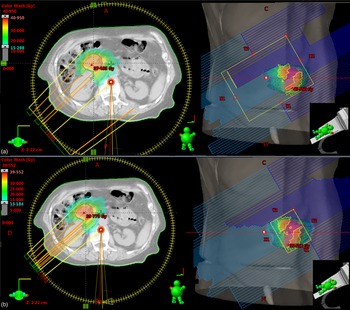
In most of the previous reports, the location of the isocentre is not generally specified. The most common arrangement in VMAT locates the isocentre at or near the target centre. However, in the case of peripheral targets, placing the isocentre at the patient’s midline can be advantageous. This arrangement diminishes clearance issues, spare couch motions and allows plans with one or more full-arc rotations. Reference Jeevanandam, Agnew and Irvine17–Reference Ross, Kim and Chen22 Regarding the beam field-of-view, the relative target position in this condition describes a wider oscillation than that with a more centred target. Thus, the MLC leaves are forced to move in wider ranges, and the subsequent secondary collimation will encompass a wider area, assuming a static arrangement. The area blocked only by the MLC tertiary collimation will then increase, with the corresponding rise in radiation leakage. In such conditions, JTT could achieve even more important radiation leak reductions (Figure 1).
Representation of a SJT plan (top) and a JTT plan (bottom) for a patient. Axial dose representation (left) and beam eye’s views for an illustrative gantry angle and arc (right).

The objective of the present work was to explore possible dosimetry differences between JTT plans and SJT plans. As a novelty, it focused on patients with peripheral targets and the plan isocentre was located at patient’s midline. Possible correlations between the reduction of the jaw secondary collimation with JTT compared to SJT and the potential dosimetry benefits of the technique were also explored.
Materials and Methods
Thirty-two patients treated at our institution between January 2019 and June 2020 were retrospectively enrolled in this study. The patients included had at least one peripheral target. The treatment plans presented the isocentre located at or near the midline and at least one full-arc rotation with a flattened beam.
Twenty-three patients had pancreatic cancer, five had lung cancer, and four had cancer in other abdominal locations. One patient presented two targets, unified and irradiated in the same plan as a single target.
The treatment plans were designed for a linear accelerator (TrueBeam STX, Varian Oncology Systems, Palo Alto, CA). This accelerator is equipped with a Millennium HD MLC (Varian Medical Systems, Palo Alto, CA) of 60 leaf pairs. The 6-MV x-ray beam was used in 22 patients, and the 10-MV x-rays beam was used in 10 patients.
A leg with SJT plans and a leg with JTT plans for all patients were compared. The same beam arrangements, energies, planning objectives, constraints and weights for each patient were used in the corresponding optimisation stages, following reported methodologies to maintain comparability between both modalities. Reference Feng, Wu and Zhang6,Reference Shi, Lai and Chen7,Reference Snyder, Wen and Huan9,Reference Park, Cho and Kim10,Reference Thongsawad, Khamfongkhruea and Tannanonta14–Reference Pokhrel, Sanford and Halfman16 The dose normalisation established in SJT plans was maintained for JTT plans.
The mean value of the prescribed doses was 37 Gy, with standard deviation of 7 Gy. Dose values covering 95 and 2% of the target volumes (D95 and D2%) were registered. Paddick’s conformity index (PCI) values were also recorded. Reference Paddick23 In several cases, at least one OAR overlapped with the PTV, and the prescribed doses to such areas were reduced compared to the total prescribed doses. In those cases, the target statistics were reported for the subtraction volume, PTV-OARs. V5, V10, V20 and Dmean values for both modalities were compared. Paired, one-tailed Student’s t-tests were applied to find out whether the differences were statistically significant.
As previously described, the reduction of the field area defined by the jaws opening is the main difference between a JTT plan compared with an SJT plan. The magnitude Ra was defined to quantify this reduction as
 $${\rm{Ra}} = {{\rm{A}}_{{\rm{wm,SJT}}}}{\rm{/}}{{\rm{A}}_{{\rm{wm,JTT}}}}$$
where
 $${{\rm{A}}_{{\rm{wm,SJT}}}} = \left( {{\rm{Aar}}{{\rm{c}}_{\rm{i}}}^{{\rm{SJT}}}{\rm{.}}\,\,{\rm{MUar}}{{\rm{c}}_{\rm{i}}}^{{\rm{SJT}}}} \right){\rm{/M}}{{\rm{U}}_{{\rm{Total}}}}^{{\rm{SJT}}}$$
 $${{\rm{A}}_{{\rm{wm,JTT}}}} = \left( {{\rm{Aar}}{{\rm{c}}_{\rm{i}}}^{{\rm{JTT}}}{\rm{. MUar}}{{\rm{c}}_{\rm{i}}}^{{\rm{JTT}}}} \right){\rm{/M}}{{\rm{U}}_{{\rm{Total}}}}^{{\rm{JTT}}}$$
with Awm,SJT being the average of the secondary collimation field area of the SJT plan arcs, weighted by the MUs for each arc, relative to the total plan MUs. Similarly, Awm,JTT is the average of the secondary collimation field areas of the JTT plan arcs, weighted by their MUs. To obtain this latter value, the positions of the jaws were first extracted from the Eclipse report of control points, and an average area for each arc was estimated. Then, these areas were weighted by the number of MUs of the corresponding arc to obtain the MU-weighted average area for the treatment. The variations of the Dmean, V5, V10 and V20 values from SJT to the JTT plan were plotted along with Ra values for each patient in order to search for possible relationships, using Spearman’s and Pearson’s coefficients. Calculations were made using simple calculation spreadsheets and the online free software by Wessa et al. Reference Wessa24
Results
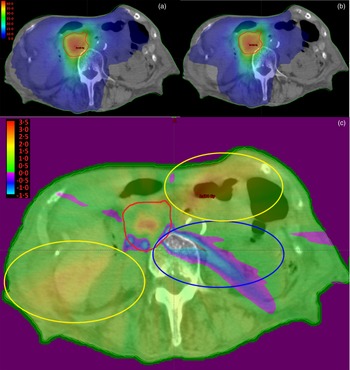
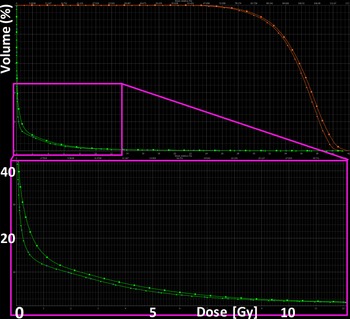
Figure 2 shows axial dose distributions for the SJT plan (top-left), the JTT plan (top-right) and the corresponding differences for one patient (bottom). Large volumes of normal tissue with reduced doses with JTT plan can be observed, enclosed by yellow ellipses, up to 3·5 Gy differences. An increase in dose is apparent in smaller volumes of normal tissue, enclosed in a blue ellipse, down to 1·5 Gy differences. Figure 3 shows the dose-volume histograms for the target and healthy tissue, further showing these differences.
Axial dose distributions for the SJT plan (top-left), the JTT plan (top-right) and the corresponding differences for one patient (bottom).

DVH for PTV and normal tissue (top) Zoom to 0–12 Gy DVH interval for normal tissue, the lower curve corresponding to the JTT plan (bottom).

The D95 and D2% in JTT plans had a mean reduction of 0·3 and 0·4%, with standard deviations of 1·2 and 1·3%, respectively, compared to the corresponding values of SJT plans. These values were not statistically significant according to the Student’s t-test (p = 0·07 for both cases). Overall, the PCI with JTT had a 5% mean reduction, with a standard deviation of 12%, this value being statistically significant (p = 0·012).
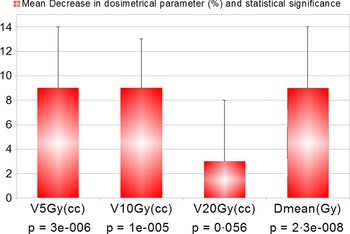
Graphic I shows the mean reduction of V5, V10, V20 and Dmean for JTT plans compared with SJT plans. The mean reductions were 9, 9, 3 and 9%, with standard deviations of 5, 4, 5 and 5%, respectively. The p-values for the Student’s t-test were 4e-9, 2e-7, 0·03 and 2, 3e-9. JTT plans achieved lower V5, V10 and Dmean values than SJT plans in 31 out of 32 plans.
Average decreases in V5, V10, V20 and Dmean

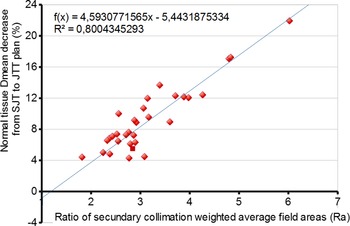
There was a significant correlation between the values of reduction of the secondary collimation field area, Ra ratios and the decrease in the Dmean values. Spearman’s correlation coefficient was 0·799 (p = 7·7e-7) and Pearson’s was 0·89, Graphic II.
Relationship between secondary collimation reduction index, Ra, and Dmean reduction

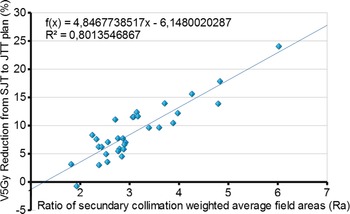
A similar correlation was found between Ra ratios and V5 reduction, with Spearman’s correlation coefficient of 0·804, p = 7·2e-7, and Pearson’s value of 0·90, Graphic III.
Relationship between secondary collimation reduction index, Ra, and V5 reduction

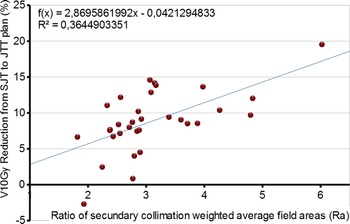
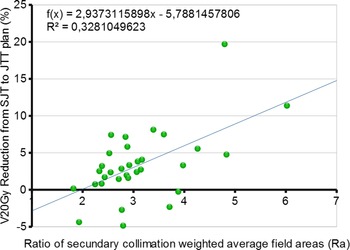
Graphics IV and V show the correlation between Ra ratios and V10 and V20 decreases, with Spearman coefficients of 0·629 and 0·489 (p = 0·00016 and 0·005), and Pearson’s r = 0·60 and 0·57.
Relationship between secondary collimation reduction index, Ra, and V10 reduction

Relationship between secondary collimation reduction index, Ra, and V20 reduction

The number of MUs of the JTT plans had a mean reduction of 2%, with a standard deviation of 11%, compared with the SJT plans. The difference was not statistically significant (p = 0·2).
Discussion
A first novelty of this work consisted of the application of JTT treatments to patients with targets off-centre and the midline location of the plan isocentre. The results obtained are in agreement with those reported in the majority of previous publications on the subject. The findings showed enhanced protection of normal tissue with JTT, as illustrated by the decreases mainly in the values of normal tissue Dmean, V5 and V10. The dose reductions found in healthy tissue are comparable to or greater than those reported in the literature. Another novelty was the significant correlation found between the normal tissue sparing and the decrease in secondary collimation, jaw-defined field area.
A basic principle in radiotherapy is to reduce the doses delivered to normal tissue as much as possible. Several authors have discussed the subject of the potential risks of modern dose modulation techniques, including JTT. Reference Feng, Wu and Zhang6,Reference Shi, Lai and Chen7,Reference Mani, Upadhayay and Das13,Reference Ng and Shuryak25–Reference Tubiana27 Modern delivery techniques can potentially expose larger volumes of normal tissue to low-dose levels due to the use of a larger number of beams or arcs and the increase in the number of MUs in the plans. This study found statistically significant tendencies to the decrease in the volumes of normal tissue that received low doses with JTT compared to SJT. The mean dose to normal tissue also decreased with JTT. Target coverage was not compromised, as assessed by D95% values. The decrease in the PCI found in this study could be of concern. This may suggest to employ dose renormalisation, as in previous works. Reference Joy, Starkschall and Kry4,Reference Feng, Wu and Zhang6,Reference Kim, Park and Park8,Reference Yao, Zhang and Chen12 For example, Joy et al. renormalise to compensate for the decrease in target dose. However, in the current work, decrease in target dose was not a significant finding. With renormalisation, target coverage can be increased, albeit at the expense of a larger number of MUs and less sparing of normal tissue, as well as a possible increase of hot spots. If target coverages are not significantly improved, the disadvantages advise against the renormalisation option. Alternatively, changes can be made to original beam arrangements and optimisation constraints for the JTT plans during the VMAT optimisation stage.
In previous studies, authors searched for possible factors and their correlation with JTT plans effects, for example, the metric reported by Murakami et al. Reference Murakami, Magome and Matsubayashi15 In the present study, a strong correlation was found between the Ra ratios and the V5 and Dmean reduction, as assessed by Pearson’s and Spearman’s correlation coefficients. These results support the role of jaw-defined field area reduction as an important factor for normal tissue protection and OARs sparing. This is coherent with the reduction of unwanted leakage radiation that tighter secondary collimation achieves in JTT treatments. The jaws apertures in SJT plans increase with the distance to the target from the patient’s midline in the tomographic slice, where isocentres were set. If the collimator angulation is different from 0 as in common VMAT procedures, these areas also increase with the angle in SJT. The JTT secondary collimation areas are not directly affected by these parameters. It is valid to point out that our results were obtained for a specific group of patients with off-centre targets and midline-located isocentres. Nevertheless, patients with elongated targets or more than one target treated with only one isocentre might present a similar situation.
Finally, the plans in this study showed no tendency to increase the number of MUs for the JTT plans as compared to the SJT plans, in contrast to findings reported in previous publications. Thus, there is no need to increase treatment times or scattered doses, unless dose renormalisation was considered necessary.
Conclusions
In the present work, JTT in VMAT was applied to a sample of patients and compared to the standard, static Jaw plans.
The target coverage was not compromised with the application of JTT, while improvements in the normal tissue doses were obtained in the majority of the plans, according to the changes in the values of the specified dosimetric parameters. The number of MUs did not show a tendency to increase. A clear correlation was found between the reduction of the primary jaws field area and the protection of the normal tissue low-dose volumes, as seen mainly by the decrease in values of Dmean and V5.
These results show that JTT can be advantageously applied in VMAT plans, especially in the cases where the target is off-centre and the treatment plan isocentre is located at the patient’s midline.
Acknowledgements
MSc Albin A. Garcia Andino received a grant from Fundación Maria Curie, Cordoba, Argentina, for his residence in Instituto Zunino.
Financial Support
This research received no specific grant from any funding agency, commercial or not-for-profit sectors.
Conflicts of Interest
Authors declare no conflicts of interest.