




No CrossRef data available.
Article contents
Stability of vocational outcome in adulthood after moderate to severe preschool brain injury
Published online by Cambridge University Press: 01 September 2004
Abstract
We studied how moderate to severe childhood traumatic brain injury (TBI) affects vocational outcome with time. This is the second follow-up of patients who were injured as preschoolers in traffic accidents. In the first follow-up the mean age was 23 years and in the present study the average age of the 27-patient cohort was 40 years. Twenty-two patients were assessed clinically by a neuropsychologist, neurologist and a social worker. Five patients, although not able or willing to participate in the clinical study, were contacted by telephone and interviewed on their vocational outcome. Compared to the first follow-up, 20/27 patients in total had no change in their vocational status. Nine out of the 27 patients were working full-time, two had subsidized jobs and 16 were not working. Twenty-four of 27 patients were independent in daily living. In the neuropsychological tests of executive functions, preserved flexibility associated with full-time work status. In conclusion, 1/3 of the patients were still employed full-time over 30 years after the TBI. This suggests that favorable vocational outcome, reached by young adulthood, is maintained at least until middle age. (JINS, 2004, 10, 719–723.)
Information
- Type
- Research Article
- Information
- Journal of the International Neuropsychological Society , Volume 10 , Issue 5 , September 2004 , pp. 719 - 723
- Copyright
- 2004 The International Neuropsychological Society
INTRODUCTION
A number of studies have shown that persistent cognitive and neurobehavioral deficits follow pediatric traumatic brain injuries (TBI; Anderson et al., 1997; Taylor et al., 2002), even in mild TBI (Klein et al., 1996; McKinlay et al., 2002; Taylor et al., 2002). The “Kennard principle” modified by Teuber to a frequently quoted statement, “It is better to have your brain lesion early in life” (Schneider, 1979), is in contrast to many follow-up studies of preschool TBI (Asikainen et al., 1996; Ewing-Cobbs et al., 1997; Max et al., 1999). However, the follow-up time has usually been 2 to 6 years (Taylor et al., 2002; Verger et al., 2000). There is one 23-year follow-up study (Klonoff et al., 1993) of mainly mild brain injuries reporting 80% employment. Emanuelson et al. (1998) reported the 7-year outcome of 18 adolescents with severe TBI, where only 2 patients were gainfully employed and 4 were in sheltered work places.
In our first follow-up in 1985 of a cohort of patients with preschool brain injury classified then as severe, we showed that normal school performance or normal intelligence is not a guarantee for good vocational outcome, as only 23% were at work (Koskiniemi et al., 1995). However, according to modern criteria (Anderson et al., 1997) this cohort may be classified as moderate to severe because the length of coma ranged from less than 1 day (i.e., <24 hr) to 90 days. We have further shown that executive functions were significantly associated with employment status in young adulthood (Nybo & Koskiniemi, 1999). There is a lack of long-term follow-up studies after TBI that evaluate the stability of vocational outcome. Some evidence suggests deterioration of working capacity over time (Olver et al., 1996). In this paper we studied the vocational outcome of TBI patients from the same cohort over 30 years after the injury and compared it to their employment status two decades previously.
PATIENTS AND METHODS
Patients
The patients had been injured in traffic accidents, 90% as pedestrians. Between 1959 and 1969, after primary care at central hospitals, altogether 55 consecutive severely head injured children were referred to the Insurance Rehabilitation Association, the centralized guidance center for all traffic related injuries in Finland. In our first follow-up in 1985, 3 patients could not be reached and 13 patients could not participate because of poor medical condition (unknown if related to TBI). Of the remaining 39 patients vocational status was determined and detailed neuropsychological assessment was carried out in 33 patients (Nybo & Koskiniemi, 1999).
In the present study, approved by the joint ethics committee of the Finnish Institute of Occupational Health and Helsinki University Hospital, 22/33 patients of the first follow-up were clinically assessed by a neuropsychologist (T.N.), neurologist (M.S.) and a social worker. The causes of the 11 drop-outs between the first and second follow-up were: 1 died, 1 emigrated, 2 did not participate because of permanent full-pension due to severe posttraumatic epilepsy. Seven refused to participate in the clinical study, of which 5 were reached by telephone and interviewed on their vocational outcome and were included in the analysis of stability of vocational status (N = 27).
The criteria for grading head injury severity at the acute phase were (1) unconsciousness lasting 24 hr or more (24/27 patients in the present study); or (2) unconsciousness lasting less than 24 hr plus presence of penetrating injury (1 patient), focal neurological deficit (1 patient) or increased intracranial pressure (1 patient; Koskiniemi et al., 1995). Of the 5/27 patients whose length of coma (LOC) was 1 day or less, 3 had developed posttraumatic epilepsy. Eleven of 27 patients (41%) had skull fracture and altogether 7/27 (26%) had posttraumatic epilepsy, of which 2 were presently seizure free without medication. In the first follow-up in 1985, 9/27 (33%) had focal CT findings. The samples of the two follow-ups did not differ statistically in terms of length of coma (LOC), age at injury, or years of education.
Methods
All the clinically studied patients were first interviewed by a nurse using a structured questionnaire including detailed questions about work history and lifestyle including standardized questions of alcohol use (AUDIT-C; Bush et al., 1998). A social worker's interview was included in order to assess the level of social functioning of the patient, and to provide support activities when needed. In addition, a detailed neurological examination and interview was carried out to reveal possible progression in the posttraumatic state or other concomitant diseases.
The neuropsychological tests for executive functions were the following: The Stockings of Cambridge (SOC) Test measuring the ability to plan actions in advance, in which the number of tasks completed with minimum moves was scored; and the Intradimensional/Extradimensional shift test (IED) measuring flexibility, in which the total number of errors was scored. Both tests are from the Cambridge Neuropsychological Test Automated Battery (CANTAB) and were administered according to the standard test protocol (CANTAB, 1999; Robbins et al., 1998). In addition to the computerized tests, the Trail Making Part B test (TMT–B; Army, 1944) and the color-word discrepancy part of the 100-item-version of the Stroop test (Stroop, 1935) were used, in which time and number of errors were scored, respectively.
The clinically studied patients (N = 22) were divided into two groups based on their vocational status: the full-time working group (FTW, N = 7) and the not-at-gainful-work group, including the two subsidized work patients (NGW, N = 15).
The statistical analysis was computed with SPSS 10.0 for Windows. To test the vocational outcome change between the first and second follow-up the Wilcoxon Signed Ranks Test was used. For the comparisons between the FTW and NGW groups, the Pearson's chi-square test was used for categorial variables and the Mann-Whitney U-test for continuous variables.
RESULTS
The overall employment between the first and second follow-up had not changed as 20/27 (73%) of the patients had no change in vocational status (p = .603). Nine patients (33%) were able to work full-time, of whom 6 had been full-time workers also in the first follow-up (Table 1). Thirteen of 27 (48%) of the patients had vocational education. One patient had an academic degree, 5 (19%) were college level professionals and 7 (26%) were skilled workers. Twenty-four of 27 (89%) of the patients were independent in daily living. The greatest change was detected in those who were in subsidized work. Of the 6 patients with subsidized jobs in the first follow-up 2 had become unemployed, 2 had reached full-time work and only 2 were still doing supported work.
Patient characteristics and vocational outcome in the 1st and 2nd follow-up

All the clinically studied 22 patients were independent in their domestic activities of daily living, and 1 patient was in need of a trustee because of extreme use of money. Eight of 22 patients had mild-to-moderate posttraumatic left-sided physical disability and 4/22 had mild-to-moderate right-sided physical weakness. One patient with mild left-sided physical disability and 1 with moderate right-sided disability were able to work gainfully.
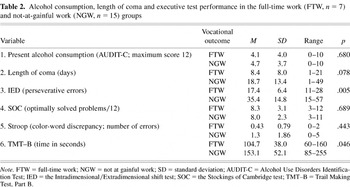
The full-time work (FTW) group was significantly better (p = .005) than the not-at-gainful-work (NGW) group in the Intradimensional/Extradimensional shift test measuring flexibility. In the Stockings of Cambridge test, no difference between the groups was detected. In the Trail Making Part B test, the NGW group performed slower than the FTW group (p = .046). In the Stroop test, no significant difference was found between the groups, although the FWT group showed a trend for better performance. Alcohol consumption by Audit-C was at group level not significantly associated with outcome, either. Difference in the length of coma did not reach statistical significance (p = .078) but at group level there was a clear trend for longer coma for the patients not working (Table 2).
Alcohol consumption, length of coma and executive test performance in the full-time work (FTW, n = 7) and not-at-gainful work (NGW, n = 15) groups

All the patients in the FTW group had a driver's license. Of the patients not at work, 7/15 (47%) were licensed to drive a car. Lack of a driver's license was not associated with the executive functions measured. In the FTW group, all the patients lived in a marital relation but of the NGW group only 2/15 had either a spouse or children. Having both a driver's license and own family relations were significantly associated with the employment status (p = .015 and p = .000, respectively).
The clinical neurological examination revealed no overall change in posttraumatic state. Minor clinical peripheral neuropathy due to excessive alcohol consumption (2 patients) or diabetes mellitus (1 patient) was detected. In the neuropsychological assessment, there was no change in general cognitive performance in any of the patients between the first and and the second follow-up.
DISCUSSION
In our almost 4-decade follow-up of patients with moderate to severe preschool TBI, we found that one-third of the patients were still employed full-time. Thus, the number of patients who worked full-time had not decreased in comparison to our first follow-up when the patients were young adults (Nybo & Koskiniemi, 1999). Only 4 patients in the second follow-up had a less favorable outcome compared to when they were contacted initially: Two patients lost their jobs because of economic depression. One patient had a late epileptic seizure and was not allowed to practice his profession as a taxi driver. One had become the mother of 3 children and stayed at home. However, 3 patients had better vocational outcome than in their young adulthood. This indicates that also positive vocational change is possible. The reduction in vocational status may be related to psychosocial and labor market factors. Between 1990 and 1995, during which time the 2 patients lost their jobs, the unemployment rate in Finland increased from 3.2% to 15.4% and the overall employment rate in 2001 was 67.7% (Statistics Finland, 2003), double that of our cohort.
Klonoff et al. (1993) showed in their 23-year follow-up of 159 pediatric head injury patients, of whom only 10% had loss of consciousness (LOC) more than 30 min, that injury severity is the primary contributory factor in the prediction of long-term outcome. Altogether, LOC alone was of limited predictive value in relation to outcome. In our study of preschool brain injuries previously classified as severe, even in the full-time work group the mean length of coma (LOC) was over 1 week and 3 patients were unconscious for at least 2 weeks. However, in the not-working group the mean LOC was 2.5 times longer. Thus, it could be suggested that the LOC is associated with vocational outcome but does not directly indicate it, which is also in accordance with our first follow-up (Nybo & Koskiniemi, 1999).
The LOC alone is not the best indicator of pediatric head injury severity, but was the only one available over 30 years ago, and was rated blind from the initial medical protocols. Of the 5 patients with known vocational status whose LOC was 1 day or less, 3 had developed posttraumatic epilepsy, 2 had skull fracture and 1 had a focal CT finding. We used the same injury severity criteria as in the first follow-up which were defined in the beginning of the 1980's (Koskiniemi et al., 1995). However, according to modern criteria it is possible that these 5 patients should be classified as having a moderate injury (Anderson et al., 1997).
In our previous study of the same cohort (Nybo & Koskiniemi, 1999) we found that the Wisconsin Card Sorting Test (WCST; Heaton, 1981) was associated with vocational outcome in young adulthood after childhood TBI. We replicated this result almost two decades later with a computerized WCST-like test (IED; Robbins et al., 1998) showing that inflexibility was significantly correlated with not being at work and also with not having a family. Defective executive functions are known have a negative effect on working capacity and psychosocial outcome (Vilkki et al., 1994). Earlier studies have also found significant relation between the long-term functional outcome and objective indicators of social adaptation after TBI, including employment status and relations with family members (Klonoff et al., 1993; Taylor et al., 2002).
In Finland traffic insurance is obligatory and legislation ensures that all individuals with traffic-related injuries are entitled to educational and vocational training, which is carried out by the Insurance Rehabilitation Association. Economic support after rehabilitation/training depends on the amount of disability remaining. Accordingly, compensation claims are not to be expected to introduce a bias in this cohort. Twelve of 22 (55%) of the clinically studied patients had mild/moderate physical disability, of which 2 were still able to work gainfully in middle age. Physical disability was present in this cohort since early childhood and was considered in vocational training. Psychiatric disability was not studied per se, but 2 patients reported depressive symptoms in the interview. Alcohol consumption did not explain the difference in work status, either.
Especially in a TBI population, tracking patients post injury becomes more challenging year after year, which greatly limits the number of long-term follow-up studies. It is acknowledged that the small sample size in this study restricts the power of conclusions. However, the drop-outs during the almost 4-decade follow-up period were mainly the most severely injured patients, who probably in the first place never had entered work life. The fact that the patients in this cohort had entered an effective and carefully documented rehabilitation system ensured by legislation may have supported favorable vocational outcome. Altogether, we found no overall deterioration in employment status between young adulthood and middle age. This suggests that favorable outcome achieved in young adulthood is maintained with adequate vocational guidance and family support at least until middle age.
ACKNOWLEDGMENTS
We thank the Insurance Rehabilitation Association for collaboration, Irmeli Koskinen for the psychosocial interview, and Terje Leivategija, Outi Fischer, Hannele Kataja, Riitta Velin and Seija Taina for skillful technical assistance. This study was supported by the Finnish Cultural Foundation.
References
REFERENCES
Anderson, V.,
Morse, S.,
Klug, G.,
Catroppa, C.,
Haritou, F.,
Rosenfeld, J., &
Pentland L.
(1997).
Predicting recovery from head injury in young children: A
prospective analysis.
Journal of the International Neuropsychological Society,
3,
568–580.Google Scholar
Army Individual Test Battery.
(1944).
Manual of direction and scoring.
Washington, DC:
War Department, Adjutant General's Office.
Asikainen, I.,
Kaste, M., &
Sarna, S.
(1996).
Patients with traumatic brain injury referred to a rehabilitation
and re-employment programme: Social and professional outcome for 508
Finnish patients 5 or more years after injury.
Brain Injury,
10,
883–899.CrossRefGoogle Scholar
Bush, K.,
Kivlahan, D.R.,
McDonell, M.B.,
Fihn, S.D., &
Bradley, K.A.
(1998).
The AUDIT alcohol consumption questions (AUDIT-C): An effective
brief screening test for problem drinking.
Archives of Internal Medicine,
158,
1789–1795.CrossRefGoogle Scholar
CANTAB.
(1999).
Cambridge Neuropsychological Test Automated Battery (CANTAB).
Cambridge, UK:
CeNeS Limited.
Emanuelson, I.,
von Wendt, L.,
Becklund, E., &
Hagberg, I.
(1998).
Late outcome after severe traumatic brain injury in children and
adolescents.
Pediatric Rehabilitation,
2,
65–70.CrossRefGoogle Scholar
Ewing-Cobbs, L.,
Fletcher, J.M.,
Levin, H.S.,
Francis, DJ.,
Davidson, K., &
Miner, M.E.
(1997).
Longitudinal neuropsychological outcome in infants and preschoolers
with traumatic brain injury.
Journal of the International Neuropsychological Society,
3,
581–591.Google Scholar
Heaton, R.
(1981).
Wisconsin Card Sorting Test manual.
Odessa, FL:
Psychological Assessment Resources.
Klein, M.,
Houx, P.J., &
Jolles, J.
(1996).
Long-term persisting cognitive sequelae of traumatic brain injury
and the effect of age.
Journal of Nervous and Mental Diseases,
184,
459–467.CrossRefGoogle Scholar
Klonoff, H.,
Clark, C., &
Klonoff, P.S.
(1993).
Long-term outcome of head injuries: A 23 year follow up study of
children with head injuries.
Journal of Neurology, Neurosurgery and Psychiatry,
56,
410–415.CrossRefGoogle Scholar
Koskiniemi, M.,
Kyykkä, T.,
Nybo, T., &
Jarho, L.
(1995).
Long-term outcome after severe brain injury in preschoolers is
worse than expected.
Archives of Pediatric and Adolescent Medicine,
149,
249–254.CrossRefGoogle Scholar
Max, J.E.,
Roberts, M.A.,
Koele, S.L.,
Lindgren, S.D.,
Robin, D.A.,
Arndt, S.,
Smith, W.L., Jr., &
Sato, Y.
(1999).
Cognitive outcome in children and adolescents following severe
traumatic brain injury: Influence of psychosocial, psychiatric, and
injury-related variables.
Journal of the International Neuropsychological Society,
5,
58–68.Google Scholar
McKinlay, A.,
Dalrymple-Alford, J.C.,
Horwood, L.J., &
Fergusson, D.M.
(2002).
Long term psychosocial outcomes after mild head injury in early
childhood.
Journal of Neurology, Neurosurgery and Psychiatry,
73,
281–288.CrossRefGoogle Scholar
Nybo, T. &
Koskiniemi, M.
(1999).
Cognitive indicators of vocational outcome after severe traumatic
brain injury (TBI) in childhood.
Brain Injury,
13,
759–766.Google Scholar
Olver, J.H.,
Ponsford, J.L., &
Curran, C.A.
(1996).
Outcome following traumatic brain injury: A comparison between 2
and 5 years after injury.
Brain Injury,
10,
841–848.CrossRefGoogle Scholar
Robbins, T.W.,
James, M.,
Owen, A.M.,
Sahakian, B.J.,
Lawrence, A.D.,
McInnes, L., &
Rabbitt, P.M.A.
(1998).
A study of performance on tests from the CANTAB battery sensitive
to frontal implications for theories of executive functioning and
cognitive aging.
Journal of the International Neuropsychological Society,
4,
474–490.Google Scholar
Schneider, G.E.
(1979).
Is it really better to have your brain lesion early? A revision of
the “Kennard principle.” Neuropsychologia,
17,
557–583.CrossRefGoogle Scholar
Statistics Finland.
(2003).
Finland in figures 2003.
Helsinki:
University Press.
Stroop, J.
(1935).
Studies of interference in serial verbal reactions.
Journal of Experimental Psychology,
18,
643–662.CrossRefGoogle Scholar
Taylor, H.G.,
Yeates, K.O.,
Wade, S.L.,
Drotar, D.,
Stancin, T., &
Minich, N.
(2002).
A prospective study of short- and long-term outcomes after
traumatic brain injury in children: Behavior and achievement.
Neuropsychology,
16,
15–27.CrossRefGoogle Scholar
Verger, K.,
Junque, C.,
Jurado, M.A.,
Tresserras, P.,
Bartumeus, F.,
Nogues, P., &
Poch, J.M.
(2000).
Age effects on long-term neuropsychological outcome in paediatric
traumatic brain injury.
Brain Injury,
14,
495–503.Google Scholar
Vilkki, J.,
Ahola, K.,
Holst, P.,
Öhman, J.,
Servo, A., &
Heiskanen, O.
(1994).
Prediction of psychosocial recovery after head injury with
cognitive tests and neurobehavioral ratings.
Journal of Clinical and Experimental Neuropsychology,
16,
325–338.CrossRefGoogle Scholar

Patient characteristics and vocational outcome in the 1st and 2nd follow-up
Alcohol consumption, length of coma and executive test performance in the full-time work (FTW, n = 7) and not-at-gainful work (NGW, n = 15) groups
 You have
Access
- 41
- Cited by