Introduction
The Echimyidae includes small to medium-sized caviomorph rodents, currently represented by 27 genera and ~99 extant species, distributed mainly throughout all neotropical forests (Redford and Eisenberg, Reference Redford and Eisenberg1992; Emmons and Feer, Reference Emmons and Feer1997; Eisenberg and Redford, Reference Eisenberg and Redford2000; Woods and Kilpatrick, Reference Woods, Kilpatrick, Wilson and Reeder2005; Patton et al., Reference Patton, Pardiñas and D'Elía2015; Fabre et al., Reference Fabre, Patton, Leite, Wilson, Lacher and Mittermeier2016). They exhibit great ecomorphological diversity, comprising semifossorial, terrestrial, arboreal, and semiaquatic life styles (e.g., Emmons and Feer, Reference Emmons and Feer1997). Semifossorial echimyids are poorly represented in the fossil record. In addition, the fragmentary remains recovered up to date have an unresolved taxonomy (Vucetich et al., Reference Vucetich, Arnal, Deschamps, Peréz, Vieytes, Vassallo and Antenucci2015). The clade includes the extant genera Carterodon, Clyomys, and Euryzygomatomys, recovered as a monophyletic group in most of the systematic approaches (e.g., Emmons, Reference Emmons, Lacey and Myers2005; Galewski et al., Reference Galewski, Mauffrey, Leite, Patton and Douzery2005; Candela and Rasia, Reference Candela and Rasia2012; Fabre et al., Reference Fabre, Galewski, Tilak and Douzery2013; Olivares and Verzi, Reference Olivares and Verzi2015; Candela, Reference Candela2016). Recently, Courcelle et al. (Reference Courcelle, Tilak, Leite, Douzery and Fabre2019) recognized a novel subfamily Carterodontinae, restricted to Carterodon, and the subfamily Capromyinae (Caribbean hutias), both as sister taxa of Euryzygomatomyinae. Carterodon sulcidens (Waterhouse, Reference Waterhouse1848) and Clyomys laticeps (Thomas, Reference Thomas1909) inhabit in the “South American open corridor,” including Cerrado, Chaco, and Pantanal ecoregions (Bezerra and Bonvicino, Reference Bezerra, Bonvicino, Patton, Pardiñas and D'Elía2015a, Reference Bezerra, Bonvicino, Patton, Pardiñas and D'Elíab). Euryzygomatomys spinosus (Fischer, Reference Fischer1814) occurs in wet grasslands and relatively open enclaves of the Atlantic Forest in south and eastern Brazil, northeastern Argentina, and eastern Paraguay (Woods and Kilpatrick, Reference Woods, Kilpatrick, Wilson and Reeder2005; Álvarez and Martínez, Reference Álvarez, Martínez, Barquez, Díaz and Ojeda2006; Bonvicino and Bezerra, Reference Bonvicino, Bezerra, Patton, Pardiñas and D'Elía2015; Loss et al., Reference Loss, Pacheco, Leite, Caldara-Junior and Lessa2015; Fig. 1).
Map of SE South America showing the current geographical range of Euryzygomatomys spinosus.

In this contribution, we present well-preserved remains of an Echimyidae, coming from early-middle Pleistocene outcrops exposed in the coastal cliffs located between Centinela del Mar and Mar del Sur localities, in the southeastern Buenos Aires Province, Argentina. We discuss the taxonomic assignation of these specimens, concluding that they represent a new extinct species of Echimyidae and evaluate its phylogenetic relationships (through cladistic and Bayesian analyses) in the context of this family. The taxonomic and phylogenetic analyses carried out here indicate that the previously known echimyid, Euryzygomatomys mordax, and the new taxon named here are closely related and represent a new genus within the clade that includes the semifossorial Carterodon, Clyomys, and E. spinosus. We discuss these results, highlighting the necessity of a refreshed integral approach to the phylogenetic relationships and classification in the context of the Echimyidae. In addition, we briefly assess the semifossorial habits of the new species and its paleoenvironmental and biogeographic implications.
Materials and methods
The fossils studied here belong to the paleontological collection of the Museo Municipal Punta Hermengo (MPH-P), Miramar, Buenos Aires Province, Argentina. Cranial measurements were taken as in Bezerra and de Oliveira (Reference Bezerra and de Oliveira2010) and Hadler et al. (Reference Hadler, Verzi, Vucetich, Ferigolo and Ribeiro2008; Table 1). The zygomatic index was taken as proposed by Verzi (Reference Verzi2002; i.e., the ratio between the anteorbital-paraorbital apophysis length and the paraorbital apophysis-posterior end of zygomatic arch length; Table 2). Dental nomenclature follows the proposal of Candela (Reference Candela2002) and Candela and Rasia (Reference Candela and Rasia2012) for lower cheek teeth, and Olivares et al. (Reference Olivares and Verzi2015) for upper cheek teeth. Dental measurements (Table 3) were taken as in Hadler et al. (Reference Hadler, Verzi, Vucetich, Ferigolo and Ribeiro2008). Nomenclature for cranial foramina follows Hill (Reference Hill1935), and for muscle anatomy follows Woods and Howland (Reference Woods and Howland1979).
Skull and mandibular measurements in mm of Proclinodontomys mordax n. comb. and P. dondasi n. gen. n. sp. are as follows: BB, greatest breadth of the tympanic bulla; BL, greatest length of the tympanic bulla; CB, condylobasal; CMB, cranial breadth at the external auditory meatus; CRB, cranial breadth immediately posterior to the zygomatic arches; D, diastema length; GLS, greatest length of skull; IFB, incisive foramina breadth; IFL, incisive foramina length; IO, interorbital constriction; LML, lower molar row length; MD, mandible height; MRL, mandibular ramus length; MX, palatal breadth; PLL, palatal length; PLT, palatilar length; PPL, postpalatal length; RB, rostral breadth; RD, rostral depth; RL, rostral length; UML, upper molar row length; ZB, greatest zygomatic arch breadth.

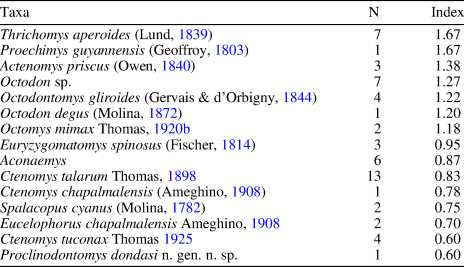
Zygomatic index in species of Octodontoidea, taken from Verzi (Reference Verzi2002, table 2), including Euryzygomatomys spinosus and Proclinodontomys dondasi n. gen. n. sp. (zygomatic index in the latter species was obtained from new specimen of Centinela del Mar; in E. spinosus it was taken from the specimens MACN 52813, 23656, 18103).

Cheek teeth measurements in mm of Proclinodontomys dondasi n. gen. n. sp. and P. mordax n. comb. dp4, lower deciduous fourth premolar; DP4, upper deciduous fourth premolar; m1, lower first molar; M1, upper first molar; m2, lower second molar; M2, upper second molar; m3, lower third molar; M3, upper third molar; L, length; WA, anterior width; WP, posterior width.

Information on fossil materials of Euryzygomatomys mordax was taken from Winge (Reference Winge1887), Hadler et al. (Reference Hadler, Verzi, Vucetich, Ferigolo and Ribeiro2008), and Hansen (Reference Hansen2012).
In order to assess the phylogenetic relationships of the new species within Echimyidae, a cladistics analysis was conducted using a modified version of the combined dataset of Olivares and Verzi (Reference Olivares and Verzi2015), which originally included 62 morphological characters to 27 taxa, and five loci for the molecular data. The monophyly of Echimyidae was not tested because it has been strongly and consistently supported by previous studies based on multilocus data (e.g., Galewski et al., Reference Galewski, Mauffrey, Leite, Patton and Douzery2005; Fabre et al., Reference Fabre, Galewski, Tilak and Douzery2013, Reference Fabre, Patton, Leite, Wilson, Lacher and Mittermeier2016; Upham and Patterson, Reference Upham, Patterson, Vassallo and Antenucci2015).
For the morphological matrix, we added the information about a new extinct spiny rat and Euryzygomatomys mordax. Octodontomys gliroides (Gervais and d'Orbigny, Reference Gervais and d'Orbigny1844) (Octodontidae) and Dasyprocta leporina Linnaeus, Reference Linnaeus1758 (Dasyproctidae) were included as outgroup (see data set S1 in supplemental material). The whole morphological matrix composed by 26 extant and extinct echimyids was analyzed using the “traditional search” option of TNT v. 1.5 (Goloboff and Catalano, Reference Goloboff and Catalano2016) available from the Willi Hennig Society site. All characters were equally weighted and considered non-additive. We conducted the parsimony analysis based on 1,000 random stepwise-addition replicates and tree bisection reconnection (TBR) branch swapping, saving 100 trees per replicate. Additionally, we enriched the molecular dataset of Olivares and Verzi (Reference Olivares and Verzi2015) with the available sequences from Genbank for the group (Table 4). The molecular matrix contains two mitochondrial loci: (1) the first portion of the protein-coding cytochrome b gene (cytb), and (2) the 12S ribosomal RNA, and three unlinked nuclear exons: growth hormone receptor exon 10 (GHR), recombination activating gene 1 (RAG1), and the von Willebrand factor exon 28 (vWF). The final molecular matrix is composed by 30 taxa including echimyids and some species of Cavioidea used to conform the outgroup. DNA sequence alignment was performed for each locus with Clustal X (Thompson et al., Reference Thompson, Gibson, Plewniak, Jeanmougin and Higgins1997) using the default settings. The morphological traits were concatenated with the DNA sequences in a matrix that reaches 5365 characters (see data set S2 in supplemental material). For those terminals that miss information, we completed the matrix with missing data or ambiguous state characters (i.e. ?, N). The parsimony analysis was carried out in TNT 1.5 (Goloboff and Catalano, Reference Goloboff and Catalano2016) through a heuristic search based on 10,000 replicates of a Wagner tree with a random addition sequence of taxa and TBR branch swapping. To evaluate the support of the branches in both datasets, we used the standard bootstrap option with 1,000 pseudoreplicates, each consisting of 10 random addition searches. The information contained in the most parsimonious trees was synthesized through strict consensus (Bremer, Reference Bremer1990).
GenBank accession numbers based on Olivares and Verzi (Reference Olivares and Verzi2015), and Upham and Patterson (Reference Upham, Patterson, Vassallo and Antenucci2015).

In addition, we implemented a Bayesian analysis in MrBayes 3.2 (Ronquist and Huelsenbeck, Reference Ronquist and Huelsenbeck2003) on the combined dataset (see dataset S3 in supplemental material) to compare results obtained by parsimony, which is a method that produces point estimates (i.e., single trees) with an approach that instead produces a probability distribution. We used two character partitions, morphology and DNA. We ran the standard partition using the Mk model, set by default in MrBayes software for morphological characters, which assumes no constant characters are present (Mkv model; Lewis, Reference Lewis2001). This was done using the standard model for unordered characters with a standard gamma distribution to accommodate the rate variation across sites. The DNA partition was run using the GTR + G+I model determined using the Akaike information criterion (AIC) in jModeltest (Posada, Reference Posada2008). All analyses were run for a total of 107 generations. Trees were sampled every 1,000 generations resulting in 10,000 saved trees, the first 25% of which were discarded as burn-in. The remaining trees were used to construct a majority-rule consensus tree and obtain a posteriori probability values.
Repositories and institutional abbreviations
MACN, Museo Argentino de Ciencias Naturales “Bernardino Rivadavia,” Buenos Aires, Argentina; MLP, Museo de La Plata, La Plata, Argentina; UNISC, Centro de Ensino e Pesquisas Arqueológicas da Universidade de Santa Cruz do Sul, State of Rio Grande do Sul, Brazil.
Systematic paleontology
Family Echimyidae Gray, Reference Gray1825
Subfamily Eumysopinae Rusconi, Reference Rusconi1935
Genus Proclinodontomys new genus
Type species
Proclinodontomys dondasi n. gen. n. sp.
Other species
Proclinodontomys mordax n. comb. (Winge, Reference Winge1887).
Diagnosis
Proclinodontomys n. gen. differs from Clyomys by having much smaller bullae. It differs from Clyomys and Euryzygomatomys by having a more developed fossa for the M. temporalis, much more procumbent upper incisors, more flared and laterally expanded zygomatic arches, frontal less markedly expanded posteriorly, jugals (between the anterior border and the lower jugal process) much deeper anteriorly than posteriorly, with the dorsal border descending more abruptly posteriorly, smaller orbital cavity, and external auditory meatus relatively smaller and slanted upward and backward. It differs from Euryzygomatomys by the absence of lateral flange of the canal for infraorbital nerve, the protuberance formed by the bottom of the alveolar sheath of the upper incisor lateral to DP4, and the narrower posterior portion of incisive foramen.
Occurrence
Early-middle Pleistocene--early Holocene of Argentina and Brazil. It is also represented in the Pleistocene of Bolivia (see below).
Etymology
From Greek pro = anterior, clino = inclination, odonto = tooth, mys = mouse; in reference to the fact that is a rodent with the front teeth inclined forward.
Remarks
Proclinodontomys dondasi n. gen. n. sp., from the early-middle Pleistocene of Central Argentina, here described, and Proclinodontomys mordax n. comb., from the Pleistocene and Holocene of Brazil (Winge, Reference Winge1887; Hadler et al., Reference Hadler, Verzi, Vucetich, Ferigolo and Ribeiro2008), previously assigned to the genus Euryzygomatomys (Winge, Reference Winge1887), share a combination of features (see diagnosis of the genus and comparative description of P. dondasi n. gen. n. sp.), differing from any other known echimyid. This allowed us to identify both species as belonging to a new genus. This study also reveals that among echimyids, both species are closely related to Euryzygomatomys spinosus and Clyomys. These working hypotheses are supported by the results from the phylogenetic analysis (see below).
In addition to Euryzygomatomys mordax n. comb., a second putative extinct species of Euryzygomatomys was listed as integrating the fossil assemblage recovered in the Pleistocene basin of Tarija, Bolivia (as E. hoffstetteri; see Marshall et al., Reference Marshall, Berta, Hoffstetter, Pascual, Reig, Bombin and Mones1984; Marshall and Sempere, Reference Marshall, Sempere and Suarez Soruco1991), but never described. Although E. hoffstetteri must be treated as a nomen nudum, its placement in Euryzygomatomys is controversial (see Loss, Reference Loss2014), and it will not be treated in detail here. However, a preliminary study made by the senior author of the cranial material of Tarija suggests that it could be assigned to Proclinodontomys n. gen. The skull of Tarija (MNHN TAR 51, selected as holotype of E. hoffstetteri by Osvaldo Reig, in schedis) has at least three diagnostic features of Proclinodontomys n. gen., such as the markedly procumbent incisors, strongly developed fossa for the M. temporalis, and the presence of the bottom of the alveolar sheath of the upper incisor lateral to DP4. Extensive studies are necessary to elucidate the status of E. hoffstetteri.
Proclinodontomys dondasi new species
Figures 3.1–3.3, 4, 5.1, 5.2
Holotype
MPH-P 173, an almost complete skull with right and left DP4-M3, only lacking the nasals.
Diagnosis
It differs from Proclinodontomys mordax n. comb. by having relatively narrower rostrum, wider interorbital region, slender incisors, M3 relatively large with respect to the M2, and narrower posterior zygomatic root.
Occurrence
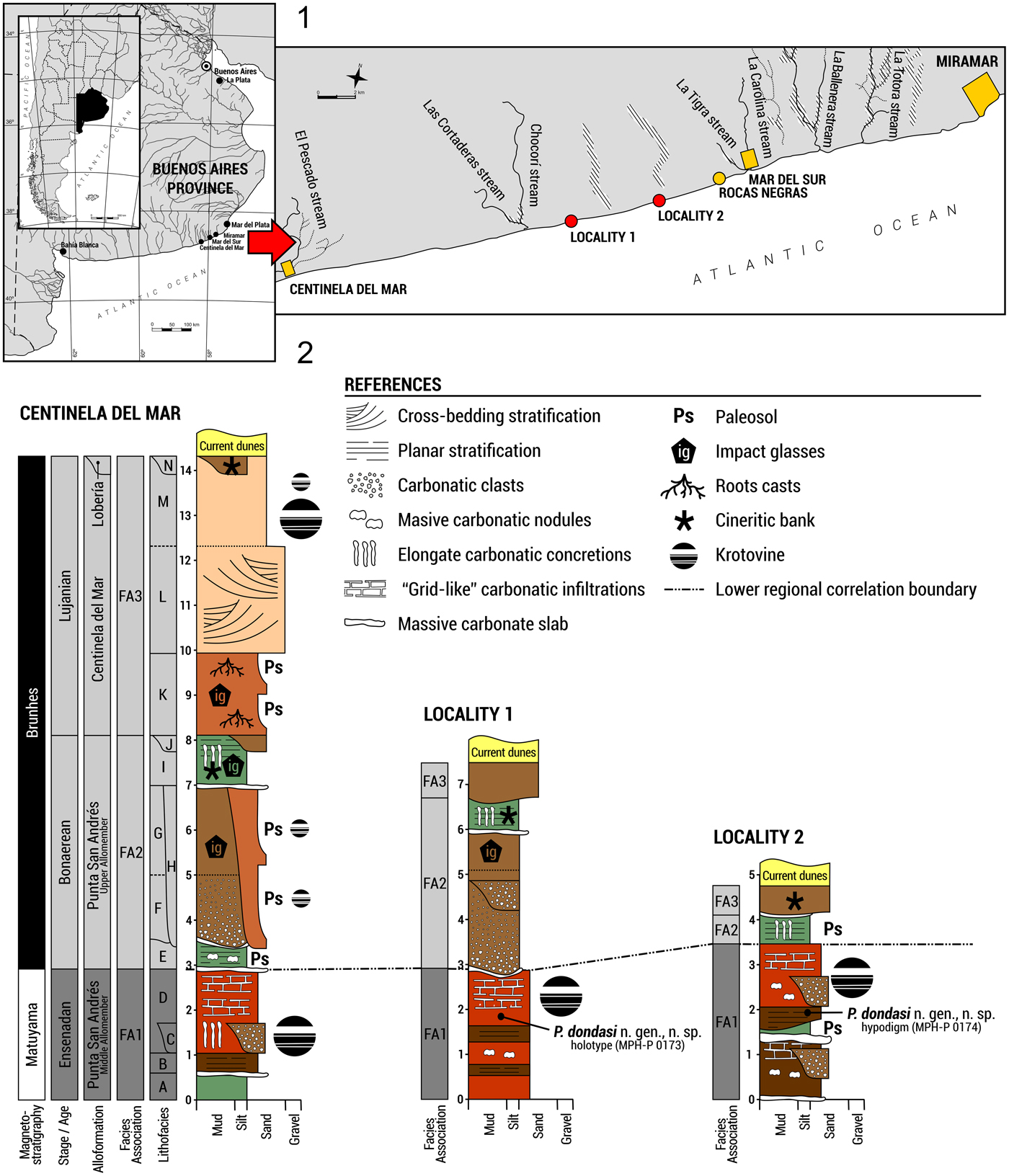
The holotype occurs in coastal cliffs located 2.5 km NE of the mouth of Chocorí stream (38°23'13.9''S, 58°04'34.83''W, Locality 1, see Figs. 1, 2.1), General Alvarado County, Buenos Aires Province, Argentina. The holotype was found in a deposit of tabular geometry located at the base of the cliff, consisting of compact silts and fine-grained sands of red to dark-brown coloration (see Fig. 2.2). The characteristics of the fossil-bearing deposit allow its inclusion in the Facies Association 1 (FA1) described by Cenizo (Reference Cenizo2011) for the cliffs of Centinela del Mar locality, located ~10 km SW of the type locality. The FA1 emerges in the basal sector (sometimes also at medium sector) of the cliffs that extend almost continuously from Centinela del Mar to Mar del Sur localities (Cenizo, Reference Cenizo2011, p. 30; see also Cenizo and Tassara, Reference Cenizo and Tassara2013, p. 21). In addition, the FA1 has been recognized (in similar facies succession, although not equal) in the Chocorí stream area as “Lower Interval” by Beilinson et al. (Reference Beilinson, Gasparini, Soibelzon and Soibelzon2015). The FA1 is characterized by a predominance of fluvial-alluvial depositional events of great homogeneity and amplitude, with the development of massive carbonate banks and “grid-like” carbonate infiltrations as main post-depositional facies, especially on its upper contact. The greater consolidation of its sediments, as well as the tabular appearance and the large horizontal extension of its deposits with respect to the overlying facies, are some of the main features that allow a rapid identification of FA1 in the field (Cenizo, Reference Cenizo2011; Beilinson et al., Reference Beilinson, Gasparini, Soibelzon and Soibelzon2015). Such facies association has been correlated with the Middle Allomember of the Punta San Andrés Alloformation described by Zárate (Reference Zárate1989), ~40 km NE of the type locality (Cenizo, Reference Cenizo2011; Beilinson et al., Reference Beilinson, Gasparini, Soibelzon and Soibelzon2015). Magnetostratigraphic studies performed in the Centinela del Mar outcrops indicate that the deposition of FA1 occurred during a period of reverse polarity assigned to chron Matuyama (Heil et al., Reference Heil, King, Zárate and Schultz2002; Soibelzon et al., Reference Soibelzon, Prevosti, Bidegain, Rico, Verzi and Tonni2009; Cenizo, Reference Cenizo2011), therefore, it would be older than 780 ka AP. This is consistent with the finding of remains of the native ungulate Mesotherium cristatum (Serres, Reference Serres1867) in outcrops of the FA1 located 1.9 km (38°23'42.2''S, 58°05'48.5''W, MPH-P 0210) and 2 km South (38°23'43.5''S, 58°05'50.1''W, MPH-P 0223) of the locality where the holotype was recovered. Mesotherium cristatum is a characteristic mammal of the homonymous South American Biozone (biostratigraphic base of the Ensenadan Stage/Age, see Cione et al., Reference Cione, Gasparini, Soibelzon, Soibelzon and Tonni2015), so that its occurrence in the FA1 supports the early-middle Pleistocene age of this unit.
(1) Geographical references of the localities mentioned in the text, including the type locality of Proclinodontomys dondasi n. gen. n. sp., and (2) their respective stratigraphic profiles.

Additional material occurs in coastal cliffs located 2.7 km SW of Rocas Negras locality (SW limit of Mar del Sur town, 38°22'19.62''S, 58°02'20.15''W, Locality 2, see Fig. 2.1), General Alvarado County, Buenos Aires Province. The specimen MPH-P 0174 was found ~3.7 km NE of the locality where the holotype was recovered (see Fig. 2.1), also from a deposit corresponding to FA1 (Fig. 2.2; see above). MPH-P 0174 was included within a concentration of microvertebrate remains, probably corresponding to metabolic waste of raptor birds, among which were identified some passerine birds and cricetid rodents.
Comparative description
Specimens described below are illustrated in Figures 3–5, with measurement data given in Tables 1 and 3.
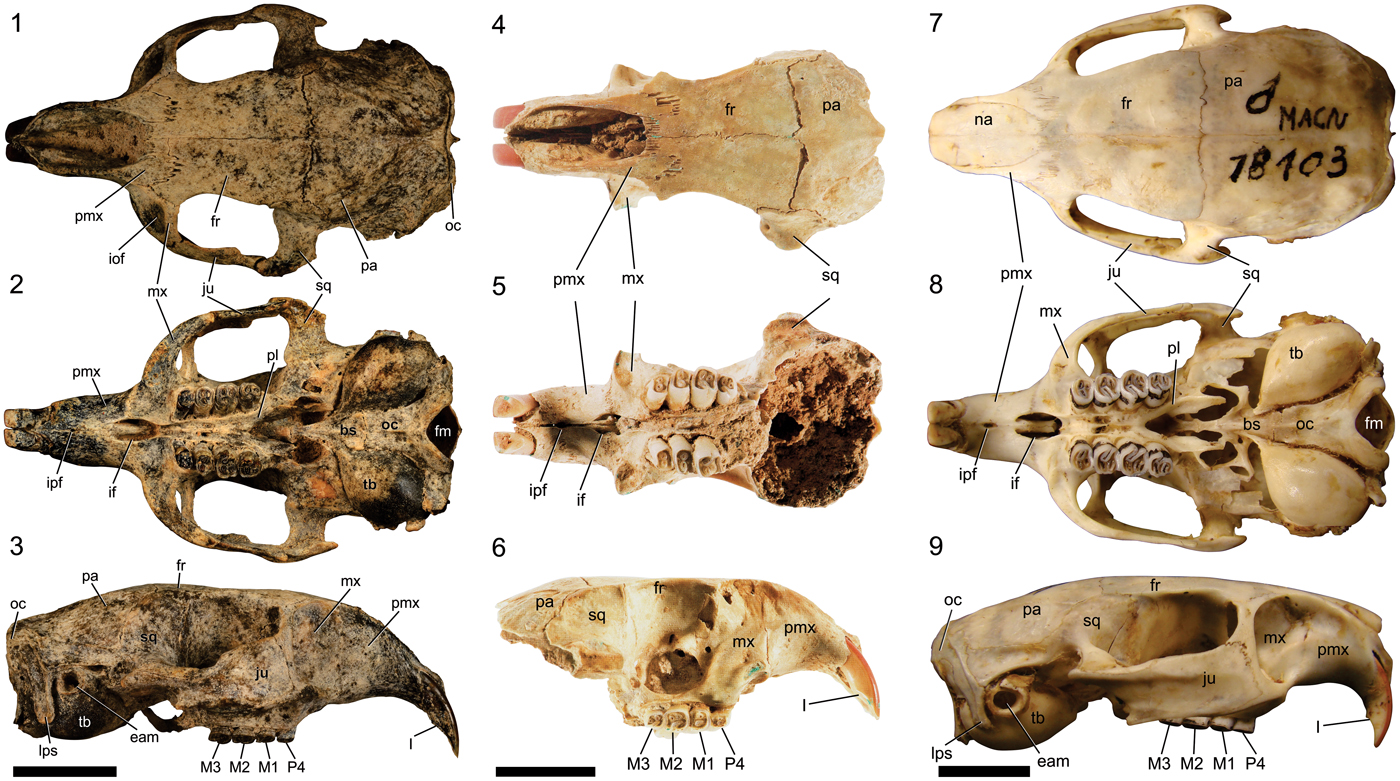
Skulls of Echimyidae. (1–3) Proclinodontomys dondasi n. gen. n. sp. (MPH-P 0173, holotype) in dorsal (1), ventral (2), and lateral (3) views; (4–6) P. mordax n. comb. (ZMUC 1/1845:13368) in dorsal (4), ventral (5), and lateral (6) views; (7–9) E. spinosus (MACN 18103) in dorsal (7), ventral (8), and lateral (9) views. Abbreviations: bs, basisphenoid; eam, external acoustic meatus; fm, foramen magnum; fr, frontal; I, incisive; if, incisive foramen; iof, infraorbital foramen; ipf, interpremaxillar foramen; ju, jugal; lps, lateral process of supraoccipital; M1, first molar; M2, second molar; M3, third molar; mx, maxilla; na, nasal; oc, occipital; pa, parietal; P4, fourth premolar; pl, palatine; pmx, premaxilla; sq, squamosal; tb, tympanic bulla. Scale bars = 10 mm.

Cheek teeth of Proclinodontomys dondasi n. gen. n. sp. (MPH-P 0173, holotype), right (1) and left (2) upper cheek teeth, and (MPH-P 0174) left lower cheek teeth (3). Scale bar = 5 mm.

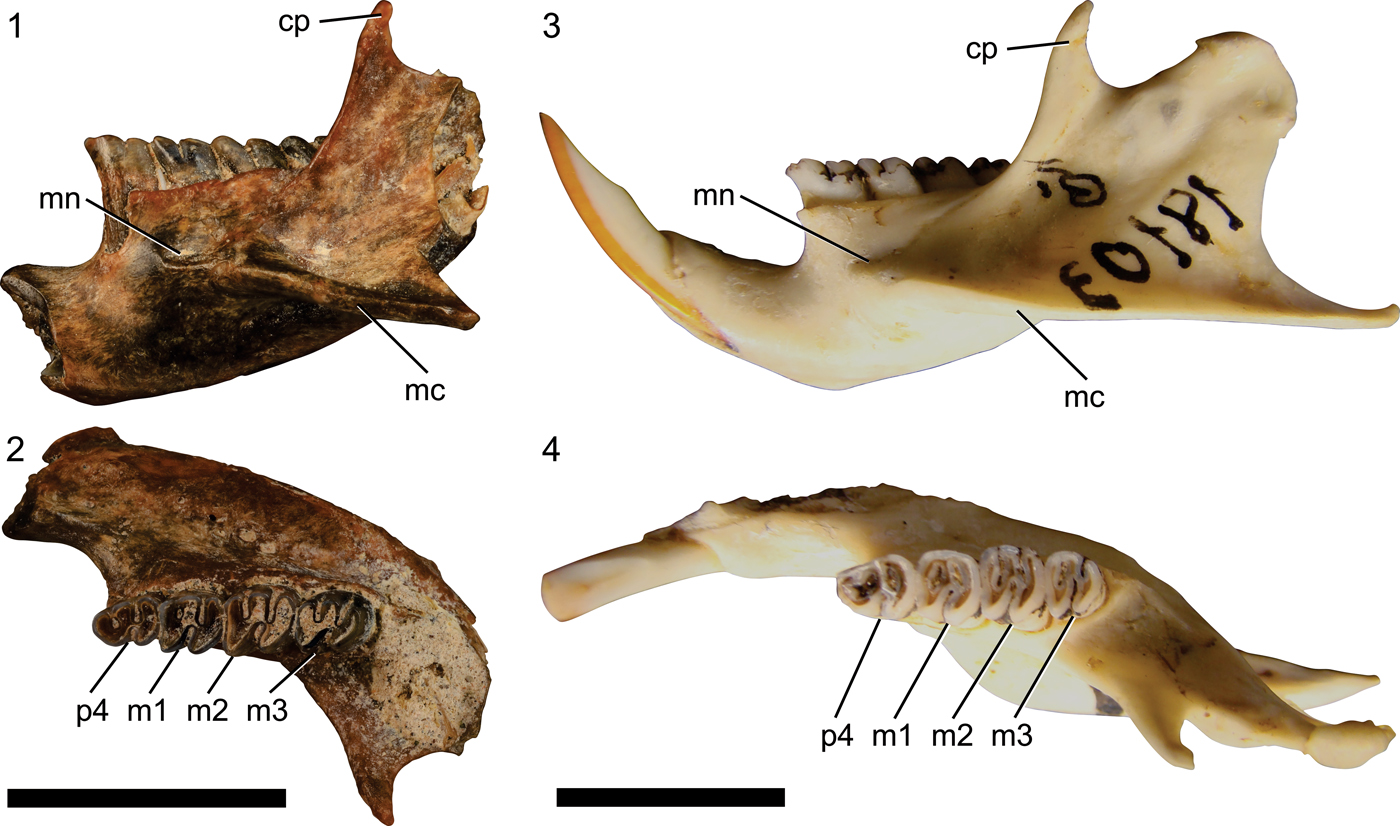
Mandibles of Echimyidae. Left hemimandible of Proclinodontomys dondasi n. gen. n. sp. (MPH-P 0174) in lateral (1) and occlusal (2) views; right hemimandible (reversed) of E. spinosus (MACN 18103) in lateral (3) and occlusal (4) views. Abbreviations: cp, coronoid process; mc, masseteric crest; m1, first molar; m2, second molar; m3, third molar; mn, masseteric notch; p4, fourth premolar. Scale bars = 10 mm.

Cranium (holotype MPH-P 173).—The rostrum is relatively longer (Fig. 3.1–3.3) than in the extant Euryzygomatomys spinosus (Fig. 3.7–3.9) and in Proclinodontomys mordax n. comb. (Fig. 3.4–3.6). The upper incisors are much more procumbent than in E. spinosus and Clyomys, as in the type of P. mordax n. comb. The diastema is similar in length to that of E. spinosus and slightly longer than in P. mordax n. comb. (see Table 1). The interpremaxillary foramen is much reduced, smaller than in the type of P. mordax n. comb. (Winge, Reference Winge1887, pl. 7, fig. 8). The incisive foramina are narrower than in E. spinosus, and, as in this species, do not show a constriction at the suture between premaxilla and maxilla (Fig. 3.2). This suture is closer to the anterior end of the incisive foramina, like in E. spinosus and the lectotype of P. mordax n. comb. (Winge, Reference Winge1887, pl. 7, fig. 8; Hadler et al., Reference Hadler, Verzi, Vucetich, Ferigolo and Ribeiro2008). As in E. spinosus, the premaxillary septum is wider in its anterior portion, narrowing gradually backward, and it is not joined to the anterior portion of the palatal bridge (Olivares et al., Reference Olivares, Verzi, Vucetich and Montalvo2012). The anterior portion of the palatal bridge is narrow, forming a sub-vertical plate with a medial crest, and is located dorsal with respect to the alveolar margin of DP4 (Olivares et al., Reference Olivares, Verzi, Vucetich and Montalvo2012).
The rostral masseteric fossa (for the origin of the infraorbital part of the M. masseter medialis) is posterior to the premaxillary-maxillary suture and dorsal to the incisive alveolus. The base of the alveolar sheath of the upper incisor forms a marked prominence lateral to the DP4, as in specimens of P. mordax n. comb., being more posteriorly located than in E. spinosus. The antorbital zygomatic ramus is subvertical and at level of DP4. The maxillary fossae are well defined. The anterior zygomatic root is anteroposteriorly broader than that of E. spinosus; it has its anterior margin markedly convex and its posterior one slightly ahead of the DP4. The masseteric tuberosity is well developed, projecting a well-defined ridge similar to that in E. spinosus and specimens of P. mordax n. comb. As in P. mordax n. comb., there is no lateral flange for the canal for infraorbital nerve. The palate is widening slightly posteriorly, where it is incised by a V-shaped mesopterygoid fossa extended until level M2-3. The posterior palatine foramina are at level of M1.
The zygomatic arches are very robust and more flared and laterally expanded than in E. spinosus (Fig. 3.1) and Clyomys. Jugals are very high and extended on the antorbital zygomatic ramus, and largely expanded dorsoventrally in its anterior portion until level paraorbitary process (Fig. 3.3), like E. spinosus, Clyomys laticeps, and Carterodon sulcidens (Emmons, Reference Emmons, Lacey and Myers2005, p. 266). In addition, the jugals (between the anterior border and the lower jugal process) are much deeper anteriorly than posteriorly (Winge, Reference Winge1887, p. 73), more than in C. laticeps (Olivares et al., Reference Olivares, Verzi, Vucetich and Montalvo2012), and much more than in E. spinosus (Fig. 3.9), with the dorsal border descending more abruptly posteriorly than in the latter species.
The jugal fossa is narrower, slightly deeper, and less dorsally extended on jugal than in E. spinosus and, like this species, it is relatively wide anteriorly, not coming to a sharp point. The inferior jugal process is well developed and is behind the paraorbitary process, like E. spinosus.
The lacrimal does not form the margin of the lacrimal foramen, which is located in the dorsal portion of the orbit, like in the living species. Like E. spinosus and Clyomys, the lateral wall of the nasolacrimal canal is strongly convex. The foramen exposing the nasolacrimal canal is dorsal to the palatine foramen, being both located at level of the M1; sphenopalatine foramen is large and anteroposteriorly posterodorsally elongated. The sphenopalatine and palatine foramina are arranged in a posterodorsally oblique groove. Ethmoid foramen is located in the frontal; it is small, rounded and posterodorsal to the sphenopalatine fissure. Palatine foramina are in a long depression of the maxilla at the level of M1. Dorsally the premaxilla extends up to level the dorsal root of the antorbital zygomatic ramus. In lateral view, the latter is at the level of DP4, like in E. spinosus. Postorbital processes of frontals are more developed than that of E. spinosus. Orbital cavity is smaller than that of E. spinosus. Large oval sphenopalatine vacuity is present ventral to presphenoid-basisphenoid suture. The interorbital region is wider than in the living species and the type of P. mordax n. comb. Frontal are less markedly expanded posteriorly than E. spinosus and Clyomys, with their lateral borders slightly concave over orbits. The entire portion of parietals corresponding mainly to the posterior region of the cranial vault is shorter than in E. spinosus. Temporal fossae for M. pars principal and M. pars orbitalis of M. temporalis are deeper than in E. spinosus and bounded by more marked crests, like in the type of P. mordax n. comb. The zygomatic root of the squamosal is more expanded anteroposteriorly than that of E. spinosus. The bullae (unknown in P. mordax n. comb.) are moderately inflated in lateral view, less than in E. spinosus, and moderately elongated in ventral view, as in E. spinosus, being much smaller than that of Clyomys laticeps. The external auditory meatus is placed higher than in E. spinosus, close to the squamosal suture, and it is smaller than that of E. spinosus and C. laticeps. In P. dondasi n. gen. n. sp. it is raised and slanted upward and backward, whereas in E. spinosus it is more laterally directed. The postglenoid foramen is large, elongated, and opens into an anteroposterior tube-like fenestra, between the squamosal and the dorsal portion of the bulla. The mastoid is moderately extended anteroposteriorly between paraoccipital apophysis and the lateral process of the supraoccipital, and it is smaller than in E. spinosus. The lateral process of the supraoccipital is more ventrally extended below level of the lower edge of the external auditory meatus than in E. spinosus. Foramina ovale (only preserved the right one) is relatively small and posteriorly located with respect the pterygoid fossae-alisphenoid canal (only partially preserved of the left side), which is narrow. The pterygoid apophysis (preserved in left side) is long and its end contacts the anteromedial margin of the bulla. The lambdoid crest is well noticeable. Unlike the latter species, the preserved portion of the paraoccipital process reaches the ventral border of the bulla (a feature better observed in lateral view). Nuchal crests are well developed, running continuously from the preserved portion of the paraoccipital processes of the exoccipitals, which are broken at its bases. The supraocciptal has a medial ridge, the occipital external crest, which is long, as in E. spinosus (unknown in the type of P. mordax n. comb.), overhanging the foramen magnum, forming the posteriormost portion of the skull.
Upper dentition
Based on the tooth wear degree, the specimen can be typified as an “old adult,” so there is no labial flexi and the hypoflexus merges into hypofossette in left DP4 and M1, whereas this flexus persists lingually open in right M2 and M3 (Fig. 4.1, 4.2). All teeth are subquadrangular in occlusal outline, with flexi and fossettes less elongated than that of E. spinosus, a condition similar to that of species of Clyomys. The DP4 is smaller than the M1 (see Table 3) with the hypofossette subcircular and smaller than the only persistent labial fossette. In the left M1 the hypoflexus is transformed into a hypofossette, whereas in the right M1 the hypoflexus is still connected with the lingual border of the tooth. In both M1, the hypoflexus/hypoffossette turns anteriorly forward with the bottom opposite to the anterior fossette; the metafossette is smaller than the anterior fossette, especially in the right M1, a feature similar to that of the Clyomys species. The M2 are larger than M1 and, as in these teeth, the hypoflexi are oriented towards the anterior fossettes, which are somewhat larger than the metafossette; the hypocone is slightly labially located with respect to the protocone. The M3 are subequal in length to the M2, unlike Clyomys species, with the hypocone more labially located with respect to the protocone of the M2; the metafossette is smaller than the anterior fossette, such as in the species of Clyomys, and displaced towards the posterior border of the teeth.
Dentary
The left hemimandible (MPH-P 0174) is very similar in size to that of the specimens of Euryzygomatomys spinosus and Proclinodontomys mordax n. comb. The notch for the insertion of the tendon of M. masseter medialis pars infraorbitalis is well developed (Fig. 5.1), such as in E. spinosus (Fig. 5.3) and P. mordax n. comb., and it is horizontally oriented. As in E. spinosus, P. mordax n. comb., and Clyomys this notch is between dp4 and m1, located above of middle mandibular height and united to the masseteric crest, forming a well-developed ridge. The masseteric fossa is relatively deep. The coronoid process (Fig. 5.1) is more slender than in E. spinosus (Fig. 5.3), and does not project posteriorly as in the species of Clyomys. This process rises laterally to the m3, limiting a relatively deep and wide retromolar fossa. The incisor is posteriorly projected to the base of m3. The lower diastema has a step anterior to the dp4 much more marked than in E. spinosus and C. laticeps. This latter feature is similar to that of the fossil specimen MLP 91-IV-25-135 (Clyomys sp.) from Argentina (Vucetich et al., Reference Vucetich, Verzi and Tonni1997).
Lower dentition
Lower cheek teeth of the specimen MPH-P 0174 have a similar general size to those of the holotype of P. dondasi n. gen. n. sp. (Table 1), being the lower cheek teeth rows some longer than the upper one, as it occurred in caviomorphs (Fig. 4), and both lower and upper cheek teeth fit in occlusion. Based on the tooth wear degree, the specimen is considered as a “young adult.” The lower cheek teeth are similar to those of E. spinosus and P. mordax n. comb., but with the flexids more persistent and more transverse lophids.
The dp4 is subquadrangular in occlusal outline, and smaller than the m1 and m2 (Fig. 4.3; Table 3). As in E. spinosus, P. mordax n. comb., and Clyomys species, the dp4 is trilophodont, with the most anterior lophid, the metalophulid I, anteriorly convex, giving a subcircular outline to the anterior border of the teeth. The second lophid in position (the hypolophid) is wide anteroposteriorly, approximately twice the anteroposterior diameter of the metafossettid. This lophid extends lingually from the anterior ramus of the hypoconid-ectolophid up to the lingual border of the tooth. The posterolophid is convex and delimits the posterior border of the metaflexid, which is transversally oriented and open lingually, so the metaflexid is more persistent than the anterofossettid. Differing from E. spinosus and P. mordax n. comb., the anterofossettid is subequal in their anteroposterior diameter to that of the metaflexid, whereas in E. spinosus and P. mordax n. comb., the anterofossettid is more anteroposteriorly elongated. The hypoflexid is located opposite to the metaflexid. All lophids are relatively wider and the flexids more persistent than those specimens of E. spinosus and P. mordax n. comb. with similar stage of wear.
The m1-m3 are subrectangular in occlusal outline, and trilophodont, with lophids transversally oriented. The hypoflexid is deep and turns posteriorly. The lingual flexids are less reentrant than in E. spinosus, P. mordax n. comb., and Clyomys species. The mesofossettid-mesoflexid is more transversally oriented than that of P. mordax n. comb. and E. spinosus, in which this fossettid turns anteriorly. The mesoflexid is less reentrant than the metaflexid. In m1 (the most worn molar), the mesofossettid is the first to be closed. The m2 is larger than m1, and the m3 is smaller than the m2, and relatively larger with respect to remaining teeth compared with species of Clyomys and P. mordax n. comb. (Table 3). Relative size of m3 is more similar to that of the MLP 91-IV-25-135 of Clyomys sp. (Vucetich et al., Reference Vucetich, Verzi and Tonni1997; Table 1), having the m3 larger than the dp4. In the m3, the metaflexid is divergent labially. In the three molars, the hypoflexid is the widest and deepest flexid of the teeth.
Etymology
The species name honors Alejandro Dondas (1948–2016), colleague and friend, tireless finder of fossils at the Atlantic cliffs of Buenos Aires Province and for many years head of the Paleontology Department of the Museo Municipal de Ciencias Naturales de Mar del Plata “Lorenzo Scaglia.” The specific epithet is formed from the surname “Dondas,” taken as a noun in the genitive case, plus the Latin suffix “i” (ICZN, 1999; Article 31.1.2).
Material
MPH-P 0174, left hemimandible with dp4–m3.
Remarks
One of the characteristic features of the MPH-P 173 is its broadly dorsoventrally expanded jugals, a trait shared with members of the tribe Euryzygomatomini (sensu Emmons, Reference Emmons, Lacey and Myers2005; i.e., the semi-fossorial Euryzygomatomys spinosus, Clyomys laticeps, and Carterodon sulcidens). However, the set of features of MPH-P 173 (see comparative description) justifies its assignment to a new species of echimyid. For example, the bulla size of this specimen, which is proportionally much smaller than in the species of Clyomys, permits discarding its inclusion in the latter. The zygomatic arches are more flared and laterally expanded than in E. spinosus and species of Clyomys. The jugals are much deeper anteriorly than posteriorly and show the dorsal border descending more abruptly posteriorly than in E. spinosus and Clyomys species. Another distinctive feature of MPH-P 173, shared with the type of P. mordax n. comb., is the great procumbency of the upper incisors, which are much more procumbent than in E. spinosus and species of Clyomys. The MPH-P 173 also share several features with P. mordax n. comb. (see diagnosis of the Proclinodontomys n. gen.), which allows taxonomic location of both species in a new genus, different from Clyomys and Euryzygomatomys, a hypothesis supported by the results of the phylogenetic analysis.
We assigned the MPH-P 0174 to P. dondasi n. gen. n. sp. based on the cranio-mandibular and dental morphological correlation between this specimen and the MPH-P 0173 (holotype), as well as taking into account the morphological correspondence observed in the living E. spinosus and Clyomys laticeps. The holotype and the MPH-P 0174 are coincident in size (Table 1, e.g., length of the cheek teeth series) and general robustness. Upper and lower cheek teeth show similar relative height of the dental crowns, thickness of the enamel, and proportions of the size of the teeth (Table 3). In both dental series, upper and lower, the third molar is relatively large with respect to the remaining teeth (Table 3). Note that in fossil and extant species of Clyomys, the M3/m3 is reduced. In MPH-P 0174, the m3 is longer than the dp4, differing from E. spinosus and the species of Clyomys. In the holotype and MPH-P 0174, the flexi/flexids are less reentrant than in Euryzygomatomys spinosus, forming less elongate fossettes/fossettids, being in these features more similar to Clyomys laticeps and C. bishopi Avila-Pires and Wutke, Reference Avila-Pires and Wutke1981 (Thomas, Reference Thomas1916; Verzi et al., Reference Verzi, Vucetich and Montalvo1995; Hadler et al., Reference Hadler, Verzi, Vucetich, Ferigolo and Ribeiro2008). However, the flexi and flexids are more persistent than those of the species of Clyomys. So that, for example, the metafossette in the M1 in MPH-P 0173 persists even with advanced state of wear of the Dp4. In agreement with this feature, the flexids of the lower cheek teeth are more persistent than in Clyomys species (the anterior and posterior flexids of the m1 and m2 persist even when the m3 is completely erupted). This indicates that the closing time of the flexi and flexids is coincident in upper and lower cheek teeth, being more persistent than in any species of Clyomys. All these features allow assignment of MPH-P 0173 and MPH-P 0174 to the same species. In addition, the set of features of MPH-P 0174 (such as proportions of the m3, morphology of the coronoid process, and persistence of the flexids) allow us to discard the inclusion of this specimen in any previously known species.
Proclinodontomys mordax new combination (Winge, Reference Winge1887)
Figure 3.4–3.6
- Reference Winge1887
Mesomys mordax Winge, p. 72, pl. 8, fig. 7.
- Reference Paula-Couto1946
Euryzygomatomys mordax (Winge); Paula-Couto, p. 5.
Lectotype
ZMUC 1/1845:13368, skull from undifferentiated Quaternary deposits of Lapa da Escrivania Nr. 5., Lagoa Santa, state of Minas Gerais (Brazil).
Remarks
Winge (Reference Winge1887, p. 72–73) erected E. mordax (as Mesomys mordax) based on two fragmentary skulls found in Lapa da Escrivania Nr. 5., Lagoa Santa, state of Minas Gerais (Brazil), recovered from undifferentiated Quaternary deposits. One of the skulls studied by Winge (Reference Winge1887, originally labelled as “skull 1”) was illustrated with a drawing (Winge, Reference Winge1887, pl. 8, fig. 7), and later by photographs (Hansen, Reference Hansen2012, figs. 35a–c). This material, recently numbered in the collections of the Zoological Museum, Natural History Museum of Copenhagen (ZMUC; Copenhagen, Denmark) as ZMUC 1/1845:13368, is here designated the lectotype of E. mordax according to Article 74.1 of ICZN (1999). Hadler et al. (Reference Hadler, Verzi, Vucetich, Ferigolo and Ribeiro2008) referred to E. mordax several cranial fragments recovered from the archaeological site Afonso Garivaldino Rodrigues (Sitio RS-TQ-58; Holocene; Rio Grande do Sul state, Brazil). In this same contribution, Hadler et al. (Reference Hadler, Verzi, Vucetich, Ferigolo and Ribeiro2008) offered an emended diagnosis of E. mordax that largely increased the knowledge of the species, which is in great part used as basis in our comparative study.
Euryzygomatomys mordax was assigned to Euryzygomatomys by having very deep reentrant flexi/flexids, forming elongate fossettes/fossettids, and by the anterior fossette and metafossette subequal in size (Thomas, Reference Thomas1916; Verzi et al., Reference Verzi, Vucetich and Montalvo1995; Hadler et al., Reference Hadler, Verzi, Vucetich, Ferigolo and Ribeiro2008). However, E. mordax has several differences with respect to E. spinosus (e.g., degree of procumbence of incisors, width relative of the interorbital region at frontals, absence of having a smaller orbital cavity with respect to extant E. spinosus; see diagnosis of the new genus) and no cranial character of E. mordax allows including undoubtedly this species within the same genus as E. spinosus, a taxonomic decision that is supported through the phylogenetic analyses (see below).
Phylogenetic analysis
The morphological matrix composed of 62 characters retrieved three most parsimonious trees, each 111 steps long. Proclinodontomys dondasi n. gen. n. sp. and P. mordax n. comb. were recovered as part of a polytomy strongly supported, that also includes Theridomysops, and the extant members of Echimyidae, Euryzygomatomys spinosus and Clyomys laticeps (Fig. 6.1, 6.2), with Carterodon as the sister taxon (see node 29, Fig. 6.1). This unresolved clade (node 28, Fig. 6.1) is supported by three morphological synapomorphies: protuberance on maxillary ventral to bottom of alveolar sheath of I1 present at level of external alveolar margin of DP4 (character/state: 11/1); protoloph on M1-2 reduced to its labial portion forming a tubercle isolated or fused to the anteroloph (character/state: 49/1); and Dp4 with lophids anterior to posterolophid joined forming a lobe of variable morphology (character/state 55/2). A second main clade formed by two groups is obtained from this analysis. The first of them composed of Thrichomys and the extinct genera Pampamys and Eumysops (node 33, Fig. 6.1), which is supported by five synapomorphic characters: (1) width of the incisive foramina at the level of premaxillary-maxillary suture near to half of or a little more than the width of the rostrum (character/state: 4/1); (2) posterior margins of the incisive foramina at the level of the anterior side of the DP4 or a little in front (character/state: 6/1); (3) suborbitary fossa in jugal present (character/state: 20/1); (4) notch for tendon of medial masseter muscle incorporated into the origin of the masseteric crest (character/state: 45/1); and (5) metalophulid II of dp4 absent (character/state: 56/2). The second subclade comprising the remaining living echimyids included in the analysis and the fossil taxon Maruchito (node 38, Fig. 6.1) share the following two morphological synapomorphies: lower margin of posterior process of squamosal laterally deflected forming a shelf (character/state: 37/1), and dorsal portion of postcondyloid process vertical in posterior view (character/state: 44/1). For more details about the morphological autapomorphies and synapomorphies that define each of the other nodes see the Supplementary Material S4, which associated with the node numbers referred in the consensus tree (Fig. 6.1).
Strict consensus of the most parsimonious trees resulting from cladistics parsimony analysis of (1) morphological characters, and (2) combined morphological and molecular data. Bootstrap support values are indicated above each branch. Circled numbers associated with some clades designate the node number of consensus tree related to the list of common morphological synapomorphies and autapomorphies of three most parsimonious trees reported in results section. (3) Majority-rule consensus obtained in a Bayesian combined analysis. Values of posterior probabilities are shown on each branch.

The molecular matrix includes four extant species not included in the morphological dataset—Callistomys pictus (Pictet, Reference Pictet1841), Makalata didelphoides (Desmarest, Reference Desmarest1817), Lonchothrix emiliae Thomas, Reference Thomas1920a, and Olallamys albicaudus, (Günther, Reference Günther1879)—so the phylogenetic relationships within Echimyidae both in the combined parsimony and Bayesian phylogenies differ slightly from the morphological tree (Fig. 6.2, 6.3). Cladistics tree obtained through combined data produced six most parsimonious trees, each with 6160 steps, and agrees with the morphological dataset recovering a polytomic clade composed by P. dondasi n. gen. n. sp. and P. mordax n. comb., Theridomysops, Clyomys, and Euryzygomatomys. The main difference with the morphological tree is the phylogenetic position of some taxa such as the genera Thrichomys, Pampamys, and Eumysops as the sister clade of two assemblages composed by Hoplomys, Trinomys, and Proechimys, and Myocastor, Mesomys, Isothrix, Dactylomys, Kannabateomys, Maruchito, Echimys, and Phyllomys. While the relationships in the concatenated phylogeny are (((Thrichomys, Pampamys, Eumysops) (Hoplomys, Proechimys)) (Callistomys, Myocastor)), Trinomys exhibits an unstable position between analyses, being part of a polytomy with Hoplomys and Proechimys in the morphological tree or uncertain position (basal polytomy of Echimyidae) in the concatenated phylogeny (see Fig. 6.1, 6.2). For some of the relationships involving fossil species, the support values tend to be low, which could be due to the affect of missing data on phylogeny (e.g., Eumysops clade).
The topology obtained by Bayesian inference recovers clear relationships, with higher resolution and support. Proclinodontomys dondasi n. gen. n. sp. and P. mordax n. comb. constitute a monophyletic group related to Theridomysops. Euryzygomatomys and Clyomys are the sister taxa of this previous assemblage (Fig. 6.3). All these genera belong to Euryzygomatomyinae, with Trinomys as the sister genus. Phylogenetic relationships of the remaining fossil and extant echimyids coincide with previously published results for the group.
Discussion
Phylogeny and classification
Phylogenetic relationships both in the morphological phylogeny and in those obtained through combined data are mostly coincident with previous morphological analysis of Candela and Rasia (Reference Candela and Rasia2012), the combined results of Olivares and Verzi (Reference Olivares and Verzi2015), and the molecular study of Upham and Patterson (Reference Upham, Patterson, Vassallo and Antenucci2015). Some slight differences in internal relationships and supports are found among our trees, such as the Trinomys position as the sister genus of the extant semifossorial echimyids Clyomys and Euryzygomatomys, which agrees with previous cladistics analyses (e.g., Carvalho and Salles, Reference Carvalho and Salles2004; Emmons, Reference Emmons, Lacey and Myers2005; Galewski et al., Reference Galewski, Mauffrey, Leite, Patton and Douzery2005; Candela and Rasia, Reference Candela and Rasia2012; Olivares et al., Reference Olivares, Verzi, Vucetich and Montalvo2012, Reference Olivares, Verzi, Contreras and Pessôa2016; Fabre et al., Reference Fabre, Galewski, Tilak and Douzery2013; Olivares and Verzi, Reference Olivares and Verzi2015; Verzi et al., Reference Verzi, Olivares, Morgan and Álvarez2016). Phylogenies obtained here support the inclusion of P. dondasi n. gen. n. sp. and P. mordax n. comb. within Euryzygomatomyinae. Furthermore, the higher resolution of Bayesian tree obtained through combined data and the formation of a clade composed by P. dondasi n. gen. n. sp. and P. mordax n. comb. as sister taxa of Theridomysops allow us to reinforce morphological assumptions by showing that these forms belong to the subfamily, but are not part of the genus Euryzygomatomys.
The addition of more taxa and more characters in cladistic analyses of Echimyidae contributed to resolving the ingroup intergeneric relationships; however, the phylogenetic position of P. dondasi n. gen. n. sp. and P. mordax n. comb. is maintained within the Euryzygomatomys-Clyomys-Theridomysops clade. Moreover, in accord with our comparative studies, no cranial character of P. dondasi n. gen. n. sp. or P. mordax n. comb. allows undoubted inclusion of both species within the same genus as Euryzygomatomys spinosus. Proclinodontomys dondasi n. gen. n. sp. and P. mordax n. comb. have several differences with respect to E. spinosus (e.g., degree of procumbence of incisors, shape of zygomatic arch, width relative of the interorbital region at frontals), and both species represent a new genus, as is supported here by the results from Bayesian analysis. In fact, Bayesian combined topology recovered a clade composed of P. dondasi n. gen. n. sp. and P. mordax n. comb., sister to Theridomysops, showing that the genus Euryzygomatomys is not monophyletic if P. mordax n. comb. and P. dondasi n. gen. n. sp. are allocated with E. spinosus (Fig. 6.3). Most relationships within Echimyidae are well resolved and supported. On the basis of these results, we assign the new species described to a new genus, including P. mordax n. comb. Future phylogenetic analyses, including all extinct and extant species of Clyomys and Euryzygomatomys, should be made in order to explore the more precise relationships among species of semifossorial echimyids.
Semifossorial habits of Proclinodontomys dondasi n. gen. n. sp. and P. mordax n. comb.—The adaptative significance of morphological features in fossorial rodents has been extensively evaluated (e.g., Dubost, Reference Dubost1968; Hildebrand, Reference Hildebrand, Hildebrand, Bramble, Liem and Wake1985; Lessa, Reference Lessa, Nevo and Reig1990; Nevo, Reference Nevo1999; Stein, Reference Stein, Lacey, Patton and Cameron2000; Druzinsky, Reference Druzinsky2010). Features of the external anatomy (reduced tail, short limbs, and long and powerful claws) were associated to fossoriality (Winge, Reference Winge1887; Thomas, Reference Thomas1916; Bishop, Reference Bishop1974; Emmons, Reference Emmons, Lacey and Myers2005; Bezerra and de Oliveira, Reference Bezerra and de Oliveira2010), but cranial features related to these habits are not well explored. Winge (Reference Winge1887) interpreted the presence of small eyes and an extension of the anterior portion of the zygomatic arch in Euryzygomatomys as related to fossoriality (Winge, Reference Winge1887, p. 72). In addition, Winge (Reference Winge1887, p. 73) highlighted that P. mordax presents more conspicuous fossorial adaptations than E. spinosus, possessing more procumbent upper incisors and more extended fossae for the M. temporalis (see also Hadler et al., Reference Hadler, Verzi, Vucetich, Ferigolo and Ribeiro2008). Proclinodontomys dondasi n. gen. n. sp. displays more-procumbent incisors (Fig. 3.3) and more-developed temporal fossae than those of E. spinosus. The latter feature indicates a relatively large M. temporalis, such as occurs in fossorial Hystricognathi (Cox and Faulkes, Reference Cox and Faulkes2014). The procumbent incisors in P. mordax n. comb. and P. dondasi n. gen. n. sp. indicate a more noticeable semifossorial adaptation than in E. spinosus (Lessa, Reference Lessa, Lacey, Patton and Cameron2000; Stein, Reference Stein, Lacey, Patton and Cameron2000). The more protruded and widened zygomatic arches in P. dondasi n. gen. n. sp. than those of E. spinosus show an area of origin for a more developed masseter muscle, as occur in rodents with fossorial habits (Stein, Reference Stein, Lacey, Patton and Cameron2000; Cox and Faulkes, Reference Cox and Faulkes2014). Another feature of Euryzygomatomys spinosus, shared with the semifossorials Carterodon and Clyomys (Winge, Reference Winge1887, p. 72; Emmons, Reference Emmons, Lacey and Myers2005), is the dorsoventrally extended anterior part of the zygomatic arch, which also would be related to the attachment of a well-developed M. masseter. Consequently, cranial features of P. dondasi n. gen. n. sp. indicate a strong development of the masseter and temporalis muscles, which are particularly well developed in chisel-tooth diggers or in species in which incisors help digging (Stein, Reference Stein, Lacey, Patton and Cameron2000). Euryzygomatomys spinosus and P. dondasi n. gen. n. sp. show relatively smaller orbital cavities than in octodontids, even more than those of Ctenomys, a feature that was interpreted as indicative of adaptation to fossoriality (e.g., Winge, Reference Winge1887, p. 72; Pearson, Reference Pearson1984; Verzi, Reference Verzi2002). According to the zygomatic index (sensu Verzi, Reference Verzi2002), the orbital cavity of P. dondasi n. gen. n. sp. is relatively smaller than that of E. spinosus (Table 2). The orbital cavity in P. dondasi n. gen. n. sp. is also more dorsoventrally shorter than in E. spinosus (Fig. 3.3). Therefore, the relative size of the orbital cavity of P. dondasi n. gen. n. sp. suggests fossorial habits for this species. Finally, the reduced incisive foramina in P. dondasi n. gen. n. sp. with respect to E. spinosus could be indicating a specialization to subterranean habits. Concerning this feature, Stein (Reference Stein, Lacey, Patton and Cameron2000) showed that shortening of the incisive foramina is a way to accommodate increasing pressures from the deep root of the upper incisor that lies dorsal to it. In sum, most of the cranial features of the new species reflect a higher degree of adaptation to semifossorial habits than those of extant E. spinosus, probably similar to those of P. mordax n. comb.
Divergence times of semifossorial lineage and biogeographic remarks
Most of the extant genera of Echimyidae, Clyomys, and Euryzygomatomys are known by fossils since the Pleistocene (McKenna and Bell, Reference McKenna and Bell1997; Ferreira et al., Reference Ferreira, Olivares, Kerber and Dutra2016). However, molecular and paleontological evidence indicate that the divergence of most extant echimyid genera occurred in the Miocene (e.g., Galewski et al., Reference Galewski, Mauffrey, Leite, Patton and Douzery2005; Fabre et al., Reference Fabre, Galewski, Tilak and Douzery2013; Courcelle et al., Reference Courcelle, Tilak, Leite, Douzery and Fabre2019). Molecular analyses estimated the divergence times of Clyomys/Euryzygomatomys in ca. 5.4 Ma (i.e., close to the Miocene/Pliocene boundary) (Galewski et al., Reference Galewski, Mauffrey, Leite, Patton and Douzery2005, table 2; see also Fabre et al., Reference Fabre, Galewski, Tilak and Douzery2013; Courcelle et al., Reference Courcelle, Tilak, Leite, Douzery and Fabre2019). This is in agreement with our phylogenetic analyses, which recovered the clade Proclinodontomys n. gen., Euryzygomatomys, and Clyomys, together with the late Miocene genus Theridomysops of Argentina (Candela and Rasia, Reference Candela and Rasia2012; Olivares et al., Reference Olivares, Verzi, Vucetich and Montalvo2012; Olivares and Verzi, Reference Olivares and Verzi2015). Thus, late Miocene could represent a strict minimum age for the origin of the semifossorial genera of echimyids (Galewski et al., Reference Galewski, Mauffrey, Leite, Patton and Douzery2005; Fabre et al., Reference Fabre, Galewski, Tilak and Douzery2013). The early origin of the semifossorial ecomorphotype within echimyids may have been triggered by the expansion of relatively open and arid environments that arose near the Miocene-Pliocene boundary (Pascual and Ortiz Jaureguizar, Reference Pascual and Ortiz Jaureguizar1990; Galewski et al., Reference Galewski, Mauffrey, Leite, Patton and Douzery2005; Candela and Bonini, Reference Candela and Bonini2017). Our results agree with the last resolved phylogeny of the family (Courcelle et al., Reference Courcelle, Tilak, Leite, Douzery and Fabre2019), where Carterodon is the deep-branching sister group of Capromyinae, in which the most plausible hypothesis related to the semifossorial adaptation likely evolved at least twice within Echimyidae, once along the branch leading to the Proclinodontomys n. gen.-Clyomys-Euryzygomatomys clade, and once along the branch of Carterodontinae. This scheme differs with the phylogenetic hypothesis of Emmons (Reference Emmons, Lacey and Myers2005), who suggested the Euryzygomatomini tribe, composed by the “fossorially adapted rodents” Carterodon, Clyomys, and Euryzygomatomys.
The record of P. dondasi n. gen. n. sp. in the SE Buenos Aires Province indicates that the Proclinodontomys n. gen.-Euryzygomatomys-Theridomysops-Clyomys clade occupied a more southern geographical range during the early-middle Pleistocene than in present days. Although the current range of E. spinosus is restricted to extreme NE Argentina in Misiones Province (Bonvicino and Bezerra, Reference Bonvicino, Bezerra, Patton, Pardiñas and D'Elía2015, map 512; Loss et al., Reference Loss, Pacheco, Leite, Caldara-Junior and Lessa2015), a single record from Corrientes Province (see Cabrera, Reference Cabrera1961; Carlos Galliari, personal communication, 1999) indicates that this rodent reached at least 29°S in historical times. The occurrence of Proclinodontomys dondasi n. gen. n. sp. in SE Buenos Aires Province implies an early-Middle Pleistocene extension of distribution of ~1,000 km southward from the current nearest locality of record (i.e., Mercedes, Corrientes) for a subtropical echimyid (E. spinosus).
Proclinodontomys dondasi n. gen. n. sp. could have lived in an environment comparable to those inhabited by the extant semifossorial echimyids. Currently, the semifossorial echimyids Carterodon, Clyomys, and Euryzygomatomys inhabit a great part of the “South American open corridor” (partially coincident with the Chacoan Subregion, sensu Morrone, Reference Morrone2006) and part of the Atlantic Forests.
The austral occurrence of P. dondasi n. gen. n. sp. must be interpreted with caution from a paleoenvironmental point of view. The distributional patterns of late Cenozoic mammals in South America should be evaluated considering the faunistic communities as a whole, under an evolutionary perspective (Reig, Reference Reig1962; Morrone, Reference Morrone2006; Pardiñas, Reference Pardiñas2008). An analysis of fossil faunistic associations is necessary to test the environmental meaning of P. dondasi n. gen. n. sp. records in southern Buenos Aires Province. In addition, more data about the habitats currently occupied by E. spinosus are required.
In a preliminary approach, P. dondasi n. gen. n. sp. can be roughly added to an assemblage of rodents, mostly caviomorphs but sigmodontines as well, which suggests warmer and more marked seasonal early-middle Pleistocene conditions in southern Buenos Aires Province (Pardiñas and Deschamps, Reference Pardiñas and Deschamps1996; Vucetich and Verzi, Reference Vucetich and Verzi2002; Pardiñas, Reference Pardiñas2008). The record of other mammals points in the same direction. For example, a noctilionid bat was reported in Pleistocene deposits near Centinela del Mar (Merino et al., Reference Merino, Lutz, Verzi and Tonni2007). However, it is important to highlight that these actually Brazilian faunistic elements are recorded as minor components in assemblages largely dominated by western Central and Patagonian small- and medium-sized mammals (Pardiñas, Reference Pardiñas2004). Much detailed faunistic and stratigraphic studies are needed in order to disclose if these past occurrences indicate significant environmental heterogeneity or, in turn, constitute true “waves” of Brazilian faunas.
Acknowledgments
The authors thank D. Boh, M. Reguero, A. Kramarz, D. Flores, P. Teta, S. Lucero, for permitting access to comparative materials under their care. C. Galliari freely shared data of Euryzygomatomys specimens collected in Corrientes Province. N. Cazzaniga guided us in the nomenclatorial issues related to the selection of the new names employed here. P. Hadler generously provided photographs of specimens of C. riograndensis Hadler et al., Reference Hadler, Verzi, Vucetich, Ferigolo and Ribeiro2008.
Accessibility of supplemental data
Data available from the Dryad Digital Repository: https://doi.org/10.5061/dryad.67fs3bs.