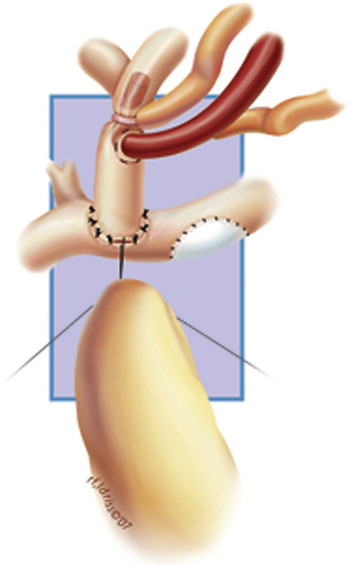
The cavopulmonary anastomosis, conceived simultaneously by several surgeons working at different institutions in different countries, has evolved in scope and implementation since first being used clinically by Carlo Carlon at the University of Padua in 1951.Reference Karl and Stellin1 William Glenn, from Yale University, refined and popularized the technique, and the procedure is often given the eponym the “Glenn procedure.” After Glenn reported his initial clinical experience with unidirectional cavopulmonary anastomosis in 1958Reference Glenn2 and 1965,Reference Glenn, Ordway, Talner and Call3 the procedure became widely accepted in the 1970s and 1980s. The anastomosis is currently used most frequently for the staged repair of those with functionally univentricular hearts on the Fontan pathway, and also for those with hypoplastic right ventricles as part of a 1½ ventricular repair (Fig. 1).Reference Mavroudis, Backer and Kohr4, Reference Norwood and Jacobs5 Technically, the anastomosis has been made with continuous or interrupted sutures, metal sewing rings, and mechanical staplers.Reference Konstantinov and Alexi-Meskishvili6 The use of cardiopulmonary bypass was added as it became available, and is currently used in the majority of patients. In contrast, some groups have begun to limit the use of cardiopulmonary bypass,Reference Liu, Lu, Chen, Shi, Su and Ding7–Reference Tireli, Basaran and Kafali11 Alternatively, some surgeons prefer the hemi-Fontan type of anastomosis, and many utilize deep hypothermic circulatory arrest when constructing this type of repair.Reference Tchervenkov, Jacobs and Del Duca12 Our strategy has been to perform the bidirectional cavopulmonary anastomosis on cardiopulmonary bypass with a beating heart. We favour use of interrupted and absorbable sutures to minimize the chances of anastomotic stricture. We have eliminated other sources of flow of blood to the lungs at the time of the cavopulmonary anastomosis. In this report, we analyse the outcomes of our strategy.
Illustration of the anastomosis created between the superior caval vein and the pulmonary arteries using interrupted sutures and a small right-angle venous cannula inserted high in the superior caval vein.

Methods
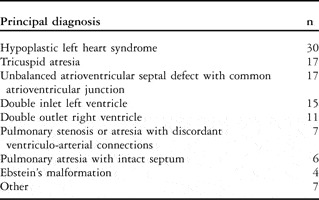
Approval was granted by our Institutional Review Board, which waived the need for individual consent. A retrospective review was performed on all patients who underwent construction of either a unilateral or bilateral bidirectional cavopulmonary anastomosis at our institution between September, 1990, and November, 2005. We included patients who underwent either an isolated anastomosis, or else an anastomosis created in conjunction with another cardiac operation. Diagnoses are listed in Table 1, the most common being hypoplastic left heart syndrome. Patients undergoing a bidirectional cavopulmonary anastomosis at the time of creating a total cavopulmonary connection, particularly those undergoing Fontan conversion with arrhythmic surgery, were excluded. Data relating to demographics, surgical technique, angiography, and death were obtained through existing cardiac surgical databases along with the medical records.
Diagnoses associated with patients undergoing bidirectional cavopulmonary anastomosis.

We identified 114 patients, having a mean age of 1.6 plus or minus 2.9 years, and ranging from 3 months to 16 years, with a median age of 8 months. There were 69 males (61%) and 45 females. Mean weight and body surface area were 8.9 plus or minus 6.8 kilograms, and 0.41 plus or minus 0.21 metres squared, respectively. The mean number of prior operations was 1.2. There were no previous cardiac operations in 9 patients (8%), while 75 patients (66%) had undergone only a single prior operation, and 30 patients (26%) had two or more prior operations. In 56 patients (49%), a Blalock-Taussig shunt had been constructed, while 5 patients had a shunt from the right ventricle to the pulmonary arteries. These were taken down at the time of constructing their bidirectional cavopulmonary anastomosis.
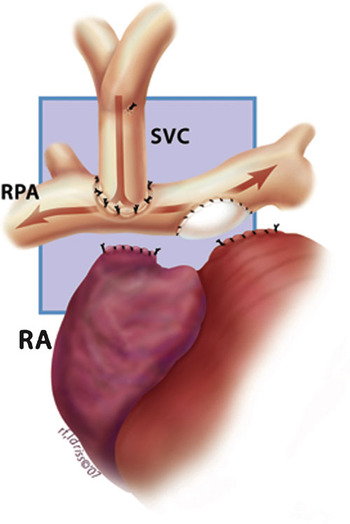
All procedures were performed using cardiopulmonary bypass with moderate hypothermia at 32 degrees Celsius. Those patients who had intracardiac procedures underwent aortic cross-clamping and cardiac arrest with cold blood cardioplegia. All other procedures, including those with pulmonary arterioplasty, were done with a beating heart. The proximal superior caval vein was cannulated with an 8-, 10-, or 12-French right-angled venous catheter (Edwards LifeSciences, Irvine, CA). The azygos vein was doubly ligated and divided in all cases. The superior caval vein was clamped cephalad to the sinus node, observing for persistence of normal p-waves. The caval vein was then divided, and the proximal cardiac stump was oversewn. The open end of the vein was measured with dilators to help make an accurately sized pulmonary arteriotomy. In patients with a Gore-Tex™ (W.L. Gore & Assoc., Flagstaff, AZ) arterial-to-pulmonary shunt, the shunt was clipped and divided immediately after commencing cardiopulmonary bypass, and the pulmonary stump of the shunt was excised from the pulmonary artery. Whenever possible, the pulmonary arteriotomy from the shunt was included as part of the cavopulmonary anastomosis. Other sources of flow of blood to the lungs, such as a hypoplastic pulmonary trunk, patent arterial duct, and so on, were routinely divided. The cavopulmonary anastomosis was fashioned with interrupted 6-0 or 7-0 polydioxanone (PDS II, Ethicon, Somerville, NJ). Sutures were spaced approximately every 2 millimetres (Fig. 2). In cases where the length of the superior caval vein was insufficient for creating a tension-free anastomosis, we inserted a posterior direct suture line with an anterior patch of pericardium or Gore-Tex™. In one patient with an existing stent in the superior caval vein due to thrombosis prior to bidirectional cavopulmonary anastomosis, we resected the vein and used an interposition pulmonary arterial homograft to create the bidirectional cavopulmonary anastomosis. A pulmonary arterioplasty was performed on 51 patients. Our preferred material for pulmonary arterioplasty is untreated autologous pericardium, which was used whenever sufficiently available in 25 of 50 patients. When not available, we have predominately used polytetrafluoroethylene, in 16 patients, or a cryopreserved pulmonary homograft in 5.
Illustration of the completed bidirectional cavopulmonary anastomosis. RA = right atrium, RPA = right pulmonary artery, SVC = superior caval vein.

Results
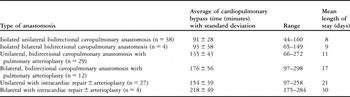
Complete follow up was available for 92% of the 114 patients, with a mean period of follow-up of 6.2 plus or minus 4.1 years, with a range from 0.6 years to 16 years. Table 2 lists the mean period of cardiopulmonary bypass, and the mean length of stay broken down by procedure.
Description of times required for cardiopulmonary bypass associated with creation of different types of bidirectional cavopulmonary anastomoses.

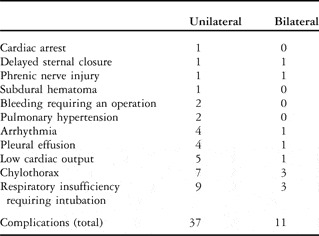
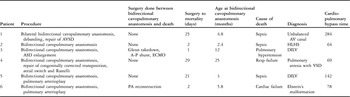
Among patients undergoing a unilateral anastomosis, 29 patients (31%) had 51 complications, while among those requiring a bilateral anastomosis, 9 patients (45%) had 12 complications. The individual complications are listed in Table 3. Re-intubation, chylothorax, need for prolonged inotropic support and effusions were the most common. There were six early deaths (5.3%), and 7 late deaths (6.1%). The causes of early death, within 30 days of the operative procedure, and details of the patients, are listed in Table 4. The mean time to death of the 7 patients dying later was 340 days.
Complications after creation of bidirectional cavopulmonary anastomosis.

Description of operative deaths in patients who underwent the bidirectional cavopulmonary anastomosis.

LEGEND: ASD, atrial septal defect; AVSD, atrioventricular septal defect; DILV, double inlet left ventricle; HLHS, hypoplastic left heart syndrome; PA, pulmonary artery; VSD, ventricular septal defect.
Follow-up angiograms were available for 76 patients, being performed at a mean interval of 2.7 plus or minus 2.5 years. None of the angiograms demonstrated stenosis at the level of the bidirectional cavopulmonary anastomosis, or at the site of superior caval venous cannulation. In 79 of the patients, the Fontan circulation has now been completed, with 76 of these operations performed at our institution, predominantly by use of an extracardiac graft. The bidirectional cavopulmonary anastomosis did not require revision or augmentation in any of these operations.
Discussion
This review of our 15-year experience performing bidirectional cavopulmonary anastomosis using interrupted sutures with continuous cardiopulmonary bypass demonstrates excellent long-term results, with no anastomotic problems noted either at follow-up angiography or during subsequent conversion to the Fontan circulation. Our preference for cardiopulmonary bypass with a beating heart for all bidirectional cavopulmonary anastomoses not involving an intracardiac procedure represents the Aristotelian mean. On the one hand, many surgeons, especially those who prefer the hemi-Fontan type bidirectional cavopulmonary anastomosis, require at least aortic cross-clamping, and often use deep hypothermic circulatory arrest. While they report outstanding outcomes, there is evidence that deep hypothermic circulatory arrest may have deleterious long-term effects, and should be avoided when possible.Reference Tchervenkov, Jacobs and Del Duca12–Reference Clancy, McGaurn and Wernovsky15 Our strategy has been to use continuous cardiopulmonary bypass and avoid deep hypothermic circulatory arrest. Creation of the bidirectional Glenn anastomosis fits in well with our eventual strategy of an extracardiac Fontan.
The other end of the spectrum is the bidirectional cavopulmonary anastomosis without cardiopulmonary bypass which, after first being described by Lamberti and colleagues in 1990,Reference Lamberti, Spicer and Waldman9 has been reported by many others, with excellent results.Reference Liu, Lu, Chen, Shi, Su and Ding7–Reference Tireli, Basaran and Kafali11 The technique requires an intact pulmonary trunk or shunt to allow adequate flow of blood to the pulmonary arteries during the anastomosis. With bilateral superior caval veins, cannulation of the one of the veins is not required, as there are enough venous collaterals in the head to decompress the vein that is clamped. In those with a solitary superior caval vein, the vein must be shunted to the atrium, or simply clamped. While the technique of venous clamping has been described without adverse events, there is experimental data that suggests that such clamping may have significant deleterious effects on the brain.Reference Jahangiri, Keogh, Shinebourne and Lincoln16–Reference Rodriguez, Weerasena and Cornel18 Rodriguez et al.Reference Rodriguez, Cornel, Semelhago, Splinter and Weerasena17, Reference Rodriguez, Weerasena and Cornel18 noted that the velocity of flow in the middle cerebral artery decreased by half when clamping the superior caval vein, and noted significant electroencephalographic changes during venous clamping. Using near-infrared spectroscopy, significant decreases in oxyhaemoglobin in brain tissue have also been noted as superior caval venous pressures increase subsequent to clamping.Reference Liu, Lu, Chen, Shi, Su and Ding7 Studies utilizing primates, however, showed no ill effects after 1-hour clamping of the superior caval vein.Reference Masuda, Ogata and Kikuchi19 There are groups that have and continue to clamp the vein, and have achieved good results in selected patients.Reference Jahangiri, Keogh, Shinebourne and Lincoln16 It is unclear if a “shunting” technique has any cognitive superiority over cardiopulmonary bypass.
In a large number of our cases, however, the only source of flow of blood to the lungs was from the systemic-to-pulmonary shunt. It is our practice to include the site of shunting as the location of the bidirectional cavopulmonary anastomosis. This takes away the source of flow of blood to the lungs, and necessitates cardiopulmonary bypass. It also effectively opens up the pulmonary artery at a site that frequently has some degree of narrowing as a result of the shunt itself. Furthermore, it is often the optimal location for the bidirectional cavopulmonary anastomosis. To find other territory of the pulmonary artery may compromise the anastomosis. We have routinely interrupted additional sources of flow of blood to the lungs. This is mostly based on our early anecdotal experience with a few patients where we left the shunt or pulmonary trunk intact having made a bidirectional Glenn anastomosis. These patients had recurrent pleural effusions with or without chylothorax, and we had to reoperate and divide the additional source of pulmonary flow.
The ability fully to inspect the pulmonary artery, and perform a pulmonary arterioplasty in any narrowed site, is another advantage of cardiopulmonary bypass that is lost when performing the procedure “off-pump.” We are very liberal with arterioplasty, as noted in almost half of the patients who had one in our series. In the final analysis, excluding those patients who did not need an intracardiac repair, a pulmonary arterioplasty, or who had a shunt at the optimal site of the bidirectional cavopulmonary anastomosis, an “off-pump” strategy could only be applied to less than one-fifth of our patients. It is our opinion that cardiopulmonary bypass is well tolerated in these patients, and the margin of safety and surgical flexibility in terms of exploring the pulmonary artery warrants use of cardiopulmonary bypass. “Off-pump” strategies require precise placement of clamps, and have the potential to deteriorate into an unsafe situation from bleeding or desaturation. This strategy has been facilitated by the newer right-angle venous cannulas that have excellent characteristics of flow for a small opening in the superior caval vein.
The choice of an interrupted anastomosis is a trade-off between speed and the potential for future stenosis. Of course, the continuous technique is faster. A study by Chen et al.Reference Chen, Chen, Seaber and Urbaniak20 in five different animal models found that a continuous technique reduced anastomotic time by almost half for arteries, and by two-fifths for veins.Reference Chen, Chen, Seaber and Urbaniak20 This same study also showed that bleeding time and blood loss were reduced with a continuous technique. Other studies have shown that, although the continuous technique may be faster, there is a decrease in compliance and flow.Reference Baumgartner, Dobrin, Morasch, Dong and Mrkvicka21–Reference Tiwari, Cheng, Salacinski, Hamilton and Seifalian23 Schlechter et al.Reference Schlechter and Guyuron22 found a reduction in flow of almost half when using a continuous technique in a rabbit arterial model. A study by Hasson and associatesReference Hasson, Megerman and Abbott24 in the dog used pulsed ultrasound to obtain data on compliance and diameter at the anastomotic site using either a continuous or interrupted technique. They showed that both compliance, and diameter at the anastomosis, were lower in continuous relative to interrupted anastomoses. In addition, animal experiments in porcine and canine models have shown advantages in the growth of the anastomoses of interrupted over running sutures.Reference Nakashima, Sugimoto, Inoue, Karashima, Onitsuka and Koga25–Reference Tozzi, Hayoz and Ruchat27 Nakashimi and colleaguesReference Nakashima, Sugimoto, Inoue, Karashima, Onitsuka and Koga25 showed that, in aortic anastomoses constructed experimentally in adolescent dogs, that use of continuous polypropylene sutures resulted in more stenosis than did interrupted sutures when assessed at 8 weeks, 6 months, and 1 year, respectively. It is our opinion that the speed of the technique using interrupted sutures is well tolerated, despite the slightly longer times required for cardiopulmonary bypass. This potentially deleterious increase in the period of cardiopulmonary bypass is small compared to the long-term benefits of using interrupted sutures, as manifested by absence of late stenoses and probable improved compliance of the vessels in our series. Absorbable sutures have been shown to decrease the incidence of late stenosis in vascular anastomoses.Reference Hawkins, Minich, Tani, Ruttenberg, Sturtevant and McGough28, Reference Pae, Waldhausen, Prophet and Pierce29 Anecdotally, at the time of Fontan conversion, we have frequently found in patients whose bidirectional Glenn was performed with running suture that the suture is a “bowstring” in the anastomosis, which creates a stenosis. In contrast, the anastomosis created with absorbable sutures is totally healed, with no evidence of a suture line.
In conclusion, the bidirectional superior cavopulmonary anastomosis has become an indispensable part of the repair of patients with functionally single ventricles. The possible benefits of a “shunting” technique versus the use of deep hypothermic circulatory arrest, or the use of cardiopulmonary bypass, remain unclear. We have found the use of continuous cardiopulmonary bypass, along with use of interrupted absorbable sutures for the cavopulmonary anastomosis, to be technically facile and associated with low mortality and no late anastomotic stenosis.