Take-Home Points
-
▪ Inadequate treatment of disorders characterized by psychosis, impulsivity, or psychopathy can all manifest themselves as violent and aggressive behaviors.
-
▪ Distinct neurocircuits are the hypothetical neurobiological substrates for psychotic, impulsive, and predatory violence.
-
▪ When evidence-based, first-line psychopharmacological treatments fail to reduce violence, high-dose antipsychotic monotherapy and antipsychotic polypharmacy can hypothetically target dysfunctional neurocircuits that mediate psychotic and impulsive violence, but not those dysfunctional neurocircuits that hypothetically mediate predatory violence.
Introduction
Violence reduction is the new mission of forensic mental health systems, as it defines who enters these settings, who has the most disruptive symptoms in these settings, and whether an individual can leave these settings.Reference Warburton 1 , Reference Stahl, Morrissette and Cummings 2 Given the enormous consequences of violent behavior in patients within forensic mental health systems, there is great need for effective treatments that can reduce violence in these patients, particularly when evidence-based treatments fail to control it.Reference Warburton 1 , Reference Stahl, Morrissette and Cummings 2 Unfortunately, almost all large, randomized, controlled trials of psychotropic agents exclude patients who are violentReference Stahl, Morrissette and Citrome 3 because such trials are often impractical or even unethical in violent forensic patients. Thus, establishing the best treatment strategy for violent patients who exhibit psychotic and impulsive symptoms due to major mental illnesses is difficult, and must necessarily rely on smaller trials, open trials, expert consensus, and case-based evidence.Reference Correll 4 – Reference Aggarwal, Sernyak and Rosenheck 35 Discussed here are both the hypothesized dysfunctional neural circuitry underlying violence in forensic settings, as well as treatment strategies based on rational targeting of brain circuits that may mediate this violent behavior.
Deconstructing the Syndrome of Violence in Psychotic Patients
The RDoC approach to violence
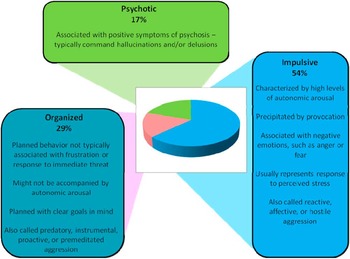
Violence can be deconstructed into its component symptoms, as can any other psychiatric syndrome, and these symptoms can be theoretically mapped to hypothetically malfunctioning brain circuits. This idea models the dimensional approach taken to psychopathology by the Research Domain Criteria (RDoC) strategy, which complements the categorical diagnostic strategy of the Diagnostic and Statistical Manual of Mental Disorders (DSM) of the American Psychiatric Association.Reference Stahl 36 Specifically, violence in forensic settings can be approached as a medical syndrome,Reference Warburton 1 , Reference Stahl, Morrissette and Cummings 2 and can be deconstructed into 3 major symptom domains: psychotic, impulsive, and predatory,Reference Stahl, Morrissette and Cummings 2 , Reference Singh, Serper, Reinharth and Fazel 37 – Reference Serper, Beech, Harvey and Dill 46 each with a hypothetically distinct neurobiological basis and different theoretically malfunctioning brain circuits. (eg, Stahl and MorrissetteReference Stahl and Morrissette 43 ). Although many if not most patients in forensic settings have a psychotic illness, this is actually the least common type of violence (Figure 1).Reference Singh, Serper, Reinharth and Fazel 37 – Reference Serper, Beech, Harvey and Dill 46 Predatory violence may actually be more common than psychotic violence in forensic settings. Although predatory violence is not the most common form of violence in forensic settings, it is often the most severe, but perhaps the least treatable, and therefore requires therapeutic security measures. It is actually impulsive violence that is the most common in forensic settings, and thus the subtype of violence that is in most desperate need of treatment in terms of frequency of occurrence, as well as relative lack of evidence from large, multicenter, randomized trials.Reference Singh, Serper, Reinharth and Fazel 37 – Reference Serper, Beech, Harvey and Dill 46 Empiric findings from recent treatment guidelinesReference Stahl, Morrissette and Cummings 2 , Reference Stahl, Morrissette and Citrome 3 and from clinical experience, as well as the existing literature,Reference Correll 4 – Reference Aggarwal, Sernyak and Rosenheck 35 suggest that novel and aggressive psychopharmacologic management may reduce impulsive violence in this population.
Heterogeneity of aggression. Identifying the type of aggression a patient is displaying may help guide the selection of appropriate treatments that target the underlying dysfunctional circuits. However, violence and aggression arise from a complex combination of neurobiological, genetic, and environmental factors, and are often presented in the context of comorbid conditions.

Psychotic violence
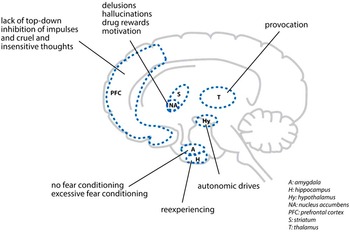
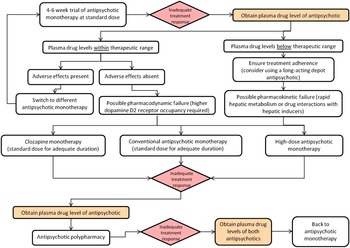
Psychotic violence is attributed to positive symptoms of psychosis, most commonly paranoid delusions of threat or persecution, command hallucinations, and grandiosity.Reference Stahl, Morrissette and Cummings 2 – Reference Aggarwal, Sernyak and Rosenheck 35 , Reference Stahl 47 Such psychotic symptoms may lead to violent behavior due to the assailant misunderstanding or misinterpreting environmental stimuli. In line with this, a recent study determined that 59% of individuals with schizophrenia who had committed acts of homicide were experiencing delusions, with a worsening of delusions in the months leading up to the homicidal act.Reference Stilwell, Yates and Brahm 19 Psychotic violence is hypothetically linked to excessive neuronal activity in the mesolimbic dopamine pathway (Figure 2), where positive symptoms of psychosis are hypothetically mediated.Reference Stahl 47 Psychotic violence linked to positive symptoms should hypothetically respond to suppression of this dopamine overactivity, and if standard doses of monotherapies or clozapine are ineffective, may be responsive to high-dosing or antipsychotic polypharmacy.Reference Stahl, Morrissette and Cummings 2 , Reference Stahl, Morrissette and Citrome 3 , Reference Singh, Serper, Reinharth and Fazel 37 – Reference Serper, Beech, Harvey and Dill 46 If standard doses fail to attain adequate plasma drug levels, ie, a pharmacokinetic failure (Figure 3),Reference Stahl, Morrissette and Cummings 2 , Reference Meyer 11 – Reference Morrissette and Stahl 15 , Reference Siever 48 – Reference Mauri, Volonteri, Colasanti, Fiorentini, De Gaspari and Bareggi 50 or if standard doses do attain adequate plasma drug levels but are nevertheless ineffective in reducing violence, ie, a pharmacodynamic failure (Figure 3),Reference Stahl, Morrissette and Cummings 2 , Reference Meyer 11 – Reference Morrissette and Stahl 15 , Reference Siever 48 – Reference Mauri, Volonteri, Colasanti, Fiorentini, De Gaspari and Bareggi 50 clozapine, high doses of monotherapies, or administration of 2 antipsychotics may be effective for positive symptoms driving psychotic violence (Figure 3).Reference Stahl, Morrissette and Cummings 2 – Reference Aggarwal, Sernyak and Rosenheck 35 The rationale, consensus guidelines, evidence, and case-based examples are beginning to emerge from the literature for how to treat patients with psychotic violence unresponsive to standard, first-line, evidence based treatments,Reference Stahl, Morrissette and Cummings 2 – Reference Aggarwal, Sernyak and Rosenheck 35 but much further research in this area remains to be done, and the positive results from the reported studies need to be replicated.
Brain areas related to violent and aggressive behavior. Impaired neurotransmission in various brain regions may contribute to the propensity for violent or aggressive behavior. The specific type of aggressive behavior is likely correlated with dysfunction in specific neural circuits. For example, both impulsive and psychotic aggression have been hypothesized to involve excessive reactivity to perceived threats (bottom-up out of control) and inadequate cortical regulation (top-down out of control). Although they are perhaps present in all patients with schizophrenia, structural and functional abnormalities in the frontal and temporal cortices as well as reduced connectivity between these brain areas may be more severe in aggressive patients than in those who are not aggressive. In the amygdala, fear conditioning seems to be excessive in both psychotic and impulsive aggression, whereas individuals with psychopathic aggression seem to lack fear conditioning.

Antipsychotic treatment algorithm. Following several unsuccessful atypical antipsychotic monotherapy trials, a trial with a conventional antipsychotic or with clozapine is recommended. High-dose monotherapy may also be considered for such treatment-resistant patients. Antipsychotic polypharmacy is recommended only after antipsychotic monotherapy has failed. Note that throughout the treatment algorithm, monitoring of plasma drug levels of each antipsychotic is critical when determining the next course of action.

Impulsive violence
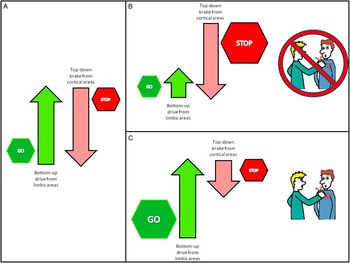
Sometimes called reactive violence, impulsive violence generally involves no planning, and is usually an immediate response to an environmental stimulus.Reference Nolan, Czobor and Roy 38 – Reference Stahl and Morrissette 43 Impulsive violence may reflect emotional hypersensitivity and exaggerated threat perception,Reference Singh, Serper, Reinharth and Fazel 37 – Reference Stahl and Morrissette 43 and may be linked with an imbalance between “top-down” cortical inhibitory controls and “bottom-up” impulsive drives (Figure 4).Reference Comai, Tau and Gobbi 7 , Reference Stahl and Morrissette 43 , Reference Coccaro, Sripada, Yanowitch and Phan 51 – Reference Kumari, Aasen and Taylor 58 Both impulsive and psychotic aggression can occur in patients with schizophrenia, although impulsive violence is common in many other disorders, including mood disorders, personality disorders, substance abuse, and many more.
Bottom-up limbic drive and top-down cortical brake. (A) Impulsive drives in response to perceived threats stem from limbic regions, including the amygdala. Activity in limbic regions is modulated by input from cortical brain regions, including the prefrontal cortex (PFC). The balance between this limbic drive and the opposing cortical brakes determines whether one will act out an impulsive behavior such as aggression. (B) If the limbic drive is not overly strong, and/or if the cortical brake is sufficient to control impulsive drives coming from limbic areas, an individual will not act out with violent or aggressive behavior. (C) If the limbic drive is overly strong, and/or if the cortical brake system is not strong enough, an individual will be at an increased risk of violent behavior.

Both impulsive and psychotic violence have been hypothesized to involve excessive reactivity to perceived threat (bottom-up out of control) coupled with inadequate cortical regulation (top-down out of control) (Figure 4).Reference Comai, Tau and Gobbi 7 , Reference Stahl and Morrissette 43 , Reference Coccaro, Sripada, Yanowitch and Phan 51 – Reference Kumari, Aasen and Taylor 58 Consistent with this, structural and functional abnormalities in frontal and temporal cortices and reduced connectivity between these brain areas have been reported.Reference Comai, Tau and Gobbi 7 , Reference Stahl and Morrissette 43 , Reference Coccaro, Sripada, Yanowitch and Phan 51 – Reference Kumari, Aasen and Taylor 58 Although perhaps present in all patients with schizophrenia, these findings may be more severe in aggressive patients compared with those who are nonviolent.Reference Comai, Tau and Gobbi 7 , Reference Stahl and Morrissette 43 , Reference Coccaro, Sripada, Yanowitch and Phan 51 – Reference Kumari, Aasen and Taylor 58 Impaired top-down control is most strongly associated with portions of the prefrontal cortex (PFC), including the dorsolateral PFC (DLPFC) and ventromedial PFC (VMPFC), as well as the orbitofrontal cortex (OFC).Reference Comai, Tau and Gobbi 7 , Reference Stahl and Morrissette 43 , Reference Coccaro, Sripada, Yanowitch and Phan 51 – Reference Kumari, Aasen and Taylor 58 These regions are involved in decision making; dysfunction in these areas results in lack of recognition of consequences, inability to use previously learned information about reward and punishment, misinterpretation of emotionally neutral stimuli as being negative, and impaired recognition of social cues.Reference Comai, Tau and Gobbi 7 , Reference Stahl and Morrissette 43 , Reference Coccaro, Sripada, Yanowitch and Phan 51 – Reference Kumari, Aasen and Taylor 58
Within the temporal lobe, the amygdala is most highly implicated in violent and aggressive behaviors. The amygdala is involved in the rapid detection of threat, as well as the excitation of fight-or-flight responses. Modulation of amygdala activity comes from prefrontal brain areas; connections between these prefrontal and limbic regions may be impaired in individuals who are impulsively aggressive.Reference Comai, Tau and Gobbi 7 , Reference Stahl and Morrissette 43 , Reference Coccaro, Sripada, Yanowitch and Phan 51 – Reference Kumari, Aasen and Taylor 58 The amygdala is hyperactive in the case of impulsive aggression, but hypoactive in the case of psychopathic (predatory) aggression.Reference Stahl and Morrissette 43 , Reference Siever 48 , Reference Coccaro, Sripada, Yanowitch and Phan 51
As in psychotic violence, impulsive violence may be responsive to antipsychotic polypharmacy or high dosing when standard doses of monotherapies or clozapine fail to control impulsive violence.Reference Correll 4 – Reference Aggarwal, Sernyak and Rosenheck 35 Additional studies of impulsive violence and high-dose antipsychotics or antipsychotic polypharmacy are greatly needed.
Predatory violence
Predatory, or psychopathic, violence involves aggressive acts that are characterized by planning of assaults, predatory gain, and lack of remorse.Reference Stahl, Morrissette and Cummings 2 , Reference Singh, Serper, Reinharth and Fazel 37 – Reference Serper, Beech, Harvey and Dill 46 A moderate proportion of all violent acts and a high proportion of the most severe violent acts are due to psychopathy (Figure 4).Reference Stahl, Morrissette and Cummings 2 , Reference Essock, Schooler and Stroup 32 – Reference Serper, Beech, Harvey and Dill 46 The neurobiological basis of psychopathy is currently under intense investigation, and findings suggest that predatory/psychopathic violence may be associated with deficient fear conditioning in the amygdala.Reference Stahl and Morrissette 43 , Reference Siever 48 , Reference Coccaro, Sripada, Yanowitch and Phan 51
Even though predatory violence in patients with psychotic illnesses may be common in forensic settings, this can occur in psychotic patients who have positive symptoms under control, and whose predatory violence will not respond to antipsychotics, including high dosing and polypharmacy. In fact, it is not clear whether predatory violence responds to any kind of treatment, least of all, psychopharmacologic interventions.Reference Stahl, Morrissette and Cummings 2 , Reference Singh, Serper, Reinharth and Fazel 37 – Reference Serper, Beech, Harvey and Dill 46 Psychopathic violence is not responsive to antipsychotics when comorbid psychotic symptoms are under control. Such patients may require restricted housing or “therapeutic security” rather than antipsychotics.Reference Warburton 1 , Reference Stahl, Morrissette and Cummings 2
Confounding factors
When selecting treatments for violent patients in forensic settings, it is important to consider the numerous confounding factors that may contribute to violent behavior, such as substance use disorders, personality disorders, cognitive dysfunction, mood disorders, noncompliance, etc.Reference Stahl, Morrissette and Cummings 2 , Reference Singh, Serper, Reinharth and Fazel 37 – Reference Serper, Beech, Harvey and Dill 46 , Reference Krakowski, Czobor and Nolan 59 – Reference Elie, Poirier, Chianetta, Durand, Gregoire and Grignon 61 Substance use issues are highly prevalent in patients with mental illness; approximately half of patients with schizophrenia have a comorbid substance use disorder.Reference Singh, Serper, Reinharth and Fazel 37 – Reference Serper, Beech, Harvey and Dill 46 Substances of abuse in particular may exacerbate symptoms of schizophrenia and lead to violence due to the effects of drugs of abuse on impulse control.Reference Volavka and Citrome 16 In fact, the risk of violent behavior in patients with schizophrenia is 4 times greater if there is comorbid substance abuse.Reference Swanson, Swartz and Van Dorn 20 Addressing substance use disorders is an integral part of the treatment plan for patients with schizophrenia, and may help prevent violence in this population.Reference Stahl, Morrissette and Cummings 2 , Reference Singh, Serper, Reinharth and Fazel 37 – Reference Serper, Beech, Harvey and Dill 46
Neurotransmitters and Violence
An oversimplification of the role of neurotransmitters in violence, particularly impulsive violence, involves hypothetical imbalances in the neurotransmitters dopamine (DA) and serotonin (5HT).Reference Comai, Tau and Gobbi 7 , Reference Stahl and Morrissette 43 , Reference Siever 48 In the prefrontal cortexes of aggressive patients, 5HT is decreased whereas DA is increased.Reference Comai, Tau and Gobbi 7 , Reference Stahl and Morrissette 43 , Reference Siever 48 , Reference Singh, Volavka, Czobor and Van Dorn 62 Dopamine is involved in the initiation and performance of aggressive behaviors, and elevated levels of striatal DA have been reported in individuals with impulsive disorders; this hyperdopaminergia may weaken inhibitory pathways that regulate impulsivity.Reference Comai, Tau and Gobbi 7 , Reference Stahl and Morrissette 43 , Reference Siever 48 , Reference Singh, Volavka, Czobor and Van Dorn 62 – Reference Winstanley, Theobald, Dalley, Glennon and Robbins 65 Notably, excessive DA in mesolimbic areas of the brain is also believed to underlie psychosis; not surprisingly, antagonism of dopamine D2 receptors forms the basis of antipsychotic treatments. This may be why high degrees of blocking dopamine D2 receptors may also have therapeutic actions in impulsive violence as well.
Serotonin modulates prefrontal activity; thus the serotonergic dysfunction observed in the OFC and in the anterior cingulate of aggressive patients suggests a lack of sufficient top-down control.Reference Comai, Tau and Gobbi 7 , Reference Stahl and Morrissette 43 , Reference Siever 48 , Reference Singh, Volavka, Czobor and Van Dorn 62 – Reference Winstanley, Theobald, Dalley, Glennon and Robbins 65 In fact, during aggressive confrontations, 5HT levels in the PFC may decrease by as much as 80%.Reference Comai, Tau and Gobbi 7 Aggressive behavior and suicide by violent means has been correlated with low cerebrospinal fluid (CSF) levels of 5HIAA, which is a measure of 5HT concentration.Reference Coccaro, Sripada, Yanowitch and Phan 51 , Reference Pavlov, Chistiakov and Chekhonin 63 Additionally, whereas 5HT depletion increases aggressive behavior, increasing 5HT levels brings about increased activity in the PFC as well as diminished aggression.Reference Rosell, Thompson and Slifstein 64 This reduction in serotonergic activity observed in impulsively aggressive individuals is not found in patients with predatory aggression, which further supports the heterogeneic nature of violent behavior.Reference Bourget and Labelle 23 , Reference Haller 57 The serotonin 5HT2A receptor in particular may be implicated in aggressive behavior: a recent study showed that availability of the 5HT2A receptor is greater in aggressive patients compared to non-aggressive patients or healthy controls.Reference Rosell, Thompson and Slifstein 64 Contrary to the antiaggressive consequences of antagonism at 5HT2A receptors, agonism at 5HT2C receptors has also been shown to reduce impulsivity.Reference Winstanley, Theobald, Dalley, Glennon and Robbins 65 Therefore, targeting of specific serotonergic subtypes, a feature of many atypical antipsychotics, has potential for antiaggressive therapies.
Targeting Psychotic and Impulsive Violence
Once violence has been assessed in the forensic setting and a psychiatric diagnosis has been made,Reference Warburton 1 – Reference Stahl 36 the next step is to deconstruct the type of violence into its psychotic, impulsive, or predatory subtypes.Reference Stahl 36 Once the type of violence in the context of the specific DSM psychiatric diagnosis is known, the succeeding step is to find a rational treatment. The RDoC approach is to consider which brain circuits may be malfunctioning and thus hypothetically result in the unique symptom profile of an individual patient, which neurotransmitters may hypothetically regulate the efficiency of information processing in those brain circuits, and then finally, which psychopharmacologic treatments to select to rationally reduce symptoms of violence by targeting the hypothetically malfunctioning brain circuits of a given patient.Reference Stahl 36 Interventions not only include rational psychopharmacologic measures, usually to occupy high proportions of dopamine D2 receptors, or act at serotonergic systems or ion channels, but also utilizing various psychotherapies such as dialectical behavioral therapy (DBT) that can have potentially powerful therapeutic actions in selected patients.Reference Stahl, Morrissette and Cummings 2
In terms of empiric psychopharmacologic interventions that seem to be effective in some psychotic and impulsive patients who fail first-line, evidence-based treatments from randomized controlled trials, one current strategy is to achieve high degrees of dopamine D2 receptor occupancy by utilizing higher than normal doses of an antipsychotic, or even 2 concomitant antipsychotics, one often a depot formulation, while monitoring plasma drug levels.Reference Stahl, Morrissette and Cummings 2 – Reference Aggarwal, Sernyak and Rosenheck 35
Summary
Violence can be approached as a medical syndrome, and violence risk can be assessed as part of the psychiatric diagnostic evaluation. Specific subtypes of violence require unique treatment approaches for best outcomes. Conducting large, randomized, controlled trials is needed so that specific evidence-based treatments can be developed for subtypes of violence when first-line treatments fail. When large, randomized, controlled trials are not possible, further development of expert consensus-based and case-based treatments is needed for subtypes of violence.