Introduction
While data on the helminth fauna of rodent species are abundant in many European countries (Mészáros & Murai, Reference Mészáros and Murai1979; Genov, Reference Genov1984; Feliu et al., Reference Feliu, Renaud, Catzeflis, Hugot, Durand and Morand1997; Behnke et al., Reference Behnke, Barnard, Bajer, Bray, Dinmore, Frake, Osmond, Race and Sinski2001; Grikieniene, Reference Grikieniene2005; Ondríková et al., Reference Ondríková, Miklisová, Ribas and Stanko2010), in Serbia, they are largely missing. The first studies of rodent helminth fauna in the country were carried out by Hungarian scientists in the northern province of Vojvodina (Mészáros et al., Reference Mészáros, Habijan and Mikes1983). Awareness about the parasitic nematode fauna in Serbia increased when several authors published findings of different helminth species in rodents (Kataranovski et al., Reference Kataranovski, Vukićević-Radić, Kataranovski, Radović and Mirkov2008; Bjelić-Čabrilo et al., Reference Bjelić-Čabrilo, Popović, Kostić and Šimić2009, Reference Bjelić-Čabrilo, Kostić, Popović, Ćirković, Aleksić and Lujić2011; Ćirović et al., Reference Ćirović, Pavlović, Kulišić, Ivetić, Penezić and Ćosić2012). However, the nematode fauna of small mammals remains almost completely unexplored in a large part of the country, as most of the cited studies were performed in the Pannonian Basin (Vojvodina).
The species examined here, the yellow-necked field mouse, Apodemus flavicollis (Melchior 1834) occurs in mature deciduous woodland, where there are an abundance and variety of seed-bearing trees (Marsh & Harris, Reference Marsh and Harris2000). Distribution of this mouse species in Serbia reflects the general pattern, with the exception of its absence in the north-east (Petrov, Reference Petrov1992). Apodemus flavicollis can be described as a typical granivore, although it also consumes green plant matter and invertebrates (Abt & Bock, Reference Abt and Bock1998). The nematode fauna of the yellow-necked field mouse is well documented elsewhere in Europe, in various countries (Mészáros & Murai, Reference Mészáros and Murai1979; Genov, Reference Genov1984; Grikieniene, Reference Grikieniene2005; Ondríková et al., Reference Ondríková, Miklisová, Ribas and Stanko2010).
However, the majority of studies on helminths in Serbia were faunistic and qualitative in their approach (e.g. Kataranovski et al., Reference Kataranovski, Vukićević-Radić, Kataranovski, Radović and Mirkov2008; Bjelić-Čabrilo et al., Reference Bjelić-Čabrilo, Popović, Kostić and Šimić2009, Reference Bjelić-Čabrilo, Kostić, Popović, Ćirković, Aleksić and Lujić2011). Besides providing a faunistic review of helminth species in three localities, the present investigation also attempts to introduce an ecological aspect into helminthological research in Serbia, namely the quantification of local community species richness (or alpha diversity) and regional-level parasite diversity (beta diversity). Guégan et al. (Reference Guégan, Morand, Poulin, Thomas, Renaud and Guegan2005) highlighted habitat area, habitat fragmentation or isolation, and the presence of latitudinal gradients as the three most important among potential large-scale determinants of local parasite diversity. In order to avoid differences in local parasite diversities caused by these major determinants, the localities analysed here were chosen to be approximately at the same latitude and altitude, in preserved unfragmented forests. Therefore, the only possible beta diversity pattern could be expected between the eastern and the western communities. Relative to geographical position, the proximity of the localities and the ecological similarities between them, we hypothesized that the nematode fauna of the yellow-necked mouse should be the same, or at least very similar, between localities. In addition to the same community composition, we expected similar levels of nematode alpha diversity in the samples.
Materials and methods
Collection and examination of mice
The localities studied are situated along a longitudinal transect at the southern, hilly–mountainous margin of the Pannonian Basin, south of the Sava and Danube Rivers. From west to east, they included Mt. Cer (44°38′37″N, 19°20′40″E), Mt. Avala (44°41′24″N, 20°31′10″E) and Mt. Liškovac (44°27′23″N, 22°1′19″E). The distance between adjacent localities is approximately 100 km. Geologically, they are positioned at the pre-Neogene deposits of the mountain systems of the Dinarides and Carpatho-Balkanides (Marović et al., Reference Marović, Đoković, Pešić, Radovanović, Toljić and Gerzina2002). With this specific position, these localities represent vegetational and biogeographical transitions between the Pannonian and Continental regions in Europe (European Environmental Agency, 2003). Transitional areas, such as these, generally show higher biodiversity (Risser, Reference Risser1995; Magura et al., Reference Magura, Tóthmérész and Molnár2001; Kark et al., Reference Kark, Allnutt, Levin, Manne and Williams2007) but also seem to be more prone to biological invasions (van Rensburg et al., Reference Van Rensburg, Hugo, Levin and Kark2013).
At each locality, trapping was carried out with the same sampling effort (3-night period) using Longworth traps provided with hay and cereals in autumn 2011 (on Mt. Cer) and spring 2012 (on Mt. Avala and Mt. Liškovac). A total of 86 individuals of the yellow-necked field mouse were examined: 32 from Mt. Avala, 14 from Mt. Cer and 40 from Mt. Liškovac. Host age was determined from the dry eye lens weight (Nabaglo & Pachinger, Reference Nabaglo and Pachinger1979). With the digestive tract intact, the mice were kept in a freezer until required. The intestinal tract was dissected from each animal and divided into three segments (small intestine, caecum and large intestine), each cut longitudinally in order to release their contents. The stomach, while present, was excluded from the analysis because its contents proved to be difficult to examine adequately due to the very high density of semi-digested food particles. The intestinal contents were deposited in water and the supernatant decanted until it was clear. The contents were then examined under a stereo-microscope and nematodes were recovered and conserved in 70% alcohol. For identification, native slides were prepared from nematodes illuminated in lactic acid. Species were classified according to the identification keys of Ryžikov (Reference Ryžikov1978, Reference Ryžikov1979) and Genov (Reference Genov1984). In this study, we examined only the diversity of nematode fauna. Tapeworms, digeneans and acanthocephalans were also detected in the samples, but they were not included in the analyses. Nematodes were by far the most numerous parasites present in the digestive tract. Moreover, determining their numbers and identifying them to species level could be carried out without any complications.
Data analysis
Quantitative parasitological parameters (prevalence and abundance) were calculated according to Bush et al. (Reference Bush, Lafferty, Lotz and Shostak1997). Sterne's exact method was used to calculate 95% confidence intervals for prevalence (Reiczigel, Reference Reiczigel2003) in the software package Quantitative Parasitology 3 (Rózsa et al., Reference Rózsa, Reiczigel and Majoros2000). Using the same software, prevalence and abundances among localities were compared by Fisher's exact test (Reiczigel et al., Reference Reiczigel, Abonyi-Tóth and Singer2008). The abundance data for each parasite species recovered were fitted by the generalized linear model (GLM; Dobson, Reference Dobson1990). The starting model included the factors: host age, host sex and locality, as well as interactions between them. The minimal best-fitting model was obtained by backward selection using the likelihood ratio test and Akaike information criterion for model comparison and selection (AIC; Akaike, Reference Akaike1974). The chosen best-fitting model for each species was the one with the lowest AIC value. The GLM fit was performed with package MASS 7.3-33 (see Venables & Ripley, Reference Venables and Ripley2002) in the R software package version 3.1.0 (R Core Team, 2014).
Analysis of nematode fauna diversity included species richness with alpha and beta diversity indices. According to Poulin (Reference Poulin1998), the observed species richness is the best estimator of the true species richness when the number of hosts is equal to or greater than 50, which was not the case in our samples. Therefore, local species richness of component nematode community was estimated by the non-parametric jackknife estimator (Burnham & Overton, Reference Burnham and Overton1978; Heltsche & Forrester, Reference Heltsche and Forrester1983). The species richness estimations were computed in EstimateS 9.1.0 (Colwell, Reference Colwell2013), with confidence intervals calculated in a randomization process of 1000 pseudosamples of the same size as the total number of empirically recovered nematode individuals, with the replacement of individuals. The mean and the maximum infracommunity species richness were also calculated, as some authors identified these measures as a more correct way to display local species richness (see Guégan et al., Reference Guégan, Morand, Poulin, Thomas, Renaud and Guegan2005). The most commonly used alpha diversity indices, Berger–Parker index (d) and Shannon's entropy index (H), were calculated for all localities in accordance with Magurran (Reference Magurran2004). However, many researchers have criticized the use of diversity indices in field studies and other applications (Tóthmérész, Reference Tóthmérész1995). It is well known that different diversity indices may rank the studied communities differently. A potential solution is the use of parametric families of diversity indices, where the diversity of each community is represented by the diversity profile. On the basis of the diversity profiles, we can define the diversity ordering of communities. In this study, the diversity ordering by Renyi's index was carried out to ensure that component nematode diversities could be compared (as suggested by Tóthmérész, Reference Tóthmérész1995). The approximate confidence intervals for diversity profiles were computed by a bootstrapping procedure on 1000 random pseudosamples of the same size as the total number of empirically recovered nematode individuals in PAST (Hammer et al., Reference Hammer, Harper and Ryan2001). The geographical pattern of diversity could be discovered by similarity and beta diversity analyses. The similarity in species presence between each pair of localities was quantified by calculation of the Sørensen similarity index (Magurran, Reference Magurran2004). Beta diversity was calculated as βW (with subtraction of 1, as recommended by Wilson & Shmida, Reference Wilson and Shmida1984; Magurran, Reference Magurran2004), and βT (Wilson & Shmida, Reference Wilson and Shmida1984). These indices were chosen because sampling effort was the same in all samples. Furthermore, these two beta diversity indices fulfilled the criterion of conformity with the notion of community turnover, according to Wilson & Shmida (Reference Wilson and Shmida1984).
Results
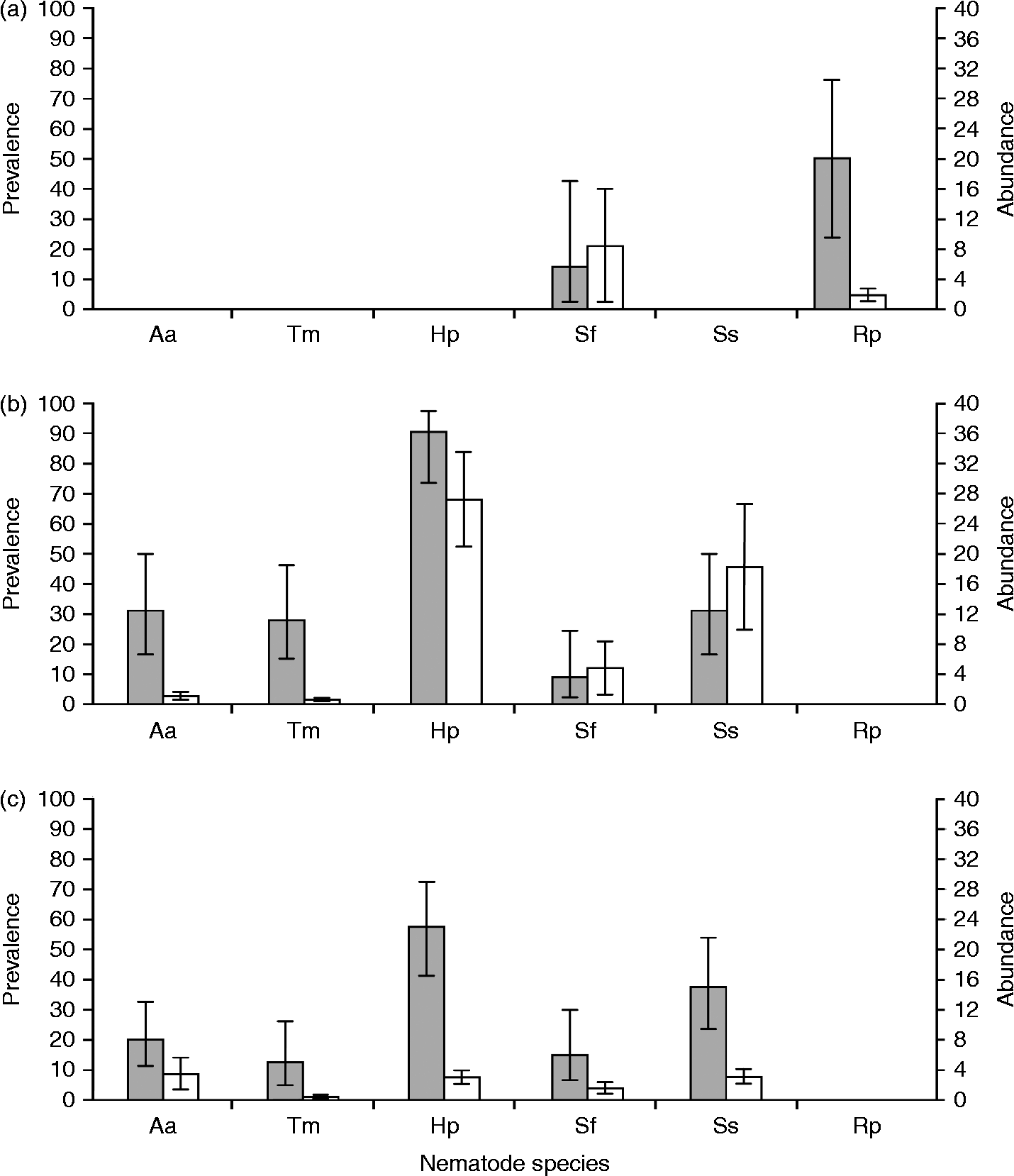
A total of six nematode species were identified: Aonchotheca annulosa, Heligmosomoides polygyrus, Rictularia proni, Syphacia frederici, S. stroma, and Trichuris muris. Two species were present at Mt. Cer, and five at both Mt. Avala and Mt. Liškovac (fig. 1). Taxonomic distinctness of Mt. Cer was seen in the presence of R. proni from the order Spirurida, and its high prevalence of 50% (fig. 1a). Nematodes were abundant in the Mt. Avala sample, where all but one of the inspected host individuals harboured these parasites, resulting in a prevalence of about 97%. Prevalence was much lower both at Mt. Liškovac (75%) and Mt. Cer (57%). It is interesting to note that, while the number of inspected hosts was greater at Mt. Liškovac compared to Mt. Avala, the former yielded only a quarter of the nematode individuals recovered from the latter site. The only statistically significant difference (Fisher's exact test) in prevalence among the studied localities was for H. polygyrus between Mt. Avala and Mt. Liškovac (P= 0.003).
The prevalence (grey bars) and abundance (white bars) of infection of nematode species in Apodemus flavicollis from Mts. Cer (a), Avala (b) and Liškovac (c). Aa, Aonchotheca annulosa; Tm, Trichuris muris; Hp, Heligmosomoides polygyrus; Sf, Syphacia frederici; Ss, Syphacia stroma and Rp, Rictularia proni.

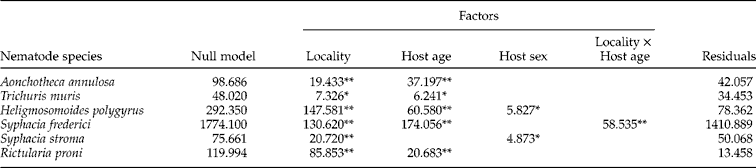
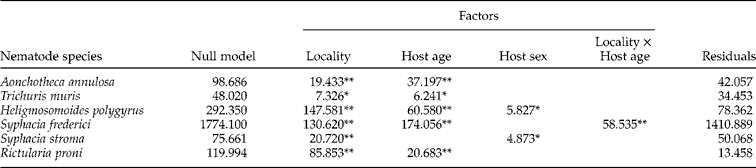
Based on both the number of parasite individuals and the abundance, the dominant species were S. frederici (81.5% of all parasite individuals recovered), H. polygyrus (52.0%), and A. annulosa (29.6%) in the Mt. Cer, Mt. Avala and Mt. Liškovac samples, respectively. In the best-fitted GLMs of variation of each species' abundances, the locality was a statistically significant factor, while host age was not significant for S. stroma only. Host sex was a significant factor of variation in abundances of two parasite species, namely S. stroma and H. polygyrus (table 1).
Generalized linear models of nematode species abundance in Apodemus flavicollis from Mts. Avala, Cer and Liškovac to show deviance values obtained by Chi-square tests; *P < 0.05, **P < 0.001.
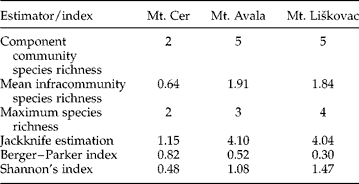
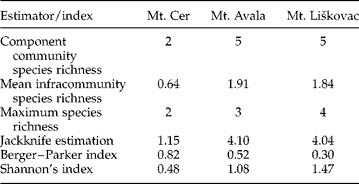
The observed species richness of the component community for each locality was compared to its estimated values (table 2). All non-parametric species richness estimators were lower than the empirically observed ones, and there was a difference in rank of the studied component communities. Shannon's index had the highest value at Mt. Liškovac, followed by Mt. Avala and Mt. Cer. Conversely, Berger–Parker's index was the highest for Mt. Cer and the lowest for Mt. Liškovac (table 2). In such a situation, the comparison of non-parametric species richness estimators and the diversity indices is unequivocal, and diversity ordering is recommended. After the diversity profiles of the analysed localities were ordered by Renyi's index, the Mt. Liškovac locality was shown to bear the highest diversity.
Estimates of infracommunity species richness and alpha diversity indices for nematode species in Apodemus flavicollis from Mts. Cer, Avala and Liškovac.
Considering the geography of species occurrence, the eastern samples from Mts. Avala and Liškovac showed complete overlap, with the same five species present in both localities, resulting in a maximal value for the Sørensen's index. However, the Sørensen similarity index between each of these populations and Mt. Cer was 0.29, with only one shared species, S. frederici. In view of this geographical difference, the value of Wilson and Shmida's βT beta diversity index calculated along the west to east longitudinal gradient (Mt. Cer–Mt. Avala–Mt. Liškovac) was 0.63, whereas Whittaker's beta diversity (βW) was 0.5.
Discussion
None of the three localities listed in this study have previously been subjected to this type of research. Therefore, all nematode species noted here offer new findings for the given areas. However, all six species have been reported previously in rodent hosts from the Pannonian Basin (Habijan-Mikeš, Reference Habijan-Mikeš1990; Bjelić-Čabrilo et al., Reference Bjelić-Čabrilo, Kostić, Popović, Ćirković, Aleksić and Lujić2011). According to diversity ordering of component communities, the highest diversity was seen in Mt. Liškovac, which had five nematode species. The same number of species was found in the Mt. Avala sample. However, its higher Berger–Parker's index value and the lower diversity, concluded from the ordering of diversity profiles, indicated more unequal community evenness than that seen in Mt. Liškovac. Mt. Cer had the lowest diversity, which was related to the low richness of nematode species, and the highest value for Berger–Parker's index due to an uneven arrangement of nematode individuals per species. Likewise, both the mean and the maximum infracommunity species richness were the lowest at Mt. Cer (table 2). The poor diversity of the Mt. Cer sample, which was the smallest host population in this study, is possibly connected with the lower probability of parasite transmission between individuals in a small population of low density. However, both positive correlation and lack of correlation between host density and parasite diversity have been seen in rodent host populations (Krasnov et al., Reference Krasnov, Poulin, Morand, Morand, Krasnov and Poulin2006). Therefore, the cause of the lowest diversity in the Mt. Cer infracommunities cannot be attributed unequivocally to the low density of a host population. It should be noted that the maximum infracommunity species richness showed the same pattern among localities as the component community diversity ordering, which is in agreement with previous recommendations in favour of this local diversity measure (Guégan et al., Reference Guégan, Morand, Poulin, Thomas, Renaud and Guegan2005).
The observed parasitic nematode species richness (2–5) is comparable to those in other parts of Europe, where values for component species richness range from 1 (Prokopic & Mahnert, Reference Prokopic and Mahnert1970; Mažeika et al., Reference Mažeika, Pailauskas and Balčiauskas2003) to 7 (Mészáros & Murai, Reference Mészáros and Murai1979; Habijan-Mikeš, Reference Habijan-Mikeš1990). As the rarest species in the samples had a prevalence of about 10%, the jackknife estimator should give the most realistic picture of species richness (see figures in Poulin, Reference Poulin1998). This means that Mt. Avala displays the greatest species richness. However, as the non-parametric estimator underestimated the observed species richness (table 2), further investigation of component community structure is recommended.
The relationships between helminth infracommunities in this study are not necessarily adequate representations of the structure of the total helminth communities of the host populations, for reasons outlined in Poulin (Reference Poulin2001). One such reason is the mathematical nature of the relationship between maximum infracommunity richness and component community richness, and our results are in favour of a curvilinear relationship. However, no definite trend can be concluded based on the three localities. According to Poulin (Reference Poulin2001), data on whether a helminth infracommunity is randomly structured or nested, or whether it follows a linear or curvilinear pattern with regard to total community richness, cannot be gauged accurately without precise null models, which have yet to be developed in Serbia. Our results could be the starting point of future null model development. Helminth communities of ecologically similar localities need not be similar. Thus, a study on bank voles in three such localities in Poland revealed that their helminth communities varied considerably (Behnke et al., Reference Behnke, Barnard, Bajer, Bray, Dinmore, Frake, Osmond, Race and Sinski2001). These variations were not a one-time phenomenon, as they extended through time and were detectable in subsequent samples (Behnke et al., Reference Behnke, Bajer, Harris, Newington, Pidgeon, Rowlands, Sheriff, Kulis-Malkowska, Sinski, Gilbert and Barnard2008a, Reference Behnke, Bajer, Harris, Newington, Pidgeon, Rowlands, Sheriff, Kulis-Malkowska, Sinski, Gilbert and Barnardb).
The high Sørensen's similarity index between Mt. Avala and Mt. Liškovac implies similarities in host ecology and behaviour in the two areas. The low similarity index between these localities and the westernmost Mt. Cer indicate the possible presence of a geographical pattern in the diversity. Quantification of this pattern is seen in the calculated beta diversity indices. Since no studies of this type have been carried out previously on helminth communities in Serbia, the present longitudinal beta diversity indices will provide a suitable point of comparison for any future studies that deal with the same topic. Mechanisms for similarities in host ecology and behaviour were suggested by Barnard et al. (Reference Barnard, Kulis, Behnke, Bajer, Gromadzka-Ostrowska, Stachon and Sinski2003), and Bordes et al. (Reference Bordes, Morand, Krasnov, Poulin, Morand and Krasnov2010). Furthermore, population genetics and dynamics also have an influence on the structure of the parasite fauna of the yellow-necked field mouse (Ferrari, Reference Ferrari2005) and possibly explain the differences and similarities found here. In a recent study of yellow-necked field mouse populations in Serbia it was shown that their genetic structure did not reflect geographical distances and predicted barriers (large rivers); rather, it reflected differences in the habitats (Adnadević et al., Reference Adnadević, Bugarski-Stanojević, Blagojević, Stamenković and Vujošević2012). In particular, the authors found no statistically significant differences in genetic diversity between two localities separated by the Danube. On the other hand, there was significantly greater genetic diversity in the locality with optimal habitat conditions than in the remaining three localities with sub-optimal conditions for A. flavicollis.
The caecum- and colon-specific pinworm species S. frederici was found in hosts from all three sites. Similarly, this species was recorded at all the researched localities in the Italian Calabria (Milazzo et al., Reference Milazzo, Di Bella, Casanova, Ribas and Cagnin2010). While Mt. Cer had the smallest number of species, it contained one species not recovered at Mts. Avala and Liškovac, R. proni. This species differs from the other nematodes detected here in having insects as intermediate hosts in its life cycle. The insect hosts in question are listed in Anderson (Reference Anderson2000) and are quite common in all three localities. The absence of R. proni in the other two localities indicates that these insect intermediate hosts are less prominent in the diet of A. flavicollis on Mts. Avala and Liškovac, which may be a consequence of differences in habitats.
Locality, host age and host sex were noted as having a significant influence on variation of parasite abundance, which is concordant with previous studies in the field. Parasite burdens, abundance and species richness generally increase with host age, as a result of longer exposure to infective stages (Behnke et al., Reference Behnke, Lewis, Mohd Zain and Gilbert1999). With regard to host sex, helminth infections in many species tend to be male biased (Krasnov et al., Reference Krasnov, Morand, Hawlena, Khokhlova and Shenbrot2005, Reference Krasnov, Bordes, Khokhlova and Morand2012; Harrison et al., Reference Harrison, Scantlebury and Montgomery2010). In addition, males also appear to be the driving force behind parasite transmission and dispersal (Ferrari et al., Reference Ferrari, Cattadori, Nespereira, Rizzoli and Hudson2004; Grear et al., Reference Grear, Luong and Hudson2012).
In this research, we confirmed the similarity of component nematode fauna between the three studied localities to a varying degree. It is most pronounced between Mt. Avala and Mt. Liškovac: not only were the same species present at both localities, but the prevalences of all but H. polygyrus were comparable and showed no statistically significant differences. However, variation in parasite abundance was different among the localities, and host age influenced this variation as well. Also, while the two eastern sites appear quite similar in species richness, there are issues concerning the conflicting results from diversity ordering and the jackknife richness estimator, which highlighted different samples as bearing the highest diversity. The taxonomically distinct sample from Mt. Cer exhibited lower similarity to the other two localities, as well as lower diversity.
Financial support
This study was funded by the Ministry of Education, Science and Technological Development of the Republic of Serbia (Grant #173003).
Conflict of interest
None.
Ethical standards
The licence for field work (under #353-03-250/2010-04) was authorized by the Ministry of Environment and Spatial Planning of the Republic of Serbia on 14 April 2011. The laboratory and field work were conducted in full compliance with the Bioethical Committee of the Institute for Biological Research ‘Siniša Stanković’ of the University of Belgrade, Serbia.