Introduction
The use of hard chromium (Cr) coating, with extensive applications in aerospace, automotive, marine, and electronics sectors, has been strictly regulated and restricted because of severe health and environmental problems caused by the hexavalent Cr in the electrolyte [Reference Leimbach, Tschaar, Schmidt and Bund1]. Ni–P and its composite coatings with high microhardness, good wear, and corrosion resistance were considered as a promising alternative material for the hard Cr coatings in critical engineering applications [Reference Tamilarasan, Sanjith, Shankar and Rajagopal2, Reference Sadeghzadeh-Attar, AyubiKia and Ehteshamzadeh3]. Minimizing friction and wear is essential to improve the efficiency and service life of components, and tribological coatings with low coefficient of friction (COF) are sought-after in the modern industry. However, the COF of Ni–P coatings is in the range of 0.45–0.7 under dry lubrication against different counterface materials [Reference Wang, Gao, Xue, Liu and Xu4, Reference Wang, Zhang, Zhang, Liu, Li and Zhou5]. Existing researches has demonstrated that the co-deposition of Co-rich Ni–Co alloy coatings showed friction reduction and anti-wear improvement [Reference Wang, Gao, Xue, Liu and Xu6]. The alloying of Co into Ni–P matrix is expected to reduce the COF and improve the tribological performance of the resulting coatings.
Co–Ni–P coatings are prepared by electroless plating and electrodeposition. In comparison with electroless plating, electrodeposition has advantages, such as simplicity and low costs of plating process. Thickness, morphology, and phase structure of the coating are easy to be controlled by adjusting the electrical parameters [Reference Jain and Pitchumani7, Reference Nicolenco, Tsyntsaru, Fornell, Pellicer, Reklaitis, Baltrunas, Cesiulis and Sort8, Reference Beltowska-Lehman, Indyka, Bigos, Szczerba, Guspiel, Koscielny and Kot9, Reference Fernandez, Turner, Lara-Lara and Deutsch10, Reference Najafi, Rafati, Fart and Zare11]. Co–Ni–P coatings are normally applied as magnetic recording media [Reference Park, Myung, Schwartz and Nobe12], microwave absorptive materials [Reference Wang, Wan, Zhang, Chen, Hu, Liu, Zhong and Deng13], and electrocatalytic materials for water electrolysis [Reference Rakap, Kalu and Özkar14]. Nevertheless, tribological and electrochemical performances of the Co–Ni–P coatings have not received much attention, although these properties are important for their industrial application under wear and corrosion conditions. Moreover, the demand for high-quality coatings becomes more rigorous with the industrial development and enhanced living conditions. Single-alloy coating cannot completely meet the requirement of the practical application conditions. Composite coatings, with alterable microstructure and capability by the intercalation of second-phase particles intercalate into the metal electrodeposit, have a highly interesting application in technologies and industries. Previous studies have confirmed that the incorporation of particle into metal matrix endowed the resulting composite coatings with enhanced anti-oxidant, anticorrosion, and friction properties [Reference Mirzamohammadi, Khorsand, Aliofkhazraei and Shtansky15, Reference He, He, Li, Fan, Yang and He16, Reference Zhou, Mai, Ling, Chen, Lian and Jie17, Reference Wang, Han, Xin, Lin, Wei, Lian, Sun, Zu and Yu18, Reference Stenberg, Dittrick, Bose and Bandyopadhyay19, Reference Wang, Wang and Jia20].
Graphene is expected to be an ideal enhancement of metal matrix composite coating for its superior mechanical, electrochemical, thermal, and lubricating capacity [Reference Qiu, Liu, Li, Zhao and Wang21]. Nevertheless, graphene is hard to be uniformly dispersed in the plating solution as there are no functional groups on its surface, limiting its potential application for the preparation of composite coatings. Graphene oxide (GO), the oxidized form of graphene, possesses remarkable properties and hydrophilic functional groups, such as –OH and –COOH, which favor its uniform dispersion in the solution [Reference Mirzaee, Dehghanian and Bokati22, Reference Mai, Zhou, Ling, Chen, Lian and Jie23, Reference Liu, Su and Liang24]. Thus, the co-deposition of Co–Ni–P/GO composite coating with excellent performances is feasible and expected. In fact, some researches has reported that GO, as a third-phase particle in electroplating, endowed the composite coatings with noble properties. Kumar et al. [Reference Kumar, Venkatesha and Shabadi25] showed that the Ni/graphene composite coatings electroplated on mild steel exhibited excellent corrosion resistance. Jiang et al. [Reference Jiang, Feng, Qian, Zhu, Han and Lin26] fabricated Ni–Mo/GO composite coating on low-carbon steel by direct current electrodeposition with ultrasonic vibration and demonstrated that distribution of reduced GO endowed the composite coating with higher microhardness, enhanced oxidation resistance, and corrosion resistance. Xue et al. [Reference Xue, Lei, Wang, Qian and Li27] prepared Ni–GO composite coatings by pulse electrodeposition technique under supercritical carbon dioxide and found that the introduction of reduced graphene oxide (RGO) into the composite coating significantly improved the wear resistance and friction reduction of the deposit.
In this study, Co–Ni–P/GO composite coatings were first obtained by an electroplating process. The effect of the incorporation of GO sheets on the microstructure, microhardness, and tribological and electrochemical performances of Co–Ni–P/GO composite coatings was systemically investigated. The introduction of GO sheets endows the Co–Ni–P/GO composite coatings with superior anti-wear and friction-reducing performances as well as better corrosion resistance property. The high-performance as-prepared composite coating is expected as a promising alternative material for the hard chromium coating in critical engineering applications.
Results
Microstructure and hardness
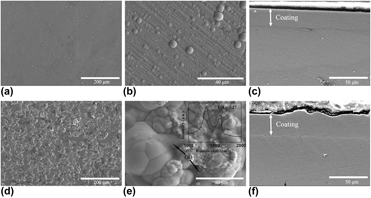
Scanning electron microscopic (SEM) images of the Co–Ni–P and Co–Ni–P/GO composite coatings surface are presented in Fig. 1. The Co–Ni–P coating shows a relative smooth surface of hemispheric structure with different diameter [Figs. 1(a) and 1(b)]. Cross-sectional view of the Co–Ni–P coating [Fig. 1(c)] shows a flat surface with a thickness about 20 μm. In contrast, the Co–Ni–P/GO composite coating surface displays a rough surface of nodule structure [Fig. 1(d)], which might result from the incorporation of GO sheets into Co–Ni–P matrix. Enlarged image of Fig. 1(e) reveals that the nodule structure is composed of smaller particles and GO sheets embedded in the Co–Ni–P matrix through the co-deposition process. The well-known carbon D band and G band observed in the Raman spectra [inset image in Fig. 1(e)] indicate that GO sheets are co-deposited in composite coatings. The higher I D/I G intensity ratio (1.27) in Raman spectra with respect to that of original GO sheets (0.95) suggests that GO sheets in the resulting composite coating have been reduced [Reference Zhang, Qin, Luo, Wu, Liu, Shen and Hu28]. Cross-sectional view of the Co–Ni–P/GO composite coating [Fig. 1(f)] shows an uneven surface, which is corresponding to the SEM image shown in Fig. 1(d).
Surface and cross-sectional morphologies of the (a–c) Co–Ni–P and (d–f) Co–Ni–P/GO composite coatings. The inset in Fig. 1(e) is the Raman spectroscopy obtained from the Co–Ni–P/GO composite coating.
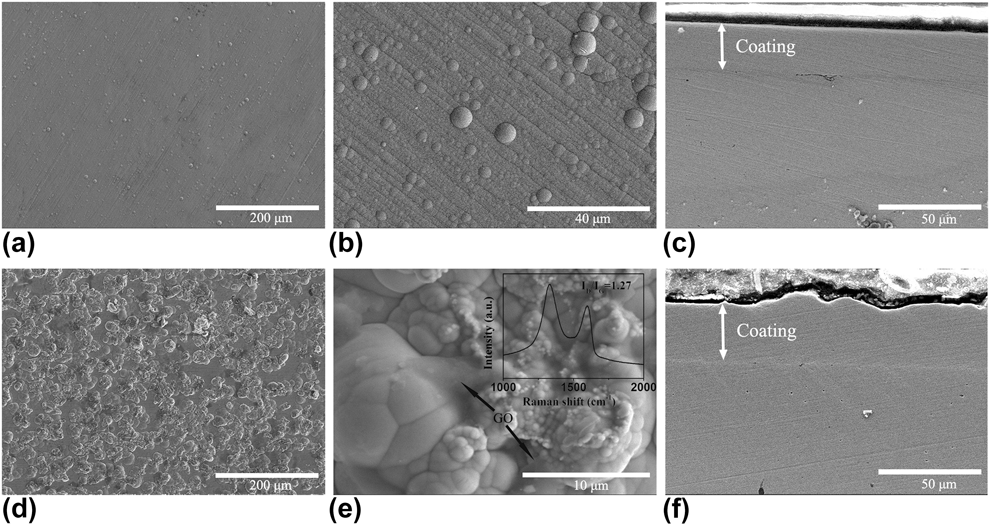
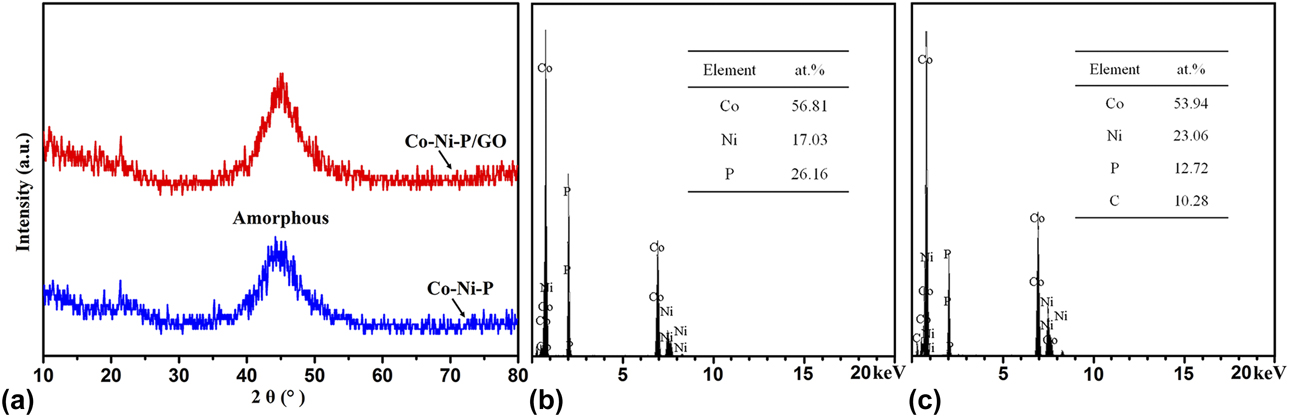
Figure 2(a) shows the X-ray diffraction (XRD) patterns of the Co–Ni–P and Co–Ni–P/GO composite coatings. Both the Co–Ni–P and Co–Ni–P/GO composite coatings display a typical amorphous structure, as the broad peak centered at approximately 45° is clearly seen in Fig. 2(a), which is because of the high phosphorus content of the as-plated coatings. The result of Energy-dispersive X-ray spectroscopy (EDS) analysis shows that the phosphorus content of the Co–Ni–P and Co–Ni–P/GO composite coatings is both higher than 12 at% [Figs. 2(b) and 2(c)]. Sankara Narayanan et al. [Reference Sankara Narayanan, Baskaran, Krishnaveni and Parthiban29] suggested that the presence of phosphorus prevented the nucleation of nickel/cobalt phase and resulted in an amorphous structure.
(a) XRD patterns of Co–Ni–P and composite coatings and EDX analysis of the (b) Co–Ni–P and (c) Co–Ni–P/GO composite coatings.
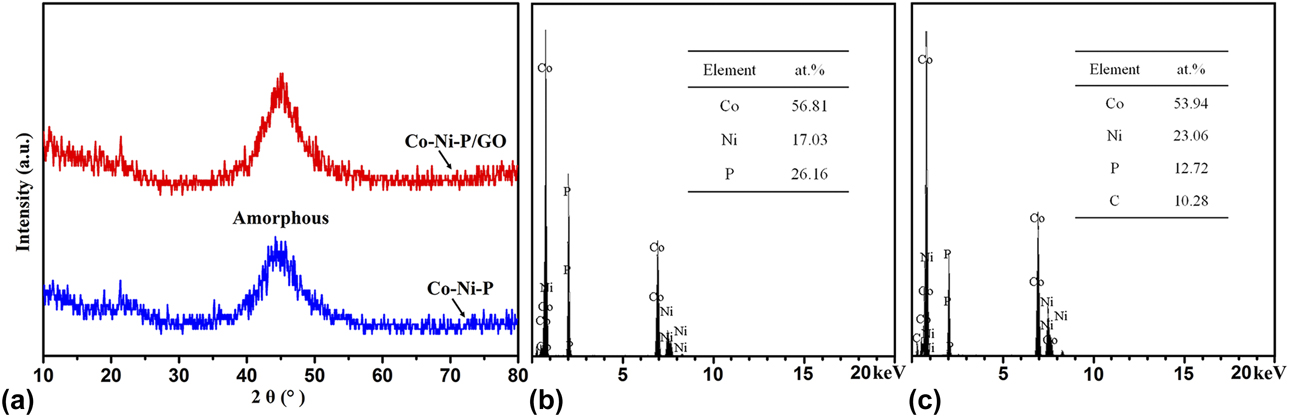
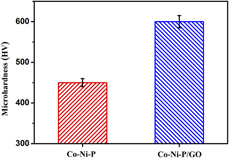
Figure 3 presents the comparison of microhardness of the Co–Ni–P and Co–Ni–P/GO composite coatings. The microhardness of Co–Ni–P/GO composite coatings is about 600 HV, which increases by 33% compared with the Co–Ni–P coatings (450 HV). Because no obvious change in diffraction peaks is observed in Fig. 2(a), it can be deduced that the incorporation of GO sheets into the Co–Ni–P matrix is the main reason for the microhardness enhancement.
Microhardness of the Co–Ni–P and Co–Ni–P/GO composite coatings.

Wear and corrosion properties
Figure 4(a) gives the typical COF curves of the Co–Ni–P and Co–Ni–P/GO composite coatings. Both the COF curves of the as-deposited coatings climb to a certain value beyond a short run-in period and keep at that value until the end of the sliding. In addition, the COF of the Co–Ni–P/GO composite coating is more stable than that of Co–Ni–P coating with the increasing sliding distance, which indicates that the co-deposition of GO sheets into the Co–Ni–P matrix favors the formation of steady contact interface during the sliding process. Figure 4(b) presents the average COF and wear rates of the Co–Ni–P and Co–Ni–P/GO composite coatings. The Co–Ni–P/GO composite coatings display an average COF of 0.29, which is smaller than that of 0.38 for the Co–Ni–P coatings. The COF of the Co–Ni–P and Co–Ni–P/GO composite coatings are both smaller than the range of 0.45–0.7 for the Ni–P coating. These results demonstrate that the alloying of Co and insertion of GO sheets into Ni–P matrix endow the resulting coatings with friction-reducing property. Figure 4(b) also shows that the Co–Ni–P/GO composite coatings have an average wear rate of about 5.29 × 10⁻⁶ mm3/(N m), which is much lower than that of 11.08 × 10⁻⁶ mm3/(N m) for the Co–Ni–P coatings, suggesting that the Co–Ni–P/GO composite coatings possess better tribological performance than the Co–Ni–P coatings.
(a) Typical friction coefficient curves and (b) average friction coefficient and wear rate of the Co–Ni–P and Co–Ni–P/GO composite coatings.

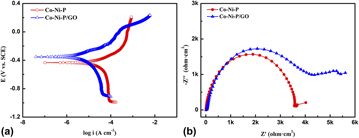
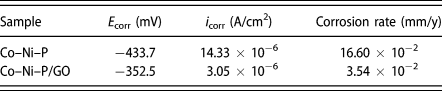
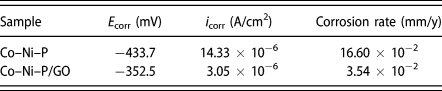
Figure 5(a) shows the potentiodynamic polarization curves of the Co–Ni–P and Co–Ni–P/GO composite coatings evaluated in 3.5 wt% NaCl solution. Corrosion potential (E corr), corrosion current density (i corr), and corrosion rate that obtained from the potentiodynamic polarization curves are given in Table I. Co–Ni–P coating show an E corr of −433.7 mV, and the Co–Ni–P/GO composite coating shifts to a more positive E corr of −352.5 mV than the Co–Ni–P coating. Moreover, Co–Ni–P/GO composite coating displays a low i corr value, which is about one fifth of the Co–Ni–P coating. Furthermore, the corrosion rate of the Co–Ni–P/GO composite coating is approximately 14% of the Co–Ni–P coating. These results reveal that the incorporation of GO sheets promotes the Co–Ni–P/GO composite coating with superior corrosion resistance than the Co–Ni–P coating according to its more positive E corr, lower i corr, and lower corrosion rate. Besides, the anticorrosion performance of the Co–Ni–P/GO composite coating is better than that of other reported GO-enhanced corrosion-resistant composite coating [Reference Jiang, Feng, Qian, Zhu, Han and Lin26] and the conventional electroplated hard Cr coating [Reference Qiao, Wu, Hong, Qin, Shi and Li30].
(a) Potentiodynamic polarization curves and (b) the Nyquist plots of the Co–Ni–P and Co–Ni–P/GO composite coatings measured in 3.5 wt% NaCl solution.

Corrosion potential (E corr), corrosion current density (i corr), and corrosion rate of Co–Ni–P and Co–Ni–P/GO composite coatings measured in 3.5 wt% NaCl solution.
The corrosion behavior of the Co–Ni–P and Co–Ni–P/GO composite coatings also measured by the powerful electrochemical technique, electrochemical impedance spectroscopy (EIS). Figure 5(b) shows the Nyquist plots of the coatings tested in 3.5 wt% NaCl solution. The diameter of the capacitive loop in the Nyquist plots reflects the polarization resistance of the coatings. As depicted in Fig. 5(b), the Co–Ni–P/GO composite coating has a larger diameter of the Nyquist loop than the Co–Ni–P coating. In other words, the Nyquist plot results further confirm that the Co–Ni–P/GO composite coating possesses better corrosion resistance immersed in 3.5 wt% NaCl solution than the Co–Ni–P coating.
Discussion
Hardness and wear mechanisms
As shown in Fig. 3, the Co–Ni–P/GO composite coatings display a higher microhardness of about 600 HV than the Co–Ni–P coatings (450 HV). The improved microhardness is mainly attributed to the introduction of GO sheets into the Co–Ni–P matrix. On the one hand, the co-deposition of GO sheets promotes the capacity of the composite coating to prevent local deformation. GO sheets act as the reinforcements, blocking the dislocation motion during deformation process. On the other hand, GO sheets with good mechanical property also lead to the microhardness enhancement for the composite coatings. Thus, the microhardness of the composite coatings is improved significantly.
Figure 4 shows that the Co–Ni–P/GO composite coatings exhibit lower average COF and wear rate than the Co–Ni–P coatings. The remarkable anti-wear and friction-reducing performances of the Co–Ni–P/GO composite coatings are mainly caused by the following reasons. The introduction and uniformly distribution of the self-lubricating materials of GO sheets in the composite coatings cause the reduction of COF. Moreover, the co-deposition of superior mechanical GO sheets endows the Co–Ni–P/GO composite coatings with higher microhardness (Fig. 3). In terms of the classical Archard’s law, the wear rate is inversely proportional to the microhardness, and thus, the Co–Ni–P/GO composite coatings obtain a lower wear rate.
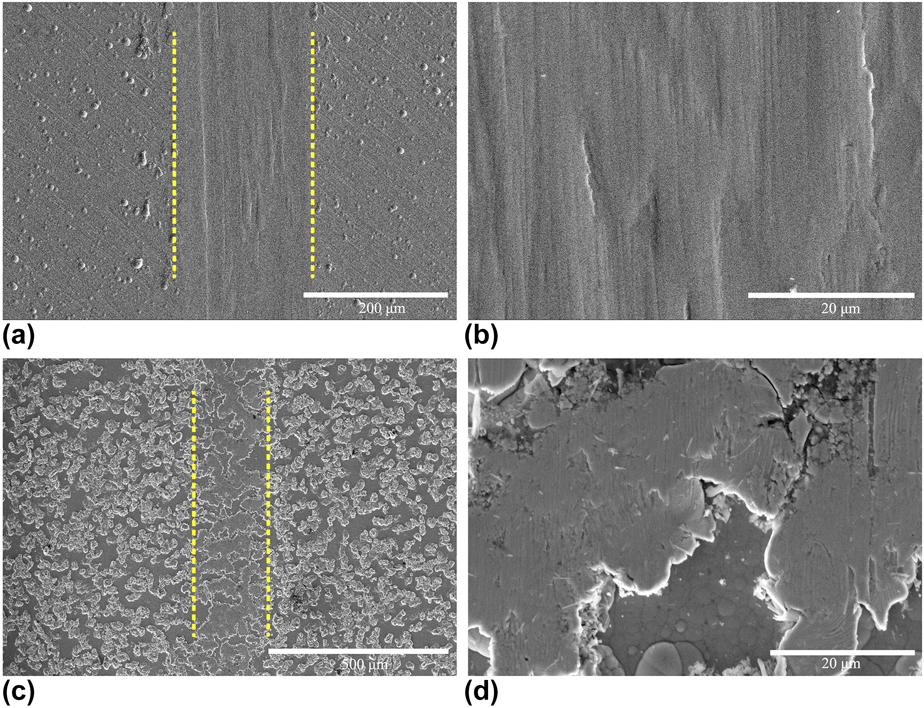
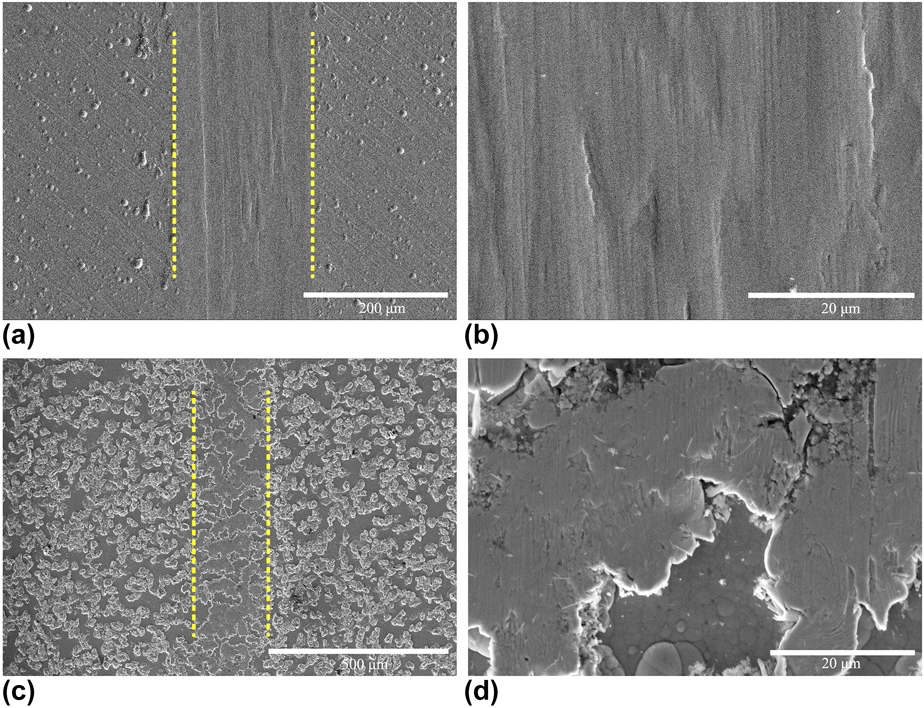
Worn surface morphologies of the Co–Ni–P and Co–Ni–P/GO composite coatings sliding against GCr15 steel ball are given in Fig. 6. It is clearly seen that there is a continuous wear scar on the worn surface of Co–Ni–P coating [Fig. 6(a)]. Besides, signs of adhesion, wear grooves along the sliding direction, and plastic deformation are also noted from its enlarged SEM image [Fig. 6(b)]. It can be concluded from these results that severe adhesive wear appeared during the sliding process, and the severe adhesive wear leads to the plastic deformation and then the wear loss of the Co–Ni–P coating is increased. Compared with Co–Ni–P coating, the Co–Ni–P/GO composite coating shows a discontinuous wear scar, only local surface has experienced the scuffing and wear [Fig. 6(c)]. The amplified SEM image [Fig. 6(d)] reveals that worn surface of the Co–Ni–P/GO composite coating is characterized by slight plastic deformation, and a few shallow scratches are seen on the wear track surface, which indicates that the wear mechanisms have changed from the severe adhesive wear for the Co–Ni–P coating to the abrasive wear and slight adhesive wear for the Co–Ni–P/GO composite coating.
SEM morphologies of wear scars of the (a, b) Co–Ni–P and (c, d) Co–Ni–P/GO composite coatings.
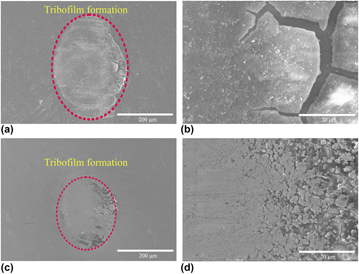
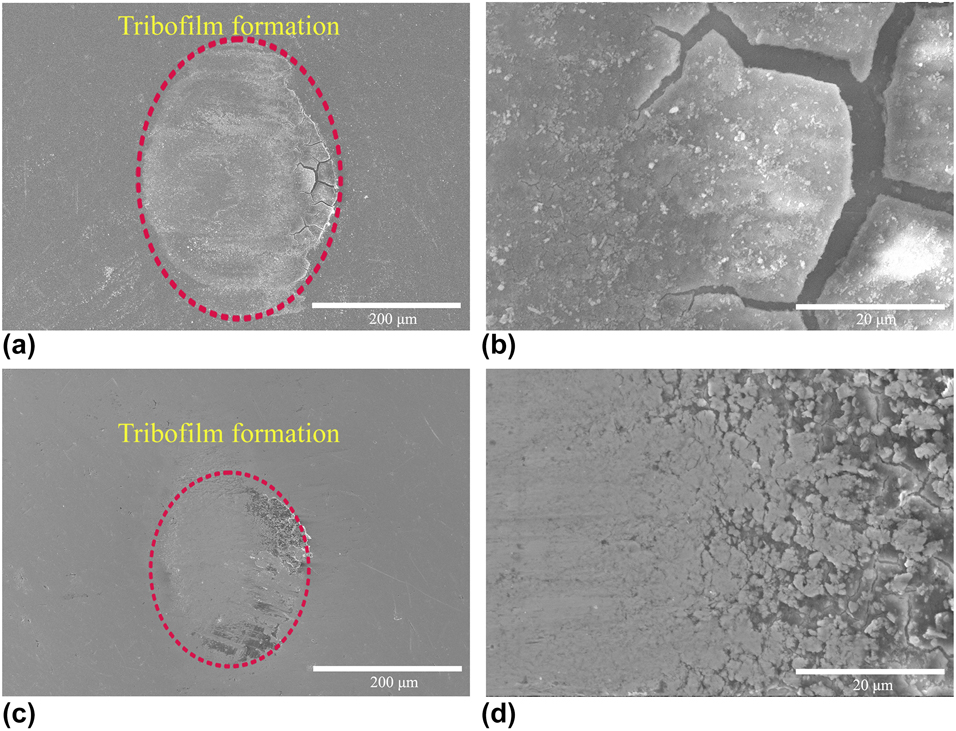
Worn surface morphologies of the counterpart balls sliding against the Co–Ni–P and Co–Ni–P/GO composite coatings are depicted in Fig. 7. Oval wear scar and accumulation of wear debris are clearly visible on the counterpart steel ball sliding against Co–Ni–P coating, as shown in Fig. 7(a). The result suggests that severe adhesion wear occurred on this counterpart ball. The enlarged image of Fig. 7(b) shows obvious sign of delamination and cracks on the worn surface of this counterpart ball, which is because of the low microhardness of the Co–Ni–P coating. The high friction stress can give rise to delamination of this coating and make it easier transfer to the counterpart steel ball. In contrast, Fig. 7(c) shows that the counterpart ball sliding against Co–Ni–P/GO composite coating displays an oval wear scar with smaller size and less accumulated wear debris on its surface than that counterpart ball of Co–Ni–P coating. However, delamination and small cracks are also observed on the magnified SEM image of the counterpart ball [Fig. 7(d)], which is because of the higher microhardness of the GCr15 (700 HV) than that of the Co–Ni–P/GO composite coatings (600 HV).
SEM morphologies of counterpart balls after sliding test against the (a, b) Co–Ni–P and (c, d) Co–Ni–P/GO composite coatings.
Electrochemical behavior
As depicted in Fig. 5, the Co–Ni–P/GO composite coating possesses better corrosion resistance immersed in 3.5 wt% NaCl solution than the Co–Ni–P coating. The incorporation of GO sheets is mainly responsible for the superior corrosion behavior of the Co–Ni–P/GO composite coating. For the Co–Ni alloy coating, when the coating is in contact with the corrosive medium (3.5 wt% NaCl), as a kind of strong adsorption anion, Cl− tends to preferentially absorb on the defect of the coating. Soluble CoCl2 and NiCl2 are formed after the reaction of Cl− with the Co2+ or Ni2+. Then, the coating is corroded and more defects will appear on the corroded coating with the dissolution of CoCl2 and NiCl2. The occurrence of more defects and dissolution of coating promote each other and speed up the infiltration of corrosive medium and the corrosion of the coating. For the Co–Ni–P/GO composite coating, the voids and cracks of the resulting composite coating are filled by the embedded and uniform distributed GO sheets, which efficiently reduce the defects, the adsorption of corrosive anion (Cl−), and the corrosion of the composite coating [Reference Aal, El-Sheikh and Ahmed31]. Besides, the corrosion channel is severely distorted by the embedded GO sheets in the Co–Ni–P matrix, the corrosive medium is obstructed from penetrating into the interface of coating and substrate, which makes stronger resistance to corrosion [Reference Qu, Zhu and Chan32]. For the above reasons, the Co–Ni–P/GO composite coating shows a lower i corr and corrosion rate and higher impedance value, i.e., superior anticorrosion capacity in the 3.5 wt% NaCl corrosive medium.
Conclusions
Co–Ni–P/GO composite coating was successfully fabricated by a pulse electrodeposition method. The co-deposition of GO sheets in the composite coatings is confirmed by SEM and Raman spectrum analysis. Morphologies, microhardness, and tribological and electrochemical performances of the Co–Ni–P/GO composite coatings are significantly affected by the embedded GO sheets. The Co–Ni–P/GO composite coating displays a rougher morphology, higher microhardness accompanied with more stability, and lower average COF during the sliding test against GCr15 steel balls, as well as lower corrosion rate in the electrochemical corrosion test carried out in 3.5 wt% NaCl solution. The improvement in friction reduction and anti-wear properties is attributed to embedded GO sheets, increasing the microhardness and the self-lubricating performances of the Co–Ni–P/GO composite coating. Besides, the embedded GO sheets in the Co–Ni–P matrix can also serve as a suitable barrier and makes the permeation path more complex, prohibiting the corrosive medium from reaching the interface of coating and substrate, resulting in the superior corrosion resistance of the composite coating.
Experimental
Preparation of Co–Ni–P/GO composite coatings
An Intelligent Multiwave Electroplating Equipment (SMD-30P; Dashun Electroplating Equipment, Handan, China) was used for the power supply. The coatings were cathodically deposited on the 45 steel using a pulse current electrodeposition process. The bath compositions and electrodeposition parameters are given in Table II. The GO sheets were synthesized according to our previous reports. The number of GO layer was less than 10 layers, which was well characterized by transmission electron microscope and atomic force microscope in our previous works [Reference Mai, Tu, Gu and Wang33, Reference Mai, Wang, Xiang, Qiao, Zhang, Gu and Tu34]. The back of the substrate was covered by insulating tapes with an area of 5 cm2 exposed in the electrolyte. Before the plating process, the surface of the 45 steel plates are mechanically polished with silicon carbide paper from 600 to 1500 P and then sequentially sonicated in acetone to remove oil contamination. After deposition, the specimens were taken out from the electrolyte, then rinsed with de-ionized water and dried immediately.
Bath compositions and the operational parameters for Co–Ni–P/GO composite coating electrodeposition.

Characterizations of the Co–Ni–P/GO coatings
Morphologies of the deposits were observed using SEM (SU8010, Hitachi, Tokyo, Japan). The element compositions were analyzed by EDS microanalyzer attached to the SEM and Raman microscope (Raman, LabRAM HR800, Horiba, Japan). The crystal structures of the coatings were characterized by XRD. The microhardness was measured with an Akashi MVK-H3 Vickers hardness tester, with a load of 25 g applied for 10 s. The average value from eight replicates for each kind of specimen was reported.
The friction and wear behaviors of the deposits were evaluated with a ball-on-disk tribometer (WTM-2E; Zhongke Kaihua Technology Development, Lanzhou, China). The tests were performed in air at room temperature and ambient humidity. GCr15 steel ball with diameter of 6.0 mm was used as the counterpart. The applied load is 2.0 N under the sliding speed of 200 rpm with a rotating radius of 4 mm. The duration of wear tests was 15 min. After the wear tests, the wear tracks were measured using a 3D laser measuring microscope (OLS4000; Olympus, Tokyo, Japan) to achieve the wear volume. The wear rates of all the films were calculated from K = V/S·F, where V is the wear volume (mm3); S, the total sliding distance (m); and F, the normal load (N). Three replicate friction and wear tests were carried out for each specimen and the average value was reported with their errors. After sliding, the worn surfaces of the films and their corresponding counterpart balls were analyzed using the SEM.
A traditional three-electrode cell was established using the as-fabricated coatings as the working electrode, and a platinum plate and saturated calomel electrode as the counter and reference electrodes, respectively. Measurements were performed by an electrochemical workstation (CHI660E; Chenhua Instrument, Shanghai, China) at room temperature with 3.5 wt% NaCl solution as corrosive medium. Before electrochemical tests, the samples were embedded in epoxy resin with an area of 1 cm2 exposed to the corrosive medium. To obtain a stabilized system, all samples were immersed for 30 min before the potentiodynamic polarization and EIS tests. The potentiodynamic polarization curves were measured at a sweep rate of 1 mV/s from −300 to 300 mV versus the open circuit potential. EIS tests were studied in the frequency range from 105 to 10−2 Hz utilizing a sinusoidal signal with 5 mV amplitude.
Acknowledgments
The authors are grateful to the financial support of the National Natural Science Foundation of China (51805089).