Alcohol use disorders (AUDs) are strongly familial (Cotton, Reference Cotton1979). A recent meta-analysis of twin studies of AUD (Verhulst, Neale, & Kendler, Reference Verhulst, Neale and Kendler2015) estimated the heritability at 51% demonstrating unequivocally the importance of genetic factors on the familial transmission of AUD. However, this same analysis also found that 10% of the variance in risk to AUD resulted from shared familial-environmental effects indicating that genes cannot explain all of the aggregation of AUD within families.
However, twin studies examine only individuals within the same generation and cannot provide information on environmental contributions to parent–offspring transmission. Here the most common method used in psychiatric genetics has been the adoption study. Despite the substantial number of adoption studies of AUD, the evidence for environmental transmission of AUD was until recently unclear. The resemblance of AUD in adoptive parents and adoptees had either not been examined in prior adoption studies (Goodwin, Schulsinger, Knop, Mednick, & Guze, Reference Goodwin, Schulsinger, Knop, Mednick and Guze1977), was entirely negative (Cadoret & Gath, Reference Cadoret and Gath1978; Cutrona et al., Reference Cutrona, Cadoret, Suhr, Richards, Troughton, Schutte and Woodworth1994) or varied as a function of environmental exposures, AUD subtype or sex (Bohman, Sigvardsson, & Cloninger, Reference Bohman, Sigvardsson and Cloninger1981; Cadoret, O'Gorman, Troughton, & Heywood, Reference Cadoret, O'Gorman, Troughton and Heywood1985; Cadoret, Troughton, & O'Gorman, Reference Cadoret, Troughton and O'Gorman1987; Cloninger, Bohman, & Sigvardsson, Reference Cloninger, Bohman and Sigvardsson1981). In the meta-analysis, the data available in adoption studies on parent–offspring environmental transmission was too heterogeneous to examine (Verhulst et al., Reference Verhulst, Neale and Kendler2015).
We recently published the largest adoption study of AUD to date using Swedish national registers (Kendler et al., Reference Kendler, Ji, Edwards, Ohlsson, Sundquist and Sundquist2015a), finding robust evidence for parent–offspring environmental transmission of AUD. Indeed, the strength of the prediction of AUD in the adoptee was nearly the same for AUD in an adoptive (OR 1.40) and a biological parent (OR 1.46).
In this report, we seek to replicate and extend these findings by using a different and particularly informative genetic-epidemiological design: a home-reared v. adopted-away high-risk co-sibling control study. Two design features make this a particularly strong method to examine the rearing effects. First, the sibling pairs are matched in family background thereby permitting us to isolate the impact of their distinct rearing environments. Second, their rearing exposures are, on average, substantially different. Adoptive parents in Sweden are carefully selected on a range of traits including low levels of psychiatric and substance use disorders, high educational status, economic security and the ability to provide to offspring a high-quality, stable rearing environment (Bohman, Reference Bohman1970; Kendler et al., Reference Kendler, Sundquist, Ohlsson, Palmer, Maes, Winkleby and Sundquist2012). Because the number of children available for adoption has been considerably smaller than the demand, the selection process is rigorous. Bohman notes that this process in Sweden was designed to ‘assess the general health, personality, and mutual relationship of the presumptive adoptive parents’ with the goal of forecasting ‘the durability of their marriage… [and] place the child in an harmonious, stable environment …’ (Bohman, Reference Bohman1970, p. 87). Furthermore, compared to adoptive parents in Sweden, biological parents of adoptees are, on average, at a much higher risk for a wide range of psychopathology, are much younger, less well educated and have substantially higher divorce rates (Kendler et al., Reference Kendler, Sundquist, Ohlsson, Palmer, Maes, Winkleby and Sundquist2012).
In addition to the primary comparison of risk between the home-reared and adopted-away sibling, this design permits us to address two important further questions. First, the high-risk siblings have variable familial risks for AUD and associated externalizing traits. This permits us to examine whether the impact of the rearing differences in the biological and adoptive families on the risk for AUD is stronger in siblings at especially high familial risk. Second, if, as we suspect, the reduced risk for AUD in the siblings reared in the adoptive home results from the high quality of that rearing environment, then would that affect attenuate if the adoptive home contains a parent affected with an externalizing syndrome or the homelife is disrupted during the rearing of the adoptee through parental divorce or death?
Methods
We used linked data from multiple Swedish nationwide registries and healthcare data, described elsewhere, with linking achieved via the unique individual Swedish 10-digit personal ID number assigned at birth or immigration to all Swedish residents. In particular, we utilized the Swedish multigenerational register to link index individuals (all individuals born 1932 and onwards and residing in Sweden at some time since 1961) and their biological and possible adoptive parents. This ID number was replaced by a serial number in order to preserve confidentiality. We secured ethical approval for this study from the Regional Ethical Review Board of Lund University (No. 2008/409).
Our database was created by entering all full- and half-sibling sets where at least one sibling in the set was adopted-away (adopted) and at least one sibling was raised by the common biological parent(s) (home-reared). For full-siblings, we required that at least one of their biological parents be high-risk which we defined as being registered (anytime from age 15 until 31 December 2015) with Drug Abuse (DA), Alcohol Use Disorder (AUD) and/or Criminal Behavior (CB) in the Swedish registers.
DA was identified in the Swedish medical registries by ICD codes [ICD8: Drug dependence (304); ICD9: Drug psychoses (292) and Drug dependence (304); ICD10: Mental and behavioral disorders due to psychoactive substance use (F10–F19), except those due to alcohol (F10) or tobacco (F17)]; in the Suspicion Register by codes 3070, 5010, 5011, and 5012 that reflect crimes related to DA; and in the Crime Register by references to laws covering narcotics (law 1968:64, paragraph 1, point 6) and drug-related driving offences (law 1951:649, paragraph 4, subsection 2 and paragraph 4A, subsection 2). DA was identified in individuals (excluding those suffering from cancer) in the Prescribed Drug Register who had retrieved (on average) more than four defined daily doses for 12 months from either of Hypnotics and Sedatives [Anatomical Therapeutic Chemical (ATC) Classification System N05C and N05BA] or Opioids (ATC: N02A). DA was treated as a dichotomous variable (any registration v. no registration) with an assumed underlying normal liability distribution.
AUD was identified in the Swedish medical and mortality registries by ICD codes: ICD9: V79B, 305A, 357F, 571A-D, 425F, 535D, 291, 303, 980; ICD 10: E244, G312, G621, G721, I426, K292, K70, K852, K860, O354, T51, F10; in the Crime Register by codes 3005, 3201, which reflect crimes related to alcohol abuse; in the Suspicion Register by codes 0004, 0005 (only those individuals with at least two alcohol-related crimes or suspicion of crimes from the Crime Register and Suspicion Register were included); in the Prescribed Drug Register by the drugs disulfiram (ATC Classification System N07BB01), acamprosate (N07BB03), and naltrexone (N07BB04). AUD was treated as a dichotomous variable (any registration v. no registration) with an assumed underlying normal liability distribution. Criminal behavior (CB) was identified by registration in the Swedish Crime (or conviction) register which excluded convictions for minor crimes like traffic infractions.
For half-siblings, we required that the common biological parent was registered with at least one of three high-risk disorders/behavior: AUD, DA, or CB. Furthermore, we required that: (1) all siblings were born between 1955 and 2000; (2) the adoptee was living with the adoptive parents by 5 years of age; (3) the reared at home were living in the same household as the biological parent for at least 10 out of the first 15 years of his/her life. Siblings adopted by biological relatives or by an adoptive parent living with a biological parent were not included as adoptees in the analysis. Age at formal adoption was not available in National records until 1991. We therefore estimated age at first cohabitation with adoptive parents (AFACP) from census data, including individual addresses, available every fifth year. The AFACP represents an upper limit of true age at adoption.
The overall sample for full-siblings consisted of 2597 families with at least one child adopted-away and one child raised by biological parents. Among those, 1316 (50.7%) were classified as high-risk families which contained 1316 adopted individuals who had 2504 full-siblings that were raised by their biological parents. The sample for half-siblings consisted of 14 288 parents with at least one child adopted-away and one child raised by the biological parent. Among those, 4623 (32.3%) were classified as high-risk parents. These high-risk families included 4623 adopted individuals who had 10 909 half-siblings that were raised by the biological parent. A total of 600 adoptees were included both in the full-sibling and half-sibling analyses.
Among all the families who adopted-away a child in Sweden over out time period of interest, the features which predicted that they also home-reared at least one of their children were older age of mother at the birth of the adopted child, higher share of high-risk parents, and lower educational status but no difference in the sex of the adopted-away child.
AUD in offspring was investigated in relation to the main predictor variable, adopted v. reared, by stratified Cox proportional hazards models with a separate stratum for each sibling set. Follow-up time in the number of months was measured from age 15 of the child until the time of first registration for AUD, death, emigration, or end of follow-up (31 December 2015), whichever came first. The key predictor variable in the models was adopted v. reared by biological parent(s). In the analysis, the resulting hazard ratio (HR) would reflect the relative difference in hazard for AUD when being adopted-away compared to residing with the biological parent(s). In the models, we controlled for parental age at birth, sex of the sibling, and in the half-sibling analyses also high-risk behavior in the non-shared parent.
In additional analyses, we investigated four aspects of the biological parents and their home environment; 2 v. 1 high-risk parent, at least one grandparent defined as high-risk grandparent v. no high-risk grandparents, AUD v. CB/DA in high-risk parent, young age at registration for high-risk behavior in the biological parent. We also examined three features of the adoptive environment: at least one high-risk adoptive parent, disruption in the adoptive family (divorce or death among adoptive parents), educational status (this variable was divided into four groups based on the relative mean educational status of the adoptive and biological parents). These analyses were done by including a two-way interaction term between the variable adopted v. reared and the variable of interest to the model, in which we also accounted for parental age at birth, sex of sibling, and (for half-siblings) high-risk behavior in the other parent. The homogeneity of the interactions in the full- and half-sibling families was tested by the relevant three-way interaction. All statistical analyses were performed using SAS 9.4 (SAS Institute, 2012).
Results
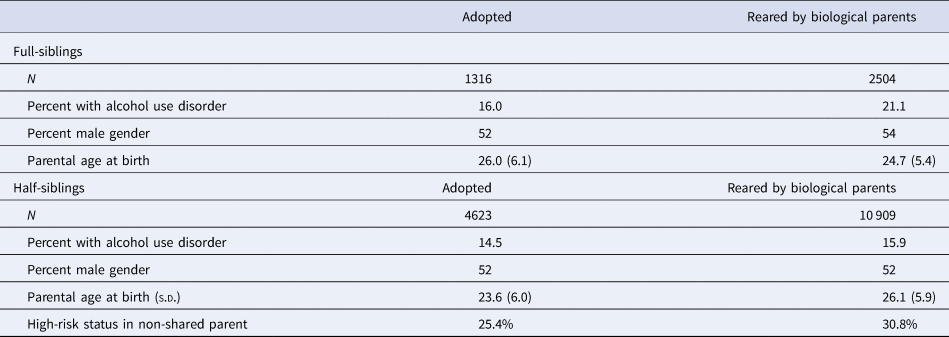
Characteristics of the full- and half-sibling samples are seen in Table 1.
Descriptive results of our informative high-risk full- and half-sibling pairs

Full-siblings
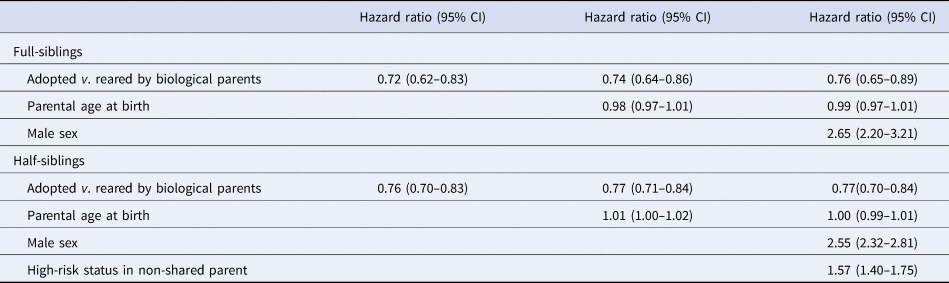
We identified 1316 full-sibships containing at least one sibling home-reared by his or her biological parents and one reared by adoptive parents. The ages of the biological parents at the birth of their home-reared offspring were slightly younger than those of their adopted-away children. The raw rates for AUD were moderately higher (21.1%) in the home-reared v. the adopted siblings (16.0%), although the rates for both groups of siblings were substantially elevated over those seen in the general population (5.5%). In these pairs, the raw HR [and 95% confidence intervals (CI)] for AUD for being raised in an adoptive home v. by their biological parents was 0.72 (0.62–0.83) which changed a little after controlling for parental age at birth and sex: 0.76 (0.65–0.89).
Half-siblings
We sought to replicate our findings in full-siblings with an independent sample of 4623 half-sibships containing at least one sibling home-reared by biological parents and one adopted-away. Of these half-sibling pairs, 58.1% shared a common father and 41.9% a common mother. Opposite to that seen in the full-siblings, the shared biological parent was somewhat older at the birth of the home-reared v. the adopted-away half-siblings [23.6 (s.d.:6.0) v. 26.1 (s.d.:5.9)]. History of AUD in the non-shared parent was slightly more common in the home-reared than in the adopted-way half-siblings. Both of these variables, therefore, were controlled for in our final analysis.
The raw rate of AUD was modestly higher in the home-reared than adopted-away half-siblings. As seen in Table 2, the raw HR for AUD for being an adopted v. home-reared half-sibling was 0.76 (0.70–0.83) which did appreciably change after controlling for parental age at birth, gender, and high-risk status of the non-shared parent. These results were nearly identical to that observed in the full-siblings (but more precisely known because of the larger sample): 0.77 (0.70–0.84).
Hazard ratios and 95% confidence intervals for alcohol use disorder registration in high-risk individuals as a function of being adopted-away or reared by biological parents

Effects of aspects of the biological parents and their home environment
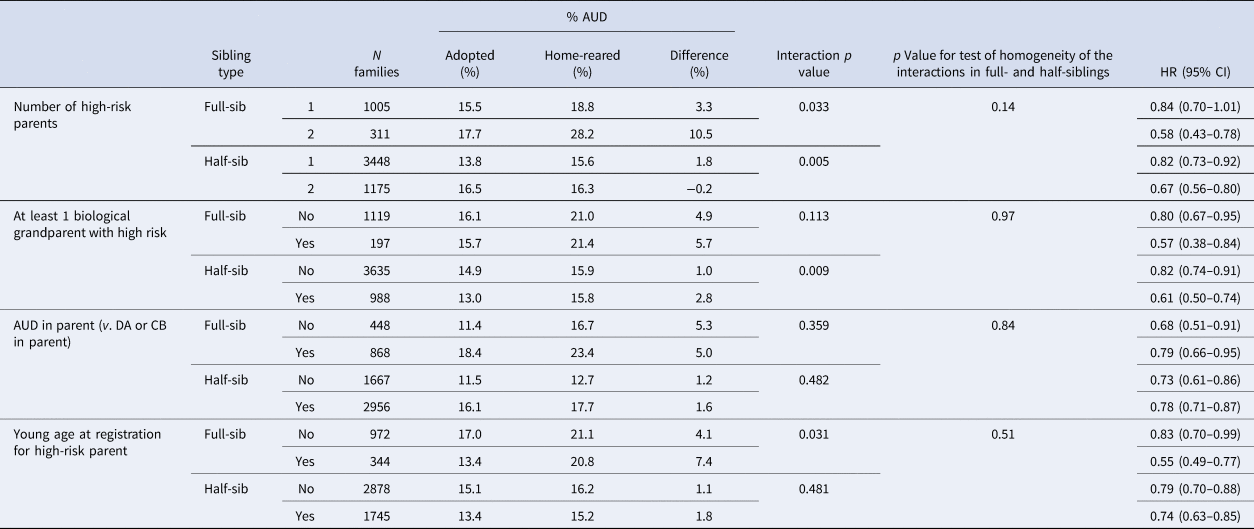
To further understand the sources of differences in the risk for AUD in the adopted and home-reared siblings, we examined four aspects of the biological parents and their home environment. First, as seen in Table 3, in both full- and half-siblings, the difference in the rates of AUD in the siblings who were adopted-away v. home-reared was greater when both v. only one of the biological parents was high-risk. In both sibling groups, the two HRs (1 v. 2 high-risk biological parents) were significantly different from each other.
Features of the biological parents that might moderate the impact in high-risk full- and half-sibling pairs raised in an adoptive family v. home-reared

Second, in both sibling groups, the protective effect of being reared in the adoptive v. home environment was greater when at least one biological grandparent was high-risk. The results were very similar in the full- and half-sibling pairs, but the two HRs were significantly different only in the half-siblings.
Third, as noted above, we defined high-risk parents as having AUD, CB, or drug abuse. We therefore examined whether there were any differences in the patterns of findings when the biological high-risk parent had AUD v. CB or drug abuse. No differences in the patterns were seen.
Fourth, because early age at the registration of AUD conveys increased risk for AUD in the offspring in Sweden (Kendler, Ohlsson, Edwards, Sundquist, & Sundquist, Reference Kendler, Ohlsson, Edwards, Sundquist and Sundquist2017), we examined the differences in the risk for siblings by rearing status when the high-risk parents had an early or late onset of their externalizing syndrome. In full-siblings, the protective effect of the adoptive rearing environment was significantly stronger when the biological high-risk parent had an early v. late onset. A similar trend was seen in half-siblings, but it was much more modest and did not approach statistical significance.
Effects of aspects of the adoptive environment
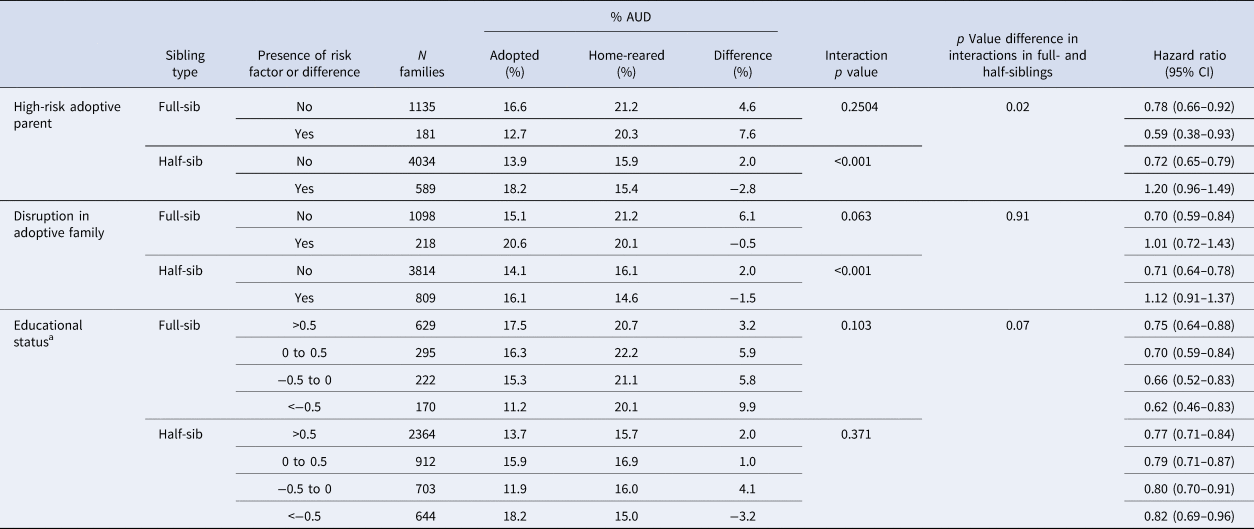
We examined three features of the adoptive environment. First, 14% of the adoptive parents of adopted full- or half-siblings had an externalizing syndrome. Compared to the risk for AUD in their home-reared sibs, the risk for AUD was significantly lower in the adopted-away half-siblings raised by unaffected parents but did not differ when one of their adoptive parents had an externalizing syndrome. Indeed, the two HRs (when the adoptive parents did v. did not have a syndrome) were significantly different. However, in the full-siblings, no such trend was seen, and the two HRs were not close to significantly different.
Second, in 17% of the adoptive homes of the adopted full- and half-siblings, a disruption in the family due to parental death or divorce occurred prior to the adoptee reaching age 15. In both full- and half-sibling pairs, compared to the risk in the home-reared sib, the risk for AUD was significantly lower in the adopted-away member raised in adoptive homes without family disruption. However, in both sibling groups, no difference in risk was seen in the home-reared and adopted-away sibs if there was a disruption in the adoptive home. These effects were nearly identical in the full- and half-siblings but largely because of differences in sample size, the two HRs were significantly different in the half-siblings and only at a trend level in the full-siblings.
Third, we divided the biological and adoptive families of our full- and half-siblings into four groups on the basis of the differences between them in mean standardized parental educational status (see footnote to Table 4 for details). We then examined whether differences in the risk for AUD in the full- and half-sibling pairs differed in these four subgroups of families. No significant effects were seen in either of sibling groups.
Features of the adoptive environment that might moderate the impact in high-risk full- and half-siblings of being raised in an adoptive family v. home-reared

a Here we depict the difference in mean standardized educational status for the adoptive family v. the biological family: >0.5: adoptive parents have more than 0.5 s.d. higher educational status than biological parents; 0 to 0.5: adoptive parents have 0 to 0–0.5 s.d. higher educational status than biological parents; −0.5 to 0: biological parents have 0 to 0–0.5 s.d. higher educational status than adoptive parents;<−0.5: biological parents have more than 0.5 s.d. higher educational status than adoptive parents.
To determine if the presence or absence of moderation effects for the biological and adoptive parents (tested by the interactions seen in Tables 3 and 4) differed in full- and half-siblings, we explored the homogeneity of these interaction terms by examining the relevant three-way interactions. As seen in these tables, of the seven three-way interactions examined, only one was itself significant, a result consistent with chance effects. These findings suggest that our tests for moderation effects were consistent across our two sibling groups.
Discussion
Early adoption studies of AUD produced no consistent evidence of environmental transmission of AUD from adoptive parents to their adoptive offspring (Bohman et al., Reference Bohman, Sigvardsson and Cloninger1981; Cadoret et al., Reference Cadoret, O'Gorman, Troughton and Heywood1985, Reference Cadoret, Troughton and O'Gorman1987; Cadoret & Gath, Reference Cadoret and Gath1978; Cloninger et al., Reference Cloninger, Bohman and Sigvardsson1981; Cutrona et al., Reference Cutrona, Cadoret, Suhr, Richards, Troughton, Schutte and Woodworth1994; Goodwin et al., Reference Goodwin, Schulsinger, Knop, Mednick and Guze1977). Using a substantially larger sample than prior investigations, we previously found clear evidence from a Swedish national adoptive cohort study that rearing environment contributes substantially to the transmission of AUD across generations (Kendler et al., Reference Kendler, Ji, Edwards, Ohlsson, Sundquist and Sundquist2015a). This study sought to replicate and extend those results using an informative sample of high-risk sibships in which some members were raised by their biological parents and others were adopted-away. By comparing the results within these sibships, we were able to control for a range of potential background confounding factors thereby permitting us to isolate the rearing effects. Furthermore, extensive evidence showed that the rearing environment provided by the adoptive family was likely to be of higher quality than that provided by the biological parents.
Our results were clear cut. Controlling for parental age and sex of the sibling, in our matched full-sibling pairs, those raised in an adoptive home had a significant 24% reduction in their risk for developing AUD. In an independent and much larger sample of half-sibling pairs, controlling also now for a history of externalizing behaviors in the non-shared parent, the parallel figure was a 23% reduction. That is, we replicated our primary analyses supporting the importance of the rearing environment for AUD risk.
Follow-up analyses permitted us to extend our findings in two important ways. First, the protective effects of the high-quality rearing environment on AUD risk provided by adoptive parents were stronger in sibships at especially high v. only modest familial risk. Interventions aimed at improving the quality of rearing would likely have their highest impact if targeted at families at especially high risk for AUD and associated externalizing outcomes. Second, we were able to replicate our main results showing different outcomes of matched siblings raised by biological and adoptive parents by comparing different adoptive homes. We found that adoptive families that contained a parent with an externalizing syndrome or that experienced parental disruption when raising the children eliminated the differences in risk between the home and adoptive reared siblings. These findings directly replicate the results of our prior classical adoption study (Kendler et al., Reference Kendler, Ji, Edwards, Ohlsson, Sundquist and Sundquist2015a) in which AUD risk in the adoptee was significantly predicted both by adoptive parental externalizing syndromes (AUD and CB) but also via disruption in the parent–child bond through parental death or divorce during the rearing of the adoptee.
Many aspects of parental and family dysfunction assessed in intact families correlate with the risk for offspring AUD and other externalizing behaviors including low socio-economic status, young parental age, parental divorce or death, parental history of substance misuse, CB and/or psychopathology, and disrupted family functioning (e.g. Farrington, Reference Farrington2005; Hawkins, Catalano, & Miller, Reference Hawkins, Catalano and Miller1992; Kendler, Ohlsson, Edwards, Sundquist, & Sundquist, Reference Kendler, Ohlsson, Edwards, Sundquist and Sundquist2016; Sher, Grekin, & Williams, Reference Sher, Grekin and Williams2005). Given the strong evidence for genetic effects on AUD (Verhulst et al., Reference Verhulst, Neale and Kendler2015) and other externalizing syndromes (Kendler, Maes, Sundquist, Ohlsson, & Sundquist, Reference Kendler, Maes, Sundquist, Ohlsson and Sundquist2013; Rhee & Waldman, Reference Rhee and Waldman2002; Tsuang et al., Reference Tsuang, Lyons, Eisen, Goldberg, True, Meyer and Eaves1996), the study of intact families cannot elucidate whether these measures of parental and family functioning are causally related to disorder risk in the children. It remains possible that the family disruption is a result of the genetic liability of parents which in turn is transmitted to their children. In this plausible scenario, there are no causal pathways that connect the family discord and offspring risk.
Given the practical difficulty and ethical problems of submitting any such effects to randomized controlled trials, it is only via natural experiments that we can clarify the mechanisms of familial transmission of AUD. Because we can never have the level of confidence in the findings of these natural experiments that we can with randomized trials, it is particularly important to apply multiple methods with different kinds of potential biases, an approach often called ‘triangulation’ (Munafo & Davey-Smith, Reference Munafo and Davey-Smith2018). In addition to the evidence, we presented here of parental–offspring environmental transmission of risk for AUD from standard adoption studies and our co-sibling control design, we have also shown a similar effect from step parents (Kendler et al., Reference Kendler, Ji, Edwards, Ohlsson, Sundquist and Sundquist2015a) and using a twin-family design (Kendler et al., Reference Kendler, Neale, Prescott, Kessler, Heath, Corey and Eaves1996).
Limitations
Our findings should be interpreted in the context of six methodological concerns. First, we detected subjects with AUD from medical, legal, and pharmacy records. This method does not require accurate respondent recall and reporting, and its validity is supported by the very high ORs [mean of 32.7 (Kendler et al., Reference Kendler, Ji, Edwards, Ohlsson, Sundquist and Sundquist2015a)] for the registration of DA across our different sources. However, compared to what might be found at the personal interview, this method surely produces both false-positive and false-negative diagnoses. While we cannot precisely estimate these biases as no large epidemiological study of AUD has been done in Sweden, such a survey was conducted in neighboring Norway and suggests that our under-ascertainment of AUD is of modest to moderate magnitude (Kringlen, Torgersen, & Cramer, Reference Kringlen, Torgersen and Cramer2001). It is probably that our sample of subjects was on average more severely affected than subjects identified with AUD from population-based interview surveys.
Second, bias can also arise in the adopted-away siblings from extensive contact between the adoptee and biological parents prior to adoption. We know that during the years of our study, adoptees were typically removed shortly after birth from the biological mother and placed in a special nursery home (Bjorklund, Lindahl, & Plug, Reference Bjorklund, Lindahl and Plug2006; Bohman, Reference Bohman1970). We previously assessed the possible impact of such a bias in our adoptive samples and found little evidence for concern. For example, if sustained contact with biological parents occurred and increased the risk for DA in the adoptee, then age at documented placement with the adoptive family AFCAP should be significant and positively associated with DA. Instead, the correlation was negative (Kendler et al., Reference Kendler, Sundquist, Ohlsson, Palmer, Maes, Winkleby and Sundquist2012). We confirmed that this was the case with AUD by conducting a logistic regression with AUD in the adoptee as an outcome and the number of years that the adoptee resided with the biological parent (ranging from 0 to 5). The resulting odds ratio equaled 1.01 (95% CI 0.94–1.08), far short of significance.
Third, given the evidence in Sweden that low parental education increases the risk for AUD (Kendler et al., Reference Kendler, Ohlsson, Edwards, Sundquist and Sundquist2016), and the evidence of higher educational status of our adoptive v. biological parents, perhaps our findings could result entirely from such effects. However, we specifically examined whether the educational differences in the biological v. adoptive families were predictive of the differences in risk in siblings raised in the two kinds of homes. They were not. Of note, we know these effects can be potent as they predict IQ differences between the home-reared and adoptive siblings in this sample (Kendler, Turkheimer, Ohlsson, Sundquist, & Sundquist, Reference Kendler, Turkheimer, Ohlsson, Sundquist and Sundquist2015b). Fourth, 600 adoptees were included in both the full- and half-sibling analyses so that the samples were not entirely independent. We re-ran the half-sibling analyses eliminating these overlapping individuals and found that the HR for adoptive v. home rearing with all the covariates was nearly identical to the obtained in our original analyses: 0.76 (0.69–0.83).
Fifth, our primary analyses did not differentiate whether the high-risk parent was the mother or father. Excluding the families where both parents were high-risk (n = 311 for full-sibs and 1175 for half-sibs), we examined whether the effect of adoptive v. home rearing significantly differed in the families where the mother only v. father only were high risk. They did not differ significantly.
Conclusions
Using Swedish registry data, we attempted to replicate and extend prior evidence that rearing environment meaningfully contributes to the risk for AUD. We did this with a natural experiment in which high-risk full- and half-sibling pairs were exposed to different rearing environments. AUD was detected using objective registry measures which did not require subject cooperation or accurate reporting. We found, in both samples, evidence that siblings reared in adoptive homes, chosen for the high quality of the provided rearing environment, had an appreciable reduction in the risk for AUD compared to their non-adopted siblings. The protective effect of adoption on the risk for AUD was significantly stronger in sibling pairs with very high familial liability and significantly weaker when the adoptive family was broken by death or divorce or contained a high-risk parent. Our results strengthen the evidence that high-quality rearing environments can meaningfully reduce the rates of AUD in those at high familial risk. This finding supports the efforts to improve the rearing environment in high-risk families as a feasible approach for the primary prevention of AUD.