INTRODUCTION
Halting the loss of biodiversity has become an urgent issue facing humanity. Governments of 191 countries have committed, in the Convention on Biological Diversity, to achieving a significant reduction in the current rate of biodiversity loss by 2010 (SCBD [Secretariat of the Convention on Biological Diversity] 2008). Much of the work to conserve biodiversity is carried out by non-governmental conservation organizations with limited resources to market themselves and their ideas for conservation strategies and interventions. In many cases, the success of a strategy is dependent on the acceptance by the public, who are expected to either finance the strategy or otherwise tolerate the restrictions that are frequently associated with conservation interventions (Hunter & Rinner Reference Hunter and Rinner2004). Acceptance will increase when, as Kaplan and Kaplan (Reference Kaplan and Kaplan1989) have suggested, natural areas are designed and managed in ways that are beneficial for people and appreciated by them. Hunter and Rinner (Reference Hunter and Rinner2004) argue that academic researchers, conservation activists, local policy makers and land managers should be particularly interested in public environmental perspectives when designing interventions to enhance species conservation.
For conservation organizations to function effectively, they require public support in the form of membership, public engagement and contributions to revenue. This in turn allows them to enhance or maintain visibility and awareness, and increases the chances of success. Representative species are used by organizations that are interested in environmental issues as an efficient way of branding the organization, thereby raising awareness and motivating public support (Leader-Williams & Dublin Reference Leader-Williams, Dublin, Entwistle and Dunstone2000). Walpole and Leader-Williams (Reference Walpole and Leader-Williams2002) stated that it is sufficient for a species to be merely charismatic and loved for it to fulfil a function of motivating public support. However, few studies have examined how conservation organizations select their representative species. Clucas et al. (Reference Clucas, McHugh and Caro2008) found that American conservation organizations tend to use mammal and bird species rather than other taxa on the covers of their magazines, and concluded that species are favoured on the basis of charisma, which stems from size and conservation status. However, it unknown whether a charismatic species is inherently more effective in promoting public support than a species featuring none of the characteristics considered to add charisma.
Flagship species
Samways et al. (Reference Samways, Stork, Cracraft, Eeley, Foster, Lund, Hilton-Taylor, Heywood and Watson1995, p. 491) defined flagship species as ‘known charismatic species that serve as a symbol or focus point to raise environmental consciousness’. They may be simultaneously described in terms of their ecological importance (Nentwig et al. Reference Nentwig, Bacher, Beierkunlein, Brandl and Grabherr2004; Walpole & Leader-Williams Reference Walpole and Leader-Williams2002). However, the connection between the ecological importance of a species and public support for environmental interventions is often based on the assumption that the public holds an altruistic world view in which nature is inherently valued. If a particular sector of the public does not inherently value nature, a representative species must have the charismatic characteristics of a flagship species if it is to be effective in a strategic function in encouraging the implementation of conservation action (Nentwig et al. Reference Nentwig, Bacher, Beierkunlein, Brandl and Grabherr2004). Entwistle et al. (Reference Entwistle, Mickleburgh, Dunstone, Entwistle and Dunstone2000) pointed out that the loss of a charismatic species can affect people more than the loss of habitat, even when the loss of habitat is the very threat to the species. Charismatic large vertebrates can therefore serve to invoke protection of other species’ habitats under the umbrella of their own high habitat demands (Lambeck Reference Lambeck1997; Meffe et al. Reference Meffe and Carroll1997). Public perceptions of a particular species’ charisma can be as important as its rarity or the degree of ‘endangeredness’, when assessing its relative economic value (White et al. Reference White, Gregory, Lindley and Richards1997). More money can often be generated for nature protection projects through the use of charismatic species than can be generated using, for example, complex ecological concepts (Leader-Williams & Dublin Reference Leader-Williams, Dublin, Entwistle and Dunstone2000).
Charisma however, is an inherently subjective characteristic. Lorimer (Reference Lorimer2006), in his thorough analysis of what determines whether a species is charismatic, described non-human charisma ‘as an amalgam of a species’ detectability, utility, aesthetics and potential to generate satisfaction’ and concluded that charisma acts primarily on the emotional, rather than the cognitive level. Meffe et al. (Reference Meffe and Carroll1997) claimed that charismatic large vertebrates provide the best vehicles for raising awareness of environmental themes in the general public because they awaken more sympathy and attract more financial support than, for example, plants or insects. However, Lorimer (Reference Lorimer2006) further pointed out that the practical and emotional effects of non-human charisma are context specific and by no means universally shared, either within cultural groups or through time. For example, a species, such as the harrier may be charismatic for one group of people, yet may be a pest species for grouse hunters, and therefore incompatible and uncharismatic (Thirgood & Redpath Reference Thirgood and Redpath2008).
Use of flagship species by conservation organizations
The need for organizations to convey a brand image into the public consciousness is strongly established in the marketing literature and is commonly achieved by means of a logo (Kotler Reference Kotler2003). The effectiveness of a flagship species is enhanced if the connection between the species and human population can be established, or if a relationship exists and the species already belongs in the people's sense of place with an inherent right of existence (Entwistle et al. Reference Entwistle, Mickleburgh, Dunstone, Entwistle and Dunstone2000). Assessment of the success of the logo, which in this case is assessment of the success of the flagship species, provides a convenient means of assessing the brand strength of the organization (Kotler Reference Kotler2003).
The use of a flagship species brings at least two advantages to conservation organizations. Firstly, it is easier to present the organization as a specialized and coherent organization. Secondly, it creates fewer mental barriers when carrying out fundraising activities, because donors can attach their support to a tangible subject that gives substance to the conservation concept; the simpler the message, the higher the willingness to donate (Leader-Willliams & Dublin Reference Leader-Williams, Dublin, Entwistle and Dunstone2000). However, the identification of an ideal flagship species can be difficult and several potential problems must be considered.
Fundraising for the broad protection of biodiversity through concentration on a single flagship species can negatively affect the credibility of an organization, especially when it is not clear to the donors how the money will be spent (Entwistle & Dunstone Reference Entwistle, Dunstone, Entwistle and Dunstone2000). Furthermore, campaigns are often based on the charisma or popularity of a species rather than on scientific or objective principles (Entwistle & Stephenson Reference Entwistle, Stephenson, Entwistle and Dunstone2000). A species must display a high probability of existing in a stable population if its protection is to serve as a conservation measure for other species. Endangered species, and thereby many potential flagship species, often tend towards very specific habitat niches and therefore do not possess this characteristic (Berger Reference Berger1997; Bonn et al. Reference Bonn, Rodrigues and Gaston2002). Furthermore, there are many areas that do not harbour a charismatic species that would be suitable as a flagship species, yet possess considerable species richness that may be neglected if charismatic species elsewhere receive the entire focus of attention (Simberloff Reference Simberloff1998; Linnell et al. Reference Linnell, Swenson and Andersen2000; Entwistle & Stephenson Reference Entwistle, Stephenson, Entwistle and Dunstone2000). In situ programmes for the protection of these species are often exclusively of benefit to the flagship species, and can even be to the detriment of other species (Simberloff Reference Simberloff1998). The attractiveness of a species then becomes a replacement for, rather than an instrument of, nature conservation (Konteleon & Swanson Reference Konteleon and Swanson2003).
The aim of this study is to understand how conservation organizations select their logos, as well as empirically test whether the charisma of a species influences public attitudes towards habitat conservation. This was achieved by addressing the following four research questions: (1) How do conservation organizations choose a representative species? (2) What are the criteria used for selection of flagship species? (3) Can the use of a charismatic species influence attitudes towards habitats? (4) Can the use of non-charismatic species influence attitudes towards habitats?
Charisma is culturally dependent (Lorimer Reference Lorimer2006), so we selected Switzerland as the geographical focus for this study because it features distinct cultural groups that are easily identifiable by the language spoken, and which coexist with similar levels of income, quality of life and environmental quality. Group differences, if any, in attitudes towards charismatic and non-charismatic species could then be reasonably attributed to culture. Our secondary aim was to examine whether the ability of a species to influence attitudes towards habitats is similar across different cultural contexts.
METHODS
Selection of logo species by conservation organizations
We used a qualitative approach to address our first two research questions, and thus made direct contact with representatives of conservation organizations actively working in Switzerland. Such a method permits deeper insight while avoiding the risk of introducing irrelevant constructs and is practicable given the small number of active organizations in Switzerland.
We selected 14 organizations that were operating in Switzerland and actively engaging in nature conservation on international (n = 4), national (n = 4) and regional (n = 6) levels. We selected primarily environmental protection organizations, although some animal protection organizations were also included in the sample if they engaged in environmental protection as part of their activities. Since the focus of this study is on the use of representative species, organizations with one or more animal species in their logos were selected. The interview partners were self-selected by the organizations and included media contact people, management committee members and organization presidents. Interviews with representatives of the participating organizations were conducted under the condition that they would remain anonymous, so neither their names, nor the names of the species on their logo can be given in this paper.
One representative from each of 16 international, regional and local conservation organizations was interviewed, and the criteria for selection of their representative species analysed. Content analysis requires the identification of the unit of analysis, for example text, paragraph or keyword (Holsti Reference Holsti, Lindzey and Aronson1968). In this case, constructs, expressed as characteristics of suitable flagship species, are the base unit of analysis and provide the ‘content unit’ (Holsti Reference Holsti, Lindzey and Aronson1968). We concentrated on constructs that were common across organizations, as well as constructs that were applicable to particular organizational contexts, such as whether the organization operates on a local or international level.
Influence of species charisma on public attitudes
To address questions 3 and 4, a quantitative experiment was undertaken, in which all respondents were asked to rate an identical series of scenarios. We randomly sampled households from two major Swiss cities, Lugano and Zurich, by direct mail survey; 1980 surveys were delivered to ensure a minimum sample size of 60 (Orme Reference Orme2006). Two groups were supplied with information about the likelihood of the presence of a charismatic species or a supposedly less charismatic species, while a control group was given no additional information, and we compared the ratings of the various scenarios given by the three groups.
The response rate was 30.2% with 599 valid questionnaires returned. Lugano is located south of the Alps, in the Italian-speaking region of Switzerland, and is characterized by cultural differences in attitudes towards nature when compared with Zurich, which is north of the Alps in the German-speaking region (Brechbühl & Rey Reference Brechbühl and Rey1998).
Participants in the quantitative phase of the study were shown photomontages of urban semi-private spaces in which varying levels of habitat quality, expressed by vegetational and structural complexity (four levels) and varying levels of infrastructure (three levels), had been added to an empty landscape using photo manipulation software. Although this study is not explicitly interested in financial willingness to pay, critics of stated-preference studies question their validity and argue that hypothetical stated choices are unrelated to real transactions as observed in markets (Heberlein et al. Reference Heberlein, Wilson and Bishop2005). Information as to the financial costs of the various scenarios was therefore also provided as an additional attribute (four levels) and was included to assist validity testing.
Participants were randomly allocated to three groups and asked to rate the scenarios on a Likert scale of one to ten, according to how much they would like the scenarios to be applied in their local area. One-third of the respondents were informed of a correlation between environmental complexity, a well functioning ecosystem and the probability of attracting the great spotted woodpecker (Dendrocopos major) to the site. A further one-third of the respondents were informed of a correlation between environmental complexity, a well functioning ecosystem and the probability of attracting the clover stem weevil (Ischnopterapion virens) to the site. The questions were worded as follows for the ‘woodpecker’ group, with the text changed accordingly for the ‘weevil’ group.
‘Each landscaping option of the outdoor areas can have positive or negative ecological effects. A measure of these effects are for example the presence of the great spotted woodpecker (see photo): The more often the woodpecker is present in the landscaping option, the better the ecosystem is.’
The remaining one-third of the respondents were given no further information and therefore functioned as a control group. The treatment species were selected on the basis of the results of the qualitative phase, which identified criteria that contribute to a species being considered charismatic in the Swiss context. The woodpecker species was selected as a charismatic, and therefore potentially appropriate for use as a flagship species, while the weevil was selected as an uncharismatic species.
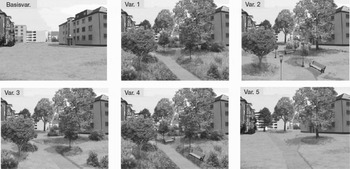
The full-concept approach for conjoint analysis was adopted in which the elements were added to the empty landscape. We considered that a full factorial design, with all 48 combinations of attributes, would be too time-consuming to complete and overly fatigue the respondents, thus potentially invalidating the responses. To reduce the size of the task, a fractional factorial design was used, and a subset of 16 of the possible combinations was selected so that each of the attribute levels was statistically independent (six of these are shown in Fig. 1). This subset is called an orthogonal array and provides uniformly distributed coverage of the test domain with fewer test cases (Louviere et al. Reference Louviere, Hensher and Swait2000). The requirement that costs should also be independent from habitat quality and infrastructure raised the issue of credibility, which was addressed by the addition of some explanatory text. The questionnaires contained illustrations (see Fig. 1), with the associated additional costs and the likelihood of attracting woodpeckers or weevils indicated by text under each illustration.
Examples of stimulus photomontages. Basisvar = the ‘empty’ landscape, Var 1–5 = various combinations of added habitat and infrastructure variables.

The most highly preferred levels of each landscape attribute, as well as the relative importance of each attribute were calculated using SPSS conjoint, which uses the ordinary least-squares estimation method. The results of this quantitative analysis are primarily expressed in terms of utility estimates and some description of their interpretation is warranted. Utility (part-worth) estimates, which are analogous to regression coefficients, were derived for each factor level from the ratings of each attribute combination (scenario). A higher utility estimate reflects a higher preference for a particular attribute at a particular level than a lower estimate, while negative utility estimates reflect a negative preference (rejection). The part-worth estimates are expressed on a common scale so the relative importance of the attributes can be compared. Comparison is made by calculating the ranges (highest–lowest) of these estimates and dividing them by the sum of all the utility ranges.
RESULTS
How do conservation organizations select flagship species?
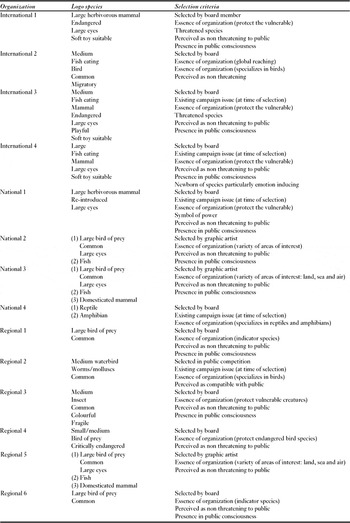
Interviews revealed the characteristics and selection criteria of species chosen as flagship species by conservation organizations actively operating in Switzerland (Table 1). Selection of a representative species was not always made from a list of candidates. In four cases (two international, one national and one regional), the representative species was the centre of a conservation or protection effort at the time that the organization was founded. In three cases, the task of selecting a representative species was allocated to a professional graphic designer and a mixture of bird, fish and/or mammal was used in each logo.
Characteristics of species chosen as flagships by conservation organizations in Switzerland, including their selection criteria.

Each organization listed the most important design criterion for their logo as that it should capture the essence of the organization and thereby inspire the formation of an internal connection with the organization. Capturing the essence was related to species selection, which was deemed to be more important than the graphical design in all of the organizations interviewed. The profile of the species was named as a criterion by three international, two national, and three regional organizations. Two international and one national organization had undertaken marketing studies to estimate the brand strength of their logo and the profile of their representative species.
Symbolism associated with various species was also deemed to be a significant selection criterion. Three of the five species representing international organizations symbolize defencelessness, and therefore species that are in need of protection. One of the national organizations used the species that was the focus of their conservation efforts, and success was included in the symbolism following the success of the campaign. All of the regional organizations nominated the requirement that the range of the species must include the area in which the organization operates, with five of the six organizations choosing species that are considered symbolic of the region.
The ecological function and/or conservation status of species was a consideration in eight of the 11 organizations operating on the national and regional levels, which have selected species that have extensive habitat requirements. Two of the regional organizations selected species (both birds) under explicit consideration of their indicator function.
Can the use of a charismatic species influence attitudes towards habitats?
When interpreting the utility estimates, it should be remembered that the utility estimates describe the effects of each attribute at each level when isolated from the remaining attributes and levels. The utility estimate for any given scenario is simply the sum of the utility estimates of the attribute levels that make up the scenario.
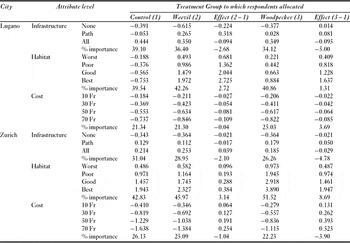
The mean utility scores of each attribute at each level and the relative importance of each attribute were considered separately for each of the target cities (Lugano and Zurich, Table 2). Some commonalities were found between the utility estimates from the control sample (labelled ‘group 1’) the woodpecker (labelled ‘group 2’) treatment sample and the weevil treatment sample (labelled ‘group 3’) from both sample locations. Utility estimates for costs were universally negative and an increase in associated costs resulted in a decrease in utility estimates in all of the six sub-samples. Similarly, the scenarios in which no infrastructure was provided resulted in negative utility estimates, with utility estimates becoming positive when infrastructure was added to the scenarios in all six sub-samples.
Mean utility estimates for each attribute level from the control group and from the woodpecker and weevil treatment groups according to sample location. The difference between the respective treatment groups and the control group is shown in the columns labelled ‘effect’.

Improvements in habitat quality resulted in increases in utility estimates in both the woodpecker and weevil treatment groups from both sample locations and for the control group from the Zurich sample. However, the control group from the Lugano sample returned negative utility estimates for all of the habitat quality levels with the utility estimate decreasing as habitat quality increased.
The difference in utility estimates between the woodpecker treatment and the control group (‘effect 3–1’, Table 2) resulting from an increase in habitat quality was similar in the Zurich and Lugano samples. The difference in utility estimates between the weevil treatment and the control group (‘effect 2–1’, Table 2) resulting from an increase in habitat quality was greater than that of the woodpecker in the Lugano sample, and smaller than that of the woodpecker in the Zurich sample. This difference between the sample locations was evident at each level of habitat quality.
DISCUSSION
We found that organizations in Switzerland tend to choose species that potentially represent their values and goals, as Kotler (Reference Kotler2003) hypothesized. However, while this suggests that they were reasonably systematic in their choices of a flagship species and tended to select species in accordance with marketing theory, it appears that the selections were largely based on intuition stemming from inherent contact with the public in the areas in which they operate. Many organizations simply chose species which were found regionally, and three of them engaged a graphic designer to make the choice for them. No evidence was found to contradict Andelman and Fagan's (Reference Andelman and Fagan2000) criticism of the often ad hoc selection of representative species. Furthermore, only three organizations had undertaken any formal form of testing of the brand strength, which Kotler (Reference Kotler2003) suggests should be afforded by the use of flagship species as logos.
Despite Walpole and Leader-Williams's (Reference Walpole and Leader-Williams2002) suggestion that flagship species need not fulfil an ecological function in addition to possessing charisma, there was a universal requirement that the species capture the essence of the organization. Understandably for conservation organizations, the protection of rare and/or endangered species forms a significant part of their perceived focus, so consideration of ecological characteristics featured strongly in the nominated selection criteria. In four cases, the species selected was the focus of a conservation effort at the time of selection, so the flagship species was of ecological significance by default. In two further cases, the selected species was a higher order predator and simultaneously known to be indicator species, so its preservation would automatically lend an umbrella function to other species. An ‘umbrella species’ is a species for which measures for its protection can also lend protection to other species (Frankel & Soulé Reference Frankel and Soulé1981); it requires a large and relatively natural habitat area for a viable population to survive and, if that area is protected, other species that live within the protected habitat range will also be protected (Peterson Reference Peterson, Agee and Johnson1988; Samways et al. Reference Samways, Stork, Cracraft, Eeley, Foster, Lund, Hilton-Taylor, Heywood and Watson1995; Meffe et al. Reference Meffe and Carroll1997). Once a species has been selected as a flagship species, the connection formed between it and the organization means that the organization has a clear interest in preservation of that species. Suggestions by researchers (Berger Reference Berger1997; Simberloff Reference Simberloff1998) that a flagship species should ideally fulfil an ecological function that makes their preservation relatively important, such as an umbrella function, appear to be adopted by default in real world applications.
However, ecological function and the consideration of less charismatic species were found to be less evident in organizations that operate internationally. These organizations appear to conform to Walpole and Leader-Williams's (Reference Walpole and Leader-Williams2002) assertion that ecological function is less important than charisma. The requirement for a species to be found throughout the range in which an organization operates is harder to meet on an international level, since there are few species with a worldwide range. International organizations therefore tended to seek species that have some symbolic meaning for the organization, whether that be historic or to reflect the focus of an ongoing campaign. Meffe et al.’s (Reference Meffe and Carroll1997) suggestion that charismatic large vertebrates should ideally be selected as sympathy attracting flagship species appears to be more accepted by conservation organizations operating at the international level.
Symbolism is independent of the actual characteristics of the species and is based entirely on popular perception. The apparent discrepancy between symbolism and essence in the international organizations that select species that are perceived as defenceless can be explained in that the species do not represent the organization itself as defenceless, but represent the organizations goals, namely to protect the otherwise defenceless.
One national organization selected a symbolically powerful species as its logo, but the species had been exterminated from Switzerland some years before. The reintroduction of this species served to add the symbolism of success with this organization and this flagship species has become a powerful connecting species between the people and the organization. Regional organizations tended to choose species that are symbolic the region and, in that way, appeal to the attachment to place of their local population, from where their supporter base comes.
Although none of the respondents explicitly mentioned charisma, it can be assumed that they would wish to invoke positive emotions when using a species to capture the essence of their organization. In addressing whether the use of a charismatic species can influence attitudes towards habitats, it was necessary to select a suitable flagship species according to the selection criteria provided by the qualitative phase. Although it has been suggested that it may be difficult to identify a species featuring all of the desirable characteristics of a flagship species (Simberloff Reference Simberloff1998; Caro & O'Doherty Reference Caro and O'Doherty1999; Caro et al. Reference Caro, Engilis and Gardner2004), we chose the great spotted woodpecker as a suitable candidate. Woodpeckers are found throughout the study area, are not commonly seen yet remain visible, are medium-sized birds, and are perceived to be compatible with humans. Furthermore, they have appeared as a well known cartoon character (Woody Woodpecker from Universal Studios), which is an example of Lorimer's (Reference Lorimer2006) observation that charisma can also be constructed and enhanced with careful marketing.
A non-charismatic species proved easier to find, with the clover stem weevil possessing none of the characteristics that were nominated during the qualitative phase of the study.
The woodpecker provides Leader-Williams and Dublin's (Reference Leader-Williams, Dublin, Entwistle and Dunstone2000) tangible subject and simple message and its selection as a flagship species was supported by the results of the quantitative phase. In examining whether the reported presence of woodpeckers can influence attitudes towards landscape scenarios, we found in both sample cities that a respondent who is informed that a particular course of action will provide a habitat for a great spotted woodpecker will tend to favour that course of action over actions that are less favourable for the species. The basic requirement in every scope test is that respondents receive a negative marginal utility of costs (Heberlein et al. Reference Heberlein, Wilson and Bishop2005), and it was found that willingness to pay decreased with cost increases. However, the Zurich woodpecker treatment groups were less strongly opposed to extra costs, and it appears that the perceived presence of a flagship species in Zurich encouraged a more altruistic mindset. There were negligible differences in utility estimates for the cost variable between the woodpecker treatment group and the control group in Lugano.
Increased likelihood of attracting woodpeckers resulted in a corresponding increase in the utility estimate. For example, the utility estimate of the ‘best’ habitat increased by 1.947 in Zurich and by 1.637 in Lugano, when comparing the woodpecker treatment group with the control group. Furthermore, the importance of the habitat variable was greater for the woodpecker treatment group than for the control group in the sample from Zurich (16.7%). This suggests that public attitudes towards habitat variables can be influenced by information about the likelihood of presence of a flagship species, in this case woodpeckers, although we should remember that pro-conservation attitudes do not automatically evolve into pro-conservation behaviour (Stern Reference Stern2000). The formulation of a positive attitude towards a particular habitat could however be expected to contribute to a predisposition for pro-conservation behaviour.
It should be noted that respondents were provided with a link between ecological quality and the likelihood of presence of woodpeckers. The acceptance of conservation interventions will be enhanced if the charismatic species also possesses the characteristics of an umbrella species (Peterson Reference Peterson, Agee and Johnson1988; Samways et al. Reference Samways, Stork, Cracraft, Eeley, Foster, Lund, Hilton-Taylor, Heywood and Watson1995; Meffe et al. Reference Meffe and Carroll1997) or of a keystone species (Simberloff Reference Simberloff1998), and it is possible that this information added to the charisma of the woodpeckers. We explored this by assessing whether species that are not perceived as charismatic or attractive could be used as flagship species.
In Zurich, the difference in utility estimates of habitat levels between the weevil treatment group and the control group (0.384 for the ‘best’ habitat) was markedly less than the difference between the woodpecker treatment group and the control group (1.947 for the ‘best’ habitat). While the woodpecker treatment groups showed a similar positive effect on utility estimates of habitat levels in both Lugano and Zurich, the weevil had a greater effect than the woodpecker in the case of Lugano (an increase by 2.725 for the ‘best’ habitat).
CONCLUSIONS
It can therefore be concluded that the pull provided by knowledge of the ecological value of the weevil exceeded that of the charismatic woodpecker in the case of Lugano. It cannot however be concluded, particularly considering the greater effect of woodpeckers in Zurich, that this challenges the assertion that flagship species should be charismatic (as found by Nentwig et al. Reference Nentwig, Bacher, Beierkunlein, Brandl and Grabherr2004; Samways et al. Reference Samways, Stork, Cracraft, Eeley, Foster, Lund, Hilton-Taylor, Heywood and Watson1995; Walpole & Leader Williams Reference Walpole and Leader-Williams2002).
Instead, uncharismatic species can potentially adopt the flagship role in specific and local cases. This contradicts, in Lugano, Meffe et al.'s (Reference Meffe and Carroll1997) contention that birds will awaken more sympathy than insects, and lends support to Lorimer's (Reference Lorimer2006) assertion that the practical and emotional effects of non-human charisma are not universally shared. In this study, the charismatic pull of woodpeckers appears to be reasonably constant across the cultural contexts, although the pull provided by ecological importance varies according to cultural context. Furthermore, it appears that the pull given by ecological importance is a cognitive influence that operates in parallel with the pull of charisma and can potentially even exceed it.
Flagship species have been shown to have the potential to enhance acceptance of habitat preservation. The great spotted woodpecker would be a suitable candidate to be a flagship for projects in Switzerland according to the criteria identified in the quantitative phase of this study. A species with no explicit connection to a population can potentially be used on a general level, however the overshadowing of the woodpecker by the weevil in Lugano showed that information about the charisma held by a species in the local context is essential before its selection as a flagship for local level application.
The study demonstrates less charismatic species may be able to fill the role of a flagship species. The clover stem weevil does not possess the characteristics identified in literature or interviews as sensible for a flagship species, yet it would be a reasonable choice in Lugano if no other more charismatic species were available. The finding that a non-charismatic species has the potential to fill the role of a flagship species when information that it is also an indicator species is provided, suggests that the ideal flagship species will be both a charismatic and an indicator species. Applications with the most efficient results originate from a combination of concepts (see Favreau et al. Reference Favreau, Drew, Hess, Rubino, Koch and Eschelbach2006). Although the correlation between the probability of presence of an apparently non-charismatic species and increases in utility estimates suggests that public information has the ability to add to the influence of charisma, further research is required to compare the effects of simple probability of presence with the effects of a combination of presence and information about a link with ecological quality.
These results may be used by conservation organizations to assist in the selection of flagship species, and in particular for those that are intended to perform a specific conservation function. To achieve ecological goals, the species chosen as a motivation should be selected specifically for the particular goal and with consideration of the local context.
ACKNOWLEDGEMENTS
We are indebted to the Swiss National Fund and in particular the National Research Program 54 for supporting the BiodiverCity (www.biodivercity.ch) interdisciplinary project led by Marco Moretti at the Swiss Federal Research Institute, WSL, of which this research is a part. We acknowledge the support of the ecologists in the BiodiverCity team, especially Thomas Sattler for his advice in selecting the treatment species and ‘assembling’ the habitats used in this study. We are also indebted to the survey respondents and to the representatives of the conservation organizations who freely gave their time.