I have previously proposed the usefulness of spectromorphology in developing compositional strategies (Blackburn Reference Blackburn2009). In this previous paper I reversed the conventional application of spectromorphology, converting the descriptive purpose into one functional in composition where vocabulary is implemented as a tool to inform sound material choice and creation. ‘In this reversal, vocabulary no longer functions descriptively; instead the vocabulary precedes the composition, directing the path the composer takes within a piece. This reversed application is an attempt at systemization and an effort to (partly) remedy the seemingly endless choice of possibilities we are faced with when beginning a new work’ (Blackburn Reference Blackburn2009). In this application, diagrams of sonic detail accompanied the text-based methodology, metaphorical to the spectromorphological word utilised. In this new article, visualisations of Smalley's vocabulary now become the focus, existing as snap-shots of spectral space to illustrate the techniques of sound creation and assemblage found within my own compositional output.
1. Visualisations
It is frequently reported that, in concert, acousmatic music has the powerful effect of conjuring imagery, shapes, trajectories and spaces, which we as listeners proceed to describe verbally. The use of spectromorphology for this purpose is appropriate due to its relevance. Most importantly, the accessibility of this vocabulary pool continues to be its greatest advantage, since spectromorphological language consists of familiar words not exclusive to musical description, but common and applicable to much wider functions, often suggestive of non-sounding situations, phenomena and other cultural experience. My aim is to take advantage of this flexible vocabulary to develop compositional strategies from spectromorphology. More specifically, my intention is to use the visually tangible to impact upon the aural sound image through establishing a new graphical vocabulary based on spectromorphology for compositional use. This unique and personal approach pays particular attention to how visual elements take precedence within spectromorphologically informed composition strategies, and raises questions regarding visual subjectivity and the subsequent impact this has upon the musical result. If as listeners we are able to describe or visualise something as rewarding in acousmatic music, why not use this same vocabulary and/or imagery to inform our own compositional intentions?
1.1. Context revision
This article is both a revision and extension of previously stated ideas (Blackburn Reference Blackburn2009); however, it is here that I direct my attention to the visual components of the research, presenting how sound-shapes of spectromorphology have the most influential power upon compositional activity in this instance. Several key points are revisited to establish context, while new diagrammatic detail is included to highlight recently developed strategies from spectromorphology as used in my own compositional work. Through these sound-shape illustrations I aim to illuminate the intricacies of Smalley's vocabulary and present spectromorphological visualisation as a pertinent step between text descriptions and acousmatic music composition, supported with corresponding sound examples from my own works. In accordance with the aims of the ‘acousmograph’Footnote 1 and the ‘acousmoscribe’Footnote 2 (both visually orientated software applications that endeavour to notate and analyse components of electroacoustic music), my illustrative representations propose to display through visual means the properties of sounds.
1.2. Preliminary notes
The strategies influenced by spectromorphology mentioned in this article should be regarded as compositional aids rather than solutions or formulas for acousmatic music creation.Footnote 3 They present possible starting points for the development of sound materials, events and structures and are then subject to other intuitive decision-making processes. To distinguish spectromorphological terminology amidst the text, I have italicised each appearance in order to clarify the context of their use.
2. Visuals informing sound material choice
Spectromorphological sound-shapes can inform the sounds we choose to work with in a piece, providing a useful starting point in the early stages of composition. This may influence the selecting of sound materials and recordings made. For example, when using the word attack from the structuralfunctions word-set (figure 1), shorter sounds with impact-like qualities (e.g. a door slamming or a hand clap) are most likely to be imagined. In this instance we would be less inclined to choose sounds more sustained in character (e.g. a microwave hum or running water).
Structural functions (Smalley Reference Smalley1997: 115).

2.1. Visual sound sculpting
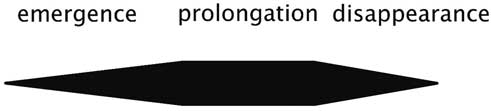
Visual equivalents of vocabulary taken from structural functions can inform the shaping and manipulation of individual sounds. Choosing one word from each column can dictate the sculpting of a single sound by accentuation of its inherent features. This allows a sound to be composed into a desired shape. Applying an increasing volume envelope to a sustained sound, for example, will create an emergence. A possible continuant for this sound might be a prolongation by looping or sustaining its original duration and a gradual fade will terminate the sound as a disappearance. Figure 2 presents my individual response to the meaning of these three words, which is also animated in Movie example 1, presenting a real-time construction of this sound-shape.
Sound sculpting.

2.2. Visual sound unit creation
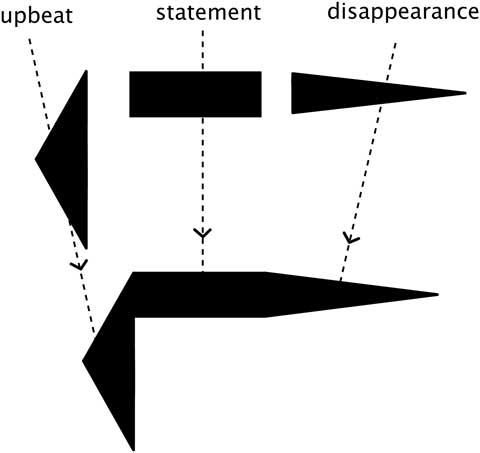
Beyond the shaping of individual sounds, the structural functions vocabulary is particularly useful in articulating structures. Three separate sounds can be individually informed by three separate visual sound-shapes. Once assembled together they form a new shape, which I refer to as a ‘sound unit’.
2.3. Sound units
The sound unit can be traced in many existent acousmatic works and continues to be a primary building block within my own approach to acousmatic music creation. I view sound unit construction within my work as a fundamental compositional strategy built entirely on the premise that every sound event has a start, a middle and an end. Construction possibilities are vast and particularly well suited for dealing with shorter sounds that yield gestural shapes through this combination process.
2.4. Sound units as visual guides
Figures 3 and 4 show two combination possibilities of forming sound units from three separate sounds. This essentially provides a miniature plan for the composer revealing how three separate sounds could be linked together, and, most importantly, provides a starting point for composition. My own work has benefited from this visual assemblage technique when creating gestural events. Movie example 2 demonstrates how the individual sound components of figure 3 are pieced together, as found in my acousmatic work Dance Machine (2009).
Sound unit – emergence, transition, release.

Sound unit – upbeat, statement, disappearance.

2.5. Structuring
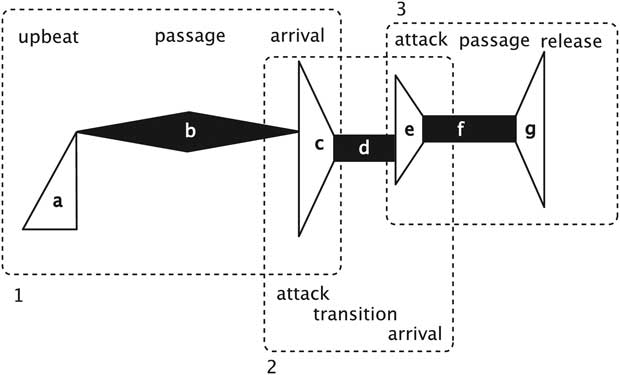
Sound units are ideal for generating small ideas when constructing new material; however, these need not exist in isolation, as constructing a series of sound units would most likely lead to a disconnected soundworld. To remedy this, ‘sound units can be strung together to form longer phrase lengths’ (Blackburn Reference Blackburn2009) forming morphological strings.Footnote 4 In this process of extension it is common for sounds to exhibit dual functionality. Figure 5 demonstrates an arrival doubling as a termination for the first sound unit (1) and as an attack (onset) for the second unit (2). The second unit's termination provides the onset for a third unit (3) and so on.
Dual functionality in a morphological string.
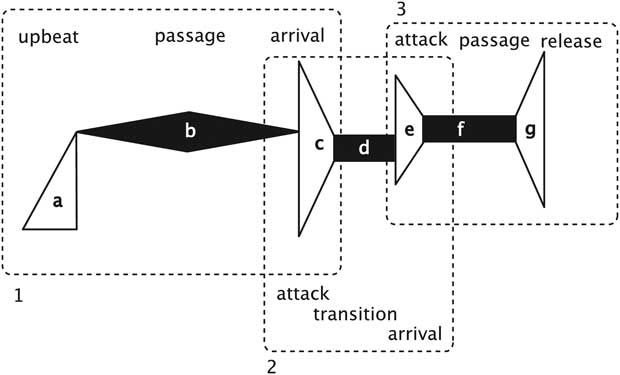
Movie example 3 demonstrates the construction of dual functionality in a section of my work Kitchen Alchemy (2007, 1′01″–1′26″). This particular composition was created entirely from morphological strings, and as a result establishes a reliance upon gestural ‘goal posts’ (a, c, e and g, figure 5) connected together by pedal-like continuants (b, d and f, figure 5) throughout.
2.6. Pedagogy
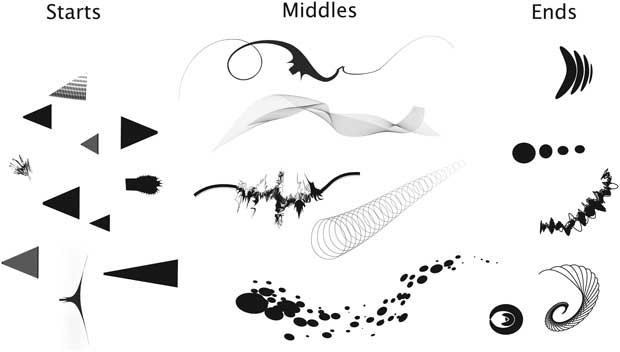
Providing a visual guide to creating small-scale structures proves invaluable in educational situations where purely descriptive detail may appear too conceptual to grasp (Blackburn Reference Blackburn2009). Introducing basic assemblage techniques using spectromorphological concepts has been trialled at the University of Manchester for three consecutive years (2008–10), providing a useful pedagogical strategy for teaching students with little or no knowledge of acousmatic music. Composition students were presented with a collection of sounds, categorised as starts, middles and ends (onsets, continuants and terminations), and then asked to build their own sound units from this pre-determined pool of sounds. Images were used to introduce structuring processes (figure 6). By following a method based upon fundamental vocabulary, students developed a strong awareness of sound function due to the categorisations presented to them, while also displaying a greater sensitivity for sound positioning within their final compositions (Blackburn Reference Blackburn2009).
Starts, middles and ends.

Sound examples 1, 2 and 3 present examples of a start, middle and end, respectively, given to students in the task.
3. Word types
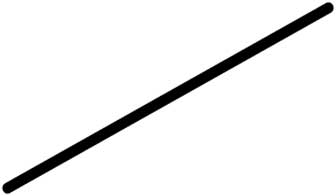
Spectromorphological words can be realised both aurally and visually as singular or composite events (Blackburn Reference Blackburn2009). An individual word informing the creation of one sound is given the term ‘singular’. An ascent can be created from one sound, as in figure 7 (Sound example 4).
Ascent, singular sound.
Alternatively, a composite word is one that informs multiple or composite sounds working in conjunction with each other. For example, the word agglomeration is suggestive of sounds travelling together and forming a collective mass, as in figure 8. This is considered to be composite since more than one sound is required in creating an agglomerating motion as in Sound example 5 (taken from my work Cajón!, 2008). An agglomeration could of course comprise multiples of the same sound; this is still regarded as composite and can be described more fully as a monomorphological Footnote 5 composite.
Composite agglomeration.

3.1. Micro-composites
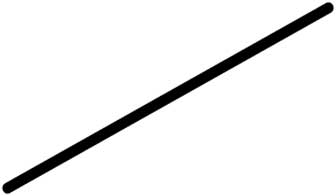
Blurring often occurs between the two types as singular words can be used as composite words. For example, the word attack can be singular, formed from a single sound (figure 9), but it is more often the case that a sound-shape is constructed from several stacked sounds, sounding as a whole. Figure 10 presents a micro-composite attack comprised from five stacked sounds as in sound example 6 (Cajón!, 2008). Visually this suggests the presence of discrete sound layers, which is conceptually accurate, but aurally inaccurate. The sonic result is cohesive and it is usually impossible to identify the individual layers the sound-shape comprises, especially on such a micro-scale. Stacking materials in this manner (as in a digital sequencer) is a fundamental strategy in utilising vertical spectral space, often yielding highly detailed and sonically rich results.
Singular attack.

Micro-composite attack.
3.2. Macro-composites
Spectromorphological words that are macro-composite are those that inform materials over much longer durations, differing from micro-scale sound units or composites previously discussed. Macro-composites can account for all sonic activity in whole phrases or sections of a work. Composing a structure of this sort is a challenging activity to engage with, as there are more sound materials to co-ordinate over longer durations. There is also the danger of being over-prescriptive when dealing with extended time frames since morphologies often develop other inherent or organic behaviours over time that might not be predicted when starting out. In some instances, efforts to impose a particular large-scale shape or evolution on a section may be contrary to the implied local development arising from a given sound's spectromorphology. The ‘bottom up’ approach to composition could be potentially compromised over such longer time frames, showing why vocabulary-informing strategies seem more successfully implemented in shorter structures, where a greater degree of control can be applied. Nevertheless, macro-composite structuring should not be ruled out, as in many cases these words can lead to some interesting and cohesive results.
3.3. Macro-composite time frames
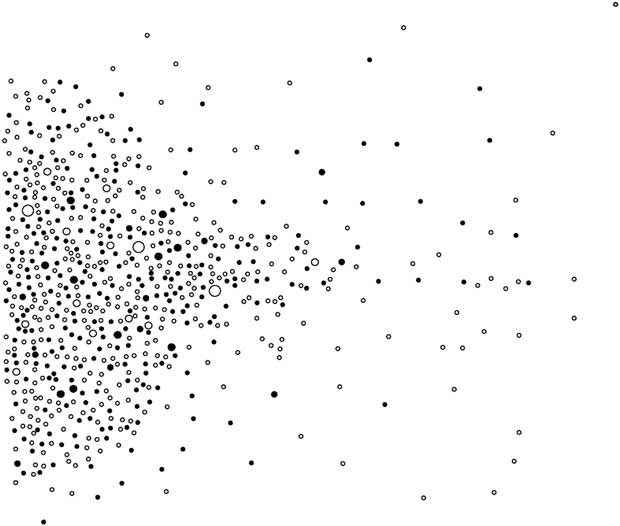
Figure 11 presents a visual macro-composite dissipation. It is possible to consider this morphology occurring over a variety of time frames, ranging from a few seconds to a whole phrase or even an entire section, several minutes in duration.
Dissipation.

In using dissipation (extracted from the motion and growth process word-set, figure 12) to inform the creation of a whole passage it should be mentioned that this descriptive label does not solely define a sound's sonic attributes. On the contrary, this composed sound (or collection of sounds) will inherently display a whole range of sonic qualities: for example, it will possess occupancy within spectral space, structural function (onset, continuant and termination), motion and behaviour. This is also true for the image itself. While most of the previously introduced shapes have been block-like for purposes of discussing structural properties, dissipation (figure 11) indicates a detailed textural quality. Increasing the shape's complexity in this instance provides a further ‘handle’ to engage with when aurally realising a sound-shape. Sound example 7 demonstrates a dissipation informed by this visualisation, where the glitch-like intrinsic components are scattered and eventually dissolve.
Motion and growth processes (Smalley Reference Smalley1997: 116).

3.4. Circular motion perception
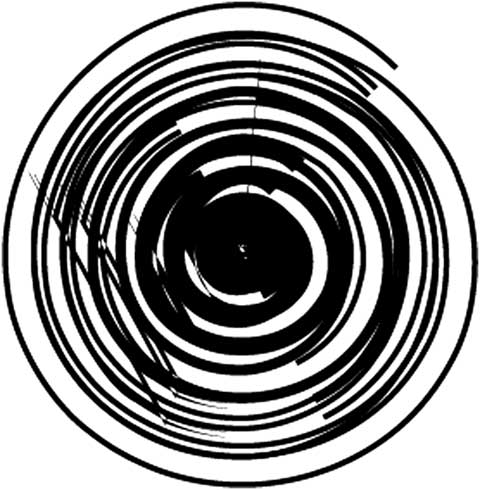
It is worth considering images suggestive of cyclic/centric trajectories while on the topic of motion and growth processes. Figures 13 and 14 present sound-shapes that appear to travel backwards through their curving shapes. This aural impossibility, due to music's temporal and linear existence, was approached when creating two macro-composite structures in my work Origami (2007). The word pericentrality and its associative imagery were used in the creation of The Goldfish (Origami, miniature IV). To achieve my intentions of representing swirling water, an aural illusion was constructed by repeatedly panning an iterative loop (Sound example 8). The multidirectional trajectories of figure 14 similarly informed the organisation of sound materials to represent swift bird-flight motion in The Crane (Origami, miniature II), by overlapping multiple bird song events and parabolas (Sound example 9).
Pericentrality.
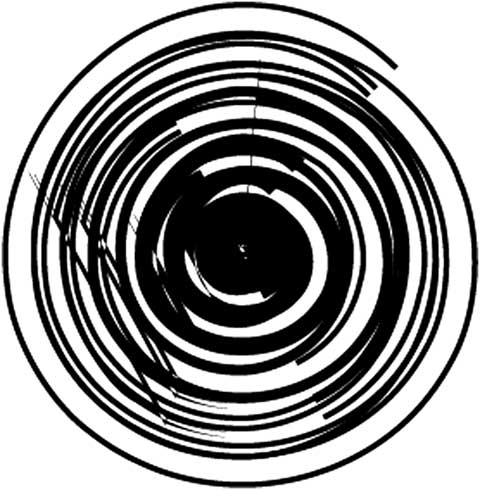
Multidirectional.

3.5. Visual archetypes and analogies
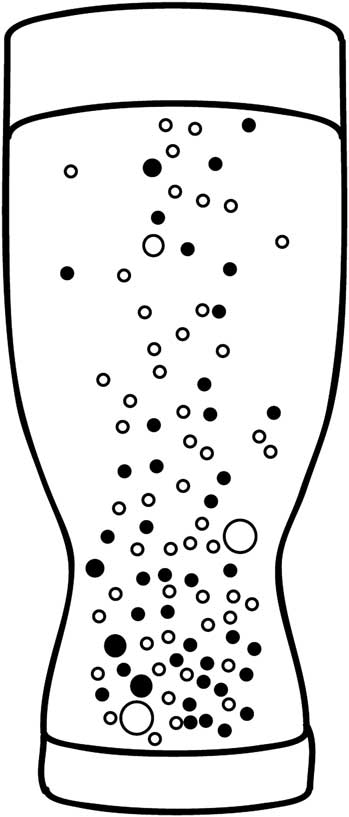
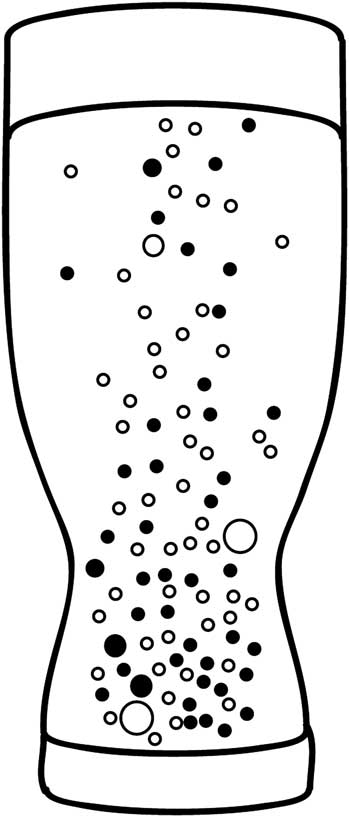
Many of the sound-shapes illustrated in this article have been conceived from instances and interactions with the author's personal cultural experience. These experiences have not always been exclusively aural to be relevant and transferable to composition. In one example, the emergence and disappearance sound-shapes (figures 3 and 4) can be considered as archetypal forms, derivative of digital waveforms and hairpins in instrumental notation. In another example, the dissipation in figure 11 is analogous to the movement of bubbles in a carbonated drink (figure 15), this time with the directional motion being from bottom to top.
Dissipation analogy.
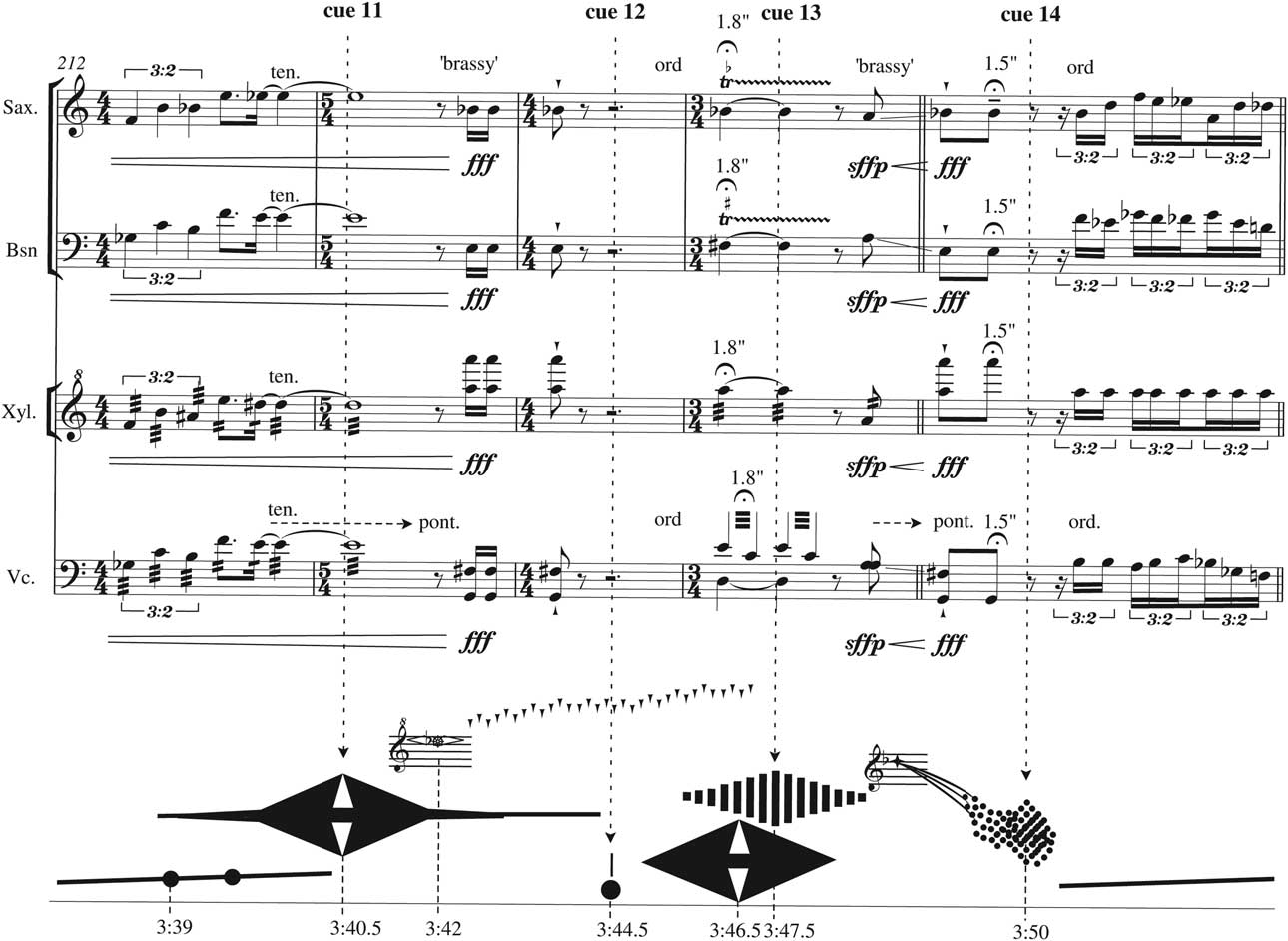
Frequently, visual archetypes are utilised in graphic scores and instrumental notation of electroacoustic works to represent sonic material attributes and synchronicity of the separate voices, as in Rajmil Fischman's work No Me Quedo… for saxophone, bassoon, violoncello, percussion and digital audio (figure 16). Drawing upon such archetypes is suggestive of a common, collective response to sound when generating visual equivalents, and it is from this perspective that my own personal approach has grown and developed.
Rajmil Fischman, No Me Quedo… score extract, page 28 (with permission of the composer). Also illustrated in Sauer Reference Sauer2009.

3.6. Further analogies and interpretations
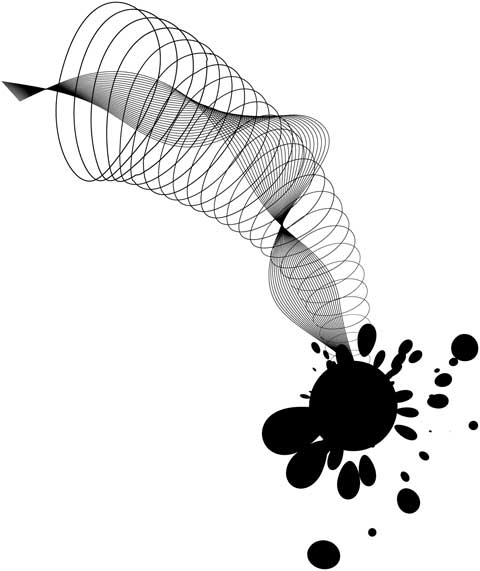
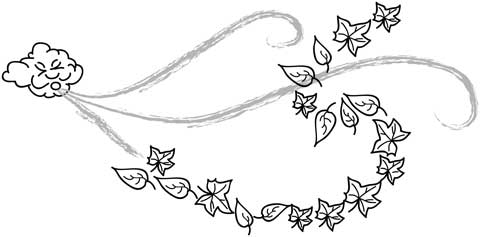
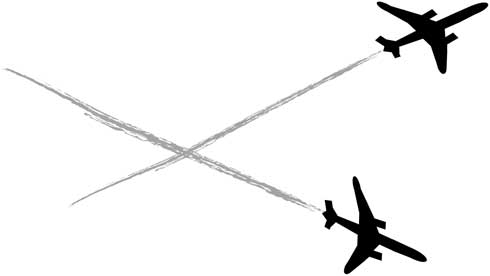
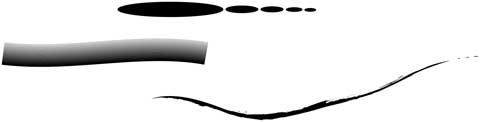
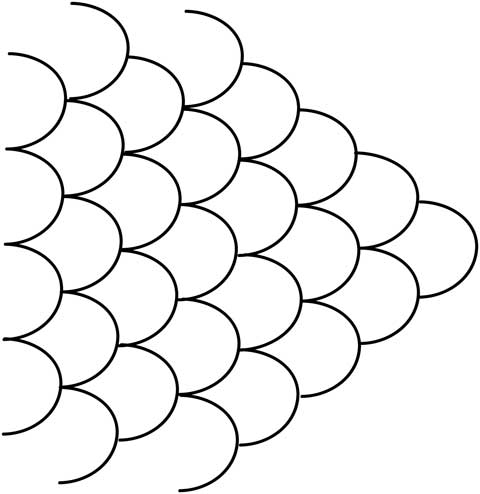
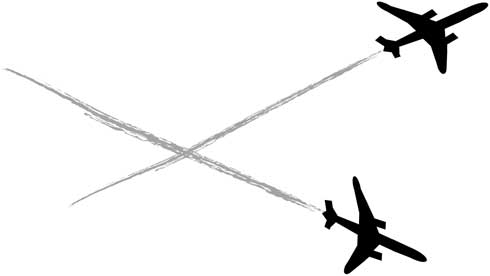
Spectromorphological vocabulary and visualisations provide starting points for creativity by inspiring compositional activity. Prescribing further detail such as articulation, motion or spatial trajectory may stipulate too many requirements at such an early stage in the process. An advantageous consequence of these unspecified qualities, coupled with the subjective nature of these images, is the range of interpretation possibilities, giving rise to a vast number of aural representations of a given spectromorphological sound-shape or word. Further examples of macro-composite terminology include turbulence (figures 17 and 18), crossover (figures 19 and 20) and overlap (figures 21 and 22), which are displayed with possible derivative analogies.
Turbulence.
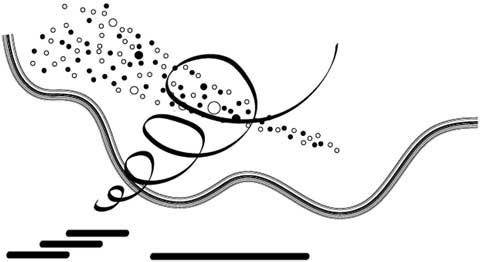
Turbulent wind and leaves.
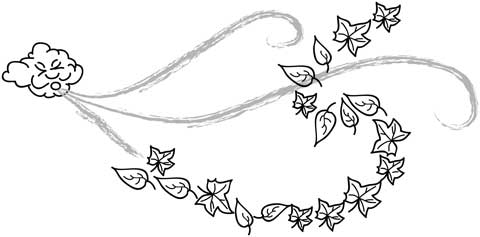
Crossover.

Crossover aircraft exhaust trails.
Overlap.
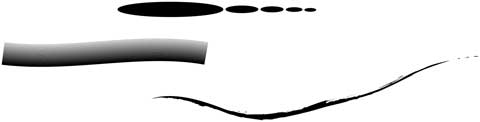
Overlapping fish scales.

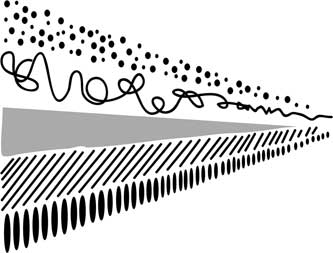
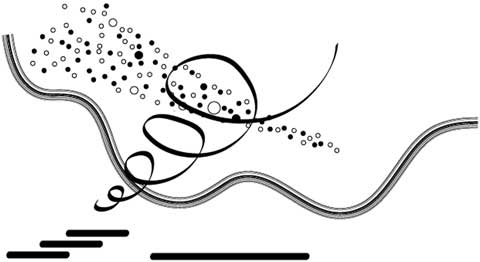
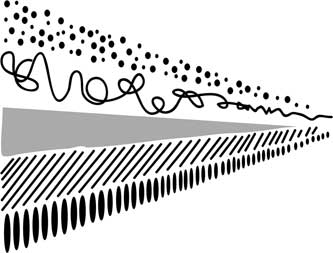
It is important to note that delivering an accurate aural equivalent of a visual sound-shape is not the purpose of this research activity. Visualisations are utilised as influential aids inspiring creativity, as opposed to descriptors identifiable in the finished output. The musical result remains the focus, so as to avoid a commentary of methodological steps taken in the piece's composition. In fact, the composed result is often far removed from the initial text or visual inspiration. In most cases my compositional intuition has taken over from these initial starting points in order to develop these ideas into the final music. Sound example 10, taken from my work Spectral Spaces (2008), demonstrates this evolutionary transformation from image to resulting sound. In this case, the sound materials were initially informed by the layered streams visual in figure 23.
Layered streams.

4. Vocabulary expansion
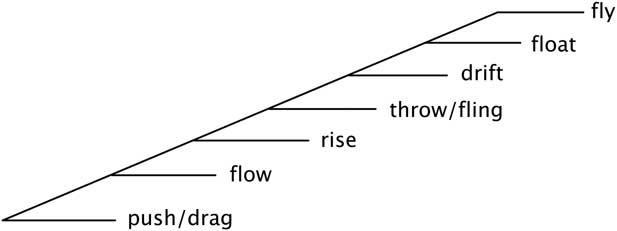
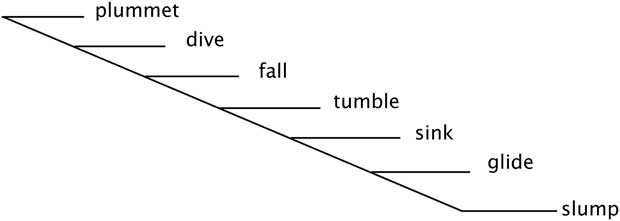
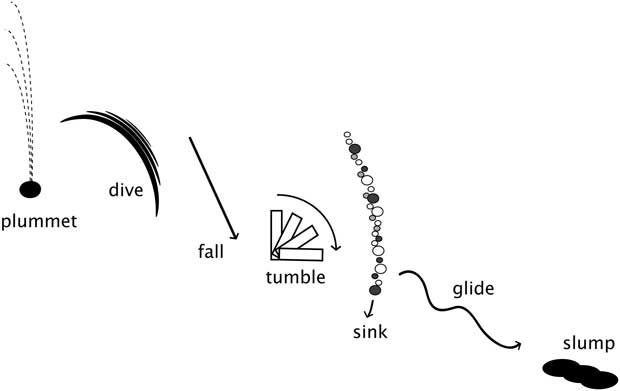
The vocabulary of spectromorphology is by no means a closed or comprehensive tool for descriptive and compositional purposes. Compositional practice demands individual tools and strategies, and, in many instances, customised vocabulary. This may take the form of vocabulary additions (figure 25) and images that are abstract (‘sink’, figure 26) or analogical (‘tumble’, figure 26).
Seven characteristic motions (Smalley Reference Smalley1997: 117).

Seven additional descending motions.

Descending motions visualizations.

To complement the seven characteristic motions (figure 24), seven additional descending motions were added to the vocabulary pool when considering motion and growth processes.
This new collection of words (figure 25) is an expansion of the concept of descending sound-shapes. Differentiation between the types of descent can aid how a sound is positioned in relation to surrounding materials within a larger structure. Visually and aurally there is a significant difference between the urgency of a plummeting sound and the relaxed nature of gliding sonic detail; thus these two words rely upon very different horizontal time frames to be aurally realised.
4.1. Additional concepts
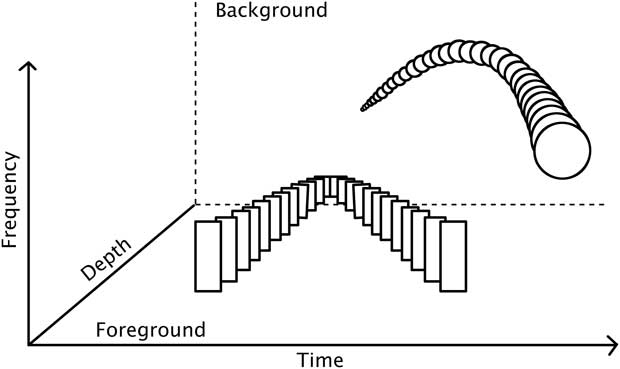
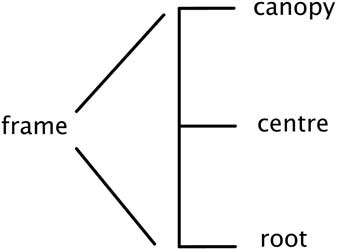
So far I have presented my sound-shape illustrations in a two-dimensional format, however, perception of sound-shapes in fact takes place within a three-dimensional environment. In figure 27 it is possible to imagine the sound-shapes exhibiting perspective detail as they retreat and emerge from more distant positions. Expanding spectral space laterally to create a three-dimensional canvas presents a more accurate picture of sound organisation possibilities. Interplay between depth layers (foreground, middleground and background) introduces an extension to the concept of spectral space (root, centre and canopy strata, figure 28) and is a move towards Smalley's ideas of spatiomorphology and space-form (Smalley Reference Smalley2007).
Depth perspective.

Spectral space (Smalley Reference Smalley1997: 121).

4.2. Sound-shape preference
My practice-based research implementing visual sound-shapes has successfully isolated and utilised the concepts of spectromorphology. However, not all vocabulary has a natural translation from description into music. Words outside common use pose some problems since it becomes difficult to extract a concrete meaning or visual analogy of an unfamiliar word in order to create an aural equivalent. When vocabulary additions are made (figure 25), preference is given to words meaningful of a wide range of situations and those with strong evocation to imagery. As a composer of acousmatic music, my inclination for certain sound-material activity (for example causality, and gestural trajectories) determines the strategies and concepts illustrated in this article. Others choosing to implement this method may create and adopt alternative vocabulary and individual visualisations to suit their own aesthetic approach and creative impulses.
5. Conclusion
This article has introduced the idea of the spectromorphological sound-shape as a visual guide for acousmatic music composition. Visual sound-shapes offer a tangible plan for dealing with sound selection, creation and arrangement. These illustrations, inspired by Smalley's descriptive vocabulary, have successfully informed areas of creative practice and are especially useful in the early stages of a new work and pedagogical situations for generating sound materials.
Further starting points can initiate compositional activity through examining the visible properties of a shape's movement, behaviour, interaction and occupancy in space, while advancing this viewpoint to three-dimensional images promotes consideration for spatial depth and interplay between lateral spectral space positions.
Spectromorphology's sound-shapes offer flexibility and are adaptable to the individual. Customising this approach through vocabulary additions, modifications, personal preference and creation of one's own images will inspire a whole array of sonic equivalents and will hopefully support the realisation of the composer's creative intensions.
A final note embraces the subjective nature of visual sound-shapes. The vast variety of interpretations and sonic possibilities of this illustrative guide influenced by spectromorphology are undoubtedly its greatest advantages.