Introduction
Deficits in cognitive processing have been well documented in schizophrenia (SCZ) (e.g. Heinrichs & Zakzanis, Reference Heinrichs and Zakzanis1998). Similarly, abnormalities in emotional processing have been observed (Tremeau, Reference Tremeau2006; Anticevic & Corlett, Reference Anticevic and Corlett2012), although in-the-moment emotional experience appears to be intact (Matthews & Barch, Reference Matthews and Barch2004; Herbener, 2008; Anticevic et al. Reference Anticevic, Repovs and Barch2012). While substantial research has been devoted to exploring these domains independently, interactions between cognitive and emotional processing, and their synergistic contributions to SCZ-related pathology, have been relatively understudied. Further, the majority of studies that have examined this interaction have focused on patients’ susceptibility to task-irrelevant emotional distraction while performing a primary cognitive task. The data in this regard are equivocal. Some behavioural and neuroimaging studies suggest greater vulnerability to emotionally salient distraction in SCZ, particularly for negatively valenced material (e.g. Bentall & Kaney, Reference Bentall and Kaney1989; Mohanty et al. Reference Mohanty, Herrington, Koven, Fisher, Wenzel, Webb and Heller2005; Park et al. Reference Park, Park, Chun, Kim and Kim2008; Strauss et al. Reference Strauss, Allen, Duke, Ross and Schwartz2008; Dichter et al. Reference Dichter, Bellion, Casp and Belger2010; Besnier et al. Reference Besnier, Kaladjian, Mazzola-Pomietto, Adida, Fakra, Jeanningros and Azorin2011), whereas others indicate no differential susceptibility (e.g. Demily et al. Reference Demily, Attala, Fouldrin, Czernecki, Menard, Lamy, Dubois and Thibault2010; Anticevic et al. Reference Anticevic, Repovs, Corlett and Barch2011, Reference Anticevic, Repovs and Barch2012; Diaz et al. Reference Diaz, He, Gadde, Bellion, Belger, Voyvodic and McCarthy2011; Gopin et al. Reference Gopin, Burdick, DeRosse, Goldberg and Malholtra2011). Anticevic et al. (Reference Anticevic, Repovs and Barch2012) have speculated that SCZ-related vulnerability to emotional distraction may hinge on the extent to which a task engages amygdala–prefrontal cortex (PFC) coupling. Specifically, they suggest that the PFC may serve to down-regulate amygdala responsiveness to emotional stimuli, particularly on tasks which are cognitively demanding and the emotional stimuli are task-relevant. In SCZ, they posit dysfunctional (i.e. weaker) amygdala–PFC coupling. Therefore, greater SCZ-related susceptibility to emotional distraction may only be apparent on cognitively demanding tasks that utilize task-relevant emotional distractions. Further, the current study hypothesizes that the inappropriate impact of emotional material may be greatest when it antagonizes cognitive or contextual cues. In this vein, studies investigating the resolution of emotional versus contextual determinants of thought or action may benefit from using experimental tasks that pit these determinants against one another in direct competition.
The rationale for these assertions is derived from several psychological and neurobiological models that illustrate the reciprocal nature of emotional and cognitive determinants of goal formation, selection and execution. For example, the two-system view of decision making described by Daniel Kahneman and Amos Tversky illustrates how intuition and reasoning are modulated by a dynamic, and opposing, interaction between emotion and cognition (for a summary, see Kahneman, Reference Kahneman2003). In this framework, the operations of system 1, which are at the core of intuitive judgments, are fast, automatic, and often recruited in response to emotional stimuli. By contrast, the operations of system 2, which form the basis for controlled reasoning, are thought to be slower, more effortful, and involve meta-cognitive mechanisms that help evaluate the quality of one's mental operations and behaviour. Speechley & Ngan (Reference Speechley and Ngan2008) have suggested that emotional stimuli may initially bias decision making towards system 1. However, should dissonance or conflict arise between the two systems, healthy individuals will typically recruit system 2 in order to ‘initiate a more thorough consideration of all available evidence’ (p. 1212). This implies that system 2 can implement corrective modifications to actions and thoughts that are erroneously based on system 1 when other cues (e.g. contextual features) are recognized as being more task-relevant. Similar dual-stream models of information processing have been put forth in the context of moral reasoning (Greene et al. Reference Greene, Nystrom, Engell, Darley and Cohen2004) and delayed gratification (Metcalfe & Mischel, Reference Metcalfe and Mischel1999).
Grace (Reference Grace2003) offers a commensurate account of this interaction from a neurobiological perspective. Following a series of single-cell recording experiments in rodents, a cortico-limbic circuit model was developed to explain how contextual and affective elements in one's environment may influence subsequent behaviour. Specifically, behavioural response selection is modulated by dual-gating influences provided by the hippocampus and amygdala. The hippocampus is considered the default gate that guides behaviour on the basis of contextual demands or past experience, whereas the amygdala acts as an event-related, affective override during instances of elevated emotional arousal. These two gates, while serving different functions, work in concert to select the most appropriate and adaptive behaviour in a given situation.
This model has been extended to suggest an antagonistic, rather than reciprocal, gating relationship in SCZ. Using a prenatal developmental disruption model in rodents, it was observed that the hippocampus has diminished gating influence, resulting in the amygdala receiving nearly unmitigated priority in determining response selection. Thus, a response pattern emerges in which behaviour is driven primarily by emotional cues at the expense of more appropriate contextual cues (Grace, Reference Grace2003). A similar conceptualization has been proposed by Christensen & Bilder (Reference Christensen and Bilder2000) and Giaccio (Reference Giaccio2006) from a cortical evolutionary perspective. Speechely & Ngan (Reference Speechley and Ngan2008) have also extended their dual-stream model of reasoning to SCZ in a manner consistent with Grace (Reference Grace2003). Specifically, they argue that stream 2 is no longer preferentially recruited during periods of conflict, and stream 1 is excessively recruited during heightened emotional states. This combination leads to a breakdown in normal reasoning whereby decision making is grounded in emotion rather than logic.
Taken together, these models imply that SCZ patients have difficulty prioritizing cognitive or contextual cues as determinants of goal-directed thought and action in the face of countermanding emotional cues. It is important, therefore, to evaluate persons with SCZ using experimental tasks designed to index the resolution between competing emotional and cognitive determinants of goal-directed behaviour. The emotional Stroop task (EST) is often regarded as the quintessential task to examine such emotion–cognition interactions. However, Algom et al. (Reference Alogm, Chajut and Lev2004) have noted that the ‘emotional Stroop effect’ is actually a misnomer. Specifically, they argue that the dimensions that are purportedly in competition with one another on the EST (i.e. emotionality and colour) ‘lack the semantic conflict or agreement that lies at the heart of the classic Stroop effect’ (p. 325). As such, employing the EST to investigate competition between emotional and cognitive response determinants is a conceptually flawed approach because there is no direct antagonism between the two dimensions. Thus, the EST does not pit emotion against cognition per se, but, rather, is another task that explores the effect of extraneous emotional distraction on primary cognitive processing. As an alternative, the current study employed an emotional list-method directed-forgetting (DF) paradigm that more directly places emotional and cognitive response cues in opposition.
In general, DF experiments demonstrate that individuals are able to intentionally forget certain information in favour of target information when cued to do so. In the list-method variant, participants are shown a set of items to study for later recall (i.e. list 1; L1). In the forget condition, they are instructed to forget those items in favour of a subsequent set of study items (i.e. list 2; L2). At recall, participants are asked to recall items from both lists. The forget cue attenuates recall of L1 and enhances recall of L2. The facilitation of recall of L2 items is due to reduced proactive interference from L1 items after receiving a forget cue. This DF effect has been reliably demonstrated across numerous different stimuli and procedural variants (MacLeod, Reference MacLeod1999; David & Brown, Reference David and Brown2003; Geraerts & McNally, 2003; Racsmány et al. Reference Racsmány, Conway, Garab and Nagymáté2008b; Wylie et al. Reference Wylie, Foxe and Taylor2008). For example, MacLeod (Reference MacLeod1999) demonstrated that even under conditions that manipulated demand characteristics (i.e. participants offered monetary compensation for recalling additional items they were told to forget), participants still exhibited better recall of to-be-remembered versus to-be-forgotten items.
The list-method DF effect (i.e. successful forgetting of items that preceded the forget cue) has been attributed to retrieval inhibition (e.g. Bjork et al. Reference Bjork, Bjork, Anderson, Golding and MacLeod1998; MacLeod, Reference MacLeod1999; Soriano & Bajo, Reference Soriano and Bajo2007; Geraerts & McNally, Reference Garaerts and McNally2008; Soriano et al. Reference Soriano, Jiménez, Román and Bajo2009; for an alternative account, see Benjamin, Reference Benjamin2006). Levy & Anderson (Reference Levy and Anderson2002) have characterized such inhibitory mechanisms as part of a broader frontal control network that is recruited to override competition from stimulus-driven, pre-potent responding. Inhibiting unwanted to-be-forgotten items, therefore, can be considered analogous to suppressing an overt, pre-potent behaviour (Levy & Anderson, Reference Levy and Anderson2008). Such pre-potent behaviours often occur automatically in response to emotionally charged stimuli. That is, motivationally significant or meaningful stimuli in one's environment are often given rapid and preferential access to cognitive, sensory, and neural processing resources which, in turn, guides behavioural output (e.g. LeDoux, Reference LeDoux2000; Dolan & Vuilleumier, Reference Dolan and Vuilleumier2003; Garrido et al. Reference Garrido, Barnes, Sahani and Dolan2012). Similarly, emotionally evocative material is often conferred an automatic memory advantage in an effect termed the emotional enhancement of memory (e.g. Kensinger & Corkin, Reference Kensinger and Corkin2003, Reference Kensinger and Corkin2004; Anderson et al. Reference Anderson, Yamaguchi, Grabski and Lacka2006; Sommer et al. Reference Sommer, Gläscher, Moritz and Büchel2008). Previous research suggests that this effect arises due to deeper encoding and increased attentional resources being devoted to affectively salient stimuli (e.g. Doerksen & Shimamura, Reference Doerksen and Shimamura2001; Kensinger & Corkin, Reference Kensinger and Corkin2003; Payne & Corrigan, Reference Payne and Corrigan2007; Nasrallah et al. Reference Nasrallah, Carmel and Lavie2009; Hauswald et al. Reference Hauswald, Schulz, Iordanov and Kissler2011). Further, this emotionality effect appears to be most prominent for highly arousing, negatively valenced material (e.g. Kensinger & Corkin, Reference Kensinger and Corkin2003, 2004; Steinmetz et al. Reference Steinmetz, Addis and Kensinger2010; for contrasting results, see Kousta et al. Reference Kousta, Vinson and Vigliocco2009). In the context of SCZ, a recent study using emotional pictorial stimuli demonstrated that memory enhancement for negative images did not differ between patients with SCZ and healthy volunteers (Herbener et al. Reference Herbener, Rosen, Khine and Sweeney2007). However, a systematic review of emotional memory in SCZ is more equivocal with respect to the modulatory effects of valence and arousal (Herbener, Reference Herbener2008). Nevertheless, modifying the DF task to include emotional content is well suited for the current study's objectives as it places the forget cue instruction in direct opposition to the emotional enhancement of memory effect. In other words, strategic inhibition must override pre-potent emotional memory enhancement for successful task completion.
Relatively few studies have examined DF using emotional stimuli in healthy populations. Wessel & Merckelbach (Reference Wessel and Merckelbach2006) observed a reliable DF effect at recall using lists comprised of both negative and neutral words, and this effect was not modulated by emotional valence. This has since been replicated using positive words (Itoh, Reference Itoh2011) and autobiographical memories (Barnier et al. Reference Barnier, Conway, Mayoh, Speyer, Avizmil and Harris2007). In contrast, others have observed that emotional stimuli are resistant to DF (Payne & Corrigan, Reference Payne and Corrigan2007), with some data indicating that this effect may be stronger for negatively valenced material (e.g. Minnema & Knowlton, Reference Minnema and Knowlton2008). Thus, it appears that DF is possible for emotional stimuli in healthy individuals, although this may be reduced when stimuli are negatively valenced. These results beg the question, however, whether clinical populations with known susceptibilities to emotional perturbations would demonstrate similar competencies with respect to strategically forgetting emotionally evocative stimuli. Indeed, studies evaluating this phenomenon among patients with major depression and borderline personality disorder have shown reduced inhibition of negative or aversive stimuli (Power et al. Reference Power, Dalgleish, Claudio, Tata and Kentish2000; Domes et al. Reference Domes, Winter, Schnell, Vohs, Fast and Herpertz2006).
A handful of studies have previously explored DF among persons with SCZ. These studies have shown a reduced DF effect relative to healthy participants, which has been attributed to dysfunctional inhibitory control processes (Müller et al. Reference Müller, Ullsperger and Hammerstein2005; Racsmány et al. Reference Racsmány, Conway, Garab, Cimmer, Janka, Kurimay, Pléh and Szendi2008a; Soriano et al. Reference Soriano, Jiménez, Román and Bajo2009; for contrasting results, see Sonntag et al. Reference Sonntag, Gokalsing, Olivier, Robert, Burglen, Kauffmann-Muller, Huron, Salame and Danion2003). To date, however, no studies have explored emotional DF performance in SCZ patients. Thus, in the context of models suggesting poor effortful, strategic response execution in the face of competing emotional cues signalling alternative responses, we hypothesized that (1) SCZ participants would exhibit a reduced DF effect overall relative to healthy volunteers, and (2) the DF effect would be disproportionately reduced for negatively valenced material.
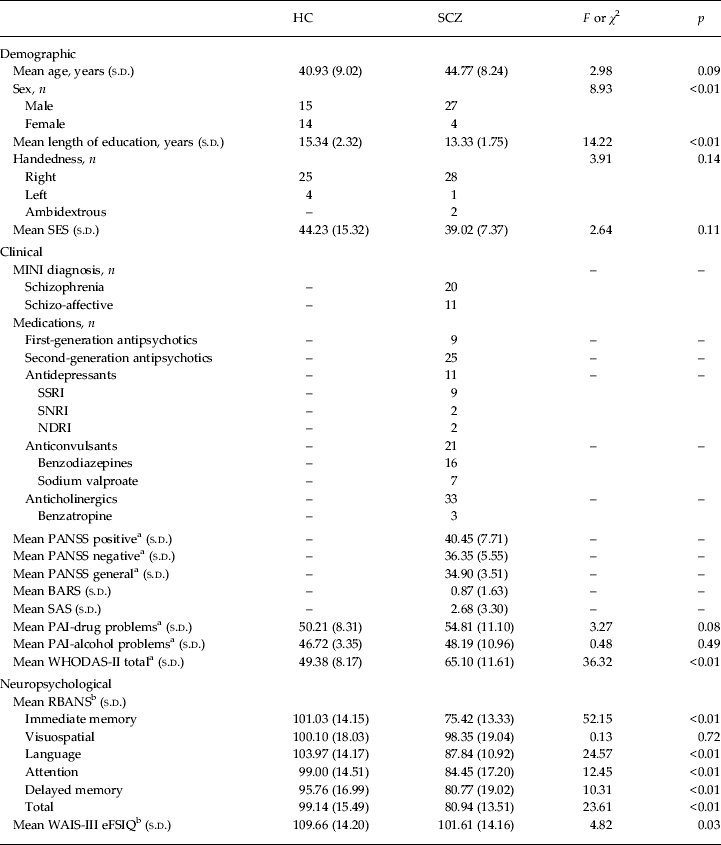
Method
Participants
The healthy control (HC; n = 29) group ranged in age from 24 to 59 years old and were recruited from online and community advertisements in the greater Hamilton, ON, Canada area (see Table 1 for demographic information). To be included in the study HCs were between 18 and 60 years of age and had normal or corrected-to-normal vision. Exclusion criteria included: (a) self-reported history of brain damage, psychosurgery, loss of consciousness, and/or other diagnosable neurologic conditions; (b) an Axis I psychiatric disorder as revealed by the Mini International Neuropsychiatric Interview (MINI; Sheehan et al. Reference Sheehan, Lecrubier, Sheehan, Amorim, Janavs, Weiller, Hergueta, Baker and Dunbar1998); (c) a diagnosis of substance abuse within the past 6 months or a lifetime history of substance dependence; (d) a first-degree relation with a SCZ-specturm illness; (e) psychotropic drug use during the 15 days preceding their participation in the study; and (f) reading ability below a grade eight equivalent as assessed by the Wide Range Achievement Test, 4th edition (WRAT4; Wilkinson & Robertson, Reference Wilkinson and Robertson2006).
Demographic, clinical and neuropsychological characteristics of HC and SCZ groups

HC, Healthy control; SCZ, schizophrenia; s.d., standard deviation; SES, socio-economic status (Blishen et al. Reference Blishen, Carroll and Moore1987); MINI, Mini International Neuropsychiatric Interview (Sheehan et al. Reference Sheehan, Lecrubier, Sheehan, Amorim, Janavs, Weiller, Hergueta, Baker and Dunbar1998); SSRI, selective serotonin reuptake inhibitor; SNRI, serotonin–norepinephrine reuptake inhibitor; NDRI, norepinephrine–dopamine reuptake inhibitor; PANSS, Positive and Negative Syndrome Scale (Kay et al. Reference Kay, Fiszbein and Opler1987); BARS, Barnes Akathisia Scale (Barnes, Reference Barnes1989); SAS, Simpson Angus Scale (Simpson & Angus, Reference Simpson and Angus1970); PAI, Personality Assessment Inventory (Morey, 1990); WHODAS-II, World Health Organization Disability Assessment Schedule, 2nd edition (WHO, 2000); RBANS, Repeatable Battery for the Assessment of Neuropsychological Status (Randolph, Reference Randolph1998); WAIS-III, Wechsler Adult Intelligence Scale, 3rd edition (Wechsler, Reference Wechsler1997); eFSIQ, estimated full-scale intelligence quotient derived from the Matrix Reasoning and Information subtests of WAIS-III (Sattler & Ryan, Reference Sattler and Ryan1998).
a T score.
b Standard score.
The SCZ group (n = 31) ranged in age from 26 to 56 years old and were recruited from two separate out-patient clinics in Hamilton (see Table 1 for clinical and demographic information). Inclusion criteria for this group were that participants: (a) be voluntary and able to provide appropriate consent; (b) meet Diagnostic and Statistical Manual of Mental Disorders, 4th edition (DSM-IV) criteria for SCZ, schizophreniform or schizo-affective disorder, as confirmed by a MINI and chart review; (c) aged between 18 and 60 years; (d) be clinically and pharmacologically stabilized for at least 2 weeks prior to their pariticpation in the study; and (e) have normal or corrected-to-normal vision. Exclusion criteria for patients with SCZ were: (a) any self-reported history of brain damage, psychosurgery, loss of consciousness and/or other diagnosable neurological conditions; (b) a diagnosis of substance abuse within the past 6 months or a lifetime history of substance dependence; and (c) a reading ability below a grade eight equivalent as assessed by the WRAT4. The Research Ethics Board at St Joseph's Healthcare Hamilton approved this study. All participants provided voluntary, written consent to participate and they were provided compensation of CAN$10 per hour plus travel costs.
Materials
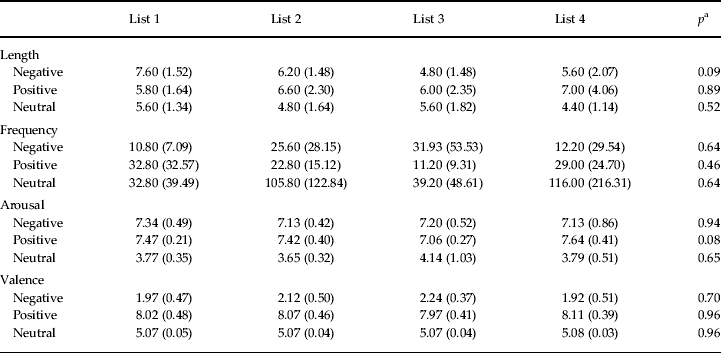
A total of four 15-item wordlists were constructed that contained five neutral, positive, and negative words obtained from the Affective Norms for English Words (Bradley & Lang, Reference Bradley and Lang1999). Different words were chosen for each list, with each list being psycholinguistically matched according to mean word length, frequency, arousal and valence ratings. Given that arousal level appears to be an important moderator in the emergence of emotional enhancement of memory, all emotional items were rated highly on this dimension (i.e. mean arousal rating of ⩾7.1 per list on a nine-point scale, with 1 being low arousal and 9 being high arousal). The word lists and their associated psycholinguistic ratings are provided in Appendix A.
Experimental procedure
Prior to the experimental session, all participants completed a baseline assessment to characterize their neuropsychological functioning and clinical status (see Table 1). In the list-method DF task, participants were shown two different 15-word lists in random order on a computer screen (3 s per word) within each condition to study for later recall. The two conditions differed according to the cues given immediately following L1 (list 1). In the remember condition, participants were told to remember as many words as possible while in the forget condition participants were told that L1 was just for practice and should be forgotten, and that the next list was the real study list. Following L2 (list 2), participants engaged in a 90 s distracter task to minimize primacy and recency effects. This consisted of counting upwards by three or four digits as quickly as possible. Following the distracter task, they were asked to recall as many words as possible from L1 and L2 by writing them down in any order on a sheet of paper. The remember condition was always presented first in the testing session as this avoided the need for further instruction to participants that they would not be deceived again (Soriano et al. Reference Soriano, Jiménez, Román and Bajo2009). Several other unrelated experimental tasks (none of which were verbal learning or memory tests) were administered between remember and forget conditions to limit inter-list contamination at recall. The duration of this inter-condition interval was approximately 2.5 h.
Data preparation and analysis
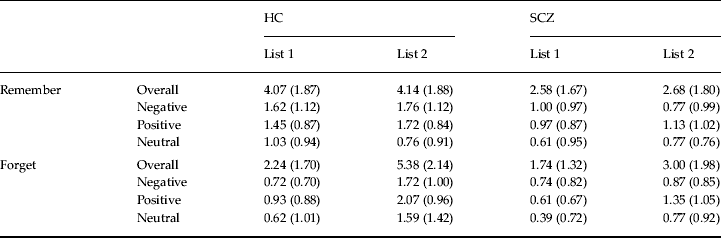
Primary statistical analyses were performed on DF scores (refer to Table 2 for raw recall scores). DF scores were calculated by subtracting L1 recall from L2 recall (Soriano et al. Reference Soriano, Jiménez, Román and Bajo2009). As such, higher positive DF scores reflect a stronger DF effect. This calculation was performed in each condition (i.e. remember and forget) and at each level of valence. Given that this difference score can reflect either L1 inhibition, L2 facilitation, or a combination of both, it is important to quantify the differential contributions of these two processes to the overall DF score. Thus, separate indices of inhibition and facilitation were computed. An index of inhibition (IOI) was obtained by subtracting L1 recall in the forget condition from L1 recall in the remember condition (Racsmány et al. Reference Racsmány, Conway, Garab, Cimmer, Janka, Kurimay, Pléh and Szendi2008a). Larger positive IOI values indicated greater inhibition of L1 items following the forget cue. Similarly, an index of facilitation (IOF) was obtained by subtracting L2 recall in the remember condition from L2 recall in the forget condition. In this way, larger positive IOF values suggested greater facilitation of L2 recall following the forget cue. Error scores were also recorded as intrusions and repetitions. (Note: no between-group differences were observed on either of these variables.) In terms of statistical analyses, the specific predictions made by our a priori hypotheses were examined via planned directional contrasts. Effects sizes are reported as Cohen's d.
Items correctly recalled across valence, condition, list and group
Data are given as mean (standard deviation).
HC, Healthy control group; SCZ, schizophrenia group.
Results
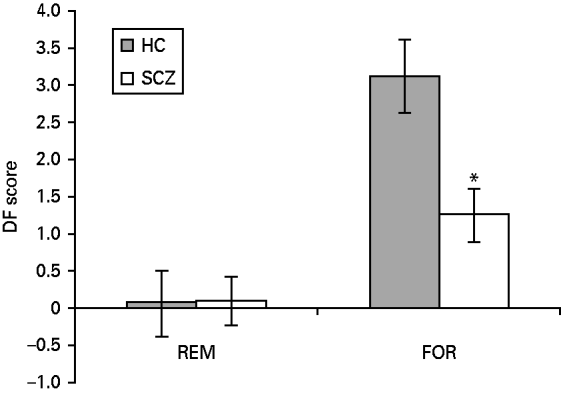
To test the hypothesis that patients with SCZ would exhibit a reduced DF effect overall relative to HCs, planned orthogonal contrasts were performed using DF scores collapsed across valence. The between-group contrast (coefficients: HC = 1, SCZ = –1) was significant within the forget condition only (t 58 = 3.12, p = 0.003, d = 0.80) (see Fig. 1), reflecting larger DF scores for the HC group in the forget condition. The within-group contrast (coefficients: remember = –1, forget = 1) was significant in the HC group only (F 1,28 = 23.62, p < 0.001, d = 1.23), though the SCZ group showed a similar, albeit reduced, effect at trend levels (F 1,30 = 3.97, p = 0.056, d = 0.60). Taken together, these contrasts suggest that although both groups exhibited a DF effect, this effect was, as predicted, attenuated in the SCZ group.
Graphical depiction of the significant group × condition interaction using mean directed-forgetting (DF) scores (collapsed across valence) as the primary dependent variable. DF scores were calculated by subtracting the number of correctly recalled items in list 1 from the number of correctly recalled items in list 2 (DF = L2 – L1). REM, Remember condition; FOR, forget condition; HC, healthy control; SCZ, schizophrenia. Values are means, with standard error of the mean represented by vertical bars. * Mean value was significantly different from that of the HC group (t 58 = 3.12, p = 0.003, d = 0.80).
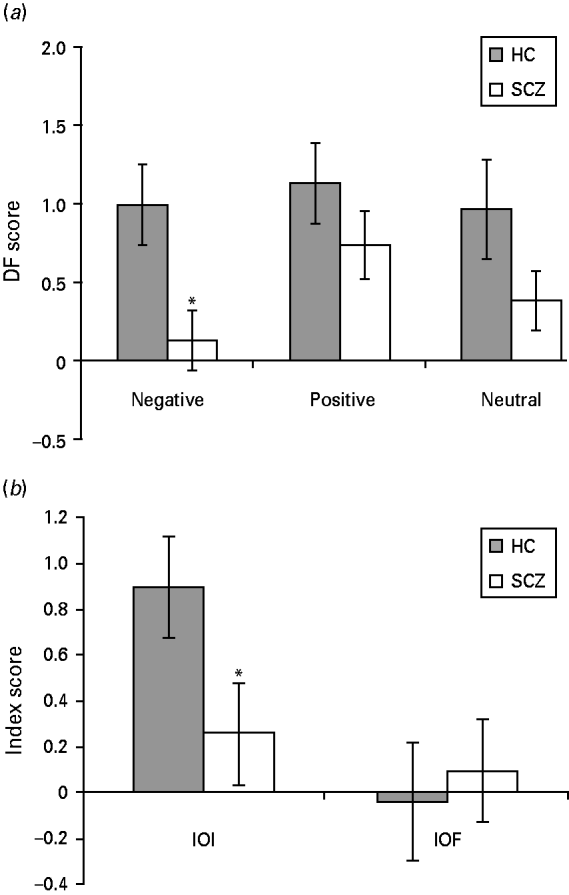
To test the hypothesis that patients with SCZ would exhibit a disproportionately reduced DF effect for negative words, planned orthogonal contrasts were performed using DF scores separated according to valence in the forget condition only. The within-group contrast (coefficients: negative = –2, positive = 1, neutral = 1) was significant at trend levels in the SCZ group (F 1,30 = 3.85, p = 0.059, d = 0.47), but not the HC group (F 1,28 = 0.02, p = 0.88, d = 0.04). Similarly, the between-group contrast (coefficients: HC = 1, SCZ = –1) was significant for negative words (t 58 = 2.78, p = 0.007, d = 0.71), but not positive (t 58 = 1.18, p = 0.24, d = 0.31) or neutral words (t 58 = 1.60, p = 0.12, d = 0.41) (see Fig. 2a). Taken together, these contrasts show, as predicted, a disproportionate reduction in DF for negative words in patients with SCZ relative to HCs and, to a lesser extent, relative to other valence categories.
(a) Graphical depiction of mean directed-forgetting (DF) scores across group and valence in the forget condition. DF scores were calculated by subtracting the number of correctly recalled items in list 1 from the number of correctly recalled items in list 2 (DF = L2 – L1). Values are means, with standard error of the mean represented by vertical bars. * A significant between-group difference was noted for negative words in the forget condition only (t 58 = 2.78, p = 0.007, d = 0.71). (b) Graphical depiction of mean index of inhibition (IOI) and index of facilitation (IOF) scores for negative words only in the forget condition. IOI scores were calculated by subtracting the number of correctly recalled items from list 1 in the forget condition from the number of correctly recalled items from list 1 in the remember condition (i.e. IOI = L1R – L1F). IOF scores were calculated by subtracting the number of correctly recalled items from list 2 in the remember condition from the number of correctly recalled items from list 2 in the forget condition (i.e. IOF = L2F – L2R). Values are means, with standard deviations represented by vertical bars. * A significant between-group difference was noted for IOI scores only (t 58 = 2.05, p = 0.045, d = 0.53). HC, Healthy control group; SCZ, schizophrenia group.
To ascertain if the between-group difference for negative words was the result of reduced forgetting of L1 or reduced facilitation of L2 in the SCZ group, independent-samples t tests were performed on IOI and IOF scores for negative words. This revealed a significant between-group difference on IOI only (t 58 = 2.05, p = 0.045, d = 0.53) (see Fig. 2b), suggesting that the reduced DF score for negative words in the SCZ group was the result of diminished forgetting of L1 negative words following the forget cue. Interestingly, patient and control groups appear to demonstrate equivalent lack of L2 facilitation for negative words following the forget cue.
An additional correlational analysis was performed within the SCZ group to determine if any aspect of their Positive and Negative Syndrome Scale (PANSS)-rated symptomatology or neuropsychological status was related to either their reduced DF or IOI scores for negative words. With respect to symptomatology, none of these correlations was statistically significant. Soriano et al. (Reference Soriano, Jiménez, Román and Bajo2009) observed that when their SCZ group was separated according to patients with and without hallucinations (as indicated by PANSS scores), those with hallucinations showed greater inhibitory deficits. We performed a similar analysis and observed no main effects or interaction when using DF, IOI or IOF scores as dependent variables. Concerning neuropsychological variables, a significant positive correlation was observed between negative DF scores and the Repeatable Battery for the Assessment of Neuropsychological Status (RBANS) visuospatial index (r = 0.38, p = 0.03).
Discussion
The current study sought to examine how individuals with SCZ deploy goal-directed cognitive processing resources in the face of countermanding emotional cues. As such, a list-method emotional DF paradigm was used which places strategic inhibitory mechanisms in opposition to the emotional enhancement of memory. That is, a task-appropriate response determinant (the forget cue) was placed in conflict with an emotional determinant that signalled an opposing response (emotional enhancement of memory). Based on previous research, it was hypothesized that persons with SCZ would exhibit a reduced DF effect overall. Further, we predicted a disproportionately reduced DF effect for negative words.
In line with these predictions, the SCZ group showed a reduced DF effect overall when scores were collapsed across valence. This is consistent with previous research in SCZ using both item-method (Müller et al. Reference Müller, Ullsperger and Hammerstein2005) and list-method (Racsmány et al. Reference Racsmány, Conway, Garab, Cimmer, Janka, Kurimay, Pléh and Szendi2008a; Soriano et al. Reference Soriano, Jiménez, Román and Bajo2009) DF paradigms. Moreover, negative DF scores in the SCZ group were reduced relative to the HC group and, to a lesser extent, relative to other valence categories and (see Fig. 1). Importantly, this valence-selective reduction in DF scores appears to have been driven primarily by reduced forgetting of L1 negative words following the forget cue, as evidenced by differential group performance across IOI, but not IOF, scores (see Fig. 2). This is similar to what has previously been observed in other clinical samples that are thought to have inhibitory dysfunction, such as borderline personality disorder (Domes et al. Reference Domes, Winter, Schnell, Vohs, Fast and Herpertz2006) and obsessive-compulsive disorder (Wilhelm et al. Reference Wilhem, McNally, Baer and Florin1996). This pattern of results suggests that individuals with SCZ were less able to engage strategic inhibitory mechanisms for the purposes of overriding recall of negative words when tasks demands called for such action.
Unexpectedly, both patient and control groups exhibited a lack of L2 facilitation for negative words following the forget cue. This indicates that the DF effect for negative words was not wholly intact for the control group either, as their successful forgetting of L1 items was not associated with the expected concomitant facilitation of L2 items. Previous studies have shown a disrupted list-method DF effect associated with negative stimuli in healthy volunteers (see Minnema & Knowlton, Reference Minnema and Knowlton2008); however, notable methodological differences make direct comparisons with the current data challenging to interpret. Given that the current experiment interspersed negative, positive and neutral items within the same list, it is reasonable to suggest that the expected facilitation effects after successful forgetting might not have been valence-specific. That is, the forgetting of L1 items in one valence category may have translated into L2 facilitation that spilled over into other valence categories due to a general reduction in proactive interference. This may account for the observation that the HC group and, to a lesser extent, the SCZ group demonstrated L2 facilitation when items were not separated according to valence (see Overall values in Table 2). Although this is speculative at this juncture, it offers an interesting avenue for further investigation.
Although we did not directly examine a neurological mechanism for the observed effects in the current study, functional neuroimaging studies offer insight in this regard. For example, a recent Functional magnetic resonance imaging (fMRI) experiment in healthy volunteers observed a higher recognition rate for to-be-forgotten negative versus neutral stimuli. Moreover, the intention to forget negative stimuli, whether successful or not, was associated with widespread activity across a distributed right hemisphere network, including the middle frontal gyrus, middle temporal gyrus, parahippocampal gyrus, precuneus and cuneus. By contrast, the intention to forget neutral stimuli was associated with right lingual gyrus activity only (Nowicka et al. Reference Nowicka, Marchewka, Jednorog, Tacikowski and Brechmann2011). These findings suggest that intentionally suppressing negative information is more effortful at both a cognitive and neural level. Another study (also in healthy volunteers) explored event-related potential effects associated with emotional DF and found that the forget cue was associated with an enhanced frontal positivity regardless of whether it followed negative or neutral stimuli, though it was slightly smaller for forget cues that followed negative stimuli (Hauswald et al. Reference Hauswald, Schulz, Iordanov and Kissler2011). A source modelling analysis revealed that this forget-cue-related positivity for negative stimuli originated in the medial PFC. Collectively, these imaging results suggest that our SCZ group may have had difficulty recruiting sufficient neural resources (perhaps within the PFC) needed to intentionally suppress recall of negative words. Indeed, this would be consistent with the assertion that internally generated inhibitory memory mechanisms arise from a frontal-mediated executive control network that is recruited to override competing, stimulus-driven responding (Levy & Anderson, Reference Levy and Anderson2002). Furthermore, this is congruent with data suggesting aberrant PFC–amygdala integration in SCZ (Anticevic et al. Reference Anticevic, Repovs and Barch2012).
Regardless of the precise mechanism, this type of speculation highlights the need for future studies to directly examine the neural underpinnings of this disturbance in SCZ via task-dependent functional neuroimaging. Such an approach will more closely link the behavioural phenomenon with a plausible biological substrate. This will be critical in advancing the breadth of knowledge concerning the neuropathology underlying impaired mental processes in SCZ and, in turn, lead to empirically validated targets for future therapeutic endeavours.
The current study did not find an association between DF scores and any PANSS-related symptomatology in the SCZ group. This observation is perhaps not surprising, as our sample consisted of clinically stable out-patients and PANSS T scores were generally low. Further, this is consistent with the majority of previous research that has examined such correlations (e.g. Sonntag et al. Reference Sonntag, Gokalsing, Olivier, Robert, Burglen, Kauffmann-Muller, Huron, Salame and Danion2003; Müller et al. Reference Müller, Ullsperger and Hammerstein2005). That said, Soriano et al. (Reference Soriano, Jiménez, Román and Bajo2009) observed that when SCZ patients were dichotomized according to the presence or absence of hallucinations, those with hallucinations showed greater inhibitory deficits relative to patients without hallucinations and HCs. We were unable to reproduce these results in the current study. Although the exact reason for this discrepancy is not known, it may have been due to differential sample characteristics between the studies (e.g. mean education level was much lower in their sample), or the modulatory effect of emotion that was unique to the current study.
Conclusions
Within the context of models suggesting a disturbance in resolving conflict between emotional and cognitive determinants of action in SCZ, these results suggest that individuals with SCZ have a reduced capacity to utilize task-appropriate contextual cues when faced with competing emotional ones. Based on the current data, this effect appears to be confined to negatively arousing stimuli. Thus, the current data extend the scope of psychological models concerning such emotion–cognition interactions in SCZ (e.g. Speechley et al. 2008), as well as offering some measure of validation for complementary neurobiological theories that are currently lacking in direct behavioural evidence from human clinical samples (e.g. Christensen & Bilder, Reference Christensen and Bilder2000; Grace, Reference Grace2003).
Psycholinguistic characteristics of the word lists
Acknowledgements
This research was supported by a Vanier Canada Graduate Scholarship awarded to R.E.P. from the Canadian Institutes of Health Research. The authors thank Iulia Patriciu, Katie Herdman and Carolyn Roy for their contributions towards participant recruitment, data collection and data management.
Declaration of Interest
None.